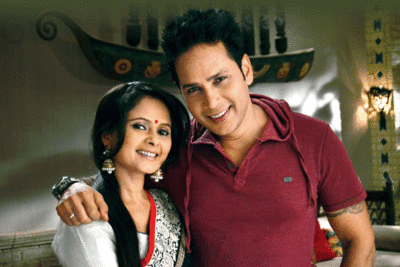
Actress Sadia Siddiqui can’t stop beaming. Why? The actress, who plays Priyanka in ‘Satrangi Sasural’, will have her brother Farhaan join the show soon.
The Siddiqui siblings will be seen together for the first time on the screen.
Farhaan, who has dabbled in theatre, films and serials, will be paired opposite actress Resham Tipnis. His character, Raunak Punjabi will be younger to Resham in the show.
Says the actor, “Sadia is one of the main reasons I took up the offer. It’s going to be exciting shooting with her. I look up to her. We never got the opportunity to work together as I was doing my things — theatre and travelling. Besides, I was sceptical of TV because of its erratic schedule and unpredictable nature. But she felt that I was apt for the role that was offered to me, and I took it up.”
The actor says that Sadia is a protective sister and likes to cocoon him. He says, “She treats me like a baby brother and often starts mothering me, which can get a little annoying (laughs). But I learn a lot from her.”
While he hasn’t worked with his sister before, the actor has featured with Resham in the play. Coincidentally, the two played spouses and he, the younger husband in it. “Fortunately, we will not have to work hard on our chemistry as we are comfortable with each other,” says he.
source: http://www.timesofindia.indiatimes.com / The Times of India / News Home> TV> News / by Neha Maheshwri / TNN / May 30th, 2015
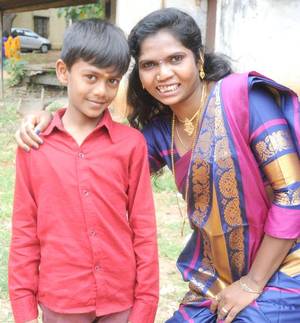
Akshay, the youngest jockey, with his aunt Manjula | Photo Credit: G.P. Sampath Kumar
From waste pickers to transgender rights activists and slum children, know the RJs of Bengaluru’s first community radio station
Sunday morning saw an eclectic gathering of radio jockeys — transgenders, people living with HIV, auto drivers, the differently-abled, domestic help, waste pickers, and animal welfare activists — come together to celebrate a decade of Radio Active CR 90.4 Mhz, Bengaluru’s first community radio station.
For this diverse group of citizens, who are often marginalised, the community radio has given them a platform to air their views. Most significantly, it has given them the confidence to live with dignity and demand for equal rights.
Salma and Siddique Pasha, waste pickers from Nayandahalli, host two shows – the daily show, Kasa Shramika Parisara Rakshaka, and a weekly Dastaan-e-Nayandahalli, documenting the stories of recyclers in the area. “The shows have given us a platform to connect with others in the community. To reach out to listeners in various slums we do shows in multiple languages — Kannada, Urdu, Tamil, and Bengali,” said Mr. Pasha.
Senior solid waste management expert N.S. Ramakanth has begun a new show called Trash Talk in English and Kannada.
Shiv Kumar, an auto driver, was first interviewed by the radio station for being awarded by the city police for his honesty in 2010. But soon he became an RJ and has since hosted multiple shows for auto drivers. He also has a show where he interviews unknown achievers and unsung heroes.
Akshay, 11, the youngest jockey, also sees a big draw with his show Chinnara Chilipili where he has been documenting traditional games along with storytelling sessions by other children. When asked how he greets his listeners, Akshay went into the RJ mode and said, “Welcome to the city’s first community radio Radio Active 90.4. We will now play games that our grandparents and parents used to play.” He produces the show with the help of his aunt Manjula along with 40 other children in the slums of Dasarahalli.
The channel has a strong programming on transgender rights with five shows, all hosted by members of the community. One popular show is Jeeva Diary, hosted by Uma which is presented as a diary of her life and its travails. “We get a good response and have got several calls from listeners who are shocked to listen to the discrimination and humiliation we face as young people in schools and at work,” she said.
Radio Active has also turned out to be a platform for the northeast community in the city to organise and voice themselves. Urmila Chanam, from Mizoram, who now hosts the show North East ki Awaz, said that the 2012 exodus of northeast community from the city set them into legal aid activism in the community.
“But the attacks on the community members never came down. So we have now started the radio show to have our voice heard. While we started featuring northeast food, fashion shows, and festivals, the show has also helped us intervene on behalf of a few victims of sexual abuse from the community,” he said.
source: http://www.thehindu.com / The Hindu / Home> News> Cities> Bengaluru / June 26th, 2017
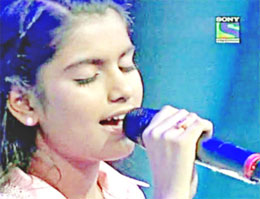
Nahid Afrin, a Borgeet student of Nrityanjali Kala Niketan, here has brought glory to the State by entering the Top Nine in the ongoing reality show programme ‘Indian Idol Junior’ telecast by Sony TV.
The elder daughter of Fatema Ansari and Anowar Ansari of Biswanath Chariali, she has already earned accolades with her melodious voice in the stages at different places of the State and can sing in different languages including Assamese, Hindi and Bengali with the same fervour.
Dr Lohit Sharma, managing director, Nrityanjali Kala Niketan informed this correspondent that Nahid had been exhibiting good performances in music since her childhood and she possesses a bright future.
Nahid, a Visharad Part 2 student in classical music under Bhatkhande Kala Kendra has been able to draw the attraction of the judges in the reality show and even Bollywood superstar Salman Khan had showered her blessings and good wishes upon her in the programme recently.
Now all she wants from the people of Assam is good wishes and votes in her favour.
source: http://www.assamtribune.com / The Assam Tribune / Home / by Hiranya Borthakur / Guwahati – July 24th, 2015
Beswa Village, Fatehpur Tehsil (Sikar District), RAJASTHAN :
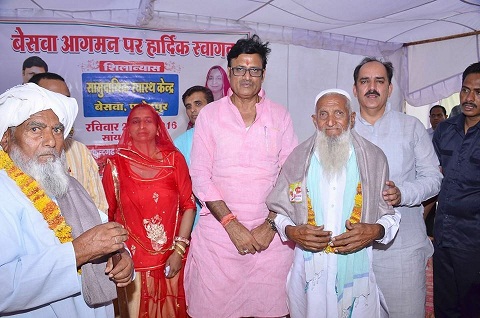
In a rare humanitarian gesture, two Muslims farmers of Rajasthan have donated their land for the building a government hospital in their area. The hospital will come up in Beswa village, in the Shekhawati region of Sikar in the state.
Recognizing the contribution of the two farmers — Asghar Khan and Hakim Ali — State Medical and Health Minister Rajendra Rathore visited the Beswa village on Sunday and laid the foundation stone for the Community Health Centre. He sanctioned Rs. 3 crore on the spot from his department’s budget for the CHC.
Villagers were all praise for the two farmer-brothers, who have donated their land measuring eight bighas, situated at a prime location on Mukundgarh Road. Beswa Sarpanch Zarina Bano said the hospital would have a minor operation theatre and a labour room in addition to regular treatment facilities.
Asghar Khan, 68, who has been tilling the land since his youth, told media that he could not see the difficulties of people in the rural area who had to traverse long distances during medical emergencies.
source: http://www.theindianawaaz.com / The Indian Awaaz.com / Home / by Ashfaq Kayamkhani / May 31st, 2016
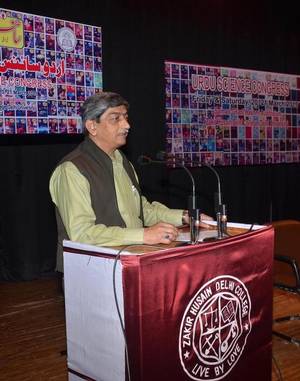
Mohammad Parvaiz at the first Urdu Science Congress in New Delhi in March 2015. Photo: Special Arrangement
A 23-year-old Urdu science magazine uses popular science to inspire progressive thought
Mohammad Aslam Parvaiz likes to describe a process that is a combination of four of his passions — botany, education, philosophy and religion. “The roots imbibe water and nutrients from the soil. The leaf photosynthesises, produces food, retains just enough for its own sustenance and sends the rest to the parts of the tree that need that food. This is the natural world’s law of diffusion — movement happens from the region of high concentration to the region of low concentration. If we see the tree as our community, that is how resources should flow too,” says Dr. Parvaiz, publisher of the magazine Urdu Science.
The first issue was launched at the World Book Fair in New Delhi in 1994. It dealt with AIDS and the myths surrounding condoms. In the last 22 years, the magazine has covered a gamut of subjects including water conservation and the need for a National Water Policy, common ailments and how to prevent them, sex determination, balding, sleep, life on Mars, and animation.
“Science is very effective in feeding the intellectual hunger of young people.Only with knowledge can they think for themselves and learn to analyse the religious scripts that they memorise. Most often it is the children of the poorest Muslims who attend madrasas. With only religious texts to lead them, and if they can read only in one language, how can you expect them to develop their personality and prosper in society?” asks the mild-mannered crusader, at present the Vice-Chancellor of Maulana Azad National Urdu University (MANUU) in Hyderabad.
In the campus, boulders display signages with scientific information and many trees carry their botanical names. “A person will absorb anything that is part of his environment,” he said to the graduate, post-graduate and doctoral students at the inauguration of an Urdu writers’ workshop. As an Urdu-medium student in a madrasa in Delhi, young Parvaiz hardly found any books or magazines in Urdu that could satiate his curiosity. In the Sunday markets of old Daryagunj, he used to find Russian books translated into Urdu, and that is how he discovered Benjamin Franklin. As a high-school student, he set up a science lab in his house. Years later, when he became the principal of Zakir Hussain College, he started a new venture in another corner of his house — Urdu Science.
“Survival depends as much on physical health as on intellectual growth, and sadly, the low potential for growth for poor students in madrasas is a problem across our subcontinent,” he says. An active member of the Modernization of Madrasa Education Project, he says that it is “ironic and tragic that clerics who lead our prayers and teach us about religion and the Koran do not have the means or the knowledge to impart a broad and progressive education. They accept that religious education is not enough, and many of them are now waiting for progressive teachers and educators to come forward and teach at madrasas.”
Having completed a PhD in botany, Dr. Parvaiz started writing in Urdu for Quami Awaz, then edited by Mohan Chirag. Noticing that most Urdu-medium students opted for the humanities, he wanted to popularise science. As a first step, he started a society called the Anjuman Farogh-e-Science, with patrons like Nobel Laureate Prof. Abdus Salam, Jamia Hamdard founder Hakeem Abdul Hameed, and Jamia Hamdard Chancellor Saiyid Hamid. The not-for-profit organisation held its first Urdu Science Congress in New Delhi in March 2015 and the second in Aligarh, this February.
“Urdu was a language of poetry and literature. People of different faiths patronised Urdu. But in those days, and even today, information in the language was very limited. And that is why I started this organisation and this magazine. My wife Shaheen helps me with proof-reading. And now I also have assistance from my colleague Dr. Tariq Nadwi.” Dr. Parvaiz is proud that the magazine has attracted enough Urdu science writers to contribute, and the magazine has so far never had to translate an article from another language. Issues from 2005 are available on the Academia.edu website.
Translation is an important key to dissemination of knowledge, agrees Parvaiz. He is on a personal mission to compile a glossary of scientific words in English, with meanings explained in Urdu. Sharing a slice of history, he says, “Delhi College was started as a madrasa by Ghaziuddin Khan. Here, mathematician Master Ramchandra and Maulvi Zakaullah translated many of the Western scientific texts into Urdu through the Vernacular Translation Society. It was there that I studied and later became the principal. I started Urdu Science when I was there. And I feel very humble that I now head MANUU, the university aiming to promote Urdu.”
A voracious reader of both religious texts and international science, Parvaiz says, “Science helps us interpret the Koran in many ways. And that is as relevant today as it was when the first issue of Urdu Science was launched.”
Mala Kumar is a children’s author, editor and freelance journalist.
source: http://www.thehindu.com / The Hindu / Home> Literary Review / October 15th, 2016
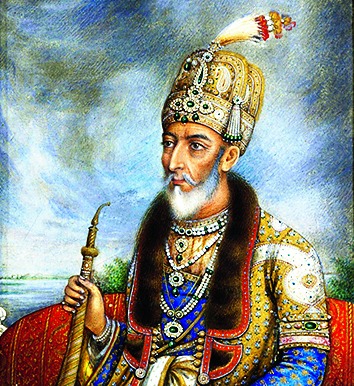
THE LIFE & POETRY OF BAHADUR SHAH ZAFARBy Aslam Parvez, Hay House, Rs 599
This has happened before. When Mahmood Farooqui’s Besieged: Voices from Delhi 1857 was published in 2010, the “voices” of the desperate Dilliwallahs, caught in the throes of a revolt that was not really theirs, sounded strangely familiar. They had been heard in William Dalrymple’s tour de force, The Last Mughal, published four years before Farooqui’s tome came out.
Ather Farouqui’s translation of Aslam Parvez’s seminal work on Bahadur Shah Zafar evokes the same feeling. This is a Zafar we know — a tragic figure undoubtedly, but also one heroic in the midst of adversity, stoic in the face of incomparable loss and grief; a fine poet, humanist and an upholder of the best of the traditions and values that the Mughal court had engendered. Only that Dalrymple’s evocative prose and writing style had done more to popularize the last of the great Mughals than any other piece of work has done for him.
The reason voices and pictures recur is because the works mentioned above conscientiously tapped into long-neglected primary and secondary Persian and Urdu sources that give a very different perspective on Zafar and the Revolt than the conventional viewpoint. Mahmood Farooqui’s research into the Mutiny Papers, written in Shikastah Urdu, threw light on the harrowing experience of the people of Delhi and the personal tragedies that severely dented the picture of the Revolt as a ‘war of independence’. Parvez’s research recovered Zafar’s image and reinstated him as an aesthete, a poet and an iconic figure of the cultural efflorescence that marked the late Mughal era. These independent researches that broke new ground went on to inform, shape and colour Dalrymple’s presentation, which took the story to the large English readership. More than three decades after Parvez had published Zafar’s biography in Urdu, Ather Farouqui’s translation tries to reach the same readership, which, incidentally, heard it all from Dalrymple first.
But Parvez’s treatment of Zafar has a unique flavour. He draws a distinction between Bahadur Shah Zafar the emperor and Zafar the poet. He is unsparing when it comes to the former. Although Parvez acknowledges that the emperor was a victim of his circumstances, reduced to the indignity of having to repeatedly petition the British for his upkeep, the author puts the blame for the last Mughal’s penury on his greed. The ways devised by Zafar’s court to tide over the cash crunch — selling of titles, access to the emperor made easy on payment, his indiscriminate borrowings from the laity — make for incredible reading. What Parvez makes obvious is that even without the Revolt, the British would have made sure that Zafar was the last Mughal to hold fort.
Parvez believes that although Zafar was unwillingly dragged into the war of 1857, once he had committed himself to it, he remained steadfast in his commitment. Dalrymple pictures it differently though. In his narrative, Zafar is withdrawn, confused and often vacillating. But the aspect Dalrymple powerfully highlights in The Last Mughal is one that Parvez repeatedly draws attention to as well — Zafar identifying himself with the suffering of the Dilliwallahs and his powerful determination to retain the secular fabric of Delhi under the severest of pressures, one that led him to ban cow slaughter even on the eve of Eid. In fact, it was to save his beloved city that Zafar took charge of the Mutiny in Delhi.
The other point that Parvez makes is that irrespective of their interests, the British were not completely unresponsive to Zafar’s needs. As proof, he points to his treatment post-Mutiny, particularly that on the way to and in Rangoon. Perhaps Parvez stretches his case a bit. Zafar is known to have been denied even pen and paper in exile. For a poet, this would have meant instant death.
Parvez’s treatment of Zafar as a poet is very different from his treatment of Zafar as an emperor. He makes a strong case for Zafar’s poetic credentials, demolishing Mohammad Husain Azad’s contention that Zafar’s poetry was ghost-written by Mohammad Ibrahim Zauq, who was appointed by Zafar himself to supervise his work. Parvez delves deep into contemporary evidence and compares literary styles to make his case. Whatever Zafar’s failings as a ruler, his calibre as a poet is something Parvez has no doubts about. Acknowledging Zafar’s limitations, Parvez says, “Zafar was like the sinking notes of music while Ghalib was the rising crescendo.”
Ather Farouqui rightly notes the significance of translating Parvez’s work. Given its importance in drawing attention to the “civilizational comingling” of the times that India is now so close to forgetting, he should have been more careful with the work. But he is not. Take his rendition of the poetry, be that of Shah Alam, Zauq or Zafar. Of the many that sound jarring is the following one by Zafar: Tori mariz-e gham ne tere is tarha se jaan/ Ghabra ke ghamgusar sarahne se uth gae (“The way the lovelorn breathed his last/ Startled sympathizers, they jumped their feet with a start”).
source: http://www.telegraphindia.com / The Telegraph,Calcutta,India / Front Page> Opinion> Story / by Chirosree Basu / Friday – June 30th, 2017
A Babur-focussed Uzbeki cultural project is using a common heritage to create a dialogue.
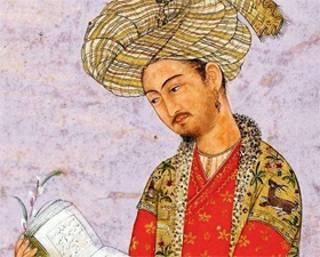
In July 1501, the great-great-greatgrandson of Timur (Tamerlane), Zahiruddin Muhammad Babur — the founder of Mughal empire — left his home in Fergana Valley in present day Uzbekistan. Five hundred years on, the Uzebki government is tracing his journey to India and his Indian connections as part of Cultural Legacy of Uzbekistan in Art Collections of the World project which began last year.
An effort to piece together the country’s history, researchers are connecting with international museums documenting the antiquity and artifacts connected to them. Till date, the Uzebki government has released 10 volumes and several short films on the cultural legacy of Uzbekistan with the help of information from leading museums in Russia, North America and Australia. “What they are doing is a first. They are not raising a dispute or demanding return of any antiquity. Instead, they are taking a holistic approach — using the common heritage to create a dialogue instead of stoking controversy,” says independent commentator Shashtri Ramachandaran, who participated in a two-day congress on the study organised by the Uzbek government.
An average Indian will be more familiar with United Kingdom, having followed their parliamentary and administrative methods or would be familiar with the cultural milieu of the United States, having developed an appetite for American TV shows. But barring academics, few are aware of the shared heritage between India and Uzbekistan that spans across centuries. A team of researchers from Uzebkistan visited the National Museum this April to piece together this lost history. “Their aim is to document material related to the Mughal era primarily. Once they present a formal proposal which is vetted by the Ministry of External Affairs and Ministry of Culture, they can start documenting work,” said Dr BR Mani, Director General, National Museum, who met with the Uzbekistan’s Ambassador last week to discuss the project.
The Uzbeki interest in the founder of the Mughal dynasty comes at a curious time, given that Babur’s successor Aurangzeb’s name was removed unceremoniously off Delhi’s roads for being an “invader”. Union Minister V K Singh even suggested that his grandfather Akbar should meet with a similar fate. In February this year, the BJP-led government in Rajasthan backed a proposal to rewrite history taught at the university level to attest that Rajput warrior-king Maharana Pratap won the Battle of Haldighati against Akbar’s Mughal army led by general Man Singh, despite historical evidence suggesting otherwise. In the same vein, RSS ideologue Indresh Kumar recently suggested that Babur and his army general Mir Baqi should be tried in court for destroying Ram Mandir in Ayodhya.
History suggests that Babur lived in India for only four years and died at the age of 47 in 1530 after successfully ousting Ibrahim Lodhi (in the Battle of Panipat in 1526). But his legacy lived on. The Babri Masjid demolition in December 1992 triggered the campaign to decry the Mughals as invaders. “Labeling the Mughals as “invaders” is bogus, historically. But Hindu nationalists do not use this label as a historical claim,” says Professor Audrey Truscke, who received severe backlash over her recent book Aurangzeb: the Man and the Myth. She adds that maligning Mughals is only a means to fuel “anti-Muslim sentiment in the present”. “It is a shameful business, especially at a time when vigilante violence against Muslims is on the rise,” she adds.
Babur was not Indian, even less an Uzbeki. He tried at least thrice to win Samarkhand but failed. “Babur took Samarkand one last time with help from the Safavids of Persia in 1513. However, as he had to publicly acknowledge his support for Qizilbash Shiism, his subjects turned against him,” explains Professor Ali Anooshahr from the History Department of the University of California.
During his time in India, Babur influenced architecture, culture, warfare and even introduced Indians to the sweet melons of Fergana. When Babur reached India, he was disappointed that the only fruit available was mango. It is said that he personally monitored planting of watermelons and musk melons. “In Babarnama, Babur writes about the apricots and pomegranates of Marghilan, fruit trees of Isfara, the melons of Bukhara, and the apples of Samarkand. He also recalled with pleasure, the various flowing rivers and brooks in that region,” adds Prof Anooshahr.
At the museum, the Uzbeki experts are particularly interested in manuscripts of the Holy Quran, scribed in Uzbekistan, which were presented to the Mughal emperors, as is evident from the royal seals on the cover page. Also of interest are 15 illustrated folios of the Baburnama. He wrote his autobiography in Chagatai language, the spoken language of the Andija-Timurids. It was during the reign of Akbar that the work was completely translated in Persian. According to Prof Anooshahr, the most comprehensive copy of the original is the Hyderabad manuscript. “Although I do not know where exactly that copy is located right now,” he adds.
The Uzbeki researchers are now looking at sources beyond the National Museum. “It is gratifying to realize that the culture of such a great country is connected with ours. We are planning to publish a couple of albums in India, depending on the results of our work,” said Professor Andrey Zybkin, the Uzbeki project coordinator.
Few sites of the Babur era have stood the test of time. Some of them include, West Delhi’s Babur era mosque, the Babri Masjid and Ram Bagh in Agra. But it is not just the Mughal era that is of interest. India and Uzbekistan go as far back as the Kushan Dynasty. The Kushan Empire, spanning an area of 37 lakh kilometres, extended from Bihar to southern Uzbekistan. It was an era when the Indian sub-continent saw extraordinary exchange of art and ideas. “At present we do not have first-hand information on the Kushan period artifacts found in Uzbekistan. It will be interesting to see how the pottery, social behaviour and culture changed from Fergana valley to Mathura,” Dr Mani added.
Apart from the Mughals and Kushans, there are other points of convergence between the two nations. Gujaratis had close trade ties with Uzbekis, so did Parsis and Armenian Christians. Professor A K Pasha from JNU explains that somewhere this search for their history is part of a “resurgence of old identity”. “For years, the Uzbeki culture was subjugated and overpowered by Russians. The Islamic feeling is growing which is why they want to resurrect their old identity,” explains Pasha.
source: http://www.mumbaimirror.indiatimes.com / Mumbai Mirror / Home> Others> Sunday Read / by Sobhana K Nair, Mumbai Mirror / June 18th, 2017
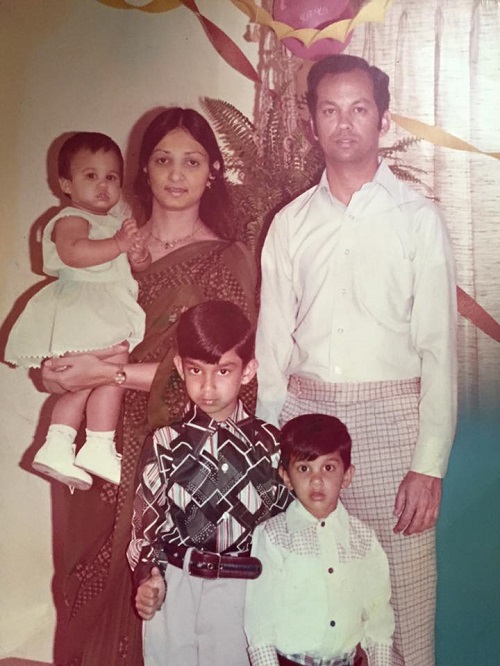
The author, his wife and three children circa late 1970s in North Dakota.
This is Day 22 of the 2017 #30Days30Writers Ramadan series – June 17, 2017
by Syed Husain
It was in the summer of 1976, following my post-doctoral assignment at Stanford Research Institute in California, I was offered a faculty position at University of North Dakota, School of Medicine. Although it was a tempting offer, leaving San Francisco and moving to Grand Forks with three small children was a difficult thing to consider.
Recalling the Persian proverb, “Mulk-e-Khuda Tang Neest, Pa-e-mera Lung Neest” (The Kingdom of God has no limits and no broken legs do I have to limit my travel), I decided to accept this offer – though I knew a Muslim community to draw on for support in North Dakota would be virtually nil.
A leap of faith indeed, but as a Muslim, I had a firm belief in my Creator and my destiny.
As we started our journey across the country, it was full of amusement and excitement. We only had ourselves to rely on – myself, my wife, and my three children, ages seven, four and one. The passage through Yosemite with tall redwoods, the majestic Grand Tetons, the enchanting Yellowstone National Park, the amazing Mount Rushmore and the Badlands was an experience to behold.
Finally, we arrived in the small college town of Grand Forks. And, we found the people of this land of Aurora Borealis, sun-dogs, snow and tumble-weed to be friendly, hospitable and compassionate.
After settling in the faculty housing, my priority was to find out how many Muslims, including students, were on campus. As the Ramadan was approaching, I wondered if they had facilities to pray and observe Ramadan. Surprisingly, I found only one another Muslim faculty and a handful of students with no place to worship. Later, I located four more families in a radius of fifty miles from Grand Forks that became the “core group” of Muslims in the area.
In this isolation, as Ramadan arrived, we made frantic calls to Chicago, Montreal, Minneapolis and Winnipeg to confirm the sighting of the moon. To determine the duration of fast and follow the fiqh ruling, we decided to follow the times in Winnipeg, the closest city with a sizable Muslim population. Those were long days — we were fasting for 19 hours a day with the sun setting around 9:45 p.m.
The University had appointed me as Muslim Faculty Adviser, and I was able to get space in the student union for our Jummah prayers and iftars. This small community had no provision for halal meat and no place to buy spices and other ingredients to prepare our food. A good Samaritan in the community located a farmer, who helped us sacrifice a heifer or a black angus.
This farmer became the source our halal meat supply for the rest of our stay (15 years) in North Dakota. Families would share the meat and drive to Winnipeg or as far as Chicago to get condiments and other supplies. The spouses in this small core group got together and started preparing meals, iftar and sahoor for their families and for students as well on weekends. We began to feel the baraka (blessings) of Ramadan in this newly formed community.
Fasting was difficult, but we managed and grew closer as a family (and as a married couple) in doing so. When we finally made it to iftar time around 9:45 p.m. and broke our fast, my wife and I (we were the only ones fasting in our family in the ‘70s) were grateful. Our children would beg us to take them to McDonald’s for ice cream after we prayed Maghreb and ate dinner, around 10:30 p.m. at night, but it was hard to get the energy to do so.
The nights we rallied and took them were very special to all of us – small treats that meant so much to our children and to us.
The summer season in North Dakota is short, sweet and very precious. It was amazing to see farmers busy harvesting crops under floodlights into the wee hours of the night. Our neighborhood on the outskirts of Grand Forks bordered a large farming field. The rumbling noise of trucks hauling beetroot and sunflower seeds were a reminder to us to get up for our sahoor.
I recalled my childhood days back in Hyderabad, India, when at sahoor time hawkers pass through Muslim neighborhoods singing local folklore, breaking the quiet of the night as these trucks did and reminding the community that sahoor time was soon to end.
Our children (and the daughter of one other Muslim family in town) were the only Muslim students in their schools. The school authorities were kind, compassionate and understanding. They were cognizant of the Islamic principles and provided our children with a private bathing facility and a place to worship. This was back in the 1980s in an educational community that probably had never seen or interacted with Muslim kids before.
Alhamdulillah, this conducive, inclusive and inter-faith understanding of the teachers and the school district authorities nurtured a healthy, positive civic atmosphere and a sense of belonging for our children. Our children use to wait eagerly for the arrival of Ramadan and for the celebration of two Eids.
These occasions were a real source of joy to these few host Muslim families and their children and to the small group of students. We celebrated Eids in a church, in an International Students’ Home on campus and in our homes.
This was our Little Mosque on the Prairie much before the celebrated television show.
This was our forging of an American-Muslim experience in a community that sometimes didn’t understand us, but developed friendships and deep relationships with us based on love, kindness and mutual respect.
In our sojourn of 15 years (1976-1991) in North Dakota, we also saw swings in the population of Muslim students and in the community due to graduations, termination of University of North Dakota’s Pilot Training programs with Gulf Airlines and Saudi Arabian Airlines and faculty transfers/retirements. In recent years, the economy of North Dakota has improved greatly due to oil exploration in Williston Basin.
The city of Fargo (one of the largest cities in North Dakota, about an hour away from Grand Forks) has seen a sizeable number of Muslim immigrants arriving. The city of Grand Forks also has its share and has seen a surge in new arrivals. We wish them all a Happy Ramadan and Eid Mubarak.
Syed Husain, Ph.D. is a retired professor of Pharmacology at the School of Medicine, University of North Dakota and a retired Scientific Review Administrator at the National Institutes of Health in Bethesda, MD. He now has eight grandchildren forging their own American-Muslim experience.
source: http://www.patheos.com / Patheos / Home> altmuslim / by Syed Asif, Guest Contributor / June 17th, 2017
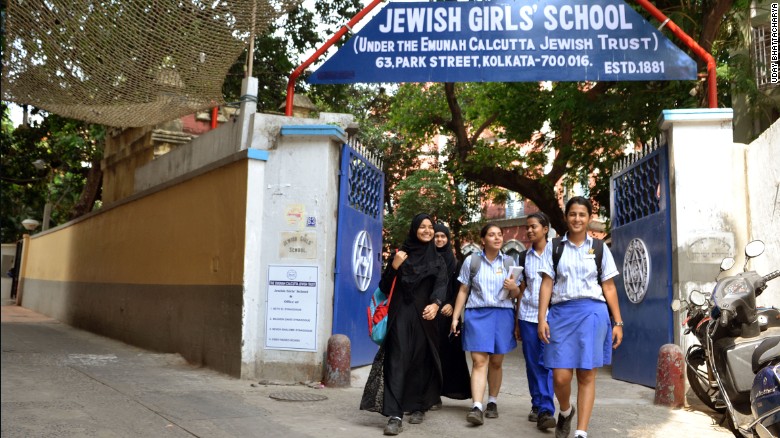
Muslim girls, some in the burqa and some in the regular uniforms, leave the Jewish Girls School in Calcutta.
Editor’s Note : Anik Basu is a Kolkata-based independent journalist.
Kolkata, India (CNN) :
When Mitana Alexander bid goodbye to Kolkata’s Jewish Girls School in 1975, she was its last Jewish student. The bulk of the others were Muslims.
But it was not the steady influx of Muslim girls in the preceding two decades that moved Alexander’s parents to take her out of the school, she says.
They were worried because she was last remaining occupant of a Jews-only dormitory, as most Jewish girls they had known had migrated to Israkel, America or Europe “with their folks.”
“They (school authorities) had to retain a matron just for me,” recalls Alexander, now aged 50. “I would be alone in the dormitory at night and my parents started panicking. Muslims had nothing to do with my leaving.”
Author-scholar Jael Silliman, whose children are settled in the US, says development in India and the outside world in the 1940s-50s led to an exodus of Jews from Calcutta.
Distinctly Kolkata
The swelling ranks of Muslim girls in the Jewish school offer a glimpse into the deep ties between Kolkata’s Muslim and once-thriving Jewish community.
More than 1,200 of the nearly 1,400 students are Muslims, as is the school’s vice principal and half the faculty.
The change began in the 1950s, when there were not enough Jewish families needing an institution set up specifically to instil Jewish values.
As Jewish enrollment petered out, the authorities decided to admit children of other faiths. The biggest response came from the Muslims of nearby areas.
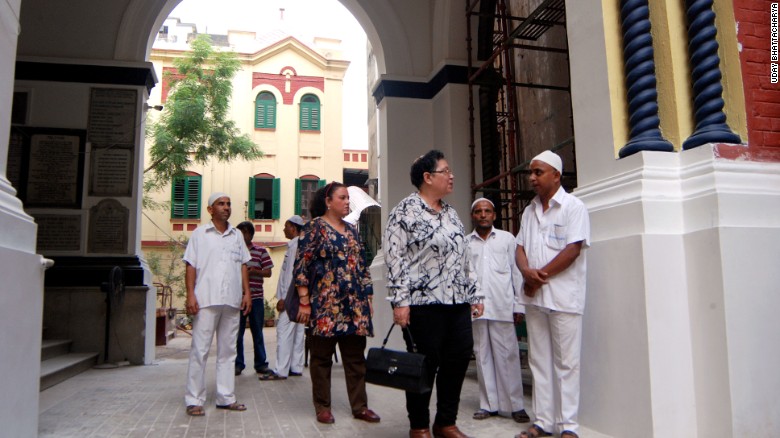
Aileen Jo Cohen (foreground) and Mitana Alexander talk to Muslim caretakers at one of Calcutta’s three synagogues.
Today, there is very little “Jewish” about the school, save for perhaps its name, the Star of David on the school gates, the school uniform and notebooks, and portraits of Jewish patrons on the walls.
Authorities have made available a “changing room” for Muslim girls whose parents frown upon their stepping out in public in school skirts.
These students leave home in the burqa, change into their uniforms once in school, and put on the burqa when leaving. “Our parents don’t like it if we bare our legs,” says senior student Zara Ahmed, 17.
“The school has come to symbolize Jewish-Muslim harmony in Kolkata,” says managing trustee Aileen “Jo” Cohen.
The harmony is visible elsewhere too; the city’s three synagogues — the smallest of which boasts of more chairs in its prayer hall than there are Jews in Kolkata — are looked after by Muslim caretakers.
Muslims also help with the dressing of bodies for Jewish burials and outside the Magen David Synagogue, Muslim bangle sellers wearing the topi (the Muslim prayer cap), have set up kiosks on the bustling footpath.
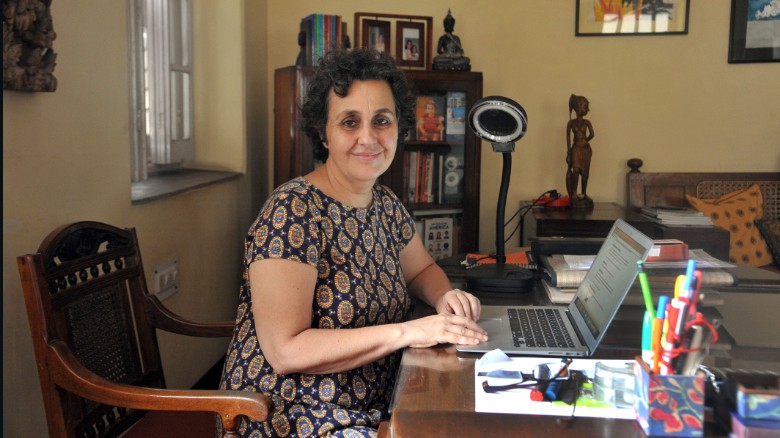
“The close ties and positive working relationships between Muslims and Jews are deeply rooted in the local context of Kolkata,” says Jael Silliman, 62, a city-born Jewish scholar and author, and a former Associate Professor of Women’s Studies at the University of Iowa.
Exiting Kolkata
The first Jew to arrive in Kolkata, on August 4, 1798, was Shalom Ha-Cohen. A native of Aleppo, Syria, Shalom was initially the court jeweler to a Muslim prince in northern India.
Shalom’s prosperity attracted other Jews from West Asia. According to community records, the population of Jews “of Arabic disposition” expanded to 600 by the 1830s. That number stood at around 4,000 when India gained independence from British rule in 1947.
However, soon after the community started emigrating en mass, beginning the end of a 200-year association with the city.
“A combination of national and global events in the ’40s and ’50s led to a very rapid dissolution of the community,” says Silliman, whose two daughters settled in the US.
With India’s independence, British settlers began returning to England, Israel came into being in May 1948, and the fledgling Indian government’s Socialist policies were perceived as not being conducive to business.
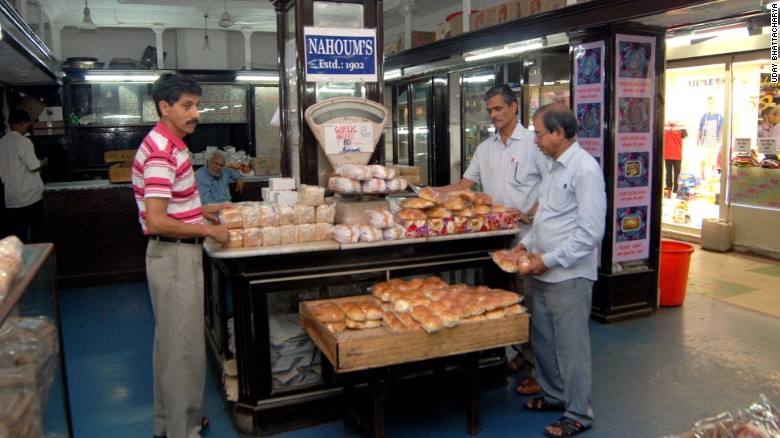
Muslim workers at the 115-year-old Nahoum’s confectionary, founded and owned by Jews, in downtown Calcutta.
Today, the number of Jews in Kolkata stands at 22, the middle-aged Alexander being probably the youngest.
And it is left to the likes of the Jewish Girls School Vice-Principal Abeda Razeq to keep those ties alive.
Her father’s best friend at college was a Jew, whose family runs the 115-year-old confectionary store Nahoum’s, and their friendship, which continued beyond college, first exposed Razeq to Jewish culture.
The two families exchanged gift hampers during their respective festivals and Razeq learnt of the similarities and differences between kosher and halal cuisine.
She even helped out at Nahoum’s at Easter and Christmas: a Muslim girl at a Jewish bakery wrapping cakes during Christian festivals in a predominantly Hindu city.
The Nahoum family has shrunk to just one member now, who spends much of his time abroad, and the workers — many of them Muslims — run the show.
Razeq did her dissertation on Kolkata’s unique Jewish-Muslim relationship, and wishes she had the time to complete her doctorate on it.
“It’s a rich subject,” she says.
source: http://www.edition.cnn.com / CNN / Home> Region> Asia / by Anik Basu / June 16th, 2017
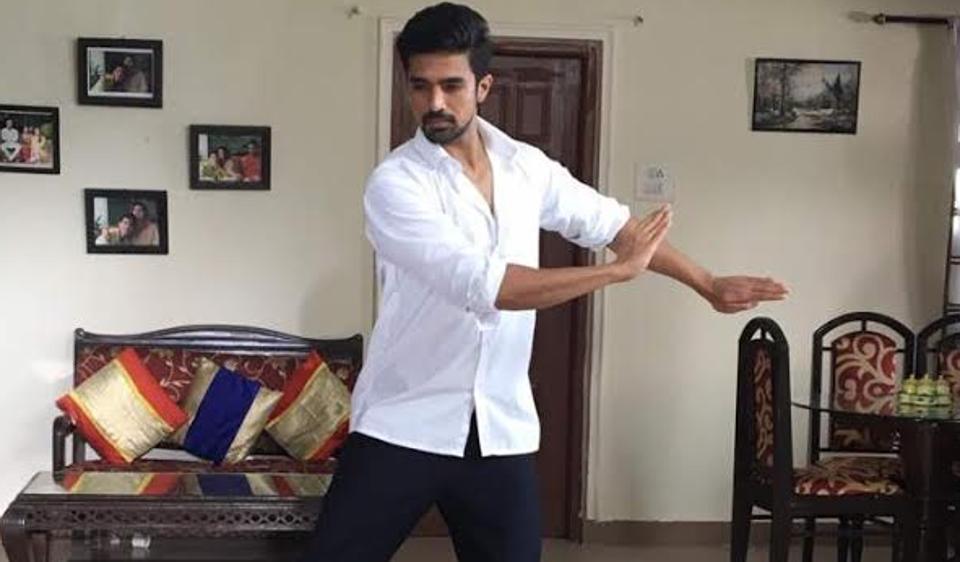
Saqib Saleem practices Kathak for his upcoming short film on Fathers’ Day.
Saqib Saleem is working on a short film that will be released on the occasion of Fathers’ Day this Sunday. The actor has learnt Kathak for the project.
Bollywood actor Saqib Saleem, who was recently seen alongside Huma Qureshi in Dobaara: See Your Evil, is now learning Kathak, a classical Indian dance form for his next project.
Saqib is working on a short film titled Aamad, where he plays the character of a Kathak dancer.
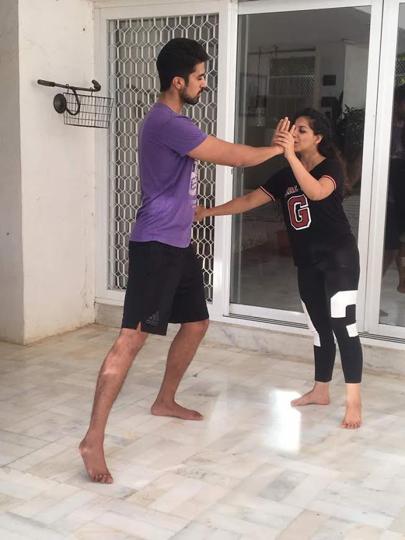
Though it was very challenging for him, the actor took it in his own stride and put together a genuine effort to learn the dance form from professional Kathak guru and actress Ishita Sharma.
Aamad is about a father who is a Kathak dancer and how his son is embarrassed of his father’s art. The plot explores how they build their relation over a period of time and overcome their personal apprehensions and start a new friendship.
source: http://www.hindustantimes.com / Hindustan Times / Home> Entertainment> Bollywood / HT Correspondent – Hindustan Times / June 16th, 2017