An oral history of marginalised Muslim women’s narratives
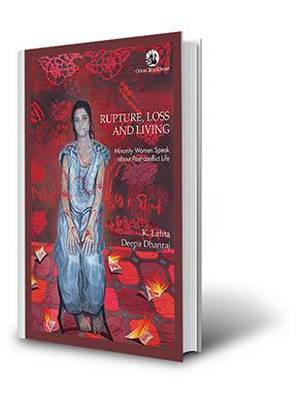
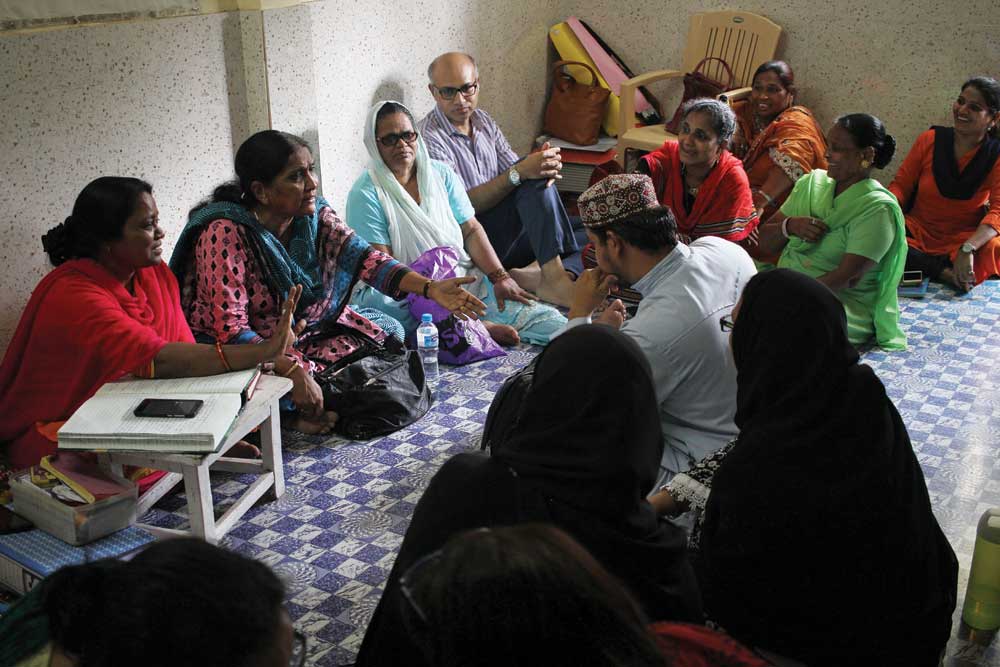
How does violence, communal or otherwise, impact ordinary people? What happens after the conflict, when the spotlight shifts elsewhere? How do victims pick up the pieces? Now direct all these questions at marginalised groups, especially poorer women, who anyways live in areas of darkness. What could have been their experience? Between 2006 and 2009 — after some of the worst communal clashes our country had seen — a scholar and a film-maker/researcher decided to investigate. Working with local researchers and activists in Mumbai, Hyderabad, and several cities of Gujarat, they began gathering stories from women survivors of collective violence.
K. Lalita and Deepa Dhanraj’s account is deeply disturbing, and this book of oral history is an important one on the narratives of marginalised Muslim women. As they write in the introduction, Lalita and Dhanraj documented life histories of 75 Muslim women survivors of communal violence, and present the stories of 19 of them divided into four thematic sections: I Began to See the World for What it is, Loss and Trauma, Negotiating Survival and Livelihood, and Claiming Accountability, Seeking Justice. Without going into issues like Muslim personal law, Islam, politics or the question of Muslim identity, the writers draw out experiences of violence these women had, “whether instigated or abetted by the state, communal, sexual, domestic or structural….”
For many of these women, “rupture manifested as complete displacement — physical, economic, domestic and emotional” — and they still live in a state of anguish, the experience too much to bear. For others “the loss of vatan (homeland)” is also the “loss of … community,” the loss of a sense of belonging to your birthplace. Add to this impoverishment, loss of income and identity — we hear of a woman in Mumbai who tells us her husband, a carpenter, lost his tools during a riot. Unable to invest in a new set, he became unemployed and depressed, and never recovered.
The stories of ordinary lives — their pain at losing their joy — stay with you. Just like Nobel Prize-winning writer Svetlana Alexievich’s oral history of the demise of communism, Second-Hand Time, where she recorded the voices of men and women rarely given an opportunity to speak. They didn’t speak of lofty ideals or politics, but of their daily lives, their joy and pain.
www.thehindu.com / The Hindu / Home> Books> Reviews / by Sudipta Datta / May 21st, 2017
Mohammed Nazim charmed his fans by portraying the lead character of
Ahem Modi in Saath Nibhaana Saathiya for six long years and gathered a legion of fans in the process. It was because his following that the actor was asked to return merely three months after he quit the show.
When asked whether it was the fans love which wad responsible for his re-entry, Nazim agrees and says, “Yes my fan following is huge because of my character Ahem. It’s because of my fans that I am back in the show. I got to know that they had stopped watching the show after I quit,”.
Well, now the admirers of Nazim have a lot to look forward to as his new avatar in the show is quite interesting.
Reveals Nazim, “My character is quite special on the show. He is a young guy called Jaggi who is a stylish tapori. He’s a Punjabi guy who is very mischievous and just full of life.”
Ahem, is quite casual about making the re-entry, and refuses to get emotional about returning to the show. He says, “Why would I miss the show? It was going on and people were watching the show. I was busy with shooting for my movie Big Daddy. We’ve wrapped shooting for that and its being edited.”
Nazim re-entry has increased the TRP too of the show.
Well, we hope Nazim has a great innings in this new avatar as well.
source: http://www.timesofindia.indiatimes.com / The Times of India / News Home> TV> News> Hindi / TNN / September 09th, 2016
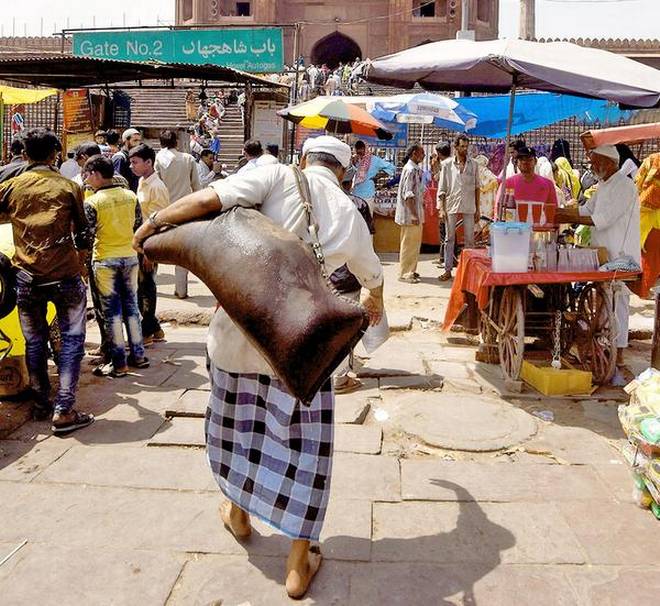
Keeping on: Shakeel Ahmad carries a goat hide flagon filled with water in Delhi / AFP
Bhishtis have been supplying water from their swollen canteens since the Mughal era
Shakeel Ahmad wanders the cramped alleyways of Old Delhi offering water from a goat hide canteen slung over his shoulder, a centuries-old service welcomed by thirsty vendors toiling under the baking sun.
Mr. Ahmad is one of last Bhishtis, a community of water carriers fading into history after generations of quenching thirsts in Delhi’s old quarter.
Bhishtis have been supplying businesses, pilgrims and passersby with swigs from their swollen canteens since the Mughals ruled India, an era before piped water sounded the death knell for their trade.
“I spent my childhood doing this. My ancestors too spent theirs,” Mr. Ahmad said, at the footsteps of Jama Masjid, a towering mosque built at the height of the Mughal empire.
Sense of an ending
“Now I am the last. I’m not sure if my children, if the next generation, will do this or not.”
For centuries, Bhishtis have sourced water from an underground basin deep beneath the warrens and Mughal-era monuments of Old Delhi — a bustling quarter hidden away from the modern Indian capital that grew up around it.
Inside a small Sufi shrine, Mr. Ahmad — like countless Bhishtis before him — draws water from a deep well, filling his large goat skin canteen known as a mashaq to the very brim.
“The water in this well hasn’t stopped since it was dug,” said Mr. Ahmad, gesturing to the murky depths of the pit below.
“It dried up just once when construction began on the Delhi metro… But then it just came back on its own.”
It is back-breaking work hauling a full mashaq around the crowded, cobbled streets in the blistering Indian summer, where daytime temperatures regularly exceed 40 degree Celsius.
A full canteen carries roughly 30 litres — enough to earn a Bhishti a mere ₹30, a pittance for the hard labour involved. “My children will find it difficult to do this job. I am the last (of my family),” he said.
Cheaper alternatives
The advent of piped water, and cheap bottled options, has decimated their business, but there’s still a handful calling out for Mr. Ahmad as he treads the lanes with his dripping flagon.
Old shopkeepers, parched in the midday sun, cup their hands for a mouthful of water, while street vendors have him fill cooling units and drink buckets to ward off the worst of the heat.
Problems with the piped water supply — not an unusual occurrence in the creaky old neighbourhood — is a godsend for Mr. Ahmad, even if a nuisance for everyone else.
“When they have their regular supply, no one bothers to call,” Mr. Ahmad said.
Of the bygone era
Business may not be booming but tourists and pilgrims still do double take when they see the elderly Bhishti in his white Muslim tunic and prayer cap carting his water skin, a flashback to a bygone era.
“Many people are amazed to see that this profession still exists… that something from the time of the kings still exists. They are surprised and happy to see us,” he said.
source: http://www.thehindu.com / The Hindu / Home> Sci-Tech> Environment / by Agence-France Presse / New Delhi – May 11th, 2017
Yaskhagana, the popular Hindu dance form from Karnataka’s Dakshina Kannada district, has been used as a backdrop in many Kannada films. But Ismail Mudashedde’s upcoming film, Banna Bannanda Badukku, will not only revolve around the dance-form, but also have a Muslim protagonist.
The film is the director’s take on the recent onslaught on Muslim artistes performing traditionally Hindu artforms in certain parts of the district.
The film stars actor Raviraj Shetty who will essay the role of a Muslim Yakshagana dancer.
“Banna Bannada Baduku is based on the real-life story of a Muslim artiste who was hounded by fundamentalists for performing the art. I was very impressed with the script when Ismail narrated it to me. I am happy to be part of the project,” Shetty told Bangalore Mirror.
Yakshagana enjoys huge popularity in the coastal belt of Karnataka and people of all communities are known to watch it even though the stories performed are mostly from Hindu epics.
Ismail, who has also written the screenplay and dialogues for the film, says it was challenging as the story was very intriguing. “This movie will remind people of the communal violence in Mangaluru and make people question if artistes should be harassed and victimised simply for performing an artform. I hope the film gives the audience a new perspective and they enjoy it,” Ismail said.
Besides Shetty, actors Anitha, Sagar, Riya Meghana, Ramesh Bhat, Satyajith and Honnavalli Krishna have pivotal roles in the film.
Real-life Yakshagana stars like Balipa Narayan and Patla Satish Shetty will be seen in guest roles.
Former Mangaluru mayor Sashidhar Hegde will also be part of the film.
source: http://www.bangaloremirror.indiatimes.com / Bangalore Mirror / Home> Entertainment> South Masala / by Nischith N , Bangalore Mirror Bureau / May 12th, 2017
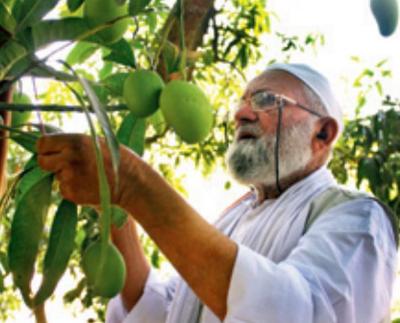
Yogi mango is latest product from the laboratory of UP’s Mango Man. Three years after Haji Kalimullah christened a mango after PM Narendra Modi he has now named another after UP chief minister Yogi Adityanath. The 74-year old Padmashri recipient, Haji Kalimullah is excited about the new variety in his orchard in Malihabad, about 30kms from Lucknow.
It’s the first time the variety named by him has not been developed by the man himself, rather, has grown naturally in his orchard. In all likelihood, it appears to be a cross of another naturally developed variety, ‘Karela’ and Dussehri.
“The Yogi mango is slender, elongated and beautiful and you won’t stop marvelling when you see it,” said Kalimullah. But the hybrid’s parent is not know even to him. “Some people visited my orchard recently and while they were looking around they asked about these four five different-looking mangoes on a tree. I said the variety might have developed naturally and they suggested to name it after Yogiji and I did,” he said.
This time, however, Kalimullah has named the variety a little earlier than usual. On all other occasions on which he developed a new variety, he waited for the fruit to ripen to know its taste and smell.
“I am still not sure how this mango is going to taste as it is green and the same can be said about how it would smell. But I hope it will taste good as it is a hybrid of Dussehri,” he said, adding that it will take about a month for the fruit to ripen.
Meanwhile, the tree bearing Modi mango has some fruits on it this year too. “Modi mango is exceptional in taste and very nice to look at,” said Kalimullah. It’s a hybrid of Kolkata’s Husn-e-Aara and Lucknow’s Dussehri. No wonder, the fruit has acquired distinct streaks of crimson like Husn-e-ara and elongation of Dussehri.
Kalimullah’s technique is different when it comes to developing a new variety. “I cross flowers, develop a fruit and then sow its seeds because every seed is different and that is how the best variety develops,” he said.
It’s anything but easy. About 99% experiments have gone waste. The few that survived brought the man recognition. He has named the hybrid of Khasul Khaas and Chausa weighing up to 1 kg after Sachin Tendulkar. He has also named one variety named after Aishwarya.
source: http://www.timesofindia.indiatimes.com / The Times of India / News> City News> Lucknow News / TNN / May 07th, 2017
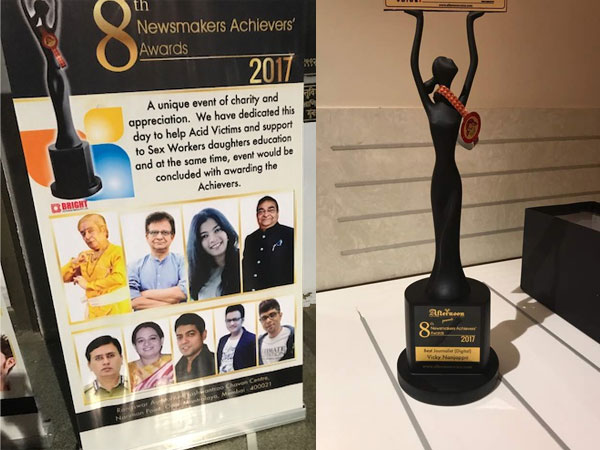
It was a proud moment for OneIndia as our special correspondent Vicky Nanjappa bagged the award of ‘best journalist (digital)’ at the Eighth Edition of Newsmakers Achievers’ Awards. The event was held in Mumbai on May 1. Unlike any, the event this year was dedicated to the acid attack victims. Vicky Nanjappa was recognised for his contribution to the field of journalism in the last 18 years. Achievers from various fields like education, art, science, politics etc were also recognised and awarded on World Labour Day.
While celebrating achievers from various fields, the Newsmakers Achievers’ Awards did its little for those in need. The highlight of the event was the financial assistance provided to children of sex workers apart from contributions to acid attack survivors. “I have undergone eight surgeries and two more will follow. I hope the accused should be awarded stringent punishment. Life is full of obstacles but one should struggle hard to overcome all obstacles,” said Aarti Thakur, a 27-year-old acid attack survivor.
Daultabi Khan, a 34-year-old victim of acid attack said, “I have to undergo huge hardships after the acid attack. I have lost vision in my one eye both my ears are deformed. I will utilise this money for treatment purpose.” Achievers of 2017 During the event, several persons from the media, academic and political sector were honoured including OneIndia’s Vicky Nanjappa for journalism. Pandit Birju Maharaj and Pradeep Welankar were honoured with the Lifetime Achievement Award while Diwakar Raote received the Best Politician Award.
Aasha Warriar was honoured with the Best Spiritual Leader award while Dr Mukesh Batra bagged the best doctor award. Dr Deepak Bhosale received the best Educationist award. Roxy Arora was honoured with the best Author award. Virag Gupta received the best lawyer award. Namrata Thakker was honoured with the Best Social Entrepreneur award.
Deep Haider received the Best Journalist (Editor) award. Rashid Hashmi was felicitated with the Best News Anchor award.
Varun Singh received the Best Journalist (Print) award. Anil Nagpal received the Best Photographer award. Nandita Venkatesan was felicitated with Best Writer/Reporter award.
Asha Mamedi bagged the Best Social Worker jury award. Sushant Divgikar was felicitated with Best VJ award. Siddharth Nigan received the Best Child Artist award. Meghna Malik was felicitated with the Best Actress award. Darshan Kumaar received the Best Actor award. Lubna Adams bagged the Best Fashion Choreographer award and Ssumier S. Pasricha received the Best Comedian award. Dolly Parekh was felicitated with Best Fashion Designer award.
Samidha Guru was honoured with the Best Marathi Actress award while Kishor Kadam bagged the Best Marathi Actor award.
“This year award function is special for us as we have tried to make a small difference in the lives of acid attack victims and sex workers daughters’ lives. By lending a helping hand to them we will rebuild their lives,” said Vaidehi Taman, Group Editor of NBC. OneIndia News
source: http://www.oneindia.com / OneIndia / Home> News> India / by Anusha Ravi / Wednesday – May 03rd, 2017
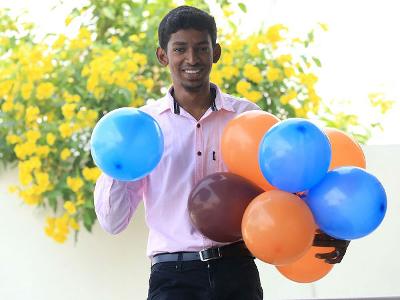
When was the last time you blew a balloon? Probably, when you were a child?
But, for 22-year-old N Sadham Hussain, son of a flower seller from Podanur, inflating balloons is the route to fame.
This engineering graduate has been in the news ever since he blew 500 balloons in a matter of 68 minutes at an event held in the city.
Hussain attempted a record in three categories- most balloons blown in a minute, most balloons blown in three minutes and the fastest time to blow 500 balloons. At the recent event, he managed to inflate 11 balloons in a minute, 29 balloons in 3 minutes and 500 balloons in 68 minutes.
“It all started in 2011 when I started doing a part-time job in balloon decorations. I was in charge of blowing balloons for birthday parties and private events. Later, I came forward to blow balloons at a symposium held at my college. (Dr NGP Institute of Technology) The pace at which I was blowing the balloons impressed a friend of mine, who later suggested that I could put the skill to good use.
That’s when I decided to give the records a shot.
Since then there has been no looking back. I blew 486 balloons in an hour at an event and that was considered a record. It’s been two years I completed my studies but I continue my passion for blowing balloons.”
Sadham now accompanies his brother in installing smart boards in schools. He already has his name etched in the Limca Book of World Records for blowing 486 balloons in one hour and 1,000 balloons in 147 minutes.
So, does he practice blowing balloons on a regular basis? “Not really! Since, I continue my job in balloon decorations and I get the opportunity to practice regularly. The only ritual I have been following from day one is to keep a glass of water and glucose next to me. You lose a lot of moisture when blowing a balloon and it’s imperative that you don’t feel tired while at it. You need a lot of stamina as well.”
However, he adds that blowing balloons is not a cakewalk while attempting a record. “The balloons diameter should be 20 cm after blowing it; you have to tie it up. Many a time I have burst a number of balloons during the process. I get extremely nervous then and lose out on time.
But, I carry on with the attempt as I have to finish inflating the maximum number of balloons at a particular time.”
The electrical engineering graduate aspires to set a world record in blowing balloons. “I want to set a world record and I am working hard towards it,” says Sadham, who is still hunting for a job that will help fulfill his dream.
source: http://www.timesofindia.indiatimes.com / The Times of India / News> City News> Coimbatore News / by P. Sangeetha / TNN / April 30th, 2017
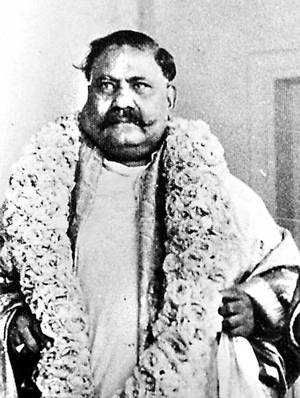
SHARING SIMILAR SENSIBITIES Ustad Bade Ghulam Ali Khan
Seasoned musicians paid melodic tributes to Ustad Bade Ghulam Ali Khan on his 115th birth anniversary in Kolkata.
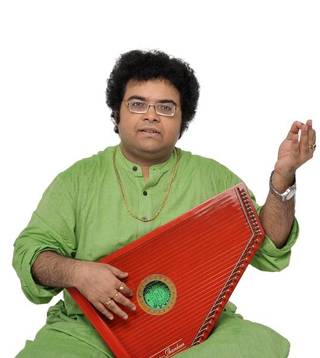
The Calcutta School of Music, in association with Saambhavi, offered homage to Ustad Bade Ghulam Ali Khan on his 115th birth anniversary (2nd April) at the century-old School’s Sandré Hall. The evening touched the nostalgic chord when Pandit Buddhadev Dasgupta who, despite his ailment, came to share his treasured memories related to Khansaheb with the audience, sobbed like a child while listening to ‘Hari Om Tatsat’, soulfully sung by Nabhodeep Chakraborty, a young torchbearer of Kasur Patiala Gharana who religiously pays melodic tributes to Khansaheb on this day every year and who conceptualised this event.
According to Dasgupta, the erudite sarod maestro who is an ardent admirer and delightful analyst of Khansaheb’s charismatic music, “Among those legendary musicians who spent part of their lives in the city of joy are Ustad Amir Khan and Ustad Bade Ghulam Ali Khan. The styles of both the ustads had the biggest impact on local vocalists and quite a few Bengali musicians, without any direct taaleem have tried to blend their styles with results which often are little short of disastrous.”
Fortunately, Chakraborty, having been trained by Ustads Raza Ali Khan, Mazhar Ali Khan and Jawad Ali Khan, grandson and grand-nephews of Khansaheb, has acquired enviable gharana treasures.
Extraordinary rehearsal
He insists on the ‘Kasur’ prefix. This has a valid reason. ‘Khansaheb hailed from Kasur, a small town 30 kilometers away from Lahore; and the people still remember the superhumanly riyaaz of ‘Kasuri Bade Ghulam’, says Chakraborty. “It was Khansaheb, who modified the original Patiala style which basically thrived on taans. (Khansaheb’s son) Ustad Munawwar Ali Khan went on record while describing the olden, somewhat rough, gayaki, ‘Aisa lagta tha jaise billiyan jhagad rahi hain (it sounded as if cats were fighting)’.”
The evening was based on some select compositions of Ustad Bade Ghulam Ali Khan under the pseudonym ‘Sabrang’. A clutch of Chakrborty’s disciples presented these khayal bandish-s with sincere reverence. Each one focused on a special aspect of their gharana’s salient features. They were ably supported by Timir Baran Chakraborty on tabla.
Among them Sagnik Sen, a child prodigy who possesses ‘Classical Voice of India 2013’ title, stood out for his short but amazingly matured and melodious presentation of two compositions in ragas Bhimpalasi and Multani. The anecdotal history of every gem, displayed during the course of this edifying evening, revealed that Khansaheb believed in ‘Sab din nahi hot ek samaan’ (Multani); that he sang in praise of ‘Dev Maheshwara’ (Bhupali); that he penned a composition in Megh but sans the description of Monsoon and often sang it in Madhmad Sarang.
In the latter part of the evening, Nabhodeep Chakraborty, accompanied by Amit Chatterjee (tabla) and Keshab Banerjee (harmonium) presented a bandish in Koheri Kalyan, one of the most heard ragas invented by Khansaheb; the others being Andoli ka Sarang, Malini Basant, Hariruddh (named after a river in Afghanistan, this raga blends Dhani and Malkauns).
His selection also included a Malkauns tarana, set to Asul-e-Fakhta tala of five beats that interprets the rhythm of the fluttering wings of a bird (Fakhta). A rare Maand from the unpublished records of Khansaheb was Chakraborty’s last piece but encores led him to ‘Hari Om Tatsat’- one of the unforgettable compositions, immortalised by Khansaheb. The screening of a documentary film on the life and music of Ustad Bade Ghulam Ali Khan topped it all.
source: http://www.thehindu.com / The Hindu / Home> Entertainment> Music / by Meena Banerjee / April 27th, 2017
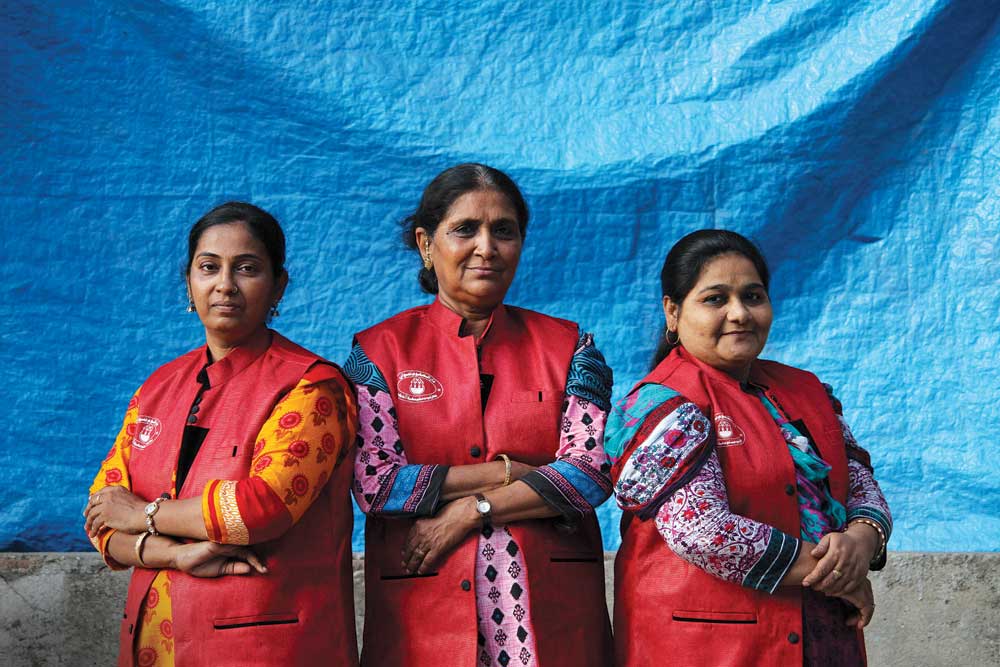
(L-R) Suraiya Shaikh, Khatoon Shaikh and Heena Siddiqui, newly appointed qazis in Mumbai (Photo: Anushree Fadnavis)
India’s pioneering female qazis are pushing for a gender-neutral interpretation of Muslim law
IN THE LAST two years that Suraiya Shaikh was preparing herself to become one of India’s first female qazis, she grew close to a young woman in a Muslim neighbourhood in Mumbai’s Khar suburb. Shaikh is a member of the Bharatiya Muslim Mahila Andolan (BMMA), an advocacy group that campaigns for female rights within the community. She came to know the woman—let’s call her Haseena, a teenager then and now 20 years old—through an outreach programme of the group.
Haseena was going through a particularly bad time. She was only just beginning to heal from a severe bout of tuberculosis, which had forced her to discontinue her school education. She spent all her time indoors, her body was getting frailer by the day, and the strong medicines she consumed had left her deaf in one ear. According to Shaikh, who used to visit Haseena at home, the young girl was also in depression.
During these visits, Haseena would convey her anxieties and fears. And Shaikh, in return, would tell Haseena about her life, and her ambition of becoming a qazi, an Islamic judge. The two Muslim women, separated by exactly 25 years in age, were to become close friends.
Several days went by last year without the two getting a chance to meet. But when Haseena suddenly appeared in front of Shaikh next, she had undergone a striking transformation. She looked healthy and had put on some weight. When she would comb her hair, Suraiya says, she would take almost two hours to do just that. But the most remarkable thing about her, Shaikh recalls, was Haseena’s new-found ebullience.
“It was love,” Shaikh now says. “She was in love.”
Haseena had fallen in love, gotten engaged, and was planning to get married by end of 2017. But this marriage, as Shaikh now laughs while recounting the story, is not going to be like any old love marriage. It is neither a simple love marriage, she says, nor an arranged one. “It will be a wrong-number love marriage.”
A young Muslim man in Malad had mis-dialled a phone number and found himself accidentally speaking with Haseena. Drawn by the quality of each other’s voice, the frequency of these ‘wrong number’ calls increased over the next few months until the two were sure they were in love and decided to get engaged.
Haseena has now put a condition to her suitor. When the two get married in December, their wedding will have to be conducted not by a qazi chosen by his family, as has come to be the tradition, but by a female one, Suraiya Shaikh.
“The boy’s family has so far not agreed to the idea of a female qazi. I believe they are saying this is not possible. But the boy has promised he will convince them,” Shaikh says. “And maybe this will be my first nikaah.”
Some days ago, when Haseena learnt that Shaikh had completed her training, she wanted to know when the qazi would need to be intimated for a December wedding. “I told her, ‘Usually you have to register a month in advance, but you had better register by October’,” Shaikh recounts. “These wrong number marriages, I don’t know… Kuchh tehkeekat karna padega (We will have to carry out some investigations).”
The BMMA, which was formed in 2007, although its members have been campaigning for Muslim women’s rights for much longer, pursues its cause in different ways. It files petitions in court, like the one that resulted in women being allowed to enter the sanctum sanctorum of Mumbai’s Haji Ali dargah. It also runs a legal aid centre in Mumbai, Shariah Adalat, for aggrieved Muslim women, which often pits them against qazis and maulanas who interpret Muslim laws unfavourably towards women.
“It’s really atrocious how these qazis go about their job,” says Khatoon Shaikh, the BMMA’s Maharashtra convenor. “Often, they don’t even have proper training. They just grow long beards and open their shops,” adds Heena Siddiqui, a BMMA member. As the women describe it, Islamic judges have several duties to perform, like ensuring that there is no underage marriage, that a wedding has the consent of both the bride and groom, and later, if the husband wants to divorce his wife, the procedure is spaced out over a proper period of time (with a reconciliation attempt), and not done by the man saying one word thrice at a single go. “But the problem with these qazis,… is that a husband will say ‘talaq’ thrice and a male qazi will just listen to the husband’s version of things and finalise a talaqnama, without once listening to the woman or asking witnesses,” Khatoon Shaikh says.
WHEN BMMA MEMBERS learn of such cases, they not only meet both parties and try to reconcile the matter, but also catch hold of the offending qazis. They send notices to them and, if needed, file police complaints. Sometimes the qazis apologise and promise to rectify issues. Sometimes they switch off their phones and refuse to meet them. In one such case some years ago, they began receiving complaints about a Bandra judge known as Musa Qazi who had solemnised marriages where the bride was a minor and finalised divorces without once meeting the wife. “We just went to his office, all of us, and really scared him,” says Siddiqui, “Now he doesn’t do anything like that. In fact, when we need a qazi, we send our people to him now.”
In most cases, however, such relatively easy resolutions aren’t available, and Muslim women languish under unfair rulings as a result. Two years ago, the BMMA released the findings of a two-year-long survey it had conducted among 5,000 Muslim women in 10 Indian states. A majority of the women turned out to be housewives who had been married before the age of 18 and who suffered from domestic abuse. Many of them were divorcees. The survey revealed that most of them wanted the Triple Talaq process of divorce to be abolished, arbitration before a divorce to be made compulsory, and any qazi who gave legitimacy to such a divorce without consulting the woman or stipulating the need for arbitration to be punished.
About three years ago, as the results of the survey began to come in and several cases presented themselves at their Sharia Adalat, members of the BMMA began to wonder: why should they only deploy their methods for fire-fighting? Why couldn’t they attempt to prevent these fires in advance? Noorjehan Safia Niaz, one of the co-founders of the group, was more specific. Why didn’t the group train women to be qazis?
The group set up a centre for Islamic learning and theology, Darul Uloom Niswaan, and prepared a syllabus covering various subjects ranging from the Indian Constitution and jurisprudence to Muslim prayers and laws, as also the history, principles and values of Islam. A total of 30 Muslim women across India were selected to join the training programme. Two years later, 15 of them have qualified as Islamic judges. There have never been women holding these positions in India before, barring a few exceptions like Shabana Ara Begum, whose father, a qazi in West Bengal, helped her become one several years ago. Niaz says she hasn’t come across any such cases elsewhere either in the larger Islamic world. Several of them have been taunted by traditionalists who claim that females cannot be judges. But the BMMA points out that the Qur’an does not bar women from the role. “The problem is not that the Qur’an is unfair towards women. It is the misinterpretation done by qazis and clerics,” Siddiqui says. “A female qazi, we think, will bring a more gender-neutral perspective when she interprets Islamic laws. She will think about the woman before deciding any matter.”
Siddiqui recounts a case she encountered a few years ago, where a husband divorced his newly-wed wife by uttering talaq thrice upon discovering that she wore glasses. “When the family had come to see her before marriage, she hadn’t been wearing the spectacles. But after the marriage, when they found that her eyesight was weak, they claimed they had been cheated,” Siddiqui says. “And can you believe it? The qazi confirmed this talaq without once meeting the girl.”
Safia Akhtar, a 65-year-old former college professor in Bhopal who has also qualified as a qazi, narrates a problem-case she is currently helping resolve. A woman wants to divorce her husband because he has taken another wife. But whichever qazi she has approached so far has forbidden her from divorcing her husband. “We are now fighting the case in court,” says Akhtar.
Among other things, women judges will ensure that for weddings, the address and identity documents of grooms as well as brides are submitted for scrutiny; that sources of income are ascertained; and that both are marrying of their own free will. “These are small basic things, but often no one does them,” Siddiqui says.
As a qazi, Khatoon Shaikh (second from left) often handles cases where women have been divorced and abandoned without any consultation (Photo: Anushree Fadnavis)
We sit on the floor in a tiny two room office in Bandra’s Kherwadi area. There is little here other than wooden stools upon which rest large registers detailing the cases of several women. The walls are covered with colourful posters of messages. ‘Jahaan insaaf nahin, wahan Islam nahin’ says one; where there is no justice, there is no Islam. Another has details of cases dealt with last year: a total of 229, of which a majority concerned Triple Talaq (31) and polygamy (35); the BMMA has managed to resolve 61 of them, a success rate of 38 per cent.
Below these charts, Nirmala, a Hindu woman who volunteers at the organisation, sits with a large register. “Fifty-four new cases already this year, can you believe it?” she asks and raises her arms.
Beside her, seated on the floor are three women. One of them, draped in a burkha, draws open her facial veil to reveal a face not older than 25, perhaps even younger. “She is almost four months pregnant,” says one of her two companions. “But her husband refuses to cooperate.” The woman’s face has no expression and her eyes seem vaguely focused on the thickness of the register.
The young woman, it turns out, was married six months ago to a Muslim man in a Jogeshwari household in the city. But she had to return home just a few months later after she was verbally and physically abused by her in-laws. She wants a divorce, but her husband has refused to grant one. Her doctors have now found that her foetus has an abnormality, a danger to her as well as the foetus if she goes ahead with the pregnancy, but the husband refuses to sign any document permitting an abortion. He was supposed to visit the office today to discuss the issue, but almost an hour later, he has not shown up.
Suraiya Shaikh’s face tightens with rage when the husband says over phone that he can’t come. She threatens to lodge a non- cognisable offence against him if he doesn’t show up in two days. The young woman gazes at the register throughout the conversation. The doctors want to abort the foetus by next week; an abortion after 20 weeks of pregnancy would be illegal. The three thank Shaikh and promise to return a few days later.
All of Saturday passes like this. A few people come with new cases or to inquire after old ones. The weekdays are much busier, where the entire room is crowded with people and their grievances. Khatoon Shaikh is away today, at a police station in Bhiwandi, where a Muslim man has kept both his children but thrown his wife out of his house on the suspicion that she is having an affair with someone. And when there is no one around, Suraiya Shaikh, Siddiqui and Nirmala joke amongst themselves.
The biggest challenge for them, they admit, will be to be accepted as qazis. “We have done all this,” Niaz says. “Now I think the community should come forward and respond.” But the qazis themselves don’t plan on waiting. Several of them have begun to contact their family members and friends to see if there is anyone of marriageable age whose weddings they can formalise.
SURAIYA SHAIKH HAD JOINED the BMMA after the group helped resolve a marital discord between her sister and her husband. Over the years, she has encountered so many cases, from Facebook Triple Talaq posts to divorce notices sent by email and SMS, that she is no longer surprised by them. She has also learnt to keep her temper in check.
But occasionally, anger gets the better of her. Some days ago, while walking out of Bandra Railway Station with her daughter- in-law, she caught sight of a man hitting his wife. She intervened to help the woman hit her husband back. Her daughter-in-law, who is quite conservative and has been suspicious of her mother- in-law’s activism, was shocked. “How could you do that?” she asked Suraiya Shaikh. “You are a qazi now.”
source: http://www.openthemagazine.com / OPEN / Home> Society / by Chendup G. Bhutia / April 28th, 2017
Renowed Tabla Player Hashmat Ali Khan | Photo Credit: S. Subramanium
Musicians remember the genius of tabla maestro Ustad Hashmat Ali Khan
With the passing away of Ustad Hashmat Ali Khan (February 3, 1932-April 22, 2017), Indian classical music has lost not only a great tabla maestro but also a generous teacher. In a world where people are stingy about passing trade secrets, the Khalifa (head) of the Ajrara gharana of tabla used to say, knowledge grows by sharing. In the words of Pandit Suresh Talwalkar, “Ustad Hashmat Ali Khan was a wonderfully warm man, with a great sense of humour and extremely polished courtly manners of a bygone age, and most of all, the finest teacher one could have.”
A 7th generation musician, the Ustad belonged to the family that despite playing a type of tabla so close to the original Delhi gharana of tabla, was able to maintain its distinct “baaj”.Born in Meerut, his grandfather Ustad Mohammed Shafi Khan was one of the navaratnas of the Maharaja of Baroda. When he was about eight, his grandfather took him to Baroda, and that is where he received his taleem. Once India gained independence, the princely states dissolved, the young Hashmat returned to Meerut where his father put him under the tutelage of Ustad Niazu Khan.At a very young age, he started teaching at New Delhi’s Bhartiya Kala Kendra. Part of the greatness of the maestro was his extremely intellectually open mind – he was always analysing the music style of others and was quick to praise. He incorporated many pleasing elements from other styles in his playing, but with a seamlessness that was envied by his fellow musicians. Talwalkar says, “He was able to embellish his playing very well; even though his own gharana Ajrara was so beautiful, yet he was able to add to it. He was also a very good human being, and extremely learned.”
Pandit Kumar Bose evinces his sorrow at the death of the Ustad, whom he describes as “bahut guni, and iss umar mein bhi, itne tayyar… He was a very fun loving and good natured man.” He added, as a tabla exponent he had researched and added to his gharana’s baaj with great finesse, and he hoped “that his son Akram keeps his music alive.”
Cosmopolitan outlook
Khan was also a very well travelled and cosmopolitan man; he had lived abroad in many countries including Russia, Mauritius, Guyana, Fiji and Australia for years, where he had been sent by the ICCR to teach. He has several students there. His wide travels had given him an urbanity not found in many musicians of his generation. One can recall anecdotes he would relate about an older generation of musicians. With an appropriate pause before the punchline, the subtle embellishments to the main story – Khan sahib was indeed extremely entertaining. There was always a compassion even while talking about musical frailties in others.
Indeed, this much loved musician will be missed; yet the legacy he leaves behind with his numerous disciples, including his musical inheritor, Ustad Akram Khan, and his grandsons, will remain.
source: http://www.thehindu.com / The Hindu / Home> Entertainment> Music / by Shailaja Khanna / April 24th, 2017