Category Archives: Arts, Culture & Entertainment

Jeelani Banu: Voice of women and the under-privileged

Badaun (UTTAR PRADESH)  /  Hyderabad (TELANGANA) :

At a time when the tribe of Telugu litterateurs, especially from Telangana, with command over Urdu was becoming endangered, arrived a man from a village in West Godavari, who spent about two decades learning Urdu.

P V Suryanarayana Murthy a journalist by profession, has over the years, not only written Urdu shayeri (poetry) but with Mahak Hyderabadi as his takhallus (penname), also penned poems and ghazals. That’s not all.

He translated afsane (short stories) by Jeelani Banu and got them published in Telugu newspapers and magazines. When he counted them last it stood at 21; enough for a publisher to come forward with an anthology. The name of the collection, since released, is titled Guppita Jaare Isukaor Sookhi Raith (Dry Sand).

“I came from Coastal Andhra and settled down in Hyderabad for mainly two reasons-the city was warm towards people from all parts of the country and two, the Urdu language. The language struck me as a goldmine. Any researcher who has access to this language would get to know a rare portrait of India. The language has given me a better understanding of my country… I chose Jeelani Banu for translation because I could relate to most of her stories… They carry a message without being preachy or propagandist. They have the local flavour along with the halo of universality,” says Murthy.

Jeelani Banu is arguably the most recognised writers in the Urdu World. At 82 she is frail and facing age related issues, but still likes to oblige admirers by sitting down with them or attending meetings at their requests. Amazingly, she does not carry an iota of that intimidating celebrity aura.

Born in UP’s Badaun, in 1934, Jeelani Banu arrived in Hyderabad with her illustrious father Hairat Badauni at a time when the city was bubbling with a whole lot of activities-literary, social, religious and political. Perhaps the feudal life with all its glamour and flaws was at its peak. She got engrossed in observing that life and by 1954 she had her first afsana, Mom ki Mariyam (Mariyam of wax), published. The story created a stir as it dealt with the pathetic living conditions of people in a village near Hyderabad.

The episode associated with the publication of that afsana goes like this. One day, revolutionary poet Maqdoom Mohiuddin knocked on the door of his friend Hairat Badauni and said he would like to see her daughter. That was also the time when Jeelani Banu observed pardah. Hairat Badauni called her out. She apprehended that Maqdoom would chide her for writing that afsana because it was not soft on Leftists. Instead, Maqdoom gave her his blessings and said she should write what her heart dictates. Jeelani Banu, since then, never bogged down in the war between Progressive and Modernist writings.

“I had kept my eyes fixed on people. The happiness and trauma that followed the historic events of 1947 and 1948 became my area of interest. I am witness to the collapse of the feudal system and the rise of democracy. Those times and the changes reflect in my writings,” she has said.

Amena Tahseen, Director Centre for Women Studies at Maulana Azad National Urdu University, describes Jeelani Banu as a chronicler of time who has to her credit 22 books that include collections of her short stories and two novels. Shyam Benegal’s 2009 national award winning film ‘Well Done Abba’ was based on her afsana, Narsaiah ki Baudi (Narsaiah’s well).

Noted writer and Shagufta Editor Mustafa Kamal believes that Jeelani Banu is essentially a Progressive Writer who flowed into Modernism without losing out on the essential elements of story-telling. Her stories carry the flavour of Telangana. The way she presented women issues make her a feminist. But she does not flaunt her ‘feminism.’

Jeelani Banu’s afsane and novels have been translated in all major Indian languages and English. She was even conferred with the Padma Shri in 2001.

Tahseen compares Jeelani Banu with Mahasweta Devi, the Bengali writer who passed away on last week. “While Devi focused on the plight of tribals, Banu spoke about the under-privileged. In her works, woman comes across alive and ready to face the challenges. Like Devi, Banu too is an activist. There are several organisations with which she is either associated or extends support to,” she says.

Not surprisingly, Murthy feels privileged to have translated her afsane into Telugu. “In spite of so many awards, I think her works have not been properly appreciated by people among whom she lives. Hyderabad should be proud to have a writer like her,” he says.

source: http://www.timesofindia.indiatimes.com / The Times of India / News Home> City> Hyderabad / TNN / July 31st, 2016
The tale of Turram Khan

REAL ISSUES, GRAND PRESENTATION Mohammad Ali Baig / Photo: P.V. Sivakumar

Hyderabad , TELANGANA :

As Mohammad Ali Baig’s “1857: Turrebaz Khan” opens in Edinburgh Fringe Festival this August, the playwright-director-actor talks about the heroic figure in Deccan history

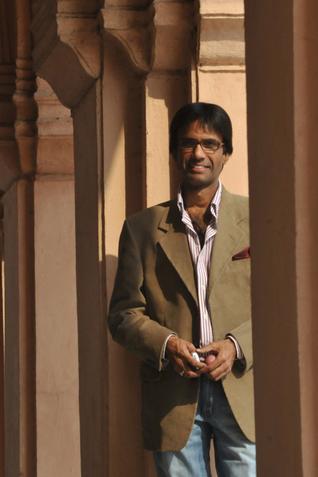
Already recognised as one of India’s best known theatre personalities and India’s youngest Padma awardee in theatre, playwright-director-actor Mohammad Ali Baig has received multiple national and global honours and awards. This time, beginning August first week, his well-known play, “Quli: Dilon ka Shahzaada”, as well as his new production “1857: Turrebaz Khan” have both been invited to the Edinburgh Fringe Festival 2016. While “Quli” has already seen several productions across the world, “Turrebaz Khan” will be premiering at the Edinburgh Fringe Festival, before travelling to London and then returning to Hyderabad.

Excerpts from an interview:

Tell us about your new play, “1857: Turrebaz Khan”, and its central character?

Turrebaz Khan was a heroic figure in Deccan history, known for his valour and courage. There is a slang in Hyderabad folklore, a positive one — “Turram Khan”. When you call someone that, you are calling him heroic. That comes from Turrebaz Khan’s name. He was a revolutionary figure freedom fighter, who revolted against the ruling design of the 4th Nizam of Hyderabad and the British. He attacked the British residency, which now houses the women’s college in Koti in Hyderabad, to free his comrade who was detained on charges of treachery without a fair trial by the British. He was caught and detained, but even the jail he was put in couldn’t hold him. After a year, he escaped, and then was caught in the forest of an area called Toopran, near Hyderabad. The man who caught him, Qurban Ali Baig, was the talukdar there. Turrebaz Khan was kept in captivity, then shot, and then his body was hanged in the centre of the city to prevent further rebellion. That is his story.

When you read about 1857, places like Delhi, Meerut, Lucknow, Jhansi and Mysore, all of them are mentioned, but Hyderabad isn’t. This is because the Nizams were allies of the British, and there was no reason to fight. But with Turrebaz Khan, there came a brief period when Hyderabad joined the struggle, the uprising.

Does the play follow Turrebaz Khan’s life?

No, the structure of the play is very interesting actually. It follows the last one hour of his life in captivity, and that one hour is also the duration of the play. It shows the difference between the man who has been captured, and his captor, Ali Baig. They are both sons of the same soil, are of the same colour, but they stand on opposite sides. Ali Baig has allied with the British. He is a man who is privileged in more ways than one, and he has no problem with who his allies are — Indians, British, French. His life is about his own family and prosperity. From his point of view, Turrebaz is “naïve”, and immature. For Turrebaz, Ali Baig has a self-serving agenda.

How does the play deal with this clear difference between the two men?

There are two people, one placating the system, another one going against it in the name of his motherland. Neither one is shown as the villain. Both are victims of their situation.

The play is about discrimination and about oppression, two issues that are relevant anywhere in the world. It can be discrimination of blacks and whites, of haves and have nots, east and west. The play brings both sides of the story out by bringing out both characters. There is very interesting wordplay between the two, philosophical debates which explore different sides of the story. At one point, Ali Baig says to Turrebaz that you talk about leaving your home to fight for your motherland, but what about your own mother at home? What about your aging father, who needs you? Before you, there have been so many others who tried to revolt against the British empire, and look what happened to them.

To this, Turrebaz replies that his motherland is more important to him than his mother; that if he is killed, the world will remember him. No one will remember Qurban Ali Baig.

There are many such debates and wordplay between the two characters and the play is an intense drama. I’ve used live percussion— marfa, dhol, etc.— to complement the dialogues.

The research must have been challenging. Do you supplement it with a lot of fiction?

A lot of research went into this play. It is definitely a challenge, because you can’t fictionalise plays like these too much. You have to pay due respect and maintain sanctity, when you portray these historical figures, since there is no one around to correct the errors. Forget political correctness, you have a responsibility of not putting them in a light that is not morally and ethically right. You can’t sit in judgement. For this play, we have picked the aspects of the story that are relevant to today’s global scenario, since it has to make sense to lot of audience everywhere.

My wife, Noor, who is also my co-playwright, has done most of the research, and a lot of it is also based on research by authorities who have written on Turrebaz.

You spoke about the need to make your play’s relevance to audience across the world. Tell us about the responses you get from these audience? How do you see them connecting to your work?

If you take “Quli”, which is the legendary love story on which Hyderabad is supposed to be founded, or “Spaces”, which is about the thought of sticking to your home and heritage, and about traditionalism versus modernism; both could be about people and lives anywhere in the world. We don’t stick to judgement; we don’t say who is right and who is wrong. Our purpose is to bring out an issue, and let the audience decide their own views.

I’ve taken these plays to English, Turkish, Romanian, Bosnian, Iranian, American audiences, to name a few. “Spaces” moves them to tears; many of them come backstage to me and tell me that this is their story. “Quli” too, sees the audience connecting to it. When they are moved, it moves me as a playwright; it shows me that the kind of theatre I believe in is working, that despite the barrier of language and context, people can connect with these plays. I hope that “1857: Turrebaz Khan” will do that same.

Your productions, held in forts and ruins, are known for usually being larger than life. How difficult is it to travel with these productions?

The earlier plays that I mounted were really huge and I was stuck with own vision of them, so we couldn’t travel. But since the last few plays, like “Spaces”, “Quli” and now “Turrebaz”, I’m still mounting them on a big scale, but I’ve tried to make them production sensible. I keep the portability in mind, so that now we are travelling light, but the end result is still grand. Of course, adapting a play I stage in forts and ruins to a festival setting is difficult, but so far, we have managed to do it successfully.

source: http://www.thehindu.com / The Hindu / Home> Features> MetroPlus / by Swati Daftuar / July 29th, 2016

District Haj Committee holds meeting

Mysuru, KARNATAKA :

Tanveer Sait to inaugurate Haj Camp-2016 on Aug. 1

HajCommitteeMPOs29jul2016

Mysuru :

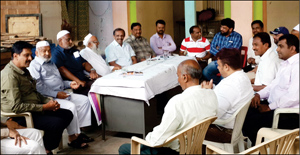
The District Haj Committee held its preliminary meeting under the Chairmanship of Abdul Azeez Chand at Muslim Girls Orphanage in city recently. The meeting elected Abdul Azeez Chand as Convener and Arif Ahmed Mekhri as Joint Convener for the orientation and inoculation for pilgrims of Haj-2016 from Mysuru, Mandya and Chamarajanagar.

The Haj Camp-2016 will be held on Aug. 1 at RK Palace in Udayagiri. Minister for Primary and Secondary Education, Minority Welfare and Wakf Tanveer Sait will be the chief guest.

Co-ordinator Mohammed Mumtaz Ahmed, Anwar Pasha, Syed Younus, Rafeeq Ahmed Khan, Rehman Khan, Irfan Silverline, Sohail Baig, Yusuf Jidda, Shabnam Sayeed, Akbar Aleem of Nanjangud, Mohiuddin of Mandya, Qurath Bhai and Khaleel, District Wakf Advisory Board Officers, were present.

For details, contact the Cordinator on Mob:97417-89000.

source: http://www.starofmysore.com / Star of Mysore / Home> General News / July 23rd, 2016

Ready to set a record

Bengaluru, KARNATAKA :

Cakewalk

CakewalkMPos29jul2016

Four baking enthusiasts have joined hands in an attempt to enter the Guinness Book of World Records for making the largest dirt pudding cake in the world.

Danish Ali, Archana Diwan, Nidhi Bagri and Poonam Ankur Shrishrimal love baking and intend to take that to a new level altogether. The task that they are about to take on is a new experience for them, but they hope that they will be able to pull it off well.

Poonam, a glass designer by profession, says, “No one has attempted to bake on this scale and we are making a 1000 kg cake which will be displayed at The Park Hotel Bangalore.”

As to why they decided to take up the challenge, they say that it is their love and passion for baking that has made them come forward. Incidentally, the very same team was also a part of the seven participant group which made an entry into the Limca Book of Records for making India’s largest caricature cake — a Santa on one leg.

“The preparation will be done throughout Saturday night, July 30, beginning at 9 pm, and it will be completed by 7 am the next day,” says Nidhi, a professional blogger.

Archana, a dentist, says, “There are a lot of rules like using custom made equipment and weighing machines and also that a proper recipe should be followed with the measurements scaled up. We hope that we are able to meet all these requirements as a cake of this magnitude hasn’t been made before.”  Danish, the only guy among the ‘Bangalore baking buddies’, has his own HP gas station and a catering unit.

source: http://www.deccanherald.com / Deccan Herald / Home> Supplements> Metrolife / DHNS / July 29th, 2016

Innovative effort to encourage love of reading

Bengaluru, KARNATAKA :

‘Read a Book Challenge’

MohammedMusabBF29jul2016

How would you like to receive a surprise package of books, hand picked specially for you, at your doorstep every month? An initiative of Mohammed Musab, a fresh BBA graduate and his friends, ‘Read a Book Challenge’ is giving bookworms in the city a new excuse to curl up in bed and stay put.

Readers who register for the challenge on their Facebook page will receive three to four books, beautifully packaged along with a handwritten personal note. At the end of the month, the books are collected and a new package of surprise titles is delivered.

“I have been an avid reader from childhood and I used to tell my friends in college to develop the habit of reading. They told me that they couldn’t decide what to read. So I recommended books for them,” said Musab. That was how the idea behind the challenge came to him and he decided to give it a shot.

The first step was to convince ‘endorsers’ to let him lend their books to strangers. “Book-lovers are very possessive about their collections. I had to assure them that I would take care of their books,” he added. Besides, he offered them the incentive of earning money through their books. After the first month, the readers are charged a nominal amount of Rs 150 which is used to cover costs and pay the endorser between Rs 15 and Rs 20 for each book lent. “I really liked the idea and my book collection was lying idle at home. Being an avid reader myself, I saw this as a chance to help people inculcate the habit of reading,” said Mohammed Shuaib Mumtaz, the first endorser who has contributed 150 books to the inventory. Musab got his friends on board — Sneh Jain designs the packaging, Hayatt Noorul makes promotional videos and posters and Rishav Jain and Smriti Menon help with the execution. The team delivered the first batch of books on June 15. Already, they have over 100 readers and 10 endorsers on board contributing over 2,500 books to their inventory.

Word of their initiative spread and people in Mumbai, Chennai, Delhi and even Srinagar have requested them to bring the challenge to their cities. Though most of their readers are in the age group of 20 to 23, now even parents are showing interest.

Having received two packages so far, Ayesha Shuaib is happy with the variety her nine-year-old son is being exposed to. “He has got books on the themes of adventure, mystery and school amongst others. As a parent, it is a great relief for me because I don’t have to make multiple trips to the library to keep him engaged,” she said.

Monthly surprises
Meanwhile, they are preparing to deliver monthly surprises to their growing number of readers. An engineer is helping them develop a website and software to manage the inventory. They are also in the process of developing an algorithm to automatically select books based on the readers’ preference.

“I have received offers from investors. However, I haven’t accepted any for now because I am not sure what I am dealing with. I don’t know if this is going to be a small startup or the next big thing so I want to let it grow slowly,” said Musab.

source: http://www.deccanherald.com / Deccan Herald / Home> City / DHNS / Meghana Choukkar / Bengaluru, DHNS – July 29th, 2016

Former MP F.M. Khan passes away

Kodagu, KARNATAKA :

FMKhanMPOs28jul2016

Madikeri :

Former Rajya Sabha member and Congress leader Faiz Mohammed Khan (82), popularly known as F.M. Khan, who was residing at Balayatrie Estate in Kodagu, passed away yesterday after a brief illness.

He leaves behind his wife and three daughters.

According to family sources, Khan’s last rites were held at Rasulpur in Guddehosur in Kodagu this morning.

Khan entered politics during 1960s along with his friend former Chief Minister R. Gundu Rao and joined the Indian National Congress led by former Prime Minister Indira Gandhi.

He became the General Secretary of State Youth Congress before becoming a member of the Legislative Council in 1974.

Khan was a two-time RS MP, elected in 1976 and1982. He was also a former Vice-President of Indian Olympic Association (IOA). He had been away from politics for more than two decades.

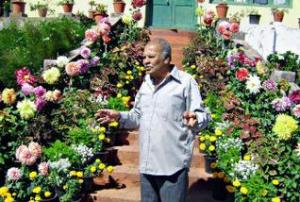
Khan was famous for his annual flower show at his Balayatrie Estate in Kodagu.

source: http://www.starofmysore.com / Star of Mysore / Home> General News / July 22nd, 2016

Of Singapore and youth life

Chennai, TAMIL NADU  :


LuthfudeenMPOs28jul2016

Clhennai  :

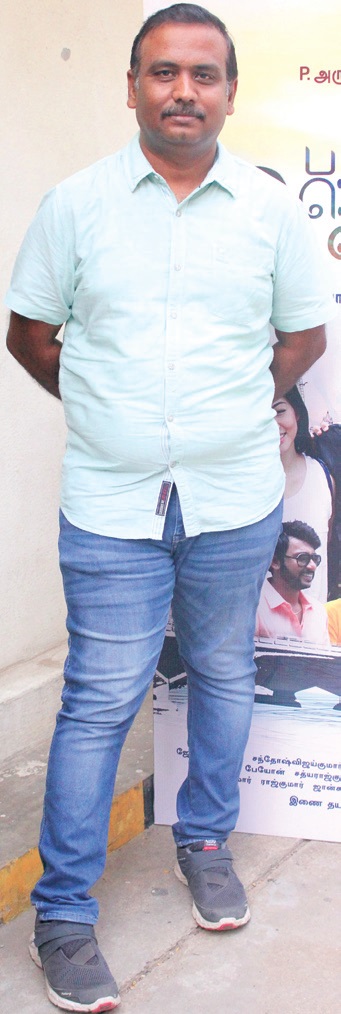
Not everyone knows that Luthfudeen Basha, son of veteran actor Nasser, studied music composition and sound design in Malaysia before Saivam (2014) happened. Excited about his upcoming flick Parandhu Sella Vaa, directed by Dhanapal Padmanabhan, he says, “This rom-com, shot entirely in Singapore, is about the lives of today’s youth, capturing the positive aspects of life.”

The actor adds he plays a naive guy from Chennai, who goes to Singapore and falls in love with everyone. “The story is about how he adapts to a new environment and what he eventually faces,” he says.

DhanapalMPOs28jul2016

Luthfudeen adds that he’s a director’s actor. Maybe, that’s why he didn’t have any apprehensions about shooting a couple of lip-lock scenes for the film. “I don’t know why everyone makes such a huge fuss about the whole thing. It’s just a film! Besides Aishwarya Rajesh, who’s the female lead (an urban architect), there’s this Chinese actor Narelle Kheng, who plays an important role. The script demanded that we do it. I initially asked the director if there was an alternative, but he went for the take! However, we finished everything in a single shot. She was comfortable with it and so was I,” he says.

He quickly adds that he doesn’t want to be typical hero material. “I want to do roles like what appa (Nasser) did in his early days. Like Thevar Magan (1992) — I want to do a powerful villain role like that!”

Filmmaker Dhanapal Padmanabhan is confident that the movie will strike a chord with the audience, especially the student community. “I visit Singapore often and every time I go there, I’m bowled by its culture and beauty. It’s a romantic city. I see a lot of youngsters from small towns there travel all over the world and excel in all they do. So I thought, ‘Why not do a ‘clean’ film set in Singapore?’ I’ve shown my sensibilities about love and relationships,” he smiles.

Dhanapal says that not many Tamil films have successfully captured the youth’s light-hearted take on life. “Parandhu… will focus on the transition of a carefree youth into a man in a sensible way. A lot of thought has gone into making the film. It has a mix of artistes and technicians from India and Singapore. The stunts have been done by Sunny Pang, who has done Chinese and Indonesian films. To win over the audience, breathtaking visuals aren’t enough, we need a good story too. Santhosh Vijayakumar Prabhakaran has done a wonderful job with the cinematography. The team opted for Luthfudeen because he fits the bill perfectly. We wanted someone who’s really young,” he smiles.

The director is all praise for his Chinese actor Narelle as well. “She wrote the Tamil dialogues in English and emoted quite effortlessly,” he laughs. He adds that for the first time, the comedians Karunakaran, RJ Balaji and Sathish have been brought on board for the film. “The audience will burst out laughing. But, they will keep you occupied throughout, though their combination scenes are few,” says Dhanapal.

Ask what’s next, and he says, “I want to do something different with every film. My first venture Krishnaveni Panjaalai (2012) was about cotton mill workers near Coimbatore. It was offbeat; Parandhu… is a breezy entertainer,” he says.

source:  http://www.newindianexpress.com / The New Indian Express / Home> Entertainment> Tamil / by S Subhakeerthana / July 25t, 2016

S.H. Raza: The man who saw the universe in a bindu

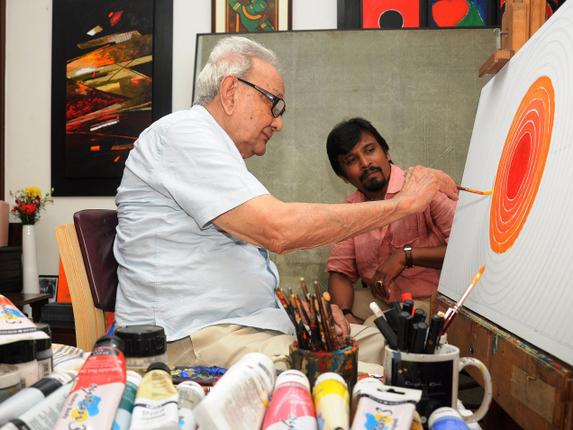
In this September 12, 2013 photo, S.H. Raza works on a “bindu” as his disciple Manish Pushkale looks on at the former's studio in New Delhi. / The Hindu
In this September 12, 2013 photo, S.H. Raza works on a “bindu” as his disciple Manish Pushkale looks on at the former’s studio in New Delhi.
/ The Hindu

“Bindu is a source of energy, source of life. Life begins here, attains infinity here”.

A few years ago, aged 89, S.H. Raza was game to talk to children almost like one, maybe just a couple of years older. Then, at the Jaipur Literature Festival he allowed the youngsters, who had surrounded him, a little peek into his life. Back in India after spending 60 years in France, his life seemed to have come a full circle. Not ready to confer retrospective dignity to his early years, Raza candidly admitted: “I was not fond of school. I was a bad student scoring low marks. Arithmetic did not interest me. My interest lay in drawing and painting. Fortunately, I found the right gurus. It is imperative parents as well as teachers understand a child’s qualities.” Raza himself was lucky. A restless soul that he was, his primary schoolteacher once asked him to continuously look at a dot on the wall inside the classroom to calm his mind. It was a little exercise that was to change the meaning of life for Raza, who turned the simplebindu into a work of art before raising it to the status of life itself.

Incidentally, Raza often judged as a France-based artist, grew up in a Madhya Pradesh village and went on to study at the Sir JJ School of Art. Around the time that the nation was hoisting the tricolour for the first time as an independent country in 1947, he founded the Bombay Progressive Artists’ Group. The group challenged the existing art establishment and Raza’s image as a rebel was probably etched with it.

His long journey in the world of arts started thus. Raza started as a landscape painter, a colourist. Soon the bindu occupied his mind and he turned to metaphysical ideas. This relentless search for the infinite got him plenty of laurels and lots of money. Though he refused to quantify art in terms of money, none could deny the steep price tags that accompanied many of his works. For instance, Saurashtra went for Rs. 15.9 crore. His La Terre attracted a whopping Rs. 18.8 crores.

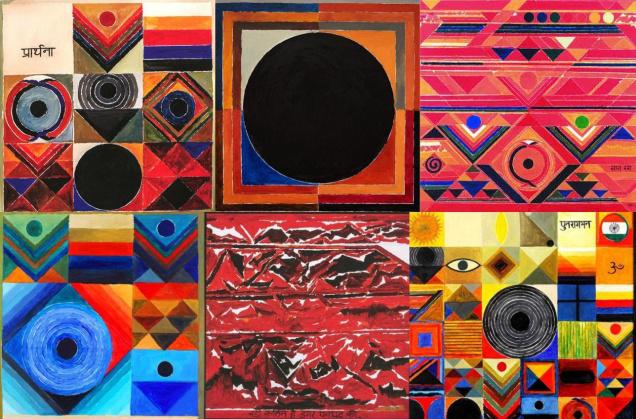
(A combination of S.H. Raza's works. “Bindu is a source of energy, source of life. Life begins here, attains infinity here," he had said)
(A combination of S.H. Raza’s works. “Bindu is a source of energy, source of life. Life begins here, attains infinity here,” he had said)

After linking all the dots in the universe of art, Raza, aged 94, passed away quietly in an intensive care unit of a hospital in New Delhi.

There was not a note that was not dignified, not a colour in the palette that was left unexplored. Often short of breath, hard of hearing with fading vision, Raza with his frail frame looked very much his age to a layman. To a lover of art, he remained a genius, transcending the inevitable frailties of age with determination. Where his eyes failed him, his fingers did not. He continued to whip up magic till the end. Even when the man who was a master at giving a new meaning to colours needed the help of an assistant to mix his colours, his magic did not elude him. Fittingly, one of his last exhibitions was titledNirantar (Relentless). With that single term he lived up to the words of noted Hindi author Ashok Vajpeyi who often said that Raza did not paint to live, he lived to paint. The exhibition itself contained some of the works he had done after coming back to India, between 2011 and 2016.

If in that interaction with youngsters in Jaipur, Raza stated that “Bindu is a source of energy, source of life. Life begins here, attains infinity here”, a few years later in New Delhi he showed other shades to his personality as he talked gently, if, one may say so, almost relentlessly, of Modernism. Yet he did not fail to talk of specifics, happy once again to talk of the bindu, how it provides focus in life, indeed, life itself. Happy he was to talk of early red, the later blues and yellows. And equally at ease talking of the marriage of art and artist, how initially man creates art, how then art forms him. Little wonder, the distinction between Raza and his art gradually disappeared over the years. His art could never conceal the artist, in the final years, it spoke on behalf of the artist. Little wonder, fellow artist Krishen Khanna once said that his friend lived his art! And Raza found profound meaning into something as innocuous as juxtaposing two colours. According to him, the two colours could be in conciliation and harmony or conflict and unending struggle, almost like a man-woman relationship. Raza brought to his canvas the quintessential Indian spirituality and tradition by concentrating his energies on colours, purush-prakriti and nari in his trademark geometric abstract works. And to think, he introduced the French to our artworld and set up studios there!

A contemporary of M.F. Husain, F.N. Souza, Khanna and Tyeb Mehta, Raza carved out his own niche on his own terms. He played with colours like none else and was wise enough to understand that art lovers abroad loved Indian art not jut for its spirituality but its constant soaking in of colours. Of course, like the longest of journeys begins with a single step, for Raza any art too began with a dot. An art work was never the sum of its parts, rather each part, each stage was art itself. Slowly, this centreing of the universe around the dot consumed the mind, and life, itself of Raza. What it gave him in return was priceless art that seeks to confer immortality on the artist.

As he celebrated the bindu in conversations, he occasionally recalled the primary school teacher too. As the Padma Vibhushan awardee fought one last battle one cannot help recall Ashok Vajpeyi’s words that Raza lived to paint. And when he could no longer paint, life lost its meaning… Life indeed had come a full circle. Yes, the bindu is the most important thing of all.

source: http://www.thehindu.com / The Hindu / Home> Features> Friday Review> Art / by Ziya Us Salam / July 23rd, 2016

Jamiat Ulema-e-Mysore hosts Eid Milan get-together

Mysore , KARNATAKA :

JamieatMysoreMPOs24jul2016

Mysuru ;

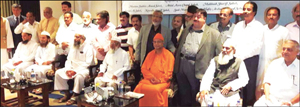
Jamiat Ulema-e-Mysore, the Mysore unit of Jamiath Ulema-e-Hind headed by Hazrath Moulana Asad Madni Saheb, had organised Eid Milan on Sunday at Hotel Grand Mercure near Moulana Abul Kalam Azad Circle (Highway Circle) here.

The programme began with the reciting of verses from the Holy Quran by Moulana Mufthi Nizamuddin Saheb. Hazrath Moulana Mufthi Syed Tajuddin Saheb welcomed.

Speaking on the occasion Hazrath Moulana Shabbir Ahmed Saheb, President of Jamiath Ulema-e-Mysore, presented a brief history of pre-Independent India and said that thousands of Ulemas had sacrificed their life for freedom.

Swami Muktidanandaji of Sri Ramakrishna Ashram, who also graced the occasion, gave a clarion call to people to stop fighting in the name of religion and added that Eid Milan was an occasion for one and all to understand each other. The Swamiji, who said that no religion preached hatred, added that all religions preach love and communal harmony.

Dr. Syed Akheel Ahmed, former Vice-Chancellor, Yenepoya University, Mangalore and former Head of the Department of Chemistry, University of Mysore, started his speech with the couplets of Dr. Allama Iqbal and said that Muslim rulers, who ruled this country for more than 1000 years had failed to present the correct picture and principles of Islam. That is why still there is a lot of confusion in the minds of non-Muslim brethren regarding Islam. Presenting the brief history of India’s Independent Movement he said that during 1857, more than 2 lakh Indians including Ulemas were martyred.

Dr. B. Suresh, Vice-Chanceller, JSS University, Abdul Azeez Chand, Secretary, Darul Uloom Arabic College, legislators Vasu and M.K. Somashekar, ex-MLC Thontadarya and former MLA S.A. Ramdas also spoke on the occasion and lauded the organisers for hosting the get-together.

Moulana Hafiz Arshad Ahmed, General Secretary, Jamiath Ulemas-e-Mysore, compered. Noor Ulla Shariff, member of the Reception Committee, proposed vote of thanks.

Sir Khazi of Mysore Hazrath Moulana Mohamed Usman Shariff Saheb, Mayor B.L. Bhyrappa, KEA Chairman R. Murthy, SJCE Principal Dr. Syed Shakeeb-ur- Rahman, Ariff A. Mehkri, Chairman, Mysore District Wakf Advisory Committee, Corporators Suhail Baig, K.C. Shoukath Pasha, former Mayors Ayub Khan and Ariff Hussain, CADA Chairman C. Dasegowda, Abdul Khader Sait, President, MESCO and Managing Director, AANCO Industries, Javeed Ali, Joint Secretary, Darul Uloom Siddiqia, Mohamed Mumtaz Ahmed, Secretary, Mysore District Relief Committee and N. Anwar Pasha (Annu Bhai), MUDA Member and others were present on the occasion.

source: http://www.starofmysore.com / Star of Mysore / Home> General News / July 18th, 2016

F.M.Khan, controversial former MP hailing from Coorg, passes away

Kodagu, KARNATAKA :

FMKhanMPOs22jul2016

F.M. Khan (82), former Rajya Sabha member, and a controversial politician hailing from Coorg, passed away on Thursday at his Balayatrie estate near Madikeri in Kodagu.

Fiaz Mohammed Khan, popularly known as F.M. Khan, was a close associate of former Karnataka chief minister, Gundu Rao who affectionately referred to his mentor as ‘Father Mother Khan’.

Khan was part of the Sanjay Gandhi brigade during the Emergency and was allegedly involved in several unsavoury incidents. But Gundu Rao always went to his rescue.

He was the general secretary of the state Youth Congress and was a member of the Legislative Council from 1974 to 1976.  Khan was elected to the Rajya Sabha twice in 1976 and 1982. He was also associated with various organisations connected with sports. He was vice-president of the Indian Olympic Association.

The former Rajya Sabha member was known for his love for gardens and won accolades for maintaining the best garden in Delhi in his MP bungalow. Back in Kodagu after his controversial political innings, Khan had been nurturing his garden and has been holding annual private flower show since 1998.

Khan was married to a Kodavathi. He leaves behind his wife and three daughters. The funeral will be held at Rasulpur in Guddehosur in Kodagu on Friday.

source: http://www.coorgnews.in / CoorgNews.in / Home> General News / July 21st, 2016