Category Archives: Arts, Culture & Entertainment

Royal Musician

KASHMIR :

Ghulam Qadir Langoo has been singing since he was a court singer of Maharaja Hari Singh

For 60 years Ghulam Qadir Langoo sang for rulers and the people of Kashmir, and his passion for music gave Kashmir, singers like Raj Begum. Shaziya Yousuf reports.

Ghulam Qadir Langoo, 95, spends his days reminiscent of his contribution to Kashmiri Sufiana music. Very few people know Langoo was a court singer for Maharaja Hari Singh.

Langoo’s family had a long association with the royal courts.  His grandfather Shabaan Langoo was a Nakaal (entertainer) in Maharaja Pratap Singh’s court. As a child Qadir would accompany his father Mohi-ud-din Langoo to the court of Maharaja Hari Singh where he would watch him play santoor.  “Maharaja would get happy and flung a gold coin, that meant much those days,” Langoo says.

Langoo learned music from his father to carry the legacy forward. Langoo’s father would also teach Hafiz Nagma to female dancers at his home.

And like his ancestors, Langoo’s stints in the court hardly brought him any riches. He lived a poor life and spent 60 years singing for the rulers, though he was a little better off than his relatives, who mostly were cobblers.  “I sang for the kings, the kings kept changing. I was like an instrument that played for anyone who stroked its cords,” says Langoo.

Apart from Hari Singh, Langoo sang for Sheikh Abdullah, Bakshi Ghulam Mohammad and has also entertained Jawaharlal Nehru and other guests.
He has shared stage with Indian musical greats like Lata Mangeshkar, Aasha Bhonsle and Mahinder Kapoor, mostly playing Tanpura. His mastery over Tanpura (musical instrument) put him into a different class.

The Maharaja’s court, he tells, was different from the royal courts seen on television, with some resemblance though.

A lady dancer, called tawafan would do Hafiz Nagma by dancing and singing to the tunes of Sufi music that Langoo, with his choir, would play. “Guests would relish royal feasts, and sweets would be distributed among musicians. We would take sweets home. I still remember there was a cardamom plant in the royal lawns,” Langoo recalls.

Many decades later, when Radio Kashmir was inaugurated, Langoo sang for whole night in Polo Ground.

“Bhakshi Ghulam Mohammad once told that we can have our own radio station if I get many more singers for it. I worked day and night to gather the artists,” he says.

He was appointed in the station, as a singer and artist but says he would even compose music at times. Once, he says, the station required female singers for some contract. The station had none then. But Langoo was eager to secure the contract and the contract form required photograph of a female singer.
He did something, he now calls his madness. “I used my wife’s photograph (who was not a singer) despite her objections. I left her crying. It was my madness, all I could see was Radio Kashmir.”

Meanwhile they started searching for female singers, in which Langoo had a major role.

“Those days singing and performing arts was an affair of lower class people like my family. So I searched there,” he says. Thus he found and trained singers like Raj Begum, Zoon Begum and Naseem Akhtar.

Slowly music industry grew in Kashmir, and with it grew his passion for it. When Langoo’s only daughter was born, he named her after Raj Begum, who by then was a household name.

“I would sing in her ears…Later I took her to famous musician Shambo Nath Sopori for professional training, but did not let her join Radio Kashmir. It wasn’t a good place for girls,” he says.

In 1964 When Sheikh Abdullah was released from jail after 11 years, Langoo was taken to Pune by Shiekh’s fellow leaders where he sang his favourite song, Walo haa baagwaano and keam sana badlow soan takdeer, qaid-e-azam sheri Kashmir

Langoo and his group were also invited by Jawahar Lal Nehru to his mansion.
At the prime minister’s house where they sang for his Russian guests, Langoo remembers how their group was terrified by the sight of two pet bear cubs, and how a tea that the guests were praising tasted like “poison”.

Among his hosts, Langoo enjoyed singing most for Bakhshi Ghulam Mohammad.

“Just a song of mine and he would forget who he was. He would join the choir and play some instrument mostly Noutt. I still remember how happy he would get,” Langoo recalls.

He sang on the foundation stone laying ceremony of new secretariat building where he says, “My photograph hung in corridors later, I don’t know if it is still there.”
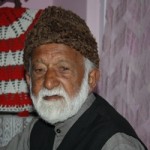
Langoo: A portriat
Langoo: A portriat

While Langoo survived on royal patronage, the performing artists of the time were in a bad state. “It was pathetic. They would be always given leftover food. Most famous among the local populace was bacha nagmawhere a small boy dressed in women outfit would dance before men, he had to entertain each person individually, if he forgot to address someone, the poor boy would be beaten to pulp.”

Since his retirement from Radio Kashmir, some 30 years back, Langoo has been living a private life. For his contribution he has been honoured with Fazil Memorial Award, Bhakshi Ghulam Mohammad Award but the “metallic toys” as he describes them, hardly sum up his contribution to the Kashmiri sufi music.”

source: http://www.kashmirlife.net / Kashmir Life / Home> Music / June 08th, 2010
The Notes of his life

Mattanacherry, Ernakulam – KERALA :

For nearly two hours Umbayee (P.A. Ibrahim) regaled a small audience at a hotel in Kochi. He sang his heart out. He moved to the lobby when he overheard the manager, who was not all that keen to have him on board, say, “He has a wonderful voice and sings well too. But he has the looks of a criminal.” Umbayee remembers saying to himself, “Sir, not just the looks, I’m a criminal.”

Life was a long struggle for Umbayee. A tough childhood, constant conflict with his father who did not approve of his interest in music, poverty – Umbayee was drawn into the vortex of crime. Smuggling watches, perfumes and such stuff in return for US dollars, drinking away his woes, he was being sucked into the slush though music was always there around him.

The story of Umbayee’s life is unravelled in all honesty in his biography titles Ragam Bhairavi, which will be released at a function to be held at the Kerala Fine Arts Hall on August 21 at 6 p.m.

“Sometime in 2005 my story squeezed into 42 pages appeared in a Malayalam magazine. Really I don’t think my story is worth telling anyone outside. But this happened. It was an interview that got a tremendous response. That’s when publishers came forward with the suggestion of turning my life’s experiences into a book,” says Umbayee.

It took nearly six years to complete. “This happened because of various reasons. This narration and writing down happened only when I was free. Then when the draft was ready I thought the language was not mine. My friend Hameed P.E. also felt the same. We decided to rewrite in a language that was truthful, intimate. Hameed assisted in the writing. That’s why it took all these years.”

The book records faithfully Umbayee’s life, from his childhood, playing the tabla, listening to music and playing for programmes on the sly to popularising Malayalam ghazals that has made him what he his today.

It was filmmaker John Abraham who first used the name Umbayee in the titles of his film Amma Ariyan, in which he acted and his voice was used. He composed one song, Urangaan urangaan nee…’ for the film Novel that is his brief tryst with films.

“When I read my story frankly I cried. God was so kind to me. People have been there in crucial phases of life helping forward, people whom I had not met before. I firmly believe that an artiste and art is for the society. Had it not been for the society I would not have survived.”

There are poignant moments in the book that Umbayee narrates with no filter. Like the one when his daughter spotted him as he walked past the Fatima Girls High School at Fort Kochi. “My eldest daughter Shailaja asked me the next day if I had walked past the school. I shook my head. She looked at sme straight in my face and said that her friends told her that he was drunk and swaying from side to side. That really hit me hard. I stopped drinking.”

Mattancherry, Umbayee’s hometown, was a huge influence on Umbayee. “There was music all around. You only had to find it. There were singers like Mehboob bhai (H. Mehboob), Dasettan (K.J. Yesudas) who were inspiration for a whole generation. My biggest blessing was being able to play the tabla for Mehboob bhai. I also got to listen to numerous legendary musicians. One performance that I can never forget is Pandit Ravi Shankar and Ustad Allah Rakha ‘live.’ That’s when I realised to stop playing the tabla and there was so much to learn.”

Umbayee’s Bombay days after being packed off as a trainee electrician when he did not know the difference between ‘AC and DC’ forms a major chunk of the book. The city changed his life. “It was here that I met my guru, Ustad Mujawar Ali Khan. I don’t know what made him accept me as his disciple. My guru was a sort of wandering minstrel, here today gone to tomorrow to some dargah.”

For nearly seven interrupted years Umbayee studied music from Mujawar Ali Khan. “In between, I used to come home. Smuggling helped finance those trips. Then one day my guru left Bombay never to come back. I still don’t know what happened to him.”

Life in Kochi struggling to make ends meet was again a challenge. He sang in a hotel, worked as laundry manager and also kept singing. It was during this phase that he brought out his first album, Aadab that had nine of Hasrat Jaipuri’s Urdu ‘shers.’ He has since then released 19 more.

The idea of Malayalam ghazals was born after a successful programme in New Delhi. It was not easy as most of established poets were not willing to give their poems to an unknown singer. “That was when a waiter at the hotel where I worked told me about Venu V. Desom. We met and that was how my first Malayalam album, Pranamam came about.”

There was no looking back for Umbayee. Poets like ONV Kurup, Yusufali Kecheri, and Sachidanandan have lent their poems, his albums have hit the mark, and his mehfils are a huge draw everywhere.

“All that I’m doing now telling my audience something which greats like Mehdi Hassan and Jagjit Singh did in Urdu and Hindi. I’m simply putting all that into Malayalam. If there is one message in my life it is how music or the arts can lift a person when he has plunged to the depths. There is so much life in our music that needs to be explored. And if there is one dream it is to set up an institution for Hindustani music,” says Umbayee.

source: http://www.thehindu.com / The Hindu / Home> Features> Metroplus / by K. Pradeep / Kochi – August 19th, 2016

My memorabilia of muslims in Chitradurga

Chitradurga, KARNATAKA :

DrNarasimhanMPOs19aug2016

by Dr. C.G. Narasimhan, Senior Consultant Surgeon

The Eid Milan get-together held recently in Mysuru and the talk given by the Imam-e-Haram of Makkah, Saleh bin Mohammad bi Ibrahim Aal Talib, during his visit to Mysuru some time back has prompted me to write about my association with Muslims during my younger days I spent in Chitradurga.

In the year 1890, Sir K. Seshadri Iyer, the then Dewan of Mysore, started Insurance Scheme under the name Mysore Government Insurance Department (MGID). It is now called KGID and has its building in Bengaluru. It took some time for the people of Mysore State to accept the new concept of insuring their lives then. Agents were appointed all over the State and necessary propaganda was carried out. My grandfather Singa Iyengar was one of the pioneers in spreading the message of taking life insurance policies.

After his retirement as a bench clerk in the Law Courts some time in 1915, he took up the agency of MGID in Chitaldrug (as it was called then). In an effort to popularise the new scheme he got his black umbrella embroidered with slogans ‘Insure Your Life today’ to impress people and go around whirling it. I am told that people started calling him ‘Gileet Singa Iyengar’ for his knack of convincing them to take policies. It was at this time he came in contact with the general public of the town, particularly the Muslims.

Several of his friends of this community used to visit his house on Dharmashala road in Chitradurga. One such person was Rahman Sab whom I as a boy of 6 or 7 years remember with the traditional beard and pajamas visiting our house for a cup of coffee every morning even after my grandfather’s death.

My father Garudachar stepped into his father’s shoes in every sense of the term. He also made a number of Muslim friends, went a step further in talking to them in their dialect Urdu. I remember him calling the seniors as ‘Hazarat’ and others as Chacha. There was one Jaleel sab who was working as an attender in the Central Library of the town. He was calling my father as ‘Bhateeja.’ One Abdul Gani, a very popular Drill and Scout teacher in the Boys High School, was another good friend of my father.

Muslims in Chitradurga those days in 1940s and 50s were mainly concentrated in three localities, Assar Mohalla, Khazi Mohalla and Baaharpet (Horapete in Kannada). The ever active senior Congress leader Jaffer Sharif from the Assar Mohalla area started his political career by winning his election to the Town Municipal Council of Chitradurga as a 24-year-old youth in the early 50s against a senior Gandhian H.C. Narayana Iyengar. Another Muslim luminary C.A.K. Junaidi, who was an Advocate and a popular person became the President of the Municipal Council.

There was one boys Urdu Middle School in the town of Chitradurga which had a total population of 24,000 or so then. The Head Master was Abdul Rahman, a tall gentleman. All his children were all Ur Rahmans like Afzal, Mohamed and Fazl, the first and second were good Basket Ball players. All the Muslim students joining High School after LS exam were necessarily admitted to the English Medium Class along with some of us. So most of my classmates were Muslim boys. To name a few they are Abdul Samad, who retired as the Superintending Engineer of KEB, Wazeer Ahmed, who became a Geologist and joined GSI, Majid Hussain, who later became Special Assistant to Divisional Commissioner, Mysore, Rahmath Ulla, Abdul Khuddus, Md Umar, Ata ulla, Md Shafi and Mubeen. Some of them used to wear the classical red tubular cap with black thread tassels, known commonly as Turkey cap or Fez, Tarboosh.

After we entered the Intermediate College where we had co-education I do remember the names of some contemporary girls, Shakirunnisa, Sakinabi, Zainabi, Mehrunnisa and Nazbunnisa who was the sister of Junaidi mentioned above. It may be of interest to note that all of them were coming in sarees like the other girls.

My association with the Muslim boys was so much that I used to talk to them only in Urdu and my friend Samad taught me how to read and write Urdu which I have not forgotten even today. I can easily write my name in Urdu. This has gone a long way in winning the confidence of my Muslim patients in Mysuru.

There were two Mosques for a population of about one thousand Muslims in Chitradurga. One in Assar Mohalla and the other in Horapete area. The former was called Jamia Masjid known for its beautiful architecture supposed to have been built by Tipu Sultan. The backdrop of the hill added to its beauty. There were Muslim dwellings only on the left side of the mosque; other sides were occupied by Hindus. Right in front of the Mosque there was Uttaradi Matadakeri occupied by Brahmins. One Bodarayachar used to arrange Harikatha discourses during Rama Navami annually across the road in front of the Mosque which indicates the absolute harmony that existed between the communities. Allowing general public to draw water from a well in the compound of the Mosque during water scarcity was another act of peaceful co-existence.

As a youngster I used to go into the premises of the Mosque and emerge out through the hind wicket gate which opened to Chickpete. My house being within a stone’s throw from the Mosque, we used to hear the morning prayer Azaan which was rendered without mike. It was like a soothing alarm to wake up particularly during my college days. The mellifluence of such morning prayers nowadays are marred by the high volume speakers and the din in the atmosphere. ‘Huli Vesha,’ the dancing ritual during Moharrum was the other attraction to us those days. A person getting painted with yellow and black stripes and jumping on the road in the garb of a tiger was a regular event in the town. One Gafoor Sab was a master in this art which is vanishing these days. Our house was a destination for him to entertain for a while and drink a glass full of hot milk and go.

Finally, I cannot forget our maamool Jutka saab Ameer shouting ‘Bajoo, Bajoo’ to clear the traffic while coming from Railway Station which was on the outskirts on Davangere road.

[e-mail: cgnshanthi@gmail.com]

Note: I want to comment (after all, ‘comment is free’ is SOM’s motto) on three points made by the writer Dr. C.G. Narasimhan (CGN). First about the Intermediate college with co-education where Muslim girls used to come “in sarees like the other girls.” The same is my experience when I studied in Intermediate college and First Grade College with co-education at Madikeri, Kodagu. Muslim girls used to come in sarees. Sadly, because of religious extremism seen these days of vote-bank politics in democracies we have a different, divisive dress-choice in our schools and colleges where some students show off their religions by dressing differently and thereby distancing themselves from the mainstream. In America, the term ‘neutral dress’ means the clothes students wear normally without any distinct religious identification.

Second point is about Dr. CGN learning Urdu and how it helped him in his profession in later days. Like smile, speech as a common language too brings people together and makes them intimate, builds confidence. Let us remember that Mohammed Ali Jinnah’s Muslim Pakistan was split asunder because the West Pakistan insisted the Bengali-speaking East Pakistan to speak Urdu and accept it as official language. A case where a common religion could not hold the country together and got itself divided on the basis of different languages — Bangladesh was born. If India was divided on the basis of religion, Pakistan was divided on the basis of language. These priests and politicians thus fragmented a loving, innocent humanity.

Third point is about Azaan, call to prayer. Those days there was no technology to use high volume speakers in my village town in Kodagu. But these days loud speakers blare, in some cases wantonly and for too long than what is considered normal. —KBG

source: http://www.starofmysore.com / Star of Mysore / Home> General News / August 19th, 2016

It’s not a dog’s world, finds activist

Mangaluru, KARNATAKA :

Animal lover Tauseef authors a book which chronicles the story of stray dogs

About six years ago, when 29-year-old Tauseef Ahmed started volunteering for the Animal Care Trust, he was advised against it. Reason: He is a Muslim. Tauseef, an MBA graduate, currently runs a real estate agency based in Mangaluru. He hails from Kudremukh in Chikkamgaluru district and grew up in a family that loves animals.

Speaking to Bangalore Mirror, he said, “At any given time, you can find at least 6-7 dogs sleeping near the garage of our home. My parents sensitised us to show compassion towards animals. Once in Mangaluru, people started questioning me in the name of religion. I felt religion is being misinterpreted. I consulted religious heads, who told me that the scientific reason could be to prevent the spread of infection. Whenever I share a post on social media about a rescue, while a majority of people appreciate my work, there are a few who tell me that I am not doing the right thing. For me, there is nothing more important than saving a life. When people ask why I rescue animals, I tell them, I always wanted to be a super hero and this is the only way I can feel being one. I am living my dream by being involved in rescues,” he said.

Tauseef is working towards bringing about a change in society. For the past six years, he has been a volunteer and rescue in-charge at Animal Care Trust (ACT). Through ACT’s Human Education Programme, they visit schools. “One day, a Muslim girl told me that in case she touched a dog, she would have to take a bath seven times. I tell children that if it is God who has created the universe, he would not create animals if they were not meant to be touched. I have noticed that this attitude is more in Mangaluru. I will try and convince children that there is nothing wrong in touching dogs.”

The number of volunteers in Mangaluru is very low. According to Tauseef, for a population of about six lakh, we have just 50-60 volunteers. “There are many people who express love towards animals, but we are not able to get sufficient volunteers. Our dream is to launch the neighbourhood dog community and we are working towards it,” he said.

“The other campaign that ACT has launched is’Go Desi”. Like cars, when it comes to dogs, people prefer imported ones such as Siberian Huskies. We have observed that the there is a drop in demand in Labradors and German Shepherds. People often forget that these breeds come from puppy mills. Some people take care of them until they start feeling that the dog is a burden. ACT has been extensively promoting “Go Desi” in an effort to promote adoption of local breeds. At the end of the day, having a desi dog means fewer visits to the vet.”

Straying around you

Tauseef has authored a book ‘Straying Around You’ which is a life story of a stray dog. This is an attempt to explain the hardships faced by these beautiful souls. The 100-page book and out of 500 copies released last month, about 350 copies have already been sold. A dog narrates the story and most of the narration is based on real-life experiences, he said.

source: http://www.bangaloremirror.com / Bangalore Mirror / Home> News> State / by Deepthi Sanjiv, Bangalore Mirror Bureau / August 18th, 2016

Encyclopaedia of Bandar

Machilipatnam(Bandar), Krishna District,  ANDHRA PRADESH :

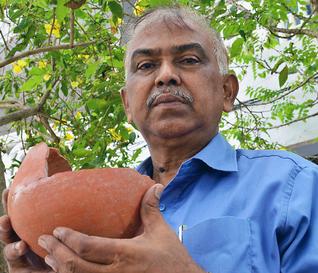
Historian Mohammed Silar with a pot collected from a Buddhist site at Gudivada in Krishna district.

‘Machilipatnam Sarvasvam’, (Encyclopaedia of Bandar), written by Bandar-based modern historian and numismatist Mohammed Silar, is all set to be released by the end of June. The book focuses on the flourishing of Buddhism and Jainism in Krishna district as well as individuals and institutions which brought laurels to the port town.

In 2010, he wrote his first book ‘Tara Tarala Bandar Charitra’, which became a reference guide for history research scholars. It was reprinted in 2013. “My second book has a detailed narration about the rule of several dynasties in Masula – from Mughal, Dutch to British and French. The history of India’s third municipality, Machilipatnam Municipality, is also one of the key chapters of the encyclopaedia,” Mr. Silar said.

Based on Battiprolu inscription in Pulinda script, Mr. Silar is trying to establish the birth of Telugu language in Machilipatnam. As Machilipatnam played an important role in the evolution of education and literature in Andhra Pradesh, the book chronicles the lives of many luminaries including Madras University’s first elected Vice-Chancellor Raghupathi Venkataratnam Naidu of Machilipatnam.

Mr. Silar, a retired Special Grade Tahsildar and a Food Inspector during the cyclonic storm in 1977, has been engaged in documenting the glorious past of the town. “Bandar population was 64,000 in 1865 as against 9,000 of Vijayawada. The demography shows the glorious past and development of the tiny town in those days”, he says.

source: http://www.thehindu.com / The Hindu / Home> Andhra Pradesh / by T. Appala Naidu / Machilipatnam – June 05th, 2014

British Prison testimony to sacrifices of freedom fighters

Andhra Pradesh :

Built in 1750s, it was used to confine freedom fighters from Krishna and Guntur districts till another jail was built in Vijayawada in 1920s

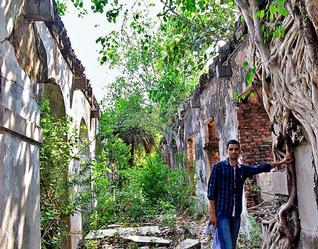
The remains of the British Prison at Bandarkota village near Machilipatnam in Krishna district.

A British construction here stands as a witness to the bravery and sacrifices of the freedom fighters of Masulipatnam and Krishna district.

The giant building, known as ‘British Prison’, reminds one of the history of freedom struggle in Andhra Pradesh.

“It was built after the Anglo-French war in 1750s. The British required a prison in Machilipatnam to incarcerate the local freedom fighters within the area of Krishna and Guntur districts and Nalgonda in Telangana State during the freedom struggle,” local historian Mohammed Silar toldThe Hindu .

According to available literature on Machilipatnam, it was the only prison to confine the freedom fighters until another prison was built in Vijayawada in early 1920s.

Jaggery unit

‘Masula History’ penned by Chitta Bala Krishna Sastry in 1922 predicts that Machilipatnam would witness rapid industrial activity, by citing the jaggery production unit set up in the British prison by then.

“After the British left the prison by early 1920s, local entrepreneur Jaldu Rama Rao obtained permission from the British to use the prison premises for production of jaggery and sugar,” said Mr. Silar. However, sugar cane production had to be stopped by mid 1940s, owing to various business reasons.

Currently, the British prison is owned by the family of Jaldu Rama Rao.

Now, an old woman resides at the entrance of the site, which is yet to get the heritage status.

Only if it gets the heritage status, any conservatory initiatives by the Archaeological Survey of India could be expected to take place.

Another heritage structure

Ironically, the British prison is located opposite another heritage site which was a hospital during the Nizam’s period.

The efforts made by the Indian National Trust for Art and Cultural Heritage (INTACH) for the conservation of the British prison as well as the other sites at Bandarkota have not yielded any results so far.

source: http://www.thehindu.com / The Hindu / Home> Andhra Pradesh / Bankarkota(Krishna) / August 15th, 2016

School where Bismil, Ashfaqullah studied struggles to commemorate past

UTTAR PRADESH :

Shahjahanpur:

On the eve of the country’s 69th Independence Day, the Abbie Rich Inter College, one of the oldest schools in Uttar Pradesh, is struggling to preserve its heritage. The school building, a hundred years old, is in dire need of repairs. The school is the alma mater of Ram Prasad Bismil and Ashfaqullah, who, long before their participation in the Kakori train robbery of 1927, were classmates and friends here. The school even has their attendance records up to 1919.
Abbey Rich is owned by the Methodist Church of India (MCI) and run on funds raised by Christian minority institutions. The nearly 700 students are mostly from poor families, with no fees charged from them till class VIII. At present, the school is looking for funds to renovate its buildings. However, fund constraints and absence of financial help from the government has brought the school to dire straits.

Abbey Rich has a past that is intimately connected with Uttar Pradesh and the rest of the country. Bismil and Ashfaqullah forged their well-known friendship while students here. Moreover, its alumni fought in both the First and Second World Wars. In the latter, three teachers and five students are known to have joined the armed forces. Their names have been commemorated in a wall plaque.

In 1991, some students put up statues of the two martyrs on the school grounds. Abbey Rich authorities have since wanted to replace them with better statues in marble and have written several times to the state government. However, no reply has been received. Meanwhile, the statues are placed facing the wall, making it difficult for anyone to see the faces either from inside or outside the school.

“Abbie Leonard Rich was an American social worker who came to Shahjahanpur in the 1850s and began teaching children under a tree. In 1857, he was forced to flee the place because people did not know he was not connected to the East India Company,” said principal Mihir Phillips.

Rich returned a few years later and the government gave him some land on rent to set up a school. In 1867, it moved to another building and got affiliation till class X, one of the first in the province. Finally it moved into the current building in 1916, build on land donated by a local nawab.

“We still have the attendance records of Ashfaqullah and Ram Prasad Bismil. They were here till class VIII, in section B actually. The students and staff feel proud to share this heritage,” said Phillips.

There is an important incident from the freedom struggle connected to both martyrs. In 1919, police raided the school to arrest both the boys. “But then principal Rufus Charan stopped the police at the gate. This gave time to the two boys to escape,” the principal said.

Professor Bikram Mani, who retired from the school told TOI, “This used to be the best school of the city but everything changed with time. We provide free education and this is probably not what people need these days. Otherwise, it would have been declared a heritage institution.”

source: http://www.timesofindia.indiatimes.com / The Times of India / News Home> City> Bareilly / Kanwardeep Singh / TNN / August 23rd, 2016

Prince of Arcot hails CM’s sanction for Kalas Mahal

Chennai, TAMIL NADU :

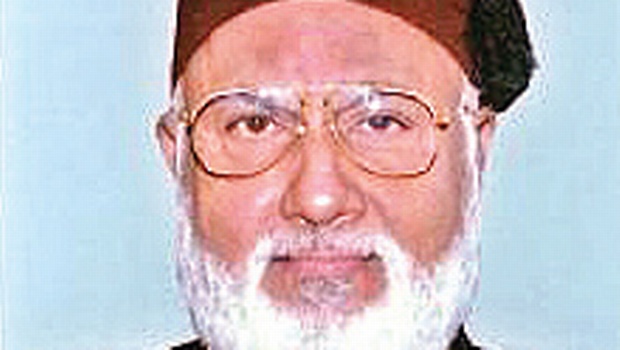
Prince of Arcot. | ENS

Prince of Arcot, Nawab Mohammad Abdul Ali, has hailed Chief Minister J Jayalalithaa for sanctioning a sum of Rs14.5 crore for the restoration of the Chepauk Palace (Kalas Mahal).

In a release, the Nawab said that the people of Tamil Nadu, particularly those who have love for history and interest in preserving historical monuments, were overwhelmed by the Chief Minister’s gesture to restore the majestic Kalas Mahal, which is perhaps the first Indo-Saracenic monument in the country.

The Nawab thanked the Chief Minister for her decision not to demolish the historic Kalas Mahal, which was ravaged by a fire in January 2012. That the CM evinced keen interest to restore it, shows her concern and love for history.

The Prince hoped the restoration would be carried out as per detailed drawings provided by a firm belonging to a conservation architect and that the  originality of the structure would be maintained.

Kalas Mahal is classified as a grade-I heritage building in the Justice E. Padmanabhan committee report

The direct descendant of the eighth Nawab of Carnatic, Muhammad Ali Wallajah (1749 to 1795), built the Kalas Mahal.

source:  http://www.newindianexpress.com / The New Indian Express / Home> Cities> Chennai / by Express News Service – Chennai / July 20th, 2013

Kalas Mahal getting back its lost glory

Chennai, TAMIL NADU:


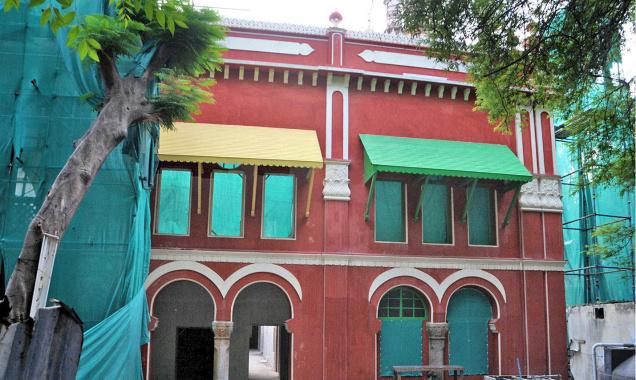
A new look:The building that is being renovated at a cost of Rs. 14.5 crore will be home to the National Green Tribunal, Southern Bench. —Photo: B. Jothi Ramalingam

People who visit the PWD complex cannot miss the once fire-ravaged walls that now sport a new look, coated with fresh terracotta paint.

A portion of the Kalas Mahal, which was once part of the Chepauk Palace and was ravaged in a fire a few years ago, will soon be restored to its original glory.

Work to renovate the ground floor of the 248-year-old building is expected to be completed by September-end.

It will be the home to the National Green Tribunal, Southern Bench. Nearly 100 skilled labourers are giving finishing touches to the building that is being restored at a cost of Rs. 14.5 crore, said officials of the Public Works Department.

“Work is on to provide flooring with kota stones, which is a fine-grained variety of limestone. Labourers who are skilled in lime plastering and ornamental beading works are also engaged in providing wall lining as per the guidelines,” an official said.

Spread over 24,000 sq.ft, the ground floor will be allotted to the tribunal Bench and will house three court halls. The Bench is now functioning at Arumbakkam.

A team of its representatives recently visited the site.

Nearly 80 per cent of the work on the ground floor has been completed so far. Similarly, nearly 50 per cent of the work to renovate the first floor is over.

“We are reconstructing the Madras Terrace roofing using materials from Rajapalayam and Srivilliputhur. The windows and doors are being replicated in the heritage building. We are also making arrangements for water supply and sanitary facilities in the structure,” an official said.

Once the project to restore the first floor is over, work to reconstruct the octagonal dome will be taken up.

Meanwhile, the PWD is also expediting the process to restore the adjacent heritage building, Humayun Mahal, which suffered roof collapses and faced a minor fire over the past few years.

“The process is on to engage a conservation architect to prepare a detailed project report for restoration of the structure. The project may be implemented in five or six months,” an official said.

source: http://www.thehindu.com / The Hindu / Home> News> Cities> Chennai / by K. Lakshmi / Chennai – August 14th, 2016

Singer Javed Ali to perform at fundraiser for war widows

NEW DELHI :

Mumbai :

Noted playback singer Javed Ali  will perform at “Jaya Hey” event at Nehru Centre here tomorrow to raise funds for the aid of war widows.

“The loss of a soldier fighting enemy is heart-breaking for any nation, but the biggest brunt of it is borne by the soldier’s family, more so (by) widow he leaves behind.

“The nation owes its freedom and security to these brave heroes. None of us can exist in isolation,” Amit Malhotra, Co-Founder and CEO of Ten Dimensions International, which has conceived and executing the fundraiser said in a statement issued here today.

“To be aware of these connections, to feel appreciation for them and to strive to give something back to the society in a spirit of gratitude is the proper way for human beings to live,” he added.

Ali, known for his hit number “Jashn-e-Bahaaran” from Jodhaa Akbar  (2008) besides other songs, said, “We have all heard about the soldiers sacrificing their life for the safety of our nation. But not many know the struggle of the war widows who are left behind. I am proud and extremely grateful to be associated with ‘Jaya Hey'”.

The proceeds from the event will go to ‘Vasantharatna Foundation for Art’, an initiative by Subhashini Vasanth , a recipient of the Neerja Bhanot Award 2016.

In 2007, Subhashini’s husband Col Vasanth Venugopal  was awarded Ashok Chakra (Posthumous) for exemplary bravery in Jammu and Kashmir.

MM NSK SMJ

source: http://www.timesofindia.indiatimes.com / The Times of India / News Home> City> Mumbai / PTI / August 12th, 2016