Category Archives: Arts, Culture & Entertainment

Cervical Cancer Less Among Muslim Women: Dr V Shanta

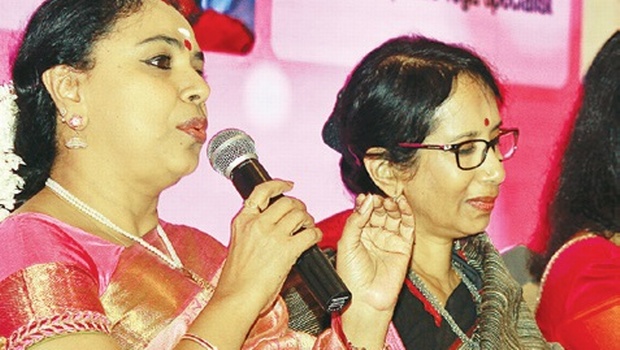
Sudha Raghunathan at Oncology meet  Martin Louis

Chennai :

Pointing out that cervical cancer is less among Muslim women, Dr V Shanta, chairperson, Cancer Institute WIA, attributes this to the religious ritual of circumcision practised by them.

Addressing the gathering at a symposium on women’s oncology organised by Apollo Hospitals and National Cancer Institute of the  United States (USA NCI) on Monday, Dr Shanta says only 8.9% of the Muslim women have cervical cancer compared to 15.4% among the Christian women and 22.1% among the Hindu women against a total ratio of 1 lakh.

“The main reason for such a drastic change is the practice of circumcision and penile hygiene,” she adds. “Circumcision has a protective effect against sexual transmission of human papilloma virus (HPV), which is a causative agent in cervical cancer,” said a doctor at the symposium.

The country has seen an uneven literacy pattern which has affected cancer detection and curing, according to Dr Shanta. Various research have proved that uneducated adults are more likely to die from cancer than the educated as awareness is a big problem for illiterate people, she said.

Further, she says that there has been a decrease in cervical cancer among women in the urban centres when compared to rural areas. But city women have recorded an increase in breast cancer. Dr Shanta cited the figures of 2009-12 to show that cervical cancer reported in Chennai is only 16.5% when compared to 22.8% in rural areas. Likewise, breast cancer reported in the Chennai is 38.6% when compared to 15.1% in rural areas.

“This is because of education and socio-economic status of the people. The attitude among the urban populace is more towards the cure than prevention. Only when they realise that prevention is better than cure can the rates of cancer death be brought down,” she explained.

State health secretary J Radhakrishnan said that private and government hospitals along with NGOs are working together to fight oncology among women. He pointed out that around 1.09 crore women were screened for cervical cancer in Tamil Nadu out of which 3.7 lakh were found to have the the disease. Similarly, around 1.33 crore women were screened for breast cancer out of which which 1.64 lakh were found to have the disease.

A symposium titled ‘Marga’ focused on a road map towards women’s oncology care in India was held. It was pointed out that 35 million deaths occurred due to NCDs (non-communicable diseases) each year which is due to sedentary lifestyle, poor diet regime and high stress levels. While many schools had banned fast foods in their canteens, parents must avoid giving kids such items, they said.

source: http://www.newindianexpress.com / The New Indian Express / Home> Cities> Chennai / by Express News Service / February 23rd, 2016
In Kerala’s Kozhikode, hunt for a Chinese legend

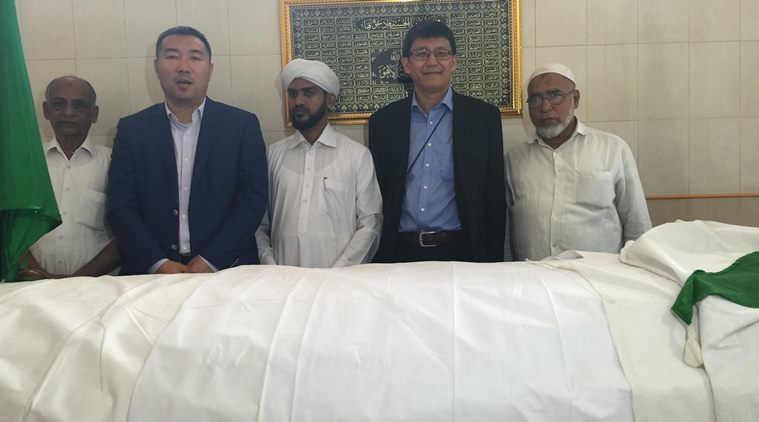
In Kerala’s Kozhikode, hunt for a Chinese legend

Kozhikode, KERALA :

More than 600 years after a seven-foot tall Chinese naval explorer touched the shores of Calicut (now Kozhikode), a bustling international port city in northern Kerala, an attempt to find his relics and perhaps his final burial place is in order in the state.

Last month, two professors, working in different countries, arrived in Kerala with the aim of finding more information about Zheng He, a fleet admiral of China’s early Ming dynasty and one of the world’s earliest navigators, much ahead of the likes of Christopher Columbus and Vasco da Gama. According to credible historical accounts, Zheng He, who had led seven naval expeditions in the Indian Ocean, was buried at sea off the coast of Calicut after he died of illness in the course of a voyage.

“We came to Kerala on January 7-9 to find information about relics and stories of Zheng He and his crew in Calicut. It was an official trip of Zhenghe International Peace Foundation,” said Shaojin Chai, a senior research fellow at the Ministry of Culture in UAE.

While history books are replete with the exploits of Columbus and Gama, not much is known about Zheng He, whose fleet was considered to be ten times bigger than his contemporaries. In fact, National Geographic magazine described  the naval armada of Zheng He off the coast of Sri Lanka as a ‘massive shadow on the horizon’, that moved like a ‘floating city’ and stretched across miles and miles of the ocean.

Zheng He, who is venerated almost like a God in several parts of China and has temples dedicated to him in Malaysia and Indonesia, was born in China’s Yunnan province in 1371. Born into a Muslim family, Zheng He was ritually castrated at the age of ten at the hands of an invading Ming army. But his life as a eunuch turned out for the better after he was sent to serve in the household of Zhu Di, who would later go on to become the Yongle Emperor. History says Zheng He was able to gain the trust of the emperor in a short period of time and convinced him to let him embark on naval trips that would extend China’s trade potential to Southeast Asia, the Indian subcontinent and the far-away Middle East.

Watch video

Zheng He’s first voyage, according to several accounts, began in the year 1405, sailing from China through Indonesia and Malaysia to finally end at Calicut via Cochin. His fleet was estimated to be more than 20,000 men travelling in more than 60 treasure ships – numbers described astonishing in most accounts. His subsequent trips took him as far as Iran and eastern Africa to the shores of Mogadishu.

For the Chinese explorer, Calicut, then a prosperous trading port that dealt extensively in eastern spices under the rule of the Zamorin, was an ideal base to conduct trade across the Indian Ocean and the Middle East.

“Chinese historian Ma Huan, Zheng He’s translator, described Calicut as very friendly, harmonious and a dynamic place where trading was fair and the Hindu king consulted with Muslim ministers to conduct state affairs,” said Professor Chai, who was accompanied to Kerala by Haiyun Ma, a professor at Frostburg State University, Maryland, US.

During their short visit, both professors visited a few mosques which had Chinese connections and inspected tombstones, but could not unearth any reliable clues that could point to Zheng He’s period.

However, CK Ramachandran, convenor of the Calicut Heritage Forum, dismissed claims that the Chinese naval commander had been buried under land.

“According to early Chinese traditions, a eunuch, after death, cannot go to heaven with a deformed body. That’s why he was ceremonially buried at sea,” said Ramachandran, who has meticulously collated several historian accounts of the Chinese in Kerala.

“I did visit Nanjing in China where a tomb has been erected in Zheng He’s memory. But it is more of a memorial. It is empty,” he added.

Nevertheless, undeterred, Professors Chai and Ma are planning to organise a conference next year in Kerala which would throw light on Zheng He’s exploits for which they have spoken to state government officials as well.

“Zheng He was considered one of the greatest statesmen and explorers in Chinese history and was our national pride for promoting peace and trade with other countries (sic),” said Prof Chai.

source: http://www.in.news.yahoo.com / by Vishnu Varma, The Indian Express / February 20th, 2016

Poet Dr. Akbar Ali passes away

Belagavi – Mysuru, KARNATAKA :

DrAkbarAliMPOs21feb2016

Mysuru :

Chutuku Kavi was also a former MLC

Renowned poet and former MLC Dr. M. Akbar Ali, passed away at a private hospital in city this morning following illness. He was 91.

He is survived by three sons, three daughters and a host of relatives and friends. His wife Banubi had predeceased him.

Dr. Akbar Ali, was said to be suffering from cancer, was admitted to the hospital about 15 days ago, where he breathed his last at 6 am this morning.

Deputy Commissioner C. Shikha, other eminent personalities and dignitaries from all walks of life paid their last respects to the departed poet at his residence in T.K. Layout.

His last rites will be performed at the Muslim Burial Ground behind city’s Central Prison this evening, according to family sources.

Profile: Dr. M. Akbar Ali, who gained popularity as a ‘Chutuku poet,’ was born at Ullegaddi Khanapur village in Hukkeri taluk of Belagavi district on Mar. 3, 1925.

After getting his early education at his village, Dr. Akbar Ali did his higher education at Belagavi and Pune and got his Ph.D Degree from the University of Mysore.

Beginning his career as a teacher at Belagavi in 1953, Dr. Akbar Ali retired from Mysore University as a Professor (Distance Eduction Wing) in 1985 on superannuation, before serving in different colleges at many places.

He has written many ‘Chutuku’ poems including Akbar Ali Chutukugalu, Belakina Aradhane, Kasi Gulabi, Kathana, Kannada Kavyadhyana and Akbar Ali Samagra Kavya.

Among the many awards and prizes he has won, includes Rajya Sahitya Academy Award (1967), National Integration Award (1974), Kannada Rajyotsava Award (1985), Honorary Award of Karnataka Sahitya Academy (1985) and DVG Muktaka Sahitya Award in 2009.

Dr. Akbar Ali was a nominated Member of the Legislative Council (MLC) from 1986 to 1992.

He had chaired the 9th Mysuru District Kannada Sahitya Sammelana in 2008 and the All India Poets meet held at Mandya in 1994.

source: http://www.starofmysore.com / Star of Mysore / Home> General News / February 21st, 2016

Pages from History : South Indian Coinage

Mysuru, KARNATAKA :

by Prof. A.V. Narasimha Murthy, former Head, Department of Ancient History & Archaeology, University of Mysore

I had the good fortune of serving the Numismatic Society of India, Varanasi, as its President, Secretary and Editor. I used to attend the annual conferences of this Society regularly. I once noticed that scholars attending the Varanasi Conference from South India could be counted on finger tips. The reason, I learnt, was that North India was very far and travel would be difficult and many scholars suggested ‘Why not a South Indian Coin (Numismatic) Society be started?’ It was a good suggestion and I contacted Dr. R. Krishnamurthy, Editor of Dinamalar (Tamil Daily) from Chennai and he welcomed the idea but told me that his business as the Editor of a Daily would not allow him to devote full time and energy for this. But he hastened to add, ‘If you can take that responsibility, my full support to you is there.’

Prof. K.V. Raman of Chennai gave me his support. The Head of the publication of New Era, Dr. Srinivasan Srinivasan agreed to print and publish the Journal of the Society on the condition ‘I should be its Editor.’ I agreed and South Indian Numismatic Society came into existence in 1990. So far it has conducted 26 conferences at different centres in Karnataka, Andhra, Tamil Nadu, Kerala. This time it met at Thiruvananthapuram in Jan. 2016. About 150 Numismatists attended.

It was our good fortune that it was hosted by the Centre for Heritage Studies under the Cultural Affairs Department of Kerala. K.C. Joseph, Minister for Rural Development, Culture and Planning, who inaugurated the conference, extended full cooperation to this conference which was a success.

There was a time when barter was the system of trade. People realised its limitation and began using coins. Coins as such have not been noticed in the Indus Valley Culture. However, Rig Veda mentions coins like Nishka, Rukma, Khadi, in the sense of coins. But actually Nishka means a necklace and hence, it has been taken as a necklace made of gold coins (kasinasara). Anyway, that is the earliest coin of our country.

South India had a period which is generally referred to as Sangam age and it was considered as a literary imagination or even bunkum. Suddenly, Dinamalar Krishnamurthy discovered a coin belonging to a Sangam King called Peruvalathi. For the present, this is considered to be the earliest coin of South India. Barring this, the Satavahana (Andhra) coins are the earliest coins of Deccan and South India.

However, we have had uninscribed punch marked coins all over the country including South India and Karnataka. These silver coins had 5 symbols punched on them and one of them represented the government or the king. At this time, Roman merchants came to South India and gave their gold and silver coins and purchased our spices, especially black pepper, which was considered as an antidote for malaria. Thus the large number of Roman coins gave an impetus for the minting of coins in South India.

Kadambas of Banavasi are considered to the actual inaugurators of coinage in Karnataka. They issued what are called Padmatanka coins. A Padmatanka is a gold piece which has a central punch of a lotus or Padma with some symbols and letters like ‘Sri’ with or without the name of the issuer. The Pallavas of Kanchi issued their own coins in gold and copper. This system was continued by the Cholas of Thanjavur. They minted the portrayal of the king with Nagari or Tamil legends. Chola coins have been discovered in plenty as to fill up them, in gunny bags. In Andhra area, Vishnukundins minted coins. In Karnataka, the Chalukyas minted coins and their most popular coin is called Varaha. This word survives even today in traditional parlance. In fact, the coin name Varaha is a contribution of Karnataka in general and that of the Chalukyas in particular.

The Western Gangas of Talakad minted gold and copper coins with elephant as the important symbol. Unfortunately, Rashtrakuta coins have not been discovered in plenty. Later, Chalukya coins have been found in plenty. The Hoysalas minted coins in gold and copper. Vishnuvardhana minted coins with lion and the legend Talakadugonda symbolising the defeat of the Cholas. One interesting coin is the one which has a portrait of Saint Ramanujacharya. The Sevunas or the Yadava coins include those of Bhillama, Singhana and Ramachandra.

Kings of Vijayanagara introduced innovation in coinage. It is not only a golden age but a golden period for Karnataka coinage. Their coinage has been praised by foreign travellers also. They introduced legends in Kannada and Nagari. The most important coin of Krishnadevaraya are the coins representing Lord Venkateswara of Tirumala and Sri Krishna holding a lump of butter in his hands. Krishnadevaraya performed Kanakabhisheka to Balaji of Tirupati by minting gold coins which had the representation of Venkateswara with Sridevi and Bhudevi and his name in Kannada or Nagari. Nayakas of Madura imitated the coinage of Vijayanagara. Their coins contain legends in Kannada and Tamil.

We may turn our attention to the coinage of Muslim kings — the Bahamani dynasty, Adil Shahi dynasty and Barid Shahi Sultans. They minted coins with legends in Arabic and Persian on both sides. Hyder Ali and Tipu Sultan occupy an important place in Karnataka history. Tipu’s innovation in coinage is amazing. He established seventeen mints in different parts of South India and minted coins in gold, silver and copper. He gave each coin a name after the Islamic Saints. His gold coins contain the Persian legend ‘The religion of Ahmad is illumined in the world by the victory of Hyder.’ The reverse has the legend ‘He is the Sultan, the unique, the just, the third of Bahari, cyclic year Azal 2.’

The Wadiyars of Mysore (now Mysuru) began issuing coins with legends. The representation of Hindu Gods by Krishnaraja Wadiyar is unique. They also minted coins with portrayals of lion and elephant with legends in Roman, Kannada and Persian. Once the British took over, they began to follow the British coinage. After independence, the entire country, including South India, is following the system which we are now seeing. Thus, South India followed a unique system of coinage which has a history of over 2,000 years.

source: http://www.starofmysore.com / Star of Mysore / Home> Feature Articles / February 21st, 2016

It’s a Jawa Day everyday with Motorcycles & Memorabilia

Mysuru, KARNATAKA :

People across the globe celebrate Jawa Day on the second Sunday of July every year, but for H. Ajay Kumar of Mahadevapura in Mysuru, who owns four Yezdi and a Jawa bike, everyday is a Jawa Day! One may wonder as to what makes him so unique when there are so many other people who own more Jawa bikes. What makes Ajay stand out is not just the motorcycles but the memorabilia of Ideal Jawa, the collectibles of Jawa factory and the info about the factory he has right on the tip of his tongue that shows his passion for the legacy that Ideal Jawa left behind. This Weekend’s Pictorial Star Supplement will take our readers on a nostalgic ride of the good-old Ideal Jawa days.

by B.N. Ramya

AjayKumarMPOs21feb2016

The Motorcycles…

Anyone studying physics in eighth standard would think of scoring high marks in exams or at the most of learning physics for the sake of good marks which counts a lot in CET to get an engineering or medical seat. But Ajay Kumar has a different story to tell.

Speaking about how his love grew for automobiles, he says, “It was when I was in eighth standard that I learnt about steam engine, internal combustion and then my curiosity to know about two-stroke and four-stroke engine arose. My dad had a Hero Puch then and with that I was introduced to Prasad uncle of Gururaja Automobiles on Ramanuja Road, the authorised dealers of Hero Puch. So anything I wanted to know about engines and machines, I was there at his shop satiating my hunger to know more about automobiles.”

It is a known fact that the words ‘automobiles’ and ‘Mysuru’ will no doubt make one think of Ideal Jawa, the second biggest Jawa motorcycle manufacturing factory in the world, next only to the original factory in Czechoslovakia. Ajay too was fascinated towards Jawa bikes like any other bike enthusiasts for its reliability and ruggedness.

About his first bike Ajay says: “As I told you my dad had a Hero Puch which I did not actually like much. I so very much wanted a bigger vehicle. When I once visited my grandma’s house on vacation, I saw a X standard boy riding bullet and I wanted to have one such bike. My father bought me Yezdi 175 CC when I was in X std. in 1999; that was my first BIG bike.”

“After that somewhere in 2002-03, I got to know about a Yezdi 60CC lying idol at a house of one of the Jawa employees, who had stopped using that vehicle after the factory had stopped production. I purchased that bike, which is now in a good condition after being given the required attention,” says Ajay adding: “then followed the purchase of Roadking from Vijayanagar; Joining some like-minded bike enthusiasts like Gavin and Azam, a Jawa Group was formed in 2007, which made way for the purchase of Jawa and then again Yezdi D250 Classic.”

“Initially I used to be an active member of the Jawa group, biking around and popularising the bikes. With passage of time and getting busy with family, though I fail to make more Jawa rides, I make sure that come what may, I attend the Jawa Day celebrations and go on rides,” says the bike enthusiast who added, his longest trip on bike was to Kodaikanal with friends and he keeps visiting Sakleshpura, where his in-laws reside, on bike enjoying the greenery en-route.

When asked where does he get his bikes repaired if they break down, Ajay says: “I alone can make repairs most of the time and if I need any major repair works, I approach Jawa mechanics Mohammed Dastagir and his son Shamshir Ahmed, who have a garage behind Dalvoy School. They are quite well-known among Jawa enthusiasts. People from Bengaluru, Chennai and Kerala too come there to get their bikes repaired.”

A native of Anantapur in Andhra Pradesh, Ajay is the son of H.V.G. Raju, a retired employee of Coffee Board and Yashoda and is married to Ashritha. Ajay, an alumnus of Sarada Vilas Educational Institutions in city, who has worked for various automobile showrooms, now runs a car driving school (The Search) in Vishweshwaranagar.

The Memorabilia…

Power bikes do not have speed and speed bikes do not have power. Jawa bikes are terrain bikes, says Ajay who is so much in love with the thundering sound of these yesteryear bikes.

Ajay, who can tell the exact date and year of the different models released by Ideal Jawa, laments about the decline of the Ideal Jawa, saying: “To demolish the factory completely, it took almost 5-6 months and I was there for almost five months everyday seeing the producer of the legendary bikes coming down. There I found some spare parts, bouchers, photographs and bulletins of Jawa factory, which speaks a lot of this giant bike producer.”

source: http://www.starofmysore.com / Star of Mysore / Home> Feature Articles / February 20th, 2016

Heavenly… Masala Chai … Atop Chamundi Hill

Mysuru, Chamundi Hill ,  KARNATAKA :

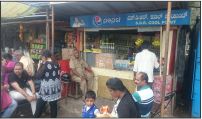
Tourists and localites at Farman's tea shop atop the hill.
Tourists and localites at Farman’s tea shop atop the hill.

Chai, does this 4 letter word make you go into a trance? If yes, then you are a tea lover! There are two types of people in this world — those who love tea and those who don’t. The love for tea can never be understood by the latter category, no matter how much the former group tries to make them understand !

Chai lovers love their cuppa and are very sceptical when it comes to substituting it with something like green tea. Although green tea has various health benefits, masala chai is equally healthy and tastes far better than that bland cuppa.

Though many tea stalls in city prepare and sell masala black chai with their own ingredients in it, one such tapri that sells masala black chai is SDR Cool Point atop Chamundi Hill, which is thronged by locals, to savour the unique masala chai prepared by Mir Farman Ali. Even tourists, who had earlier relished the masala chai, make it a point to visit his shop whenever they came to Mysuru.

Mir Farman Ali, a resident of Turabh Ali Street in Mandi Mohalla, speaking to SOM, said that prior to selling tea he frequented Chamundi Hill to sell the inlay works prepared at his home during the year 1980.

Coming from a family of artisans, Farman, who himself is an expert in inlay works, said things were going good for some days and he used to earn enough to take care of his family. But as the business declined, his meagre earnings were not enough to feed the family.

It was at this juncture he thought of changing his business and embarked on the idea of selling tea to visitors and devotees who thronged the temple as there were just one or two shops atop the hill then.

Instead of the regular tea, he wanted to sell tea prepared out of some unique ingredients that his mother used to give him as a child. So, in the year 1991, Farman opened a small shop and began to sell masala chai.

Disclosing some of the ingredients, Farman said his tea contained Jeera, Ginger, Black and White Pepper, Saffron and Black Salt among others which are powdered in the right proportion. These ingredients are useful to fight inflammation, fatigue, cold and flu, improves digestion, good for heart, boosts metabolism and also helpful in preventing diabetes, he claims.

One of Farman’s customers, P.K. Anil Kumar of Wildwalkers, who organises trekking expeditions to various places in the State, said that though he is not a tea freak, he never forgets to visit Farman and have a glass of that masala chai as it is very refreshing and fights tiredness. Anil has been visiting Farman’s chai shop since 18 years.

Many trekkers, who climb the steps of Chamundi Hill, never forget to visit Farman’s stall located near the parking lot behind Mahishasura’s Statue and savour the cuppa.

So next time you visit the hill-top, don’t forget to have a sip of that magical masala chai as the experience cannot be expressed in mere words !

source: http://www.starofmysore.com / Star of Mysore / Home> Feature Articles / February 19th, 2016

Eminent vocalist Abdul Rashid Khan passes away

Eminent Hindustani classical vocalist Ustad Abdul Rashid Khan performing during an event on August 11, 2013. File photo: Shanker Chakravarty / The Hindu

Eminent Hindustani classical vocalist Ustad Abdul Rashid Khan performing during an event on August 11, 2013. File photo: Shanker Chakravarty
/ The Hindu

He was as a recipient of Padma Bhushan and Sangeet Natak Akademi award

Kolkata, WEST BENGAL / Rae Bareli, UTTAR PRADESH :

Kolkata :

Eminent Hindustani classical vocalist Ustad Abdul Rashid Khan passed away at a private hospital here today following old-age related ailments, family members said. He was 107.

He fell sick in the morning and was rushed to a hospital where he took his last breath, the family members said.

The body will be flown to Raebareli tomorrow for the burial, they said.

A recipient of Padma Bhushan in 2013 and Sangeet Natak Akademi award, he was a resident guru at the ITC Sangeet Research Academy in the city for the past 20 years

Despite movement restrictions and age-related illness, he used to appear for public performances till recently.

One of his students said that he took a class with his pupils even yesterday.

Condoling his death, West Bengal Chief Minister Mamata Banerjee said, “Saddened at the passing away of veteran vocalist Padma Bhushan Abdul Rashid Khan.

India has lost a great gem in the world of music”, she said in a tweet.

source: http://www.thehindu.com / The Hindu / Home> National> PTI / Kolkata – February 18th, 2016

6th National Science Film Festival : EMRC wins Two Awards for Documentary Film

Mysuru, KARNATAKA :

Syed Kaleem, Senior Producer of EMRC

Mysuru :

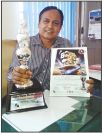
 Educational Multimedia Research Centre (EMRC), attached to University of Mysore, won two national awards for the documentary film titled ‘DGWT – A cause for Concern,’ in the recently held 6th National Science Film Festival organised in Mumbai. The institute won the Silver beaver award which carries a trophy, a citation and Rs. 50,000 cash prize and also the best graphics award carrying a trophy, a citation and Rs. 30,000 cash prize.

The documentary was directed by Syed Kaleem, Senior Producer of EMRC, Mysuru and Former Director of EMRC, Odisha. This is the second National Award won by Syed Kaleem. The first one was in 2001 for the film on the life of Kodava’s titled ‘Kodavas, The highlanders.’

The best graphics award was received by Chandra Kumar, graphic artiste of EMRC, Mysuru. The film was photographed by Keerthi Kumar, sound effects by Badrinarayana and Somashekar was the Technical Director. The narration of the film was done by Beliappa.

The film highlights the grave danger caused due to depletion of ground water and its long time impact on ecology and environment.

source: http://www.starofmysore.com / Star of Mysore / Home> General News / February 15th, 2016

Workshop on Agricultural Finance

Bengaluru , KARNATAKA :

Mysuru :

Mysore Akashvani, in association with Prasar Bharati and Indian Broadcasting Service, has organised a day-long workshop on Agricultural Finance Management at CIIL on Hunsur Road at 10 am tomorrow (Feb.15).

Bengaluru Akashvani Station Director M.A. Ahmed will inaugurate the workshop.

Mysore Akashvani programme Chief M. Raghavendra will preside.

Karnataka Agricultural Price Commission Chairman Dr. T.N. Prakash Kammaradi will deliver the keynote address.

source: http://www.starofmysore.com / Star of Mysore / Home> In Brief  / February 14th, 2016

B’luru advertiser puts his faith & funds on billboards

Bengaluru, KARNATAKA :

SalaamCentreMPOs11feb2016

Bengaluru:

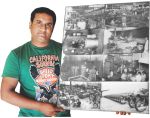
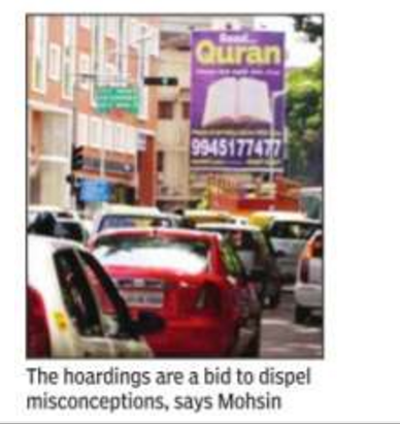
For months now, citizens of Bengaluru, the eastern parts in particular, have been seeing huge billboards at vantage points with the tagline, ‘Islam: Facts Vs Fiction’, offering a free copy of the Quran from the advertiser.

Passers-by wonder who’s leasing out the space and why, and having read the message, move on.

Syed Hamid Mohsin, who runs an outdoor advertising business, was known for his love of cars, buying the latest models of luxury cars every year. Six years ago, he found himself facing serious questions.

“There are more than white, and those seen at dargahs, about love jihad and extremism, and other issues.”

He founded the Salaam Centre in 2008 and turned to dispelling misconceptions about Islam and fostering inter-community harmony through the use of billboards, social media and other channels.

His book on Islam has been translated into Hindi, Kannada, Tamil, Telugu and Marathi.

“The usual question from 100 misconceptions about Islam,” said the 50-year-old.

“I’ve tried to explain the difference between Pakistan’s national flag, which is green and intelligence sleuths and the judiciary and others is:where do I get funds for such work, and for the plush office on Bannerghatta Road?’ Mohsin said.

A Bengaluru business man has got billboards posted at key points across the city to dispel misconceptions about Islam and spread the message of communal harmony .

“Outdoor advertising gives me my bread and butter and the income from it is funnelled here. I have a bungalow and a Mercedes Benz which I haven’t changed in six years. Earlier, I used to have two luxury cars and change these every year . Instead of paying an EMI of Rs 1lakh on cars, I decided to do this. I don’t want to go into philanthropy or give educational scholarships because others are doing this,” says Syed Hamid Mohsin, who runs an outdoor advertising business. “I keep the hoardings for short periods as people get bored,” he said.

source: http://www.timesofindia.indiatimes.com / The Times of India / News Home> City> Bangalore / TNN / February 11th, 2016