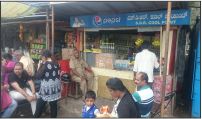
Tourists and localites at Farman’s tea shop atop the hill.
Chai, does this 4 letter word make you go into a trance? If yes, then you are a tea lover! There are two types of people in this world — those who love tea and those who don’t. The love for tea can never be understood by the latter category, no matter how much the former group tries to make them understand !
Chai lovers love their cuppa and are very sceptical when it comes to substituting it with something like green tea. Although green tea has various health benefits, masala chai is equally healthy and tastes far better than that bland cuppa.
Though many tea stalls in city prepare and sell masala black chai with their own ingredients in it, one such tapri that sells masala black chai is SDR Cool Point atop Chamundi Hill, which is thronged by locals, to savour the unique masala chai prepared by Mir Farman Ali. Even tourists, who had earlier relished the masala chai, make it a point to visit his shop whenever they came to Mysuru.
Mir Farman Ali, a resident of Turabh Ali Street in Mandi Mohalla, speaking to SOM, said that prior to selling tea he frequented Chamundi Hill to sell the inlay works prepared at his home during the year 1980.
Coming from a family of artisans, Farman, who himself is an expert in inlay works, said things were going good for some days and he used to earn enough to take care of his family. But as the business declined, his meagre earnings were not enough to feed the family.
It was at this juncture he thought of changing his business and embarked on the idea of selling tea to visitors and devotees who thronged the temple as there were just one or two shops atop the hill then.
Instead of the regular tea, he wanted to sell tea prepared out of some unique ingredients that his mother used to give him as a child. So, in the year 1991, Farman opened a small shop and began to sell masala chai.
Disclosing some of the ingredients, Farman said his tea contained Jeera, Ginger, Black and White Pepper, Saffron and Black Salt among others which are powdered in the right proportion. These ingredients are useful to fight inflammation, fatigue, cold and flu, improves digestion, good for heart, boosts metabolism and also helpful in preventing diabetes, he claims.
One of Farman’s customers, P.K. Anil Kumar of Wildwalkers, who organises trekking expeditions to various places in the State, said that though he is not a tea freak, he never forgets to visit Farman and have a glass of that masala chai as it is very refreshing and fights tiredness. Anil has been visiting Farman’s chai shop since 18 years.
Many trekkers, who climb the steps of Chamundi Hill, never forget to visit Farman’s stall located near the parking lot behind Mahishasura’s Statue and savour the cuppa.
So next time you visit the hill-top, don’t forget to have a sip of that magical masala chai as the experience cannot be expressed in mere words !
source: http://www.starofmysore.com / Star of Mysore / Home> Feature Articles / February 19th, 2016
Eminent Hindustani classical vocalist Ustad Abdul Rashid Khan performing during an event on August 11, 2013. File photo: Shanker Chakravarty
/ The Hindu
He was as a recipient of Padma Bhushan and Sangeet Natak Akademi award
Kolkata, WEST BENGAL / Rae Bareli, UTTAR PRADESH :
Kolkata :
Eminent Hindustani classical vocalist Ustad Abdul Rashid Khan passed away at a private hospital here today following old-age related ailments, family members said. He was 107.
He fell sick in the morning and was rushed to a hospital where he took his last breath, the family members said.
The body will be flown to Raebareli tomorrow for the burial, they said.
A recipient of Padma Bhushan in 2013 and Sangeet Natak Akademi award, he was a resident guru at the ITC Sangeet Research Academy in the city for the past 20 years
Despite movement restrictions and age-related illness, he used to appear for public performances till recently.
One of his students said that he took a class with his pupils even yesterday.
Condoling his death, West Bengal Chief Minister Mamata Banerjee said, “Saddened at the passing away of veteran vocalist Padma Bhushan Abdul Rashid Khan.
India has lost a great gem in the world of music”, she said in a tweet.
source: http://www.thehindu.com / The Hindu / Home> National> PTI / Kolkata – February 18th, 2016
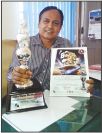
Educational Multimedia Research Centre (EMRC), attached to University of Mysore, won two national awards for the documentary film titled ‘DGWT – A cause for Concern,’ in the recently held 6th National Science Film Festival organised in Mumbai. The institute won the Silver beaver award which carries a trophy, a citation and Rs. 50,000 cash prize and also the best graphics award carrying a trophy, a citation and Rs. 30,000 cash prize.
The documentary was directed by Syed Kaleem, Senior Producer of EMRC, Mysuru and Former Director of EMRC, Odisha. This is the second National Award won by Syed Kaleem. The first one was in 2001 for the film on the life of Kodava’s titled ‘Kodavas, The highlanders.’
The best graphics award was received by Chandra Kumar, graphic artiste of EMRC, Mysuru. The film was photographed by Keerthi Kumar, sound effects by Badrinarayana and Somashekar was the Technical Director. The narration of the film was done by Beliappa.
The film highlights the grave danger caused due to depletion of ground water and its long time impact on ecology and environment.
source: http://www.starofmysore.com / Star of Mysore / Home> General News / February 15th, 2016
Mysore Akashvani, in association with Prasar Bharati and Indian Broadcasting Service, has organised a day-long workshop on Agricultural Finance Management at CIIL on Hunsur Road at 10 am tomorrow (Feb.15).
Bengaluru Akashvani Station Director M.A. Ahmed will inaugurate the workshop.
Mysore Akashvani programme Chief M. Raghavendra will preside.
Karnataka Agricultural Price Commission Chairman Dr. T.N. Prakash Kammaradi will deliver the keynote address.
source: http://www.starofmysore.com / Star of Mysore / Home> In Brief / February 14th, 2016
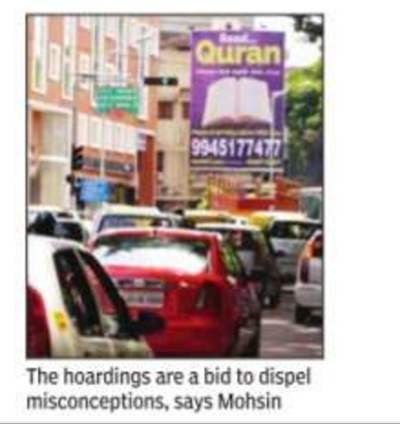
For months now, citizens of Bengaluru, the eastern parts in particular, have been seeing huge billboards at vantage points with the tagline, ‘Islam: Facts Vs Fiction’, offering a free copy of the Quran from the advertiser.
Passers-by wonder who’s leasing out the space and why, and having read the message, move on.
Syed Hamid Mohsin, who runs an outdoor advertising business, was known for his love of cars, buying the latest models of luxury cars every year. Six years ago, he found himself facing serious questions.
“There are more than white, and those seen at dargahs, about love jihad and extremism, and other issues.”
He founded the Salaam Centre in 2008 and turned to dispelling misconceptions about Islam and fostering inter-community harmony through the use of billboards, social media and other channels.
His book on Islam has been translated into Hindi, Kannada, Tamil, Telugu and Marathi.
“The usual question from 100 misconceptions about Islam,” said the 50-year-old.
“I’ve tried to explain the difference between Pakistan’s national flag, which is green and intelligence sleuths and the judiciary and others is:where do I get funds for such work, and for the plush office on Bannerghatta Road?’ Mohsin said.
A Bengaluru business man has got billboards posted at key points across the city to dispel misconceptions about Islam and spread the message of communal harmony .
“Outdoor advertising gives me my bread and butter and the income from it is funnelled here. I have a bungalow and a Mercedes Benz which I haven’t changed in six years. Earlier, I used to have two luxury cars and change these every year . Instead of paying an EMI of Rs 1lakh on cars, I decided to do this. I don’t want to go into philanthropy or give educational scholarships because others are doing this,” says Syed Hamid Mohsin, who runs an outdoor advertising business. “I keep the hoardings for short periods as people get bored,” he said.
source: http://www.timesofindia.indiatimes.com / The Times of India / News Home> City> Bangalore / TNN / February 11th, 2016
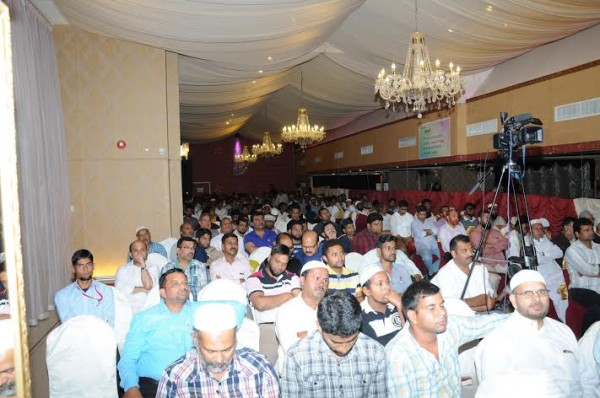
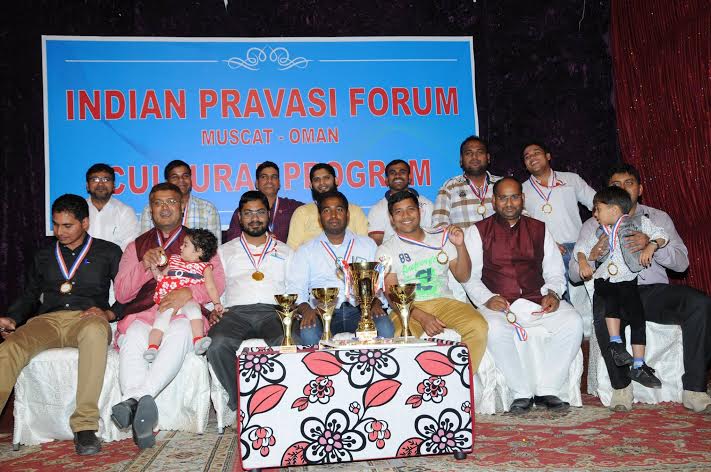
Indian Pravasi Forum Oman Organized “Paigham E Rasool (PBUH) and Children’s Cultural Program-2016 on 22nd Jan at Al Maas Hall in Muscat.
Yusuf Hyder Mukka (President Indian Pravasi Forum Oman, Karnataka Chapter) in his Presidential address emphasized for the unity of community. He stressed the importance of brotherhood.
While addressing the gathering Mufty Haneef Ahrar Qasimi (National Secretary of All India Imam Council), the chief guest of this occasion highlighted “guidelines from life of Prophet (PBUH) in present situation”.He described how the prophet granted the status of women in society.
He also stressed the importance of teachings life style of Prophet Mohammad (PBUH) and explained how he is a role model from all aspect for all mankind and his entire life should be followed Muslims.
The event started with cultural program for children’s under the supervision of Abdul Rahiman Nitte and Noor Mohammed. Over one hundred children participated enthusiastically in cultural program. Suhaib Bailoor group presented “Lavish Life” skit.
A quiz competition was also held for the audience.
While Maqsood Chandavara introduced the guest, Moideen Sunathkere proposed vote of thanks. Haneef Bantwal and Hashim Kundapur were the conveners of the program.///
The program was graced by the presence of Janab Faisal Khan, Janab. Moulana Saheb Zade Mahmood, Janab. Riyaz Gangolli (President of Gangolli Jamath Oman), Janab. Moideen (president of DKSC Oman), Janab. Moideen Shastan (President of SKMWA Oman), Janab. Abdul Shukoor( Vice President of Thonse Jamath Oman), Janab. Anwar Moodabidre (President of Indian Social Forum Oman –Karnataka Chapter), Janab. Noor Mohammad Padubidre (President of Indian Pravasi Forum Ruwi Area), Janab. Irfan Ujire (President of Indian Pravasi Forum Barka Area), Janab. Maksood Chandavara (President of Indian Pravasi Forum North Zone) was on the dais on the occasion.
source: http://www.muslimmirror.com / Muslim Mirror.com / Home> Culture / by Abdul Mubarak Karaje / Muscat – January 27th, 2016
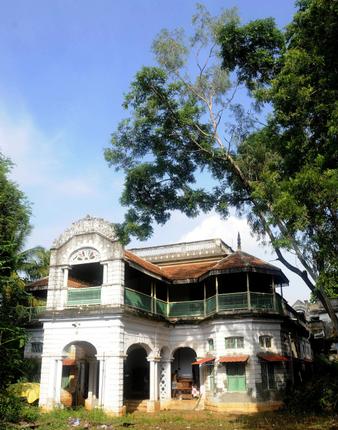
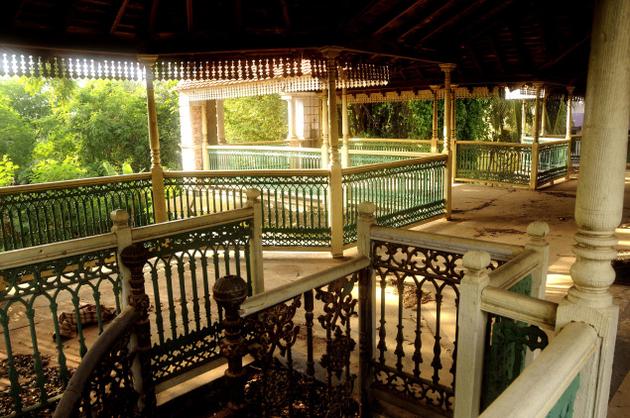
A view of the M.K. Maaligai in Khajamalai, Tiruchi. Photos:A. Muralitharan
Behind the façade of this heritage residence in Tiruchi lies the story of its enterprising owner, M.K. Mohamed Ibrahim Ravuthar.
It is an arresting sight on the Race Course Road in Tiruchi. A stately home, complete with gabled roofs and stained glass windows peeks out demurely from behind black granite walls, willing you to stop and take a closer look.
“It’s a unique building just like the man who built it,” says Dr. M.A. Ansar, describing the mini 11-roomed palace and his grandfather M.K. Mohamed Ibrahim Ravuthar in one breath.
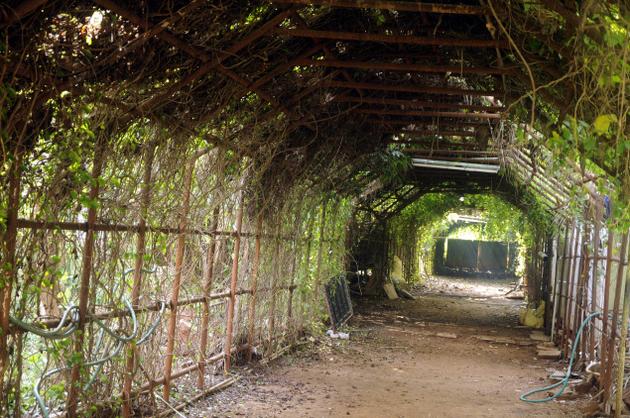
Built in 1928, the M.K. Bungalow was actually the main home in a complex of four residences in this quiet nook off the Race Course Road in Khajamalai. It resembles a structure straight out of a Jane Austen novel, especially when you walk through the green corridor (an iron trellis walkway that is still covered with the ‘December Poo’ or Philippine Violet vines planted by the patriarch) to reach the main entrance.
A trellis ‘green corridor’ leads up to the bungalow. Photo: A. Muralitharan
The garden is overgrown, and the annexes that once housed a live-in washerman, stables for horses and cattle, huge bathrooms and an elaborate pantry and storehouse, clearly have seen better days. Even so, when Mrs. Najma Begum, the current resident of the house and one of M.K.M. Ibrahim’s granddaughters, opens the main door, it is possible to see flashes of another, more flamboyant world that once existed here.
“When Thatha was alive, this house used to be called ‘M.K. Maaligai’ (Palace), today I can hear people calling it the ‘Pei (Ghost) Bungalow,’ when they walk past on the other side of the walls,” says Mrs. Najma.
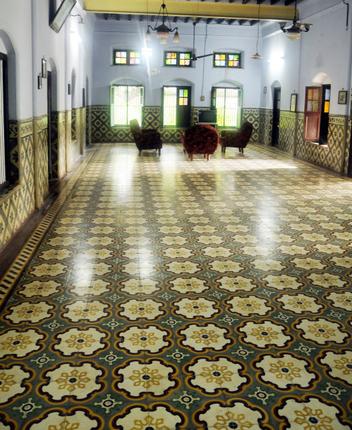
Keeranur tiles brighten up the interior of the M.K. Maaligai. Photo: A. Muralitharan
As room leads to room, each with Keeranur floor tiles and wide windows fitted with cooling coloured glass, the other tales about the house are dusted off and narrated too.
Tales of how chandeliers with red glass and gold paintwork imported from Austria used to adorn the halls. Records that were played on a Polyphon, a coin-operated music box which played metal discs measuring 195/8 inches in diameter, for dance parties hosted for British guests. And how a fountain and a ‘chaukhandi’ (gazebo) used to be star attraction of the garden.
The M.K. Maaligai was the entertainment venue not just for M.K.M Ibrahim’s friends and business acquaintances, but also guests of the State from Britain. On average, some 15-20 people would gather for the daily repasts, made with the finest of produce sourced from nearby towns.
Elaborate decorative work done on the verandah’s eaves and railings. Photo: A. Muralitharan
As the tour continues, up an imported cast-iron spiral staircase (one of two), to the first floor where the master suite looks out on a large decoratively gabled verandah, it becomes clear that this house was meant to be a personal work of art.
Hands-on leader
“My grandfather used to be known as the ‘Prince of Tiruchi’ for his lavish lifestyle,” says Dr. Ansar, whose late father M.K. Abdul Salam was the eldest son of M.K.M. Ibrahim. “Though he didn’t have much education, he used speak English fluently because of his close association with the British. He was among the invitees to a special assembly to commemorate the coronation of King George VI in May 1937.”
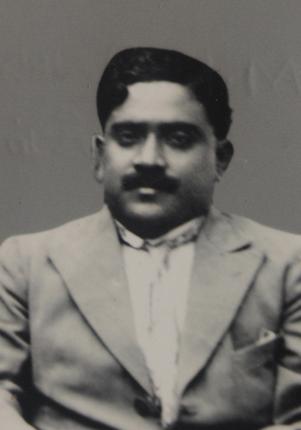
M.K.Mohamed Ibrahim Ravuthar.
Born in 1885, M.K.M. Ibrahim was the second son of M. Kasiappa Ravuthar, a wealthy businessman and landowner who migrated to Tiruchi from Ettayapuram, Tirunelveli district (see related story on Page 4).
Taking over his father’s kerosene dealership and leather tanneries after his elder brother Yusuf died, Ibrahim diversified the family business rapidly, branching out into petrol supply (he owned 18 petrol stations in his heyday), bus transport, and construction, besides starting a third tannery near Hyderabad.
The family made the Palakkarai area in Tiruchi its base.
The contracting projects that his M.K. Constructions company is associated with are still in use – the Erode Railway Junction, a part of Erskine’s Hospital Madurai (now renamed Government Rajaji Hospital), the Kakinada port (Andhra Pradesh), Chikmaglur Railway Station (Karnataka) and Railway staff quarters in Dindigul, besides a number of highways.
He also built a four-storey building in Chennai, close to the harbour, between Angapannaickan Street and Moore Street, where the leather from his tanneries used to be transported to by coal-fuelled lorries, and then exported to Britain.
Despite not being a part of the Independence movement, Ibrahim commanded a lot of popular support in Tiruchi. He served the city as its Municipality Vice-Chairman from 1925-28 and as Chairman from 1928-31.
He was a close friend of veteran freedom fighter P. Rathinavel Thevar, and co-operated with him on numerous occasions to preserve communal harmony in the city.
Known as a hands-on leader who once paid Municipality workers their salaries from his own funds, he donated the land for Ibrahim Park on West Boulevard Road on the condition that it would be put to public use.
He owned homes similar to M.K. Maaligai in Dindigul, Kodaikanal and Courtallam, which became summertime resorts for the family.
A poignant reminder
“The bungalow was still under construction when there was an epidemic of cholera or typhoid in the inner city areas in the late 1920s,” recalls Dr. Ansar. “Thatha decided to shift the entire family to this place from Palakkarai.”
Despite the love with which he built the residential complex, M.K.M Ibrahim was able to spend only around two to three years there, as he passed away at the age of 55 years on December 2, 1940 due to a heart ailment.
“It is astonishing to see how much this person achieved in a short period of 20-25 years,” says Dr. Ansar, whose father grew up in the complex of four residences along with his siblings. “He was inspired by the things he saw and people he met on his travels, and always tried to recreate the best of it for himself.”
Following the partition of his properties, the M.K. Maaligai was bequeathed to his second son M.K.M. Abdul Hakeem in 1949, whose children still maintain ownership of the heritage building.
After a brief spell as a student’s hostel, the M.K. Maaligai is now back to its original role as a family home.
“We clean it out for family functions, and whitewash it sometimes,” says Mrs. Najma Begum, who stays alone on the ground floor of the vast house.
“Even though it needs a lot of effort to maintain, we’d rather not demolish it. This residence is tied to many people’s lives.”
***
Snippets from an eventful life
M.K.M. Ibrahim fell in love with Rukkaiyya Bi when he saw her coming from the Madrassa (Islamic school) while he was working in Palakkarai. She was 9, he was 15. They married two years later, despite initial parental disapproval. They went on to have three sons and two daughters.
Tiruchi observed an unofficial day of mourning when M.K.M. Ibrahim died on December 2, 1940. Shops were closed as the public thronged to catch a sight of the cortege that was taken out from the family home in Palakkarai, through Main Bazaar to Rock Fort, NSB Road, and Main Guard Gate and to the burial ground just a few yards away from where the procession started in Palakkarai.
In the middle of the four homes that he built around the M.K. Maaligai, M.K. Ibrahim had left space for a tennis court that was never completed. The yard has since been sold to a scrap merchant.
His eldest son M.K.M. Abdul Salam showed an aptitude for public office, and was the first Congress Member of Parliament from Tiruchi in 1957.
***
Founding father
It is easy to see where M.K.M. Ibrahim got his penchant for largesse and flamboyance from. His father, M. Kasiappa (a merging of ‘Kasim’ and ‘Appa’), Ravuthar was an businessman who made his fortune in the early 19th century after migrating to Tiruchi from Ettayapuram.
He was the kerosene agent for Tiruchi and Thanjavur districts, and owned residential properties in the city centre called ‘stores’. The ‘Kasiappa Ravuthar Store’ was one such property near the Rock Fort area.
Besides that he had nearly 500 acres of agricultural lands near Samayapuram and Maruthur.
Kasiappa Ravuthar built two tanneries, one for goatskin and another for buffalo skin which used to be sent to Chennai and then exported to England, in the 1880s. Since the British didn’t allow outside sales, the leather used to be auctioned in England, and the money would be sent back to him in India.
As an expression of gratitude for recovering from a severe skin abscess on his back, Kasiappa Ravuthar dedicated a gold ‘kalasam’ to the main stupi (pillar) of the Nagore Dargah weighing 1,000 sovereigns, that stayed intact until it was knocked down by cyclonic winds in 1958.
source: http://www.thehindu.com / The Hindu / Home> Features> MetroPlus> Society / by Nahla Nainar / November 13th, 2015
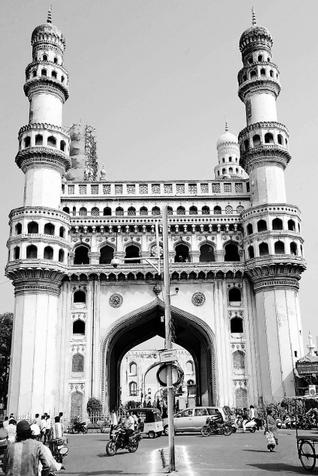
The high definition closed circuit cameras in front of Charminar.- Photo. K.V.S. Giri
Two lamp posts with HD CCTV cameras planted near Charminar as it completes 425 years
The iconic Charminar got a birthday gift from the police in the year when it completes 425 years. Two lamp posts with CCTV cameras have been planted firmly in line with the view from Mecca Masjid. It is exactly in the line of sight where people take photographs of the monument with the full height of minars in view.
Now, whoever takes a selfie will have a lamp post poking out of the head. “We have installed these HD CCTV cameras as part of the city-wide security upgradation,” informed a police official.
Ironically, it was on February 8, 1591 after 2 p.m. that the foundation of Hyderabad was laid. So, a celebration should have been in order as the city completes 425 years of being a magnet to people from across the world.
“On an auspicious day when the moon was in the constellation of Leo and Jupiter in its own mansion and all the stars were favorable, the foundation of Hyderabad was laid,” are the words in Tarikhe Farishta , which gives a brief history of the foundation of Hyderabad.
“This constellation position occurred in 1591 according to my calculations based on astrological information. Coincidentally after 2 p.m. on February 8, 1591, the moon entered Leo and Jupiter was in Visakha. Mansion usually refers to lunar position or nakshatra. Jupiter rules visakha nakshatra,” informed Anurag Sharma, who does astrology consultancy and research.
According to the history of Qutb Shahi dynasty in Tuzuke Qutbshahi , the foundation of Hyderabad was laid on October 30, 1590 the first day of Muharram, to mark the end of a cholera epidemic. The villagers of Chichilam got together and planted a tazia (a wooden flag appearing like a palm) in the middle of the road that connected the Golconda fort to the port of Machilipatnam. Once the plague subsided in October, at the end of the rainy season, the relieved king built the monument to mark the occasion and also as a marker of the four cardinal points of the city. The building was supposed to work like a charm and the inner arches of monument are capped by images of ferocious rats with gargantuan teeth. The building was completed in 1597.
Today, the Charminar is a centrally protected monument under the Archaeological Survey of India and no construction or defacement is allowed within 100-metres of the monument.
Asked about the cameras within 100 feet of the monument, an ASI official said: Security concerns are paramount and whatever the police are doing is for the good of the society.”
So, whether the city officials celebrate or not, the prayer of Mohammed Qutb Shah when he laid the foundation of the city has come true: “Oh Allah! bestow unto this city peace and prosperity. Let millions of men of all castes, creeds and religions make it their abode, like fish in the water.”
source: http://www.thehindu.com / The Hindu / Home> National> Andhra Pradesh / Serish Nanisetti / Hyderabad – February 10th, 2016
QuaideMillath Documentary Film Released and Screened in Kuwait
A special historic documentary film, explaining the chronicle, virtues of Marhoom Honorable QuaideMillathSaahib, was Launched in Kuwait on the cool pleasant evening of Thursday, 08.01.2015.
Muhammad Ismail(1896–1972) was an Indian politician belonging to the Indian Union Muslim League. He was a member of the Tamil Nadu Legislative Assembly, and a member of the Indian Parliament – both Rajya Sabha and Lok Sabha. He was also a member of the Indian Constituent Assembly which framed the Indian Constitution. He is popularly known in his native states of Tamil Nadu and Kerala by the title “Quaid-e-Millat” (Leader of the Nation).
For More details please click: http://en.wikipedia.org/wiki/Muhammad_Ismail /http://ta.wikipedia.org/wiki/முகம்மது_இசுமாயில்& http://ml.wikipedia.org/wiki/മുഹമ്മദ്_ഇസ്മായിൽ
The program was initiated and well organized by the Kuwait Tamil Islamic Committee (K-Tic), whose executive members are key associates in forming QuaideMillath Forum in Kuwait and candid members of Indian Union Muslim League, Tamilnadu State.
This documentary movie, was published by Muslim League Publication, and was directed by Aloor Sha Nawaas, renowned as “Ilam Oodaga Pooraalee” (Young Media Gladiator)a title conferred by K-Tic during his first visit to Kuwait. He was further designated as “AavanappadaAalunar” (Biopic Commandant), in the Grand Seerathun-Nabi (sal.) Convention, held at Masjid Al Kabeer on 02.01.2015.
The documentary was screened at the “Sirajul Millath” hall at Rowdha. This event was presided by K-Tic President, Moulavee Al-Haaj M.S. MuhammadMeeraShaFazilBaaqavee, and anchored by K-Tic’s General Secretary Moulavee A.B. Khaleel Ahmed Baqqavee M.A., The program started with Qur’anic Recitation by K-Tic’s Vice-President MoulaveeM. MuhammedNizamudeenBaaqavee, welcome speech by K-Tic’s Deputy General Secretary Al-HaajA.K.S. Abdul Nazar.
The Key Note was delivered by the Director of the Film, Aloor Sha Nawaas, where he mentioned the struggle on making the movie, for the great leader, whose roots are lost or forgotten by the blooming generation.
He mentioned, this movie was created from zero to this level, so that it shall be an immense tribute to the noble leader – not only for Tamil speaking community nor only for Muslims but for whole regions and religion allover India.
The movie enlightened the strengthening of early Indian Union Muslim League, when QuaideMillath, joined and servedearnestly.
The spectators astonished and shed tears on watching the movie.
Executives of Indo-Kuwait Friendship Society, Kuwait Kerala Muslim Cultural Committee, ThaimanKalaiIlakkiyaPeravai, Kuwait Tamizhosai Poet Association, Islamic Guidance Centre andTamil Nadu Islamic Student Association witnessed and greeted the outcome & efforts on the documentary and each observer was presented with a DVD copy of the film.
Representatives of various Tamil Associations, businessmen, social workers, community activists, admired on the missioned by Honorable leader of QuaideMillath. The event concluded with vote of thanks and Dua’a by K-Tic’s Deputy Treasurer Al-Haaj H. Mohammed Nasar.
——————————
Media & News Wing, Kuwait Tamil Islamic Committee (K-Tic), Kuwait.