Two weeks ago, in a quiz designed by Pavan Jha, we had posed a few questions on veteran actor Dilip Kumar to The Hindu readers. As promised, here are the answers:
01. Which Dilip Kumar-starrer was an adaption of Emily Bronte’s classic novel Wuthering Heights? Certain portions of the film were supposedly directed by him without credits.
Dil Diya Dard Liya (1966). The official director was A.R. Kardar.
02. Which film initially had Jayalalithaa cast opposite Dilip Kumar, only for her to be replaced subsequently by another heroine?
B.R. Chopra’s Dastaan (1972). Jayalalithaa was replaced by Bindu.
03. A big star of the ’60s, known for idolising Dilip Kumar and aping his acting style, made his debut playing the uncredited role of Dilip saab’s friend. Who is the star and which Dilip Kumar film is it?
Rajendra Kumar in Jogan (1950).
04. We see Dilip saab shooting for a film in Hrishikesh Mukherjee’s Guddi. Which film is it?
Phir Kab Milogi (1974), which had Dilip Kumar in a guest appearance.
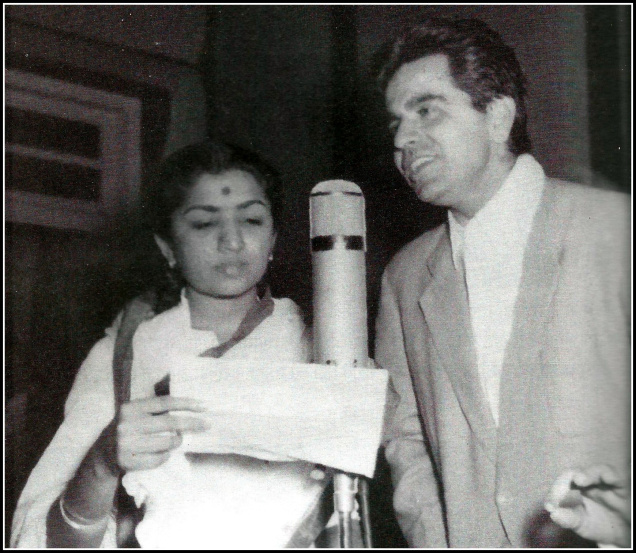
05. A remarkable moment in his career. What’s so special about the occasion? Name the film and its director.
With Lata Mangeshkar at the recording of the song Laagi nahin chhoote ram from Hrishikesh Mukherjee’s Musafir (1957). This was Dilip saab’s only full-fledged attempt at singing in a film
06. In which film produced by Madhubala was Dilip Kumar replaced by Kishore Kumar? All because their personal and professional relationship had taken an ugly turn.
Dhake Ki Malmal (1956).
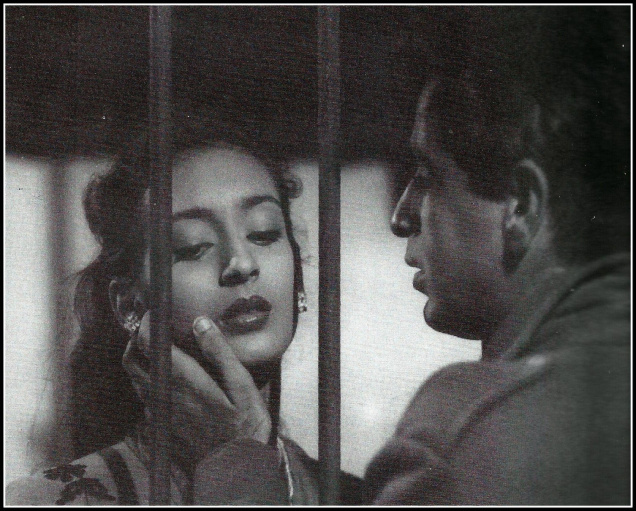
07. Dilip Kumar and Nutan never worked together in their prime, only later in the ’80s. However, there was one film starring them which was shelved in the ’50s. Identify the film.
Ramesh Saigal’s Shikwa (1954). In this shelved film, Dilip saab played an undertrial Army officer.
08. Dilip Kumar’s eldest brother Ayub Sarwar started a film starring him in an unusual title role but it never got completed. Which film is it?
Kala Aadmi
And the winner is…
No one! Most people mistook Gopi (1970) to be the film in which Jayalalithaa had been cast opposite Dilip Kumar. No one got all the answers right. The maximum correct responses were six out of eight and they came from: Seshagiri Row Karry (srkarry@yahoo.com), Unnikrishnan Menon (unnikrishnanmenon8@gmail.com), Sowmya Divyanathan (sowmyadivyanathan1980@gmail.com), Kumar Shashi (kushana007@gmail.com), Smitha V. (smithav1986@yahoo.com), Rajeev (rajeevmarcz@rediffmail.com), Sohrab Alam (sohrabalam15@gmail.com), Dhananjay Jha (desiringdj@gmail.com) and Rajeev Malhotra (gm.finance@mriu.edu.in). Congratulations and better luck with our next quiz.
source: http://www.thehindu.com / The Hindu / Home> Opinion> Comment / January 02nd, 2016
Two Chinese have come to the land of Zamorin to find the final resting place of the Chinese explorer who conquered seas through willpower.
The goal of these researchers is to find the grave and the trading points of Zheng He, the explorer who landed in Kozhikode seven times on ships .
They are professor Haiyun Ma, a Chinese descendant who teaches history at Frostburg State University in the US, and Dr Shaojin Chai, a senior researcher at the UAE’s culture ministry .
Zheng He is a hero in China, where students learn about his adventures. They only know that he died in Kozhikode due to sudden illness. Chinese researchers have come to find out if there is anything in Kozhikode that reminds of him .
A Chinese had been buried at Cheenedath mosque in Valiyangadi. Though the team visited the mosque, they could not find anything specific. Haiyun Ma and Shaojin came to Kozhikode with the help of Abbas Panakkal, a fellow at Griffith University, Australia.
english.manoramonline.com
The man who brought Ma Huan
Zheng He, born in 1371, began his travel at the age of 28. He landed in Kozhikode in 1430 with Chinese silk, vessels, jars and fishing nets. He was received by the Zamorin. He returned to China with spices and other goods many times. Over the period, he brought 2,800 Chinese to Kozhikode. One among them was Ma Huan, a historian. It is said that Zheng He even took elephants and horses from here. It is not clear whether Zheng He, a Muslim, was buried on land or at sea .
source: http://www.english.manoramaonline.com / OnManorama / Home> News> Kerala / by Lenin Chandran / Saturday – January 09th, 2015
A senior professor and his student occupy a table at Wazir Hotel, off the busy Mohammed Ali Road at crowded Bhendi Bazaar. Over endless cups of tea the professor, a sort of walking encyclopedia on people he met in the past, reminisces about Wazir Hotel’s heyday when it was a favourite haunt of poets, lyricists, musicians, singers and qawwals. Lyricists like Shakil Badayuni, Sahir Ludhianvi and Majrooh Sultanpuri chatted up the music maestro Naushad even as legendary qawwal Aziz Nazan discussed details of his delightful mehfils. And then the professor orders tea yet again but the waiter places two empty cups on the table announcing that the tea is over and the hotel is downing shutters forever. That was in 1986.
This scene from senior Urdu journalist-playwright Saeed Hameed-penned and Mujeeb Khan-directed play ‘Wazir Hotel’ after the long vanished famous eatery is part of Imambada-based Urdu Markaz’s second Bhendi Bazaar Urdu Festival (Jan 8-10). Aimed to revive that fast fading flavor of an era when shairi thrived and culture flourished, the festival celebrates a spirit which today lives in tales and memories.
Many memories will come alive when television actor Neha Sharad reads letters of Safia Akhtar (poet-lyricist Javed Akhtar’s mother) to her husband Jan Nisar Akhtar while ghazal exponent Pooja Gaitonde sings some of Jan Nisar Akhtar’s famous film songs, including the immensely romantic Main tumhi se poochhti hoon mujhe tumse pyaar kyun hai (Black Cat). “This festival dispels many myths and one of them is that Urdu belongs to Muslims alone,” explains Gaitonde.
“The idea is to tell people what Bhendi Bazaar symbolized and can still offer if earnest efforts are made,” says Zubair Azmi, director of Urdu Markaz and the festival. The festival maintains its “secular” character. So, apart from a mushaira featuring non-Muslim poets of Urdu, a discussion titled “Celebrating Urdu” will see non-Muslim intellectuals like Jnanpith Awardee novelist Bhalchandra Nemade and Sudheendra Kulkarni talk about Urdu’s contributions to our celebrated composite culture. “The festival is fast becoming a platform to showcase Bhendi Bazaar’s cultural ethos and promote communal harmony,” says local MLA Amin Patel. While admitting Patel’s “critical facilitation” to host the fest, Azmi agrees with him that the fest needs to be held on a larger scale.
It is not the old-timers alone who will get their antennae recharged through a medley of plays, soirees and singing of Sufi kalams and old Bollywood numbers, but even the young and restless can look forward to fun-filled sessions. “Workshops on drama, fiction, scriptwriting and poetry will engage college students to learning the finer points of these arts,” informs the festival’s reception committee chairman Farid Khan.
source: http://www.timesofindia.indiatimes.com / The Times of India / News Home> City> Mumbai / by Mohammed Wajihuddin / January 03rd, 2016
Princess Niloufer, the beloved daughter-in-law of the last Nizam of Hyderabad, may have left the city shortly after the Police Action in 1948. But even a good six decades later, she continues to be an enigma that at once intrigues and haunts Hyderabadis. On her centenary year, even as a photo exhibition by Birad Rajaram Yagnik attempts to reveal unknown vignettes of her life, and a documentary film on her is being worked on by historian Arvind Acharya, Hyderabad Times looks back at the dramatic life of the much loved princess of the city of Pearls. Surely, it was nothing short of a movie!
A fairytale set in 19th Century
When Niloufer Farhat Begum Sahiba was born in Istanbul, in January 1916, the Ottoman Empire was already fast crumbling. When she was barely a toddler, the Ottoman surrender was formalised aboard a British warship (October 1918). And by the time she was seven, the 700 year-old empire had officially fallen. In the backdrop of this downfall, the princess had to leave her fairytale life in Istanbul behind, and move to France with her mother in 1924, never to return. aged eight at that time, Niloufer would go on to lead a very ordinary life, learning to read and write French along with Urdu. Her exercise books had her learning about geography of the world. she stuck bits and pieces of the map in separate pages, oblivious to what the future held for her — a future where she would be remembered as the beloved princess of three cities. And yet, hold reign over none.
The romance with Hyderabad
Cut to 1931. In Hyderabad, Mir Osman Ali Khan, the seventh Nizam — also the world’s richest man — was looking for suitable brides for his sons. And that’s how Niloufer, just 15, found herself in Hyderabad. In a grand, royal wedding held in Nice in November 1931, Niloufer married Moazzam Jah, the Nizam’s younger son.
The Nizam had chosen Durru Shehvar (Niloufer’s first cousin) for his elder son — so the shift to a foreign land was less daunting perhaps. Another reason that made Hyderabad feel like home was that the Princess found a father figure in the Nizam. Though known to be officious and keen on protocol otherwise, the Nizam considered Niloufer his daughter. He even let her call him ‘father’. Life in the Hill Fort Palace was grand, Hyderabad was at its cultural peak, and the Princess took on many avatars — fashionista, socialite, philanthropist.
The sartorial queen
Between 1933 and 1948, Niloufer became a fashionista through whom the world got acquainted with Hyderabad. Her sarees, her choice of jewellery, her lifestyle became a talking point. Photographers, especially a crafty portrait photographer, Antony Beauchamp, loved her easy beauty. the international press adored her. Niloufer is credited with adding Parisian grace to the Indian saree. Her sarees were crafted specially for her, by Madhav Das in Mumbai. She loved chiffons and crepes, and wore them often with a broad woven Banaras brocade border. In fact, Mme. Fernande Cecithe, who was originally hired as a midwife for the princess, later created excellent designs to be embroidered on her sarees too. Her wardrobe is still studied by fashion students across the globe and her collection of sarees are now treasured at the New York Institute of Fashion Technology.
The socialite princess with a golden heart
One of the very prominent facets of Niloufer’s social life was the Lady Hydari Club, through which she also initiatied events and dos to raise funds. In 1941, Niloufer decided to organise the staging of a play Ondine (by dramatist Jean Giraudoux) to raise funds for London, which was recuperating from the damages of World War II. She was told by her father-in-law that a princess must not be seen acting in a play. So, her secretary at that time, Fatima Ghani, who would accompany her all the time and therefore even knew the dialogues, took on the princess’ role of a knight-errant Hans von Wittenstein zu Wittenstein.
But it wasn’t until 1949, that Niloufer’s biggest contribution to Hyderabad was going to emerge. When her maid, Rafath Unnisa Begum, died in childbirth, she was so shattered that she decided to ensure that no more such deaths take place. she decided to set up a maternity hospital, which stands today as Niloufer Hospital in Nampally.
The truth behind the glamourous veneer
She was one of the most beautiful women of her time. She was a much loved princess, both at home and overseas. But Niloufer had long learned that the glamour of all this was just that — an eyewash at best. At the heart of it all, there was pain and emptiness. She spent her best years in Hyderabad, craving to experience motherhood — a desire that was never fulfilled.
By this time, Niloufer had already witnessed her first cousin Durru Shehvar give birth to two sons, Prince Mukarram Jah in 1933 and Prince Muffakham Jah in 1939. Her childlessness put much strain on her marriage. In 1948, Moazzam took a second wife, Razia Begum. And by 1951, Niloufer had decided to split from her Hyderabadi commitments.
She moved back to France with her mother. Nice, back then had many members of royalty in exile, allowing Niloufer to still be socially active. As she aged gracefully, her photos from the era show her wearing the string of pearls that her mother had gifted her at birth.
However, irrespective of where she was based, Niloufer never severed her Indian ties. Her friendship with Jawharlal Nehru was one such connection. One of her letters following the assassination of Gandhi read: “Dear Pandit, You have heard and read the cry of so many millions of hearts — you have felt perhaps more than anyone else that great silence that set the void and the loneliness after he (Gandhi) was no more”. The duo continued to stay in touch, Niloufer wrote to Nehru even during the elections and Nehru who was on the road canvasing for the polls, replied, “But I want to tell you that you will always be welcome here whenever you care to come.”
Finding love again
After a good 11 years of being single, Niloufer met Edward Pope and found love once again. In February 1964, she married Pope in the presence of Nawab Ali Yawar Jung who was the Best Man.
Niloufer died in 1989 and was buried in a grave in Bobigny near Paris. The Muslims-only cemetery that is a two-hour drive from Paris not only has her mother resting there, but also all the members of her Seljuk dynasty. Surely, a life as romantic, as magnanimous, and as dramatic as Niloufer’s, deserves to be immortalised.
source: http://www.timesofindia.indiatimes.com / The Times of India / News Home> City> Hyderabad / by Samyuktha K, TNN / January 06th, 2015
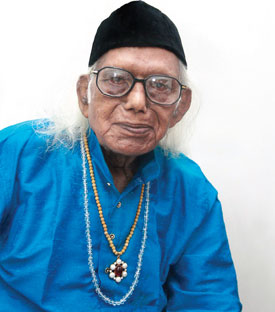
At the age of 104, Ustad Abdul Rashid Khan continues to enthral music lovers across the country with his vocal stamina, virtuosity and lyricism.Vandana Shukla has the honour of meeting the maestro
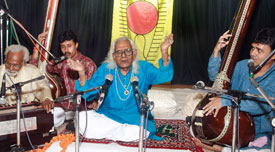
As he is brought to the stage, resplendent in silk kurtaadorned with gold chains, the audience gapes. His age alone makes him a phenomenon worth watching. By the end of his 90-minute recital, they are awestruck—Ustad Abdul Rashid Khan’s gamak taan can make a 25 year-old sulk for want of stamina. But there is no arrogance, only a childlike simplicity when the 104 year-old Ustad removes his black topi and shows us a layer of black hair sprouting from beneath his glorious silver. We wonder about his teeth; after a 100 years, the teeth are said to reappear as well. “The new ones will come only when the old ones fall,” chirps his grandson Bilal Khan, who accompanies him on the tabla.
A direct descendant and proponent of the third son of Miyan Tansen, Surat Sen, Ustad Abdul Rashid Khan sings like autumn leaves surrendered to the winds—in complete abandon. Sitting cross-legged while rendering Puriya Dhanashree, his arms spread like wings, releasing permutations of notes that even connoisseurs find hard to keep track of, floating across labyrinthine octaves. Those who came to the show to satisfy their curiosity about his age now find themselves impelled to stay mesmerised by his artistry. “He enjoys God’s blessings,” says eminent vocalist Pandit Ulhas Kashalkar. “Most vocalists can’t sing beyond the age of 80 years but he still sings with so much power.”
Ustad Abdul Rashid Khan has no concrete answers to offer on his longevity or mastery over music. All he allows us is a glimpse of an amazing mind and soul that live in complete surrender to the Almighty. He is creative like a child, energetic like a young man, and wise like a wizard. Two years ago, while arriving for a concert in Brindavan, he found people greeting each other with ‘Radhe Radhe’. He didn’t have any compositions using the term Radhe, though there were many with references to Krishna. Within 10 minutes of the drive that took him from the hotel to the concert hall, he composed two beautiful bandish.
The amazing vigour that defines Ustad Abdul Rashid Khan’s voice is as remarkable as his mesmerising control over complex notes
He still travels extensively, his concert tours sometimes running for a month at a stretch. We meet him in Chandigarh a day after he has performed at Kamani Auditorium in Delhi; the day before that, he was in Lucknow. In the days ahead, he will go back to Delhi for two consecutive concerts, and then to Varanasi and Allahabad. He attempts an explanation: “When I sing, only God is with me, I do not see anything; I do not do anything; everything is done by Allah!” His faith in the divine was reinforced many years ago. “I was close to
50 when I was given mercury in my food at Khagra in West Bengal,” he recounts. “In those days, when two artists engaged in a duel; one had to lose. The person who lost poisoned me out of envy. I lost my fingers and toes; how my vocal cords were spared was a miracle. I live so that I can sing, and it is His will.”
Ustad refuses to dwell upon what has been lost. “I don’t take any medication. I have only heard of older, and younger, people suffering from diabetes and high blood pressure,” he says with a chuckle. Still, he is a stickler for his routine—he doesn’t eat lunch because it interferes with his namaaz. He compensates with a good breakfast and dinner, which includes chicken, meat and a sweet, preferably rasmalai or gulab jamun.
His appetite for rhythm and rhyme is equally hearty. Gifted with a natural mastery over words—he has penned thousands of verses and compositions under the pen name Rasan Piya—Ford Foundation and ITC Sangeet Research Academy (ITCSRA) have recorded about 2,000 of his compositions for their archives. In the view of Ustad Mashkoor Ali Khan of the Kirana gharana, it is these recordings that enabled the world to learn about Ustad’s talent. “Once people heard him in Kolkata, they realised what a reservoir of knowledge he has,” he says. “It was then that ITCSRA decided to invite him to Kolkata. He has produced many shagird. He is an amazing vocalist; for his age it is no less than a miracle. This apart, he is an extraordinary composer.”
How many of his compositions does the Ustad remember? “Arre baap re!” he chortles. “I don’t remember anything. I just remember Allah.” Hundreds of bandish were, in fact, chewed by a goat, Bilal tells us teasingly and adds, “People plagiarise his compositions; somebody earned thousands of dollars by fusing his Bhairavi composition with French music, and recently I heard a group from Pakistan sing his composition as their own.” With his characteristically naughty smile, Ustad dismisses Bilal and says, “Let them steal; I will compose 10 new ones. Why should I feel sad over such triviality?”
As a child, he was forced by his father to leave kushti (wrestling), his great passion, fearing he might pull a muscle in the neck that might affect his vocal cords. “I had to leave akhada, I could not disobey,” he says. “He was my father and guru. In those days, discipline was foremost and so was obedience. My grandfather Ustad Bade Yusuf Khan was given the stage after 22 years of taleem. We were made to see that each raga had a personality, and you could not disrespect it by hurting its character, by singing it at a wrong time and season.” Those roots continue to nourish him. “Music has been my life and it has given me everything,” he says with candour. “Bismillah Khan, whom I revere, once asked violinist Dr M Rajam, who was heading the music department at Benaras Hindu University, to wait till he arrived. He wanted to hear my concert.” This is something he misses today, the paucity of good listeners who truly appreciated the value of music.
Does he, then, worry that the tradition is being diluted? “No,” he replies firmly. “There are organisations like ITCSRA, Devi Foundation and SPICMACAY [Society for the Promotion of Indian Classical Music and Culture Among Youth] that are doing a lot to save this tradition.” Part of this effort is to embrace change. For instance, girls were not taught music in his gharana—he deprived his own daughters of musical training—and his sons grew up to become contractors. But today, Ustad is proud of his female disciples, who include Rupali Kulkarni, Pampa Banerjee and Shashi Tripathi. “I was nine when Baba started teaching me,” recalls Kulkarni, a station director with Vividh Bharati. “He was as loving as a father while being an exacting teacher. He would get mejalebi, yet lay a lot of emphasis on varjish [exercise], telling me that controlling one’s breath and singing require a lot of stamina. He composed such difficult yet beautiful compositions for me.”
Ustad’s grandson Asad Ali Khan is equally fulsome in his praise—he is the only grandchild that Ustad has trained vocally and lives and travels with him, like Bilal. “In my opinion, there is no teacher in India more knowledgeable than Baba,” he says in a tone that borders on reverence. “He is my Baba; at the same time, he is the best teacher one could have. He never gave me special treatment and treated me like any other disciple. He never loses his temper, yet he makes us do what he wants. He is also fun to be with.”
Ustad too revels in the company of his disciples, particularly when they tour together for concerts. He speaks to them well into the night, not letting them sleep! “Why waste the night sleeping when there is so much to say and sing?” he wonders. When he is not on the road, he teaches music at Kolkata ITCSRA from 11 am to 4 pm. Ustad’s memory remains as active as the maestro himself. He still remembers all his students (past and present), the names of his 15 grandchildren, who all live in Rae Bareilly, and all the dates and places of significance to his life. He is reticent, though, on the subject of his wife—he lost her when his children were young and he appears to have drawn a gentle veil over that chapter. Indeed, setbacks or successes, the Ustad has handled them all with consummate dignity—and faith. As he tells us, “Himmat… sirf himmat se hi safar tay hota hai, aur himmat voh deta hai. (Only courage takes you along, and courage comes with His grace).
Featured in Harmony Magazine
December 2010
source: http://www.harmonyindia.org / Harmony India.org / Home> H People> Diary 100 / Featured in Harmony – Celebrate Age magazine, December 2010
DJ Hassan has been spinning magic since 2008. A remixer, producer, harmony-arranger and DJ trainer since seven years, Hassan has mastered his music in genres like house and electro Bollywood.
Though he started his journey by learning to spin hip-hop tracks, he is now devoting his time completely to Bollywood. A common name at club gigs and private events, DJ Hassan is known for belting out chartbusters and has his aces up his sleeve from ‘Desi Girl’ to ‘Dabangg’.
He is also a feted DJ internationally, in many places including Doha, Dubai and Sri Lanka.
How did 2015 treat you in the realm of music?
It was a great year for me. I went places and played all across the country. I mainly played at major parties. My biggest event was playing at a private party, where about 3000 people enjoyed the tunes that I spun.
What are you looking forward to in 2016?
All my shows. I plan everything two months in advance so I know that in the end, it will turn out great.
What’s the scenario like for young DJs entering the scene?
The younger lot have to struggle for about four years to survive in the market. Only then, they can establish themselves. Most people think that they can get by in DJing with high-end laptops and expensive mixers but without talent and hard work, they won’t be able to make a name for themselves in the industry.
Comment on the music scene in the City.
There is a lot of space to co-exist. People are extremely open-minded about classical, fusion, Western and Bollywood in Bengaluru.
There are also newer genres coming up by the day as youngsters listen to different kinds of music, travel more and are aware of world music. The crowd is the ‘shuffling’ sorts, who don’t stay in one place and have different influences in music, which is good for musicians and bands to experiment.
Álthough you started with hip-hop tracks and then moved to Bollywood, you are often considered as a Bollywood DJ. What is it that connects you to Bollywood music?
The sheer universality of the genre. It has a certain depth and is a genre that will stay on. At the end of the day, everyone wants to go back home and listen to Bollywood music.
The future of the DJ industry?
The youngsters are spoiling the market by accepting small-budget shows. They also don’t know how to attract the crowd in this industry. They should learn to stay true to themselves and their talent.
Your plans for the New Year?
I’m welcoming 2016 by playing an exclusive set on December 31 at Sutra, Lalit Ashok.
Any New Year resolutions?
I will get to know only in 2016.
source: http://www.deccanherald.com / Deccan Herald / Home> Supplements> MetroLife / by Anushka Sivakumar, DHNS / December 31st, 2015
Makhdum Ali Mahimi, who is buried in the popular Mahim dargah, is the patron saint of the city police.
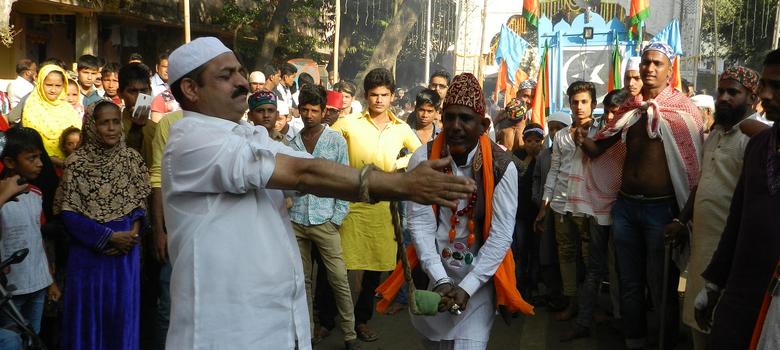
A constable in plain clothes holds his arms out to be whipped.
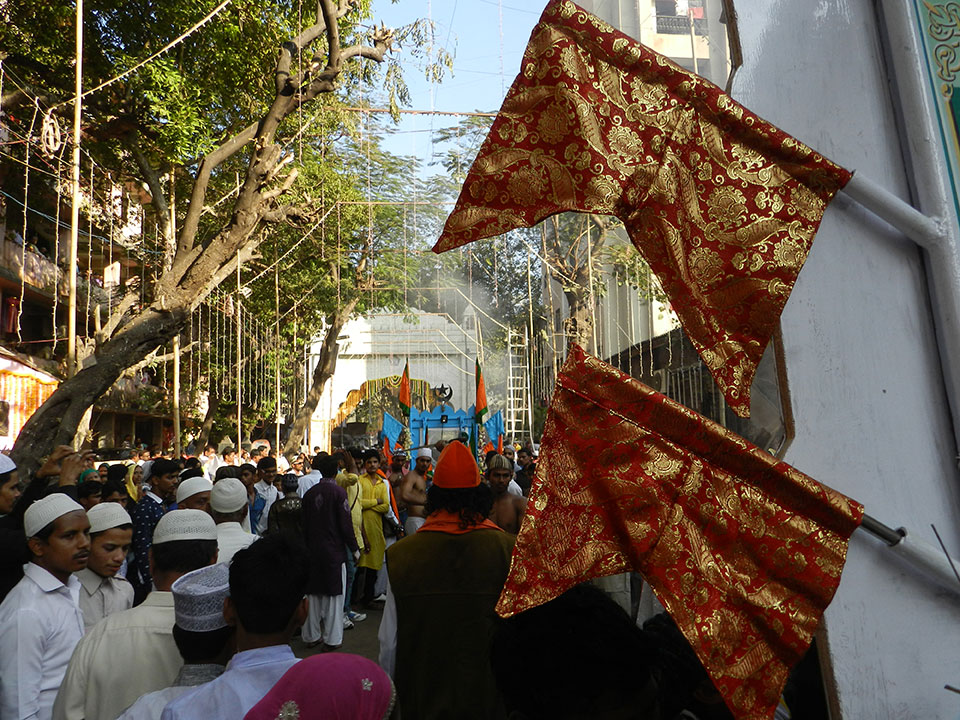
The Mumbai police was out in full force on Friday to mark the first day of the Urs or death anniversary of Makhdum Ali Mahimi, the man to whom the famous Mahim dargah in the central part of the city is dedicated.
Makhdum Ali Mahimi was a 14th-century Sufi scholar remarkable in many ways, but perhaps the most remarkable is that he happens to have been the patron saint of the Mumbai police since its roots as a citizen’s militia in the 17th century.
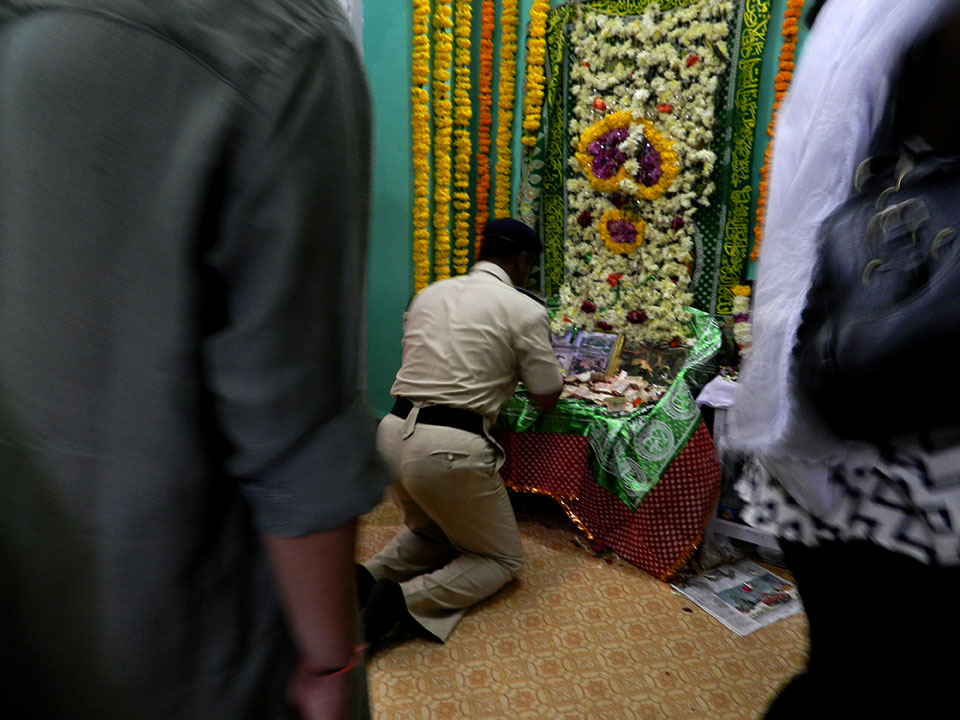
Once a year on Mahimi’s Urs, thousands from around the city, not least the Mumbai police force, come to pay their respects and seek his blessings. The Mumbai police force has the privilege of laying the first chadar, or decorative tomb covering, of the Urs in Mahimi’s respect.
The Mahim police station, about 200 metres away from the dargah, has been built on the site where Mahimi is said to have lived. A green steel cupboard in the Senior Inspector’s room is said to contains the saint’s possessions. During the ten days of the fair held each year to honour Mahimi, the office is thrown open for devotees.
“The full Mumbai police follows Makhdumi Baba,” said Basheer Baba, 55, who is among the dargah officials overseeing the festivities. “Nobody can break that bond. There should be more chances like this of Hindu-Muslim love.”
In the rooom that holds Mahimi’s possessions
An ancient tradition
On hearing that a journalist was in the vicinity, a series of constables in festive plain clothes ushered this reporter in to a small building off the main compound where the retired senior police inspector organising festivities this year, sat with his team of ten constables.
“I was in the papers today,” the inspector said, taking a small, neatly folded rectangle of paper out of his pocket. “See, that’s my name, LB Shaikh.”
Shaikh, as the Times of India said in its three-paragraph note of the procession’s timings, happened to join the police force in 1979 on the very day of Mahimi’s urs. His first posting was at the Mahim police station. This, he said, gave him a special attachment to the holy man.
“He was not a saint – he was our guide,” Shaikh said. “He was a very scholar person, a spiritual and qualified man. Police used to take advice for unsolved cases and he would help us. This is a long tradition of 500 years.”
Scholar and judge
It is in fact slightly longer than that. Mahimi is thought to have died in 1431, 584 years ago. He was born in 1372 to a family of intellectually inclined Arab immigrants called nawaits. He lived in Mahim his entire life.
Abdus Sattar Dalvi, in a brief history of the Mahim Dargah which is dedicated to Mahimi, writes:
“The figure of Makhdum Ali Mahimi has commanded respect for his unquestioned devotion to his mother, his generosity, his liberal outlook, and his achievements as a Sufi and a scholar.”
As a spiritual and intellectual person, he became a member of an unaffiliated group of Sufis called Uwaysi. He was also renowned for his scholarship, particularly for an early incisive commentary in Arabic on the Quran. Mahimi’s legal excellence, Dalvi notes, was such that Sultan Ahmad Shah of Gujarat made him a qazi for the Muslims of Thana district.
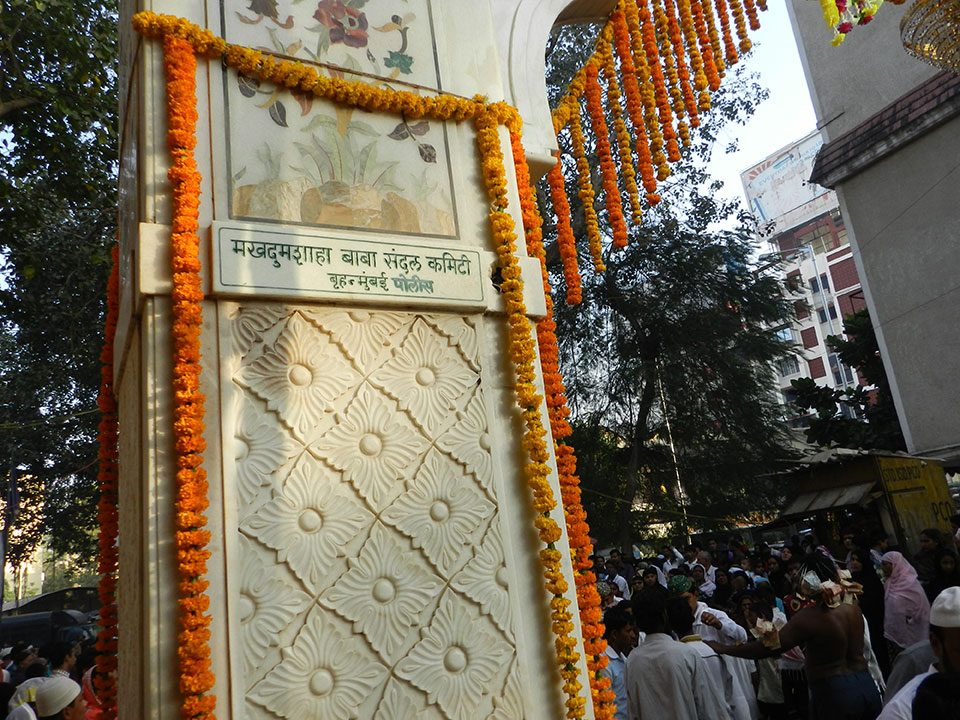
An arch declares the Mumbai police’s attachment to Makhdoom Ali Mahimi.
It was perhaps this appointment that led him to be so closely linked with the Mumbai police. The East India Company formed Bombay’s first militia in 1669, soon after the Portuguese had handed over the group of seven islands to the British in dowry.
The constabulary at that time was drawn largely from conscriptions of land owners, but excluded Brahmins and Banias for a fee. Most of the early recruits were from the Bhandari community of toddy tappers, who were among the original inhabitants of Bombay.
As remained the precedent until Independence, the organising officer of the motley group was a European. It was one of these officers who was said to have worshipped the saint and sought his help for cases.
“A Portuguese sergeant at the time used to worship him and seek his advice a lot,” Shaikh said. “In that way he solved many cases. So at the time of his last illness, he said that after he died, only the police would do Makhdum Shah Baba’s seva.”
Faith runs deep
And so it is today. The Mahim police station was built in 1923 over the site of the saint’s accepted abode. Among the thousands of civilians who lined up on Friday for a chance to seek his blessings, were uniformed members of the police force – traffic police in white, the main force in khaki, and even the red of the police band.
The procession on Friday began, as usual, in the afternoon from the Mahim police station. It ended at the Mahim dargah 200 metres away only at around 11 pm.
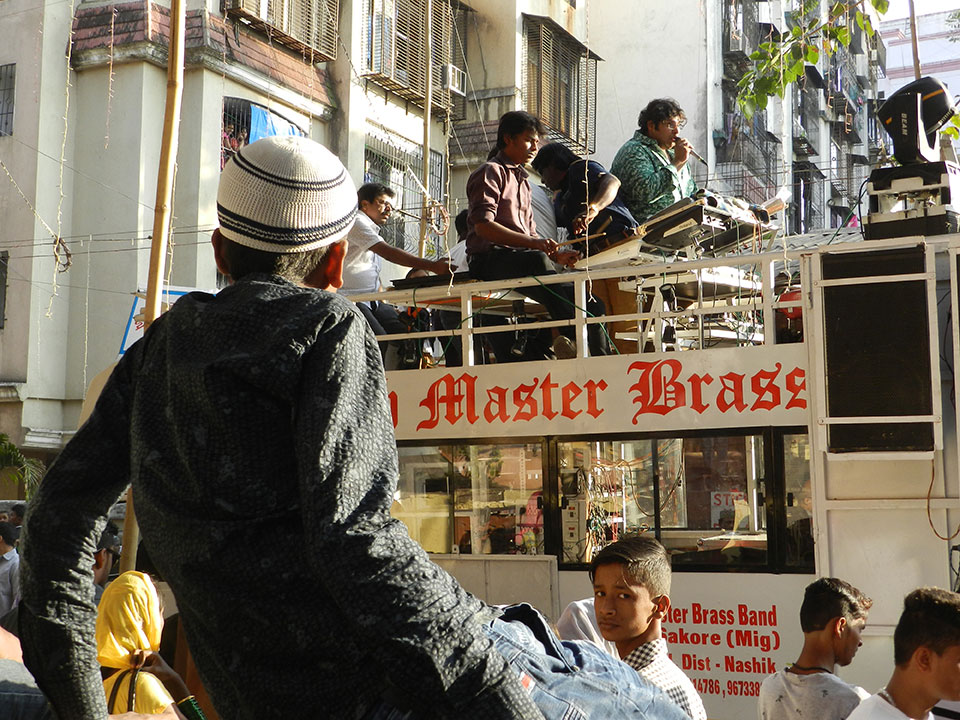
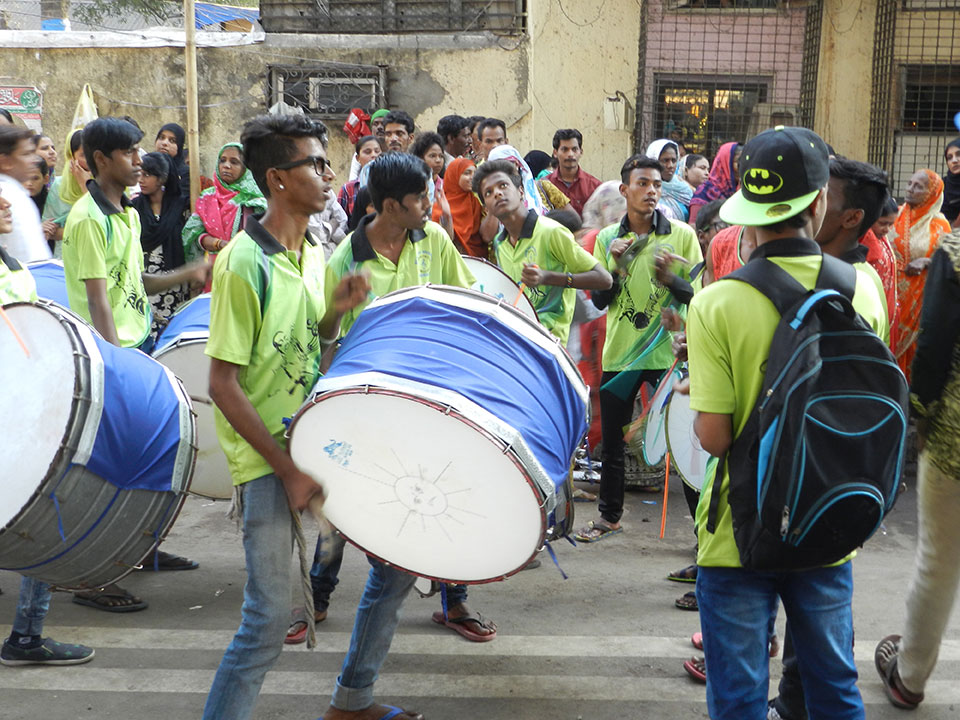
Three vans, all blaring deafening music, marked the procession lines. One, a group called Shaikh Master Brass, had as its star singer a man from Mazgaon whose claim to fame was being one of the qawwali singers in Deewani Mastani from the film Bajirao Mastani.
A woman dressed in decidedly non-festive clothes and looking as if she were on a mission clutched a decibel meter. When asked which organisation she represented, she wordlessly pointed with an air of doom at its measured 104 decibels and set off once again into the din.
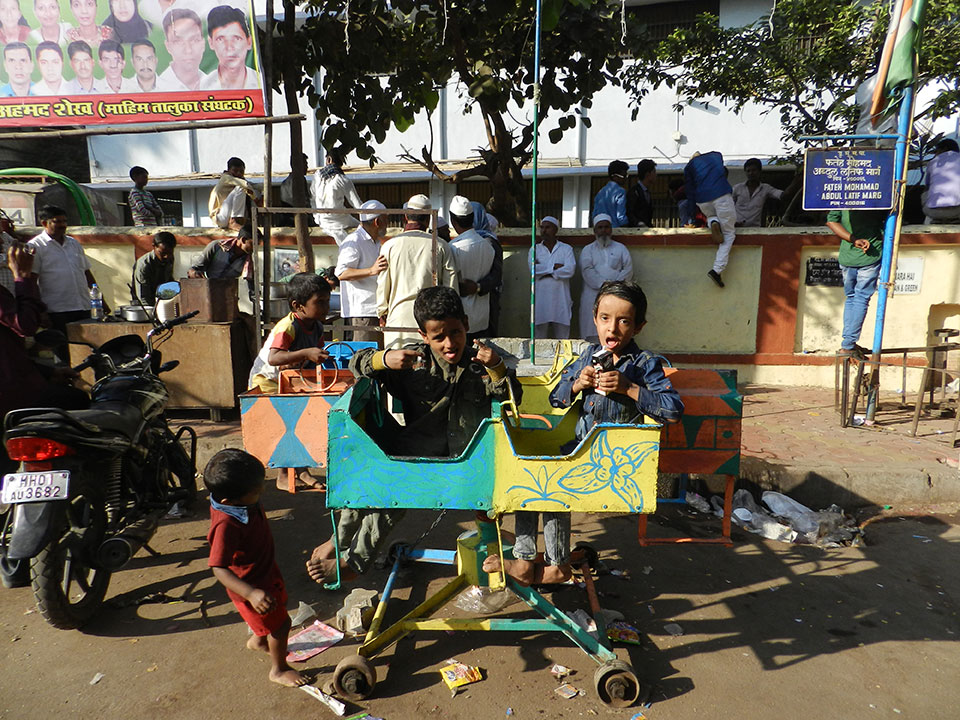
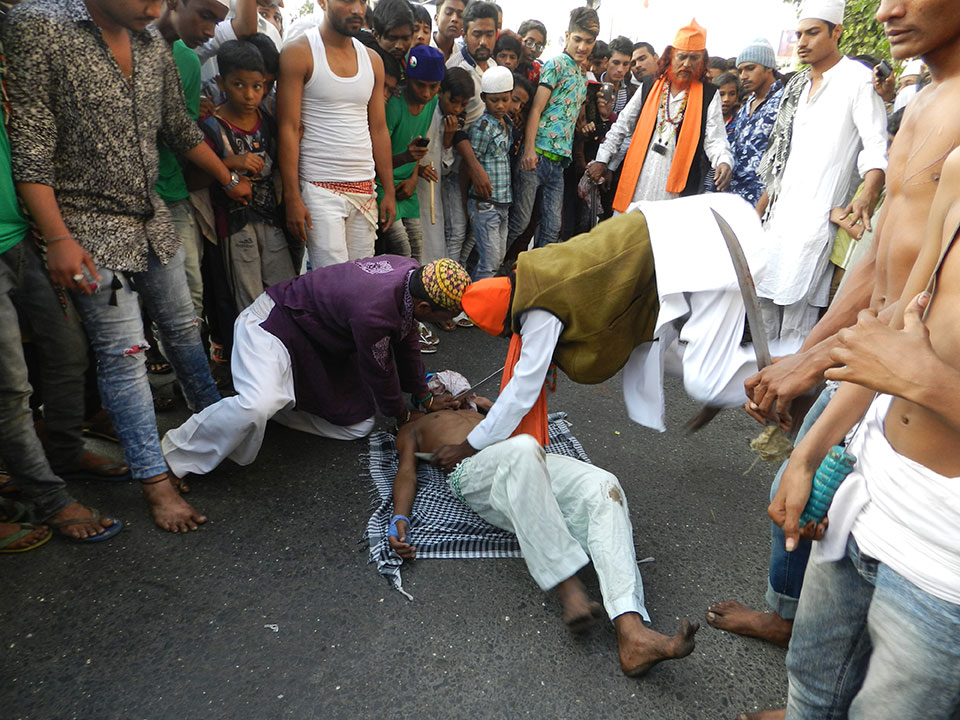
Children and adults alike clambered up to line the boundary walls of residential buildings for a better view as the regular events of an urs proceeded in the centre – devotees swirling incense towards themselves, young men whirling blades to cut their backs, children getting their ears pierced.
Sania Qureishi, 8, was a tough customer. When asked what she liked best about the fair, she pursed her lips and said, “I don’t know yet. I will have to wait and see before I can decide.”
A man for Mumbai
Other places in the city also bear Mahimi’s name, notably the colloquially named JJ Flyover that was until a few years ago the longest in Mumbai. In records, it is called the Qutb-e-Kokan Makhdoom Ali Mahimi Flyover.
Nor is he just the saint of the Mumbai police force. Aspiring actor Ramesh Kumar credits his moderate success in films to him.
“I am a Hindu, but I have faith in Baba,” Kumar said. “Hum jaat ko nahi manta, kalakar hai.”
Kumar, or Junior Johny Lever, as he prefers to be known, said that he has been seeing the procession since he was a child growing up in Mahim. Two years ago, he began to perform comedy and anchor small events at the station. He also got a role as extra in two films. This he credits to the intervention of the saint who he began worshipping six years ago.
Said head constable Chandrakant Salve, “See, the way Mount Mary [in Bandra] and Siddhivinayak temple [in Prabhadevi] are both parts of Mumbai, in the same way even Makhdumi Baba is Mumbai’s only. There is no race or religion here – Hindus, Muslims, Christians, they all believe in him. So do I.”
Behind the optics of the grand gesture, though, some problems remain. Muslims form about 1% of the Maharashtra police force, lower than the national average of 4%, according to the National Crime Records Bureau. That’s the kind of structural imbalance offering a chadar to the saint won’t be able to remedy.
source: http://www.scroll.in / Scroll.in / Home> Syncretic Tales / by Mridula Chary / Photos by Mridula Chary / December 26th, 2015
Mir Alam Tank is a fresh water tank in Hyderabad, located in the southern part of Musi River. It had been a primary source for drinking water to the city before the construction of Osman Sagar and Himayat Sagar.
The tank was named after Mir Alam Bahadur, the then Prime Minister of Hyderabad during the reign of Asaf Jah III, the third Nizam of Hyderabad State. Mir Alam Bahadur is believed to have laid the foundation for the tank on July 20, 1804 which was then completed in a period of two years and declared open on June 8, 1806. It was from the share of the treasure he got from Srirangapatnam that he built this tank.
It is indeed a treat to watch this engineering marvel that was built by a French engineering company, which comprised of 21 semicircular arches spread across one mile. It was reportedly planned by General Michel Joachim Marie Raymond, popularly known as Monsieur Raymond, the French Military General to whom Hyderabad’s Raymond Tomb has been dedicated and is the founder of Gunfoundry in Hyderabad.
Mir Alam Tank is a testimony to the efforts of Hyderabad’s erstwhile rulers who have used the topography of Deccan plateau to build vast water bodies. The boating facility is popular with tourists where one gets to enjoy the pleasant breeze and a refreshing experience. The cruise facility is available at an affordable price and the tourism department has introduced modern boats as well. During the peak time of Mir Alam Tank’s utilisation, historians say that the water of the tank was so sweet and pure that people carried them in containers to their home towns.
Nehru Zoological Park lies adjacent to this tank and boats are operated on the lake. It is a perfect tourist spot in Hyderabad. One can choose mechanised boats, steering boats or speed boats. With changing time patterns of the day, the lake acquires different hues. Several migratory birds make the precincts their home during different seasons while the dense vegetation of the Nehru Zoological Park at one side offers a tropical feel.
Compiled by Jaya Vellampalli
(This column features strikingly beautiful, yet lesser-known gems of Hyderabad, which have some intriguing tales related to them.)
source: http://www.metroindia.com / MetroIndia / Home> LifeStyle> Places / by Jaya Vellampalli / December 27th, 2015
While the Bruhat Bengaluru Mahanagara Palike (BBMP) plans to introduce stringent measures in the city to ensure proper waste segregation by Bengaluru’s citizens, 33-year-old Mansoor Ahmed, waste-picker from the city, will be in Paris for the 2015 United Nations Climate Change Conference, COP (Conference Of Parties) 21, scheduled to be held from November 30 to December 11.
His hard work and vision in spreading awareness about waste management among the citizens has led him to Paris to present a talk to participants from across the world.
During his visit to Paris, he will talk about the importance of waste segregation and how he was able to create awareness and convince 75 per cent of his customers to segregate waste at source.
Mansoor speaks three languages: Tamil, Hindi and Kannada. He admits he cannot utter a single sentence in English. “English is not a problem as long as my work talks for me. I’m genuine and there is sincerity in my work which will speak for me. Besides, I will have a translator. As part of my talk, I will be narrating my journey from a seven-year old rag-picker to what I’m today,” he says. He has a team of 12 members at the Jayanagar DWCC who manage an inventory of 10-12 tonnes of dry waste every month.
Mansoor’s talk will be translated by Kabir Arora, who coordinates Alliance of Indian Waste-pickers (AIW) – an informal network of organisations, cooperatives, and companies working on waste management with the help of waste-pickers. Hasiru Dala, which is a coalition member the AIW and an organisation of waste-pickers and waste workers, is sponsoring Mansoor’s 10-day trip.
“The team from Hasiru Dala asked me if I was interested in going to Paris for a conference. I was elated and immediately said yes. My passport and visa had to be made,” says an excited Mansoor. He flew to Delhi from Bengaluru on Monday and will reach Paris later in the day.
Mansoor operates the Dry Waste Collection Centre (DWCC) (recyclables and inorganic waste aggregation and sorting unit) in ward 168 of Jayanagar in. He went door-to-door in the area around the centre to encourage residents to segregate their wastes and drop it at the DWCC.
The daily collection of the DWCC is about 120 kg from waste-pickers. The DWCC receives one tonne of waste from apartment collection. Mansoor uses a rotating fund of `3,000 to buy wastes from the apartments.
He will be part of a joint delegation of Indian Youth Climate Network (IYCN) and Alliance of Indian Waste-pickers (AIW) for COP 21.
The IYCN is a network uniting Indian youth and youth-oriented organisations who are concerned about climate change and environment issues. The network works to generate awareness about and establish consensus on what role India should play in the global debate of climate change and how it should address its domestic issues.
Mansoor was just a seven-year-old when he began helping his parents collect waste by sorting it. At that time, he used to manage around 500 kg of waste every month.
He attended a small government school near his home but had to drop out of school in Class 5 when his father passed away.
He is the oldest among nine siblings (he has six sisters and two brothers), and the burden of responsibility to take care of them brothers and sisters feel upon his young shoulders.
He joined the informal waste sector with his mother to help supplement the family income.
They ran a small scrap shop near their home where all the waste-pickers from their slum would bring their daily collection. They would manage around 500 kg of waste every day.
Working with waste has therefore been the only job that Mansoor has known, but it has provided for him and his family. Thanks to the use of technology and people his people-management skills, Mansoor has been able to scale new heights.
He says he is eager to learn the concepts of solid waste management followed in Paris and will find ways to implement it at his centre too.
From the conference, he wants the countries to pursue the agenda of recycling (Waste to energy) in their climate action commitments as opposed to incineration of waste — which is currently being proposed as a climate solution by many governments. Incineration is being perceived as a threat to Mansoor’s and many other green entrepreneurs’ livelihood.
For his visit, he was asked to buy a pair of thermal wear as Paris would be freezing at this point of time. “I didn’t know that we could find thermal wear here. I was asked to buy them; but one pair costs `2,000. But it’s going to keep me warm when I land there. I have already purchased my formal wear two months ago. I am too excited about my trip. It all feels surreal,” he says.
With his contagious smile he has been easily able to build excellent relationships with his customers to whom he provides waste collection services. The last few days he has been flooded with congratulatory messages from them for this prestigious trip.
Today, with the Paris trip materialising, he feels his hard work has paid off although he claims never to have imagined that he would be able to visit a foreign country. “This is my first visit to a foreign country…and in an airplane. I’m feeling ecstatic and proud. Never in my life had I imagined that I would get such an opportunity. This would not be possible if it were not for the people who supported me throughout my life. I really want to thank my well-wishers, friends and relatives,” says Mansoor, who has three children: two boys and a girl.
He has enrolled his children in Oxford School in JP Nagar. And his aim now: To give his children a solid education … and the freedom to follow their dreams.
source: http://www.bangaloremirror.com / Bangalore Mirror / Home> Bangalore> Civiv / Bangalore Mirror Bureau / November 30th, 2015
East African Asian society was complex and contradictory as any truly multicultural society needs to be, and perhaps as only Indians can make it
Toronto, CANADA :
It is amusing to contemplate that if an Indian man, one afternoon in March 1498, had been able to swim, he would have escaped capture by Vasco da Gama off the Mozambique coast, and the world might have been different. The Indian, whose companions had managed to swim away, was called “Davane” by his captors; he was from the Gujarati city of Khambat (Cambay). Davane gave advice to da Gama on local matters and even assisted him in outwitting the local sultan, so that the Portuguese ships eventually anchored safely in Malindi, up north in present-day Kenya. Here he took a pilot, who was possibly a Gujarati, and reached the Malabar coast.
Portuguese sailors plying the Indian Ocean thereafter often wrote about the presence of Indians and Indian ships in Kilwa, Mombasa, and Malindi. Around 1500, Captain Duarte Barbosa observed, “These ships of Cambay are so many and so large, and with so much merchandise, that it is terrible to think of so great an expenditure of cotton stuffs as they bring.” The trading connection between India and East Africa is actually even older, as the carving of a giraffe on a wall of the Konark sun temple indicates.
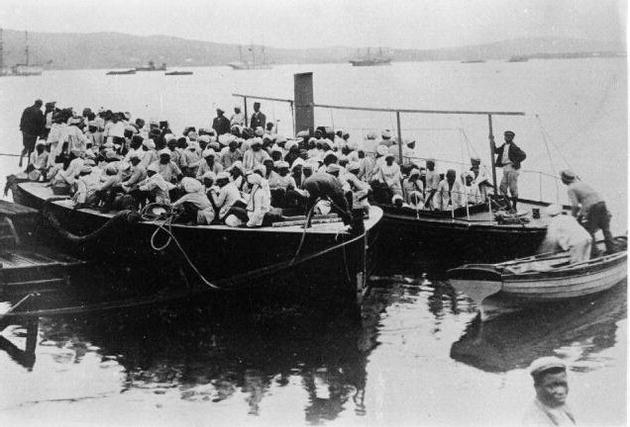
The arrival of Indians in South Africa by boat. / The Hindu Archives
It was in the nineteenth century, however, that Indians began arriving in numbers to trade and settle in Zanzibar, which was by then a major metropolis in the Indian Ocean with international connections, and home to the ruling Omani sultans. The more enterprising men ventured off to the small towns dotting the mainland coast. Most Indians arrived penniless from their drought-prone villages in Kathiawad and Kutch, and remained modest traders, but a few of them went on to become veritable merchant princes with spectacular wealth. Among them were Jairam Sewji, Ladha Damji, and Tharia Topan, to whose firms the sultans farmed out their customs collection and to whom they were often in debt.
Generation of tycoons
With the advent of British and German colonialism in the early twentieth century, Zanzibar’s commercial power and political influence waned, while the interior of East Africa opened up with new infrastructure and increasing trade. As a result, the Indians spread out all over the mainland, which now consisted of the three colonies of Kenya, Uganda, and Tanganyika. (In 1964 Tanganyika and Zanzibar joined to form Tanzania. The Indians went on to be called “Asians”.) The new generation of tycoons included Sewa HajiParoo, whose caravans went from Bagamoyo (near Dar es Salaam) all the way north to the Kilimanjaro region. His apprentice, Allidina Visram, topped him to become “the uncrowned king of Mombasa,” supplying the dukas (shops) that had sprung up from Mombasa to Uganda, and further in eastern Congo and southern Sudan. In 1890 A.M. Jeevanjee, a Bohra from Karachi, arrived in Mombasa and made his fortune supplying goods (and workers) to the Uganda Railway. Much of early wood-and-iron Nairobi was constructed by his firm; the city’s Jeevanjee Gardens was his donation.
By the mid-twentieth century every small town in East Africa had the characteristic Indian strip of shops, and in even the smallest village you would find an Indian family branch running the solitary Indian shop. The Asian population totalled 366,000, with the highest number, 176,000, in Kenya with its total population of around 9 million. Unlike elsewhere, Indians had settled in East Africa as communities; there were Bhatias and Khojas, Jains, Shahs, Patels, Lohanas, Sikhs, Bohras, Memons, Kumbhads, and others. In the cities, the larger communities like the Khojas had their own primary and secondary schools for girls and boys, hospitals, dispensaries, and community halls. Dar es Salaam, with roughly 100,000 people at the end of the 1950s, had at least five Asian cricket teams. Abject poverty was rare, and even the most straitened household could afford three simple meals a day. For us growing up in East Africa, it was India that was poor and backward, as revealed to us in the newsreels and Indian films of the period.
Complex and multicultural
East African Asian society was complex and contradictory as any truly multicultural society needs to be (and perhaps as only Indians can make it). Asians tended to live close to their own communities; caste discrimination persisted, as did Muslims sectarian differences. Yet by the standards we see today in the world, East Africans were largely tolerant. It was understood that you did your thing. The azaan would go off in the mosques, the Khoja ginans would blare out over loudspeakers from their jamat khanas, a temple procession would block a road, the Diwali fatakdas would explode in the Hindu sections (and elsewhere). There was hardly any inter-communal violence, and nothing to compare remotely with the communal and caste slaughter that seems so routine in India.
Undoubtedly the Asians were racist — looking up to the “Europeans” and down on the Africans, by whom, as middlemen, they were often resented. Intermarriage between communities and races was a taboo that was just beginning to yield as I emerged from my teen years. Because the poorest people were among the Africans, it has been broadly claimed and often in Shylockian language that Asians were their exploiters. Asian liberals like to wallow in self-guilt. I have often retorted that my widowed mother worked from eight in the morning to ten at night, running her small shop, barely making ends meet while raising five children; whom did she exploit? Today many Tanzanian African women run small businesses similar to my mother’s. We often forget the wealthy and sophisticated African peoples who owned land and cattle; and while many Africans had homes in their villages, most Asians in Africa did not. If Asians did not marry Africans, the Africans, with ancient traditions of their own, had their own taboos; to imply that they panted to lay hands on Asian women is itself racist.
At the end of the 1960s
Be that as it may, around East Africa’s independence, in the early 1960s, there was a thriving community of Asians who saw themselves as Africans. In Tanzania most would speak two Indian languages plus Swahili and English. Among the elite there was excited talk of the “new African Asian” identity. There were Asian politicians and budding writers — Wole Soyinka’s Poems of Black Africa (1975) includes, significantly, three young Asian poets from Kenya; Africa’s most influential and exciting literary magazine of the 1960s, Transition, was founded and edited by Rajat Neogy of Kampala; and Amir Jamal, Tanzania’s beloved minister of finance for many years, was elected in African constituencies. At the end of the 1960s, there was no doubt in my generation that Africa was our home and we were in the vanguard.
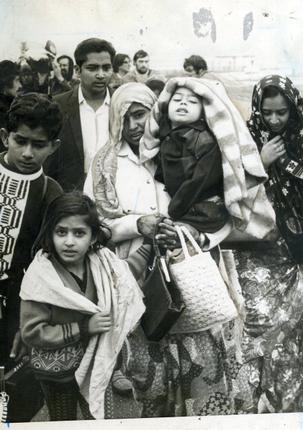
The first set of Ugandan refugees to arrive at Stansted Airport near London after then Ugandan President Idi Amin ordered them on September 18, 1972 to leave the country. / The Hindu Archives
And yet in the 1970s it all fell apart. Kenya’s Asians who had not renounced their British citizenships in time had to leave en masse. In Uganda, Idi Amin had a dream and expelled all the Asians in another “Asian exodus”. In Tanzania, in spite of Nyerere’s enlightened policies, his socialism, combined with the Idi Amin scare, drove out many Asians. What remains of the Asians today is a somewhat insecure and aggrieved population, though most appear dedicated to where they live. Racism of the old sort is gone; intermarriages do happen. At crowded kabab and bhajia restaurants in Dar es Salaam, it is truly pleasing to see Indians and Africans squeezed together at the tables. Indian cuisine has made a big headway especially in Tanzania; country bus stops often have a stand making chapatis; “pilau,” “biriyani” and “sambusa” are Swahili words. What thwarts complete integration is the Asians’ distinct features and cultures, often reinforced by their religious traditions.
A new crop of young Indians has started to arrive. When I see them, they seem foreign and lost. At times I get xenophobic — what are they doing here? do they even speak the language? — when I myself am now Canadian, but also an African Asian.
(M.G. Vassanji is the author of A Place Within: Rediscovering India, and most recently, of And Home Was Kariakoo: A Memoir of East Africa. He lives in Toronto. www.mgvassanji.com)
source: http://www.thehindu.com / The Hindu / Home> Opinion / by M. G. Vassanji / December 27th, 2015