Category Archives: Arts, Culture & Entertainment

Amidst Sahitya Akademi row, President Mukherjee gives away Sangeet Natak Akademi awards

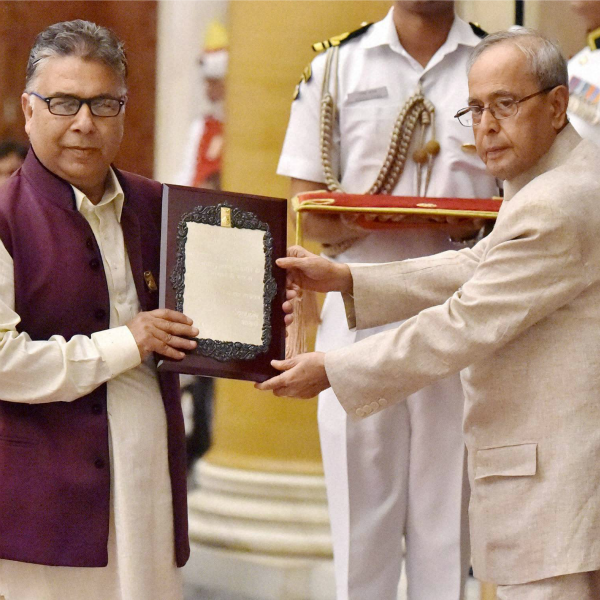
Eminent folk singer from Jammu and Kashmir Abdul Rashid Hafiz who is known for his renditions of traditional singing Chakri was among eight artists facilitated for their contribution in traditional arts.

Doyen of Indian theatre M S Sathyu, eminent vocalists SR Jankiraman, Vijay Kumar Kichlu and Harmonium player Tulsidas Borkar were on Friday awarded the coveted Sangeet Natak Akademi  fellowship by President  Pranab Mukherjee.

Along with them, 35 other noted personalities from various disciplines of dance, drama and music were conferred Akademi awards for 2014 by the President at a glittering ceremony in the imposing Darbaar Hall of the Rashtrapati Bhavan in New Delhi.

Eminent folk singer from Jammu and Kashmir Abdul Rashid Hafiz who is known for his renditions of traditional singing Chakri was among eight artists facilitated for their contribution in traditional arts.

Noted Kashmiri folk singer Abdul Rashid Hafiz receiving the Akademi Award from President Pranab Mukherjee at Sangeet Natak Akademi Awards 2014 function at Rashtrapati Bhavan in New Delhi on Friday. PTI

61-year old Hafiz, who trained under Sarangi Nawaz Gulam Muhammad Dar, is known for giving Chakri his own touch. Chakri is one of the most popular types of traditional music played in Jammu and Kashmir. The responsorial singing uses harmonium, and traditional instruments like the rubab, the nout, the geger and the chimta. The Akademi Awards carries purse money of Rs 1 lakh in cash, a Tamrapatra and an Angavastram.

Sangeet Natak Akademi Fellowships (Akademi Ratna Sadasyata) and Sangeet Natak Akademi Awards (Akademi Puraskar) are recognised as the most coveted national honours bestowed on performing artists as well as teachers and scholars in the field of performing arts.

Among the eminent artists awarded fellowship of the Akademi, 85-year-old Sathyu is doyen of Indian theatre known for his classic movie ‘Garam Hawa’ on partition which introduced actors like Farooq Sheikh to Indian cinema.

Besides, he has designed and directed productions for many theatre groups including Hindustani Theatre, Alyque Padamsee’s Theatre, Herbert Marshall’s civic theatre, Balraj Sahni’s Juhu Art Theatre among others. His play Mudra Rakshas will be performed on October 27.

source: http://www.dnaindia.com / DNA Analysis / Home> News> India / Place:New Delhi, Agency:PTI / Friday – October 23rd, 2015

Kashmiri journalist bags media award

Former Director of AJK Mass Communication Research Centre, Jamia Millia Islamia, Obaid Siddique, also congratulated Aliya.

Independent journalist from Kashmir, Aliya Bashir, was conferred award by Schizophrenia Research Foundation and Press Institute of India for her reportage on mental health issues from Kashmir.

The award, SCARF-PII Media for Mental Health Awards, running in its third year, was given to her in Chennai for her piece ‘Kashmiri Women Explore Spiritual, Psychiatric Treatment for Mental Illness’ in which she chronicles the lives of three women with mental illness and how they cope up with the problem.

Aliya bagged the first prize in the English category while the second prize was given to Divya Chyandrabbau of The Times of India.

Meanwhile, senior journalists and academics have congratulated Aliya on her feat.

“For us, it is a moment of pride and happiness. Congratulations Aliya,” veteran Kashmiri journalist Yusuf Jameel wrote on social networking site, Facebook.

Former Director of AJK Mass Communication Research Centre, Jamia Millia Islamia, Obaid Siddique, also congratulated Aliya.

In her talk at the awards ceremony, Aliya has noted that there is need of telling more stories of people with mental illness and how they live.

source: http://www.greaterkashmir.com / Greater Kashmir / Home> Kashmir / by GK News Network / Srinagar – October 22nd, 2015

The Ustad and his times…

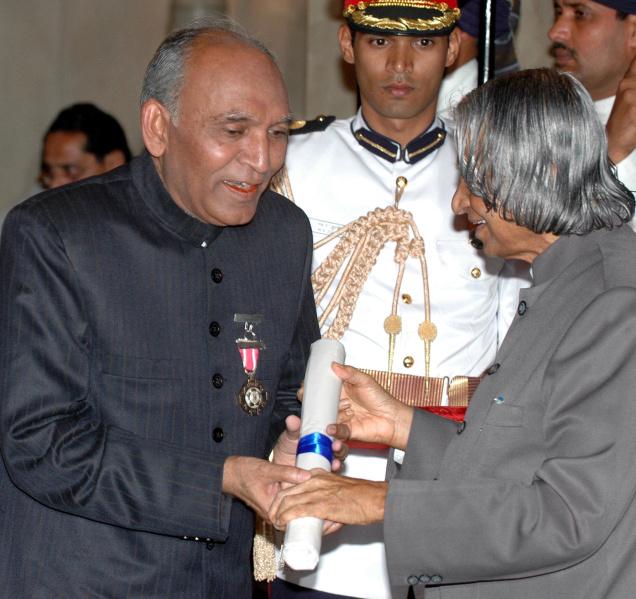
Ustad Ghulam Sadiq receiving the Padma Shri / Photo Sandeep Saxena / The Hindu

Ghulam Sadiq Khan, an eminent Khayal singer, rues that ustads do not get the same kind of reverence as they used to.

Ghulam Sadiq Khan, an eminent Khayal singer of the Rampur Sahaswan Gharana, recently released a three CD pack titled “Dharohar”. His dulcet Raga Darbari testifies to his range as a noted singer.

A recipient of Padma Shri, Sadiq Khan’s first guru was his father, the late Sarangi Player Ustad Ghulam Jafar Khan (1908-1981) and his second guru was Ustad Mushtaq Husain Khan (1878-1964). As a student, he was told to treat his guru as God but rues that ustads these days do not get the same respect.

Excerpts from an interview:

What affected you deeply when you wanted to establish yourself as a singer?

Slow recognition but when it came there was no looking back. From the age of 15 to 27, I faced difficulties and had to work very hard. In 1956, I became famous countrywide as if a bomb had burst. My struggle was to learn music, practice and appear before audiences and mehfils. Allah took me sky high and my first concert made me. I never looked back after that. Earlier I had to go to people and ask for programmes and tell them who I was. Later things became smoother.

Did these problems discourage you?

I struggled in riyaaz for 10 to 12 years and practised for over 10 hours a day for five years. Programmes started coming regularly and I became known after a hard time. A yug of riyaaz went by but my lineage and gharana helped me stand on my own feet. Others helped too.

What did you learn from your difficult days?

I learnt that honesty is the greatest thing in music. Also, belief and dependance on the Ustad is paramount. They are to be regarded as God. Today’s Ustads don’t have that respect from others and this has led to a decline in North Indian classical. I learnt to believe in the Guru and to regard him as God is the biggest thing.

Today I am happy with what God has given me – ilm (art), izzat (respect), shoharat (name) throughout the world. My CDs have been released in London and Singapore. What more can one ask for?

source: http://www.thehindu.com / The Hindu / Home> Features> Friday Review / by Atul Mittal / October 22nd, 2015

Poetic touches in Urdu

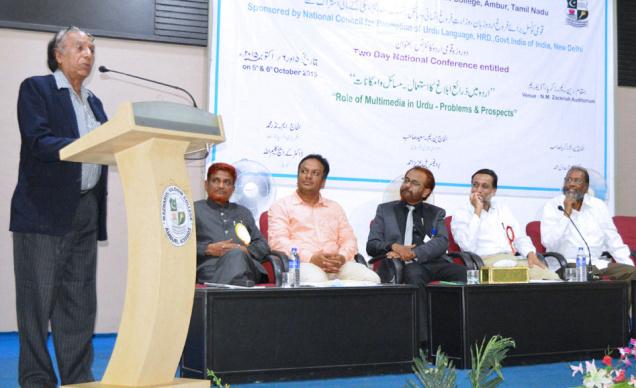
Urdu poets share their verses at a mushaira in Ambur.

Urdu poets met recently at a mushaira (symposium) in Ambur to bring alive the beauty of the language. The event, organised by the Department of Urdu of the Mazharul Uloom College, Ambur was part of a two-day national seminar on “Role of Multimedia in Urdu: Problems and Prospects,” sponsored by the National Council for the Promotion of Urdu Language (NCPUL) attached to the Union Human Resource Development Ministry, New Delhi.

A group of poets from the Southern States brought alive the brilliance of Urdu poetry and captivated a large audience with their couplets and ghazals that spoke of love, peace, national integration and communal harmony.

The highlight was the versatile renditions of internationally renowned poet, Althaf Hussain Shadaab ‘Bedhadak’ Hyderabadi. His couplet — “Ameero, Ghareebon ki dua bhi lelo; davayen sirf lene se ho saktha hai” got him a standing ovation.

Niyaz Ahmad Niyaz of Vaniambadi chose the famous ghazal, ‘Chupke Chupke Raat Din Aansoo Bahana Yaad Hai’ penned by Maulana Hasrat Mohani, a freedom fighter and Urdu poet.

Poets Mahmood Shahid ‘Kadpavi’ of Kadapa, Andhra Pradesh, Haamid Akmal of Gulbarga, Karnataka and Raahat ‘Haraarat’ of Ambur, too shared their shaiyiri, some old and some new, much to the delight of the literary lovers.

M. Nazar Mohamed, secretary and correspondent, Mazharul Uloom College, presided.

source: http://www.thehindu.com / The Hindu / Home> Features> Friday Review / by Syed Muthahar Saqaf / October 22nd, 2015

Nadia royal family bears Puja torch since Akbar era

Krishnanagar  :

Illuminated by earthen lamps and torches (mashals), the idol of Ma Raj Rajeshwari looks resplendent in the Akbar-era Natmandir at the Krishnagar Maharaja’s palace.

The serenity is suddenly shattered by the town crier’s shrill call: “Attention! Agnihotri Bajpeyi Raj Rajendro Maharajadhiraj Nabadwipadhipati Mahashaya Krishno Chandro Roy Bahadur is arriving.”

On cue, 108 dhakis beat drums to frenzy.

The Maharaj arrives in an elaborately carved silver palanquin that was gifted to one of his forefathers by Emperor Jahangir. He approaches the pulpit. Shortly thereafter, the palace cannon booms, a signal for the beginning of sandhi puja. A hundred and eight buffaloes are assembled before the Goddess. At shandhikshan, the heads are severed and placed before the Goddess as offering to cleanse the human spirit of its evils. “As a child, I grew up watching these rituals being performed while sitting on my grandmother Maharani Jyotirmoyee Debi’s lap. Growing up, I always held a grudge against Ma Raj Rajeshwari. How could the divine mother, the supreme protector of good and the destroyer of evil, devour so many harmless, helpless lives? I would often bring this up with my father. Being a God-fearing man, he would stick to tradition till the resistance melted away when he saw my infant son Manish crying on witnessing the sacrifice.The practice was stopped in 1987,” said Saumish Chandra Roy , the 39th descendant of Nadia royal family .

Nadia Rajbari’s Durga Puja remains the oldest puja in what was then Anga-Banga-Kalinga or undivided eastern India region. Started in 1603 by Maharaj Rudra Rai, the great grandfather of Krishno Chandro, it has continued uninterrupted till date. “The puja began two years before the death of Emperor Akbar. Since it all happened at the height of the Mughal era, the influence is very strong in the architecture of the natmandir,” said Saumish’s son Manish. However, though the grandeur of celebrations have shrunk over the centuries, the rituals have remained intact.

Ma Raj Rajeshwari has seen Nadia during the most tumultuous of times. In medieval India, persecution and heinous tyranny on the grounds of religion was common.

Blood was spilt for the protection and defense of Nadia’s “honour”, for the protection of the freedom to choose and profess the religion of our choice.”Jato dharma Stato jayo” (Stay in the path of good dharma and victory will be yours) is embedded in the Krishna gar royal family’s coat of arms.

Ma Raj Rajeshwari’s power was tested during Partition. Nadia had initially been ceded to what was then East Pakistan on grounds of religion. “For three nightmarish days, we were Pakistanis. My father Saurish Chandra Roy , the last officially recognized maharaja, had told Sir Cyril Radcliffe (the chairman of the Boundary Commission in British India) that if Nabadwip was lost to Pakistan, then what would remain of the great Hindu faith in the Anga-Banga-Kalinga region?

 
After three days of rioting, rape and arson, a significant portion of Nadia was returned back to India. The entire population went wild with joy when the news was broadcast over All India Radio. People arrived in trucks from far and wide and assembled in front of the palace gates, shouting ecstatically “Ma Raj Rajeshwari’r Jai!”

Though the princely order was abolished by former Prime Minister Indira Gandhi, some royal customs are still followed. The Maharaj was believed to be the protector of his people.Accordingly a clay model of a “shatru”, symbolizing evil, is created which is slain by the Maharaj every year during the Durga Puja. Saumish does the slaying now.

source: http://www.timesofindia.indiatimes.com / The Times of India / News Home> City> Kolkata / by Subhro Niyogi, TNN / October 19th, 2015

Life, Literature Make for Absolute Films, Says Cinematographer Sunny Joseph

Thiruvananthapuram :

Observing lives and reading literature go a long way in making a film in its absolute form, said cinematographer Sunny Joseph at the valedictory ceremony of the three-day long second Padmarajan Documentary Short Film Festival held at VJT Hall here on Wednesday.

“Cinema is an art form most lapped up by youth. There is an overdose of film festivals as well. It spreads the wrong notion that having a mobile phone camera alone is enough to make a film. They should understand that a knowledge on life is essential for making a film and literature takes you to the lives of the lesser known,” he said.

At the Kerala State Youth Welfare Board organised festival, he recollected his experiences with  “Pappettan” on the sets of the movie ‘Arapatta Kettiya Gramathil’, where he had a 12-day stint with him. Radhalakshmi, wife of director Padmarajan, in her keynote address said those who pursue film-making should have a serious approach towards art. Film critic M F Thomas, cinematographer K G Jayan and film maker Santhivila Dineshan were present.

Winners

‘Soochiyum Noolum’ by Aneesh Kairali bagged first in the short film category. ‘Feet in the Sand’ by Krishnakumar and ‘Achanariyan’ of Saji Palamel came in the second and third positions.

In the documentary section, ‘Strokes of Nature’ by Faisal Muhammed got the first prize. ‘Vithachathu Koyyunnavar’ by Vinod T S and ‘Living the Green Dream’ of Sabil Krishnan emerged second and third. Priyan Prince’s ‘The Newspaper Boy’ received a special jury award.

Best short film director is Aneesh Kairali and Faisal Muhammed was chosen as the best documentary film director.

source: http://www.newindianexpress.com / The New Indian Express / Home> Cities> Thiruvananthapuram / by Express News Service / October 15th, 2015

Fusion feast for Kubers of the world

BallalMPOs15oct2015

by N.K.A. Ballal, Retd. Sr. Vice-President, ITDC

Our Prime Minister Modi has done the impossible. Recently, he managed to get the ceos of 47 Fortune Companies to come together for a meal with him at the Waldorf Astoria, New York. Just to name a few who were invited, Goldman Sachs, Boeing, ibm, Lockheed Martin, Citigroup, PepsiCo, PayPal, Cargill, Starwood, etc. The total worth of the companies under one roof that day was 4 trillion dollars. Wow, the agenda of course was to highlight the “Make in India” campaign and convince these companies to invest more in India.

The biggest headache for Modi’s managers was to zero in on the cuisine and the man to do it. When such global heavy- weights are together, the menu also has to be top class. Modi also insisted that it should be an exhibition of India’s rich gastronomical culture showcasing the different regions of this vast nation. The officials at last chose the celebrity chef Vikas Khanna, a household name in India. This gentleman, born in Amritsar, owns a Michelin Star restaurant “Junoon” in New York. He is considered as one of the best in Indian fusion food business. He has travelled all over India to the nooks and corner including our own Udupi and has integrated the local cuisine with his own fusion style.

Vikas looks like a film star, is a bachelor to boot and has a huge female following all over the world. Vikas and his team laboured for months to try out various combinations and give something unique to these guests who are used to the best of the world and make the evening memorable.

What is fusion cuisine? Personally, I have sat down having some fusion cuisine and not liked them. They are superb to look at but somewhere down the line the original taste vanishes and that is the reason I am not for it. Many a times I have had to come and have dinner at home after a sit down fusion meal. But anyway I am in minority and the whole world craves for these kind of dishes. Let us now have a look at the menu that was served to these esteemed guests:

Paneer-Ravioli, Mizoram black rice khichdi, Coconut rice creme brulee, Thandai chicken, Pomegranate sangria with tandoori pineapple, Coconut chutney mousse, Corn dhokla molten cake with berry compote, Seviyan cakes, Fusion modak and more. It is said that the modak recipe has been given to him by the legendary singer Lata Mangeshkar. I have not gone into details regarding the different pickles and papads served on the table. To ensure authenticity of the recipes, the ingredients were flown in from India. Several of the names are familiar like chutney but chutney mousse? Thandai is a milk drink made of badam and pepper and served specially during the festival of Holi in several parts of eastern UP. But a chicken dish made from this? Real fusion.

I really wish that these Moghuls loosen their purse strings after eating these exotic fusion meal. These recipes form a part of a book called “Utsav – A Culinary Epic of Indian Festivals” penned by Vikas Khanna. This book, weighing 16 kg, is a 1000-page Coffee-Table book. It contains 1000 recipes from 70 Indian festivals. This book has been published by Bloomsbury Publishing and is written with pure gold ink. A Collector’s Item, this book was presented to the US President Obama by Vikas Khanna after the above event. The cost of the book, anybody’s guess?

Coming back to India and our own Namma Mysuru, I was pleasantly surprised to receive an invitation from my friend Dr. Javeed Nayeem on behalf of an organisation called Anjuman -e-Hadiqatul Adab to attend an Eid Milan dinner on Sunday, 4th of October. Since I knew that there will be lots of speeches in Urdu, I wanted to give this event a miss. But on second thoughts, I attended the programme. For the first 45 minutes, I did think that I had made a mistake to come as I could not understand anything being discussed on the stage. But then Dr.Javeed sprang a surprise. He called a Urdu teacher, Lal Hussain Ilkal from Bijapur (now Vijayapura) to come and speak. Looks are deceptive and Mr. Hussain is a perfect example of that. I have attended a few discourses and it is for the first time I have come across a speaker who could fine balance between religions. What a speaker, having a complete command on Kannada language, proficient in Arabic, Gita and even Basavanna’s poems. It was such a joy to hear someone talk in pure Kannada with hardly an English word thrown in during his 45-minute discourse on the subject of religion without casting aspersions on any religion or language. The icing on the cake was the lovely vegetarian meal arranged by the hosts. The divide between the two prominent communities are too huge but your “alilu seve” to bridge the divide, Dr. Javeed, is very commendable. Thank you Dr. Javeed and your team.

Dwelling on the subject of vegetarian food, are my readers aware that the oldest and very popular vegetarian restaurant in the world, certified by the Guinness Book of Records, is in Switzerland and not in India. Surprised? The restaurant called “Haus Hiltl” was founded in 1898 by some German immigrants to popularise vegetarianism as a way of healthy living. This restaurant is located in Zurich’s Sihlstrasse district and has been visited by our own Morarji Desai among other celebrities. Imagine getting Indian thali, sambar-vada, palak-paneer, chutney and curries in Switzerland. Well, next time you venture to Switzerland, do not miss this landmark joint.

[e-mail:ananthballal@yahoo.com]

source: http://www.starofmysore.com / Star of Mysore / Home> Feature Articles / October 15th, 2015
Old Quranic Exhibition at Chow Mohalla Palace

Prince Azmath Jah inaugurated the 600 year old manuscripts of Quran at Chow Mohalla Palace, Khilwath yesterday. The exhibits include 2.5 cm to 9 ft. books written in various styles of Arabic Calligraphy from Iran, Iraq, North India, Kashmir etc. Speaking on this occasion, Prince Azmath Jah applauded the efforts of the persons who organized this exhibition.

Prince Azmath Jah inaugurated the 600 year old manuscripts of Quran at Chow Mohalla Palace, Khilwath yesterday. The exhibits include 2.5 cm to 9 ft. books written in various styles of Arabic Calligraphy from Iran, Iraq, North India, Kashmir etc.

Speaking on this occasion, Prince Azmath Jah applauded the efforts of the persons who organized this exhibition.

Present on this occasion were, Princess Asra Jah, Princess Shehkaar, Prince Azam Jah, Mr. Asif Pasha, former Law Minister, Lt. General Zaki, Begum Bilquees Lateef, Mohammed Abdul Basith, former DGP, Mr. Meer Kamaluddin Ali Khan, Secretary, Mukkram Jah Trust for Education and Learning, Mr. Iqbal Ali Khan, Mr. Faiz Khan, Mr. G.Kishan Rao and Ms. Anuradha Naik.

Speaking on this occasion, Prince Azmath Jah told that he is very much pleased to see this exhibition which has added to the beauty of Chow Mohalla Palace. Ms. Anuradha Naik played a key role in organizing this exhibition.

–Siasat News

source: http://www.siasat.com / The Siasat Daily / Home> News> Hyderabad / February 08th, 2014

A maestro and his love for ‘Benglor topi’

BismillahKhanMPOs12oct2015

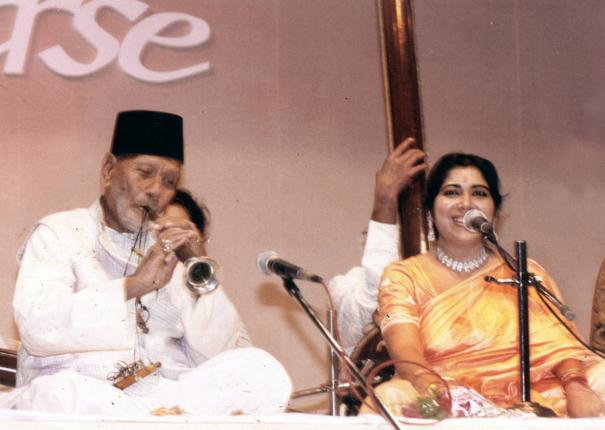
As the world celebrates the birth centenary of shehnai maestro Bismillah Khan this year, Bengaluru and Karnataka have their own links with the Ustad to cherish.

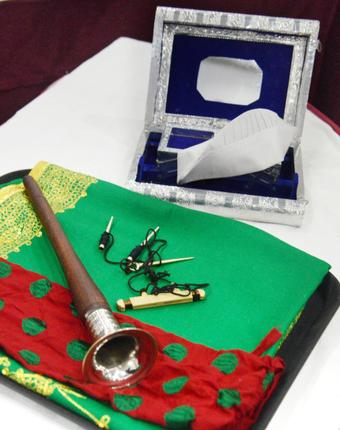
His youngest daughter, Bengaluru-based Kaneez Fatma recalls that he loved his ‘Benglor topi’, as he fondly referred to the special topi he had received from the then king of Mysuru Jayachamaraja Wadiyar after one of his concerts at the palace. “He wanted to wear his ‘Benglor topi’, which he cherished, for every small function and kept it safely packed after use,” recalls Ms. Fatma.

TopiMPOs12oct2015

Organisers of his concerts here too have fond memories of the maestro. Imagine Bismillah Khan making audiences sway in unison to his Ram Dhun, says S.N. Varadaraj of Sree Ramaseva Mandali, Chamarajpet. “He was such a pious devotee of the Ganga that he would bring water from Varanasi for his entire stay here,” he said.

Bismillah Khan’s shehnai playing for the Kannada film Sanaadi Appanna and his subsequent association with Rajkumar, who played the role of a shehnai player in the film, remains etched in Karnataka’s memory for its heritage value. “His modesty was so apparent. In 1977, after the recording, he used to show us pictures and proudly declare that Kannada hero Rajkumar had lunch with him,” recalls the maestro’s son Zamin Hussain Khan.

And when it came to gastronomic delights, the maestro could not resist some of the delicacies of Bengaluru, reveals his family members. “He loved the shami kabab that his friend Nazeer used to prepare for him here. Mysore bonda and vada were also among his favourites and he even used to source them when someone visited Varanasi from Bengaluru,” says his grandson Afaque Haidar Khan.

Soma Ghosh concert in Bengaluru today

Special concert

As a tribute to the shehnai maestro Bismillah Khan during his birth centenary year, Bengaluru Art Fest, steered by Suma Sudhindra and Veena Murthy Vijay, will feature a Hindustani vocal recital by Soma Ghosh, whom the maestro regarded as his adopted daughter, on Sunday at 6.30 p.m. at the National Gallery of Modern Art.

“I feel humbled to have been acknowledged by Khan saheb nearly two decades ago at a mehfil in Varanasi when he singled me out and said my style reminded him of time-honoured yesteryear mehfil gaayikas. Khan saheb’s love for the neo-classical poetic mehfil genre, mainly sung in courts for a closeted royal crowd, had him revive some of the signature darbari mehfil facets into his own styling.

Nobody is singing mehfils these days, and I plan to present some components such as kajari, thumri, tappa, dadra, hori and ghazal during by Bengaluru concert,” said Ms. Ghosh.

source:  http://www.thehindu.com / The Hindu / Home> News> Cities> Bengaluru / by Ranjani Govind / Bengaluru – September 20th, 2015

Reviving an 800-yr-old art

Kolkata  : 

Among the stories of torture, loot and oppression that the British left behind for us, one of the most common is that of how the thumbs of muslin weavers from Bengal were chopped off to wipe out the ancient art form from the face of the country. Muslin has since then been an item only to be seen in museums across the world.

A fine cotton textile making art that originated in India in the ancient times, with the maximum concentration in Bengal, and proliferated under Mughal patronage since the 17th century, muslin died an unnatural death when the British decided to smother it so that they can bring in their own mill-made textiles from Manchester to India.

Recently, the West Bengal chapter of Crafts Council of India has taken up a project to revive the art of muslin making. It started in 2010 and now weavers who were being re-skilled for producing muslin, have finally been able to reach an enviable thread count of 500.

After the Mamata Banerjee government came into power, the state micro, small and medium enterprises department also started thinking on how the fine textile making art can be revived in Bengal. The MSME department scouted for experts in villages across five districts of the state where muslin used to be produced traditionally. In this manner, some 793 weavers’ families were chosen from Birbhum, Murshidabad, Nadia, Bankura, West Misnapur and Burdwan, who had all been connected with muslin making some generations ago. The state government encouraged them to take to the art once again.

When the thread count reached 300 last year, muslin made by weavers under MSME made its way to the government’s Biswa Bangla Haat. MSME department is trying its best to increase the count further because the higher the count, the better is the quality of muslin.

During the time of the Mughals, muslin weavers from Dhaka were able to reach a count of 1500. Samples of these are available in museums across the world. A 500 count means that the two threads crisscross each other to create a mesh 500 times in the span of a square inch. “It all started quite by an accident. An American advertising honcho, Anne Johnson, had visited us with inquiries about muslin and whether any efforts were being made to revive it. She was fascinated with muslin and was even prepared to fund it if we took up a revival project, which we eventually did at a cost of Rs 70 lakh,” said Ruby Pal Chowdhury, who heads the Crafts Council of India here.

The Crafts Council project took place in Kalna, where master weavers, who are otherwise associated with the production of khadi yards under the aegis of the Khadi and Village Industries Commission (KVIC) of the central government and West Bengal Khadi Board (WBKB), kept experimenting with spinning of the yarn with the right thickness out of cotton sourced from Gujarat.

“Once the yarn is spun, it has to be soaked in starch made of kolma or dohor nagra varieties of rice. The water used is essentially rain water to keep the solution soft. There is no formula for this, these are part of family knowledge that are being gradually recalled through re-skilling,” said Pal Chowdhury.

The weavers of the council have not only been able to weave muslin yards but also entwine antique jamdani motifs in it. These have been christened as muslin jamdani and a pure saree woven thus costs nothing less than Rs 20,000. These creations are now available for viewing at Artisana, the council’s outfit at Chowringhee Terrace, while a mega debut is also being planned.

Considering the huge expense that such revival incurs, the council is also trying to tie up with Biswa Bangla to take the revival issue a step forward.

“We would welcome this because the final aim is to bring back muslin to its original glory. That will be possible only if we are able to keep giving incentives to weavers to sacrifice other commercial interests and concentrate on spinning finer yarns and then weaving finer counts,” said Sinha.

source: http://www.timesofindia.indiatimes.com / The Times of India / News Home> City> Kolkata / by Jhimli Mukherjee Pandey , TNN / October 11th, 2015