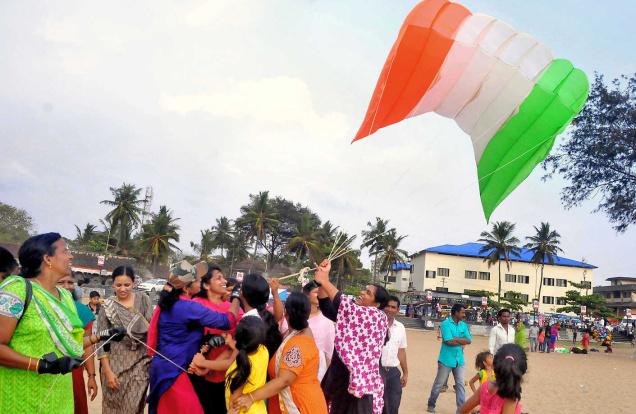
Women, who participated in the kite flying training programme on Sunday on Kozhikode beach, trying to control a kite.— Photo: K. Ragesh
It takes eight to 10 men to control the 1,000-kg circular kite of the One India Kite team. Founder of the team Abdulla Maliyekkal was quite apprehensive when he gave the reins of the kite to a group of women . His apprehension was not misplaced considering how the women struggled with it initially, but it gave way to happiness watching the first professional all-women kite team in the country take form.
The team named ‘Incredible India’ was launched on the Kozhikode beach on Sunday, on the occasion of International Women’s Day.
Training in style
Supported by their parent group One India Kite Team, the women who have undergone training in the nuances of kite flying, took off in style flying the Circular kite and the Kathakali kite amidst the curious Sunday crowd on the beach. “This is the most relaxing experience I have ever had. Controlling a kite is not child’s play. It takes great coordination and team work. Hence while flying the kites, we forget everything else,” said Mini Nair, team captain.
The team now plans to take part in kite festivals across the country and abroad where they plan to present some kites of their own.
As part of the launch of the women’s team, the One India Kite Team, in association with the women’s wing of Junior Chamber International, Calicut, had organised a kite-flying training programme for women, which was attended by 25 women. “The training was given by expert kite flyers Abdulla Maliyekkal,Hashim Kadakkalakam and Shyam Padman.
source: http:// www.thehindu.com / The Hindu / Home> News> National> Kerala / by Aabha Anoop / March 09th, 2015
Nine months ago, Teer Gran in Meerut was in the news for all the wrong reasons – communal clashes had broken out, claiming one life. Several people were injured. Few are aware, however, that Teer Gran is home to the Muslim families that make the colourful Holikas that Hindu communities traditionally burn on Holi eve. This locality is also called ‘Holi Mohalla’.
Around 25 Muslim families here make more than a 1,000 Holikas which find their way to various west UP cities besides Meerut. Mohd Yunus, 50, has a small shop near the lane leading to Bhairon Temple. On Tuesday, there were numerous life-size effigies, decked up and colourful, with feminine features, lining his shop.
“Holika symbolizes victory of good over evil. Hindu legend has it that after demon king Hiranyakashipu demanded that he be worshipped, his son Prahlad remained defiant, and said he would only worship Lord Vishnu. The king’s sister Holika, on instructions from her brother, attempted to burn Prahlad alive by taking him in her lap and sitting on a pyre. Holika had a magic shawl with which she could save herself from burning. She hoped her nephew would be reduced to cinders. When the fire was set, however, the shawl flew and enveloped Prahlad instead. Holika was burnt to death. Prahlad escaped unhurt,” Yunus explains.
For generations, Yunus’ family has been making effigies of Holika that are burnt on the eve of Holi festivities.
“We have no records, but for hundreds of years our family has been making these effigies.” There are about 25 Muslim families that make Holikas in Holi Mohalla. The effigies are made with waste paper, masks and colours.
Shaukat Ali, another resident of the area, said, “We need to make about 1,000 Holikas every year. These travel to Muzaffarnagar, Baghpat and Muradnagar.”
The Holika effigies are the work of entire families. With time, interestingly, volumes have grown. Mohd Wasim, an effigy maker, said, “Earlier, communities would select one place to burn the Holika, which was made on order, and would be quite tall and expensive – we have made effigies 20 feet tall, costing about Rs 2,000, at least. Now, as cities have expanded, even small colonies have their own Holika burning ceremony. Volumes have grown, but the size of each Holikas has shrunk. These days, we make Holikas about five feet tall, costing about Rs 250 each, at most.”
While the Muslim families here make Holikas ahead of Holi, they also make effigies of Ravana ahead of Dusshera. “The Ravanas are rather more difficult to make. For the rest of the year, we make decorations for temples and mosques,” Wasim said.
Asked of his experience during the riots last year, Yunus said, “Buddhi bhrasht ho jaati hai logon ki (people go out of their minds) in time of riots. No one wants riots. These are all politically motivated, and everyone only suffers a loss. Thankfully for us, every time communal tension happens here, Hindu friends ask me to move to a safer place and take responsibility for my shop.
source: http://www.timesofindia.indiatimes.com / The Times of India / Home> City> Meerut / by Sandeep Rai / March 03rd, 2015
Back in the 1950s, when Bangalore was like something out of a F. Scott Fitzgerald bok, Whitefield was a small township on the outskirts of the city. On arriving at the railway station, one took a horse-drawn carriage home through the small, winding streets. It wasn’t long, however, before development put paid to much of that old world charm.
The Sommer House, a colonial bungalow that has been restored to its former beauty by long-time resident Sulaiman Jamal, aims to recreate some of that old world charm. Thrown open to the public on Monday evening, as a community center that gives senior citizens and retired army officials that long lost society whirl, Jamal, whose association with the area began when he set up his factory there said: “We have lived in Whitefield for ten years now, but when I first visited, it was a pretty wild place, Every six months, another bungalow would be torn down.”
The two-bedroom gabled roof Sommer House, bought two years ago by Jamal, replete with antique furniture, is home to a piano that belonged, back in the day, to the Defence Services Cinema. The cottage, sits surrounded by a garden, with restored vintage cars dotting the property.
Jamal would like the House to host programmes like piano nights, dancing, catered dinners and plays. Most importantly, it will also have a free catered dinner every month for senior citizens.
Beth Chapman, President, Overseas Women’s Club, has helped put Sulaiman’s ideas in motion.
“I’m always looking for old bungalows and the stories that surround them,” she said.
“The house is opposite Forum Value Mall and people expected a superstructure here,” Sulaiman explained. “They wonder what the catch is, but there is none. We want the people of Whitefield to feel a sense of belonging with what is now a community center.”
source: http://www.deccanchronicle.com / Deccan Chronicle / Home> News> Current Affairs / DC / Darshana Ramdev / June 18th, 2013
Radha Viswanathan re-lives moments of living and performing with an icon, to Ranjani Govind.
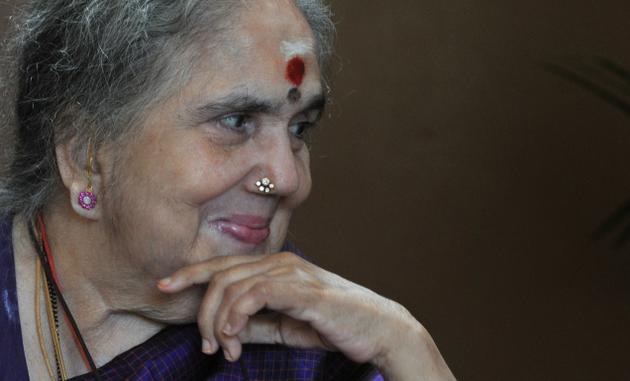
“It’s comforting to see my grand-daughter Aishwarya become a serious performer. I remember the days when I would wonder whether there would be anyone in the family to carry the legacy forward. My prayers seem to be answered,” says the 80-year-old Radha Viswanathan, daughter of M.S. Subbulakshmi, during a recent interview in Bengaluru.
Radha was recently honoured during the release of an album of a nearly 40-year-old soundtrack of MS and hers, in Bengaluru, with veteran mridangam vidwan T.K. Murthy and former ISRO chairman K. Radhakrishnan participating. The album was recorded in Mumbai by the National Centre of Performing Arts (NCPA) and is now being brought out in association with Sony Music.
Radha is happy that the rare gems from the 1970s, was now being shared with rasikas. “It is a historic occasion for our family.”
Radha, who accompanied her mother for over 60 years, be it at live concerts or recordings, cherishes every memory of the time she spent with her iconic mother. “I was blessed to have a mother who was an embodiment of compassion,” she says, as she gets nostalgic. Radha’s mobility might have been restricted to a wheelchair owing to several health issues, but her zest for life, passion for music and elephantine memory keep her as youthful as ever. She can leave you stumped with her recollection of events, rolling back to instances when as a four-year-old she remembered the time when MS entered her family.
Talking about her computer-like memory, Radha says, “Storing information is inherent to my persona. Every time I sang a kriti leant instantly at class, Semmangudi mama would say, ‘You have a camphor-like brain, catching everything instantly!’” recalls Radha, who always made notations of the trickiest of sangatis.
Looking settled in her son V. Shrinivasan’s home, the contentment is apparent on her still radiant face. “It’s rewarding to have taught Aishwarya nearly 500 kritis. Do you realise that it is authentic Semmangudi, Musiri and T. Brinda schooling that I have passed on? My younger grand-daughter Saundarya too is catching up,” she says.
But why didn’t MS train other students? “My mother was too busy an artist to teach. She was incredibly humble and used to continuously learn from others and considered herself a student all her life,” says Radha. There were instances when Radha learnt from Semmangudi Srinivasa Iyer as MS was too busy. Radha would later sing what she had learnt to her mother. “In fact, we practised together to get the nuances right,” she remembers.
Radha stepped on to the music platform as a four-year-old, singing tail-enders or the so-called ‘tukkadas.’ “That was the beginning of my musical journey. But later I learnt from Mayavaram Krishna Iyer and GNB’s sishya, T.R Balu,” she says. Once when MS was unwell, Musiri came visiting. Radha had then sung ‘Saraseeruha’ in Nattai and ‘Sudhamayi’ in Amruthavarshini. Fourteen years later, when the same kritis were presented at the Central College of Music where Musiri was the principal, he remembered, “I recall Radha singing these kritis as a six-year-old. Even then, I knew she would go a long way.”
It was Musiri who had advised them about the importance of ‘voice synchrony;’ he had told Radha, “Your voice should blend with MS’s and sound like a single, integrated tenor.” No wonder their Vishnu Sahasranamam recording is known for this quality! “In the line, “Amaaani Maanado Maanyo,” when MS briefly stopped to take a breath, it had to be re-recorded, but Amma insisted it be left alone. ‘Let people know that Radha sang along,’ Amma said.”
What was special as far as their voice experimentation was concerned were the lessons that MS and Radha got from T. Brinda and T. Muktha, who had by then set a trend in high-and low-octave singing. Kritis such as ‘Janani Ninnuvina’ in Ritigowla, ‘Raave Himagiri’ in Thodi and ‘Teera teeyaga raada’ in Gowlipantu that saw MS taking to the base and Radha singing in the higher octaves, became a rage with audiences.
Father Sadasivam’s love for dance saw Radha and Anandi (daughter of Kalki Krishnamurthy) team up and learn Bharatanatyam from Vazhuvoor Ramaiah Pillai. Her ability to learn and absorb was so amazing that Radha had her arangetram, along with Anandi, as an 11-year-old! They performed to packed audiences, effortlessly. “Even here, Amma would sing padams for us. Who can forget the rave reviews that the two got for their superb pairing in ‘Maalai Pozhudinilae’ and ‘Thayae Yashoda’?
Says Radha’s son, Shrinivasan, “In 2010, when my mother was asked to do abhinaya at the Cleveland Tyagaraja Aradhana, she obliged and left the the audiences in tears. And mind you, she was sitting all the while!”
It was her love for song and dance that Radha saw act as the young Bharatan in ‘Shakuntalai’ in 1940 and as Bala Meera in ‘Meera’ in 1946. “By the time, the Hindi version came, I had grown taller and so I did not act in it,” she says. When Radha was13, she had led the chorus in ‘Meera’ and had the music director Bhattacharya refer to her as ‘my boss.’
Born in 1934, December 11, in Gobichettipalayam, Radha was married to Viswanathan and went to Ahmedabad. But Radha’s passion for music and MS’s need for a vocal support soon brought them together and they travelled the world and became ambassadors of Carnatic music.
From Radha’s memory bank
* MS always advised me and my sister Vijaya to have a smile on our faces while singing.
* We took classes from Semmangudi, Musiri, Brinda-Muktha, K.V. Narayanaswamy, Siddeshwari Devi in Hindustani, Sandhyavandanam Srinivasa Rao and Meera bhajans from Dilip Kumar Roy.
* Radha still remembers the first concert at The Music Academy. Prime Minister Nehru was to inaugurate. The Udaipur Maharaja, mesmerised by our Kalyani rendering, had offered MS his kingdom!
* She recalls MS’s ‘never-question’ attitude towards her father Sadasivam’s ‘concert listing’ as a mark of respect for his knowledge and intuitive knack of planning.
* Once, Radha danced in front of Mahatma Gandhi with MS singing ‘Ghana Shyam Aaaye Re’ at the Birla House in Delhi. “And Gandhiji really enjoyed my performance!”
From the NCPA archives
The CD with 16 songs of M.S. Subbulakshmi and Radha Vishwanathan that Sony Music has released in association with the National Centre of Performing Arts (NCPA), is part of “Masters Works” series,” which was recorded in the 1970s.
Shridhar Subramaniam, president, Sony Music said, “Two more live concerts of MS and Radha, with Karaikkudi Mani on the mridangam will be released in two months. Also in the pipeline is one with Alla Rakha and Zakir Hussain on the tabla.”
NCPA had 5000 hours of live and studio-recordings in several genres mainly done in Mumbai from 1971 for their archival and academic purposes and directed towards student-researchers. Soon, recordings of Pandit Jasraj, Ustad Bismillah Khan, Ustad Rashid Khan, Gangubai Hangal, Dr. M. Balamuralikrishna and M. L. Vasanthakumari, were released by Sony Music.
source: http://www.thehindu.com / The Hindu / Home> Features> Friday Review / by Ranjan Govind / February 26th, 2015
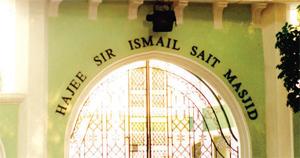
The history of Bangalore is a colourful tapestry whose warp is interwoven with countless political and cultural narratives. But the equally significant weft consisted of traders and businessmen whose lives extended beyond commercial success to large acts of philanthropy. Despite these extensive contributions that benefitted the city and its people, their memories are now preserved primarily in the hearts of old Bangaloreans, personal family records and physical fragments across the city; a memorial, a building or a road. The Hajee Sir Ismail Sait Masjid was built over 100 years ago and gives Mosque Road it name. It was initially meant to accommodate about three hundred people but the largesse of its builder went far beyond its walls.
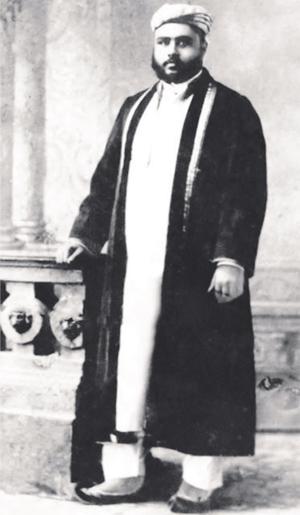
Haji Sir Ismail Sait was born on March 7th 1859 and following his father’s untimely demise, moved from Mysore to Bangalore around 1870. Being from the mercantile Cutchi Memon community, he followed suit after being educated in both Bangalore and Chennai. Arif Hussain, at the Hazrat Haider Shah Jeelani Dargah, tells me an anecdote (unverified) about his early years where he was advised by the saint, his spiritual mentor, to initially trade in goods that were white in colour (like eggs, garlic and milk) to ensure wealth and success. The young Ismail Sait evidently had a nose for business and saintly advice. His English Warehouse near St. Mark’s Road soon sold not just milk powder but every conceivable import from England. Branches were opened in Hyderabad and Chennai, where he was the first to bring in imported kerosene from America in the late 19th century through Spencer and Co.
The entrepreneurial streak also ran through trading in military provisions, timber and mining. He was a banker, mill owner and export-importer. Over time, he was also Chairman of Chamber of Commerce Mysore; Director in the Mysore Sandalwood Factory, Binny Mills and the Mysore Iron Works, Bhadravathi. It was a diverse portfolio but India was opening up to the world and opportunities were yours for the taking. Business was supported by memberships in several distinguished clubs including the Willingdon Sports Club, Bombay, Calcutta Club and the National Liberal Club of London. “He had great business sense and wonderful PR skills” says Zafar Sait, his great-grandson.
But public service was a priority. Healthcare and education were key concerns. The Gosha Hospital (1925) near Queens Road was built with personal funds for reclusive Mohammedan `purdah nashin’ ladies. It was formally opened with 20 beds. Philanthropic friends donated clocks, beds, `frigidaires’, aluminiumware and other supplies. He also built schools, mosques and rest houses in Bangalore, Whitefield and Mysore. Staggering sums of money were donated to the Mysore State University, Aligarh University and medical institutions including Victoria and Bowring Hospitals. His will made strict provisions for educating family members, `both male and female’ and providing alms to the poor.
In 1911, he was nominated to the Madras Legislative Council and received the title’ Fakhr-ut- Tujjar from the Mysore Maharaja in 1919. Family photographs show a dapper gentleman dressed in traditional Cutchi Memon robes, and then in European attire when he was knighted in 1923. When Hajee Sir Ismail Sait passed away in 1934, he left behind his wife Ayesha Bai, five sons, two daughters and a legacy of philanthropy that Shabbir Malik Sait, his great grandson says continues even to this day. He belonged to a time when we gave back what we received in equal measure.
The writer is a cultural documentarian and blogs at aturquoisecloud.wordpress.com
source: http://www.bangaloremirror.com / BangaloreMirror.com / Home> Bangalore> Others / by Aliyeh Rizvi, Bangalore Mirror Bureau / May 05th, 2014
Imagine poetry being ‘sold’ off the streets. Yes, you heard that right! With a noble mission to revive Telugu poetry in the two states, 50-year-old Sheik Sadiq Ali is seen pushing around his cart which doesn’t sell vegetables, but poetry!
“The declining state of Telugu poetry has always bothered me. So I decided to take it to the masses and what better way to do it than a pushcart,” Sadiq explains. While most people lecture on the need for reviving the Telugu poetry from air-conditioned auditoriums, he decided to do stay connected with lovers of literature. Though he doesn’t have shortage of resources to hold book exhibitions, the 50-year-old decided to use a push-cart for his mission. To buttress his argument for adopting this unconventional method to promote Telugu poetry, he says: “Pusharts are something that people feel comfortable with. They have been a part of our culture for ages. It will be inappropriate for a non-traditional object to promote traditional poetry”.
Sadiq now takes his pushcart around town, one area at a time, holding forth on poetry and inviting people to read books. With over 135 titles on his pushcart, Sadiq literally carries a mobile bookstore to your doorstep. “What surprises me is the kind of response I receive from people of all age groups. Those who are new to Telugu poetry spend some time reading a book and end up buying it. These are small steps towards the bigger mission,” says an earnest Sadiq.
A native of Kalluru in Khammam distruct and a postgraduate in Telugu literature from Osmania University, Sadiq has books by various Telugu poets on his cart. The cart – ‘Thopudu Bandi’ – adorns pictures of famous Telugu poets like Sri Sri, Arudra and Maqdoom Mohinuddin. “People on Facebook started seeing what I am doing and sent in their books. So if someone buys the book, the poet gets the money, which in a way encouraging poetry,” he elaborates.
Sadiq, who was a journalist with a Telugu daily, Udayam, which was shut down long ago – embarked on his his ‘literary’ journey on February 22 when he travelled from Ramnagar to People’s Plaza in the city. Ever since, he has been travelling to one part of the city everyday promoting Telugu literature in his own unique way. And he does not intend to stop until he covers all the districts in Telangana and Andhra Pradesh. “There is a lot to be done and there is not much time. All I want is to bring back the golden era of Telugu poetry,” he says with an air of determination. His initiative has reached many through social networking sites and people like Chukka Ramaiah, a well-known educationist, have heaped praise on him for this unique initiative.
But Sadiq, who left his marriage bureau business, isn’t pushing around the 200-kilo cart full of poetry for fame or money. “I have enough to make ends meet. What I am doing isn’t for a living. It is out of passion. It is for the love of Telugu poetry,” he says with a broad smile and a sense of pride.
A fifty-year-old man pushes his cart on the roads of Hyderabad. He isn’t selling vegetables or trying to earn a living with the cart, but he is a man on a mission to revive Telugu poetry in the two Telugu speaking states.
Meet Sheik Sadiq Ali, who gave up his business to revive the art of Telugu poetry in Andhra Pradesh and Telangana.
While most people talk about reviving Telugu poetry from air-conditioned auditoriums with an ‘intellectual’ audience, Sadiq decided to do exactly the opposite. “The declining state of Telugu poetry has always bothered me. So I decided to take it to the masses and what better way to do it than a pushcart,” he explains.
Despite the availability of funds, the 50-year-old decided to use a cart over an exhibition or a display truck. And the reason: “Carts are something that people feel comfortable with. Carts have been a part of our culture for ages. It will be incorrect to a non-traditional object to promote traditional poetry,” elaborates Sadiq.s
source: http://www.timesofindia.indiatimes.com / The Times of India / Home> City> Hyderabad / by Bhavneet Singh, TNN / March 03rd, 2015
I was standing outside the swank automobile showrooms in India Garage the other day, watching excited owners roll out onto St Marks Road in their ribbon wrapped cars. Ironically, the petrol bunk area inside this graceful building was where around 1920, Hajee Osman Sait, an eminent Cutchi Memon businessman, struck a match and deliberately set fire to all the imported goods sold in the Cash Bazaar as it was called back then.
This brazen act of arson must have seemed incomprehensible to gentile customers in the Cantonment. The Cash Bazaar opposite Bowring Institute (1868) was where they bought everything from pins and provisions to ‘English vegetables’, fruits and flowers. Setting fire to goods was something a flourishing trader just did not do. The popular shopping arcade was also a family legacy. It had been built by his grandfather Yousuf Pir Mohammed who had moved to Bangalore from Kutch. Each of his seven sons received ‘three doors’ from where they managed their business. The building, therefore, had 21 doors that opened onto a wide verandah with cast iron grills.
But while the Cantonment speculated, the Non-cooperation Movement (1920) led by Gandhiji escalated into public meetings and protests across the country. Amongst other things, it also advocated a boycott of British goods. This civil disobedience ran in parallel with the pan-Islamic Khilafat movement (1919-1924) whose leaders, including the brothers Maulana Mohammad and Shaukat Ali, were allied with the Indian National Congress at that time.
Hajee Osman Sait, President, Madras and Bangalore Khilafat Committee, was deeply inspired by India’s freedom struggle. He played host to Gandhiji, Pandit Nehru and the Ali brothers at his home on St Mark’s Road (around present day Hotel Nandhini). He sold his property, donated money and apparently even publicly auctioned off his eldest son to raise funds. Ebrahim was returned respectfully and the money, donated. He opened an Indian National School (1921) on his property, Stafford House (now Bishop Cottons Girls School) and sent his own children to local schools. The Cash Bazaar bonfire was yet another contribution to the movement.
Masood Ali, Yousuf Sait’s son, says his grandfather was an unbelievably wealthy businessman who owned over 20 acres in the area, including several large bungalows of which four were named after his sons — Yakhoob, Ebrahim, Khader and Yousuf Villas. Four white horses drew his famous buggy. They were housed on Residency Road before the Imperial Talkies was built and then moved to stables at the Cash Bazaar which also sold hackney carriages.
The stables were later occupied by Sir Mark Cubbon’s horses and used by the Bangalore Riders Club (1934). Later on, Addison & Co. sold bicycles, cars (Peugeots and Buicks among them) and motorcycles next door. India Garage’s history of hot wheels began here long before shiny automobiles arrived in India.
Haji Osman Sait’s dedication to the freedom movement cost him dearly. He passed away in 1928, in a rented home around the age of fifty-six. Masood Ali says his funeral procession was over 5 kms long and extended from the Jumma Masjid off Commercial Street to the Jayamahal Palace burial ground.
India Garage was subsequently sold in an auction in the 1930s and then became the first showroom of the pioneering VST Group founded by V S Thiruvengadaswamy Mudaliar in1911.The building retains the original structure and some trees he planted. But its doors now open out to a free, liberalised India.
The writer is a cultural documentarian and blogs at aturquoisecloud.wordpress.com
source: http://www.bangaloremirror.com / Bangalore Mirror / Home> Bangalore> Others / by Aliyeh Rizvi, Bangalore Mirror Bureau / May 12th, 2014
Was Mumtaz Mahal’s body mummified before her temporary burial in Burhanpur and later finally laid to rest at the Taj Mahal in Agra?
This is the subject of a book “Taj Mahal ya Mummy Mahal?” written by Afsar Ahmad, released on Sunday by the registrar of Central Hindi Institute Dr Chandra Kant Tripathi, here.
Historical records say that Mughal emperor Shah Jahan, the builder of the world heritage monument Taj Mahal, had her body transported to Agra from Burhanpur, six months after her first burial.
Her body remained buried in a ‘kachcha’ grave in the Taj Mahal complex for around 12 years and was then transferred to the main mausoleum.
How was Mumtaz Mahal’s body preserved for so long? Afsar Ahmad tries to answer this question in his book “Taj Mahal ya Mummy Mahal?”
He claims that her body was mummified.
Shah Jahan built the 17th century Taj Mahal here in memory of his beloved wife Mumtaz who died while giving birth to their 14th child in Burhanpur, a town in Madhya Pradesh.
“The real truth about Taj Mahal was suppressed. If the truth had been revealed when Taj Mahal was being built, it would have become almost impossible to construct the monument,” Ahmad said.
The journalist-turned-writer has also disclosed in the book what he claims are several unknown facts related to Mumtaz’s death.
The book has details about Mumtaz’s death and her last few days and details of the mummification of her body.
The book has been published by Evoco Networks.
A large number of scholars and heritage conservationists were present at the release of the book at a hotel here.
source: http://www.newindianexpress.com / The New Indian Express / Home> Nation / PTI / March 01st, 2015
Mr. Mohammed Shah Aalam Rasool Khan, Chairman Shadan Educational Society announced to provide free education to students of Hifz-e-Quran, orphans, labour and children of families living below poverty line and said that he has done this for the Sawab-e-Jariya of his late father Dr. Mohammed Vizarat Rasool Khan. Mr. Shah Aalam Rasool Khan announced this while addressing the 25th annual function (Silver Jubilee) of Shadan Group of Modern Schools, Khairiatabad branch.
Mr. Shah Aalam Rasool Khan also said that morals and character building are must right from the primary education for reformation of society. He also stressed the need to pay attention on communication skills besides character building.
Siasat news
source: http://www.siasat.com / The Siasat Daily / Home> Hyderabad / Siasat News / Sunday – March 01st, 2015
Agra will on Saturday celebrate the 275th birth anniversary of noted 18th century Urdu poet Nazeer Akbarabadi, popularly known as the “people’s poet”. This year, the anniversary falls on Basant Panchami — the first day of spring.
The modest tomb of Akbarabadi, who wrote on subjects of love and common man’s life, is located just 100 metres away from Taj Mahal. It will be in focus Saturday as his admirers will queue up to pay him homage.
For most part of the year, Nazir’s tomb in the Taj Ganj area lies in a neglected state. Only during Basant Panchami does it springs back to life as a ‘mushaira’, or poets’ conclave, is held.
The Agra Municipal Corporation and the Agra Development Authority took the initiative to provide a canopy over the tomb and spruce up the area to attract tourists who visit the Taj Mahal.
His life in Agra
It was Nazeer Akbarabadi who gave Agra a new identity through his poetry.
He wrote about things that touched the hearts of both Muslims and Hindus and these included festivals, dance and theatre, bird fights and kite-flying.
Nazir looked at the follies of royalty with disdain but sang lyrically about the antics of Lord Krishna and poked fun at the fundamentalists.
Nazir also loved the Taj Mahal ‘deeply’ and there is a story that once he decided to leave Agra for greener pastures but returned after walking some distance when he lost sight of the monument. IANS
source: http://www.thehindu.com / The Hindu / Home> News> In School / by IANS / Agra – January 24th, 2015