Category Archives: Arts, Culture & Entertainment

Strands of belonging

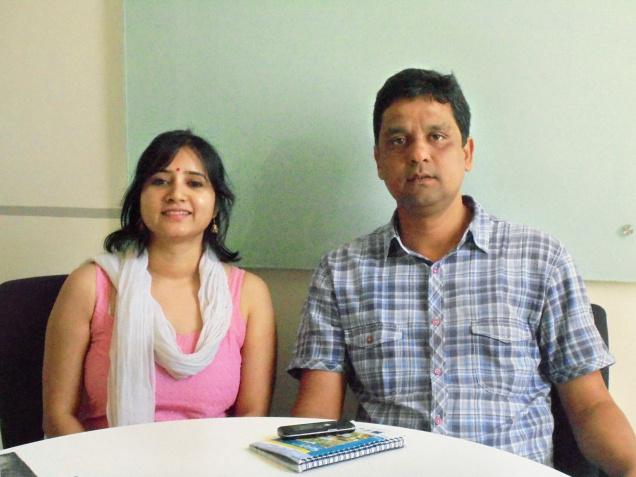
Malini Bhattacharjee and Nazrul Haque

In a research paper presented at Jamia Millia Islamia, academics Nazrul Haque and Malini Bhattacharjee highlight why Assamese Muslims are now asserting their ethnic identity alongside their religious identity

The ethnic violence in Bodo Territorial Council areas of Assam has been in the news for some years. Particularly bloody and recurring has been the conflict between the Bodos and the largely Bengali-speaking Muslims, leading to many from both the communities living in uncertainty and fear in camps for some time now. The accusations of the Bodos against the Muslims as illegal immigrants from Bangladesh who occupied their fallow land — and therefore ‘outsiders’— have been at the core of the conflict.

Not just in the Bodo areas but across Assam, the fight against illegal immigration from Bangladesh has been long, and at times bloody. A porous international border, unfulfilled promises of the Assam Accord and both State and National parties perennially playing vote bank politics, have contributed to the protracted problem. The emergence of the All India United Democratic Front (AIUDF) — on largely religious lines — has added to the complexities.

In this din, a critical voice seems to have gone unheard — that of the Assamese Muslims, locally called Goria, Moria or Desi. Many political and religious groups, time and again, have tried tying them to the Bengali-speaking Muslims highlighting their religious identity. However, lately, the community is seen to be asserting its ethnic identity as equally important as its religious identity, thus situating them in a peculiar position in the politically charged and religiously polarised milieu of the State.

The complexities of the topic got rare attention at a recent conference in New Delhi on the North East. Nazrul Haque and Malini Bhattacharjee, from Bangalore’s Azim Premji University, presented a paper — Identities in Quandary: The Complex Narrative of ‘Assamese Muslims’ — at “Reimagining the North East: Narratives, Networks and Negotiations”, hosted by Jamia Millia Islamia’s Centre for the North East. The research paper stood out for throwing light on an important slice of Assam history, often overlooked.

Haque and Bhattacharjee expounded on the advent of Islam in Assam through the invading Muslim armies since the 13th Century; their defeated soldiers taken captive by the Ahom kings creating, first, the Gorias, and later the Morias in the mid-16th Century. While Desis are people from the Koch and Nath communities converted to Islam, they highlight that many others became Muslims in Assam at the call of the Sufi saint Azan Fakir in mid-17th Century.

The Bengali-speaking Muslims, the paper points out, emigrated from erstwhile East Bengal to Assam during the British rule from 1826 to 1947. It “reached its peak during 1971 with the creation of Bangladesh”, leading the 1971 Census to record a 34.98 per cent increase in Assam’s population from the 1961 Census. However, Assamese language and local culture continued to be the binding force for the rest of the communities across religions.

In this interview, the duo states that language being the defining factor of the 1980s Assam Students’ Movement against illegal immigration, Assamese Muslims took part in it but “later became suspicious in an increasingly communal environment.”

Excerpts from the interview:

What attracted both of you to the topic? How long you have been researching on it?

Haque: We both are from Assam and have grown up witnessing the syncretic nature of our local culture (irrespective of religion and in spite of it) and also the changing narratives of that ethnic bonding. For the last few years, we could also sense a tension among indigenous Muslims of Assam and the various reasons for that — rise of global Islam, increasing religious intolerance in India, demand of democracy and politics, controversy surrounding the issue of ‘immigration’, etc. That made us interested in the topic as this case study speaks to a very important and global phenomenon. We did our first field interviews last November.

What is the size of their population?

Haque: There are no government figures, for obvious reasons. However, organisations like All Assam Goria, Moria, Desi Jatiya Parishad quote a number of around 30 lakhs. Some academics point out that in 1901, there were 2,48,842 Muslims in the Brahmaputra valley. The count, as per 1951 Census, was 19,81,859 (15 lakh were estimated to be of East Bengal origin).

In this identity war of ethnicity versus religion, how much are Assamese Muslims under pressure to side with religion? How much of it is political pressure?

Haque: The force of religion is quite powerful, as almost everyone we interviewed had admitted. There are changes in important social ceremonies, food habits, folk music, literature, the way people dress and conduct their daily life. There are political pressures too and more so because of the rise of the BJP and AIUDF in Assam politics, almost simultaneously.

How representative of the community are organisations like AAGMDJP?

Haque: It seems there are too many contradictions even within organisations ‘representing’ indigenous Muslims of Assam. Who are ‘indigenous’ and who are not? However, one fact is important — of all such bodies, AAGMDJP is the only one well accepted by all other ethnic organisations (Tai Ahom Students Union, Ahom Royal Society, Moran Students Union, Motok Students Union, Dimasa Students Union, Sonowal Kachari Parishad, All Bodo Students Union) and for some years, they are almost working together. That was evident in some public meetings we attended.

How much have Assamese Muslims suffered in the Bodo-Muslim violence? How strong is the tendency to club them with Bengali-speaking Muslims because of religion?

Bhattacharjee: There are many layers to this question and they are complex. One thing is distinct — the Bodoland violence was not (only) because of religion. Even now, the stands taken by various groups (including the BJP, the RSS or Hindu Yuva Chatra Parishad) are clear and publicly so — that one can’t club all Muslims in Assam under one religious umbrella. However, interests representing people from East Bengal origin (even Na Asomiyas) definitely try to make it a Hindu-Muslim issue and our sense is that so do intellectuals who don’t have first-hand knowledge of the region.

source: http://www.thehindu.com / The Hindu / Home> Features> MetroPlus / by Sangeeta Barooah Pisharoty / March 11th, 2015
A celebration of Urdu

Urdu’s finest poets, authors, performers and artists from India and other countries like Pakistan, US and Canada come together to bring alive the lyrical beauty and resonating eloquence of the language.

Eminent names such as Javed Akhtar, Rekha Bhardwaj, Gopi Chand Narang, Zia Mohyeddin, Intizar Hussain, Rakshanda Jalil, Ashok Vajpayee, Musaffar Ali, Nida Fazri, Purshottam Agarwal are set to participate in two-day festival, ‘Jashn-e-Rekhta’ that begins here March 14.

The festival is organised by Rekhta Foundation, a non profit body, in collaboration with India International Centre (IIC) to bring the glorious past, the beauty, power and versatility of Urdu.

All the genres of the language can be found in one place through live performances, panel discussions, film screenings and interactive sessions, organisers said in a statement.

The language of lovers, idealists and poets will be celebrated through qawwalis, gazal renditions, mushaira and the 16th-century Urdu oral storytelling art form – Dastangoi.

“Marking its debut year the festival aims to bring the quintessential spirit of Urdu – its inclusive ethos and creative richness and it an annual affair,” organisers said.

National award winning playback singer Rekha Bhardwaj, is set to open the festival on March 13 with her melodious songs.

Other days will see vocalist Vidya Shah and Danish Hussain pay tribute to Begum Akhtar on her birth centenary. A qawwali performance by Dhruv Sangari and an evening dedicated to ghazals by Radhika Chopra and Hamid Ali Khan are in the line up.

Among the debates lined up at the festival is one titled “Changing Face of Mushaira”, which is set to feature Kumar Vishwas of the Aam Aadmi Party with Munawwar Rana, Satyapal Anand and Ravish Kumar.

“The World of Women in Urdu Literature” would see Azra Abbas, Sukrita Paul Kumar and Tarannum Riyaz debate and moderated by Baran Farooqi.

One of the interesting debates include “Internet ke Duniya mein Urdu” moderated by Pervaiz Alam and features Ajmal Kamal, Ali Madeeh Hashmi, Lalit Kumar and Rana Safvi.

“Urdu and Hindi: Convergence and Divergence” would see Ashok Vajpeyi, Kedarnath Singh and Shamim Hanfi in discussion.

Lyricist Javed Akhtar will be in conversation with Sukrita Paul Kumar on the first day which will also see the screening of the film “Garam Hava”.

Book exhibitions, calligraphic art and street plays are among the other highlights of the festival.

Organisers say they want to make the festival a “one stop destination” for Urdu admirers.

source: http://www.business-standard.com / Business Standard / Home> PTI Stories> National> News / PTI / New Delhi – March 10th, 2015

The last LUNA moped in city showroom sold

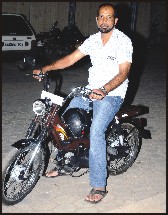
City hotelier Nadeem buys the moped for Rs. 12,000

NadeemMPOs12mar2015

Mysuru :

Luna, the much sought moped by many in earlier days, will now remain as memories as the last moped was sold at a showroom in city recently.

Nadeem Ahmed Khan of Taj Biriyani on Mysuru-Bengaluru highway, out of love for the moped, bought the Luna TFR 49CC moped manufactured by Kinetic Engineering at Kangtani Motors on Chamaraja Double Road bearing Engine No. CJ 13028771 and Chassis No. CJ 03023920 for Rs. 12,000 which included Rs. 1,610 lifetime tax and has got it registered at RTO (East).

In the mid-1980s, the Luna moped from the Pune-based Kinetic Group was a popular brand on Indian roads – a low-cost two-wheeler that helped bicycle riders upgrade to a better mode of transport. It was sleek, stylish, sported a chrome body and had both a regular as well as a pedal kick start.

It was a much sought moped for middle income group as it was giving a mileage of about 40 to 50 km per litre with a speed of 50 km per hour. The customers had to wait for months for the moped to be delivered to them after booking it.

With the advancement of science and technology in automobile sector and new vehicles with latest technologies being launched, the demand for Luna decreased or almost stopped which made the manufacturer stop producing the moped.

Nadeem, speaking to Star of Mysore said that he bought the moped out of love towards it and added that money was not a concern to him as the moped would not be available in the market anymore.

He said that he would keep the moped at his house and would use it occasionally.

It may be recalled that Nadeem had got a sheep from Australia during last Bakrid, had also purchased a huge sea fish and lobsters to serve for his customers at Taj Biriyani.

source: http://www.starofmysore.com / Star of Mysore / Home> General News / March 10th, 2015

Biriyani that Royalty relishes

Created at Sri Kanteerava Narasimharaja Wadiyar Sports Club, Mysuru

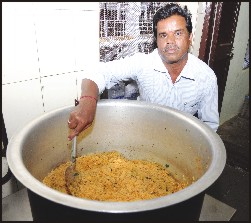
Narayan is seen preparing the famous mutton Biryani at Mysore Sports Club

by S.N. Venkatnag Sobers

In his recent interview to The Sunday Times, Yaduveer Krishnadatta Chamaraja Wadiyar, who has been adopted to the Mysore Royal Family of Wadiyars, when asked about his favourite food said, ‘‘I cannot say I have a favourite. But, if cornered, I would probably have to go with the famous Biryani from the Mysore Sports Club.”

In fact, he is not alone. Thousands of Mysoreans have been relishing the famous mouth-watering mutton biryani at the Mysore Sports Club over the past few decades.

The man behind the famous mutton biryani is Narayan, who has been working at the Mysore Sports Club for the past 32 years. Wanting to discover the man who created a Biryani that satiated the royal palate, Star of Mysore went to Sports Club to talk to this master chef. He is Narayan.

Speaking to Star of Mysore, Narayan said that members of the Royal Family including late Srikanta Datta Narasimharaja Wadiyar, Chaduranga Kantharaj Urs, Gayathri Devi, Yaduveer Krishnadatta Chamaraja Wadiyar and others were fond of the biryani cooked by him.

Mysore Sports Club introduced Mutton Biryani to its guests in 1989 and since then, it has been relished by many. Earlier to this, cooks from outside were invited to prepare biryani during events organised at the club.

Narayan said that he learnt the art cooking biryani through his guru Abdul Sattar, who lived in Mandi Mohalla.

“When I joined the Sports Club as a kitchen assistant, the then Secretaries B.A. Nanaiah and Dr. N.M. Srinivas encouraged me to learn the art of cooking biryani and since then, I have been cooking the delicacy,” he said.

Speaking about his cooking style, Narayan said that he starts preparing for biryani at around 12 noon by marinating mutton and adding necessary masala. Once the mutton is cooked, the half cooked basmati rice is added to mutton and is kept for blending for about one-and-a-half hours. Later, the hot biryani is served to the guests at the Club from 7.15 pm.

Everyday around 15-20 kg mutton biryani is prepared at Mysore Sports Club and not bit of it remains in the end. In fact, the biryani is so famous that even the non-members of Mysore Sports Club do not miss out a chance tickling their taste buds whenever they get an opportunity to visit the club. In fact most of the non-members demand the club members not to book them rooms at the Club but for a parcel of mutton biryani.

Given an opportunity, one must visit the Mysore Sports Club to savour this gastronomic delight.

source:http://www.starofmysore.com / Star of Mysore / Home> Feature Articles / Thursday – March 05th, 2015

American ‘bansuria’ revives his Bong links

Kolkata :

He was born in Woodstock and became a raga exponent in Kolkata, his bansuri featuring in a Grammy-winning album and Oscar-winning film along the way.

Flautist Steve Gorn is in town to perform at a concert presented by Calcutta Classical Guitar Society in association with Flute Lover’s Association on Wednesday.

Gorn had first come to India in 1970. He visited Kolkata a year later. “I had a Western music background. My father was a pianist and I played jazz saxophone and Western flute. During the late 1960s, though, many in our generation got influenced by Ustad Bismillah Khan’s shehnai. I came to Varanasi to explore Indian classical music and even tried the the shehnai. But since I was already playing the flute, I shifted to bansuri,” he said.

Gorn next travelled to Kolkata and began learning bansuri from Gaur Goswami, a disciple of the legendary Pandit Pannalal Ghosh. “I stayed around Gariahat and would take a tram to Shyambazar. That year, 1971, was a troubled time because of the Bangladesh war. Bombs were going off, curfews were imposed and thousands of refugees strea- med in. But I was young and couldn’t gauge the political situation. Now of course I know things better,” he told TOI.

“But back then, the music used to be a lot different from what it is now. Kolkata had an old-world charm and the music I love comes from that era — the music of stalwarts such as sitar maestro Pandit Nikhil Banerjee. For me, it is the ‘bhav’ or ‘ras’ of Indian classical music that is more important than anything else,” he said.

By 1972, Gorn and his wife had spent about 16 months in India. Then came a long gap and he returned again in 1986. “But Indian classical music continued to influence my compositions for films, dance shows and theaters,” he said. It also took him around the globe. Last year, he performed in China, Japan, Bulgaria, Czech Republic and Holland. “That’s why I speak only smattering of Hindi and Bengali,” he says apologetically.

Pandit Hariprasad Chaurasia heaps praises on Gorn. “He is a very good musician and a nice human being. We are very good friends and I have visited his home many times,” the flute maestro told TOI on Tuesday.

In 2004, Gorn played the flute for “Born Into Brothels” which was shot in Sonagachi and bagged an Oscar. “One scene is very close to my heart — a boy flies a kite and the flute melody also rises with its flight,” he said.

In 2011, he featured in the Grammy-winning album “Miho – Journey to the Mountain”. “Dhruba, the nephew of Pannalal Ghosh, played sarangi in the album. Miho is a museum in Japan and the music director was invited to visit and create music reflect the Asian artworks that were on display,” he told TOI.

Gorn has also been a part of several Grammy-nominated albums, including two this year.

source: http://www.timesofindia.indiatimes.com / The Times of India / Home> City> Kolkata / by Shounak Ghosal, TNN / March 11th, 2015

‘RSN Memorial Award’ for Freedom Fighter

Ramashesh and Sanjhi Artist Huseni

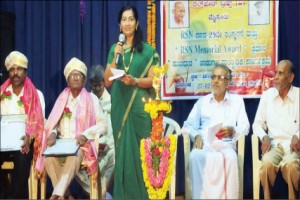
Zoo Authority of Karnataka (ZAK) Chairperson Rehana Banu is seen delivering inaugural address during the award function organised by R.S. Naidu Art and Cultural Welfare Trust in memory of Freedom Fighter R.S. Naidu at Nadabrahma Sangeetha Sabha in city recently as Sanjhi Artist S.F. Huseni, Freedom Fighter M.R. Ramashesh, Brahmana Association Chairman Raghuram and R.S. Naidu Trust President P.Y. Venkatadri look on.

Mysuru :

Freedom fighter M.R. Ramashesh and Sanjhi Artist S.F. Huseni were conferred with ‘RSN Memorial Award’ at a programme organised by R.S. Naidu Art and Cultural Welfare Trust in memory of freedom fighter R.S. Naidu at Nadabrahma Sangeetha Sabha in city recently.

Speaking after inaugurating the programme, Zoo Authority of Karnataka (ZAK) Chairperson Rehana Banu said, “Many artists across the country have contributed in their respective fields despite lack of encouragement and recognition. They should be lauded for their commitment and passion. We should encourage the artists through felicitation programmes.”

After the award function, Indu Shekhar and Troupe presented a musical programme.

Renowned artists of Mysuru and Bengaluru sang the old film songs sung by P.B. Sreenivas, S.P. Balasubramanyam, P. Susheela, S. Janaki and others. They even sang the songs from the movies of Dr. Rajkumar, Dr. Vishnuvardhan and Puttanna Kanagal.

The following songs were sung on the occasion: ‘Hindusthanu endu mareyada…’ from the movie Amrutha Ghalige, ‘Snehada kadalalli…’, ‘Aseya bhava olavina jeeva’, ‘Karunada thayi’, ‘Haadu haleyadaadarenu’, ‘Jeeva veene needu midithada sangeetha’, which made the audience to travel down the memory lane.

Mike Chandru compered the musical programme.

Singers including Indrani Anantharam, CFTRI Krishnamurthy, KEB Gangadhar, Srinivas Hemanth, Vijayanand, Joyce Peters, Anantharam, Kiran Kumar, Geethalakshmi Keni, Vijay Manasa and others took part in the function.

R.S. Naidu Art and Cultural Welfare Trust President P.Y. Venkatadri and Trustee M.K. Ramesh; K. Raghuram, Chairman, Brahmana Association; Mysuru Anand and Parthasarathy were present on the occasion.

source: http://www.starofmysore.com / Star of Mysore / Home> General News / Wednesday – March 04th, 2015

Now, a women’s sport too

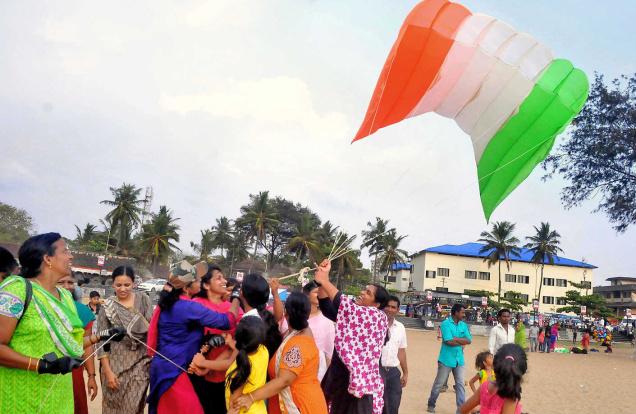
Women, who participated in the kite flying training programme on Sunday on Kozhikode beach, trying to control a kite.— Photo: K. Ragesh

It takes eight to 10 men to control the 1,000-kg circular kite of the One India Kite team. Founder of the team Abdulla Maliyekkal was quite apprehensive when he gave the reins of the kite to a group of women . His apprehension was not misplaced considering how the women struggled with it initially, but it gave way to happiness watching the first professional all-women kite team in the country take form.

The team named ‘Incredible India’ was launched on the Kozhikode beach on Sunday, on the occasion of International Women’s Day.

Training in style

Supported by their parent group One India Kite Team, the women who have undergone training in the nuances of kite flying, took off in style flying the Circular kite and the Kathakali kite amidst the curious Sunday crowd on the beach. “This is the most relaxing experience I have ever had. Controlling a kite is not child’s play. It takes great coordination and team work. Hence while flying the kites, we forget everything else,” said Mini Nair, team captain.

The team now plans to take part in kite festivals across the country and abroad where they plan to present some kites of their own.

As part of the launch of the women’s team, the One India Kite Team, in association with the women’s wing of Junior Chamber International, Calicut, had organised a kite-flying training programme for women, which was attended by 25 women. “The training was given by expert kite flyers Abdulla Maliyekkal, Hashim Kadakkalakam and Shyam Padman.

source: http:// www.thehindu.com / The Hindu / Home> News> National> Kerala / by Aabha Anoop / March 09th, 2015

Meet the Muslims who make ‘Holikas’ for Holi eve

Meerut:

Nine months ago, Teer Gran in Meerut was in the news for all the wrong reasons – communal clashes had broken out, claiming one life. Several people were injured. Few are aware, however, that Teer Gran is home to the Muslim families that make the colourful Holikas that Hindu communities traditionally burn on Holi eve. This locality is also called ‘Holi Mohalla’.

Around 25 Muslim families here make more than a 1,000 Holikas which find their way to various west UP cities besides Meerut. Mohd Yunus, 50, has a small shop near the lane leading to Bhairon Temple. On Tuesday, there were numerous life-size effigies, decked up and colourful, with feminine features, lining his shop.

“Holika symbolizes victory of good over evil. Hindu legend has it that after demon king Hiranyakashipu demanded that he be worshipped, his son Prahlad remained defiant, and said he would only worship Lord Vishnu. The king’s sister Holika, on instructions from her brother, attempted to burn Prahlad alive by taking him in her lap and sitting on a pyre. Holika had a magic shawl with which she could save herself from burning. She hoped her nephew would be reduced to cinders. When the fire was set, however, the shawl flew and enveloped Prahlad instead. Holika was burnt to death. Prahlad escaped unhurt,” Yunus explains.

For generations, Yunus’ family has been making effigies of Holika that are burnt on the eve of Holi festivities.

“We have no records, but for hundreds of years our family has been making these effigies.” There are about 25 Muslim families that make Holikas in Holi Mohalla. The effigies are made with waste paper, masks and colours.

Shaukat Ali, another resident of the area, said, “We need to make about 1,000 Holikas every year. These travel to Muzaffarnagar, Baghpat and Muradnagar.”

The Holika effigies are the work of entire families. With time, interestingly, volumes have grown. Mohd Wasim, an effigy maker, said, “Earlier, communities would select one place to burn the Holika, which was made on order, and would be quite tall and expensive – we have made effigies 20 feet tall, costing about Rs 2,000, at least. Now, as cities have expanded, even small colonies have their own Holika burning ceremony. Volumes have grown, but the size of each Holikas has shrunk. These days, we make Holikas about five feet tall, costing about Rs 250 each, at most.”

While the Muslim families here make Holikas ahead of Holi, they also make effigies of Ravana ahead of Dusshera. “The Ravanas are rather more difficult to make. For the rest of the year, we make decorations for temples and mosques,” Wasim said.

Asked of his experience during the riots last year, Yunus said, “Buddhi bhrasht ho jaati hai logon ki (people go out of their minds) in time of riots. No one wants riots. These are all politically motivated, and everyone only suffers a loss. Thankfully for us, every time communal tension happens here, Hindu friends ask me to move to a safer place and take responsibility for my shop.

source: http://www.timesofindia.indiatimes.com / The Times of India / Home> City> Meerut / by Sandeep Rai / March 03rd, 2015

Sommer House: Tales from the jazz age

SommerHouseBF09mar2015

Bengaluru: 

Back in the 1950s, when Bangalore was like something out of a F. Scott Fitzgerald bok, Whitefield was a small township on the outskirts of the city. On arriving at the railway station, one took a horse-drawn carriage home through the small, winding streets. It wasn’t long, however, before development put paid to much of that old world charm.

The Sommer House, a colonial bungalow that has been restored to its former beauty by long-time resident Sulaiman Jamal, aims to recreate some of that old world charm. Thrown open to the public on Monday evening, as a community center that gives senior citizens and retired army officials that long lost society whirl, Jamal, whose association with the area began when he set up his factory there said: “We have lived in Whitefield for ten years now, but when I first visited, it was a pretty wild place,  Every six months, another bungalow would be torn down.”

The two-bedroom gabled roof Sommer House, bought two years ago by Jamal, replete with antique furniture, is home to a piano that belonged, back in the day, to the Defence Services Cinema. The cottage, sits surrounded by a garden, with restored vintage cars dotting the property.

Jamal would like the House to host programmes like piano nights, dancing, catered dinners and plays. Most importantly, it will also have a free catered dinner every month for senior citizens.
Beth Chapman, Pre­sident, Overseas Women’s Club, has helped put Sulaiman’s ideas in motion.

“I’m always looking for old bungalows and the stories that surround them,” she said.
“The house is opposite Forum Value Mall and people expected a superstructure here,” Sulaiman explained. “They wonder what the catch is, but there is none. We want the people of Whitefield to feel a sense of belonging with what is now a community center.”

source: http://www.deccanchronicle.com / Deccan Chronicle / Home> News> Current Affairs / DC / Darshana Ramdev / June 18th, 2013

A daughter remembers…

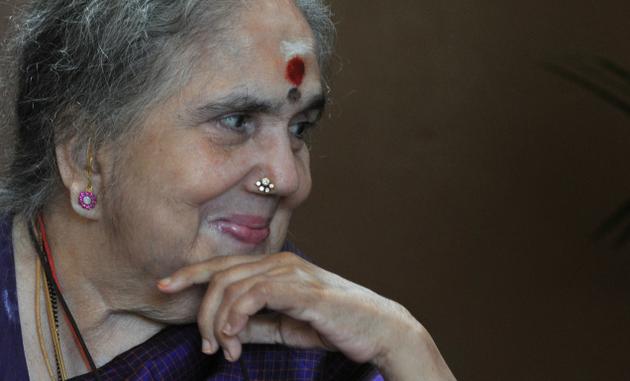
Radha Viswanathan. Photo: K. Bhagya Prakash

Radha Viswanathan re-lives moments of living and performing with an icon, to Ranjani Govind.

“It’s comforting to see my grand-daughter Aishwarya become a serious performer. I remember the days when I would wonder whether there would be anyone in the family to carry the legacy forward. My prayers seem to be answered,” says the 80-year-old Radha Viswanathan, daughter of M.S. Subbulakshmi, during a recent interview in Bengaluru.

Radha was recently honoured during the release of an album of a nearly 40-year-old soundtrack of MS and hers, in Bengaluru, with veteran mridangam vidwan T.K. Murthy and former ISRO chairman K. Radhakrishnan participating. The album was recorded in Mumbai by the National Centre of Performing Arts (NCPA) and is now being brought out in association with Sony Music.

Radha is happy that the rare gems from the 1970s, was now being shared with rasikas. “It is a historic occasion for our family.”

Radha, who accompanied her mother for over 60 years, be it at live concerts or recordings, cherishes every memory of the time she spent with her iconic mother. “I was blessed to have a mother who was an embodiment of compassion,” she says, as she gets nostalgic. Radha’s mobility might have been restricted to a wheelchair owing to several health issues, but her zest for life, passion for music and elephantine memory keep her as youthful as ever. She can leave you stumped with her recollection of events, rolling back to instances when as a four-year-old she remembered the time when MS entered her family.

Talking about her computer-like memory, Radha says, “Storing information is inherent to my persona. Every time I sang a kriti leant instantly at class, Semmangudi mama would say, ‘You have a camphor-like brain, catching everything instantly!’” recalls Radha, who always made notations of the trickiest of sangatis.

Looking settled in her son V. Shrinivasan’s home, the contentment is apparent on her still radiant face. “It’s rewarding to have taught Aishwarya nearly 500 kritis. Do you realise that it is authentic Semmangudi, Musiri and T. Brinda schooling that I have passed on? My younger grand-daughter Saundarya too is catching up,” she says.

But why didn’t MS train other students? “My mother was too busy an artist to teach. She was incredibly humble and used to continuously learn from others and considered herself a student all her life,” says Radha. There were instances when Radha learnt from Semmangudi Srinivasa Iyer as MS was too busy. Radha would later sing what she had learnt to her mother. “In fact, we practised together to get the nuances right,” she remembers.

Radha stepped on to the music platform as a four-year-old, singing tail-enders or the so-called ‘tukkadas.’ “That was the beginning of my musical journey. But later I learnt from Mayavaram Krishna Iyer and GNB’s sishya, T.R Balu,” she says. Once when MS was unwell, Musiri came visiting. Radha had then sung ‘Saraseeruha’ in Nattai and ‘Sudhamayi’ in Amruthavarshini. Fourteen years later, when the same kritis were presented at the Central College of Music where Musiri was the principal, he remembered, “I recall Radha singing these kritis as a six-year-old. Even then, I knew she would go a long way.”

It was Musiri who had advised them about the importance of ‘voice synchrony;’ he had told Radha, “Your voice should blend with MS’s and sound like a single, integrated tenor.” No wonder their Vishnu Sahasranamam recording is known for this quality! “In the line, “Amaaani Maanado Maanyo,” when MS briefly stopped to take a breath, it had to be re-recorded, but Amma insisted it be left alone. ‘Let people know that Radha sang along,’ Amma said.”

What was special as far as their voice experimentation was concerned were the lessons that MS and Radha got from T. Brinda and T. Muktha, who had by then set a trend in high-and low-octave singing. Kritis such as ‘Janani Ninnuvina’ in Ritigowla, ‘Raave Himagiri’ in Thodi and ‘Teera teeyaga raada’ in Gowlipantu that saw MS taking to the base and Radha singing in the higher octaves, became a rage with audiences.

Father Sadasivam’s love for dance saw Radha and Anandi (daughter of Kalki Krishnamurthy) team up and learn Bharatanatyam from Vazhuvoor Ramaiah Pillai. Her ability to learn and absorb was so amazing that Radha had her arangetram, along with Anandi, as an 11-year-old! They performed to packed audiences, effortlessly. “Even here, Amma would sing padams for us. Who can forget the rave reviews that the two got for their superb pairing in ‘Maalai Pozhudinilae’ and ‘Thayae Yashoda’?

Says Radha’s son, Shrinivasan, “In 2010, when my mother was asked to do abhinaya at the Cleveland Tyagaraja Aradhana, she obliged and left the the audiences in tears. And mind you, she was sitting all the while!”

It was her love for song and dance that Radha saw act as the young Bharatan in ‘Shakuntalai’ in 1940 and as Bala Meera in ‘Meera’ in 1946. “By the time, the Hindi version came, I had grown taller and so I did not act in it,” she says. When Radha was13, she had led the chorus in ‘Meera’ and had the music director Bhattacharya refer to her as ‘my boss.’

Born in 1934, December 11, in Gobichettipalayam, Radha was married to Viswanathan and went to Ahmedabad. But Radha’s passion for music and MS’s need for a vocal support soon brought them together and they travelled the world and became ambassadors of Carnatic music.

From Radha’s memory bank

* MS always advised me and my sister Vijaya to have a smile on our faces while singing.

* We took classes from Semmangudi, Musiri, Brinda-Muktha, K.V. Narayanaswamy, Siddeshwari Devi in Hindustani, Sandhyavandanam Srinivasa Rao and Meera bhajans from Dilip Kumar Roy.

* Radha still remembers the first concert at The Music Academy. Prime Minister Nehru was to inaugurate. The Udaipur Maharaja, mesmerised by our Kalyani rendering, had offered MS his kingdom!

* She recalls MS’s ‘never-question’ attitude towards her father Sadasivam’s ‘concert listing’ as a mark of respect for his knowledge and intuitive knack of planning.

* Once, Radha danced in front of Mahatma Gandhi with MS singing ‘Ghana Shyam Aaaye Re’ at the Birla House in Delhi. “And Gandhiji really enjoyed my performance!”

From the NCPA archives

The CD with 16 songs of M.S. Subbulakshmi and Radha Vishwanathan that Sony Music has released in association with the National Centre of Performing Arts (NCPA), is part of “Masters Works” series,” which was recorded in the 1970s.

Shridhar Subramaniam, president, Sony Music said, “Two more live concerts of MS and Radha, with Karaikkudi Mani on the mridangam will be released in two months. Also in the pipeline is one with Alla Rakha and Zakir Hussain on the tabla.”

NCPA had 5000 hours of live and studio-recordings in several genres mainly done in Mumbai from 1971 for their archival and academic purposes and directed towards student-researchers. Soon, recordings of Pandit Jasraj, Ustad Bismillah Khan, Ustad Rashid Khan, Gangubai Hangal, Dr. M. Balamuralikrishna and M. L. Vasanthakumari, were released by Sony Music.

source: http://www.thehindu.com / The Hindu / Home> Features> Friday Review / by Ranjan Govind / February 26th, 2015