Category Archives: Arts, Culture & Entertainment

Sports makes on physically fit : Dr. Saleem

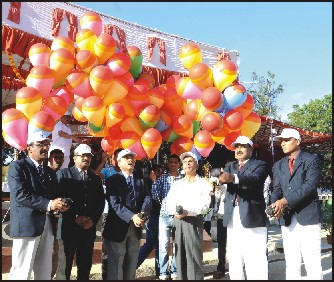
City Police Commissioner Dr. M.A. Saleem is seen releasing pigeons along with Prof. M.G. Krishnan, Vice-Chancellor, KSOU and other dignitaries to mark the launch of Annual Police Sports Meet

Mysuru :

The city police battled it out with each other at the annual sports meet that began here yesterday. Their lathis were replaced with javelins, while the heavy rifles with shot-puts, at the Police Parade grounds, the venue of the meet.

The cops were in a sportive mood on the first day of the three-day Annual Sports Meet -2014 organized by Mysore City Police. Speaking at the inaugural, KSOU Vice-Chancellor Prof. M.G. Krishnan said, “All sports should be treated equally but unfortunately this is not happening in India.” He said that cricket was the only sport that was getting more prominence in the country compared to others. Vice-Chancellor wished the Police personnel who were participating in the meet to show their best performance.

City Police Commissioner, Dr. M.A. Saleem said “Sports activities play a vital role in keeping policemen fit and healthy. So every year sports meet was being organised.” He advised police to develop sportsmanship and competitiveness even while carrying out their duties that would improve the health of the society.

Law and Order DCP A.N. Rajanna, Crime and Traffic DCP M.M. Mahadevaiah, Armed Reserve DCP Shivanna, Mounted Police Commandant Janardhan were present.

The event will see police personnel taking part in race, tennis ball throw, discus throw, passing the ball, shot-put, lemon-spoon race, tug-of-war, table tennis, shuttle badminton, long jump, javelin throw, etc.

Valedictory: The valedictory will be held on Dec. 7 at 4 pm. Retd. ADGP Kempaiah will be present on the occasion.

Results of the first day Men’s category

Javelin throw : Satyavelu (first), S. Manjunath (second), Shivakumar (third).

Shot put : Arogyaraj (I), H.R. Shivakumar (II), Lokesh (III)

Long jump: Jayakumar (I), Mylari (II), Vijaya Kumar (III)

200 m running: Mylari (I), Vijaya Kumar (II), Amarnath (III)

Women’s category

200 m running: Asha Rani (I), Rekha (II), Vani (III)

Javelin throw : Shylaja (I), J. Rekha (II), Zareena Taj (III)

Shot put : Shylaja (I), Rekha (II), Zareena Taj (III)

Long jump : M. Vani (I) Siddamma (II), Asha Rani (III)

source: http://www.starofmysore.com / Star of Mysore / Home> Sports News  /  Saturday , December 06th, 2014

Retro beauties roll down city streets

Lucknow:

Sunday was a fun day for city’s motor sports aficionados and patrons of vintage cars and motorbikes. It was time to enjoy the ride in the retro beauties rolling down the streets of Lucknow. From Austin Chummy 1926 and Ford A 1928 vintage cars to Nortan, Birmingham Small Arms Company (BSA) and Royal Enfield motorcycles the annual vintage car and motorcycle rally once again brought back memories of a bygone era.

Organised by Hindustan Petroleum Corporation Limited (HPCL) and Vintage Car and Motorcycle Club of Lucknow as a part of Lucknow Mahotsava, the vintage rally started from Koneshwar, Chowk after being flagged off by district magistrate Raj Shekhar.

Over 45 vintage beauties on wheels comprising 30 cars and 15 motorbikes were on the streets of Lucknow, the owners flaunting their priceless possessions.

Meandering through the roads of Old City passing through Rumi Darwaza, Chhota-Bada Imambaras, Hazratganj and also through the posh modern localities like Vibhuti Khand, the rally terminated at Indira Gandhi Prathisthan, Gotminagar.

Owner of the oldest vintage car Austin Chummy 1926, M A Khan, who has been participating in the rally for the past 21 years from the time Lucknow Mahotsava first organised such an event, said, “Old beauties always retain their charisma and preserving them helps conserve a cultural heritage.”

Along with the Lucknowites the rally comprised participants from other cities of Uttar Pradesh too.

Dr Tarun Sehgal, a resident of Sitapur and a proud owner of a treasured classic car, MGTC 1947 who has been participating in the event since past 11 years, said, “Every time I take out my MGTC 1947 model I enjoy the experience of driving and basking in the vintage glow.”

Secretary of Vintage Car and Motorcycle Club of Lucknow and also one of the participants, Sandeep Das believes though maintaining vintage or even for that matter classic vehicles is an expensive affair, the passion of the proud owners overrides the money spent and energy consumed.

In Car Parlance

Vintage cars– Cars manufactured before and till December 31 st 1939(Second world war) are called vintage cars

Classic cars– Cars manufactured between 1940-1962 are termed as classic cars.

ource: http://www.timesofindia.indiatimes.com / The Times of India / Home> City> Lucknow / by Uzma Talha, TNN / December 01st, 2014

Tales From a Vanished Past

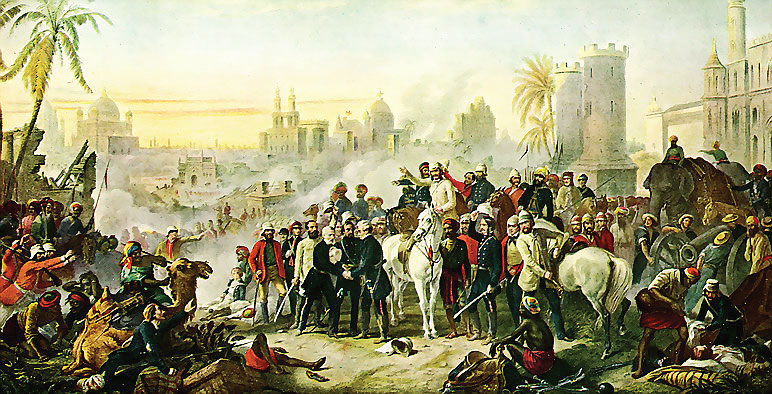
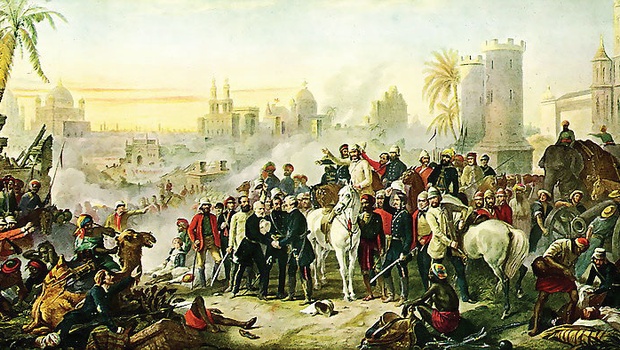
The Relief of Lucknow, 1857 by Thomas Jones Parker

Asked to review a particular book, Abraham Lincoln is said to have responded by saying, “People who like this sort of thing will find this the sort of thing they like.” Shamsur Rahman Faruqi’s The Sun that Rose from the Earth is precisely the sort of book that those who like leisurely and erudite books will like. A collection of five stories, each a fairly long short story, originally written in Urdu and admirably translated into English by the author himself, The Sun that Rose… is not the right fare for light readers on the go or casual reading for the frivolous-minded; every single one of its 600-odd pages is a connoisseur’s delight, brimful with evocative detail and flavoursome with the choicest of Urdu verses. It requires patience and attention, not to mention stamina to read even one story in one sitting.

SunRose02MPOs11dec2014

As in the case of his previous book, The Mirror of Beauty, first written in Urdu as Kai Chand Thhe Sar-e Asman and subsequently published in its English translation to great critical acclaim, The Sun… evokes a vanished past not merely with a historian’s eye for perfect detail but with an aesthete’s sensibility for all that is fine and rare in life and letters. The stories are set in a cusp of time when two worlds are fusing and merging: the rays of the setting sun are bathing Mughal India in the warm glow of its last rays and a colonial India—with its “English-style madrassas”, vilayati cloth and other commodities flooding the shops and bazaars that are rife with rumour and gossip about the latest political intrigues —is coming into its own.

Beni Madho Singh ‘Ruswa’, the young protagonist of the first story ‘Bright Star, Lone Splendour’, travels from Azamgarh to Delhi to meet an ageing Mirza Ghalib. By then a lion in winter, Ghalib recites a Persian verse of his to his callow provincial visitor:

My station cannot be discerned by any eyes but mine

For my star is so far up that it doesn’t shine bright.

Writing a memoir of that fateful meeting, Ruswa conjures up scores of people, Rajas and nawabs, dastango and poets, even a pretty hostess at an inn who spoke “beautiful Urdu with quiet elegance and who (still) regarded Mirza Ghalib sahib as an outsider and not a native of Delhi”—character, both real and imagined who were “gobbled up like a python swallowing a small bird” by the events unspooling from 1857, the annus horribilis.

SunRose03MPOs11dec2014

Showing a propensity for deliberately using archaic words and expressions in keeping with the historical nature of his work as well as different registers and intonations for different characters to denote their class and caste distinctions, Faruqi studs his narrative with a profusion of Urdu poetry which convey the “culture” of his settings far more effectively than dialogues or reported speech. Wit and repartee, the cut and thrust of civilized banter, punning and wordplay, ingenious use of a word with many meanings, all this and more is inserted into the leisurely narrative through explanatory asides. For instance, “zila” meaning “side” was used “to mime the language from unlikely angles and use free play of association as a weapon of wit…With the decline of culture, the art of zila fell into disrepute, then desuetude. It was, in fact, not just frivolity, but could be used in poetry with much effect by the ingenuous poet. Mir used it often and with such subtlety that all but the most discerning listeners failed to get the zila angle. The effect of zila is impossible to reproduce in translation, but here are a few examples from the poetry of Mir, with the necessary commentary:

How I wish I was one of this garden: like the scent of flowers

I’d float with the morning breeze, enjoy myself, and then dissipate, like air.”

And so it goes on: leisurely commentary, erudite asides on poetics, keen observations on society, culture and manners coming together in a seamless whole. And so, while the five stories are neither long short stories, nor novellas or even novels in the conventional sense, they are a valuable introduction to a vanished past. That Faruqi has re-imagined many historical figures and real events and brought them to life for the modern reader in a richly textured, elegantly sprawling work of fiction is a testimony to his creative prowess.

source: http://www.newindianexpress.com / The New Indian Express / Home> LifeStyle> Books / by Rakshanda Jalil / December 06th, 2014

Thousands visit wildlife photo expo

Visitors having a look at the exhibits displayed in ‘Click Your Pic 2014’ wildlife photography contest and expo at Brookefields Mall in Coimbatore./ by Special Arrangement / The Hindu

Importance of wildlife photography stressed

Thousands of visitors flocked Brookefields Mall in the weekend to see the wildlife photographs displayed by 165 photographers across the country in the ‘Click Your Pic 2014’ wildlife photography contest and expo. It was organised by the Environment Conservation Group.

The photographers displayed India’s rich biodiversity. Eminent wildlife photographer T.N.A. Perumal, who distributed prizes to the winners of the competition, on Sunday, spoke on the importance of wildlife photography and change in technology that had made wildlife photography much easier.

I. Anwardeen, Conservator of Forests, Sathyamangalam, asked the public to work towards conserving wildlife and India’s rich natural heritage.

R. Mohammed Saleem, president of ECG, elaborated on the importance of the pictures displayed in the expo and efforts taken by photographers in taking them.

Winners were given prizes in three different categories. In the mammals category, Sudharshan Murthy came first, followed by Bharathi and Dhanuparan. In the birds category, Ganesan Ram won the first prize. Anvitha Jaganath and Sivakumar came second and third. In the insects category, Sibi Ussan bagged the first and the second prizes. R. Prakash Kumar of Nallampalayam bagged the third prize.

Prizes for the drawing competition held on Friday were also given away to school students on Sunday.

The exhibition is open to visitors at Brookefields till November 19. Schools can bring their students in batches to visit the exhibition and learn our rich natural heritage.

source: http://www.thehindu.com / The Hindu / Home> News> Cities> Coimbatore / by Staff Reporter / Coimbatore – November 18th, 2014

The heart of the natter

Chatterers both, these siblings are each other’s sounding boards, critics and best friends. The energy is infectious, we find
DanishKubraMPOs10dec2014

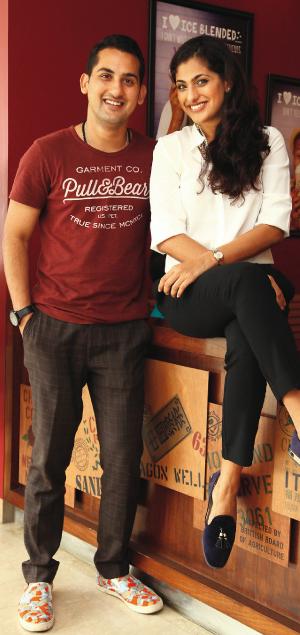
Relative Value with Danish (26) and Kubra Sait (31)

A riot. That’s what this brother-sister duo is. What was meant to be an hour-long interview steamrolls at full speed into nearly three, before plodding to a reluctant halt. They laugh a lot. They also tease, crack abundant jokes, high five each other repeatedly, make casual conversation with onlookers and fans, and are generally high on life. Exhaustingly so, especially to reticent people not given to much exuberance. Danish and sister Kubra, well known in Bangalore as anchors, emcees, TV hosts and him, the voice of prankster Nagaraj on the radio (or Chacko, Azhgar…take your pick), make no effort dispel the notion that they are talkers. Fun ones, at that.

Older sister Kubra will repeatedly deny that she is a bully — and Danish will say she used to be one — but it is apparent that she is very involved in her little brother’s life. Case in point — the T-shirt, shoes and socks she has carried with him to change into photographs for this interview, which Danish obligingly accedes to without a thought or a look at her choices. He trusts her implicitly, it’s clear. “This is my world — my mom and sister. We are each other’s best friends,” he says earnestly, and she nods.

They get along like a house on fire, and it’s almost impossible to catch them out of tune. Danish starts a sentence, Kubra completes it. Kubra teases a train of thought, Danish responds with perfectly-timed laughs. They put their synergy down to having grown up in a broken home, where their parents were constantly at odds. Through it all, Kubra, a self-proclaimed “warrior”, remained fiercely protective of her brother. “He was so cute! Not that he isn’t now,” she says, looking at him fondly. ‘Didi’ (older sister) as Danish endearingly calls her even as we are surrounded by starry-eyed autograph-hunters, is the proverbial older sibling — pampering, indulgent, and sometimes domineering.

She recalls growing up with an “adorable” kid, who ate up all his chocolates and asked her to share as per mom’s strict instructions. “He didn’t even have his own clothes!” she says with a giggle. “He was so fair that if you gave him a tiny slap on the cheek, he would start bawling and turn beetroot red,” she says, gesturing animatedly. “So my mum would put him in my red frilly frock, which had layers and layers going right down to the floor, and give him a small smack on the cheek, and then click a picture while he would cry.” That is all she can complete before collapsing into laughter while a mortified Danish yells into the microphone — “We were poor! POOR! Put that down as the reason please.”

Mother and daughter would “torture” the littlest member of the family, but also made him the centre of their universe. Kubra has drawn his biology diagrams for him, driven him to boarding school and even sat with his head on her lap as they bawled when it was time to leave him there. “Of course we miss each other — first when she went to Dubai and now that she is in Mumbai,” says Danish, restlessly swirling chopsticks in the air before Kubra promptly puts them away. “Some of my best childhood memories are of the family going to the movies — she and mom on one bike and me and dad on another — and all I’d want to do is sit with Didi because she was the cool one.” Kubra also dropped him to school — a ride on a black, kickstart TVS bike filled with chatter and games where they would follow the fastest person ahead of them on the road.

Danish too weighs in on his sister’s relationships, work choices, and even plays mediator when she fights with their mother, who he says, “runs their lives.” “And when we quarrel with mom, one will stand up for her saying ‘you can’t talk like that about her!’ before becoming one unit and telling mom to leave the other alone. But while I’ll listen and resolve things, this one will go add more fuel to the fire — bloody!” he says, gesturing at his sister who is convulsing in laughter before saying guiltily, “Yes he’s right, I do that!”

Danish’s sister is his first critic — pulling him up for everything from calling an old man a ‘rascal’ in humour during a prank call to critiquing his clothes — “Look at what he’s wearing!” She recalls how as a child, he fought with her and went to Lalbagh, dressed in a casual t-shirt and his school tie, “and then clicked photos with all the Mickey Mouse dustbins.” He’s also honest with her. In fact, a week before they co-anchored the Pro Kabaddi League for TV, Kubra says she was on edge, unconvinced that it would work. “He was sure — and look how well it did!” They go on to talk about how much they love Shah Rukh Khan, who they met during Temptations 2004 in Bangalore and then during the Pro Kabaddi league. Once again, it’s hard to pries them apart.

Kubra says it “melts her heart” when “no matter where we are or with who we are, he’ll turn around and say, ‘Didi, can we go? Didi, can we do this?’ He’s taller than me, super independent and so, good at what he does, but still accords me that respect and fondness.” On stage, therefore, the first time he referred to her as Kubra, it gave her a jolt. “I also find it very weird ya, to call her Kubra. So I just say ‘HEY’!” he says loudly, with his trademark energy. And just when it seems like it’s all sibling love, he pulls her leg. “After a point when we’re hosting, I’ll call her Didi and she’ll call me Dan. But this one toh goes into a trance! We were doing a show where we’re giving the 1,000 ranked person an award and she goes ‘you are the lonely lamp in this darkness…’. I’m thinking, God, stop it already!”

Being in the same profession, they say, was a happy accident. “He was doing really well in theatrics school, while I was in Dubai, working for Microsoft and also anchoring events for the company before realising I wanted to do it for myself. Somehow, we both found our way into this profession. We took separate paths, but landed up in the same place,” Kubra says.

Ever since, there has been no looking back. Today, the two try and work together when possible, and make it a point to solicit feedback from the other “and mom, of course” no matter where they are. Work is central to both their lives, especially Danish’s, who admits that he doesn’t have too many friends. “In the last two-three years, people have gotten to know me. But for old Bengalurians, I’m still Kubra’s brother. In fact, we sometimes whet events like that. If I introduce myself as Kubra’s brother and they don’t know who she is, I know what kind of work they’ll give me,” he says. She nods, adding, “And now Danish is doing so well that people recognise me through him. It’s a weird twisted heirloom.”

We’ve hurtled from early evening to night, and it is time to wrap up. They banter about how she went from being a tomboy who wore Danish’s WWE t-shirts to college to one “glam” chick because of the “double poverty” they were in, he says with a guffaw. Loud laughter, again. The hilarity, we realise, is just one of the many reasons these two are as tight as thieves.

source: http://www.bangaloremirror.com / Bangalore Mirror / Home> Columns> Sunday Read / by Sowmya Rajaram , Bangalore Mirror Bureau / November 15th, 2014
Karanji Park gets Orchidarium

Wildlife photo expo inaugurated; Great Indian Rhinos released for public viewing at Zoo

Mysuru, Karnataka  :

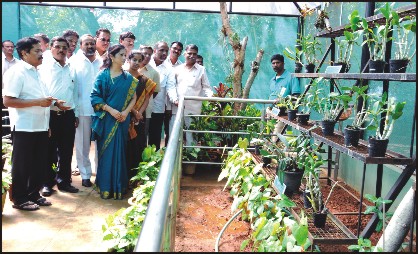
Adding to the existing attractions at Karanji Lake Nature Park, an Orchidarium with 98 Orchid plants of various varieties was inaugurated by Rehana Banu, Chairperson, Zoo Authority of Karnataka (ZAK), at the Park premises on Lalitha Mahal Road in city this morning.

RehanaBanuMPOs10dec20134

Orchidarium is an indoor enclosure for keeping and cultivating plants and observing them under natural conditions, especially for the cultivation of various types of Orchids.

Orchidarium is an area that provides the desired environmental conditions for different varieties of Orchids grown abundantly for cultivation and conservation of Orchids both endangered and otherwise.

It is provided with optimum lighting conditions for the plants while protecting them from direct and harsh sunlight. The structure is covered with mesh with a roof to protect the plants from direct sunlight.

Prior to the inauguration of the Orchidarium, the Wildlife Photography exhibition was inaugurated at the Zoo Library by MLA M.K. Somashekar.

The expo, which is being held in two categories like Zoo Animals and Wildlife Photography has a total of 220 pictures clicked by both amateur and professional photographers.

In the Zoo Animals category, pictures of Hippo and its baby, playful bear cubs, tiger and its cubs playing and other pictures of Zoo animals are on display.

In the Wildlife Photography category, prize winning photos of World Wildlife Day contest clicked by photographers S.R. Madhusudhan, G.S. Ravishankar, M.K. Sapthagirish and others has been put on display.

A pair of Great Indian Rhinos, three-year-old Virat and one-year-old Bablee, brought to Mysuru Zoo from Patna’s Sanjay Gandhi Biological Park about two months ago, were released for public viewing by Mayor R. Lingappa and MLA M.K. Somashekar at an enclosure made for them at the Zoo premises.

Zoo Executive Director B.P. Ravi, Manager Shivanna, Zoo Veterinarian Dr. Suresh, RFO Girish and others were present.

source: http://www.starofmysore.com / Star of Mysore / Home> General News  /  Thursday , December 04th, 2014

Together, they fly Guinness flag

An aerial view of the national flag formed by volunteers who created a Guinness record in Chennai on Sunday / PTI

30,000 Chennaiites break record with ‘human Tricolour’

At 4 a.m. on Sunday, Chennaiites started gathering at the YMCA grounds here; a few hours later, a Guinness World Record was broken. Over 30,000 people came together to create the world’s largest human formation of a national flag, surpassing Pakistan in this feat.

Nine months ago, a sports club in Lahore made the first attempt to create a human national flag of Pakistan with 28,957 people and held the record for the largest formation till Sunday.

Seyda Subasi-Gemici, adjudicator of Guinness World Records Ltd., said, “It is a big historical day for India. I was very touched when I saw people gather around 5 a.m. and wait till noon in this heat to be a part of this event. They have truly showed their unity today.”

India is prepared to create such huge records and they can recreate this at any point in time, she added.

She recollected how she visited Chennai last year for “Parle Golu Galatta 2011,” the largest doll collection.

Isak Nazar, Governor of Rotary Club International 3230 that organised the event, said, “This achievement that people of Chennai have made is special. We organised this event to instil patriotism among the people and let future generations know about the importance of national flag.”

Planning for the event started 10 months ago.

“We mobilised people from colleges and corporate firms over a period of time. We had a set of architects who planned this,” Mr. Nazar said.

source: http://www.thehindu.com / The Hindu / Home> News> Cities> Chennai / by Staff Reporter / Chennai – December 08th, 2014

Natl. Seminar on Tribal Education begins at CIIL

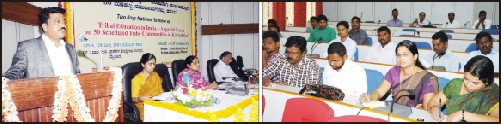
Prof. T.T. Basavanagouda, Director, Karnataka State Tribal Research Institute, Mysuru, is seen addressing the gathering. S. Prathibha, Research Officer, Karnataka State Tribal Research Institute, Mysuru, Kumuda. B. Susheelappa, AEE and Writer, 110 KV Sub Station, Jog Sagara Taluk, Shivamogga district and Prof. C. G. Hussain Khan, Retired Professor, Dept. of Anthropology, Karnatak University, Dharwad are seen on the dias. Picture right shows a section of participants.

Mysuru :

A two-day National Seminar on ‘Tribal Education in India – A Special Focus on 50 Scheduled Tribe Communities in Karnataka’ organised by Karnataka State Tribal Research Institute, Mysuru began at Central Institute of Indian Languages (CIIL) on Hunsur Road in city this morning.

The major theme of the workshop is ‘Socio-Economic and educational aspects of Scheduled Tribes in Karnataka.’ The seminar is being attended by Students, Research Scholars, Lecturers and Professors of Departments of Ancient History and Departments of Anthropology of various Universities.

The programme was inaugurated by Kumuda. B. Susheelappa, Assistant Executive Engineer and Writer, 110 KV Sub Station, Jog Sagara Taluk, Shivamogga district.

Kumuda, in her inaugural address said “Nowadays, most of the youth in India are following Western culture which is not a good sign. We should respect and follow our Indian culture rather than following the culture of Western countries.”

Prof. T.T. Basavanagouda, Director, Karnataka State Tribal Research Institute, Mysuru who presided over the function said, “There are 43 lakh tribal people in Karnataka, out of which 20 lakh tribals stay in forests.” He regretted that these tribal people are illiterate and uneducated. “There are various schemes and funds available from Central and State Governments for the welfare of Tribal people. But awareness has to be created among the tribal people to utilise these funds,” he added.

Prof. C. G. Hussain Khan, Retired Professor, Department of Anthropology, Karnatak University, Dharwad, in his keynote address said “Karnataka has 4.1% of the country’s scheduled tribes.” He regretted that most of the tribal children are malnourished. He also spoke about female foeticide and urged the government to take strict action against those who indulge in female foeticide. “Education is the most important social input for the economic development of any society. But low educational status of tribal community adversely affects the socio-economic condition of tribal people.” he added.

Valedictory function

The valedictory function will be held tomorrow at 4 pm at the same venue. Prof. T.T. Basavanagouda will preside and Prof. C. Basavaraju, Registrar, UoM will deliver valedictory address.

source: http://www.starofmysore.com / Star of Mysore / Home>  General  News  /  Friday , November 28th, 2014

Rehana Banu takes over as Zoo Authority Chief

Rehana Banu, who took charge as Zoo Authority Chairperson in city yesterday, being greeted by Zoo Deputy Director Dr. Suresh as Rafiq Ahmed, Syed Akram Pasha and Zoo Member-Secretary R.S. Suresh look on

Mysuru, (ACP,SBD&RNN) :

Former MCC Ward 40 Corporator Rehana Banu yesterday took over as the Chairperson of Zoo Authority of Karnataka (ZAK) at its office inside the Zoo premises in city.

Rehana Banu, who arrived at the Zoo at about 7.20 pm, was greeted by Zoo Deputy Director Dr. Suresh, who offered a bouquet to the new Chairperson. Immediately after taking charge, Rehana met MLAs Vasu, Tanveer Sait and M.K. Somashekar and thanked them.

Zoo AEE Nagendrappa, Superintendent Jayaram, Congress leader Rafiq Ahmed, Corporator Suhail Baig and others also greeted Rehana on her nomination as Chairperson of ZAK.

Meanwhile, Sundar Das, Senior Congress leader from H.D. Kote, yesterday took charge as Chairman of Karnataka Seeds Corporation from Managing Director Vishakanta at its office in Hebbal, Bengaluru.

Narayan, Ananthu, S.E. Basavaraj take charge

It is learnt that former Mysuru Mayor Narayan today took charge as Chairman of Karnataka Safai Karmachari Commission at its office in Sampangiramanagar in Bengaluru.

R. Ananthu: Former Mysuru Mayor R. Ananthu, who has been nominated as Chairman of Mysore Paints and Varnishes (Mylac) has told SOM that he would take charge later today after meeting Chief Minister Siddharamaiah.

S.E.Basavaraj: Former Mysuru ZP President S.E. Basavaraj, who has been nominated as Chairman of Karnataka Maharshi Valmiki Scheduled Tribes Development Corporation Ltd. today took charge at its office in Vasanthanagar, Bengaluru.

K.R.Mohan Kumar and C. Dasegowda await orders

It is learnt that former Dry Land Development Board Chairman K.R. Mohan Kumar, who is tipped to become the Chairman of Mysuru Urban Development Authority (MUDA) and Mysuru City Congress President C. Dasegowda, who has reportedly been nominated as Chairman of Command Area Development Authority (CADA) are yet to receive official orders and the same are likely to be issued today, according to sources.

source: http://www.starofmysore.com / Star of Mysore / Home>  General  News  / Wednesday , November 26th, 2014

ASI forms taskforce for restoring 3 Mughal-era structures

Agra:

The Archaeological Survey of India (ASI) has formed a task force under the organization’s additional director general (ADG) BR Mani for the restoration and protection of three Mughal era-structures – Hanthi Khana, Aga Khan haveli and Khan-e-durran haveli situated on the Yamuna bank in vicinity of the Taj Mahal.

Mani along with senior ASI officials (Agra circle) conducted a survey of the structures on Saturday to ascertain their present condition. They found that all the three structure are in dilapidated condition and encroached upon by locals.

“We will ensure that these monuments are conserved and remain protected from encroacher. A survey has been done,” Mani said.

ASI officials said the selected monuments have found mention in a book written by Ebba Koch, Austrian architectural historian, as riverfront Mughal gardens in Agra. They are located on north eastern side of the monument, said an official.

According to information, Khan-e-durran was Shah Jahan’s governor of the Deccan and played a major role in annexation of Daulatabad fort in 1633. His haveli was later converted into a tannery during British period. At present, its ownership is in dispute. The ASI task fort has also been looking into this matter.

Likewise, Aga khan was the superintendent (also a fuajdar) under Shah Jahan and responsible for maintaining law and order at the river front. “He was also responsible for ensuring proper care of a thousand horses of the Mughal army. He died in 1658,” said an official.

The Hanthi gate was the entry point to the elephant enclosure. Although not much information is available about it, it does find mention in Koch’s book and also in Padshahnama written by Abdul Hamid Lahori in the 17th century.

The ASI will also chalk out a plan to plant trees in the Taj heritage corridor located between the Taj Mahal and the Agra Fort and convert it into a greenbelt. The Supreme Court had passed an order this regard in 2006, but nothing much was done so far because of lack of funds and experts. Now, the project has taken wings once again after former minister of culture, Shripad Naik directed the ASI in August to revive the project.

source: http://www.timesofindia.indiatimes.com / The Times of India / Home> City> Agra / Aditya Dev / November 22nd, 2014