Category Archives: Arts, Culture & Entertainment

Cyclone memorial cries for attention

Structure built to remember 30,00 who died in cyclone

A view of cylcone victims memorial constructed during British rule at Gilakaladindi near Machilipatnam in Krishna District of Andhra Pradesh. Photo: Ch. Vijaya Bhaskar / The Hindu

People tend to recollect harrowing times of Diviseema uppena, a cyclone that devastated Machilipatnam, whenever a cyclone hits the State. But, here is a cyclone memorial which has faded in the memories of times gone by.

Great tragedy

Close to 30,000 people were swept away by the giant ocean wave over Machilipatnam town on the night of the cyclone of November 1, 1864. Following the great tragedy, Manuel Fruvall had constructed the memorial in the memory of his brother’s family and 30,000 people of this tiny town who died in the cyclone, at Bandarkota village near here.

A plaque put up outside the this monument says that the memorial was constructed in remembrance of Anthony and Maria Fruvall, their sons Peter Manuel and Daniel and their daughter Honey and her children Joseph and Georgiana and 30,000 people who were swept into the eternity by the ocean.

In 1860s, the total population of the town was around 60,000. In remembrance of then Machilipatnam Chief Magistrate G. Thornhill, who strove to control post-cyclone deaths due to spread of several diseases, Mr. Fravell also dedicated the memorial to him, says amateur Historian Md. Silar.

Many people of the town do not even know where the monument is located there. But, fishermen community in the vicinity recollected that thousands were killed in 1864 cyclone.

Many demanded that the government come up with a plan to restore and preserve the memorial.

Mr. Silar says that the monument commemorates the fate of thousands of people.

The memorial withstood vagaries of nature. But, now stands testimony to negligence by government machinery.

Dilapidated monument

The dilapidated monument is surrounded by the bushes and trees. “Our repeated appeals to the District Collector and authorities concerned to protect the heritage fell on deaf ears,” he adds.

source: http://www.thehindu.com / The Hindu / Home> News> Cities> Vijayawada / by G. V. R. Subba Rao / Machilipatnam – October 16th, 2014

Mukhtiar Ali: I am a woman when I sing…

Sufi music

MukhtiarAliMPOs21oct2014

Mukhtiar Ali, who is the 26th generation Sufi singer from Rajasthan belonging to the Mirasi community, insists that Sufi kalam is about looking for Him — evoking Him who is present within ‘us’.

His rendition of ‘Kabeer khada bazaar mein, maange sabki khair…’ sure worked wonders on a few hundred souls gathered at Vanaranga in Mysore recently. Evoking the mysticism and deep sense of spirituality which are the essential elements of Sufi music, Mukhtiar Ali filled every bit of space. His voice alternating between honeyed and lilting tones, soothed many a hearts and filled them with love and deep sense of total surrender.

Mukhtiar Ali, who is the 26th generation Sufi singer from Rajasthan belonging to the Mirasi community, insists that Sufi kalam is about looking for Him — evoking Him who is present within ‘us’. Living in the hot and arid Pugal in Rajasthan, Mukhtiar has been witness to many contradictory shades in the world of music. Much like the music he sings, his talks too, are not devoid of hidden meanings.

“Bahut dekh liye. Par abhi bahut kuch dekhna baaki hai (I have much, but there is a lot left to see),” he says when asked about whether Sufi music is ‘back’ for good. After the success of ‘Had – Unhad’ — a documentary film made by Shabnam Virmani that shot him to fame; Ali has seen a lot of ‘shift’ in attitude in his own community. Ali admits Sufi was not his first love, but will surely remain his only love. “I tried my hands at agriculture, tailoring, weaving, and worked with Urmul Trust for few years before finally turning towards Sufi,” he says.

The carrier of an oral tradition, with no written notes to refer to; or formal documentation of learning process of Sufi music, Mukhtiar slips into notes with ease. Has it ever unnerved him before others? No, he says. Recollecting his experience with formally trained musicians, Mukhtiar says he was in Chennai recently to attend a mega music festival. Musicians from various disciplines had gathered for the same. There was a 10-day rehearsal as a run-up to the final recording and everyone was “counting something” at their finger tips and asked Mukhtiar to do the same, as he was to join them at the middle note of the song. He was nervous initially and then gathered enough courage to tell them “Bhayya, aap gao. I will catch the note perfectly alright, wherever I am to join you. But, don’t ask me to do this counting. I have never done it all my life!” After that, it was a smooth sailing for Ali who recorded well on the final day, while most others had lost their energy owing to the 10-day rehearsals!

Expressing his discomfort over closed spaces, Mukhtiar feels he sings the best when he is ‘with’ people. “I love open air theatres or informal gatherings. I feel euphoric when people egg me on. I am the best Meera, or Radha they would have heard. I surrender totally when I sing for people… like a woman who sings for her lover. ‘He’ is my focus and I look for Him in the gathering. Get me into an airconditioned, sound-proofed studio, I am a restless soul who is at his worst fidgety self,” he says.

Have the generations of singing eroded Sufi of its essence? Do they still sing Bulle Shah with as much dedication? “Bulle Shah is still the same. He still churns your stomach when you listen to anyone sing his kalaam. But the contemporary Sufiana Kalam (Sufi songs) has no ‘dum’. You don’t feel a thing when you sing them,” he reveals. How does he best describe the contemporary Sufi writing then? Pat comes the reply: “Clever play of words, but minus the essential essence.
“Bollywood has ‘used’  Sufi, often, to cater to the taste of its audience. Everything is diluted and coloured suitably to be served to them. At the same time, we cannot refute the fact that Bollywood has been the best vehicle Sufi music has found to reach the masses. ‘Dama Dam Mast Kalandar’ is as necessary today in concerts as is ‘Kabir Khada Bazaar Mein, Maange Sabki Khair’…. We cannot deny this,” he observes.

source: http://www.deccanherald.com / Deccan Herald / Home> Supplements> Sunday Herald Art & Culture / by Preethi Nagaraj / January 09th, 2010

Tamil poet Iqbal named for Singapore’s highest cultural award

Indian-origin Singaporean poet and writer K.T.M. Iqbal will be awarded Cultural Medallion, the country’s highest cultural award by President Tony Tan Keng Yam on Thursday night in Singapore.

It is the highest recognition for the 74-year-old Tamil poet whose achievements include more than 200 children’s songs written for Radio Singapore in the 1970s and 1980s, as well as seven collections of poetry.

Mr. Iqbal said he was “delighted” to receive the award which was “an incredible honour”.

“My first love is poetry. We have been together for 60 years. I never imagined this would bring me the Cultural Medallion award,” The Straits Times quoted Mr. Iqbal as saying.

Mr. Iqbal learned the basics of Venpa, a form of classical Tamil poetry from a poetry-writing workshop. “I would sit on the street in the evening to write or an idea might come when I was on the bus,” said Mr. Iqbal.

The poet, also a retired bank executive, has received recognition in the education system of Singapore also.

Mr. Iqbal’s compositions are studied in schools and some of them have appeared in the subway stations as part of efforts to bring the arts close to the community.

Mr. Iqbal migrated to Singapore at the age of 11 with his father from Kadayanallur in South India in 1951.

A Tamil newspaper Malaya Nanban, which is now defunct, introduced him to the simple but evocative compositions of Tamil poet Mathithasan. The poet’s vivid depiction of people and values in society inspired the young Iqbal to start penning poems.

The retired bank executive continues to pen poems and hopes to produce an edited collection of his best Tamil poems and an English translation of it.

Along with the award, Mr. Iqbal will get 80,000 Singapore Dollar grant, which can be used to fund artistic endeavours over their lifetime, according to The Straits Times.

“The money once spent is gone. But to have the nation recognise your contribution is great and it will encourage people to keep writing poetry,” said Mr. Iqbal.

The award will also be given to sculptor Chong Fah Cheong, 68, and 51-year old Alvin Tan, the artistic director of a theatre company, The Necessary Stage. Recipients are each eligible for a 80,000 Singapore Dollar grant.

The award, instituted 35 years ago, has been presented to 115 artists to date, including Mr. Iqbal, Mr. Chong and Mr. Tan.

source: http://www.thehindu.com / The Hindu / Home> News> National / by PTI / Singapore , October 16th, 2014

Telling it as it is

Poet-activist Salma / by  Jack Llewellyn-Karsk
Poet-activist Salma / by Jack Llewellyn-Karsk

Poet-activist Salma on her experiences at the Writers of India Festival, Paris

On May 26, this year, poet Salma received a letter inviting her to be a guest of honour at the Writers of India Festival, Paris, in September. The festival, a new collaboration between Columbia University, New York, and the Bibliothèque nationale de France, featured a series of lectures and discussions with more than 12 Indian writers at Reid Hall, Columbia and BnF in Paris. Salma talks about her journey as a poet, her experiences in Paris and how poetry can make an impact.

You used to write secretly when you were young as you were confined to the house from the age of 13. Did you ever think at that time that you would be an established writer?

(Laughs) I was very confident my words would reach the world. I still remember this scene vividly. I was 16. I was standing with my sister in the kitchen and she was rolling out chapatis. ‘You had better learn to cook,’ my sister said. Otherwise, people will say we did not bring you up properly. I told my sister — I’m going to be a famous writer. I’ll go to many countries and attend many conferences. I don’t need to learn to cook!

And now, you have just attended the Writers of India festival. How was the experience?

There were several readings and discussions every day and at least five events were happening at the same time. Everything was well organised. They had French translators. I was the only one to have a screening of my film Salma! It was followed by an interview with senior journalist, Judith Oriol — she came prepared with an in-depth questionnaire.

What was the audience reaction to your film, which documents the story of your life?

Many of them got very emotional. It was hard for people to believe that so many women do not have even the basic rights and that it is a struggle.

Is poetry part of our everyday culture?

Thirukkural

What made you write poems, not stories?

Like many girls in a Muslim community, I was not allowed to leave the house in my small town Thuvarankurichi. I had many conflicting feelings and I wanted the freedom to live life, do many things. A poem can be a powerful expression and all my pent-up emotions came through in verse.

Can you read from one of your poems presented at the festival?

A few lines from Naan Illadha Avan Ulagam (His world beyond me). It is about a mother and son.

He, who had asked me

on a night of the moon’s full retreat

if the sun too would be gone someday,

has no more answers to seek from me.

How have your experiences impacted your writing?

It is an unbelievable life, to be a writer. My poems are for everyone, but I especially wanted to reach out to women, and make a difference for them. They must realise their lives. They must understand their identity.

Your family’s resistance to your writing – did that change?

There were many changes that happened over time, but the big shift happened when I entered politics. At that point, my family had no choice but to accept it.

(Salma won a seat reserved for women in Thuvarankurichi in the 2001 panchayat elections and was elected MLA in 2006).

Your writing got acceptance when it was connected with a larger purpose — political and social. Can writing by itself bring about social change?

Writing alone cannot bring change. We need political will to usher in change.

The theme of the festival in Paris was on the impact of globalisation on cultural creation and consumption. Did the festival address these ideas?

I got the chance to be on the same platform as award-winning writers Jeet Thayil, Vikram Chandra and Kiran Desai and there were stimulating exchanges. All participants had to contribute essays on globalisation, which will be published in the form of a booklet.

In India, many do not consider storytelling and poetry real professions. How did you find it in other countries?

People respect writers. A writer receives more adulation than a politician, in some ways. From the time I landed at the airport, people used to ask me to recite a poem in Tamil, just because they wanted to hear how it sounded!

source: http://www.thehindu.com / The Hindu / Home> Books> Author / by Sujatha Shankar Kumar / October 17th, 2014

Deve Gowda to launch Mysore Varsity Alumni Assn.

Mysore :

Former Prime Minister, H.D. Deve Gowda will be launching the Alumni Association and various other programmes of University of Mysore at 10.30 am on Oct. 16 at Crawford Hall.

As part of the centenary celebrations, the ex-PM will release a booklet, Convocation Address Vol.II, Centenary Account Gateway and lay foundation stone for School of Planning and Architecture.

MPs R. Dhruvanarayan, C.S. Puttaraju and Pratap Simha will be the guests of honour. Prof. K.S. Rangappa, VC, will preside.

On the occasion, two of the oldest Alumni — former VCs Prof. D. Javaregowda and Prof. B. Sheikh Ali — will be felicitated.

source: http://www.starofmysore.com / Star of Mysore / Home>General  News / Wednesday ,  October 15th, 2014

Lucknow Expressions society hosts literary evening with british scholar Rosie Llewellyn Jones

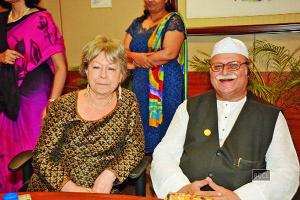
It was a packed house when the Lucknow Expressions society organised another literary evening, this time with historian Rosie Llewellyn Jones.

Rosie Llewellyn Jones (left)

Rosie’s writings on Nawab Wajid Ali Shah were released by filmmaker Muzaffar Ali, who was the chief guest at the event. Introducing the audience to the life of Wajid Ali Shah, Jayant Krishna expressed disappointment over the lack of monuments or places in the city named after the Nawab.

“Perhaps, we are looking for the international airport to be named after him,” joked Jayant. Muzaffar Ali, on the other hand, spoke about a temple in Vrindavan with a statue of Nawab Wajid Ali Shah.

The event concluded with a question-answer session, followed by high tea.

source: http://www.timesofindia.indiatimes.com / The Times of India / Home> City> Lucknow / by Renu Singh, TNN / October 16th, 2014

Lokmanya Tilak’s immortal stamp on Ahmedabad

Ahmedabad :

The city is rightly regarded as the battlefront chosen by Lokmanya Tilak for India’s struggle for Independence as it figured prominently in all his endeavours. To commemorate Tilak’s birth anniversary today, TOI trawls through history and comes up with some fascinating facts about Tilak’s close association with Ahmedabad and  Mahatma Gandhi .

According to city historian Rizwan Qadri, Tilak – one of the earliest and strongest advocates of Swaraj (self-rule) and a strong radical in the Indian consciousness – first came to Ahmedabad in 1893 to attend a Bombay Provincial Council meeting. In the city, he met reformist poet Kavi Dalpatram, who played a major role in promoting the Gujarati language. When Dalpatram died, Tilak presented a tribute in Kesri, a Marathi newspaper Tilak had founded in 1881 as a voice of the freedom movement.

At the 1902 Congress session in the city, several close aides of Tilak participated. In 1907, a moderate Congress leader from Ahmedabad, Ambalal Sakarlal Desai, had a direct clash with Tilak over ideological differences.

The forms of political action initiated by Tilak – the boycotting of British goods and passive resistance – later found resonance in Gandhiji’s strategies to win liberty for India.

On July 22, 1908, Tilak, a bitter critic of British colonialism and its oppressive rule in India, was arrested for sedition. Tilak was shifted to Ahmedabad by a special train on July 23 in 1908, which happened to be his birthday. Tilak was incarcerated in the Sabarmati Central Jail for 53 days, during which hundreds of supporters protested the British move. This forced the British to deport him to Mandalay, Burma (Myanmar), to serve the sentence of six years.

During the Navratri of 1908, around 60 to 70 garba songs were written keeping Tilak in mind, which were banned by the British.

source: http://www.timesofindia.indiatimes.com / The Times of India / Home> City> Ahmedabad / by Ankur Tewari, TNN / July 23rd, 2014

Office-Bearers of MEWA

The Executive Committee of Muslim Employees Welfare Association (MEWA) was reconstructed at the Annual General body Meeting (AGM) held recently.

The following are the office-bearers unanimously elected for a period of three years, according to a press release from Secretary Shameem Ahamed: V.A. Siddique (President), Capt. Mir Afzal Hussain (Vice-President), Shameem Ahamed (Secretary), Baqar Umer Khan (Joint Secretary), Syed Ibrahim Hussaini (Treasurer), Anwar Pasha, Abdul Razak Shariff, Syed Rafiulla Hussaini and Thalath Afroze (Members) and Mir Sarfarazur Rahman and K. Shafiulla Khan (Co-opted members).

source: http://www.starofmysore.com / Star of Mysore / Home> In Brief / October 09th, 2014

Sweetest sound of secularism

Ahmedabad :

Fourteen-year old Ayesha Belicha, a native of Radhanpur, knows whole chapters of Bhagvad Gita by heart. Ask her about the second stanza of the book’s ninth chapter and she will recite it with perfect diction. She is one of the five Muslim girls from city-based Prakash Andh Kanya Vidyalaya who on Sunday made it to the finals of the Gita recitation competition organized by a religious organization, Adhyatma Vidya Mandir.

“I was not exposed to the Gita at all before the competition. But with encouragement and the constant support of my teachers, I started understanding the meaning of the shlokas that I recite. It is not about religion but about an overall philosophy of life,” said Ayesha.

It was a rare show of religious harmony at the competition that was held in Thaltej on Sunday. The five girls stood out for their brilliant performance. A total of 86 students from class V to IX, who were selected out of 450 students of 12 city-based schools, participated in Sunday’s event.

Kundan Rawal, principal of Prakash Andh Kanya Vidyalay, said that they have all-faith prayers at the school where they identify the good singers and girls with good memory.

“We asked the bright girls whether they would like to participate and they happily agreed. For the past one-and-a-half months, they have listened to audio tapes to refine their pronunciation. They have also got Gita in braille script,” she said.

Swami Viditatmanand of Adhyatma Vidya Mandir said that they see it as blurring of communal lines. “A child does not know about religion or faiths. We are glad that children from other faiths are participating as it will at least expose them to the world outside. It will also provide them a viewpoint for evaluating other faiths. Our goal in organizing this annual event is only this ? to make the children aware of their heritage,” he said.

source: http://www.timesofindia.indiatimes.com / The Times of India / Home> City> Ahmedabad / TNN / August 25th, 2014

Mysore’s green warrior

Heritage

Karnataka owes much of its position as one of the top-ranking horticultural states in the country to the initiatives taken by Tipu Sultan, who sent missions abroad to collect seeds of flowering plants, vegetables and fruits including the famed Ganjam fig and the Devanahalli pomelo, writes S Tahsin Ahmed.

TipuMPOs15oct2014

On December 10, 1985, when I accompanied the CBI team as the official witness in a raid conducted at Mysore during which a sword belonging to Tipu Sultan was seized, I visualised Tipu as a brave and valiant king who died fighting the British invaders. Later, I realised that Tipu Sultan was a much celebrated ruler in the history of South India not just for his military exploits, but also for his contributions in the fields of sericulture, rocketry, animal husbandary, social reforms, handicrafts, trade and commerce, etc. There is another major achievement of Tipu Sultan that has not been highlighted enough: his contribution to the field of horticulture.

In fact, Karnataka owes much of its position as one of the top ranking horticultural states in the country to the various initiatives taken by Tipu Sultan in his 18-year rule (1782-1799). Today, horticultural crops are raised on 18.99 lakh hectares of land in Karnataka, accounting for about 15.07 per cent of the total cultivable area.
What do historical records reveal?

In 1799, immediately after the defeat of Tipu Sultan, the British asked Francis Buchanan to survey South India which resulted in the publication of the historical work, ‘A journey from Madras through the Countries of Mysore, Canara and Malabar (1807)’. This book gives an interesting account of horticultural fields which were called tota, as existing during Tipu’s regime. “In the ashta gramas, there are four kinds of tota or cultivated garden lands, tarkari tota or kitchen gardens; tayngana tota (read tengina) or coconut gardens; but many other kinds of fruit-trees are planted in them; yele tota or betel-leaf gardens; huvina tota or flower gardens.” Buchanan also lists 48 vegetables grown in the areas ruled by Tipu Sultan.

Francis Buchanan took notes at lectures at the Botanical Garden, Edinburg in 1780 (before he came to Mysore) which got misplaced. Through another traveller, it accidentally reached Srirangapatna and came to the possession of Tipu Sultan. Tipu got this manuscript bound in tooled leather and added it to his big library, a reflection of his interest in botany and passion for horticulture. His library included many books on management of fruit trees.

Tipu kept up a sustained campaign against feudal chiefs called palegars who usurped land belonging to farmers. Land seized from palegars was handed over to farmers, tenants and bonded labourers. Tipu, it seems, was one of the earliest champions of the land reforms movement. Farmers were encouraged to expand the area of horticultural cultivation. Waste lands were exempted from rent in the first year of cultivation which was followed by tax concessions in the succeeding years. Incidentally, area expansion is one of the major schemes of the National Horticultural Mission today.

Tipu had a huge army and military police, to whom he gave cultivable land in addition to regular pay. Low-level workers like nirgunties were also allotted land to boost cultivation. He is the only king in the history of Karnataka who did not grant a single jahgir. These anti-feudal reforms had a far-reaching impact on the growth of agriculture and horticulture.

Missions abroad

An 80-member mission headed by Mohammed Darwesh Khan was sent by Tipu to France. The mission reached Paris on July 16, 1788, and met the French emperor and handed over a memorandum given by Tipu.
Among other things, the memorandum demanded seeds of flowering plants, vegetables, European fruit plants and trees. The mission was successful in procuring spice plants and camphor seedlings from Molucca.

A huge trade mission was sent by Tipu Sultan to Turkey which met Sultan Hameed in Constantinopole on November 5, 1787. It carried large quantities of black pepper, cardamom, sandal wood etc and succeeded in identifying an overseas market for this produce.

The mission brought back seeds of many flowers, vegetables and fruits. The famous Ganjam variety of fig was brought from Turkey.

Tipu Sultan wrote letters to the darogha at Muscat and instructed him to buy saffron seeds and date palms. The darogha was also asked to obtain silk worms from Qishm island and send them to Srirangapatna alongwith a few men knowledgeable about sericulture.

Farmers were encouraged to cultivate mulberry in their lands. In several diplomatic and trade missions sent by Tipu Sultan to countries like Muscat, Oman, Jordan, Iraq, Iran and Penang, export and import of horticultural produce was a major component.
Role of Thigalars

Tipu noticed that a class of people called Thigalars near Salem had expertise in cultivation of vegetables.

He encouraged them to migrate to Bangalore, Hoskote, Kolar, Devanahalli and Sira, which boosted the cultivation of vegetables in Karnataka. Other measures taken were to exempt farmers growing vegetable crops and cash crops like cashew, cardamom and cinnamon from payment of land revenue. The famous Devanahalli pomelo was also introduced by Tipu.

It was made mandatory for the village patels to plant avenue trees on either sides of the roads throughout his kingdom. But the interesting aspect here is that Tipu ordered planting of mango and tamarind trees among other trees which reveals that preference was given to useful trees over ornamental or just shade-giving trees.

Establishment of gardens

One wonders how Hyder Ali, father of Tipu Sultan, who was in the thick of military campaigns throughout his reign, found time to establish gardens. Hyder who had a taste for gardens (‘Char-bagh’ style), planned Lalbagh on 40 acres of land at Bangalore along the lines of Khan Bagh at Sira, established during the time of Dilawar Khan, the representative of the Moghul emperor in the South.

He imported plants form Delhi, Multan, Lahore and Arcot, apart from laying out a garden at Malvalli and another fruit garden at Srirangapatna, also called Lalbagh.
Tipu expanded Bangalore’s Lalbagh by acquiring more land. The garden was earlier known as cypress garden because the roads from the entrance to the garden and inside the garden were lined with cypress trees.

This is evident from a painting of this garden drawn on the spot by R H Colebrooke and published in 1793 at London. Another painting of the Lalbagh by James Hunter published in 1805 and showing many cypress trees is captioned ‘East view of Bangalore with the Cypress garden.’

Equally magnificent was the Lalbagh at Srirangapatna. The Gardens around the Gumbaz where both Hyder Ali and Tipu Sultan are buried were full of fruit trees, flowers and vegetables of every description. This Lalbagh is also believed to have served as a nursery for the kingdom. Fruits like apples, pears, guava and plantains were successfully grown here. Imagine apple trees in a place like Srirangapatna and that too in the 18th century! Also grown were betel nuts, coconuts, sandalwood, sugarcane, indigo, cotton, mulberry, cereals and pulses.

In the Third Mysore War (1792), the cypresses of Lalbagh at Srirangapatna were axed to provide firewood for British troops. After the war, Tipu restored much of the glory. But in the final war of 1799, British troops breached the fort wall and devastated Lalbagh. Nothing remains of this garden except a painting of the entrance to Lalbagh at Srirangapatna by James Hunter (1805).

The fruit orchard at Malavalli also no longer exists. Buchanan who visited this garden after Tipu’s death noticed 2,400 trees with mangoes and oranges in abundance. The garden surrounding the Daria Daulat Bagh at Srirangapatna was more of an ornamental garden, but very well maintained.

Tipu Sultan’s love for horticulture was so great that he linked this with dispensation of justice. For petty offences, convicts had to plant fast growing plants and for major offences, they had to plant trees like jamun, mango and coconut. In 1788, Tipu Sultan issued a circular to all amildars and in 1792 he passed a regulation that the fines of the farmers shall be commuted if the offender plants two trees, waters them and nurtures them till they reach a certain prescribed height.

Can we think of a better environmentalist among kings gone by, long before environment and climate change became fashionable slogans?

(The author is Additional Director of Horticulture (Administration), Lalbagh, Bangalore.)

source: http://www.deccanherald.com / Deccan Herald / Home> Supplements> Spectrum / by S. Tahsin Ahmed / July 04th, 2011