Three former senior photojournalists with The Hindu , Bangalore, T. Abdul Hafeez, T.L. Prabhakar and K. Gopinathan, were among the six who were honoured by the CMR University and CMR Group of Institutions on Monday.
The others areP. Sarangapani, D. Baburaj and P. Samson Victor. Chairman of CMR Group of Institutions K.C. Ramamurthy said the felicitation was a humble gesture for the service rendered by them to the society.
H.R. Ranganath, Managing Director and Editor of Public TV, was the chief guest.
source: http://www.thehindu.com / The Hindu / Home> National> Karnataka / September 30th, 2014
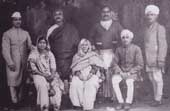
I am beholden to P.V. Rawal of Jammu for sending me a photograph of Allama Iqbal’s Kashmiri Brahmin family taken in Sialkot in 1931. At this time Iqbal was in his mid-fifties. He had already risen to the top as the greatest Urdu poet, at par with Mirza Asadullah Khan Ghalib. Although he was proud of his Brahmin descent, he had nothing to say about his Hindu relations. In this picture, the elderly lady seated in the middle is his grandmother, Indirani Sapru, nicknamed Poshi, wife of Pandit Kanhaya Lal Sapru. The man standing on the left in a shawl is Iqbal’s cousin, Amarnath Sapru; note the close resemblance to the poet.
The family traces its origin to one Birbal. They lived in the village of Saprain (hence, the surname Sapru) on Shopian-Kulgam road. Then the family moved to Srinagar where Iqbal and most of his cousins were born. Birbal had five sons and a daughter. The third one, Kanhaya Lal, and his wife, Indirani, had three sons and five daughters. Kanhaya Lal was Iqbal’s grandfather. His son, Rattan Lal, converted to Islam and was given the name Nur Mohammad. He married a Muslim woman — Imam Bibi. The Saprus disowned Rattan Lal and severed all connections with him. There are different versions of Rattan Lal’s conversion. The one given to me by Syeda Hameed, who has translated some of Iqbal’s poetry into English, maintains that Rattan Lal was the revenue collector of the Afghan governor of Kashmir. He was caught embezzling money. The governor offered him a choice: he should either convert to Islam or be hanged. Rattan Lal chose to stay alive. When the Afghan governor fled from Kashmir to escape its takeover by the Sikhs, Rattan Lal migrated to Sialkot. Imam Bibi was evidently a Sialkoti Punjabi. Iqbal was born in Sialkot on November 9, 1877. As often happens, the first generation of converts are morekattar than others. Iqbal thus grew up to be a devout Muslim. It is believed that once he called on his Hindu grandmother, then living in Amritsar. But there is no hard evidence of their meeting and of what passed between them; Iqbal did not write about it. Though he had many Hindu and Sikh friends and admirers, he felt that the future of Indian Muslims lay in having a separate state of their own. Iqbal was the principal ideologue of what later become Pakistan. Iqbal’s mother-tongue was Punjabi but he never wrote in it. He used only Persian and Urdu, as did many Urdu poets before him.
There are many aspects of Iqbal’s personal life which have not been fully researched by his biographers. We know he married two or three times and that his favourite son was Javed, who became a judge of the Lahore high court. Iqbal’s affair with Atia Faizi of Bombay when they met in London is well-known. There must have been some correspondence between them to show the kind of relationship they had. When in Heidelberg, he was taken up by his young German tutor, Emma Veganast. This secret was divulged by the mayor of Heidelberg in a speech in which he named a part of the bank of the river Neckar after him — Iqbal Weg. The Pakistani ambassador to Germany had the mayor’s speech mentioning the girl’s name suppressed. Iqbal and Emma continued to write to each other till the end of his life. The correspondence should be available in archives in Lahore and Heidelberg. Lovers of Iqbal, among whom I count myself, deserve to be presented with a fuller picture of their idol. We have biographies of Rabindranath Tagore revealing all his love affairs but none of the Allama telling us of the kind of man he was.
Cleansing the system
A couple of lines by Guru Nanak which I often recite to myself to preserve my mental balance run as follows:
Haumain deerag rog hai
Daaroo bhee iss maahen
Ego is a foul disease
Its cure also lies in itself.
I agree with every word of the Guru’s advice. Egoism or self-esteem is a disease like cancer. If not nipped in the bud, it infects other parts of the body and ultimately makes a person a deadly bore who loves talking about himself and wants others to praise him. Every one of us is prone to catch it and must evolve his own methods of fighting it.
Since I get more than my share of flattery from men and women who want me to write about them in my columns, I have to battle against them in different ways. Most tell me how they have read everything I have written and how much they liked it. I know it is not true; so I try to put it out of my mind. Others lay it on thick, that is, makkhan lagoing, when they come to see me. I do my best to change the subject. Despite that some of it sticks because later I find I am pleased with myself. I have found a more effective antidote: it is to make fun of myself. I narrate incidents in which I have made an ass of myself. I did that so many times. Everyone has a hearty laugh at my expense and thinks I must be the kind of fool I make out myself to be. It has a cathartic effect. It purges a lot of ego-poison out of my system.
Try out this purgative
Recently, I had to undergo an endoscopy to clear or confirm cancer in my belly. Needless to say, I wanted everyone to show concern for my health. It is another form of feeding one’s ego. As I had calculated, I got exaggerated shows of affection for me. After it was over, I felt I should restore my ego-balance to its earlier level. I wrote about it in lurid detail. Since I had to use a lot of indelicate vocabulary, which I feared publishers of my columns would find unacceptable, I sent the copy to Vinod Mehta, editor of Outlook. He is the only man I know who would understand what I wanted to say without censuring how I said it. In that piece I have written in detail about the humiliation and loss of esteem an endoscopy entails. Writing about it did cleanse my system of the false notions I had about myself. I felt much better.
source: http://www.telegraphindia.com / The Telegraph, Calcutta / Front Page> Opinion> Story / Saturday – June 30th, 2007
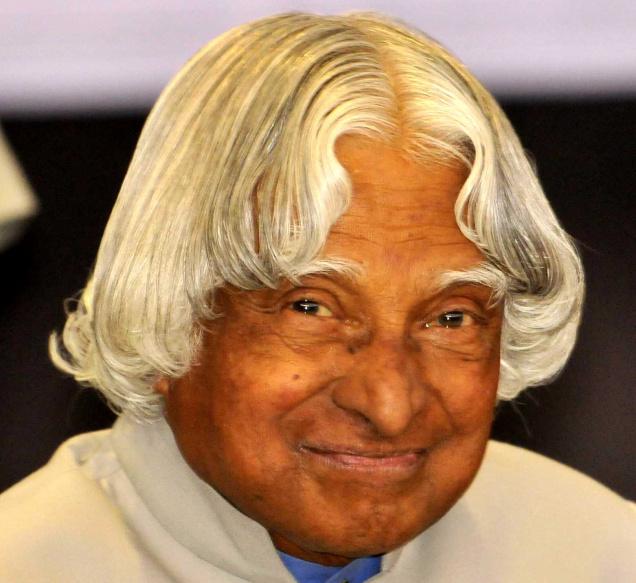
Former President Abdul Kalam says that true nation building is not made by political rhetoric alone but should be backed “by the power of sacrifice, toil and virtue”. File photo: K. Ramesh Babu / The Hindu
For former President A.P.J. Abdul Kalam, becoming a fighter pilot was a “dearest dream” but he failed to realise it by a whisker as he bagged the ninth position when only eight slots were available in the IAF.
In his new book “My Journey: Transforming Dreams into Actions”, published by Rupa, Mr. Kalam, who specialised in aeronautical engineering from Madras Institute of Technology, says he was desperate to pursue a career in flying.
“Over the years I had nurtured the hope to be able to fly to handle a machine as it rose higher and higher in the stratosphere was my dearest dream,” he writes.
Out of the two interview calls Mr. Kalam got, one was from the Indian Air Force in Dehradun and the other from the Directorate of Technical Development and Production (DTDP) at the Ministry of Defence in Delhi.
While the interview at DTDP was “easy” he recounted that for the Air Force Selection Board, he realised that along with qualifications and engineering knowledge, they were also looking for a certain kind of “smartness” in the candidate.
Mr. Kalam bagged the ninth position out of 25 candidates and was not recruited as only eight slots were available.
“I had failed to realise my dream of becoming an air force pilot,” he writes.
He says he “walked around for a while till I reached the edge of a cliff” before deciding to go to Rishikesh and “seek a new way forward.”
“It is only when we are faced with failure do we realise that these resources were always there within us. We only need to find them and move on with our lives,” says Mr. Kalam who went on to put his “heart and soul” at his job as the senior scientific assistant at DTDP.
The book is filled with stories of “innumerable challenges and learning” in his years as the scientific adviser when India conducted its second nuclear test, his retirement and dedication to teaching thereafter and his years as President.
Mr. Kalam has compiled life’s learnings, anecdotes and profiles of key moments and people who inspired him profoundly in the book, which will hits the stands on August 20.
He recounts “staring into the pit of despair” when he failed to make it as an IAF pilot and how he pulled himself up and rose to become the man who headed India’s missile programme and occupy highest office in the country.
While the 82-year-old, popularly known as the Missile Man for his contribution to the development of ballistic missile technology, had in 1999 brought out his autobiography “Wings of Fire” and followed it with “Turning Points”, a journey through challenges” in 2012 that details his political career and challenges, the latest book talks about the people who left a deep impression on him as he was growing up.
In the 147-page book, Mr. Kalam writes about his experience of watching his father build a boat, his early working life as a newspaper boy at the age of eight and even his first-hand experience of the way in their religious elders settled a religious matter in his school.
In a chapter “A brush with fire”, Mr. Kalam recounts the 1999 January 11 incident involving two aircraft which took off from Bangalore towards the Arakkonam-Chennai coastline and crashed, killing 8 men on board.
While Mr. Kalam immediately flew to Bangalore from Delhi and met the bereaved families, he says the grief of the devastated parents and the wailing of the infants remained with him even after years of the incident even after he moved from his office at South Block to Rashtrapati Bhavan.
The former President says that true nation building is not made by political rhetoric alone but should be backed “by the power of sacrifice, toil and virtue”.
“When grand plans for scientific and defence technologies are made, do the people in power think about the sacrifices the people in the laboratories and fields have to make?” he writes.
The book also contains a chapter detailing Mr. Kalam’s favourite books “which have always been close companions” who “were like friends” guiding him through life. Lilian Eishler Watson’s “Light from Many Lamps,” the “Thirukural”, Nobel Laureate Alex Carrel’s “Man the Unknown” have been listed.
Poetry says Mr. Kalam has been “one of his first loves” and poems by T.S. Elliot, Lewis Carroll and William Butler Yeats has “played out in my over and over again”.
In conclusion, Mr. Kalam writes his life can be summed up as “Love poured to the child… struggle… more struggle… bitter tears… then sweet tears… and finally a life as beautiful and fulfilling as seeing the birth of the full moon.
“I hope these stories will help all my readers understand their dreams and compel them to work on these dreams that keep them awake,” he writes.
source: http://www.thehindu.com / The Hindu / Home> Books> Authors / PTI / New Delhi – August 18th, 2013
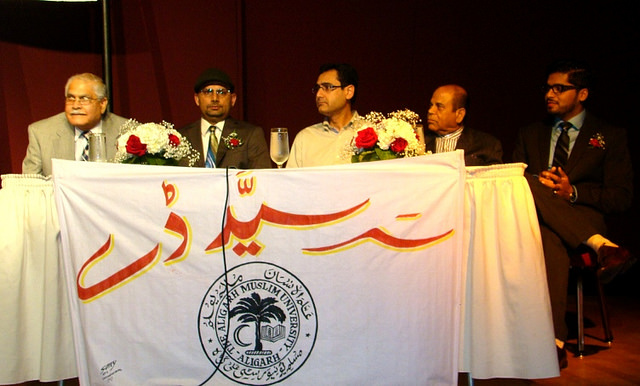
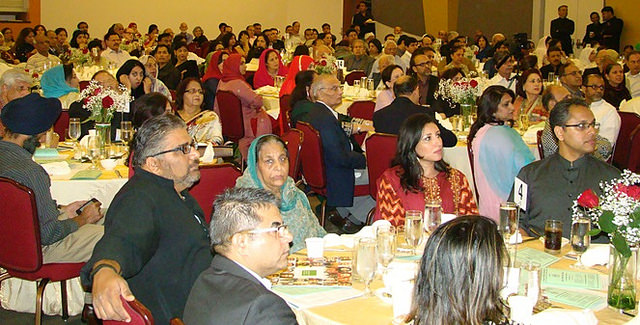
The Aligarh Muslim University Alumni Association of Northern California carried on its annual tradition of holding Sir Syed Day in the San Francisco Bay Area with a fine evening of cultural expression, reflection and entertainment at the ICC in Milpitas on Saturday, September 20th.
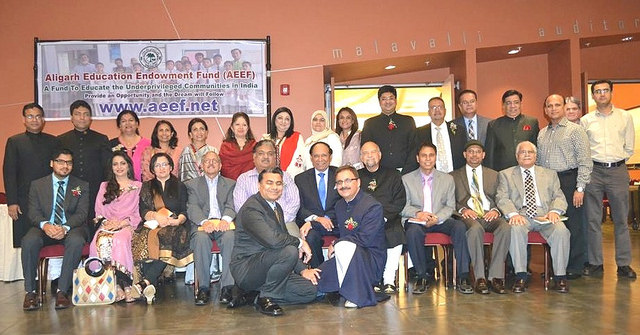
Funds were also collected on the occasion for the Aligarh Education Endowment Fund (AEEF) which supports those whose path to education is impacted by lack of funds or social mobility. Both children and youth are assisted through this AEEF vehicle and one can commend Aligarh Muslim University (AMU) alumni for making their annual homage to Sir Syed Ahmad Khan, the founder of their Alma Mater an added purpose.
After a fine dinner of Mughlai cuisine the formalities began with the traditional recitation from the Holy Qur’an by Mohammed Nadeem. Emcee for the evening Dr. Shaheer Khan made the necessary introductions. He said that everyone here needs to be thanked for their dedication, because the hall tonight is full to its maximum capacity and people unfortunately had to be turned away. He added that the Mushaira or Urdu poetry recital held here attracts many people but it is the cause which is the prime reason for this gathering, which is Sir Syed and AMU. He said that Aligarh was and is a movement and not just a place. He also took the opportunity to thank the sponsors and supporters along with the ICC for making this event possible. He also recognized local South Asians who are running for positions in the upcoming elections (Mohammed Nadeem running for Santa Clara City Council and Moina Shaiq running for Fremont School Board were here. Congressional candidate Ro Khanna was to arrive later).
Next was the President’s Welcome which this year was given by the new head of the AMU Alumni Association of Northern California, Mr. Shachindra Nath. In his short speech Shachindra Sahib welcomed everyone and took the opportunity to share his familial connection with Aligarh Muslim University (AMU) which his father also had the good fortune to attend. He pointed out the mutual respect and tolerance which he found at AMU. “I am so proud to be an Aligarian,” he said. Shachindra Sahib has been a dedicated member of the AMU Alumni Association for several years and it should come as no surprise that today he is the President of this organization.
The Sir Syed Day keynote address this year was presented by Ambassador Islam A. Siddiqui. Dr. Siddiqui till recently served as Chief Agricultural Negotiator in the Office of the U.S. Trade Representative and has now joined a think tank, the Center for Strategic and International Studies (CSIS) as a senior adviser in its Global Food Security Project in Washington DC. He is also a very familiar face to many of us in northern California because of his many years working for the State of California in Sacramento and for his long-time community activism; he is one of the founders of UMA and has been the President of the Downtown Sacramento Muslim Mosque. Although not an alumni of AMU, Dr. Siddiqui said that he was forever indebted to the campus because that is where he met his wife over 40 years ago!
“When I think of Sir Syed Ahmad Khan’s contributions to India and the world at large, it is about Education, Economic Empowerment and Moderation,” said Siddiqui. Giving the audience a backdrop of British-Indian history, and the poor state of Muslims after the 1857 revolt (the first attempt by Indians to gain independence) which failed, Sir Syed’s unique role was highlighted. “Here came a thinker and a visionary, who had worked for the British East India Company, had studied the causes of the Indian revolt, published a commentary on the Bible and was even instrumental in establishing The Scientific Society of Aligarh,” he said. He added that Sir Syed was fighting for the educational, social and economic uplift of Indian Muslims about the same time as President Abraham Lincoln was fighting for the cause of African Americans to abolish slavery in the United States.
He said that today the situation of the Muslim masses in India is not great and cited some relevant statistics from the Sachar Committee Report of 2006 which concluded that “When it comes to education the situation of Indian Muslims is indeed depressing as compared to other socio-religious communities and the problem is more acute among girls and women”. Siddiqui remained hopeful that as India’s economy grows, economic opportunities for all Indians will expand. “As the saying goes: A rising tide lifts all boats,” he said. He also reinforced the charter of the AEEF and its fundraising activity by saying that it is our moral obligation to give back to the under-privileged in the community and country that made it possible for us to reach where we are today.
Dr. Shaheer Khan returned to present an AEEF Update. The Aligarh Education Endowment Fund needs about $100,000 for 2014-2015 academic year to fund its projects which include the sponsorship of excellence in education through scholarships, Aligarh Modern School, Hamara School Aligarh, Faizabad Public school (Faizabad), Faiz-e Aam Muslim Inter College (Faizabad), Hira Public School (Ambedkar Nagar), J.A.B.I.C. Bhadarsa (Ambedkar Nagar), J.D.J.B. Anand P.G. College (Faizabad), M.I. Girls Inter College (Faizabad), Rishiraz Singh Maha Vidyalya (Faizabad), and many others.
It is also supporting Saiema Mansoor Public School (Hathras), vocational training for women, a mentorship program and students at premier institutions in India. A short fundraising appeal was made with a target of $60,000 in mind. And in the process, just before the entertainment, the Aligarh Tarana or anthem was enthusiastically played and sung by some of the alumni of AMU present.
The second part of Sir Syed Day is the “International Mushaira” which brings together some of the finest poets or practitioners of Urdu language poetry from around the globe (mainly from where it is used most, India and Pakistan). Countries can be partitioned but one cannot do that with a language. Urdu’s birthplace is in India where AMU is physically located too, but Urdu ironically is the national language of Pakistan. Where borders and governments divide, language-culture and family unite. I did get an opportunity at this event to meet the Consul of India in San Francisco and air the trials and tribulations of getting a visa for India for a person of Pakistani origin!
This year the list of poets was “Pakistan heavy” for the lack of a better term. The Mezban or host poets in order of appearance were Shahid Siddiqi (Canada), Misum Samer (Bay Area), Faisal Azeem (Canada), and Ahmar Shehwaar and Tashie Zaheer (both from the Bay Area). The Mehman or guest poets were Ambareen Haseeb ‘Amber’ (Pakistan), Nusrat Mehdi (India), Abbas Tabish (Pakistan) and Sarfraz Shahid (Pakistan). Two new aspects were noted in this year’s Mushaira. One the Nizamat was done by a young lady (Amber) and two the Sadarat and closing poet (Sarfraz) was the one who provided comic relief (possibly designed so that people went home in a good mood).
It would take another full article here just to cover the Mushaira segment of the evening. But just to highlight some of the activity here, senior poet Abbas Tabish aptly described the entire Mezbaan Shayir group (locals) as amongst the most talented that he has ever seen. All of them were worthy and it was good to see young Faisal Azeem back in this area. I just had to thank Tashie Bhai personally for his one line that made us proud. In a nutshell none of the local “amateur” poets were less than professional!
Amongst the four Mehman Shayir’s (guests) Ambareen was extremely entertaining both as a poet and in her “Tum Bhi Naa” and in her Nizamat role. Nusrat Mehdi was the feminist voice of the evening and she was amazing in Tarannum especially with her “Mein Bhi to Hoon”. Abbas Tabish was his usual pensive self with his “Intizar ke Lamhe” and his ode to mothers everywhere. And last but not least Sarfraz Shahid who in his Sadarat role provided enough comic relief to us that many had smiles on our faces as we made our way out of the door. His take on “Maulana and Hoorain”, romance in Cricket “Musalman mard ko char hi run ki Ijazat Hai” and his political cutlery were all very well received.
The Annual Sir Syed Day Aligarh magazine was also released on this occasion. The magazine is dedicated to Hali and Shibli. This year marks the 100th death anniversary of Maulana Altaf Husain Hali and Maulana Shibli Nomani, two pivotal members of the team of Sir Syed’s ‘Rufaqaa’ in the establishment of the MAO College.
In conclusion we did not stay for the doosra daur (round two) of the poetry but it was already quite a rewarding and satisfying event for us. The Aligarh Alumni Association of Northern California once again needs to be congratulated for holding this gathering where everyone enjoyed the food, revisited Sir Syed’s vison and participated in quality entertainment.
source: http://www.twocircles.net / TwoCircles.net / Home> News / by Ras H. Siddiqui, TwoCircles.net / September 30th, 2014
The only public library of its kind that has survived without government grants, NGO money or foreign funds
Muslim Library at Shivajinagar, houses more than 25,000 rare books and manuscripts. Photo credit:Anantha Subramanyam K
It was a time when the final push for freedom from British rule was gaining momentum. Prose and poetry were motivating people to join the freedom movement and a small group of Muslim intellectuals in the city responded the best way they knew — by spreading knowledge. Determined not to seek funds from “outside”, the group gathered as much money as they could spare and launched a library.
A hundred years on — commence centenary celebrations on Sunday (Sept 28) — the Muslim Library in Shivajinagar still stands tall and proud, a testimony to the steely determination and goodwill of its founding group. The library now houses about 25,000 rare books and manuscripts and holds a record of sorts: It is the only public library of its kind that has survived without any government grants, NGO money or foreign funds.
Located at Number 8, Veerapillai Street near Jumma Masjid Road Cross, Shivajinagar, the Muslim Library continues to retain and promote the old charm of calm and quiet library-reading in the age of Kindles and iBooks. Though the library is largely patronised by senior citizens, one can find young academicians and researchers pouring over tomes in the library every day.
“Apart from translations of Mahabharata, Ramayana and the Bible in Urdu, the library has around 2,000 books in Persian and an equal number in Arabic,” said Ayub Ahmed Khan, president of The Muslim Library Trust. What differentiates this library from others though is its funding mechanism: It has been self-financed since its inception.
The library was launched on May 5, 1912 by a group of Muslim intellectuals including Mahmood Khan Mahmood (author of Saltanat-e-Khudadad — an authoritative history on Tipu Sultan in Urdu), printing press owner Mir Abdul Haq, headmaster Abdul Rauf, teacher Farheed Khan, advocate Mohammed Saleh Ansari and Mohammed Abdul Abdul Aziz. “These people were inspired by the freedom movement,” says Khan. “They contributed from their own pockets and vowed not to source funds from outside. That custom continues till date,” he said.
Although launched in 1912, it began full-fledged operations only a couple of years later (that’s why the centenary celebrations this year) from a rented room with a collection of 867 books. Abu Mohammed Abdul Wahed, the septuagenarian secretary of the library, says, “By 1929, the library had 29 members and 12,000 books. We now have 600 members not just from Bangalore, but even from Kolar, Mulbagal and Doddabalapur. The present members of the library are well-known personalities including IAS, IPS officers, doctors and lawyers all of whom are proud to be associated with the library. All our members donate books and the collection has now swelled to 32,000.”
Inflation appears to have given the membership fee a miss — it was Rs 10 in 1928 and is now a very affordable Rs 200. The visitors’ book has the names of several dignitaries including poet Mohammed Iqbal who penned ‘Sare Jahan Se Achcha’, author Syed Sulaiman Nadvi, poets Josh Malihabadi, Jigar Moradanadi and Seemab Akbarabadi. Moulvi Abdul Haq, the editor of the Urdu journal ‘Shair’, also visited the library in 1937.
The library got its own three-storey building in 1970 in Shivajinagar. The building was constructed by L Mohammed Yisuf, the architect of 66 buildings of various Muslim organisations in the city. Mohammed Altaf Hussain, who has been librarian for the past 15 years, said, “A lot of school children visit during the summer vacation. There are 30 to 40 regular visitors every day. The library is open between 10 and 12 in the morning and 4 and 8 in the evening.”
Hussain reveals that great care is taken to maintain the books. “Besides daily sweeping etc, the library is comprehensively cleaned and pest-controlled every month. I don’t keep old books lying around. They are taken out of cupboards only if members specifically ask for them. We have regular visitors who come here to read magazines and newspapers, but most visitors are keen to read novels which are treasured in our library.”
source: http://www.bangaloremirror.com / Bangalore Mirror / Home> Bangalore> Others / by Bharat A. Patel , Bangalore Mirror Bureau / September 28th, 2014
The grand construction of General Claude Martin, the Constantia, served as a lodge for Freemasons, a secret society, as many of the English officers including Martin were Freemasons.
Many such lesser known facets pertaining to the life and times of Claude Martin were brought to light by celebrated British historian, Dr Rosie Llewellyn Jones at La Martiniere College on Sunday. The talk was organised by Indian National Trust for Art and Cultural heritage (INTACH), Lucknow Chapter.
After being attacked by the Raja of Banaras invading Lucknow through Farhat Baksh Kothi, General Claude Martin began residing in the Constantia which he built as a fort. Constructed with four spiral columns that go right up to the terrace, cleverly with a lone staircase, Gen Martin made sure the building he liked to show off to his fellow Englishmen was secure with iron doors made from imported English iron. These doors could then be shut once a single man defending the building from the top took position upstairs.
Constantia was safeguarded by cannons on the first floor of the building next to lion statues with lamps within them. “Its construction as a defensive structure to frighten people, basically its attackers, is one of the least known features of the Constantia, which prior to being an educational institution, was a fort,” shared Dr Jones.
INTACH’s convenor Vipul Varshney talked about the axial symmetry and architectural genius of the gigantic structure with pioneering ventilation. Dr Jones also spoke about many paintings of Claude Martin.
Iron girders in the basement of the Constantia go deep down to its foundation. Dr Jones denied presence of any such tunnels opening into the Gomti against a popular myth.
Convernor Vipul Varshney talking about the architectural skyline of Lucknow said, “the heterogeneity of cultural conceptions and artistic styles triumphed to strike a harmony between the many buildings of Lucknow getting along the Nawabi and English architecture successfully in Lucknow’s skyline, and so in that order we decided to educate and inform Lucknowites about one such magnificent structure, the Constantia.”
Gen Martin a self taught man had as many as 5000 books and the presence of certain books on creating electricity have made historians like Dr Jones believe that he might have attempted to create electricity as well in the lower rooms of the Constantia. The result of his trial and error techniques on it though are yet to be studied further.
Heritage conservationist and lawyer by profession, Mohammad Haider stating the building as an unprotected monument applauded the efforts of Principal Carlyle McFarland, the staff and students of the college, ” the unique feature of this building stands in the fact that it has been well maintained within the precincts of its original form and the monument an architectural masterpiece is devoid of any uncalled for scribbling on the walls of the campus unlike the state of most protected monuments in the country.”
source: http://www.timesofindia.indiatimes.com / The Times of India / Home> City> Lucknow / by Yusra Husain, TNN / September 29th, 2014
Once confined to South India, coffee has emerged into pan Indian beverage, not just at cafes but also in homes. However, the coffee industry is facing several challenges due to shortage of labour in its estates and plantations. Hassan M Kamal investigates
There’s a story that claims how nearly 400 years ago, a Sufi poet named Baba Budan smuggled coffee beans from Mocha (Yemen), to the hills of Chikmagalur in Karnataka. While there is no recorded evidence to prove this story, it has remained a popular folklore among India’s coffee lovers.
The presence of a controversial shrine of the Sufi saint on top of Dattagiri (or Baba Budan) range of the Western Ghats, watching over the coffee estates of Chikmagalur, further lends credence to the belief. After its arrival, over the next four centuries, coffee grew to become an integral part of South Indian culture.
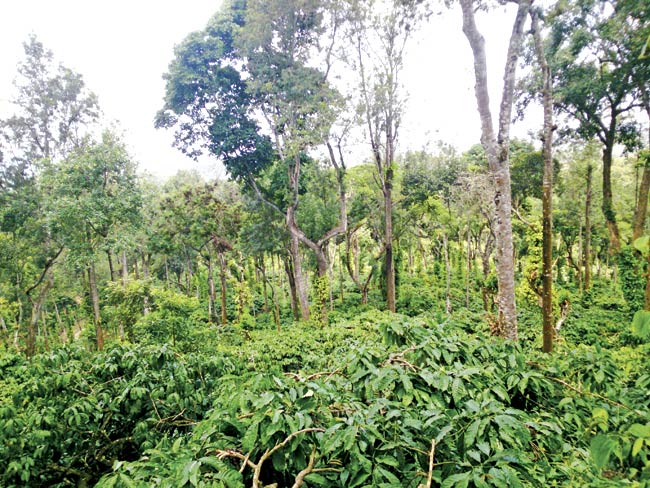
Most coffee plants in India are grown under the shade of trees. Pic courtesy/ Dr Ashwini Kumar BJ
Different communities and cities came to master the art of growing coffee, roasting and brewing a fine concoction from the coffee beans, in their own way.
Aromatic trail
“Even today, there are several households in South India who roast their own batch of coffee beans in the kitchen, grind it and prepare a decoction that suits their needs,” shares Dr Ashwini Kumar BJ, who holds the Coffee Board Research Chair at the Indian Institute of Plantation Management in Bangalore.
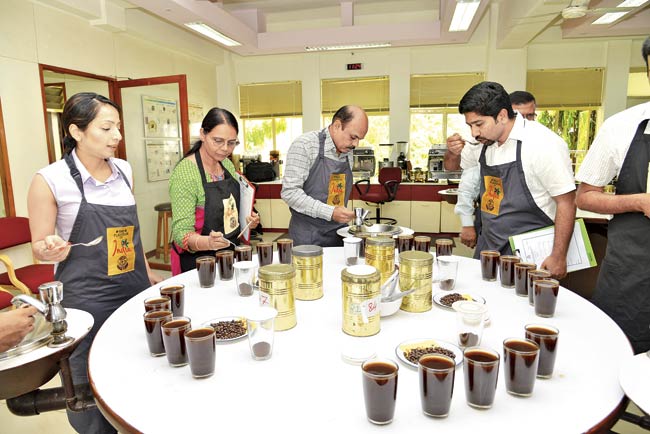
A tasting session in progress at the Coffee Board head office in Bangalore. Pic courtesy/ Dr Ashwini Kumar BJ
Their methods have created specialty coffees, which are in huge demand in the Western markets as well as location-centric versions of Indian filter coffee like the Degree coffee of Kumbakonam in Tamil Nadu (most popular among Tamilians), Coorg coffee and Chikmagalur coffee, each known for its unique taste, informs Dr Kumar (check box for details).
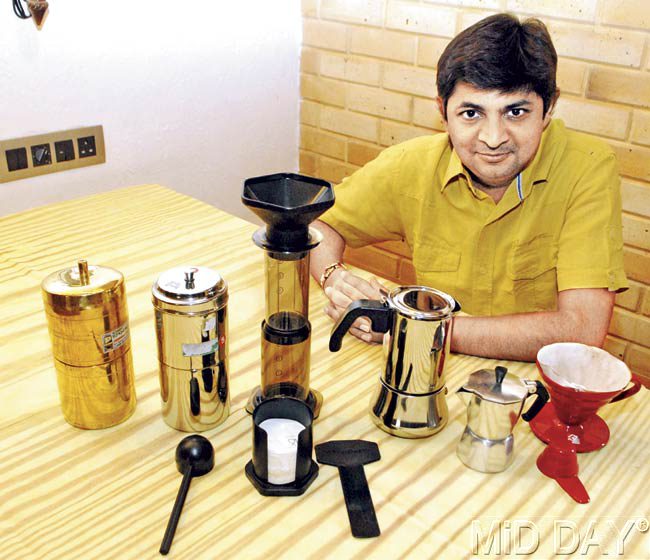
Mumbai-based brewing expert Jignesh Shah with the three coffee-making equipments (from left to right) the Indian Filter Coffee Maker (in brass and steel), Aero Press and the Moka Pot. Pics/ Shadab Khan
The equipment to make the popular Indian filter coffee is proof of how engrained the beverage is in the daily life of a South Indian. While the origins of the filter coffee maker aren’t documented comprehensively, according to photographer K Suresh, a die-hard coffee lover, the earlier method required keeping ground coffee wrapped around a cloth dipped in a pot of water overnight.
“My grandma would make fresh coffee every morning; jaggery was used to sweeten it. Sugar was reserved for tea,” he recalls. He still sources coffee beans from Mangalore, but also vouches for beans sold at Philips Tea and Coffee in King’s Circle, a locality famous for its authentic coffee. “The process continues with the Indian filter coffee makers, even today.
The ground coffee is kept inside a chamber and filled with hot water. Overnight, the coffee filters down into a chamber right under it, giving the final decoction a strong flavour,” says Jignesh Shah, a Mumbai-based coffee entrepreneur. He adds that in most South Indian families, there’s a tradition of offering the first drink from the brew to the head of the family in the morning.
Arrival of new coffee fans
Shah comes from the new breed of coffee lovers, who are not South Indian, but have acquired a taste for this beverage, and see coffee as an item that needs to be appreciated. “Most Indians have been cheated with, when it comes to coffee, as we have never got anything beyond instant coffee. Coffee is more than that,” says Shah.
He adds that the beverage is gaining popularity among other communities, including the tea-crazy North Indians. “And, I’m not referring to a Barista, Cafe Coffee Day or Starbucks outlet (though they played a role in popularising coffee) or drinking instant coffee from vending machines, but coffee fans who want to prepare it from scratch in their own homes.”
Shah recently launched his brand of coffee, Jewel Aromantic, and has also been conducting workshops and taking classes, teaching Mumbaikars how to brew coffee at home. One of his focus areas has been making inexpensive fuss-free coffee makers like the Italian Moka Pot (comes for just Rs 500), Indian Filter Coffee maker (Rs 500) and the most-recent Aero Press (Rs 2,500), now available in India.
“Most of us are only aware of instant coffee or the expensive espresso machines. But there are several other equipments like the Moka Pot, the Aero Press or the Indian Filter Coffee Maker, which are inexpensive and easy to operate. Now, people are exploring these options, and loving them,” he adds, adding, “Some devices like the Aero Press and Indian Filter Coffee Maker doesn’t require any heat source.”
Home of specialties
India grows two types of commercial coffees Indian Robusta and the Indian Arabica. Earlier, most of the produce used to be the Indian Arabica, which is still in huge demand internationally. But since Arabicas are prone to pests, most coffee estates have moved to the Indian Robusta. “It has a much more stronger taste than the Arabica, and though it was initially not considered good, and still fetches lower prices internationally, it’s gaining popularity in the market,” says Shah.
Dr Kumar says that what gives Indian coffee a special place internationally is its unique coffees, which are referred to as Specialty Coffees. “The three specialty coffees produced in India are Monsooned Malabar, Mysore Nuggets and Robusta Kaapi Royale. All these coffees vary in their cup characteristics, and are popular internationally,” he adds.
India is also gaining popularity for its unique animal coffee, the Monkey Parchment coffee, a rare type of coffee made from beans chewed by Rhesus monkeys. The coffee is produced in Chikmagalur, Karnataka.
“The monkeys select the best coffee cherries, pick them, chew them leisurely for a few minutes and spit the remainder of the fruit onto the ground.
These discarded fruits are collected, rinsed, washed and processed using water to remove the pulp (parchment), and then dried. The enzymes in the saliva of the Rhesus monkey initiates a chemical process, giving the beans a different taste and colour,” says Shah.
Challenges galore
But all is not good with the coffee estates, located mostly in the Western Ghats. In the last few years, there had been several reports of labour constraints in Indian coffee estates. “Most of India’s coffee is grown in undulating slopes of the Western Ghats.
The coffee plantations are experiencing a severe shortage of labour for undertaking key farm operations, such as manuring, application of fertiliser, harvesting and farm-level processing. While larger plantations have initiated efforts for mechanisation, medium and small plantations continue to incur higher costs on labour, thereby reducing their surplus for capital investments,” says Dr Kumar.
According to a report by The Seattle Times, some plantations in India have begun offering good-quality housing, medical care and other benefits to attract labour. But it’s been of no help. Another major problem is the low level of value addition at the farm level, informs Dr Kumar.
“The value addition of coffee takes place at the level of roasters and retailers. But since most of our coffee is exported as green beans (unprocessed), most Indian coffee producers become very susceptible to the fluctuations in international prices. Higher value addition and domestic consumption could reduce the susceptibility of producers to the drastic price fluctuations that are currently seen in primary markets of Indian coffee,” he adds.
Another concern emerges from lower production due to unseasonable and fluctuating rainfall. “While the consumption of Indian coffee has increased, the productivity of Indian coffee plantations has been stagnant,” reveals Dr Kumar adding that India should produce more coffee to meet the domestic demand and exploit opportunities that emerge from a growing international demand for Indian coffee.
Grading of coffee primarily refers to the segregation / classification of coffee beans based on their size. The primary grades of Arabica Coffee are Peaberry, AB, A, B, C, Blacks/Browns, Bits and Bulk. The primary grades of Robusta Coffee are Peaberry, AB, C, Blacks/Browns, Bits and Bulk.
Bits and Bulk are the most inferior in the lot and used to make instant coffee. In India, coffee is also categorised based on taste like Monsooned Malabar, Mysore Nuggets and Robusta Kaapi Royale. Based on the region of production in India, 13 regional coffees have also been defined.
They are Anamalais, Araku Valley, Bababudangiris, Biligiris, Brahmaputra, Chikmagalur, Coorg, Manjarabad, Nilgiris, Pulneys, Shevaroys, Travancore and Wayanaad.
Improve your coffee quotient
What’s roasting?
Roasting is a process that helps bring out the aroma and flavour of coffee.
The major techniques for roasting coffee beans are Rotating cylinder or drum roasting where the coffee beans are fed into a cylinder through which hot air is passed and the drum rotates; and fluidized bed roaster where gases entering into the fixed chamber of the roaster lead to the beans’ rapid turbulent circulation (levitation).
Following roasting, the beans are cooled and run through a destoner that uses air to remove stones and other extraneous materials. The roasted beans are then ground by using grinders.
source: http://www.mid-day.com / MidDay / Home> Life and Style News> Food News / by Hassan M Kamal / September 27th, 2014
After Wajid Ali Shah, the last Nawab of Lucknow lost his empire, his mother Janab-i’Aliyyah went all the way to England to meet the Queen and seek justice, but she failed in her mission as she got no audience.
History lovers in Lucknow will now have access to new insights into the life and times of the last Nawab of Oudh along with rare pictures and never-heard before information. Regarded by the East India Company as a debauched ruler who spent his time with ‘fiddlers, eunuchs and women’ instead of looking after the kingdom, Wajid Ali Shah has become the centrepiece of yet another historical book.
Written by British historian Rosie Llewellyn Jones, ‘The Last King in India’ talks, besides his mother’s failed overseas mission, about Begum Hazrat Mahal’s revolt in 1857.
Though most artifacts of historical importance were lost forever after the downfall, with painstaking efforts, they have re-surfaced to narrate the story of an era in which the Nawab created exquisite poetry, theatrical pieces, music and dance. In the well researched book, he comes across as a compassionate person towards his subjects. The magnificent Qaiserbagh built by him came to be known as one of the most elaborate palace complexes ever created.
Given how little was known about the last Nawab of Awadh, the historian and author researched about Wajid Ali Shah from the original documents in Indian and British archives and through meetings with his descendants.
Several paintings and photographs have also been found. In one of the photographs Wajid Ali Shah is seen sitting with one of his 350 wives and a child on a couch. Although, almost every palace and structure along the banks of Hooghly river was either destroyed or auctioned by the British after his death in 1887, in order to eliminate any chances of a rebellion, his pictures still hang on the wall in Matiya Burj.
It is said that he had actually created a miniature Lucknow in Matiya Burj and transported its multi-faceted culture there.
At the release of her latest book, Jones said “I have always been a fan of Wajid Ali Shah. He was misunderstood by the British as he never wanted bloodshed in his kingdom and continued not to bow against them, much to their dismay. His love for poetry, art and dance is admirable and he was one of the greatest patrons of the cultural landscape.”
source: http://www.timesofindia.indiatimes.com / The Times of India / Home> City> Lucknow / by Shefali Mehrotra, TNN / September 28th, 2014
Shah Rukh Khan and Bollywood’s Global Fortunes Advance
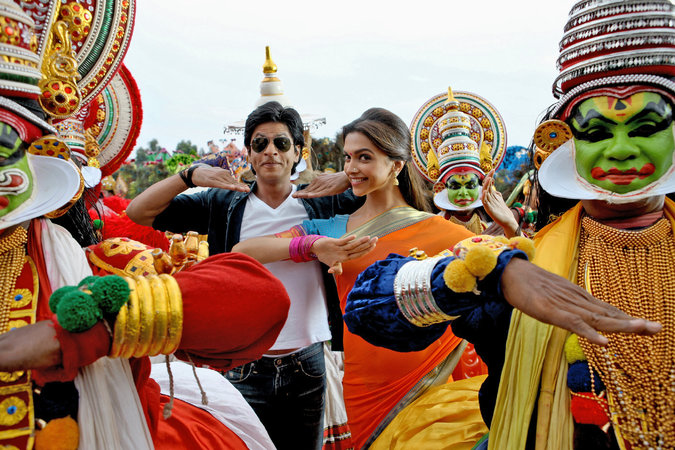
The Bollywood superstar Shah Rukh Khan, left, and Deepika Padukone in “Chennai Express,” from 2013. Credit Red Chillies Entertainments/UTV Motion Pictures
Mumbai :
Shah Rukh Khan has many titles. The 48-year-old Bollywood superstar is known as King Khan, King of Bollywood and Bollywood Badshah (or emperor). This summer Mr. Khan became a knight. In a glittering ceremony in Mumbai, the French foreign affairs minister, Laurent Fabius, conferred France’s highest civilian honor — the Knight of the Legion of Honor — on Mr. Khan. In the official news release, Mr. Fabius said, “The French people hail Shah Rukh Khan’s talent and generosity,” which transcend “cultural and historical differences.”
Mr. Khan’s archrival Aamir Khan (no relation) was also transcending cultural differences. On July 25, his latest film, “Dhoom 3,” an action thriller and India’s highest-grossing film ever, was released on 2,000 screens in China, a first for an Indian film and a distribution strategy more often used for Hollywood blockbusters.
“There are numerous Aamir Khan fans in China,” the film’s Chinese distributor, Ying Li of HGC Entertainment, said in an email. “His image is very positive.”
The French and Chinese are among the many converts to Bollywood’s rapidly growing following. Hindi films have long had devoted fans among the 21 million Indians living overseas, and in the 1950s and ’60s, the actor-director Raj Kapoor became a household name in Soviet Russia, while Hindi films traveled to the Middle East and Africa. But in the last decade, Bollywood’s unique cocktail of emotion, song, dance and melodrama has found takers in several new markets. According to the box office tracking company Rentrak, revenues for Indian films across 36 territories rose from $66.2 million for 69 titles in 2009 to $289 million for 170 titles in 2013.
The new fans are in countries as diverse as Turkey, Peru, Panama and Iraq. Hindi films first reached Japanese theaters in 1952, but regular releases began only last year. Aki Sugihara of the Nikkatsu Corporation, the leading distributor of Hindi films there, said the Japanese like “the fact that there is not too much dependency on CGI, like in Hollywood movies.”
The Japanese pop musician and soundtrack composer Matsumura Masahide (known as Titi Matsumura) is a fan and said the appeal lies in the films’ ardent approach. “We like Indian films full of emotional feeling with the richness of heart, which Japanese people tend to miss now,” he said by email. “Even when films describe a negative problem, the way to describe it is full of big Indian love.”
The Germans are besotted with Shah Rukh Khan. Their ardor can be traced to 2004, when a German television station programmed a prime slot for “Kabhi Khushi Kabhie Gham” (“Sometimes Happiness, Sometimes Sadness”), featuring Mr. Khan as the estranged, adopted son of a rich industrialist. The three-hankie melodrama — the film’s tagline was “It’s all about loving your parents” — single-handedly opened up a new market. Viewers “cried, felt great pleasure, joy and release,” the film’s distributor, Stephan Holla, said by email. “We do not get this from German movies or Hollywood.”
Among those viewers was Julia Wessel, a 25-year-old student of cultural anthropology. “I was intrigued by it, but I was even more intrigued by the effect it had on my mother,” she said by email. “I cannot remember ever seeing my mother cry, not even at funerals. But there she was watching this film, and she had tears running down her face.”
Bollywood became such an obsession that Ms. Wessel dropped her studies and in 2006, started a German-language Bollywood magazine called Ishq (Urdu for love), which now has a circulation of 30,000 in Germany, Austria and Switzerland.
Despite evangelists like Ms. Wessel, Brand Bollywood hasn’t been an easy sell overseas. Hollywood and regional productions provide stiff competition. Even big-name studios like Disney India, which produces Disney-branded films, find it tough going in other countries. Amrita Pandey, who heads marketing and distribution for the studio, cited a host of factors in an email interview: “Language barriers, high investments required to develop new markets, the definite grammar of Hindi films and cultural gaps are also barriers.”
In Britain and the United States, these barriers have proved insurmountable. They are the largest overseas territories for Bollywood, but while Hindi films do penetrate mainstream theaters, the audiences are mostly of South Asian descent. Avtar Panesar, vice president of international operations for Yash Raj Films, one of Bollywood’s largest studios, pegs the non-Indian viewership at 0.5 percent. “We have done events in theaters, carried out media campaigns,” he said by email. “But it seems that these films are being made by Indians and watched by Indians.”
The crossover Hindi film has been the holy grail for Mumbai filmmakers since the success of Ang Lee’s “Crouching Tiger, Hidden Dragon” in 2000, the Oscar-winning American-Chinese-Taiwanese coproduction that drew mainstream audiences in the United States. But efforts at such cross-pollination have delivered uneven results. The Indian company Reliance Entertainment invested upward of $500 million in Steven Spielberg’s DreamWorks, but the hits have been limited. Initially, Hollywood studios in India stumbled with local productions. Eventually Disney found an Indian partner, UTV, and Disney India’s first film after the merger — a rom-com called“Khoobsurat” — was released in the United States on Sept. 17.
Relativity Media is hoping to alter the landscape. At the Cannes Film Festival in May, it announced a $100 million joint venture with B4U, a Bollywood entertainment company. “We don’t consider ourselves Hollywood,” Relativity’s chief executive, Ryan Kavanaugh, said by phone. “We consider ourselves a content technology company. Studios think, ‘How do we sell our stuff to them?’ We are looking at how to create content for this huge market.”
Instead of finding one film that satisfies both palates, the Relativity strategy is to tailor the same content for two markets. So with an as-yet-untitled action-comedy now in production with Zach Galifianakis, Owen Wilson and Kristen Wiig, the plan is to film it again in Bollywood. A reboot of “The Crow” would follow a similar model, with two versions shot simultaneously — one in Hollywood and one in Bollywood with American actors in the Indian version and vice versa. “Our goal is to be at this long-term,” Mr. Kavanaugh said, “We go slowly and we take the consumer with us.”
Along with consumers, Hindi films have also evolved. They are no longer a monolithic entity defined by song and dance. Daring, more personal indie productions known as Hindie movies are also making inroads locally and globally. In the past year, “The Lunchbox,” a small-budget film starring Irrfan Khan as a widower forming a bond with a neglected Mumbai housewife, made about $10 million globally at the box office, with about 40 percent of that coming from America. Despite the absence of songs and mainstream Bollywood stars, “The Lunchbox” was among the highest-grossing Hindi films in the United States. It was distributed by Sony Pictures Classics, which perhaps helped it find viewers beyond the Indian market.
Could films like “The Lunchbox” help the Hindi film industry infiltrate the final frontier of the American mainstream? As Shah Rukh Khan put it in an email: “Our content is improving. Our technology is improving. It’s time.”
source: http://www.nytimes.com / The New York Times / Home> Movies / by Anupama Chopra / September 26th, 2014
A version of this article appears in print on September 28, 2014, on page AR15 of the New York editionwith the headline: Bollywood Is Prancing Far Abroad. Order Reprints|Today’s Paper|Subscribe
The amphitheatre of Dayananda Sagar Institutions was echoing with excitement well before the auditions of the Clean & Clear Bangalore Times Fresh Face 2014 contest even began. Several students registered for the event, including some from last year.
The talent round was a fun session as the students sang, danced, mimicked, acted and beat-boxed. Though the majority of participants were boys, the audiences enjoyed cheering and hooting for every single person who participated. Some noteworthy performances included Nikeel Mohan’s entertaining Bhojpuri dance and Yoshita P’s powerful beat-boxing.
The second round was equally engaging as our judges — theater personality and television actor Shashank Purushottam and RJ Siri — encouraged the participants and asked them questions about their values and morals.
After the second round, it was time to announce the winners.
Manal Ahmed Nazir’s acting skills and mature answer in the question-answer round, and Sneh Gupta’s brisk movements made them the winners.
The first runners-up were equally good — Ritika Pundir’s melodious singing and energetic dance moves and Chandramouly Kandachar’s super-fast rap were applauded by all.
The second runners-up were also loved by the audience and judges — Nikhil Shenoy’s twisted moves were a treat to watch and Vaishnavi Swaminathan’s confidence in the second round was appreciable.
The radio partner for Clean & Clear Bangalore Times Fresh Face 2014 is Radio Mirchi.
source: http://www.beautypageants.indiatimes.com / The Times of India / Home> Beauty Pageants> Fresh Faces> Archives / by Parinatha Sampath, TNN / September 26th, 2014