Dasara Tourism Sub-Committee President Sudhakar S. Shetty speaking at the Sub-Committee meeting at Hotel Hoysala this morning as Member Secretary C. Anitha, Sub-Committee Executive President S.K. Husseini, Special Officer H.M. Ramesh, Vice-Presidents Kumar and L. Parshuram look on.
Mysore :
For the first time in the history of Dasara, the Dasara Tourism Sub-Committee plans to display as many as 50,000 Circuit Maps containing details of roads from Mysore to tourist spots in Mysore, Chamarajanagar, Mandya, Kodagu districts at tourists spots and vantage points for the benefit of tourists, said Sub-Committee President Sudhakar S. Shetty here this morning.
Addressing a meeting of the Sub-Committee at Hotel Hoysala on JLB Road in city, he said that the primary objective of the Committee was to ensure proper infrastructure like drinking water, toilets, bathrooms and cleanliness around all tourist spots to meet the needs of tourists.
Stating that 18 tourist kiosks at a cost of Rs. 26,000 each, manned by the students of tourism courses in Mahajana and Vidya Vikas Colleges in city and foreign students in city and 32 guides around Mysore Palace, dressed in specially designed blazers, will be set up at tourist spots and vantage points to guide tourists.
Sudhakar Shetty also said that the Sub-Committee had urged City Police Commissioner Dr. M.A. Saleem to initiate criminal action against those found guilty of selling duplicate products to visitors besides urging the MCC Commissioner to ensure that debris and garbage around the tourist spots in particular and the city in general before the commencement of the Naada Habba.
The Sub-Committee President also said that literature containing details of tourist spots will be placed at boxes which will be placed at all hotels and tourist agency offices in city.
Tourism Development Authority sought: As Mysore and surrounding districts have abundant tourist potential, there is an absolute need for formation of a Tourism Development Authority to promote tourism, which is one of the most flourishing industries in parts of old Mysore region which has numerous places of tourist interest, some members opined.
S.K. Husseini, Assistant Director, Department of Tourism, who is also Sub-Committee Executive President, H.M. Ramesh, Divisional Traffic Controller (City Division), KSRTC, who is also the Sub-Committee Special Officer, C. Anitha, Sub-Committee Member Secretary, Kumar and P arashuram, Sub-Committee Vice-Presidents and Sub-Committee members were present at the meeting.
source: http://www.starofmysore.com / Star of Mysore / Home> General News / Saturday , September 20th, 2014
Some things touch people’s heart strings in a very strange way and the reason for this is not very easily understood or explained. My last week’s article about HMT watches seems to have stirred people’s sense of nostalgia far beyond my expectations. This is evident by the spate of responses I have been getting over the whole of the week. The emotional impact of the closure of HMT’s watch division on people’s minds can be gauged by the many letters that have appeared in Star of Mysore too ever since the news was published last Friday. But some sad stories too can have happy endings as you will see.
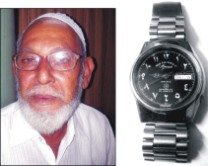
Last evening as I was seeing off the last of my patients for the day, I found a familiar figure walking into my consulting room with a smile. It was Baba Sab, my former neighbour of many years who had sold his house a couple of years ago and moved out to another locality. After exchanging pleasantries for a few moments he complimented me on my writing and said that he was particularly touched by my article on HMT watches. He then removed the wrist watch he was wearing and placed it on my table and said, “This is a watch about which y ou have made a mention in your last article and I have one with me.”
The piece that lay before me was a West End Sowar Prima, an automatic mechanical watch with a black dial and Eastern Arabic numerals. (Incidentally, and perhaps a little interestingly, Arabic numerals are the numerals we use while writing in English while Eastern Arabic numerals are the ones in the actual Arabic script as seen in the picture). I told him that I had indeed mentioned it by name in my article and I knew all about it because my father and grandfather and all my uncles had always worn West End watches. It was a sort of a family tradition and in the good old days, a good watch only meant a West End.
He then surprised me by saying, “I have been wearing it for some years and now I want you to have it because you are one person who knows what it is worth.” I immediately protested and refused his offer to which he said, “I have worn it long enough. Now I want you to accept it as a token of my affection and regard for you. I have always admired your writing and I will be happy if you accept it from me. Please do not refuse my humble offer.” Perplexed, I did not know what to do.
Here was a simple and humble man who thought so highly about me and with his strange and most unexpected gesture of magnanimity he had put me in a very delicate situation if not a real fix. He was indeed an unusual kind of man. When he first thought of selling his house he had come into my consulting room once before and offered it to me at a price considerably lower than the best offer he had received. He very rightly told me that Islam teaches that a good Muslim should give first priority to the welfare and happiness of his or her neighbours in all matters. Only after I reassured him that I had no intention of buying his house did he proceed to sell it to its present owner. And, he did sell it for a sum much higher than for what he had offered it to me.
Now, refusing his gift would have broken his heart and accepting it would have made my own heart heavy. After a few uneasy moments of confused introspection I decided to let his heart have its way and picked up the watch with an uneasy smile. He felt visibly relieved and thanking me profusely for accepting it he quickly left the room leaving me in a daze. My friends are not wrong when they say that interesting things happen to me which provide me interesting writing material!
West End watches came into production in the year 1886 in Switzerland and they were named after the upmarket district of the same name in London. Known for their ruggedness and durability, they quickly became a household name in India and it appears when the Indian Cavalry contingent was dispatched to fight in Mesopotamia during the First World War, the soldiers were provided with West End watches. That is when the model ‘Sowar’ was introduced after the Sowars or Lancers of the cavalry regiment.
We still have my father’s West End Sowar Prima as a family heirloom, along with its original box, user manual, bill and hexagonal spanner. Very oddly, perhaps because they were mechanical watches, every West End watch used to come with a spanner to enable its owner to open its back and make the movement go slow or fast as required to keep the correct time! My friend Ulliada Arun, perhaps has the oldest West End watch that I know of in perfect working condition. It is from the year 1902 and it still keeps the right time and my friend wears it all the time!
A lesson in harmony: Last Wednesday’s SOM had a review by Dr. Manik Bengeri, about the Kannada play ‘Raavi Nadeeya Dandeyelli’ which was recently staged at the Vanaranga theatre of Kalamandira. My wife and I had an occasion to see it at the urging of my friend Sri. K. R. Mohan, a former senior manager of the Syndicate Bank, who had also written a small introductory piece about it in SOM.
Although adding anything to the already very well written piece certainly seems superfluous, what impressed me very much apart from the excellent theme of the play was the portrayal of the way goodness in human nature prevails over baser instincts. The correct presentation of what the Holy Koran says about how we should live in absolute peace and harmony with all those around us, forgetting our castes and creeds, needs to be complimented.
‘Parivarthana’ which presented the play and all those who are responsible for it in some way or the other deserve not only to be congratulated for what they have done but also encouraged to continue to present it before much larger audiences across the length and breadth of the country. Plays like this that can promote communal harmony at a time when it seems to be under great stress should be showcased before the younger generation in schools and colleges and this can be done at a surprisingly modest cost. Therefore managements, parents’ associations and even philanthropic individuals, if not institutions, can do this job if they mind. Do think about it. It certainly is worth a thought.
The play made me recollect an incident that I once heard from the mother of my friend, Mallikarjun Nisty from the turbulent time of partition. It tells a heart touching story of human goodness from a time when goodness seemed to be extinct. It appears a Hindu man and his family from the Pakistan side of the border who were leaving for the Indian side was seated in a crowded train with their belongings. As the train was about to leave, their Muslim neighbour’s wife who was also a very close friend of the man’s wife, rushed into the compartment with an angry expression and began rummaging through their bags, ostensibly to check what they were taking away with them.
Her job done, she left the shell-shocked family but not without taunting and cursing all those who were going away to the other side. As the train steamed out of the station, the man’s wife who was now in tears at her former friend’s unbelievably cruel behaviour put her hand into her bag to find her handkerchief. To her amazement, she found a wad of currency notes with a small note from her friend that said, “I am sorry about the way I behaved. But there was simply no other way I could help you under the watchful eyes of the hostile mobs around. Do keep in touch with us if possible. May God protect you and your family.”
e-mail: kjnmysore@rediffmail.com
source: http://www.starofmysore.com / Star of Mysore / Home> Feature Articles / September 19th, 2014
Assam’s oldest Muslim structures have finally found a chronicler that will recount the legends, the tales and anecdotes that went into making some of the most fascinating architectural masterpieces of the state.
Al-Ameen Welfare Society, a NGO of prominent Muslims, will come out with a book on Assam’s old mosques and dargahs next year.
The aim is to sensitise people and the government to protect and preserve these magnificent structures both in the Brahmaputra and the Barak valley.
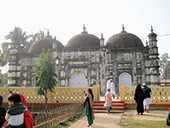
People visit the Panbari mosque in Dhubri on Friday. Picture by Bijoy Kumar Sarma
Take Panbari masjid or Rangamati masjid, for instance. Built in the Mughal era, during the 15th or 16th century, this mosque is the oldest not only in Assam but probably also in the whole of the Northeast.
Very few know about it — with lack of maintenance robbing it of much of its glory.
The book, therefore, hopes to highlight some of these glorious structures and goad people to preserve them.
It is part of the Al-Ameen Welfare Society’s ambitious project to chronicle the history of the Muslims of Assam, complete with their cultural heritage and contributions to greater Assamese society.
Komoruzzaman Ahmed, founder president of the society, told The Telegraph that raw material for the book has been gathered and will be compiled soon.
“Our main project aims at helping the present generation of Muslims realise their ancestors’ positive role in formation of a cohesive and harmonious society in Assam. Such a realisation will also make the present generation of Muslim contribute towards building a unified society in Assam,” he said.
Muslims started settling in Assam in 1206 AD.
Ahmed said the history, heritage and contributions of Muslims to the larger Assamese society should be studied, probed and recorded.
Another book on a comprehensive study of the Islamic religious literature written in Assamese will also be published next year.
“Though Assamese literature is rich in medieval Hindu religious prose, we have so far not been able to trace any Assamese Islamic religious literature and mystic or Sufi songs like Satya Peer’s geet, Chand Sai geet and jikir and jari by Ajan Fakir. The study has made an attempt to probe if Islamic literature in Assamese existed in the mediaeval period,” he said.
Ahmed said there is also a study on contribution of Muslims in the fields of art, handicrafts, architecture, engraving, painting, music, language, food habit and items, utensil, furniture and clothes of Assamese society.
source: http://www.telegraphindia.com / The Telegraph, Calcutta / Front Page> North East > Story / by Daulat Rahman / Guwahati – December 23rd / Saturday – December 24th, 2011
A book written by a Muslim woman about issues of national importance is sure to be taken seriously. Though the book under review talks about the contemporary Muslim psyche, it is also a commentary on the country, its politics and the mindset of its people.
The word ‘azadi’ in the title can be read as ‘freedom’. But Azadi is also the name of the author’s mother. Seema Mustafa writes without inhibition. The book, as she says in the preface, was born out of her discussion about the ‘Muslim mood in India’ with one of her colleagues. The book combines many things: communal riots, the Gujarat pogrom, army repression in Jammu and Kashmir and the Northeast, terrorism, the Sachar report, the question of reservation, the condition of women, the effect of 9/11 on Muslims in India and abroad, apprehensions and dreams of the Muslim youth. It mentions some instances of repression by the police that are shocking, since they violate the notions of democracy and secularism. Anger, fear and sorrow are palpable in the accounts. But Mustafa is optimistic about the Muslim youth, and has an abiding faith in secularism and democracy.
The book records the life of a Muslim lady brought up on liberal values. It also offers a dispassionate view of the Muslim community in India. The account may help to change the stereotypical ideas about the community, its youth and especially its women. It tells us how Muslim girls, even in villages, want to be educated. Mustafa shows how the community is neglected, discriminated and repressed by the insensitive State machinery. But the young men and women of the community still have not lost faith in democracy and a pluralistic society. They want to acquire modern education and lead a better life.
Mustafa identifies a marked shift in Indian politics over the decades, especially after the demolition of the Babri Masjid. She also points to the apathy of political parties about the damage to the secular fabric of the country. Unlike journalists who resort to euphemism when talking about communal issues, Mustafa speaks candidly. She recalls the brazenness with which the Babri Masjid was razed to the ground and the brutality of the 1984 riots. The government, on both the occasions, did not even try to put up a resistance. The violation of human rights in the treatment of Muslim youths picked up in Hyderabad and elsewhere by intelligence branches should be an eye-opener. If Mustafa is angry, she is also worried that the country is being hijacked by communal elements.
Mustafa has the mind of a true journalist; that is her strength as well as her weakness. She weighs everything on the anvil of logic. Her language fails to come out of the confines of journalistic parlance, but she remains true to her purpose of presenting the real picture. Mustafa speaks from a strong sense of injustice. She staunchly criticizes fundamentalists of every community. Even with her elitist background, she feels more for the poor people of her community than the conservative mullahs.
source: http://www.telegraphindia.com / The Telegraph, Calcutta / Front Page> Opinion> Story / Friday – February 08th, 2013
ALIGARH: Reading The Fault in Our Stars, now that social media is abuzz with talks of the film adaptation of the book, maybe a tad difficult if you live in Aligarh. Despite the city being home to one of the country’s most prestigious educational institutions – Aligarh Muslim University – the absence of a good bookshops selling fiction, non-fiction or, for that matter, anything beyond prescribed reading material for students is quite a telling let-down.
“The city has somehow never really felt the need to have the kind of arrangement where you can go and buy fiction in a store that’s well-furnished with eclectic literary offerings,” says Shubhangini, a CAT aspirant. “Although there is not much of a choice when it comes to book shopping, it doesn’t mean people in Aligarh are not aware of the current scenario in the world of literature. Popular books can be procured through some of the stores by placing an order and paying a commission.”
There are nearly 100 bookshops functioning for decades in Aligarh, but they mostly cater to the madrassa-going students and sell Urdu literature. And almost all stores stock reading material that help in preparations for competitive examinations. This leaves the lover of fiction/non-fiction with little choice but to tap online sources or place an order at a bookshop, which may take anywhere between a week and 10 days (depending on availability) to deliver. The other option is to travel down to Delhi or the National Capital Region and go on a book shopping spree or, if one is a student, rely on AMU libraries to satiate the inner bibliophile.
Though education fairs are common in Aligarh, book fairs are few and far between. “It is a small city without much tourist inflow. So, there are not many stores that sell popular books. There are far more education fairs than book fairs here,” says Sandeep Choudhury, who recently organized an education fair in the city.
Students being on the look-out for better opportunities and job prospects have prompted even the oldest bookstore in the city – Malviya Pustakalaya – to stock books for competitive exams and recruitment tests. Malviya Pustakalaya, incidentally, has one of the most valuable collections of literature, religion, philosophy and Hindi novels.
“These were ordered, so we got them,” says Sanjeev Agarwal of Vimal Book Store, pointing to a stack of popular fiction and non-fiction reading material. It was only recently that 1 % of the shop’s stocks began comprising authors like Arundhati Roy and William Dalrymple. “Earlier, there used to be a store selling fiction but now it has shut down, probably because of dipping sales.”
However, what makes Aligarh unique to bookworms is its repository of Urdu literature. Home to a substantial number of madrassa and AMU students, the city’s stores have an enviable collection of fiction and non-fiction by Faiz, Firaq and Ghalib. “Urdu works are most popular as a lot of retired professors or students from madrassas or AMU reside here,” says Asad Faisal Farooqui, who frequents the Education BookHouse established in 1927.
“It is interesting to see modern English literature being translated into Urdu for them,” he says, adding, “Students have bought Urdu translations of books by Jaswant Singh, Irfan Habib and also religious texts, including translations of the Bhagvad Gita.”
However, the trend does not go beyond prescribed reading material or books talked about in popular media. As Ashok Kuckreja of Aligarh Law Books, says, “Students buy what their professors recommend, which may be pertinent to one’s course but may not help build a larger reading repertoire.”
The experienced bookseller rues never being asked for books by, say, legal humourist Marc Galanter or by the likes of AP Herbert. “Not even 1% of that genre is ordered here, I have tried so many times to bring to their notice the works of Edward Heward on Lord Denning, John Mortimer’s ‘The Devil’s Advocate’ and Krishna Swamy’s work on V R Krishna Iyer, but there is no interest,” Kuckreja says.
source: http://www.timesofindia.indiatimes.com / The Times of India / Home> City> Agra / by Eram Agha, TNN / September 22nd, 2014
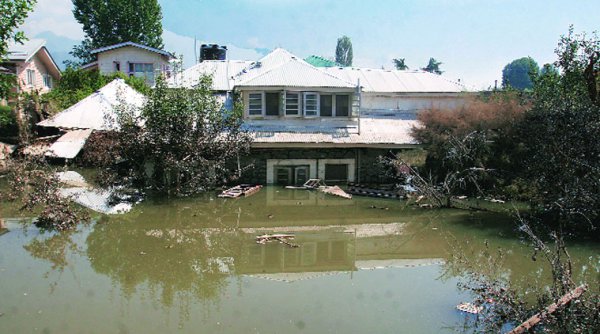
Agha Shahid Ali’s submerged house in Srinagar’s Rajbagh. ( Source: Express photo by Shuaib Masoodi )
The Jhelum flowed through many of Kashmiri poet Agha Shahid Ali’s poems. “When I return, the colours won’t be so brilliant, the Jhelum’s waters so clean, so ultramarine. My love so overexposed”, he wrote. Shahid’s home, his wooden desk, a rocking chair, books and papers are now under Jhelum waters.
This hut of a house of two floors, lower than the nearby road, and nestled in a wild garden in Rajbagh had become the international address for Kashmir’s literary scene. Shahid, who brought into focus Kashmir’s tumult through his poems, grew up here. He later kept returning from the US where he taught at Amherst College till his death in 2001.
A piece of old architecture, this house was Shahid’s last memory in his home city. Its rooms and the hundreds of documents, photographs and books they contained were a reminder of the poet who introduced the ghazal form to English. Today all is submerged and probably destroyed. When Shahid’s father Agha Ashraf Ali was rescued from the house in a rush, nothing else could be saved.
While the deluge has ravaged Srinagar’s roads, buildings and homes, it has also taken away something more precious — invaluable parts of Kashmir’s history and culture. Flood waters have entered the government archives, cultural academy, the building housing Srinagar’s museum and several other libraries. The flood has also destroyed scores of private collections of texts, rare religious manuscripts, letters and other important connection to Kashmir’s past.
A mile from Shahid’s home, the Valley’s best known artist Masood Hussain said he could only save his latest work: seven paintings based on Shahid’s seven couplets that he had promised the poet before his death. “When the flood came, it submerged everything in my neighbourhood,’’ Hussain said. “My brother had two rubber boats but in those hours of crisis, I forgot everything and helped rescue some 40 people. Several houses around my home collapsed.”
A Kashmiri journalist had a 250-year-old copy of the Quran that had been passed from generations in his family. He could not take it out when the flood rushed into his house in Rajbagh. A resident of Tulsibagh had letters from 1890, documenting those times, preserved in his home. They are gone too.
Idrees Kanth, who is researching Kashmir’s social history for his PhD at Leiden University in Amsterdam, said the loss is irreparable. “Many people in Kashmir had private archives. The sudden onset of flood left them no chance to save the precious material, Kanth said. “It’s not just lives and property we have lost, we have lost a part of our history too.”
He said he was praying the government’s archives are safe. “There are 20 lakh files in the archives, which aren’t even indexed. We may never know what has been lost in these floods.”
Director of archives, Mohammad Shafi Zahid told The Indian Express, that the archives are safe. “The flood water has submerged the low lying building but not the one where our archives are housed,’’ he said. “The papers are all safe.”
The archives house old Kashmiri, Persian and Arabic manuscripts which are important for their religious, philosophical and literary value. The building also houses old land records, state subject documents, bureaucratic correspondence of J&K State since the Maharaja’s times among other papers. However, Saima Iqbal of Indian National Trust For Art and Cultural Heritage said she was not allowed into the archives to check.
source: http://www.indianexpress.com / The Indian Express / Home> India> India-Others / by Muzamil Jaleel / Srinagar – September 23rd, 2014
The cricketer, who whacks the ball around the stadium ruthlessly, is extremely gentle while dealing with animals. Pathan works with the NGO Gujarat Society for Prevention of Cruelty to Animals
The brutality with which he smacks a cricket ball makes Yusuf Pathan appear ruthless. There’s little or no expression on his face as he wields his willow. But under it all, there is a very soft spot. The one he reserves for animals.
Yusuf accepted our invitation to supper at Port Elizabeth, where India was playing a one-day international against South Africa. With Discovery Channel running in the background, he started talking about his favourite animal – the lion.
When the word ajeeb — perhaps not the most accurate one — was used to describe the king of beasts, he subjected us to a terse lecture. “How can you use the word ajeeb? Have you taken a close look at it? It’s truly a wonderful creation of Allah,” he thundered. Yusuf then went on to describe his encounter with a lion inside Johannesburg’s Lion’s Park.
“We were following this really magnificent creature. Suddenly, it turned and pounced on the car, stood on the jeep’s bonnet and stared at us through the windscreen. Its face with the full mane was awesome.
As it opened its mouth and roared, I could only think of the prey it must have devoured. The lion stood on the vehicle for three minutes and those three minutes were like three hours for us.” The calm Yusuf brings to the crease and the instinct that takes over him when he’s attacking bowlers are perhaps traits he shares in common with the animal he so loves.
This incident was an insight into the man’s love for his environment. He said he inherited his passion from an uncle. “My late maamu, Azizul Islam, was really fond of wildlife. Whenever possible, I would tag along with him on his excursions into forests.
That is how I got hooked,” he says. Initially, Yusuf says, his abba didn’t approve of him bringing animals home. But gradually, he too started loving them. “Now, when I’m not around, he takes care of them.”
The life of an Indian cricketer alternates between various stadiums around the world and the plush environs of multi-starrer hotels.
The first thing Yusuf does when he gets into his hotel room is surf for Animal Planet, which needless to say, is his favourite channel. “I don’t like watching movies. Animal Planet or Discovery is all I want in my spare time,” he says.
Whenever he tours abroad he shops for items that come in handy for a night out in the jungle. “I’ve spent nights out in deep forests and it is the most wonderful of experiences. I usually carry three to four pairs of clothes, a small tent and a torch.
To be honest, I’ve managed to spot only a few wild cats in Gujarat till now. The moment I find time, I will be off to Ranthambore or Gir to see the big cats,” he says.
But his love for animals is not confined to watching wildlife. Snehal Bhatt Bhavsar, who works with the Gujarat Society for Prevention of Cruelty to Animals (GSPCA), is full of tales of the work Yusuf does with her NGO. She says that even before Yusuf became a household name, he would often volunteer for GSPCA and take great interest in rescuing animals, even taking them home to nurse them back to health.
“He has answered our calls in the middle of night and driven around with us to rescue abused animals. It doesn’t matter if it’s a dog, a chicken, a goat, a horse, a pigeon or a baby owl. He’s always there.
He takes the animals to his farm house outside Baroda, treats them and then releases them. He currently has a couple of horses there and really loves them although he has been kicked hard by one of them once,” she says.
Bhavsar says that when chickens were being culled mercilessly during the bird flu, Yusuf was so disturbed that he would plead with people to stop the killing. “When I visited his old house, there was an open air chicken shop on the same lane.
I couldn’t stand the ghastly sight. I pointed out to Yusuf that this was happening right outside his house even though he cared so much for animals. The next time I went there, the shop had disappeared,” Bhavsar adds.
Yusuf says, “I love all animals. Like us, Allah has given them life. What I really like about them is their wafaadari (loyalty). If you give them love, despite their inability to speak, they reciprocate in their own ways. It is so touching and tells you about the greatness of God and how he has balanced things so wonderfully in this world. It’s only we humans who don’t understand.”
source: http://www.punemirror.in / Pune Mirror / Home> Others> Sunday Read / by Ehtesham Hasan / February 06th, 2011
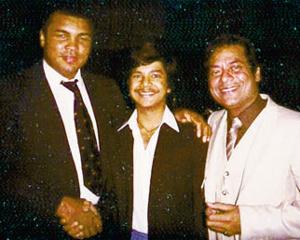
Producer Naved Jafri on meeting heavyweight champion Muhammad Ali
This picture was taken in 1981. I was 13 years old and accompanied dad on a trip to Abu Dhabi. The Sheikh had organised a fundraiser in order to build mosques in the area. The chief guest for the night was former American professional boxer Muhammad Ali, whom I was excited to meet.
Bollywood celebrities like Rishi Kapoor and Asha Sachdev were there to attend the event as well. For entertainment’s sake, my father and Ali had a friendly match. It was hilarious to see my dad and the heavyweight boxing champion, who stood at 6 ft 3 in, in the same ring.
For comic effect, dad even scampered around as Ali pretended to pound him. The crowd seemed to love it and everyone was cheering. After the fundraiser, which was a great success, a bunch of us went out for dinner with Ali. It was an elaborate dinner in a five star hotel. But one thing that struck me about that night was Ali’s sharp sense of humour.
When saying our goodbyes, he shook my hand. It was an impressive handshake, especially since his hand was three times the size of my little fist.
source: http://www.punemirror.in / Pune Mirror / Home> Others> Leisure / by Yolande D’Mello / July 20th, 2014
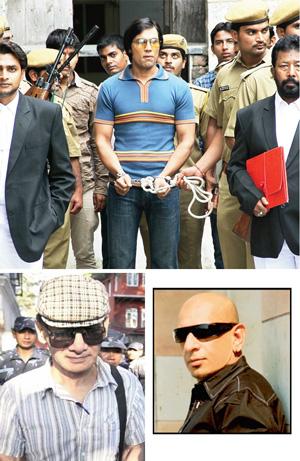
still from Main Aur Charles (top); Charles Sobhraj (Left) & Salim Asgarally (Inset)
BACKSTAGE PASS
FILM:Main Aur Charles
Fashion designer Salim Asgarally doesn’t normally agree to do costumes for films, but transforming Bollywood actor Randeep Hooda into Charles Sobhraj, the Bikini Killer of the 1970s, was an irresistible lure. Charles, who was convicted and jailed for 12 murders between 1976 and 1997, and is currently serving a sentence of life imprisonment in Nepal, was a dapper dresser.
“He is an intriguing character whose journey spans different eras. I was ready for the challenge that Prawaal Raman’s film, Main Aur Charles, offered,” explains Salim. Three months of intensive research yielded several different looks to experiment with.
Charles moves from Bangkok to Delhi and on to Mumbai and Goa with a tenure in the Tihar jail in between. Salim promises a new look for the con man in every city.
“In Bangkok, he’s urbane in trench coats, which make way for suits and blazers in subdued checks teamed with’70s style ties, his trademark beret and designer glasses when he’s trying to pass himself off as a moneyed gentleman in Delhi,” explains the stylist. Salim points out that even when he was jailed, till he was convicted, Charles was allowed to throw Christmas parties, give interviews to the international press and wear his own clothes.
“So, among the prison uniforms was this intelligent, widely travelled, conman with a suave front. The continuity had to be retained even when he fled to Mumbai after a daring jail break. But once in Goa, he turns into a carefree hippie in swimming trunks and shorts,” says Salam, who wanted the clothes to become an aid in storytelling while making Randeep look good on screen.
Usually Hindi films don’t bother with authentic depiction of period styles or the colour palette, but for Salim they were the basic parameters. When designing for Charles, he stuck to muted hues like sky blues, coffee browns and olive green.
And to ensure that everything was in sync, he ordered vintage frames and borrowed costumes from Nepal’s royalty. The ‘Main’ in the title is Amod Kant, the investigating officer on the case, whose observations the film is based on.
Adil Hussain, who plays the character, is mostly seen in his cop’s uniform, but when with the family, he’s a typical middle-class civilian in trousers and bush shirts, a distinct contrast to the flashy Charles.
There are other characters too, like Richard Thomas, the British hitchhiker Charles meets, whom Salim dressed up in casual denims, and Mira, the Delhi law student, who Richa Chadha brings to life on screen. Mira is togged up in Indo- Western wear and junk jewellery from the Janpath market. Smiles Salim, “Main Aur Charles wasn’t an easy film, but it was a satisfying project.”
source: http://www.punemirror.in / Pune Mirror / Home> Others> Leisure / by Roshmila Bhattacharya / July 06th, 2014
Mir Osman Ali Khan receives Prime Minister Lal Bahadur Shastri at Begumpet airport. Responding to Shastri’s appeal, the Nizam donated 5000 kg of gold to the National Defence Fund
OF POWER AND POISON
British Residents in Hyderabad spoke of the mutual antipathy that apparently existed between the Nizam’s eldest wife Dulhan Pasha and her sons Prince Azam Jah and Prince Moazzam Jah.
The mother of the two Sahebzadas was keen to marry them to her nieces, described by the Resident, Lt. Col. T.H. Keyes, as “two half-starved little Hyderabadi girls”. She had even been involved in a public slanging match with the Nizam on the issue of her sons’ marriage, and was supposed by British officials to be not fond of her sons.
To illustrate the discord between the mother and sons, Keyes recalled what Prince Moazzam Jah used to reveal to his guests. The younger Sahebzada claimed that his mother wanted to become the regent on the Nizam’s death. “When someone takes the cue and asks how she could be regent when his brother and he are of age, he replies: ‘We won’t be here. Mother is always experimenting with poisons, and there are no cats left in King Kothi’.”
…The rumours of poisoning in 1932 also led to revival of allegations that Sir Salar Jung I had been poisoned by the Nizam’s zenana as he had been insisting on Mahbub Ali Pasha being sent to Europe for education.
TONNES OF GOLD FOR WAR EFFORT
Mir Osman Ali Khan, Nizam VII, may have delayed his decision on merging Hyderabad State with the Indian Union after Britain left the country in August 1947, but he created a record when he responded to the call of Prime Minister Lal Bahadur Shastri in 1965. The PM visited Hyderabad and requested the Nizam to contribute generously to the National Defence Fund, set up in the wake of the Indo-Chinese skirmish. Without a second thought, Mir Osman Ali announced that he would contribute five tonnes of gold to augment the war fund. In monetary terms, the Nizam’s contribution was about Rs 75 lakh, or about three-fourth of the annual Privy Purse he received from the Centre. In terms of today’s gold price in the international market, this donation translates to a whopping Rs 1,500 crore.
The Nizam’s donation of 5,000 kg of gold to the National Defence Fund in 1965 was the biggest ever contribution by any individual or organisation in India and remains unsurpassed till today.
However, known for his wit and frugality, Mir Osman Ali Khan did not hesitate to seek the return of the empty iron boxes once the gold coins and bars were offloaded in Delhi. “I am donating the gold and not the iron boxes. Do not forget to return them,” the Nizam told the officials even as his son-in-law and confidant Ali Pasha carried trays of gold coins from the Nazri Bagh Palace. The empty boxes were duly returned.
ALBERT ABID AND THE SILK SOCKS
Hyderabad’s history is full of fables about foreigners who gave Hyderabad a new meaning and purpose. Albert Abid Evans, a Jew from Armenia, gave Hyderabadis their first department store and a new name to an otherwise abandoned locality.
Abid’s, one of the busiest business centres of Hyderabad, owes its name to Albert Abid, who set up a shop that served the needs of Hyderabadis from needle to grains and stationery to clothes.
…As a valet of the Nizam, Abid looked after Mir Mahbub Ali Khan’s wardrobe, the biggest of its kind in the world. It is rumoured that Nizam VI did not like to repeat his silk socks and the enterprising Abid would put the used socks back in the packet they came in and recycle them while his trusting master kept paying for new socks! If rumours are to be believed Abid also helped himself to the rings from his ruler’s fingers when his ruler was in a stupor and promptly thanked the Nizam very profusely the next morning for gifting him the jewellery.
AN UNHAPPY PRINCESS
Niloufer Khanum Sultana, who was called the world’s most beautiful woman, was pained by the fact that she was unable to produce an heir and felt that she had failed in her duty as a princess. It was especially upsetting for her that her cousin Princess Durru Shehvar had given birth to two lovely boys, Prince Mukarram Jah and Prince Muffakham Jah.
On a particular occasion, when Princess Niloufer was in England in response to her mother’s distress call about her financial and social health, Prince Moazzam Jah decided to let everyone know that it was not he who was responsible for their childless marriage. He brought a lady of doubtful repute into his home, and was apparently able to demonstrate his virility. Princess Niloufer returned from England to learn of this treachery and never shared a room with her husband again.
Her husband’s betrayal was not the only fact that pained her. She also returned to find that her personal maid, of whom she was very fond, had died in childbirth. This moved her to open a hospital for children and women. The Niloufer Hospital is still a sought-after medical institution today.
This gesture of the childless princess earned her a place in the hearts of Hyderabadis.
BORN TO RULE
Prince Mukarram Jah had the best of education — Doon, Harrow, Cambridge and LSE. He also trained at the Sandhurst Military Academy in England. …During a visit to Hyderabad, his first wife Princess Esra said he was a bright young man when she married him but was overwhelmed by the fast-paced political developments at home.
In 1969, the Indira Gandhi government decided to discontinue the annual purse to descendants of former rulers of princely states, who numbered around 600. The land bank vanished with the Land Ceiling Act. Mukarram found himself at a complete loss when he lost his privy purse and was compelled to sell off his assets. He would dispose invaluable jewellery to meet his immediate needs without verifying the value of the gems he offered for sale. Not surprisingly, he was taken for a ride by everyone, while the list of those dependent on him kept expanding. This list had grown to include the legion of relatives (14,792), servants (14,000), grandfather’s concubines (42) and children (hundreds of them).
Despairing of the circumstances he found himself in after the demise of his grandfather, this last true blue Nizam protested, “I was taught to be a soldier, not an administrator.”
Given the title of the eighth Nizam and brought up as an imperial prince of the Ottoman Empire, he was not wrong when he once confessed, “I was born to rule. That was the only thing I was prepared for.” Some believe it was the burden of having to deal with so many trusts and their beneficiaries that caused Mukarram Jah to leave for Australia.
3,000 WIVES?
In June 1936, the India Office received a letter from one Irene Cowen from Sheffield, asking how many wives the Nizam had and how many children. “A Hyderabadi had given a lecture on the Nizam’s government and in that had mentioned that the Nizam had over 3,000 wives, but he did not know the exact number, and had described him as having ‘a good many children’,” she wrote. …The Foreign Office sent Miss Cowen this reply: “The statement made by your lecturer is, on (the) face of it, incredible. Nor is any record of the kind suggested maintained in this office.”
The Nizam, however, did have over 100 women in his zenana and was even accused of kidnapping some. As for his progeny, it is claimed that Osman Ali Pasha sired over 147 children. A more modest estimate puts this figure at 28 daughters and 44 sons. However, like most stories about the Nizam, this claim is often exaggerated.
According to his daughter Basheerunissa Begum, it was impossible even for the family to keep track of everyone in the palace as each wife of the Nizam and her children had separate living quarters within the palace and had numbered badges to help the palace guards keep track of their security and identity.
source: http://www.deccanchronicle.com / Deccan Chronicle / Home> Lifestyle> Offbeat / DC Correspondent / June 01st, 2014