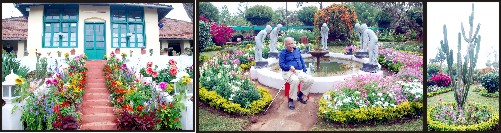
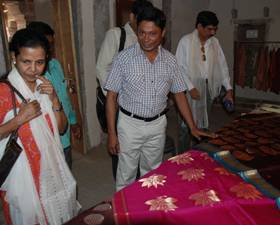
An eye-catching flower show has been organised from Jan. 26 to Jan. 28 from 10 am to 5 pm at the Yousuf Ali Khan memorial flower garden at the premises of Balyatri Coffee Estate near Boikeri on Madikeri-Suntikoppa Road in Kodagu.
The estate belongs to former Rajya Sabha member F.M. Khan. Briefing the press on the annual flower show, Khan said that “over 90 varieties of flowers and fruits have been grown in the garden which is the only private flower garden in the country. The garden took shape about 50 years ago and for the last 15 years the flower show is being organised annually for the public. The garden houses Philia, Lorsper, Khel, kelen chus, cactus, dahlia, daisy, roses, pinks, kupia and other exotic varieties including bonsais.
He said that horticulture was bifurcated from agriculture when Indira Gandhi was the Prime Minister to boost the growth of horticulture which has not happened to the desired level yet. Continuing, he opined that Congress needed young leaders like Rahul Gandhi and Priyanka.
However he felt that Rahul should address more public rallies instead of closed-door meetings to reach the masses.
source:http://www.starofmysore.com / Star of Mysore / Home> General News / January 25th, 2014
Celebrated writer Kamala Surayiya, whose selection to Kerala’s highest literary award came under fire from pro-Sangh cultural outfits, on Wednesday said it was time to stop “hurling stones” at her.
“I am grateful to my critics, for they make me realise my shortcomings. But is it not time to stop hurling stones at me?” asked Surayiya.
The well-known writer was apparrently referring to the outcry by the pro-Sangh cultural outfits for her selection for the Ezhuthachan Puraskaram, in her acceptance speech here.
Surayiya received the Ezhuthachan Puraskaram, carrying Rs 1 Lakh, from Kerala Chief Minister A K Antony at a functuion at the Durbar Hall in the government secretariat.
The pro-Sangh cultural forum Thapasya had criticised the choice of Surayiya for the prize instituted after Ezhuthachan, revered as the ‘father of Malayalam literature’, holding that Surayiya represented a value system different from the one for which Ezhuthachan stood.
Her critics, however, had said their opposition was not for her convertion to Islam.
“Abuses are not new to me. They are quite common in Kerala. Once I was considered for the Nobel prize. A poet from Kerala dashed off a letter to the Nobel authorities with 150 signatures appended to it. They held that considering me for the honour was like kicking the Nobel,” she said.
“I do read criticism. But I don’t dare open letters mailed to me these days. Most of them have abusive contents.
“What wrong did I do. Maybe I embraced a minority religion. For me religion is just a means to realise God. I stand for unity of all religions,” Surayiya said.
source: http://www.articles.timesofindia.indiatimes.com / The Times of India / Home> City> Thiruvananthapuram> Kerala / PTI / January 01st, 2003
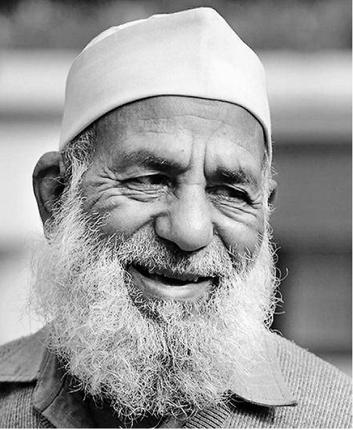
Feast for the eyes:Mohd. Aqib worked for days to get the carriage (right) used by President Pranab Mukherjee at Beating Retreat ceremony ready.— / Photos: S. Subramanium & Sandeep Saxena / The Hindu
Aqib has spent decades looking after President’s buggy
The coach will head outside Rashtrapati Bhavan for the first time in two decades on Wednesday
On Wednesday, when President Pranab Mukherjee rode out to witness the Beating Retreat ceremony at Vijay Chowk in the horse-drawn carriage, known as the President’s Coach, one man intently observed every turn of the wheel.
Mohd. Aqib, a master craftsman who has spent decades looking after the six-horse carriage, worked relentlessly for days to get the carriage ready for the President.
Familiar with every part, he knows how to clean and maintain the handcrafted leather seats and how to add shine to the gold inlay work on the wheels. The red velvet of the mounting steps has to be just right and the canopy has to open with a single tug of the hooks.
“Just as doctors read the pulse, I can feel the veins of this wood and metal carriage. For years now I have been maintaining this coach… ,” he said.
There is a team of skilled workers to help the octogenarian, but Mohd. Aqib will not trust anyone. He oversees the work with hawkish vigil and, from the repository of his memory, recalls the tiniest of detail.
Armyman to the core
“I retired from the Army in 2001, but my association with it continues and I get to work on the carriages at Rashtrapati Bhavan. I am still an obedient solider of the Army and whenever they need me I will be present. My children sometimes worry for me, but I tell them, a soldier never says no,” he laughed.
When not working on the carriages at the President’s Estate, Mohd. Aquib’s skills take him across the country to places where carriages once owned by the Maharajas await repair and restoration. “I am responsible for looking after the buggies of several royal families, including that of Vasundhara Raje, some of these carriages have been presented to the Army.”
Having worked his magic on some of the oldest and decrepit carriages, Mohd. Aqib can build a gleaming new coach in as little as three months. “My first restoration work was the carriage of the Nawab of Aligarh. He wanted me to restore the wagon so that it could be presented to the Army; he was particular that it should not be disrespected after he was gone.”
“The Maharajas and even the British officers were very particular about their carriages. They would not hesitate to spend large sums of money. The Maharaja of Patiala got a carriage made with 10 kg of silver in Paris and presented it to his daughter who was married into the Kapurthala royal clan. The coach used by the President was made from raw material procured from London and great attention was paid to ensure that it was not just beautiful, but comfortable as well. It is a rare coach with low steps for allowing women to climb in without having to raise their feet too high,” he said.
Buggy-making and maintenance is a dying art he says. Even though he is among the very few who have mastered the skill, Mohd. Aqib feels awkward negotiating a fee.
“I do it out of a sense of love and duty. It is not a trade….” The President’s Coach left Rashtrapati Bhavan for the first time in two decades on Wednesday.
Owing to security concerns, the carriage is limited to use only at Rashtrapati Bhavan.
source: http://www.thehindu.com / The Hindu / Home> National> New Delhi / by Smriti Kak Ramachandran / New Delhi – January 30th, 2014
The Nizams’ rule found place in the record books of both the Legislative Assembly and Council on Friday.
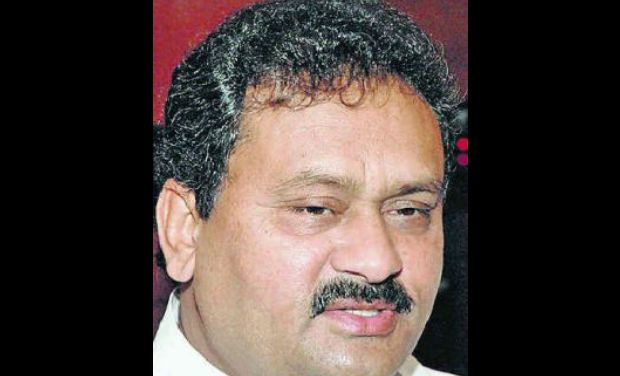
Congress MLC Mohd Ali Shabbir actually submitted a detailed note to Council chairman A. Chakrapani, stating that the Nizams, especially Nizam VII, had developed Hyderabad city and not Telugu Desam president N. Chandrababu Naidu.
Shabbir listed over 100 buildings, monuments, infrastructure projects, government departments, hospitals and others, including the present Assembly building, Jubilee Hall, Hussainsagar Lake, Railway network, Road Transport Corporation, Begumpet Airport, Osmania University, Osmania General Hospital etc. that had been constructed by the Nizams or during their reign.
“Pre-1956 Hyderabad was the largest and most prosperous of all princely states in India. It had its own army, airline, telecommunication system, railway network, postal system, currency and radio broadcasting,” he explained in the note which was part of the debate on the AP Reorganisation Bill.
“Hyderabad, the first planned city of India, was already a developed city centuries before it became part of Andhra Pradesh. The world’s first drinking water reservoir, Hussainsagar, was built in 1562,” he said.
Several MLAs and MLCs like Akbaruddin Owaisi, Mohd Shabbir Ali, Etela Rajender and others gave credit to the Nizams for the development of Hyderabad, while some Seemandhra MLAs like D. Narendra and others criticised their rule, which they said, had led to the Telangana armed rebellion and the notorious Razakaar movement.
“I wanted to put the record straight. The Nizams developed Hyderabad city and others contributed later. The claim of Leader of Opposition in Assembly, Nara Chandrababu Naidu, is ridiculous that he got Hyderabad on the global map. The fact is, Naidu went on the global map and got recognition by reciting the name of Hyderabad repeatedly,” Shabbir Ali said in the note to the Legislative Council Chairman.
He challenged Seemandhra leaders for an open debate on Hyderabad. “In fact, Naidu tried to damage the culture and identity of Hyderabad. The historic Hussain Sagar Lake was shrunk during Naidu’s period and he tried to change the name of the city from Hyderabad to Cyberabad. Even NTR’s samadhi is built on encroached land which was originally Hussain Sagar,” he alleged.
source: http://www.deccanchronicle.com / Deccan Chronicle / Home> News> Politics / DC / January 25th, 2014
Karnataka hopes to maintain its winning streak at the Republic Day parade
The Congress government in Karnataka will roll out the tableau of ‘Tipu Sultan—the first ruler of India to see the evil designs of the East India Company’ at the Republic Day parade.
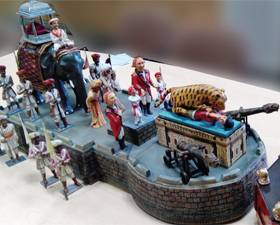
Karnataka has been winning accolades every year during Republic Day parade. Sources in the Information Department told Bangalore Mirror that this year, it was unanimously decided to have Tipu’s battle against East India Company as the theme of the tableau. While one part reflects his valour with a life-size bust and an unsheathed sword, another part story depicts his humiliating defeat at the hands of Lord Cornwallis who took away Tipu’s two sons as captives in the Second Mysore War (1780-84).
“Tipu was one of the first rulers who saw the evil designs of the East India Company. He repeatedly said that he would rather live two days as a tiger than live 200-years like sheep. Tipu’s personality also has qualities of a good diplomat, visionary and a planner. He had a vision for missile technology and the first-ever rocket centre was set up in Srirangapatna. He had embassies with France, Amirs of Afghanistan and Sultan of Turkey and established trade contacts,” explained a source from the Information Department.
The scene that the government has recreated in the form of tableau was adopted from the painting of Brown who has pictured a lame Vakeel escorting two sons of Tipu. The children, dressed in muslin cloth with blue slashes and white turban, look towards Lord Cornwallis, reflecting a poignant moment in the history of India. The tableau also depicts Tipu’s famous sword measuring 91 cms with an impressive and ornate hilt carrying an Arabic inscription which reads ‘Sword of the Ruler’.
The state won President’s awards for its tableaux in the past four years.
source: http://www.bangaloremirror.com / Bangalore Mirror / Home> Bangalore> Others / by Niranjan Kaggere, Bangalore Mirror Bureau / January 22nd, 2014
When you ask a software engineer like Shahid Ahmad about Jacquard weaving, the answer would stump many a fashion designer. “It is actually the world’s oldest binary system,” says Ahmad of Digital Empowerment Foundation (DEF). He has even devised a Jacquard card punching machine that eliminates two weeks of manually punching a card with the binary sequence to an hour’s work. And the weavers of Chanderi village in Madhya Pradesh are rejoicing.
Ahmad’s tryst with the age-old traditional weaving business of Chanderi began when it was gasping on its last breath. It started off with a 2008 basic survey of Chanderi village on the instigation of Jyotiraditya Scindia when Ahmad had gone to invite him for a DEF function.
The survey threw up distressing facts: weavers were being treated as labourers and earned a pittance; a few businessmen controlled the market; there wasn’t much demand for the products in the market and the youngsters were migrating to cities. Ahmad decided to give the ancient craft and its craftsmen a shot of digital empowerment. Thus was born Chanderiyan, a programme that has transformed the ancient weaving village of Chanderi.
Ahmad eased the bottleneck in the designing process (which was done manually by a couple of designers on graph paper). “I wanted to speed up designing and other aspects of the business while retaining the traditional looms,” he recalls. He also wanted to increase the earning capacity of the weavers, which was then at Rs 2000 a month.
He customised the CAD CAM software and trained 20 weavers in using the software. Of these, three to four weavers were selected to train a further 100 weavers. Simultaneously, a design library was created with 10,000 traditional designs, some retrieved from old saris.
Digitisation gave the weavers a chance to create designs and replicate the same in the loom quickly. It also allowed them to visualise new colours and create contemporary variations without having to waste precious man hours. The demand for Chanderi saris increased as the market saw newer designs and faster supply. Today, the weavers earn at least Rs 10,000 per month. The business turnover, according to an IIM Calcutta survey is anywhere between Rs 65 crore to 100 crore.
Ahmad has now taken his big idea a step further: he has devised an e-portal (Chanderiyaan.net) wherein weavers can sell their products directly to the customers globally. He also trained the weavers in aspects like taking photographs of their products, sending couriers etc. He also put up Wi-fi in a five kilometer radius. “From raw materials pricings to what exhibitions are on, the youngsters can now take their own decisions,” says Ahmad.
His dream is to make the weavers the future businessmen of Chanderi. Ahmad admits to now being more of a textile engineer than a software engineer; he even trains NID students from Bhopal on the technique of Jacquard weaving. He might not be familiar with colours, warps and weaves, but he sure knows his binary system.
source: http://www.bangaloremirror.com / Bangalore Mirror / Home> Work / by Jayanthi Madhukar, Bangalore Mirror Bureau / January 21st, 2014
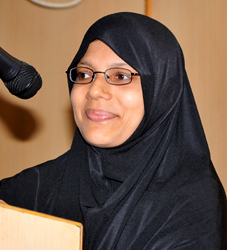
Mangalore-based woman activist Shahida Aslam has been unanimously elected the new president of National Women’s Front. She was the Karnataka state unit president of the organisation.
The announcement was made at the third national general council of the organization that was held on Sunday at Malabar House, Puttanathani in Kerala.
Aslam, who holds a master degree in mass communication and journalism, is a freelance journalist from Mangalore. She was part of the editorial board of Prastutha, a Mangalore-based Kannada fortnightly. She also had worked for a women’s monthly magazine.She was also an office-bearer of Karnataka women’s writers forum. She presented a paper titled ‘Muslim women in public space’ at an international conference organised at Calicut by institute of objective studies, Delhi. She had also worked as a member of several fact finding teams for human rights organisation and women’s rights organisation.
Alima Fathima from Tamil Nadu and Fareeda Hasan from Kerala have been chosen as the vice president and general secretary of the NWF respectively.
The council started with the introduction by the national president Shahida Tasnim. She said, “The last two years of the organization were the years of growth. We were successful in reaching new places and setting state committees in Goa and Andhra Pradesh. The organization also received good response from women activists from Delhi which has encouraged us to take our movement to the northern part of India in the coming term.”
The leadership oath to the president was given by the returning officer. The newly elected president administered the oath to the newly elected office bearers and national committee member. The programme concluded with the valedictory speech of the newly elected president Aslam, who motivated the members to put in more efforts for the protection of rights and social justice.
The general elected a 13-member national committee and also the new office bearers. The new leadership is as below:
1. Shahida Aslam Karnataka – President
2. Alima Fathima Tamil Nadu – Vice-president
3. Fareeda Hasan Kerala – General secretary
4. Shifa Coimbatore, Tamil Nadu – Secretary
5. Shahida Tasnim, Karnataka – Treasurer
6. Zainaba Ali, Kerala – National committee member
7. Asiya Maryam, Tamil Nadu – National committee member
8. Nousheera Karnataka – National committee member
9. Atiya Firdos, Delhi – National committee member
10. Shareena Najib, Kerala – National committee member
11. Habeeba Usman, Kerala – National committee member
12. Rehana, Goa – National committee member
13. Safiya Erode, Tamil Nadu – National committee member
The following resolutions were passed by the national general council:
1. Provide security, justice and rehabilitation to Muzaffarnagar riot victims: The NGC of NWF demanded the immediate rehabilitation and adequate protection of the riot victims of Muzaffarnagar. The government failed to attend the basic needs of the people displaced from their homes and native villages. The NGC strongly believes that rehabilitating the families thrown out of their native villages along with providing security to their lives and properties is the primary task the government has to fulfil. The NGC demands the UP government to take immediate steps to solve the humanitarian crisis and fulfill is promises.
2. Pass the Communal Violence Bill in the upcoming parliament session : The country has been infected by the deadly virus of communalism since independence. This in turn resulted in various communal riots which has caused an extreme loss to the country and especially to the Muslim community. After every riots the culprits go scot free and no legal action is taken on them. Such negligence by the law authorities has only increases the confidence of the communal fascist forces. The demand for the communal violence bill is a long pending demand which has only seen promises but no actions. The NGC of NWF demands that the government immediately brings into effect a powerful communal violence bill in the upcoming Lok Sabha session and take quick steps for its implementation.
3. Take immediate steps for protection of women: Since the past few years the issue of rapes has come to the national attention. It is a tragedy that even after so much discussion happening about this issue the government and police has failed miserably to protect the women from such heinous crimes. Every day we see a new incident happening in almost all the cities of country. The cases happening to women from rural and tribal areas not even reported. The NGC of NWF strongly demands the central and state governments to take the issue very seriously and give top priority to the protection of women.
source: http://www.daijiworld.com / DaijiWorld / Home> Top Stories / Press Release / Mangalore – January 20th, 2014
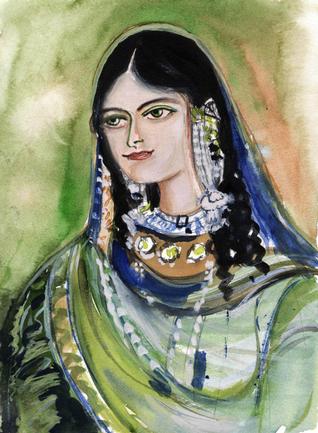
The winds of change prevented Nawab Shah Zamani Begum from becoming a Mughal Empress
One spent an entire day looking for information on Nawab Shah Zamani Begum or some trace of the house of Bahadur Shah Zafar’s youngest daughter-in-law. Just as pretty as Zinat Mahal, she was felicitated by Mirza Ghalib in the sehra (panegyric) he recited at her wedding to Mirza Jawan Bakht. Zinat Mahal’s house still stands as a ruin in the Lal Kuan area. May be Zamani Begum too lived close by. But it dawned that the house was probably in Jaipur, her “maika” or maternal home. But before January 6 (when X’mas ends) got over one was pleasantly surprised by what seemed like a belated present. “Zafar and The Raj” seen in the light of the new moon peeping from the window, did contain some valuable information on the subject. But first about Bahadur Shah, fondly called “Abban” in the zenana. Like his forebears, he too celebrated all festivals and enjoyed eating Twelfth Night (after Christmas) plum cakes presented by Sir Thomas Metcalfe, say some records.
So much has been published on Zafar (1775-1862) that anything written now sounds trite, but Prof Amar Farooqui’s treatise, covering the period 1800-1850s, seems an exception. Talking about religious festivals, he says Zafar celebrated the two Eids, Dussehra, Diwali and Holi with great enthusiasm, being bathed in seven kinds of water and weighed in gold coins and grain, which were later given in charity. Only a buffalo and a goat were officially sacrificed in the fort on Eid-uz-Zuha and the meat distributed to the poor. For his own table, Zafar preferred venison from deer shot by him on the Yamuna bank. A good shot with the fowling piece, he trained many disciples to use the gun. It’s a tragic irony that he couldn’t even take a sip from a spoon of soup during his last illness.
According to Farooqui, “The abundance of game in the forest zone beyond Mehrauli took the Emperor annually for a prolonged stay to the Qutb during winters. A routine followed since (his father) Akbar Shah’s time.” On 6 January, 1851 Mahbub Ali Khan, Bahadur Shah’s factotum, was ordered to prepare for the move to the Qutb. In Mehrauli he was invited by Mahbub Ali to look at a garden he had developed near the Minar. Bahadur Shah visited the garden along with his wives, who spent the entire day there amusing themselves with plucking the oranges — 2000 of which were sent to the Red Fort for the princes who had stayed behind. Bahadur Shah then went hunting in the surrounding area, though he had prohibited the killing of peacocks and nilgai (blue bull). “During the winter he would set up camp at Najafgarh jhil, accompanied by his wives, for a spot of bird-shooting.” The one animal he had an aversion to was alligators, which abounded the Yamuna and often preyed on humans. “Fishermen had instructions to catch them so that they could be brought to the palace to be killed in his presence. A reward of Rs. 2 was given for every reptile killed.” Rupees two must have been equal to more than Rs.2,000 at today’s inflated rates.
The treatise gives such interesting facts and more like how Mirza Jawan Bakht, Zafar’s favourite son, died in Moulmein (Burma) of liver cirrhosis in 1884, as he had taken to drinking heavily. He had been sent from Rangoon to Moulmein to convalesce. His mother, Zinat Mahal, died in July 1886 of colic. She had been addicted to opium for 17 years (probably to get over the tragedies she had suffered).
Jawan Bakht’s wife, Shah Zamani Begum died in July 1899, when Jawaharlal Nehru was nearly 10 years old. Zamani Begum had accompanied the Emperor, the queen and her husband to Rangoon. A year after Zafar’s death, in 1863 she, along with her son and daughter, was allowed to visit her mother and other relatives in Jaipur and Delhi. She was to originally spend a year in north India but the visit was abruptly curtailed after three months as the British thought that her presence could lead to trouble for them. She had arrived in December 1863, accompanied by a Mrs Cannon, who then returned to Rangoon. The Begum’s mother came to Delhi from Jaipur to meet her.
The Lt-Governor of Punjab got to know of the visit in February 1864 and immediately objected to it, saying she should be directed to return to Burma, now that she had met her mother. Later James Talboys Wheeler, Secretary to the Chief Commissioner of British Burma, who had taken charge of the royal family, suggested that Zamani Begum be allowed to travel to Calcutta with Jawan Bakht, who could return after a month while she stayed back for treatment of a serious eye ailment that was threatening her vision. Wheeler also asked for funds for the marriage of her 11-year -old daughter. He had suggested a sum of Rs.2,000 but the Government sanctioned only Rs.1,000. It also rejected the suggestion that Jawan Bakht should accompany his wife to Calcutta.
Their son, Mirza Jamshed Bakht (born about the same year as Tagore) went on to get an English education at the Diocesan School and Rangoon College and turned out to be a man of pleasing personality. He was associated with the initiative to build a mausoleum to his grandfather and was regarded as one who spoke the “English language gracefully”. “He lived a life of genteel poverty,” dying at the age of 60 in 1921, some 22 years after his mother. Had she had the good fortune of being the next Mughal Empress after Zinat Mahal, Shah Zamani Begum’s name would have enlivened history but the wind suddenly changed (“Gayi yak ba yak jo hawa palat”). As for her ancestral house, it may be there in Ghat Gate, Jaipur where some of the well-known Muslim families still reside, despite the noise pollution caused by the ironsmiths of Loharon-ka-Khura.
source: http://www.thehindu.com / The Hindu / Home> Features> MetroPlus / Down Memory Lane / by R. V. Smith / January 19th, 2014
The 10-day annual book festival will commence at the municipal ground near the new bus stand here on January 31.
More than 50 publishing companies and equal number of book selling companies will participate in the expo, a brain child of Collector Darez Ahamed. The exhibition last year netted a sale of about Rs. 98 lakh while Rs. 38-lakh worth books were sold in 2011. This year it has been targeted to sell books worth Rs. 1.05 crore through the exhibition, sources said.
V. Irai Anbu, Director of Anna Institute of Management and Director General of Training, and M. Thirumalai, Vice Chancellor, Tamil University, Thanjavur, will be chief guests at the inaugural function on Tuesday evening. Noted writers, including Ponneelan, Sahitya Akademi awardee and president of the All India Progressive Writers Association, Su. Venkatesan, Sahitya Akademi awardee, S.Tamilselvam, Prof. G. Gnanasambandam, and Parveen Sulthana, Tamil scholars, and Thamira, film director, will participate in programmes at the venue on different days.
source: http://www.thehindu.com / The Hindu / Home> News> Cities> Tiruchirapalli / by Special Correspondent / Perambalaur – Decemeber 30th, 2013
Sultan Mohammed Quli Qutub Shah, the founder of Hyderabad, was the first poet of Deccani language, the proto model of Urdu, and not Wali Deccani as has been often claimed by historians of the language, Syed Taqi Abedi, a Hyderabadi-Canadian researcher, said on Wednesday.
The researcher also stated that the credit of tracing the origin of Urdu language to the 16th century goes to Syed Mohiuddin Quadri Zor who has left behind extensive research on Deccani, Urdu and Hindi.
Delivering the first Syed Mohiuddin Quadri Zor Memorial lecture which was jointly organized by Maulana Azad National Urdu University, Maulana Azad Club and Zor Foundation at Salar Jung Museum, Abedi said until Zor’s research on Urdu became known, Wali Deccani was considered the first Deccani-Urdu poet who had an anthology to his credit.
Ziauddin Ahmed Shakeb, who presided over the function, concurred with Abedi and said that while Wali belonged to 18th century, Qutub Shah wrote poetry in the 16th century. He said that owing to Zor’s undisputed works, the universities across the world have started a separate discipline on Deccani language and literature.
“Until 15th century Hindi and Urdu were spoken languages. The foundation of Urdu as a written language was laid down in the Deccan. It became a secular language in which mass literacy campaigns were undertaken. The kind of work Zor has left behind is equally beneficial to Urdu and Hindi linguists since Deccani is considered to be the prototype for the two languages,” he said.
Abedi revealed that the royal copy of the anthology of Qutub Shah was with the State Central Library which was earlier known as Kutub Khan-e-Asafia. “The copy is no longer there. It was said that the anthology was eaten away by moths. I doubt this and suspect that somebody has stolen it. It is also possible that it will reappear in European markets of artifacts,” he said.
Shakeb said that there is a file in the Institute of Archives and Research which says that the anthology was sent to the Nizam with a proposal for editing and publishing it. “There is only one sentence related to the anthology which says it did come back with the proposal file,” he said.
The two scholars said that Zor made use of the two incomplete parts of the anthology which are still available in the library of Salar Jung Museum. One of the greatest achievements of Zor was setting up of Idara-e-Adabiyat-e-Urdu along with three other friends at Punjagutta. The building of the Idara is known as Aiwan-e-Urdu. Mohammed Miyan, vice-chancellor of Manuu, pledged support for research on Zor and his works. He also promised to host an international conference on Urdu.
source: http://www.articles.timesofindia.indiatimes.com / The Times of India / Home> City> Hyderabad> Anthology / TNN / December 26th, 2013