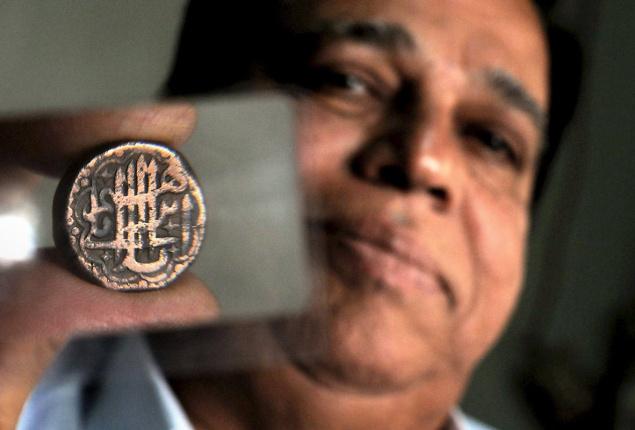
Historian M.A. Qaiyum with the coin minted during the Ibrahim Quli Qutub Shah rule that he chanced upon on a pavement in Old City. – / Photo: Mohammed Yousuf / The Hindu
450-year-old copper coin of 3 Qutb Shahi ruler found
The missing link is finally here. M.A. Qaiyum, noted historian, could not hold back his surprise when he recently came across the 450-year-old copper coin minted during the rule of Ibrahim Qutb Shah. Curiously, the historian stumbled upon the rare coin on an Old City pavement.
Coins of the third Qutb Shahi king, Sultan Ibrahim Quli Qutb Shah, had been conspicuous by their absence. Even the A.P State Museum, which boasts thousands of copper coins of the erstwhile rulers, drew a blank when it came to those dating back to 1550-80 when Ibrahim Qutb Shah ruled.
“It’s a rare find, as coins of that period are not available in the museum,” says Mr. Qaiyum, who got it for a song.
Inscription
What adds substance to the coin is the legible inscription on it. The obverse side has the name, ‘Sultan Ibrahim Quli’, inscribed, and the reverse sports the legend, ‘Ghulam-e-Murtuza Ali’.
The coin, which weighs about 12 gm, represents an excellent piece of calligraphy. The style is quite similar to the Arabic inscriptions seen on the Qutb Shahi tombs.
According to numismatists, only six coins of the Ibrahim Qutb Shah period are available as of now.
But, it is not known as to what legend they bear and when they were issued.
The 6 coin, published by Hurmuz Kaus, an ancient coin collector, is of small size and bears the legend, ‘Juloose Jaiz Ibrahim Quli’, on the obverse and ‘Sadatmand-e-Ali’on the reverse . The coin was issued from the Golconda Mint in 1565 A.D.
The recently discovered coin bears the distinct legend of the ruler, Ibrahim Qutb Shah, in Arabic style. Scholars believe him to be the first Sultan to issue coins in his own name in the Qutb Shahi dynasty.
But, many do not subscribe to this view, as only one coin of Subhan Quli and four coins of Jamsheed Quli, the immediate predecessors of Ibrahim Qutb Shah, are available.
source: http://www.thehindu.com / The Hindu / Home> News> Cities> Hyderabad / by J. S. Ifthekhar / Hyderabad – February 09th, 2014
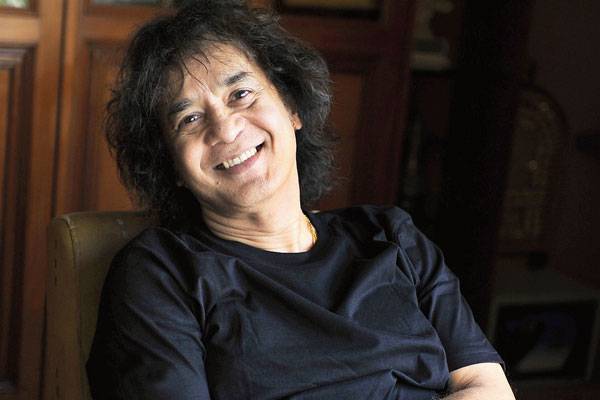
Zakir Hussain’s annual tribute to his abbaji on the day he passed away (February 3), is a day-long a musical marathon. The event is known to bring together musicians of eclectic styles each year. Last year, the Grammy-nominated banjo player Bela Fleck and jazz/bluegrass double bass player Edgar Myer had come down. This year, Khol drummers from Kolkata, the Panchratna Sanai Tafa Mandal from Nagar and gospel percussionist Lil John Roberts from the US will feature in this cultural happening.
For Zakir though, the event transcends the memory of his father. “It’s not then about my father. This is about a celebration of the art that he represented and he loved and the passion that he had for his culture. So, it’s nice to celebrate that culture and the effect that music had on our lives.”
While a show of this length can be exhausting, he is quite clear that performing is his lifeblood. “I actually feel elated when I play. I’ve arrived on stage tired and left the stage replenished. Playing music is the easiest thing. It’s not the hardest thing. That’s because we love doing it. It’s all the other paraphernalia that tires you out. Packing bags, arriving at the airport, going through security, fighting about excess baggage… All that stuff. The travel part of the touring is tiring. The performance is really the most fun part of the whole day. It inspires us to be able to deal with all the other stuff that goes on,” he says, continuing, “Music is really having a great renaissance time in india. Lots of young musicians are finally being noticed and focussed upon.”
He also elaborates on what playing solo and with a group of musicians means to him. “Playing the tabla solo, I am sharing with people centuries of this particular tradition, ragas, that I have learned and grown up with. Whenever I play a solo gig, I draw on memories of great maestros of the past. In my mind, I go, ‘okay, this is from this past maestro, this from that maestro’ and I bring that same piece of music that existed ages ago, into the present moment. Playing solo is fun but when I play live in a group, I enjoy the challenge of bouncing ideas off other musicians. Playing live is also different when you play with a singer or play only instrumentals in a group. When I play with a singer I need a particular pitch, it’s got to be in a particular way so as not to overpower the vocals. You won’t play the same as with a ghazal player than how you’d play with a sitar player. ”
While jamming and improvisations might be what fuels him, he also feels that live shows are a form of theatre. “Some of the performances at the Grammys this year were like theatre productions. That whole thing emerged since Michael Jackson’s Thriller. To me, he really pioneered that art… It requires much more production than say, a camera close up of Keith Urban playing the guitar compared to a Madonna doing Like a Virgin. You’ve got to get in your costume, you’ve got to be in the right place on the stage at the right time when the spot comes on ‘x’ area of the stage and then perform without a hint of self-consciousness,” he concludes.
source: http://www.articles.timesofindia.indiatimes.com / The Times of India / Home> Music> Zakir Hussain / by Reagan Gavin Rasquinha, TNN / February 01st, 2014
In a unique project in Kerala, a government school becomes a world-class institution
When Oscar laureate A.R. Rahman flew down to Kozhikode recently, it was not for a music programme but to see the amazing transformation brought about in a government school.
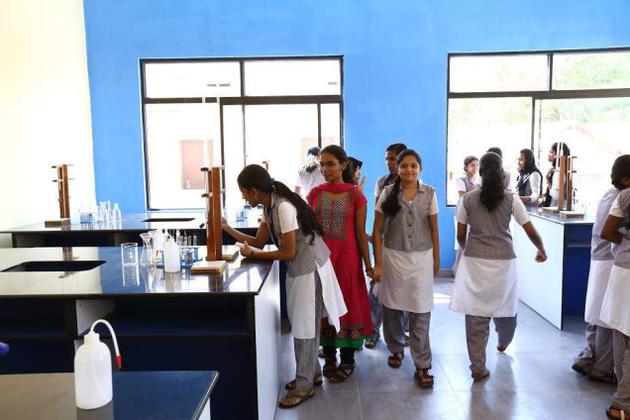
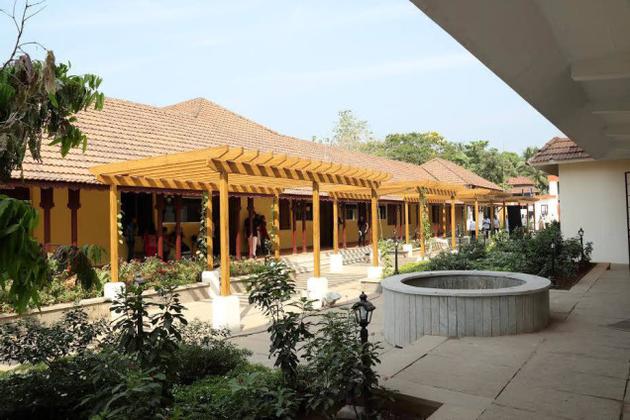
In a programme masterminded by school authorities under the guidance of the local MLA, the 120-year-old Government Vocational Higher Secondary School for Girls in Nadakav, which mostly teaches children from society’s weaker sections, has been upgraded to international standards.
In the spacious new auditorium, Rahman recalled how he met old friends K.E. Faizal and wife Shabana in New York where they told him about how the Faizal-Shabana Foundation had spent Rs. 15 crore on a school project in Kerala. That’s when Rahman decided he wanted to visit the school and see for himself the transformation.
Kerala’s achievements in the education sector, particularly in democratising it, have been remarkable. Its success in bringing education within the reach of the poorest children has made its literacy rate among the highest in the country. And now, this unique collaboration between MLA Pradeep Kumar and a private foundation has emerged as another development model for education in the country.
What was once just another government school now boasts of facilities unheard of in similar schools — an astro-turf playground, super-smart classrooms, computers, and a state-of the-art science lab, among other facilities. Pradeep Kumar, the CPI (M) MLA for Kozhikode, says his mission was to have a world-class school that would still be affordable to ordinary people. The state’s Planning Board came up with a project titled Promoting Regional Schools to International Standards through Multiple Interventions or PRISM.
World-class it certainly is. Infosys provided 150 computers, and ISRO gave a high-tech science lab. From the government and the MLA’s local area development fund came Rs. 7 crore. For the rest, NRI tycoon Faizal and Shabana stepped in with Rs.15 crore from the Faizal-Shabana Foundation. The plan was provided by Indian Institute of Management, Kozhikode (IIMK). Rahman, obviously impressed by what he saw, has announced the support of Rahman Foundation in Chennai for a music school that he immediately inaugurated. Interestingly, the school’s facilities are open to the people of the neighbourhood.
The school is a superb example of government-private participation in the education sector, and a rare instance where bitter political foes — the Congress-led United Democratic Front and the CPI(M)-led Left Democratic Front — played equally productive roles. The project was initiated by Pradeep Kumar when the LDF government was in power and it was completed under the UDF government.
The Nadakav school is a promising chapter in the attempt to resist the commercialisation of education that threatens to make high-class education unaffordable to everybody but the very rich. It is also a heartening attempt to lift the sagging image of government schools and make them more attractive to students who are migrating in large numbers to private schools that boast of attractive infrastructure and ambience. It has often been noted that better infrastructure and facilities could improve both morale and quality of education in government schools.
Meanwhile, Pradeep Kumar has turned his attention to two other government schools in his constituency, but finding benevolent sponsors is not easy. Work has begun in the Government Higher Secondary School of Karaparamba with a small allocation from the MLA’s local area development fund, and the search is on for other funds to complete the work.
At a time when education standards are falling appallingly across the country, this unique public-private model might be just the shot in the arm that government schools need.
source: http://www.thehindu.com / The Hindu / Home> Features> Sunday Magazine / by R. Madhavan Nair / February 08th, 2014
Raipur witnessed a three-day fashion extravaganza at this recently-held fashion show at a city club.
While pretty ladies turned on the heat with glam desi wear, men were no less while walking the ramp in traditional attire. The do also had in attendance models Pooja Missra and Shawar Ali, who elevated the experience of the evening.
source: http://www.timesofindia.indiatimes.com / The Times of India / Home> City> Raipur / by Deepsha Agrawal, TNN / January 22nd, 2014
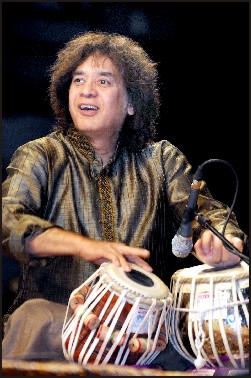
The jam-packed audience in the Nada Mantapa at Sri Ganapathy Sachchidananda Ashram last evening were in a different world while the ensemble of the violin duo of Ganesh and Kumaresh, tabla virtuoso Ustad Zakir Hussain and the mridanga artiste Trichy Harikumar took them on a journey of mesmerising, transcending and a rapturous trance.
Ustad Zakir Hussain, who like his illustrious father Ustad Allah Rakha, has successfully brought tabla on to the centrestage globally, in a brief tete-a-tete with Star of Mysore Correspondent Nandini Srinivasan shares his views on the evolution of music — why he is not the only ‘good’ tabla player and how fabulous the young musicians are… Like a review in The New York Times aptly said… the blur of his fingers rivals the beat of a Hummingbird’s wings.
SOM: Whistles for a classical concert? How do you justify that?
Kumaresh: Why not?
SOM: That is what I am trying to ask…. how do you artistes manage that?
Zakir Hussain: I think it is a refreshing expression of joy and happiness and release of incredible moment of passionate energy. They have to scream and they have to shout as they are in such ecstasy. That’s what it is..Ecstasy…not whistle-tacy!
SOM: From tabla being just an accompaniment to bringing it to centrestage… How much effort has that taken from your illustrious father and you?
Zakir Hussain: It’s not an effort by me, it’s an effort from the audience. I am doing exactly what I used to do before. Tabla is still an accompanying instrument. I accompanied them (Ganesh and Kumaresh) today. It’s just the love of the audience that brings that much attention focus and blessing to the instrument. I just do what I’m taught to do and it’s pretty much just that.
SOM: Solo tabla has a huge audience, so does it become difficult to accompany?
Zakir Hussain: Playing accompaniment is more challenging than playing solo, as you are trying to gauge the mood of the people you are playing with and try to offer them the kind of support that they want or is necessary. With these guys (points to the violinist brothers) I take much more liberty and they offer me support ! So that’s the challenge…In solo you are in control and you do what you want to do.
SOM: You play with instrumentalists and vocalists… which is more difficult?
Zakir Hussain: Both are…Like I said, accompaniment is itself challenging because when you are on the stage you are not only playing the tabla, but also judging the mood of the audience, the mood of the composition being played, the expression that it is supposed to be put out. This is not just for tabla. It is for any accompaniment. We have to provide them with the kind of support they need.
Half the time the drummer doesn’t even know what is going to happen. In that sense it’s even more challenging and difficult because the instrumentalist may think of something to do and then the rhythm player has to immediately rise and provide the carpet… the kind of rhythmic carpet that is needed. And it has to be like a smooth highway on which the instrumentalist can drive. If it’s bumpy then it’s going to be a problem. So yes it is a difficult challenge.
SOM: At one point in your career you had said that you would retire from music as you were unhappy with the commercialisation of music?
Zakir Hussain: I did ?? I would never say that because commercialisation helps me (smiles). It allows me to live better, buy a bigger car, buy a nice bath gel to shower with. It’s not a question of what you would call commercialisation. I don’t think the musicians of today have ever complained about music becoming so acceptable to the masses. It’s specially joyful for us to watch so many people listen to music. And so many people listen to all kinds of music. They listen to classical, jazz, rock, pop anything…
What’s interesting in India is that the same people who listen to jazz will listen to classical music, they listen to ghazals, they go to a theatre… the same people… they have such varied interests. Such a vast panorama that they understand and enjoy and choose. For us it’s such a great thing that music has become so available and accessible, which is helping the music to survive, music to prosper and nurture. So no issues about commercialisation there you see !
SOM: I did read your statement somewhere…
Zakir Hussain: Maybe I was misquoted. It happens… somebody asks me a question like commercialisation of music is not a good thing and I’m answering the question and it gets turned around to say how I’m explaining why it’s such an unhealthy thing ! It’s not. It’s very healthy!
SOM: You are the poster boy of Indian classical music…
Zakir Hussain: It’s a curse that I have to live with until someone else becomes the poster boy! It’s like this you know.. .I have to tell you… I play tabla and I’m a pretty good tabla player. But there are just as good tabla players around in India, at least 20-25 of them. They are just as good, if not better tabla players than I am. It’s just that people resonate with me at the moment, people respond to what I do. I am not doing anything different than 20 other tabla players and I am not even doing it better than 20 other tabla players. It’s just that I have found a wavelength that the audience and I have latched on to and are connected. That’s all it is. And you must know and you must please realise that just like there are 5 great sitar players who are playing all good, 10 great Saarangi players, 20 vocalists who are performing… , they are all as good as each other. It’s just that somebody becomes a marquee name and a poster boy and the media starts to believe and project, mistakenly that he is the best. His concerts are always listed in the papers, people are coming in thousands to listen to him, so he must be the best! That is not the criterion, ok…
Yes it’s a fact that I am supposedly the poster boy in classical rhythmic tradition but certainly I am not the only one.
SOM:Indian percussion has had an impact on other kinds of music…
Zakir Hussain: I think it goes both ways. I have to admit that my tabla is a concoction of North Indian classical music, South Indian classical music, Indian folk music, Indian spiritual music and rock, pop, jazz, latin, soul….you name all these music… my tabla actually is a concoction of all that. It represents where I started, where I have been, where I am now and hopefully where I am going to go. So all those inspirations are projected in my tabla playing. So I have to say that yes I am inspired and influenced by so many other elements of rhythmic music in the world. Similarly every other drummer, tabla player, percussionist will tell you the same thing I told. Ask Shivamani sitting here. He will say he’s inspired by 500 other drummers from all over the world not just India. Ganeshji and Kumareshji will tell you the same thing. You will hear harmony and counter point. You will hear cannon, you will hear western classical music in their Indian classical music. So all these inspirations have come forth and that somehow becomes who you are. You could be dressed in jeans and a sweater, but you are an Indian. You are influenced by Western design. But it’s now a part of you and so you express yourself by being this complete person that has not only absorbed all that has to be absorbed from out there, but has now become a mirror of all that exists out there.
It’s a great thing and that’s what music is. Look at Shivamani. That’s why he can be in LA yesterday and in Mysore today. And these guys (Ganesh and Kumaresh) play all over India and the western world and open up schools in Portland and Seattle…
[To be continued]
Part 2 :
Tabla Wizard Ustad Zakir Hussain Speaks About His Kind of Music …
Ustad Zakir Hussain poses for a photograph with SOM Correspondent Nandini Srinivasan.
“I was watching my father playing when he was 70-73 years old. He would get on to the stage and he looked his age. As soon as he started playing, he looked 20 years younger. The smile on his face would be a mile long… and he would look like he was on the best ride ever… he was in the greatest play pen that he could ever be in,” says tabla wizard Ustad Zakir Hussain about his illustrious father late Ustad Allah Rakha in a brief tete-a-tete with Star of Mysore Correspondent Nandini Srinivasan during his visit to city on Jan. 30 to perform at Sri Ganapathy Sachchidananda Ashram along with violinists Ganesh-Kumaresh and mridangist Trichy Harikumar.
[The first part of the exclusive interview was published in SOM yesterday. Today we publish the second and concluding part.] — Ed.
SOM: There is a sect of puritans who feel fusion music is killing the very essence of pure classical music?
Ganesh: Yeah…fundamentalism in anything is good.
Zakir Hussain: Yeah I would agree with them. You need those puritans to maintain the core of the music as it was conceived. But in defence of music progressing and evolving into something that is today you have to realise that we have no clue how music was 300 years ago. We hear stories… I’m sitting here and saying Saint Thyagaraja composed different kritis and hundreds of compositions. But we don’t know exactly how he composed it… I am sorry Sir! I have to say that it’s been handed down and interpreted by so many different musicians who were around him. They kind of heard it, pieced it together because he was in his trance and he was putting the music out. And everyone around him were taking bits and pieces, comparing notes and coming up with compositions. We have no clue what happened 150 years ago… who played what and how… we don’t know… we just have stories, belief and faith that this is how the music was.
So when you have these puritans that’s what they have. They have this very strong belief and faith that music was like this in those days. And thank God for that because without them we would have no identity. They create this beautiful frame from which young musicians emerge and we plug into that. We now have an identity and we can go out and conquer the world because we know who we are. We are not lost. Shivamani you travel around the world and create music that is so unique…you should say something about that.
Shivamani: Whether Carnatic or Western, wherever you go, music never dies, it’s always alive.
SOM: You have been a great inspiration to the younger generation…
Zakir Hussain: Don’t blame me, it’s not my fault ! Did you see…when Shivamani walked into the hall what incredible happiness and joy was in that applause and welcoming of him. It’s all of us… but I have to say one thing to the young people…if they are looking for an inspiration…if they are looking for a role model and if it’s not their parents then there is something wrong. It has to be them…we can be guides… we can be the suggestion judges, we can offer a way, we can offer help and that’s what we should be doing. The young people should look inside themselves and inside their cocoons for inspiration and role models.
SOM: You are the one carrying forward the legacy of your illustrious father. How heavy is this onus on you?
Zakir Hussain: My father carried the tradition of his guru and his guru carried the tradition of their gurus. It’s not something or unusual or unique…this has been going on for thousands of years in the world. The son of a cook has been a cook and the son of a musician has been a musician and that’s happened over centuries. It is not too much of a weight to carry; it is an honour… it’s joy and it’s with pleasure that I sit out there because I know what I have or what I have seen or what I have heard and I have experienced with my instrument is a wondrous world. It’s a world that is so beautiful, so stupendously fabulous… that I have no problem saying to you or the audience…”Look what I’ve got… It’s something special. It’s the greatest toy in the world, it’s the most fabulous Lego anywhere!”
It’s incredible because I was watching my father playing when he was 70-73 years old. He would get on to the stage and he looked his age. As soon as he started playing, he looked 20 years younger. The smile on his face would be a mile long… and he would look like he was on the best ride ever… he was in the greatest play pen that he could ever be in. And I always used to say to myself ‘God! I hope I feel that way when I play’. That I could have that kind of joy and happiness with my connection to the spirit of the tabla when I am 70. It would be such a fabulous thing. So it’s not a weight or a burden, it’s with joy and happiness and willingness that I share with people what my father shared with people and what his guru shared too. Everybody does that. Shivamani’s is a unique case here. What he has assembled together has never been done before; so his energy and his creative world…that burden or weight, whatever you call it, will have to be carried by someone else that he will designate and another legacy will begin. And I’m sure that whoever he designates it to, will with pleasure go out. When a General points to a soldier and gives him the flag and a sword and asks him to lead, that soldier with pleasure goes into battle to die.
SOM: Who is your soldier?
Zakir Hussain: Oh! I’m very happy to say that I have a whole battalion out there. And they are not my students, they are my guru brothers… I don’t have students. Whoever I teach, I teach in my father’s name. When you talk about Yogesh, Satyajit Talwarkar, Vijay Ghate, Anindho, Shubhankar…we are in the category of sharing…of sitting on a big dining table called the tabla.
SOM: You have a lot of female fan following. Do you know that?
Zakir Hussain: Actually you know what, it’s not that I have a lot of female fans; it’s just that we are at a point in our world and it’s a happy point, where the women are not hesitant to express themselves. I mean 30 years ago they were just as ecstatic about watching Palghat Raghuji, Palghat Mani Iyer, Ustad Allah Rakha or Pandit Kishen Maharaj. It’s just that they couldn’t express themselves… they just couldn’t scream and shout and say ‘Wah Wah’ ‘Shabaaz’. Now they do that and they will do that for me and I’m very jealous to say to Shivamani and many other people. In general there is a great equalising support now within young people male and female. So it just appears that there are more female fans. They’ve always been there for everybody. It’s just that they didn’t put up their hands. I’m thankful to society for letting that happen and I’m thankful to the ladies for getting out there and grabbing that opportunity.
SOM: There is a lineage of course, but you have created your own space?
Zakir Hussain: My space? I wouldn’t want to create something that is my space. What I have is for everyone. I can’t just keep it to myself. It’s just so great and so good that the whole excitement of wanting to share will kill me if I keep it inside of me. It has to be heard…It’s not my space and I haven’t tried to create my space. I’ve tried to create an environment in which everyone for a second can be most ecstatically happy that they can ever be. We have very few happy moments in this world now…in this day and age… so when we come here and sit in a concert and they enjoy and they are happy… for those few moments the worries of the world are forgotten… they are just outside this concert hall.
SOM: There is an allegation that the media does not give enough space for the performing arts…
Zakir Hussain: Like I pointed out to you the media knows that I am the best, but it’s wrong. The media is not bothered to find out who are the other 20 who are good. Because when I said there are 20 others who are just as good, you didn’t even ask me who they were… you didn’t want to know… you were not concerned… It’s just that I’ve got this guy, he’s the beat and I’ll write about him… It’s like you walk into a restaurant and ask to bring me your BEST chicken dish… we just want the best and we forget that Best is a 4-letter word. It’s not really where it is at…We need to move at. The media needs to themselves go and adopt young musicians and put their names forward so that the audience can know about them…they are all very good, they are young, they are handsome…the girls will shriek for them too ! They are fabulous.
Media should nurture our arts and culture. An artiste is just a representative of the art…
SOM: Any favourite raaga?
Zakir Hussain: No…it depends on the day and the moment. You can arrive at a concert because some great musician is known for playing this raaga very beautifully and you want to hear it and you are excited about it… but it doesn’t work that evening…you can never say that… but then another raaga he plays is so incredible that that becomes your favourite raaga for that evening…
SOM: Any concert that you think is unforgettable?
Zakir Hussain: No…I hope not… if I do then I’ll be considering that concert as the best that I’ve ever been and if that’s the case then I should retire. There’s no thing like the best… you got to keep getting best.
SOM: How have you managed to stay the same ever since the ‘Wah Taj days…’
Zakir Hussain: Do you know how many hours it takes me to remain the same! No it’s not me, it’s the music, it’s the energy that we are around that energises us and rejuvenates us. I could be dead tired but I get on to the stage but halfway through the concert I actually feel more energy, more excitement, more pulse inside me. So it has to be music…
Part 2 of Interview : source: http://www.starofmysore.com / Star of Mysore / Home> Feature Articles / February 01st, 2014
Part 1 of Interview : source: http://www.starofmysore.com / Star of Mysore / Home> Feature Articles / January 31st, 2014
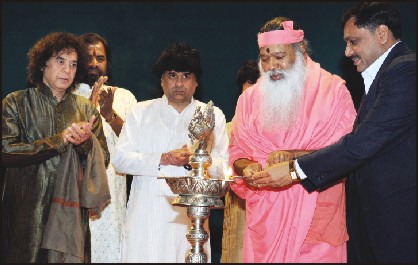
City Police Commissioner Dr. M.A. Saleem and Sri Ganapathy Sachchidananda Swamiji are seen lighting the lamp to inaugurate the music concert as Tabla Maestro Zakir Hussain and other artistes look on.
Mysore :
The audience at Nada Mantapa at the premises of Ganapathi Sachchidananda Ashram on Ooty Road here were mesmerised by the Tabla recital of Ustad Zakir Hussain last evening.
The Tabla maestro was accompanied by Ganesh and Kumaresh on Violin and Trichty Harikumar on Mridanga. The synchronisation of the awesome quartet was so perfect and rhythmic, the music lovers remained spellbound throughout the programme which featured both Hindustani and Karnatak classical music.
Sri Ganapathy Sachchidananda Swamiji graced the occasion. City Police Commissioner Dr. M.A. Saleem and others were present on the occasion.
source: http://www.starofmysore.com / Star of Mysore / Home> General News /January 31st, 2014
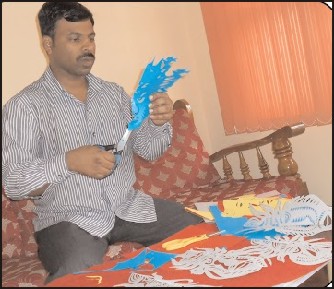
Mysore Art Gallery and Saanjhi Kala Loka have jointly organised a three-day workshop and exhibition on ‘Sanjhi Mask Art’ by artist S.F. Huseni (Mysore Huseini) at Mysore Art Gallery premises on Ramanuja road in city from tomorrow.
The programme will be inaugurated tomorrow by D. Mahadevappa, Chief Editor of ‘Prajanudi’ at 11 am.
Nirmala Matapati, Assistant Director, Dept. of Kannada and Culture and Littereteur P.M. Subramanya will be the chief guests.
A workshop and training programme on Sanjhi art will be held on Feb. 2 and those interested may register their names through Mob: 98451-53277.
The exhibition and the workshop will conclude on Feb. 3.
Artist’s Profile
S.F. Huseni (Syed Fakruddin Huseni), was born on April 15, 1976 to Syed Peer and Zeenatunnisa Bi at Shivana Samudram (Bluff) in Mandya district.
He completed his Diploma in Fine Arts, Art Master (A.M) and BFA in painting at K.P.J. Prabhu Artisan’s Training Centre (Canara Bank PRJD Trust).
Huseni, who is gifted with this art, received encouragement from his parents right from his study time. The present theme of paintings created by the artist mainly depict the theme “Home in every Heart.”
Huseni has participated in many solo exhibitions and group exhibitions besides conducting camps and is a recipient of various State Awards and scholarships. For details, log on to mysorehuseini.blogspot.com or call Mob: 98451-53277.
source: http://www.starofmysore.com / Star of Mysore / Home> General News / January 31st, 2014
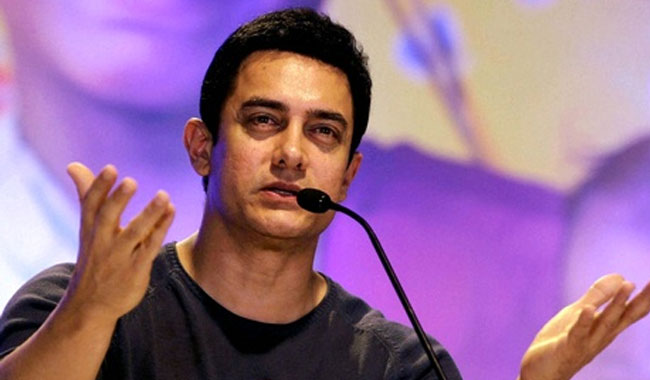
Superstar Aamir Khan has lent his support to end the violence against women in the global `One Billion Rising` campaign.
In the global campaign, supporters join together to show collective strength to support gender equality and end violence against women. India too has joined in as the instances of rape and brutality in the society today are increasing every year.
Aamir Khan, who has been an active crusader for social causes, has urged people to join hands in support for the campaign. The first episode of the popular television show `Satyameva Jayate` was focussed on female infanticide.
For `One Billion Rising`, the Padma Bhushan Awardee has made a video message to urge his fans to come and join the global movement.
In the video Aamir says, “I believe that to combat violence against women, we men, will first have to change. Raising our hand to strike a woman does not increase our masculinity. Instead, it shows cowardice. If we truly want to be real men, I feel, we will have to first learn to be sensitive. This year, in February, a billion voices will rise again to end violence against women across the world. I would like if you join in and become a part of this movement.”
Last year several celebrities came up to lend a hand to the cause such as Shubha Mudgal, Farhan Akhtar, Anushka Shankar, Shabana Azmi. The ghastly act of the gang rape of Jyoti Singh on 16th December 2012, in Delhi brought forward many supporters for the dance demonstration at Parliament Street in the national capital, New Delhi.
In 2014, Actress Gul Panag has also joined in for the cause along with several NGOs from across the country.
source: http://www.zeenews.india.com / Z News / Home> Entertainment> Society / by Aparna Mudi / Thursday – February 06th, 2014
Mohammed Azharuddin has turned 50. He lost his grandfather, the man he loved the most on November 17, 1984. Azhar debuted on December 31, 1984, scoring three centuries. In his 17- year cricketing career, he was captain for nine years. A life ban on playing cricket, divorce with his wife Naureen , second marriage and separation from Sangeeta Bijlani, losing a 19-year-old son to a road accident — he has seen it all.
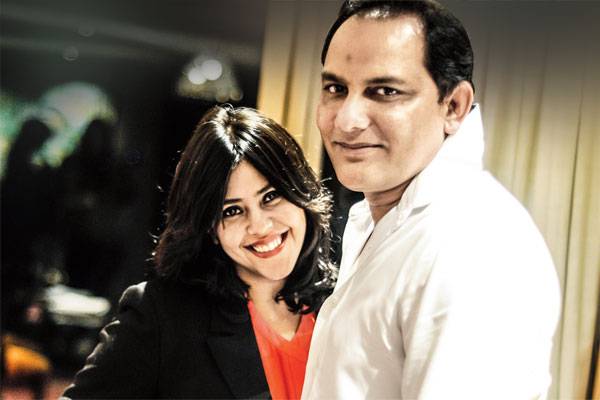
(Ekta Kapoor and Mohammed…)
In the words of Ekta Kapoor , who has now bought the rights of making a film on his life, he is a Victim and a Victor who has emerged victorious. He had led a glorious life, but one that was never picture- perfect. He is humble, emotionally strong and very stylish. Bombay Times spoke exclusively to both about their reasons for making and agreeing to this film on one of India’s greatest cricketing icons. Excerpts:
In conversation with Ekta Kapoor:There are several cricketing legends. Why a film based on Azharuddin?
My dad is an obsessive cricketing fan and for him, Azhar sir is a cricketing god. My dad has shifted his interest in the construction business and is usually not interested in any of the movies I have made. But, he is jumping for this movie. Like my mother, Azhar sir, too, is an Aquarian and number 8. She too likes him, does not cry and is strong for everybody around her. He has been the captain all his life, be it on the field or off it. Some people are victims and some are victors, but those who are victorious have their collar up like he always does.
You can make a documentary on 100 cricketers. But that is only one level of the film. I remember I was 26 when I was awarded the Ernst & Young award for being the youngest and the first woman to be given the award. But four days after, I was told that the award could not be given to me as my TRPs were fake. No one really takes you to a courtroom as in the minds of people, they want to believe that you are wrong. Eventually, it got proved that I was right when Rahul Bajaj called me and gave me the award. I have never enjoyed picking up an award more than that, sitting amongst such old men. At the same time, on the day I was being given the award, due to a personal issue that morning, my happiness was diluted. And that’s what happens in life too, where life is not picture perfect. And I am here to tell his story.
Here is a man who has been condemned but has stood up. Some people wear age on their face, some wear experience. He wears his experience. I had decided that I will just pick up the phone and tell him that we want to present your life. It’s a life with a lot of blemishes, a lot of colour. The best thing about his life is that it is not picture-perfect as one thing was always missing. For instance, he played only 99 matches, not 100. I am not a cricket fan. I am a fan of the man. People have pushed him down, but he stood up and walked and at 50, stands tall. He is an icon whose story needs to be told.
In conversation with Mohammed Azharuddin:You are 50. Are you excited about a film being made on your life?
I am happy. I was very reluctant and took one year to agree. I realised that people want to know my story. I have gone through a lot of ups and downs and a lot of hardwork. The biggest thing I possess is infinite patience. Once you are patient, things fall in place. During that period of time, I could have said so many things that would have backfired on me. But I didn’t, only due to my patience. At the end of the day, it took a long time but you can’t fight destiny. Whatever is destined to happen will happen. I am excited to see how the film will be made. There are many struggles that I have forgotten, but the film will probably remind me of those. I am a positive person and the story is finally a positive one.
Where do you get your patience from?
My religion. Allah is with people who show patience. If you are down in the dumps, Allah will help you if you have belief. But this is a personal thing between you and him. You can’t fool Allah. I remember after I scored my three 100s in my first match, this photographer saw me praying and wanted to take pictures. I was reluctant, but allowed him to. He came the next day and wanted to take them again as he said that despite him taking so many pictures, his reel was blank.
Why do you always have your collar standing?
I used to always field at silly point or point, where the rays of the sun were always very strong and my neck would burn. So, I started wearing a handkerchief, but it was uncomfortable. I later moved to collar that has now become my style. People like me this way.
What do you consider your strengths?
My strength is my humility. When you are humble, people like you. I feel happy when people tell me, ‘Sir, you should play now also.’ I know I can’t physically. I keep myself fit. Somebody today tells me, ‘Why don’t you go and play in New Zealand?’ They know I can’t play, but it’s their feeling that makes them say that. I have always been strong and never show my emotions. I will be the last person to come and say, ‘Well done.’ Number 8 is an up-and-down number, When you are up, nobody can touch you, but when you are down, everybody pulls you down. Emotionally, I depend only on myself. My strong belief in the Almighty carries me.
What do you think are the qualities the actor who will play you should possess?
He needs to be stylish. People tell me that my game was very stylish. I learnt to be stylish over time. Allah gave me the talent. I showed it on the field. Saif Ali Khan, due to his cricketing background and style, would be my first choice, but Ekta is the boss and will decide.
Do you watch Hindi movies?
My favourite movie is Abhimaan as my favourite actor Mr Amitabh Bachchan was in it. The only time my mum lifted her hand at me was when she caught me listening to Sholay dialogues by the roadside. That is the only time she beat me. Long back, I told Mr Bachchan that, ‘Sir, because of you I got beaten.’ Nobody can touch Mr Bachchan in style.
You never showed your emotion on the field. Have you ever broken down in life?
I broke down only when I lost my grandfather Mir Vajehuddin (nana). I was 21 then and it was November 17, 1984. I debuted a month later on December 31 and made three 100s. Till his last day when he died of a heart attack, I would sleep in between my nana and nani. He was a very pious man, who was a descendent of Prophet Mohammed’s family, so he belonged to his lineage. I can always feel him next to me. At times, I was not even allowed to watch films when I was growing up as he would say, ‘No, this is not your line.’ I would get frustrated. I would tell him, ‘You let everybody go, but don’t let me go.’ And he would say, ‘You will remember me one day.’ Can you imagine that the autograph I sign was taught to me by him. He signed for me and would make me practise it 50-60 times a day. He was a brilliant mathematician, who could count in Arabic and Persian and give the answer in English. He taught me a lot of things. He said, ‘Stay humble as that is the best thing you can possess in life. The day you think you are somebody, you will come down.’ You couldn’t talk to him looking into his eyes, as he had very powerful eyes. He would never look into a camera as he would say that the camera would break if he did so.
He never told me but he told my mother, ‘Don’t tell him but he will become a big cricketer’ My parents too were very supportive of me playing. My father had only one wish that I should score a 100 at the Lords cricket ground, which made him very happy when I did. I would get up at 4.30 in the morning and before going to practice, I would give my grandmother tea. At that time, she would give me her blessings, which were very powerful. I am the eldest son (five younger siblings) and it is my job to play captain even at home. I never show my emotions. When my son passed away, so many times I felt like crying, but then there are so many people behind me, like my parents. If I break down. they will break down and I need to carry them with me. My mother even today keeps telling me, ‘Allah should have taken me.’ It was very tough for them as within a week, they had lost two grandchildren.
Talk about your relationship with Kapil Dev?
Kapil paji is a very nice man. He understands people. He could take anything from my kit bag and so could I. We did not need to ask each other. Usually people don’t give even their broken bats to you. You have to a have a big heart to give. If you give, you get. If you don’t give, you don’t get. I had that rapport with him. I played under him and he played under me. As a captain, I didn’t need to tell him anything as he knew everything exactly what he had to do. I would just give him the ball. I knew he knew his job and if he goes on to the field, he will do his job. I learnt from him. If he is convinced, he will support you. Mr Kamal Morarka and Mr Raj Singh Dungarpur also helped me. I didn’t meet Mr Morarka many times, but at that time he really supported me. He is a nice person who is not scared of anybody. That’s what is most important. He will express what he feels. I never forget people who help me.
source: http://www.timesofindia.indiatimes.com / The Times of India / Home> Entertainment> Hindi> Bollywood / by Priya Gupta, TNN / January 31st, 2014
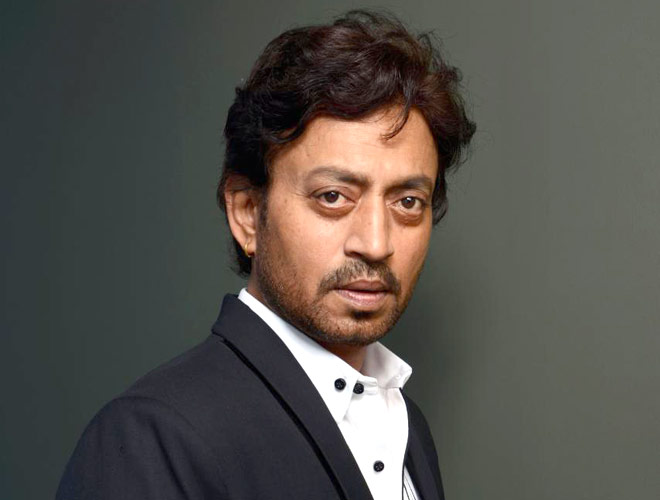
Acclaimed Indian actor Irrfan Khan won the best actor award for his brilliant performance in ‘The Lunchbox’ at the 10th edition of Dubai International Film Festival (DIFF).
Irrfan won the award Friday in the Muhr AsiaAfrica Feature category, while films writer-director Ritesh Batra got a special mention for screenplay for the film about a lunch box, which becomes a symbol of hope, in the same category. World renowned Indian filmmaker Shekhar Kapur headed the jury.
Sandeep Ray won the best director award for his Bengali language film ‘Shirno Bahu’ (Thin Arms), which revolves around an octogenarian woman who undergoes treatment for a debilitating medical condition, in the Muhr Asia Africa shorts category.
DIFF chairman Abdulhamid Juma said that the sense of community this year was palpable.
“After 10 years, we are seeing recurrent visitors, both film professionals and cinema lovers, from the region and beyond. This year we celebrated the gains that have been made in Arab cinema in the past decade, the result of years of work from our team to discover, nurture and promote talent from the Arab world,” he added.
“There is a feeling that Arab cinema has ‘arrived,’ with increasing numbers of Arab films on the world stage, winning awards at the most prestigious festivals, and gaining currency even with audiences who have never visited the region.”
source: http://www.indiatoday.intoday.in / indiatoday.in / Home> Movies> Bollywood / by IANS / December 16th, 2013