Category Archives: Arts, Culture & Entertainment

Sharon Stone’s Taj memories set in stone

This wasn’t the typical Sharon Stone you see posing in glamorous gowns on red carpets across the world. The star decided to ditch the gowns for a much more casual black smock with her hair tied up in a ponytail, and traded the fashion poses for the more awkward touristy ones, as she went about dropping to her haunches and leaning alarmingly far back to capture her friends, with the Taj Mahal in the background, at the best angle possible.

(Sharon Stone strikes the…)

Stone took her sweet time on this visit. Not only was her camera trained on every stone carving, she’d also stop to point the lens at cows, cute Indian babies or other locals. When two Indian women pointed their camera at her, the actress was so fascinated with their sindoor that she started clicking them back. It took them 10 seconds to change their expression from bewilderment to a smile.

This was also not a typical Hollywood celebrity visit to an Indian monument. Missing, for starters, was the sea of paparazzi we’d witnessed when Tom Cruise was here in 2011. There wasn’t even one bodyguard in sight. Instead, Stone chose to sightsee with six of her closest friends, including family friend Tikka Shatrujit Singh.

“I have known her for eight years, she’s a crusader,” Singh said. When asked if he catches up with the star regularly, Singh replied, “It’s because she’s here in India for the first time that I got to spend so much time with her. Wahan pe kahan time milta hai? Bade Hollywood star hain.”

The Taj Mahal didn’t fail to impress the Basic Instinct actress, who was teary-eyed when the guide told her the story behind the monument, and she broke down at Shah Jahan and Mumtaz Mahal’s graves. Stone continued to whisper ‘beautiful’ and ‘magical’, until it was time to leave.
When asked about her lasting impressions of India, Stone chose to be bitingly frank rather than politically correct. Calling India a poem that was both beautiful and sorrowful, she said, “I think that there are things that are required to gracefully bridge the gap between the eccentricity of wealth and the slumber of the poverty. For example, the millions of people that are defecating in the streets, I think it’s not only of service to those people to create a sanitary system, but also for the wealthy people. It’s not logical or intelligent to breathe that in the air. And so, for modern sense of grace, and a higher elevated sense of that same poetry, it seems logical to produce the sanitization system.”

She also spoke about CBI Chief Ranjit Sinha’s recent “rape is inevitable” remark. “When we see public officials making statements that, you know, ‘rape is inevitable’, ‘when it happens to you, enjoy it’ – it lacks the logic that rape is not a gender issue and that lacks compassion, and should be regarded in that way. So, I think it’s a sense of creating maybe one step further in the use of modern communication to achieve that goal,” she said.

“For example, if six out of 10 people aren’t registered to vote, it’s illogical that we don’t use the six billion cellphones or the cellphones that the six billion people on the planet have to register people to vote. Because, if you have everyone voting, then you have a more logical sense of fluidity among the people. And a more modern sense of the inevitable. Because the world, with communication as it exists, is taking an inevitable step towards understanding what’s happening on a global sense,” she elaborated.

source: http://www.articles.timesofindia.indiatimes.com / The Times of India / Home> Entertainment> Hollywood> Taj Mahal / by Kritika Kapoor, TNN / November 22nd, 2013
WRITE ANGLE : Who is Dara Shukoh?

Gopal Gandhi’s Dara Shukoh: A Play raises the relevance of Dara Shikoh in contemporary India.

Few men who read history in school remember Dara Shikoh, the philosopher-prince of Mughal India. He is but a fleeting figure even if an enlightened one. The spotlight is well and truly on Aurangzeb, terse, taciturn, untamed. In a world looking for convenient, even if inaccurate, summations, Dara is reduced by our historians to being a favourite son of Shah Jahan, and Aurangzeb, a fratricidal ruler who did not hesitate to put to the sword his own. That almost all kings in the years of yore did the same matters little. That Dara had a life before the fatal battle of Samugarh with Aurangzeb, that he had a life quite removed from that of any of his brothers is never pointed out. For most, Aurangzeb is a convenient villain, Dara the easy but fallible hero.

However, today as our nation faces the prospect of being ruled by revisionist politicians — ironically, they seem to be getting mixed up with their history lessons too — it is important to take some time out, and realise what we lost when Dara lost, and what we can gain if we imbibe his spirit. With such a thought, I picked up Gopal Gandhi’s Dara Shukoh: A Play. It was released some time ago and I had all but left it on the shelf with the likes of Dilip Hiro’s Baburnamah for company.

However, the events unfolding in the run-up to the general elections made me go back to it. Dara is relevant, even necessary today. The book instantly set in motion a series of conjectures: what if the heterodox Dara and not the more orthodox Aurangzeb had won the battle of brothers? If mid-17th Century India had thrown up a different victor, would the nation have been partitioned? Didn’t medieval India throw up a man who was wedded to pluralism of thought and faith much before the founding fathers of our Constitution made it a benchmark for future generations? And would Hindus and Muslims have lived here, as Sir Syed Ahmed Khan said, like the two eyes of the nation? Imagine if a Sufi had outlasted a warrior! Imagine.

The questions shall never be answered. But revisit Dara we must. Understand what he stood for, preach many of his things, and we might just end up with a nation that takes pride in its pluralist culture, a society where Hindus read both the Vedas and the Quran, the Muslims appreciate that the concept of one universal God precedes their arrival here; appreciation rather than mere tolerance of each other’s culture being the hallmark. Follow this, and the need to combat the challenge thrown up by communal elements disappears. Who can argue with a man who drinks from the common nectar of Sufis and bhakti saints?

And Gopal Gandhi, with an enviable and apt lineage for such a project, goes about demolishing many prejudices, exposing many lies. He chooses to spell him Shukoh, explaining beautifully that ‘Shikoh’ in Persian means ‘terror’ while ‘Shukoh’ stands for ‘glory’. Gandhi’s Dara is not a tragic figure; rather he is a man whose time is now. Gandhi chooses not to dwell much on a failed general — a poet is doomed to be a failure on a battlefield anyway. He stays focussed on the undercurrents of the thoughts of the man who translated the Upanishads into Persian — ideas that did not endear him to the radical elements on both sides of the religious divide. A play may not necessarily be an ideal substitute for a history textbook, but hey, did not Rajkumar Hirani’s Lage Raho Munnabhai do more for introducing Mahatma Gandhi to the bubblegum brigade than any academic book or lecture?

The best help often comes from the source least expected. A play, a film, a book, a philosopher may yet show us the way. After all, amidst all the political mudslinging and a society being rapidly polarised, we could do worse than heed Dara’s words. Remember what he said when his followers screamed, “Shuja — his brother and fellow claimant to the throne — murdabad”? Dara replied, “Let us not wish death to any one/That is base;/All of us have God’s breath in us,/In any case./We live and have our being/ With his grace.”

In this age, Dara deserves attention.

source: http://www.thehindu.com / The Hindu / Home> Books> Columns / by Ziya Us Salam / Chennai – November 22nd, 2013

Sepia notes: Harbinger of change

DilipKumarMPos23nov2013

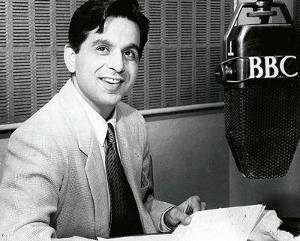
Dilip Kumar takes part at a special broadcast of BBC Indian Service during his visit to London in April 1953.

Born to a dry fruit merchant in December 11,1922, Yusuf Khan started his career as a manager at Bombay Army Canteen. But fate had other plans for him. A chance encounter with Devika Rani of Bombay Talkies landed this shy and debonair young man in Tinsel Town.

Of this Ashok Raj in his book Hero wrote: The Silent Era to Dilip Kumar says: “Devika Rani had gone out for shopping to a local market. At one fruit shop, she looked keenly at the young man engrossed at selling his merchandise. It was by mere chance that the shy shopkeeper had only replaced his father that day. Devika Rani found this young man with a sensitive face and expressive eyes quite unusual. She gave him her visiting card and asked him to meet her at the studio.”

Bombay Talkies not only changed his destiny but also his name — Yusuf Khan became Dilip Kumar and made his debut in Tinsel Town with Jwar Bhata (1944).

It has been 70 long years since Yusuf was ‘spotted’ and today he is considered as the ‘first modern Indian actor’ who freed himself from the theatrical mannerisms and developed a more natural and distinctive style, which stressed on silent pauses and hand gestures and films like Andaz, Jogan, Daag, Baabul, Aan, Daag, Foot Path, Madhumati, Devdas, Naya Daur and Ganga Jumna stand testimony to his versatility.

source: http://www.mumbaimirror.com / Mumbai Mirror / Home> Entertainment> Bollywood / by Mumbai Mirror / October 19th, 2013

Bidar only South Indian monument to figure in latest World Monuments Fund list

According to the World Monuments Fund, the sites in the list are crying for immediate attention for preservation, protection, and adaptive reuse. / The Hindu

House of Sheikh Salim Chisti in Fatehpur Sikri and Juna Mahal in Rajasthan are also on the list

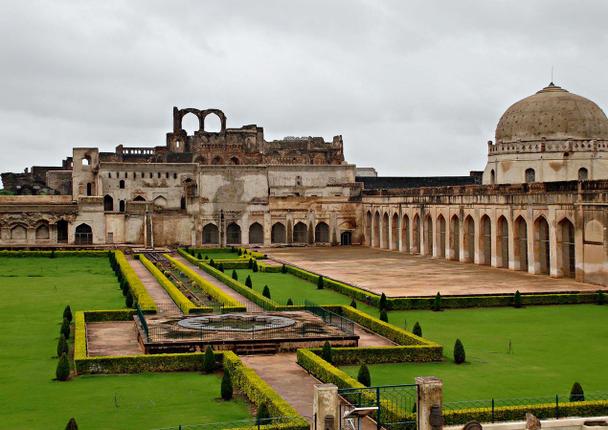
The historic city of Bidar figures in the 2014 World Monuments Watch list released by the World Monuments Fund (WMF), a New York-based NGO working for the protection of monuments.

WMF president Bonnie Burnham announced the list in New York on October 8, according to P.C. Jaffer, Deputy Commissioner of Bidar. The WMF had received 741 proposals from 166 countries. But the final list contains 67 sites from 41 countries.

The three sites in India to figure in the list are the house of Sheikh Salim Chisti in Fatehpur Sikri, Juna Mahal in Rajasthan and “the historic city of Bidar”. These, according to the list, are sites are in need of immediate attention for preservation, protection, and adaptive reuse.

Benefits

Mr. Jaffer said the announcement would benefit the city in many ways. It would attract worldwide attention, leading to increased tourist footfalls. It would also help the government get technical advice and support from institutions specialised in the preservation of monuments.

“It could also help us raise funds from the government or donor agencies for protection and preservation of monuments,” Dr. Jaffer said.

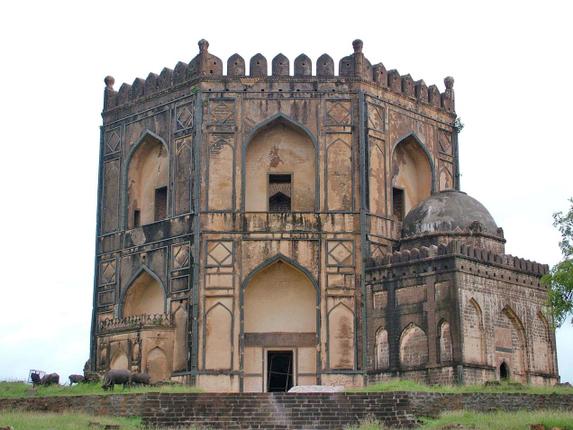
Bidar has three national monuments - Bidar Fort, Ashtur tombs and the Madrasa of Mahmud Gawan. / The Hindu
Bidar has three national monuments – Bidar Fort, Ashtur tombs and the Madrasa of Mahmud Gawan. / The Hindu

Bidar has three national monuments – Bidar Fort, Ashtur tombs and the Madrasa of Mahmud Gawan. The city also has 20 sites recognised by the State Department of Archaeology and Heritage and over 40 unrecognised sites of the medieval periods.

Facebook page

“We will upload the WMF recommendations on the district website. We will also open a Facebook page on Bidar on the WMF watch list and raise awareness about the issue,” the Deputy Commissioner said.

Two interpretations centres would be set up in the Bidar Fort and at Ashtur at a total cost of Rs. 80 lakh. This would provide information to tourists on the architectural and cultural aspects of monuments. In this background, an international seminar on Bidar’s heritage would be organised in January.

According to a release issued by Ms. Burnham, a copy of which was sent to the district administration, the list contains sites that are facing several preservation challenges like climate change, armed violence, neglect by authorities, lack of resources or even increased tourism activity that can damage monuments. An independent panel of international experts on archaeology, culture and preservation had prepared the list, Ms. Burnham said.

Over 150 sites have been preserved and protected by the WMF and its associate organisations in several countries since 1996. Famous sites restored by the WMF personnel include Venice in Italy, Gokarna Mahadev temple in Nepal, and the Citadelle Laferrière in northern Haiti.

The WMF also takes up restoration works on sites referred by Unesco.

source: http://www.thehindu.com / The Hindu / Home> News> National> Karnataka / by Rishikesh Bahadur Desai / Bidar – October 10th, 2013

Daud Khan Sadozai

Photo: Kavi Bhansali

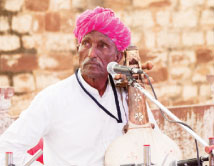
His kamaycha follows wherever he goes. Hakim Khan, 75, who performed at the Jodhpur RIFF along with folk artists singer Kamla Devi and Algoza player Dode Khan Fakir is as particular about his music as he is about the instruments used in it, specially the kamaycha that is losing its popularity by the day.

A senior-most player from the Manganiyar community, he sings and plays the instrument simultaneously with perfect precision.

He has been practising music since he was 12, under the tutelage of late Shri Jusba Khan Manganiyar of Dangri village, Jaisalmer. “I spent more than a year with him, learning the nuances. He was a hard task master and there was no place for any errors.” he laughs.

source: http://www.newindianexpress.com / The New Indian Express / Home> Magazine / by Ayesha Singh / November 03rd, 2013

Dr. S.K. Kareem Khan, the Folklore Sage of Karnataka

DrKareemKhanMPos22nov2013

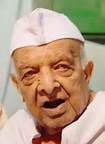
It is a good fortune that Karnataka’s soil has been treaded by personalities known for their universal outlook and integrity. A melting pot for various languages, religion and culture, Karnataka had a number of persons belonging to Muslim community whose contribution to Karnataka’s secular traditions is immense. Historically we had Ibrahim Adilshah, the ruler of Bijapur whose work in Urdu, Kitab-e-Nauraspopularised Hindu music among the Muslims. Karnataka was the abode of Sufi saints like Baba Budan and Khwaja Bande Nawaz whose way of life and moral sermons inspired both Hindus and Muslims and paved way for Hindu-Muslim amity. In the 20thcentury there was another similar figure who was not only a symbol of Hindu-Muslim unity but also a freedom fighter, folklorist, singer, lyricist and a dramatist. He was the late Dr.S.K.Kareem Khan. Born in 1908 at Sakleshpur in Hassan district of Karnataka to an Afghan soldier, Abdur Rahman Khan, and his wife Jainabi, S.K.Kareem Khan studied classical Sanskrit and Kannada literature under Achangi Narayana Shastri of Sakleshpur and despite his informal education, mastered Sanskrit and Kannada.

As a Folk Singer: It was during his teens that Kareem Khan was attracted towards folk songs. His house at Sakaleshpur was a halting place for touring merchants selling brass and copper wares. After dinner they used to hum folk songs which young Kareem used to listen with rapt attention. Inspired by the call given by Mahatma Gandhi he Kareem Khan joined the freedom struggle and this took him to various places. This occasion gave him an opportunity to hear and chronicle folk songs which he came across and later he himself used folk as a medium to spread the message of the freedom. Later collecting and singing of folk songs became his life’s passion. He used to visit villages and standing under a platform or tree frequented by people used to sing folk songs. Mesmerised by his melodious voice people used to gather around him. At the end he used to urge the people to join the Congress party then involved in the country’s freedom struggle. He was jailed several times for his participation in the freedom movement. There his fellow jail inmates used to pester him to sing folk songs for them. Such was the sweet voice possessed by Kareem Khan.
Multi-faceted Personality: Kareem Khan’s was a multi-faceted personality. He penned screen play and song lyrics for Kannada films, wrote dramas, translated works from Sanskrit and Urdu to Kannada, was a researcher, essayist and a pioneer scholar in folklore studies. This apart he was fully involved in the country’s freedom struggle and Karnataka’s unification movement. During 1930s worked as an editor and sub editor of two publications Loka Mitra of Dharwad and Antharanga of Udupi. .  In the early 1960s he launched `Janapada Prakashana’, an exclusive publication dedicated to folk literature, art and music; copies of which he sold at 50 paise each. Secularist to the core he led a simple life, true to the Gandhian principles which he cherished. Though he avoided power and publicity, such was his achievements that honours came in abundance. He was conferred the Janapadashri and Karnataka Rajyothsava awards by the government of Karnataka, Nadoja award by Hampi University, honorary doctorate from Gulbarga University and numerous other honours from various institutions and organisations. Given epithets like Janapada Jangama and Janapada Bheeshma, he was the President of Karnataka Janapada and Yakshagana Academy from 1987 to 1990. He passed away in Bangalore on 29th July 2006.
Modern Shishunala Sharif: It would be surprising to know that there is a lot similarity in the life and works of Santa Shishunala Sharif and Kareem Khan. Both were known for their simplicity and integrity. Both were secular in their outlook and had good knowledge of Hindu epics, traditions and culture. While Shishunala had Govindabhatta as his guru, Kareem Khan had Narayanashastry as his guru. While Shishunala was a mystic poet, Kareem Khan was a social activist cum folklorist. The composition of both these stalwarts will be evergreen in the minds of the Kannadigas.
source: http://www.karnatakahistory.blogspot.in / Home> Dr. S.K.Karim Khan / by S. Srinivas / May 22nd

It’s Atalji versus Dr Khan on 100-ft road

The secular vs saffron tussle over naming the 100-ft road in Indiranagar after noted folklorist and freedom fighter Dr S K Karim Khan has gained new life, with his family knocking on the doors of the BBMP to implement a 2006 resolution on the issue.

In 2010, the BJP, which is the ruling party in the BBMP, created a ruckus and demanded that the same road be named after former Prime Minister Atal Behari Vajpayee. Result: BBMP officials and representatives are “inconclusive” over implementing the resolution.

The family points out that Khan’s contribution to Kannada folklore and culture has been immense, resulting in several awards. He single handedly collected thousands of oral epics and ballads and recorded them.

Though a follower of Islam, Khan had profound respect and deep understanding of local mythology and was best remembered for his devotional songs in Kannada which even won state and several other awards. He lived the life of an ascetic as he spent considerable years of his life in a hotel room in Basavanagudi.

Khan’s grand nephew Tanveer Ahmed told Bangalore Mirror, “It has been six years since his death. Yet, posthumous recognition for the literatteur has remained elusive. This is not the way to treat a person who devoted all his life for the language and culture. Not the just folklore, but he was the first to chronicle the history of Bangalore’s founder Kempe Gowda and wrote three books on the life of Kempe Gowda. His song Natawara Gangadhara… won state award. He was presented with the Nadoja award along with Jnanpeeth Awardee Dr Shivarama Karanth. But still nobody knows about his contribution in Bangalore. Should it take six years to name a street after him?”

‘No Personal Interest ‘ 
Ahmed pointed out that the family members neither have any personal interest nor benefit from the move. “We only hope that a kind gesture by BBMP would help future generations remember a man who did great work for Kannada and culture of the land.”

The state government, which promised several things upon his death, is also yet to deliver on its promises. “During the final rites of Khan, then home minister M P Prakash announced a trust in Khan’s name. Further, the then CM H D Kumaraswamy responded positively. This also has not happened,” Ahmed said.

Khan was born to parents with Afghan-Arab lineage. Despite being a high school dropout, Khan mastered Kannada and Sanskrit and developed indepth knowledge about Hindu mythology and Sanskrit texts. “In fact his works on Kempe Gowda served as major evidence for the union government to rename the BIAL as Kempe Gowda International Airport,” he added.

The family wants the Kannada Development Authority to profile Khan’s life and works and bring it out in the form of a compendium accessible to all. They also suggest a state award to foster communal harmony in Khan’s name.

source: http://www.bangaloremirror.com / Bangalore Mirror / Home> Bangalore> Civic / by Niranjan Kaggere, Bangalore Mirror Bureau / November 22nd, 2013

Kashmir Ki Kali: Srinagar’s famed Shalimar Bagh has been restored to what it was in Jehangir’s time — Farah Baksh

Srinagar’s famed Shalimar Bagh has been restored to what it was in Jehangir’s time — Farah Baksh, or ‘the delightful’. Now for the 15 others, writes Gargi Gupta

KashmirMPos21Nov2013

In a television interview, conductor Zubin Mehta proclaimed that despite the controversy about the concert, Kashmir now had a beautifully restored garden, fountains, flowers et al.  Many agree.

“Zubin Mehta’s concert was the best thing to happen to Shalimar Bagh,” laughs Sheikh Irfan Qadir, assistant executive engineer in the Roads & Building department of the Jammu & Kashmir government. Qadir should know — he’s been working at Shalimar Bagh since early this year, deputed by the state government in its race-against-time to restore the 17th century gardens laid out by Mughal Emperor Jahangir, in time for Mehta’s concert with the Bavarian State Orchestra held on September 7.

German ambassador in India Michael Steiner and Chief Minister of Jammu and Kashmir Omar Abdullah took close interest in the repair works, visiting the site several times in the months leading up to the concert. After all, this was a high-profile event, hosted by the German Embassy in India, attended by dignitaries and broadcast on high-definition to millions of viewers across the globe.

“When the German ambassador first came here,” says Qadir, “Shalimar Bagh was in such a bad state that he looked around and despaired at having the concert here.” Describing the state of ruin, an October 2012 report in British newspaper Daily Mail bemoaned that the ‘fountains have long stopped working and the walls are peeling at every corner’. Photographs accompanying the article, showed the water channels silted up and covered in vegetation.

Strangely, Shalimar Gardens, or any of the other 15 Mughal Gardens in Kashmir, is not protected by the Archaeological Survey of India, or its Kashmir circle. It is the floriculture department of the state government that looks after these gardens, which attracts lakhs of tourists every year.

“The last ‘sensible’ conservation effort took place in 1941,” informs M Saleem Beg, convenor of the Jammu & Kashmir chapter of Indian National Trust For Art and Cultural Heritage (INTACH), which has overseen the current restoration exercise. The committee prepared a detailed conservation plan for Shalimar Bagh in 2005. That, says Beg, came about by sheer accident. “In 2004, Jagmohan, then tourism minister, allocated Rs1 crore for reconstructing the Mughal wall in Nishat Garden. Appalled, I met him to point out how inappropriate ‘rebuilding’ a historic wall was.

He told me to come up with a conservation plan for the gardens and asked me to name the budget. I had rattled off a figure of Rs5 lakh. We ended up spending Rs9 lakh.”

Much of the work at Shalimar, says Beg, entailed undoing earlier unscientific, ill-considered conservation efforts. For instance, the water channels were covered in concrete. “We removed thousands of kilos of cement,” says Qadri. The channels, measuring 1,000 ft x26 ft, were relaid with crushed stones, then covered with lime concrete. “We had to source lime concrete, which is what the Mughals used, from Amritsar. The material takes much longer to dry than cement, but we were determined to do it the right way,” he says. “The stage for the musicians was laid out over these channels, but they did it very carefully, placing it over small metal stools so as not to leave a single mark on the grass,” says Qadir.

The stones that lined the rim along the water channels, the foot-bridges across them, niches along the walls and terraces had become loose or were displaced over time; these were carefully taken out, cleaned and refixed. The pavements too were re-laid with local devri stone. The Pink and Black Pavilions were restored with new shingle roofs and their walls covered with a 20mm coat of lime plaster. “We have not yet touched the ceilings,” says Qadir, pointing to the richly-painted panels, which are a more recent addition, probably the time of Kashmir’s Dogra rulers.

Nearly Rs3.5 crore was spent on Shalimar Bagh’s restoration. The fountains are working; the channels are clear; a Mughal-era hammam (public bath house) on the premises has been opened to public and there are better public conveniences. Of course, the problems too are visible, the most being the buildings outside that have been built too close to the Mughal-era boundary wall.

Perhaps, the only long-term hope for Kashmir’s Mughal Gardens is in securing a World Heritage Site status. Six of the better-known gardens did make it to the tentative list in December 2010. But despite several representations to the culture ministry, the elaborate dossier that is required for their final application, has not yet been prepared.

source: http://www.dnaindia.com / DNA / Home> Lifestyle> Report / by Gargi Gupta / Agency:DNA / Sunday – October 20th, 2013

A woman’s romance with well of death

Baby Khan.
Baby Khan.

Alappuzha:

She is a woman who dares death by doing  motorcycle stunt-riding in motordromes (well of death). Baby Khan, 40, from Chadayamangalam of Kollam district,  is also a housewife who takes care of a big family.

On the sidelines of a carnival being held at Oachira Parabrahma temple, Baby Khan, mother of three,  told DC:  “I perform the stunts that a  man does in a motordrome.”  Her  romance with bike stunt began during childhood when her poor parents took her to watch a motordrome show in Chadayamangalam. “The sound of the bikes  without the silencer  attracted me. When my family moved to Tirunelveli, they let me learn  bike riding,” she says.

Rajiv, a bike stunt rider,  taught her the first lessons of riding a bike and doing stunts. Subsequently, she  joined an amusement troupe in Tamil Nadu. She is now part of the troupe called Golden Amusement owned by Babu Khan, her husband.

There are seven bike stunt riders in the group. “Even though we have been in the field for decades, an insurance coverage or pension is still a distant dream. Two years ago, I met with an accident  in the carnival held as part of Oachira temple festival. I was rushed to the hospital and was forced to take two days’ rest,”  she says. “We are constantly on the move  and I have travelled the whole of India several times,” she adds.

She performs the stunts from 4 p.m. till 10 p.m.   “I am proud of being a bike stunt rider and I have a lot of fans as well, mostly children. They often look at me with wonder.  I intend to do stunts as long as I can as there is a thrill in being one of the few women in the field,” she says.

source: http://www.deccanchronicle.com / Deccan Chronicle / Home> News> Current Affairs / DC / by T. Sudheesh / November 20th, 2013

I am… Basheer; Gold, silver polisher

Basheer / The Hindu
Basheer / The Hindu

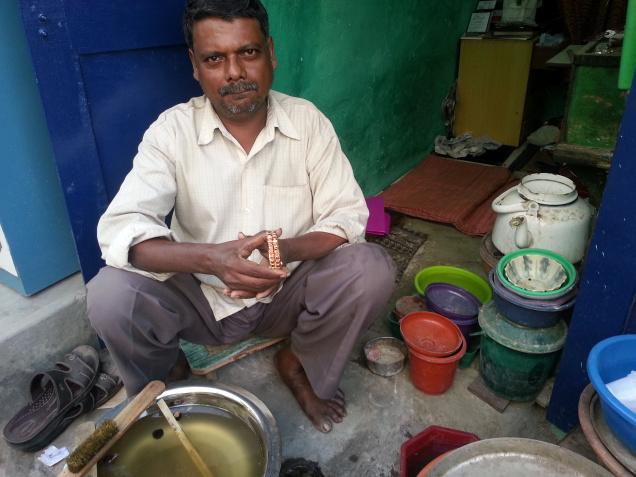
It’s only four in the evening, but Basheer has already decided to go home — he has no work that day. “The festive season just got over, hasn’t it? People will come to polish bangles and chains only after a few days,” he says, softly. Seated in front of a steel basin, with four boondhi kottais (soap berries) and four small brushes floating in the water, Basheer talks of the gold polishing business that he has been a part of for the last 30 years.

A Class 8 dropout, Basheer was initially a two-wheeler mechanic, before he trained for five years and became a skilled silver and gold polisher. After working out of several locations in Mylapore, Basheer now runs the ‘K. Noor Mohamed Gilt Shop’. “Earlier, I had my own shop. This one,” he says, pointing to the small, rectangular shop, with its blue shutters and green walls, “belongs to my cousin. He asked me to run it.” I strain to hear his voice, which gets drowned in the street noises of Mathala Narayanan Street; it’s only an old, narrow thoroughfare, but vehicle sounds and arguing neighbours make us raise our voices.

Our loud voices attract attention. One gentleman enquires why I’m asking Basheer “all these questions”; another offers to answer on his behalf and says, “He lives in Kunrathur.” Basheer explains that he moved to the ECR approximately 30 years ago. “Land was cheaper there, but now, it sells for crores!” Every morning, for the last three decades, Basheer has been taking two buses to reach Mylapore. “It’s faster to get here now, even though there’s heavy traffic after Tiruvanmiyur. In those days, there were hardly any buses, you see!” he smiles. The return journey is equally long, and he typically gets home for a late dinner around 10 p.m.

The day is spent in polishing silver and gold. Job orders range from small items — bangles and chains — to the temple kavacham or crown polishing. “Approximately 15 years ago, I polished silver items for the Kapaleeswara temple. Many of my customers are from Chennai, but some come from faraway places too.” Basheer, very modestly, says he’s an expert at polishing temple (dance) jewellery. “Dance jewellery is made in Nagercoil, and it’s difficult to clean and polish, as it has a lot of stones,” he says, showing me a pair of red-stone bangles that he has freshly gilded for a customer. It’s hard to tell it’s only ‘covering’.

To gold polish jewellery, Basheer first cleans it well. “I use soap berries bought from the naatu marundhu kadai; they foam naturally,” he says, pointing to the soapy water in the basin. Next, Basheer readies the ‘gold bath’, by dissolving a tiny amount of gold in acid, and boiling the resulting fine dust in water. This is then used to coat the article, by electrolysis. “After plating, the chain or bangle is dried on a bed of sawdust. It will then shine like gold.” (Silver plating is somewhat similar, except, it is buffed in the end).

Gold polishing costs around Rs. 250, a price that does not make it really profitable. “Gold prices have increased, but customers are not willing to pay more,” Basheer says. But he also rationalises their reluctance — gilt jewellery itself sometimes only costs Rs. 250, and the gold finish lasts for just a few months. And yet, Basheer seems happy with his lot; he talks of his three children — all graduates — and his visits to Nagore, with his family, once every two years. And when an old woman comes to his shop seeking alms, he springs up from his low stool, and fetches her a few coins…

(A weekly column on men and women who make Chennai what it is)

source: http://www.thehindu.com / The Hindu / Home> Features> MetroPlus> Society / November 11th, 2013