Category Archives: Arts, Culture & Entertainment

It’s Atalji versus Dr Khan on 100-ft road

The secular vs saffron tussle over naming the 100-ft road in Indiranagar after noted folklorist and freedom fighter Dr S K Karim Khan has gained new life, with his family knocking on the doors of the BBMP to implement a 2006 resolution on the issue.

In 2010, the BJP, which is the ruling party in the BBMP, created a ruckus and demanded that the same road be named after former Prime Minister Atal Behari Vajpayee. Result: BBMP officials and representatives are “inconclusive” over implementing the resolution.

The family points out that Khan’s contribution to Kannada folklore and culture has been immense, resulting in several awards. He single handedly collected thousands of oral epics and ballads and recorded them.

Though a follower of Islam, Khan had profound respect and deep understanding of local mythology and was best remembered for his devotional songs in Kannada which even won state and several other awards. He lived the life of an ascetic as he spent considerable years of his life in a hotel room in Basavanagudi.

Khan’s grand nephew Tanveer Ahmed told Bangalore Mirror, “It has been six years since his death. Yet, posthumous recognition for the literatteur has remained elusive. This is not the way to treat a person who devoted all his life for the language and culture. Not the just folklore, but he was the first to chronicle the history of Bangalore’s founder Kempe Gowda and wrote three books on the life of Kempe Gowda. His song Natawara Gangadhara… won state award. He was presented with the Nadoja award along with Jnanpeeth Awardee Dr Shivarama Karanth. But still nobody knows about his contribution in Bangalore. Should it take six years to name a street after him?”

‘No Personal Interest ‘ 
Ahmed pointed out that the family members neither have any personal interest nor benefit from the move. “We only hope that a kind gesture by BBMP would help future generations remember a man who did great work for Kannada and culture of the land.”

The state government, which promised several things upon his death, is also yet to deliver on its promises. “During the final rites of Khan, then home minister M P Prakash announced a trust in Khan’s name. Further, the then CM H D Kumaraswamy responded positively. This also has not happened,” Ahmed said.

Khan was born to parents with Afghan-Arab lineage. Despite being a high school dropout, Khan mastered Kannada and Sanskrit and developed indepth knowledge about Hindu mythology and Sanskrit texts. “In fact his works on Kempe Gowda served as major evidence for the union government to rename the BIAL as Kempe Gowda International Airport,” he added.

The family wants the Kannada Development Authority to profile Khan’s life and works and bring it out in the form of a compendium accessible to all. They also suggest a state award to foster communal harmony in Khan’s name.

source: http://www.bangaloremirror.com / Bangalore Mirror / Home> Bangalore> Civic / by Niranjan Kaggere, Bangalore Mirror Bureau / November 22nd, 2013

Kashmir Ki Kali: Srinagar’s famed Shalimar Bagh has been restored to what it was in Jehangir’s time — Farah Baksh

Srinagar’s famed Shalimar Bagh has been restored to what it was in Jehangir’s time — Farah Baksh, or ‘the delightful’. Now for the 15 others, writes Gargi Gupta

KashmirMPos21Nov2013

In a television interview, conductor Zubin Mehta proclaimed that despite the controversy about the concert, Kashmir now had a beautifully restored garden, fountains, flowers et al.  Many agree.

“Zubin Mehta’s concert was the best thing to happen to Shalimar Bagh,” laughs Sheikh Irfan Qadir, assistant executive engineer in the Roads & Building department of the Jammu & Kashmir government. Qadir should know — he’s been working at Shalimar Bagh since early this year, deputed by the state government in its race-against-time to restore the 17th century gardens laid out by Mughal Emperor Jahangir, in time for Mehta’s concert with the Bavarian State Orchestra held on September 7.

German ambassador in India Michael Steiner and Chief Minister of Jammu and Kashmir Omar Abdullah took close interest in the repair works, visiting the site several times in the months leading up to the concert. After all, this was a high-profile event, hosted by the German Embassy in India, attended by dignitaries and broadcast on high-definition to millions of viewers across the globe.

“When the German ambassador first came here,” says Qadir, “Shalimar Bagh was in such a bad state that he looked around and despaired at having the concert here.” Describing the state of ruin, an October 2012 report in British newspaper Daily Mail bemoaned that the ‘fountains have long stopped working and the walls are peeling at every corner’. Photographs accompanying the article, showed the water channels silted up and covered in vegetation.

Strangely, Shalimar Gardens, or any of the other 15 Mughal Gardens in Kashmir, is not protected by the Archaeological Survey of India, or its Kashmir circle. It is the floriculture department of the state government that looks after these gardens, which attracts lakhs of tourists every year.

“The last ‘sensible’ conservation effort took place in 1941,” informs M Saleem Beg, convenor of the Jammu & Kashmir chapter of Indian National Trust For Art and Cultural Heritage (INTACH), which has overseen the current restoration exercise. The committee prepared a detailed conservation plan for Shalimar Bagh in 2005. That, says Beg, came about by sheer accident. “In 2004, Jagmohan, then tourism minister, allocated Rs1 crore for reconstructing the Mughal wall in Nishat Garden. Appalled, I met him to point out how inappropriate ‘rebuilding’ a historic wall was.

He told me to come up with a conservation plan for the gardens and asked me to name the budget. I had rattled off a figure of Rs5 lakh. We ended up spending Rs9 lakh.”

Much of the work at Shalimar, says Beg, entailed undoing earlier unscientific, ill-considered conservation efforts. For instance, the water channels were covered in concrete. “We removed thousands of kilos of cement,” says Qadri. The channels, measuring 1,000 ft x26 ft, were relaid with crushed stones, then covered with lime concrete. “We had to source lime concrete, which is what the Mughals used, from Amritsar. The material takes much longer to dry than cement, but we were determined to do it the right way,” he says. “The stage for the musicians was laid out over these channels, but they did it very carefully, placing it over small metal stools so as not to leave a single mark on the grass,” says Qadir.

The stones that lined the rim along the water channels, the foot-bridges across them, niches along the walls and terraces had become loose or were displaced over time; these were carefully taken out, cleaned and refixed. The pavements too were re-laid with local devri stone. The Pink and Black Pavilions were restored with new shingle roofs and their walls covered with a 20mm coat of lime plaster. “We have not yet touched the ceilings,” says Qadir, pointing to the richly-painted panels, which are a more recent addition, probably the time of Kashmir’s Dogra rulers.

Nearly Rs3.5 crore was spent on Shalimar Bagh’s restoration. The fountains are working; the channels are clear; a Mughal-era hammam (public bath house) on the premises has been opened to public and there are better public conveniences. Of course, the problems too are visible, the most being the buildings outside that have been built too close to the Mughal-era boundary wall.

Perhaps, the only long-term hope for Kashmir’s Mughal Gardens is in securing a World Heritage Site status. Six of the better-known gardens did make it to the tentative list in December 2010. But despite several representations to the culture ministry, the elaborate dossier that is required for their final application, has not yet been prepared.

source: http://www.dnaindia.com / DNA / Home> Lifestyle> Report / by Gargi Gupta / Agency:DNA / Sunday – October 20th, 2013

A woman’s romance with well of death

Baby Khan.
Baby Khan.

Alappuzha:

She is a woman who dares death by doing  motorcycle stunt-riding in motordromes (well of death). Baby Khan, 40, from Chadayamangalam of Kollam district,  is also a housewife who takes care of a big family.

On the sidelines of a carnival being held at Oachira Parabrahma temple, Baby Khan, mother of three,  told DC:  “I perform the stunts that a  man does in a motordrome.”  Her  romance with bike stunt began during childhood when her poor parents took her to watch a motordrome show in Chadayamangalam. “The sound of the bikes  without the silencer  attracted me. When my family moved to Tirunelveli, they let me learn  bike riding,” she says.

Rajiv, a bike stunt rider,  taught her the first lessons of riding a bike and doing stunts. Subsequently, she  joined an amusement troupe in Tamil Nadu. She is now part of the troupe called Golden Amusement owned by Babu Khan, her husband.

There are seven bike stunt riders in the group. “Even though we have been in the field for decades, an insurance coverage or pension is still a distant dream. Two years ago, I met with an accident  in the carnival held as part of Oachira temple festival. I was rushed to the hospital and was forced to take two days’ rest,”  she says. “We are constantly on the move  and I have travelled the whole of India several times,” she adds.

She performs the stunts from 4 p.m. till 10 p.m.   “I am proud of being a bike stunt rider and I have a lot of fans as well, mostly children. They often look at me with wonder.  I intend to do stunts as long as I can as there is a thrill in being one of the few women in the field,” she says.

source: http://www.deccanchronicle.com / Deccan Chronicle / Home> News> Current Affairs / DC / by T. Sudheesh / November 20th, 2013

I am… Basheer; Gold, silver polisher

Basheer / The Hindu
Basheer / The Hindu

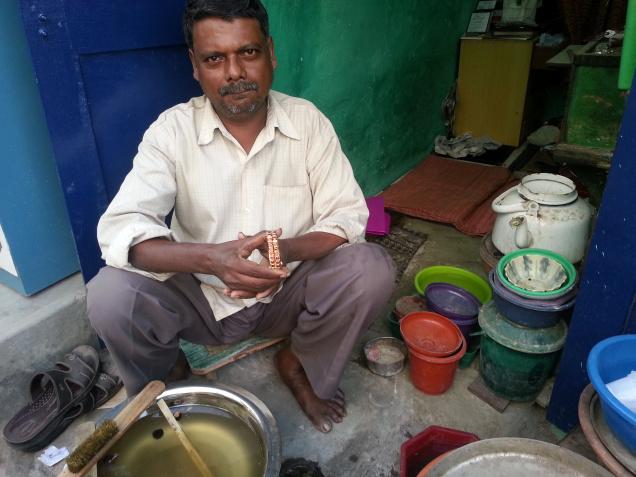
It’s only four in the evening, but Basheer has already decided to go home — he has no work that day. “The festive season just got over, hasn’t it? People will come to polish bangles and chains only after a few days,” he says, softly. Seated in front of a steel basin, with four boondhi kottais (soap berries) and four small brushes floating in the water, Basheer talks of the gold polishing business that he has been a part of for the last 30 years.

A Class 8 dropout, Basheer was initially a two-wheeler mechanic, before he trained for five years and became a skilled silver and gold polisher. After working out of several locations in Mylapore, Basheer now runs the ‘K. Noor Mohamed Gilt Shop’. “Earlier, I had my own shop. This one,” he says, pointing to the small, rectangular shop, with its blue shutters and green walls, “belongs to my cousin. He asked me to run it.” I strain to hear his voice, which gets drowned in the street noises of Mathala Narayanan Street; it’s only an old, narrow thoroughfare, but vehicle sounds and arguing neighbours make us raise our voices.

Our loud voices attract attention. One gentleman enquires why I’m asking Basheer “all these questions”; another offers to answer on his behalf and says, “He lives in Kunrathur.” Basheer explains that he moved to the ECR approximately 30 years ago. “Land was cheaper there, but now, it sells for crores!” Every morning, for the last three decades, Basheer has been taking two buses to reach Mylapore. “It’s faster to get here now, even though there’s heavy traffic after Tiruvanmiyur. In those days, there were hardly any buses, you see!” he smiles. The return journey is equally long, and he typically gets home for a late dinner around 10 p.m.

The day is spent in polishing silver and gold. Job orders range from small items — bangles and chains — to the temple kavacham or crown polishing. “Approximately 15 years ago, I polished silver items for the Kapaleeswara temple. Many of my customers are from Chennai, but some come from faraway places too.” Basheer, very modestly, says he’s an expert at polishing temple (dance) jewellery. “Dance jewellery is made in Nagercoil, and it’s difficult to clean and polish, as it has a lot of stones,” he says, showing me a pair of red-stone bangles that he has freshly gilded for a customer. It’s hard to tell it’s only ‘covering’.

To gold polish jewellery, Basheer first cleans it well. “I use soap berries bought from the naatu marundhu kadai; they foam naturally,” he says, pointing to the soapy water in the basin. Next, Basheer readies the ‘gold bath’, by dissolving a tiny amount of gold in acid, and boiling the resulting fine dust in water. This is then used to coat the article, by electrolysis. “After plating, the chain or bangle is dried on a bed of sawdust. It will then shine like gold.” (Silver plating is somewhat similar, except, it is buffed in the end).

Gold polishing costs around Rs. 250, a price that does not make it really profitable. “Gold prices have increased, but customers are not willing to pay more,” Basheer says. But he also rationalises their reluctance — gilt jewellery itself sometimes only costs Rs. 250, and the gold finish lasts for just a few months. And yet, Basheer seems happy with his lot; he talks of his three children — all graduates — and his visits to Nagore, with his family, once every two years. And when an old woman comes to his shop seeking alms, he springs up from his low stool, and fetches her a few coins…

(A weekly column on men and women who make Chennai what it is)

source: http://www.thehindu.com / The Hindu / Home> Features> MetroPlus> Society / November 11th, 2013

Archaeological Survey of India to touch up Tipu’s summer palace

Tipu Sultan's Summer Palace / The Hindu
Tipu Sultan’s Summer Palace / The Hindu

Paintings will be cleaned using chemicals, and scribbles on the walls will be covered by patch plastering work

Years of dust and smoke that have masked the paintings on the walls and ceiling of Tipu Sultan’s summer palace in Bangalore may finally be cleaned up, while portions of the wall vandalised with graffiti could also receive much-needed attention.

The Archaeological Survey of India (ASI), which protects the 18th Century monument, will take up chemical cleaning of the paintings. The scribbles on the walls will be covered by patch plastering work.

Protected monument

Located in the busy Kalasipalya area, the wooden edifice built in Indo-Islamic style, is a protected monument along with the nearby fort and dungeon.

The chemical wash is expected to brighten the paintings at the palace, most of which are vivid floral designs in water and vegetable colour.

Conservation wing

The process will be done by the ASI’s Mysore-based chemical conservation wing.

“Chemical wash was conducted on a small test area about five years ago. The painting has not changed much since then,” a senior ASI official said. He explained that it was a slow process that was dependent on humidity and dust, among other factors.

Besides, structural conservation work has to be completed before chemical wash is taken up.

TipuPalaceAbodeMPos19nov2013

An eyesore

However, this will do little to address the damage to paintings from scribbles and scratches.

“If the graffiti has to be removed, restoration of paintings has to be taken up. This is nearly impossible. It is difficult to maintain the same quality of painting and sourcing raw materials is highly impossible,” the ASI source said.

Instead, patch plastering work could be taken up to remove the eyesore in some spots.

“We will attempt to fill the scribbled portions with the patch work.”

Public office

The official claimed: “The palace was a public office before it was handed over to us in the 1950s. Much of the graffiti is from that period.” It was this sort of vandalism that had led the ASI to hire private security guards at the palace.

“We do not encourage visitors to stay on the palace premises for long,” another official said.

Colour washing of pillars with a protective coating and replacing some wooded portions that have been damaged by the elements too are on the agenda.

source: http://www.thehindu.com / The Hindu / Home> News> National> Karnataka / by Sharath S. Srivatsa / Bangalore – November 19th, 2013

Special lecuture series on Urdu held at CIIL

UrduMPos19nov2013

Mysore :

National Testing Service-India (NTS-I) of Central Institute of Indian Languages (CIIL) has been organising series of special lectures by eminent scholars at CIIL, Mysore. One such lecture was held on Nov. 12 at CIIL.

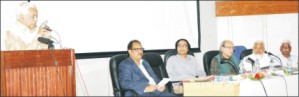
Prof. Qazi Afzal Husain (Director, APDUMT, Aligarh Muslim University, UP) delivered a lecture on “Evaluation of Language and Literature with Special Reference to Post Modernism in Urdu” and Prof. Shamim Hanafi (Professor Emeritus, Jamia Millia Islamiah, New Delhi) delivered a lecture on “Evaluation of Culture in Urdu Language and Literature”.

Prof. Awadesh Kumar Mishra, Director, CIIL, presided.

Around 100 participants comprising distinguished scholars of Urdu, research scholars of Urdu from the University of Mysore and the staff of NTS-I, NTM and LDC-IL of CIIL attended.

Dr. M. Balakumar (Head, NTS-I) coordinated the programme. Dr. L. Ramamoorthy (Head, LDC-IL), Dr. V. Ilangovan (SRP, NTS-I), Dr. Biresh Kumar (RP, NTS-I) were present.

Workshop

Besides this, a five-day workshop on scrutiny of Conceptual Explanations of the aspects for assessing language and literature included in the General Frame of Reference (GFR) began at the National Testing Service-India (NTS-I) of Central Institute of Indian Languages (CIIL) on Nov. 11. This workshop was initiated to finalise the Urdu version. The same task will be carried out in all the other Indian languages soon.

In this workshop, the accuracy and appropriacy of the coinage of terms, language used in explanations, consistency in the usage of terminologies across levels and the overall readability of the explanations are verified. Besides, the experts will provide model question items for testing each of the terms explained. The General Frame of Reference comprises approximately about 700 terms in the areas of Language, Literature and Personality.

The explanations were prepared by the resource persons of Urdu of NTS-I. They are being checked by the subject experts for their conceptual clarity and language uniformity. The experts lauded the initiation of the work as it is very relevant and necessary, which will in turn help many stakeholders of education and also opined that the material will help in the creation of technical manpower in the area of testing and evaluation, one of the crucial area of education.

The experts participating in this programme are Prof. Qazi Jamal Hussian (AMU, Aligarh), Prof. Ali Ahmad Fatmi (University of Allahabad), Prof. Rafathunnisa Begum, Prof. Safdar Imam Qadri, Prof. Masood Siraj and Dr. Abdur Rahman (from University of Mysore).

The Urdu academics of NTS-I — Dr. G.M. Ansari, Dr. Md. Rizwan, Dr. Salim Ahmed and Dr. Zubair Shadab Khan — are assisting the experts under the supervision of Dr. M. Balakumar, Head, NTS-I. Prof. Awadesh Kumar Mishra, Director, CIIL is providing the overall guidance for the programme.

source: http://www.starofmysore.com /  Star of Mysore / Home> General News / November 13th, 2013

Forever in search of reality

Chronicler of cinema

The 1950s. When 12-year-old Nasreen Munni Kabir sat in the darkened Scala Theatre in Charlotte Street, London, catching her first glimpse of Hindi films, little did she ever imagine that years later, she would plunge headlong into making documentaries and authoring 14 books on Indian cinema. 

Like millions of NRIs, Nasreen says her family also kept connected to the mother country through food and films. “More than Indian cinema, I would say Hindi film songs,” she says, a brightness shining in her dark eyes as she travelled down decades. This was the 1950s, an era when the DVD or the Internet were far from even entering the scene. At such a time, there was even more romanticism attached to cinema and songs. “They not only defined the idea of home, but also defined the idea of romance,” Nasreen said, “like the song Chandni raatein, pyaar ki baaten.”

Some distributors in London showed Indian films on Sunday mornings when regular business was low, and this is where the love for the flickering images on screen was born. And it was obvious that those memories were still fresh, as a luminous smile lit up her face when she recalled them. “The first images that I can remember are that of Nimmi running through mustard fields in Mehboob Khan’s Aan, and she is singing ‘Aaj meri man mein saki bansuri bajaye koi…’ More than the song, I was struck by Lataji’s beautiful singing. And who is standing at the end of the field on a black horse but Dilip Kumar. Now, anybody growing up in the 1950s had to fall in love with Dilip Kumar, otherwise they were pure idiots!” she exclaimed delightedly.

Hindi film music strengthened her affair with the world of Indian cinema, and the beautiful songs led her to the films themselves. By this time, the young girl was clear in her mind that she wanted to be a part of the film industry. She was 18 and was already working as an aide in several films. French films were causing ripples at the time, and she even worked as assistant director to the path-breaking French new wave director Robert Bresson in Four Nights of a Dreamer in 1971. “He was a master! And my name is there in the credits,” she said, with a fresh young girl’s pride that belied all the years of carving a name for herself as a documentary-maker of repute.

It soon became clear to young Nasreen that she had tochoose a different path in the world of cinema. “I always wanted to work in films, but I always thought I did not have the personality or the talent to make fiction films. I thought I was better at recording reality, so I wanted to go down the documentary route. So when I was in France in the 1980s — I had already done a doctorate in cinema studies from the Sorbonne — I started thinking of doing a thesis on four Indian directors — Bimal Roy, Guru Dutt, Mehboob Khan and Raj Kapoor, because I thought they were the best. This was in 1982-83.”

Instead of beginning her thesis, she started programming Indian film festivals at the Pompidou Centre, getting 100 films to be shown there in 1983. “This was big. Satyajit Ray, G Aravindam and others came!” In 1985, she followed it up with another festival of popular Indian cinema. By this time, it became clear to her that the films of Guru Dutt had caught her imagination.

“Because he combined many forces, a deep understanding of cinema, and had a singular voice and vision. You see two shots and you would know this was Guru Dutt. Same as Bimal Roy, Mehboob sahab, but you cannot pretend to put the same energy into four people. Either you go wide, or you go deep. It’s better to go deep and do one thing properly. And I thought to myself that I would spend most of my next 10 years doing research on Guru Dutt, because his films moved me the most. He was a romanticist, but had a fantastic understanding of cinema, it was brilliant.”

What followed was a three-part documentary series called In Search of Guru Dutt that was produced by Nasreen for UK’s Channel 4. While Dutt himself had passed away by then, the documentary traces his life through extensive interviews with colleagues and family members, and excerpts from his films.

That was the beginning of many documentaries that followed through the years on Hindi films and personalities, including Follow That Star (Amitabh Bachchan), Lata in Her Own Voice (Lata Mangeshkar), and The Inner/Outer World of Shah Rukh Khan. Her deep research for her documentaries led her to publish 14 books. Interestingly, two of the books are immortal dialogues from Mughal-E-Azam and Awaara, with notes and comments.

We return to Hindi songs, and Nasreen said the beautiful lyrics, songs, singers and music composers had played a large part in immortalising the first 50 years of Indian cinema. We discuss maestros like S D Burman, writers like Sahir Ludhianvi, Lata Mangeshkar and Mohammed Rafi, and many eternal hit songs, as the clock ticked away relentlessly. She didn’t have the clichéd view that the music and lyrics of the past were far better than that being produced today. “That was good for those days; this is good for today. Even Gulzar sahab continues to write lyrics today.”

We veer towards Hollywood taking over cinema in most parts of the world. She cuts in. “Hollywood has taken over. For the past 30 years! Where do you see German productions? There are (just) 12 films a year in England.” She said Hindi cinema has withstood the onslaught of Hollywood. “You name one country in the world that still produces 100 films a year,” she said, refusing to get into a debate about form.

“We are not talking of aesthetics. I am talking of employment, industry. In the world today, I believe it’s India, China (Hong Kong films) and then it’s Hollywood. I am not talking reach and moneymaking. In terms of moneymaking, I think Hollywood is No. 1. Here they get very happy with 100 crore. There it would be the weekend earning of Batman!” she said with a twinkle in her eye.

As she hurries away to join a discussion with other writers, the energy I had witnessed made me very sure that there would be many more documentaries and books from this incisive director and author.

source: http://www.deccanherald.com / Deccan Herald / Home> Supplements> Sunday Herald Entertainment / by S. Nanda Kumar / November 17th, 2013


Waheeda Rehman’s handprints take pride of place at film event

Waheeda Rehman says that she feels honoured to be a part of the panel

Legendary actress Waheeda Rehman’s handprints were captured at the South Africa India Film and Television Awards (SAIFTA) event and she said that she felt honoured.

“Taking handprints is a new trend. It is good for the artists. I feel honoured,” Waheeda said.

“It’s a great opportunity for two countries to come together. All the best,” she said about SAIFTA. The press meet was also attended by John Abraham, Manoj Bajpayee and Suniel Shetty.

SAIFTA, an annual event, will take place in Durban on September 6 and Saif Ali Khan will host it.

Shootout At Wadala and Shootout At Lokhandwala will be screened at the event.

The star-studded Indian panelists for the event include names like Waheeda Rehman, Mukesh Bhatt, Boman Irani, Rakeysh Omprakash Mehra and Farah Khan.

Sanjay Gupta, director of Shootout At Wadala, said: “Students in Durban want to know the film-making process. Our two films will be screened as they are unique and based on real events.”

The star cast of both the films will be present at the event and interact with the audience.

source: http://www.movies.ndtv.com / NDTV Movies / Home> Bollywood / Indo-Asian News Service / July 16th, 2013

Sandal Urus Shariff of Sufi Saint Hazarath Mohammed Salman Misbahi in city

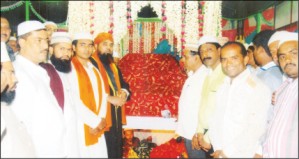
Seen in the picture are Corporator Suhail Baig, Moulana Anwar Ahmed Nizami, successor of Hazarath Mohammed Salman Misbahi, Riyaz Pasha, Ilyas Baig, Fiyaz and others at the Astana Salamaniya Dargah at Badamakan burial ground near Tipu Circle in city recently.

Mysore :

Astana-e-Salamaniya Dargah Committee, Mysore, had organised Sandal Urus Shariff of Sufi Saint Hazarath Mohammed Salman Misbahi, Founder of Azeezia Educational Trust here recently.

The Sandal Urus Shariff procession consisting of students of Arabic College, Sufi Saint, Revered Moulvis, Ulmas, Islamic Clerics, Scholars, Dharvesh of Ahala-Sunnath-wo-Jamath and devotees began from the Association Office in Lashkar Mohalla and passed through Ashoka Road, Sawday Road, Pulikeshi road, Fountain Circle to reach Astana Salamaniya Dargah at Tipu Circle on Mysore-Bangalore road. The programme was held under the supervision of Fayaz Pasha, social worker Abdul Azeez, Riyaz, Ilyaz Baig and Corporator Suhail Baig.

A lecture on ‘Azmath-e-Ahowliya Allah’ was held under the guidance of Moulana Mohammed Anwar Ahmed Nizami, successor of Sufi Saint Hazarath Mohammed Salman Misbahi, Secretary of Azeezia Educational Trust under the Presidentship of Sir Khazi of Mysore Moulana Mohammed Usman Shariff.

Moulana Asgar Ali, Khateeb-o-Imam, Jamiya Masjid on Irwin road and Moulana Mufti Sajjad Hussain Khan, Principal, Jamiya Tipu Arabic College, Srirangapatna spoke on the life of Sufi Saint.

Moulana Abdul Salam, Moulana Maqbool Nizami, Moulana Syed Imdad Ulla, Syed Fazil Ashrafi, Riyaz Pasha, Fayaz, Abdul Jabbar, Tanveer Ahmed, and others participated.

Sir Khazi of Mysore Moulana Mohammed Usman Shariff released the new 2014 Azeezia calendar on the occasion.

source: http://www.starofmysore.com / Star of Mysore / Home> General News / November 11th, 2013

237th Annual Sandal Urus Shariff of Hazarath Hyder Ali held

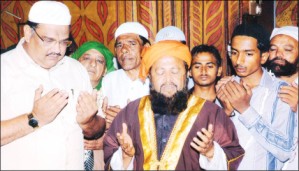
Tanveer Sait, MLA and Chairman of Tipu Sultan Wakf Estate, Srirangapatna, along with religious leaders and devotees, is seen offering prayers during the Sandal Urus Shariff of Hazarath Nawab Hyder Ali Khan Bahadur, recently.

Mysore :

The 237th annual Sandal Urus Shariff of Hazarath Nawab Hyder Ali Khan Bahadur, organised by Madarasa-e-Quvatul Islam Nawab Saheb Physical Education Management Committee Secretary Afrooz Pasha in city recently.

Sandal Urus procession along with Fukras Jamath, Syed Ahmed Baba from Bangalore began from city to reach Tipu Tomb in Srirangapatna where Masjid Aqsa Tipu Tomb Srirangapatna Khateeb Moulana Inayath ur Rehman Razvi read Fatha Khani which was held under the Presidentship of MLA and Chairman of Tipu Sultan Wakf Estate, Srirangapatna, Tanveer Sait, who paid floral tributes to the tomb.

Senior advocate M.S. Mukram, Sufi Wali, Mysore Dist. Wakf Board Advisory Committee former member Sajjad Ahmed, President of Azeez Sait Block Congress Committee Rafeeq Ahmed, social worker Ayaz Pasha and devotees participated in the programme.

Afrooz Pasha proposed a vote of thanks.

source:  http://www.starofmysore.com / Star of Mysore / Home> General News / November 11th, 2013