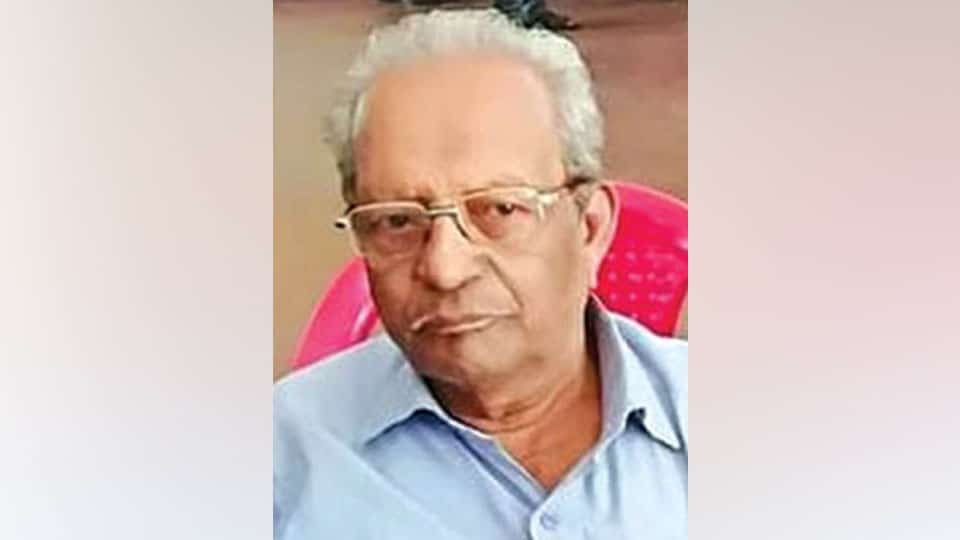
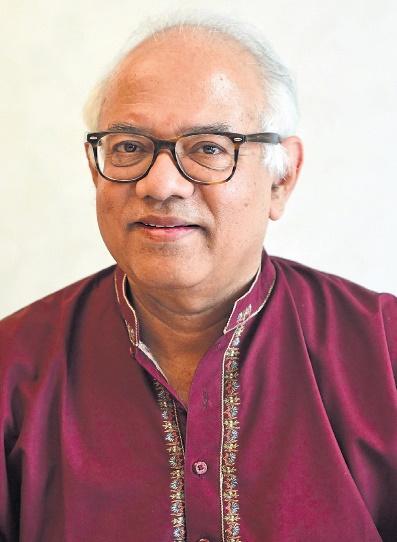
Abdul Rahman Khan alias Gowher Tarikervi (82), retired lecturer at Teachers Training Institute, Vasanth Mahal and a resident of Rajivnagar near Makkah Masjid, passed away yesterday in city.
A well known Urdu Poet of the State, he leaves behind his wife, three daughters, two sons, grand children and a host of relatives and friends.
Namaz-e-Janaza was held at Masjid-e-Azam on Ashoka Road this morning followed by the burial at the Muslim Burial Grounds near Tipu Circle.
source: http://www.starofmysore.com / Star of Mysore / Home> Obituary / April 19th, 2021
This promising artist who hails from Dabeerpura, describes her works as impressionistic, abstract and contemporary.
Bad times often bring out the best in some people. It happened with Ayesha Nazneen. When most persons found the lockdown unnerving, for her it was a godsend opportunity to indulge in her passion. No, she wouldn’t be able to travel, see waterfalls or be one with nature. But surely she could do all this with her canvas, colours, brushes and palette knife.
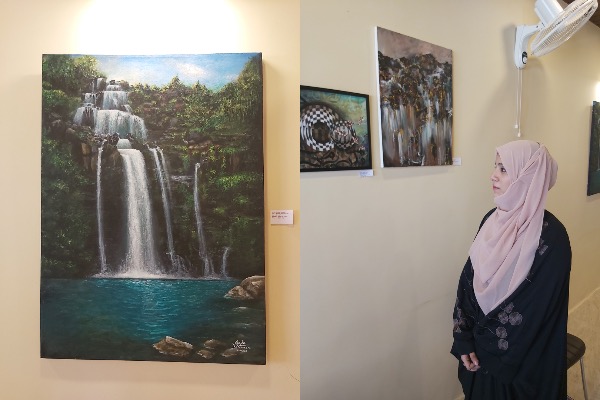
She did just that. She did not let the pandemic to come in the way of her creativity. Each day was a new start, a new opportunity to explore her feelings and put them on the canvas for the world to see. The other day Nazneen had her ‘Dreams Unlocked’. Her solo art exhibition gave a peep into her dreams.
While it was her first art show, it was also the first such event for the Luqma Kitchen Studio, the newly-opened women-only space at Dar-ul-Shifa. “Women in this part of the city have a lot of skills which need to be tapped,” remarked Rubina Nafees Fatima, president, Safa Society.
This promising artist who hails from Dabeerpura, describes her works as impressionistic, abstract and contemporary. Most of her exhibits relate to dreams of women. She makes use of circles to create an illusion of cage — to indicate how women have traditionally been confined. She also paints the theme of education as the liberating force. Judicious mix of vibrant and contrasting colours is her hallmark. Her favourite work remains the ‘Dream of Final Abode’. This acrylic on canvas depicts a milky waterfall, the artist’s perception of the luxurious life promised in Paradise.
A self-taught artist, Nazneen has been sketching right from her childhood, drawing inspiration from her artist-grandfather, Azeemuddin. An assistant professor at Shadan Women’s College of Pharmacy, she plans to explore sculpture next. Her aim is to use art to illuminate, educate and motivate people.
source: http://www.telanganatoday.com / Telangana Today / Home> Features / by J S Ifthekhar / April 12th, 2021
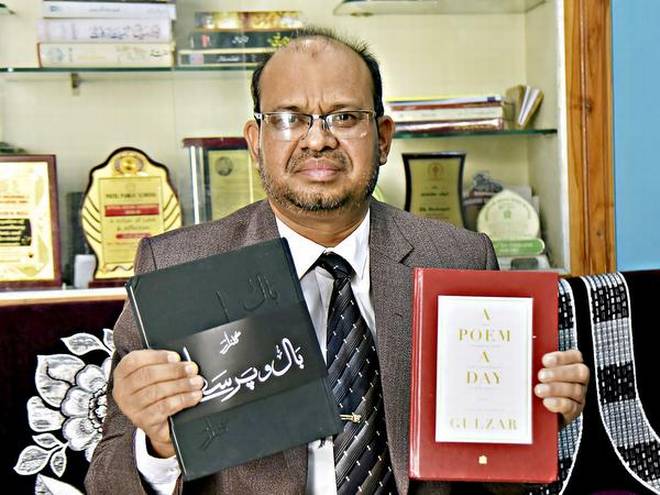
Prized possession: Mustaque Ahmed S. Mulla displays the books sent by lyricist Gulzar.
The award-winning poet calls up Mustaque Ahmed S. Mulla after he reads the latter’s letter
Never in his dream had Mustaque Ahmed S. Mulla thought that a letter he wrote to award-winning poet and lyricist Gulzar would lead to a moment he would cherish for life.
It was in the second week of March that Prof. Mulla, principal of Tippu Shaheed Institute of Technology at Old Hubballi, happened to watch a reading of Mirza Galib’s poem by Mr. Gulzar in the ‘Jashn-e-Rekhta’ programme.
A fan of ‘Gulzar Sahab’, Prof. Mulla could not resist penning down what he felt. He also wrote about Mr. Gulzar’s determination on reading and writing in Urdu in its own ‘Rasmul Khat’(script) and his views on learning Urdu and expressing it Devanagari script. Mr. Gulzar’s 1972 film Koshish revolved around visually-impaired characters and Prof. Mulla related to it as his father was disabled. He wrote on how the film changed his view of his father, posted the letter and had almost forgot about it.
One afternoon, a few days later, Prof. Mulla’s cell phone rang and to his surprise, the person identified himself as Gulzar. He could not believe that a Dada Saheb Phalke award winner would personally call him and checked to confirm what he had heard.
The conversation extending to over 15 minutes will remain etched in the memory of Prof. Mulla and his daughter Nikhat Sameen, who was by his side. “Gulzar Sahab thanked me for my letter and sought to know about Hubballi and its literary culture. His poetry, films, the region, my father, his struggle, Koshish… all figured in the conversation,” Prof. Mulla recalled.
Mr. Gulzar asked Ms. Sameen, a postgraduate students, about the city, its literary circles and her literary inclination. She requested Mr. Gulzar to send an endorsed copy of his latest Urdu poetry collection Bal o par sare.
“He said he would send it. A few moments later, he called back to ask whether she knew Urdu. At that moment, I said, I too had the right to an endorsed copy, being her father,” Prof. Mulla told The Hindu. Ms. Sameen told her father that more than a poet and lyricist, Gulzar Sahab was a great human being who respected others’ sentiments.
After the conversation, Mr. Gulzar sent two books, one in English for Prof. Mulla and one in Urdu for Ms. Sameen, with endorsement.
These days, Prof. Mulla’s house has visitors who comes to see the books with Mr. Gulzar’s handwriting. Prof. Mulla never gets tired recalling the pleasant surprise.
source: http://www.thehindu.com / The Hindu / Home> News> States> Karnataka / by Girish Pattanashetti / Hubballi – April 16th, 2021
The Luqma Studio started by Safa Society provides a platform for like-minded women to network and exchange ideas.
There aren’t many places for women to hang out and unwind in Hyderabad. But now, they can boast of a women-only space. Yes, Darulshifa, the heart of the old city, offers such a legroom for them. At Luqma Studio, they can let their guard down and relax — leaving their worries behind.
The unique initiative is the brainwave of Safa Society, the city-based NGO, which aims at socio-economic empowerment of women. The one-of-a-kind studio provides a much-needed platform for women to engage in dialogue, network and exchange ideas. No, Muslim women are not making a beeline to the studio as yet. That will take some time but the very idea of women-only area has gone down well with the fair sex.
Those who dropped in at the inauguration of the studio, along with the Luqma kitchen, last week were pleasantly surprised at the idea of women having a place of their own. “Don’t we need such a place in the #MeToo era,” remarked a young woman pleading anonymity.
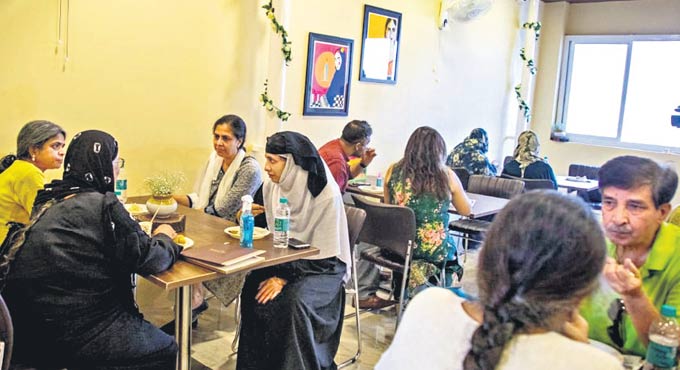
The all-female studio is well-furnished and has room for about 25 persons. The pink-coloured walls are decked up with art portraits of women. Adjacent to the studio is the spacious Luqma kitchen, the food brand of Safa, aimed at turning ordinary women into foodpreneurs. “We want Muslim women to make use of the studio and engage in meaningful discourse. They can also showcase their talent here,” says Safa Society president, Rubina Nafees Fatima.
Rubina Nafees Fatima
The studio can be an oasis for women seeking rest and relaxation. They can order something sizzling from the kitchen next door and chit-chat leisurely, something the presence of men would hinder. The homely ambience only adds to the pleasure. There will be special events with prominent women from different fields addressing them on a range of subjects.
There are many myths about Muslim women. What adds to the confusion is people judging them through the prism of stereotypes. “Women from different communities can now intermingle and discover each other,” says Rubina.
With its safe and supportive environment, will Luqma Studio open up new vistas for women?
source: http://www.telanganatoday.com / Telangana Today / Home> Features> My Hyd / by J S Ifthekhar / April 04th, 2021
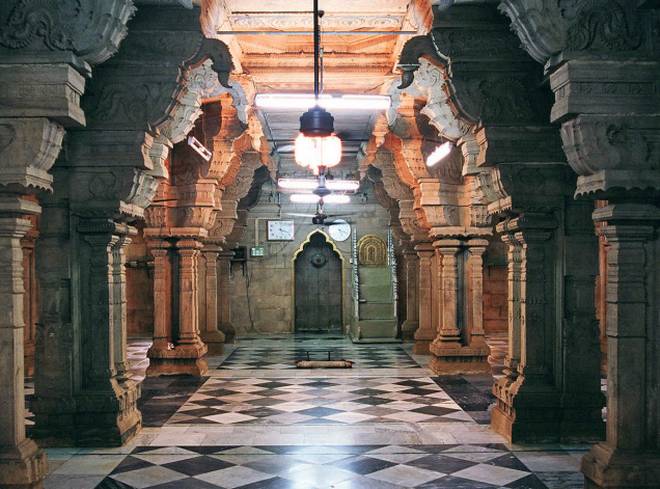
The 17th century mosque in Keezhakarai is the finest example of Dravidian-Muslim architecture.
Yaadhum , a documentary film, tracing the history and identity of the Tamil Muslim community, has won the Bronze Remi award at the 48th WorldFest -Houston – the third longest running International Film Festival in North America.
“The film is a Tamil Muslim’s journey in search of his roots and identity,” says Kombai S. Anwar, the film-maker who won the award under the Cultural/Ethnic category. There were participants from 33 countries and more than 550 international film-makers attended the festival. The film was also screened at The Hindu Literary Festival.
Distorted history
Mr. Anwar said his objective was to set right the distorted history of Muslims constructed by Western historians.
“Contrary to the popular perception that Islam made advances through violent conquests, in Tamil Nadu the religion arrived with trade. The sculpture found in the Tirukurungudi temple explains the maritime trade with the Arabs,” he said.
Inspiration
Two incidents — late writer Sujatha’s argument that thousands of Vaishnavites were killed during the Muslim invasion and Anwar’s role in helping the local community preserve the Kallupalli (the mosque made of granites) — became the inspiration for the film.
“Muslims in Tamil Nadu adapted themselves to the local cultures and combined the elements of Dravidian architectures while constructing mosques,” he said.
Dravidianarchitecture
Even though there are a lot of mosques built following the Dravidian architecture, the 17thcentury mosque in Keezhakarai constructed by Seethakathi, known as Vallal Seethakathi, remains the finest example of Dravidian-Muslim architecture.
The film covers excavations, inscriptions, old mosques built in the architectural traditions of Tamil Nadu and Kerala, literature and interviews with well-known historians.
It attempts to correct the distorted historical account of how the community came to the State
source: http://www.thehindu.com / The Hindu / Home> News> States> Tamil Nadu / by B. Kolappan / Chennai – May 15th, 2015
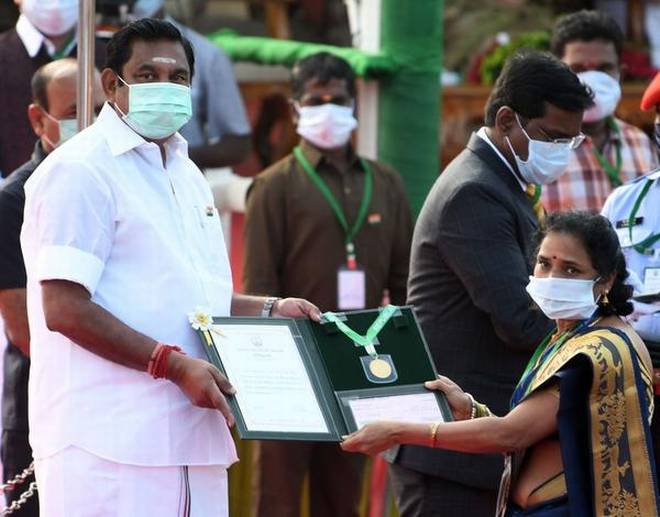
Tamil Nadu Chief Minister Edappadi K Palaniswami giving away the Anna Medal for Gallantry P. Mullai, a teacher in Pulivalam Government High School in Sholinghur in Ranipet district | Photo Credit: Raghunathan SR
TN Chief Minister Edappadi K. Palaniswami gave away the medals at the Republic Day celebrations on Tuesday
A school teacher who risked her life to save her students from an explosion, a veterinary surgeon who rescued an elephant that plunged into a 60-feet deep well, a loco pilot who noticed boulders on railway tracks and saved his passengers and a cab driver who acted swiftly to save the life of an injured policeman were awarded the prestigious Anna Medal for Gallantry during the Republic Day celebrations on Tuesday.
Chief Minister Edappadi K. Palaniswami handed over the medals to the recipients, in the presence of Governor Banwarilal Purohit, Madras High Court Chief Justice Sanjib Banerjee and other dignitaries. The Anna Medal for Gallantry (given to government servants and general public categories) carries a cheque of ₹1 lakh, a medal worth ₹9,000 and a certificate.
On January 29, 2020, P. Mullai, a teacher in Pulivalam Government High School in Sholinghur in Ranipet district, smelled the strong odour of LPG in the neighbourhood. Disregarding her personal safety, she guided her students to safety. “But her selflessness ended in misfortune as the LPG exploded in the neighbourhood, collapsing the house wall adjacent to the school, leaving her injured,” read her citation. She saved her 26 students but had to be admitted to hospital in a highly critical stage. She has recovered eventually.
Forest Veterinary Assistant Surgeon A. Prakash was involved in the rescue of an elephant that fell into a 60-feet deep well on November 19, 2020 and was actively involved in the rescue that lasted over 18 hours. When the rescued elephant charged at the gathering of the people unexpectedly, Mr. Prakash followed the animal and gave it an anaesthetic drug with his bare hands, after realising there was no time left for loading the tranquilliser gun.
Loco Pilot J. Suresh of Vaigai Express noticed his train was approaching boulders on the tracks due to a landslide on November 18, 2020. Despite inclement weather and poor visibility, he stopped the train immediately and thereby saved the lives of over 1,500 passengers on board the train.
R. Pugazendiran of The Nilgiris district saved the life of an injured policeman after a tree fell on the latter on August 5, 2020. Mr. Pugazendiran “reached the spot quickly with his vehicle and rushed the injured police constable to the nearest hospital. The police constable was saved.”
Inspector of Police T. Magudeeswari of the Prohibition Enforcement Wing in St. Thomas Mount, Sub-Inspector of Police N. Selvaraju of the Central Investigation Unit in Salem, Head Constable S. Shunmuganathan of Srivilliputhur Taluk Police Station in Virudhunagar district and Head Constable S. Rajasekaran of Kilkodungalur Police Station in Tiruvannamalai district received the Gandhi Adigal Police Medal. The Gandhi Adigal Police Medal is awarded to personnel of the Tamil Nadu Police, who have undertaken outstanding work in curtailing illicit liquor. The Award carries a sum of ₹40,000.
The police stations in Salem Town, Tiruvannamalai Town and Kotturpuram in Chennai received the top three ranking stations across the State. Mr. K.A. Abdul Jabbar from Coimbatore district received the Kottai Ameer Communal Harmony Award for 2021.
source: http://www.thehindu.com / The Hindu / Home> News> States> Tamil Nadu / by Special Correspondent / Chennai – January 26th, 2021
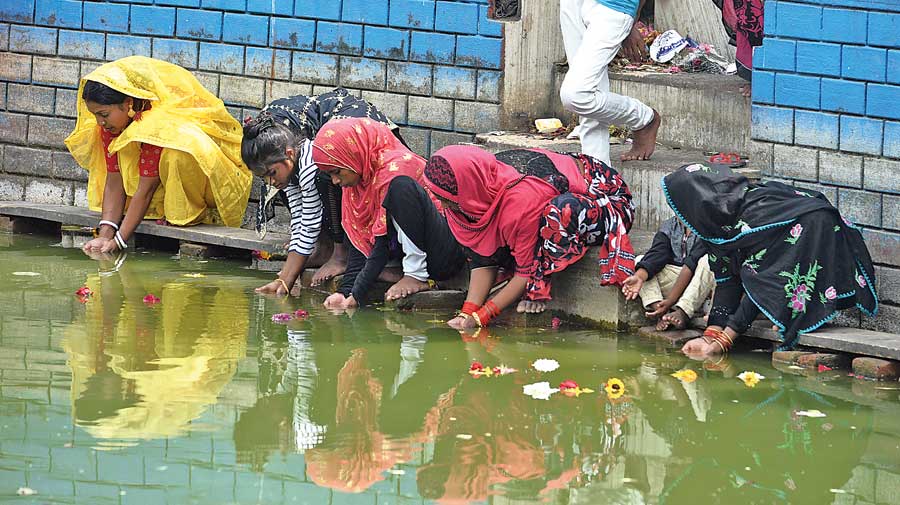
A Hindu woman (in yellow sari) prays at the pond in Ghutiari Sharif compound with Muslim women / pix: Gautam Bose
A BJP rally kept raising high-pitched “Jai Shri Ram” cries as it marched along the Baruipur-Canning Road in South 24-Parganas on Friday afternoon.
Slogans in support of the incumbent regime in Delhi were belted thick and fast and scorn was heaped on “infiltrators and termites”. It was around 12.30pm and the road was not busy. But some cars were stalled by the rally.
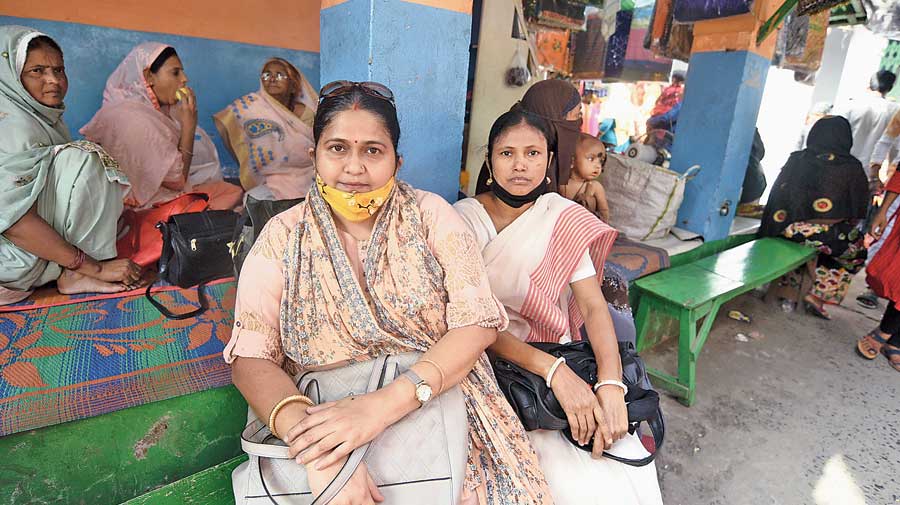
One of them was headed to a shrine dedicated to a Muslim saint, 35km from the heart of Calcutta and two stops before Canning, the gateway to the Sunderbans. All the occupants of the car were Hindus.
Debi Majumder (left) and Umme Habiba Laskar at the Ghutiari Sharif shrine on March 26. Majumder is a Lake Market resident . Laskar is an ayah employed by a neighbour of Majumder. The picture was taken minutes after the two dipped their palms into the pond together / pic: Gautam Bose
“I am going to Ghutiari Sharif for the first time. I have heard that if you pray sincerely, Ghazi baba answers your prayers,” said Suparna Dutta, 22, part of the group from Garia.
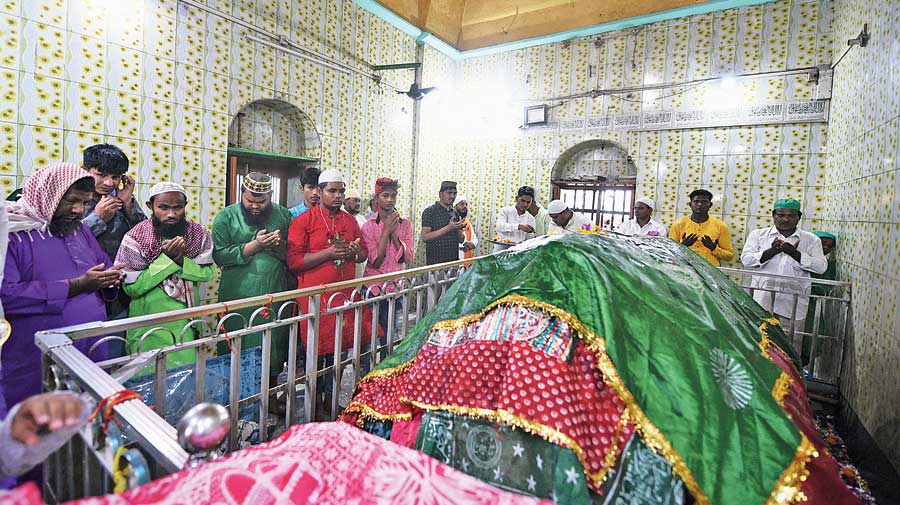
A suburb in South 24-Parganas, Ghutiari Sharif is known for the mazaar (resting place) of Pir Ghazi Mubarak Ali, a revered 17th century figure.
It is also a testament to the secular character of the popular devotional culture of Bengal at a time religious polarisation is the dominant narrative everywhere from political rallies to election manifestos.
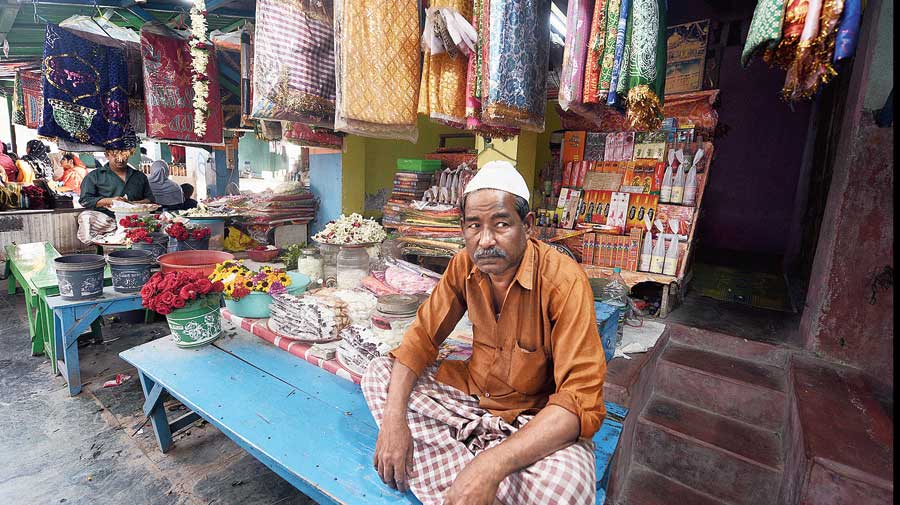
Salim Dewan, 65, who owns a store selling incense sticks, flowers, chadars and other objects offered to the Pir’s resting place / pix: Gautam Bose
Legends and folklore in Bengal are often a part of everyday life, transcending barriers of religion and caste. When this reporter visited the shrine on Friday, scores of women with sindoor-smeared foreheads were seen dipping their palms into a pond in the shrine compound, praying silently to have their wishes (manat) fulfilled.
The shrine embodied the deep-rooted syncretism in Bengal’s culture, something that social scientists said would pose a formidable challenge to any political party seeking to polarise voters.
That syncretism was perhaps best represented by an image of two women — Debi Majumder and Umme Habiba Laskar — dipping their palms together in the pond.
Majumder, a first-timer at Ghutiari Sharif, had come from her home in Lake Market. She came to know of the place from Laskar, an ayah who looks after one of Majumder’s neighbours. Laskar is a resident of Champahati, another suburb not far from Ghutiari Sharif, and has been there several times.
They had boarded a train from Ballygunge to reach the Ghutiari Sharif station on Friday. The shrine is a less than five-minute walk from the station. Around 1.30pm on Friday, the two dipped their palms into the pond together.
“I prayed at the mazaar and then made my wish at the pond. I have skipped breakfast, in keeping with the ritual,” said Majumder. Many visitors fast till they pray at the mazaar.
Suparna Naskar, who lives in Baruipur, had accompanied a Muslim friend who had come with her newborn. “She had wished for a child. Today, we have come to thank Ghazi baba for granting the wish,” said Naskar.
The shrine is a five-minute walk from the Ghutiari Sharif railway station in the Sealdah-Canning suburban section. The narrow road is dotted with shops. The resting place of the pir is at the centre of the compound. The top of the shrine has a mosaic dome with four towers.
Legend has it that the area, then part of the Sunderbans, was hit by a severe drought four centuries ago. Pir Ghazi Mubarak Ali is said to have brought rainfall to the area. He is also said to have cured a Hindu king, Madan Roy, from a severe bout of illness, after which Roy gifted him swathes of land. The mazaar stands on that land.
“Baba’s spirit still endures, taking care of this place. He did not discriminate between people. We have maintained that tradition. Around one-third of my customers are Hindus,” said Salim Dewan, 65, who owns a store selling incense sticks, flowers, chadars and other objects offered to the pir’s resting place. Dewan is a common title given to the future generations of the pir, some of whom are also part of the managing committee of the shrine.
“Many such mazaars and dargahs in Bengal are entrenched in a syncretic culture. The devotees come from all faiths, light incense sticks and offer sinni (a sweet concoction of milk, flour, bananas, raisins and other fruits, usually made during pujas in Bengali homes) and other homely food to the presiding saint,” said Epsita Halder, who teaches comparative literature at Jadavpur University and has researched on the scriptural understanding and popular devotionalism of vernacular Islam in Bengal.
“In medieval Bengal, many Islamic preachers became popular among the common people because they spoke in a simple language that everyone could connect with. They were not heavy on scriptural understanding of a religion but talked about devotion as a way of life,” Halder said.
Ghutiari Sharif falls under Canning West Assembly seat, won by Trinamul’s Shyamal Mondal in 2016. This time, the ruling party has fielded Paresh Ram Das. His main contender is Arnab Roy of the BJP.
Roy switched sides from the TMC to the saffron camp recently and his candidature has triggered protests from local BJP workers, like at so many other places of the state.
The influence of the shrine goes far beyond one constituency.
Ghutiari Sharif hosts two major fairs in a year. One is in the first week of August, commemorating the death anniversary of the pir. The other is in June, which coincides with the famous Ambubachi Mela at the Kamakhya temple in Assam. According to the local legend, King Madan Roy, a regular at the Kamakhya temple during the fair, started a similar fair near his home after being impressed by the pir.
Special trains are run during the fairs and lakhs of people, Hindus and Muslims, throng the shrine, apart from tens of thousands every week.
Those at the helm of the shrine said they kept off politics.
“We have always practised an inclusive culture and will continue doing so, irrespective of which party comes to power,” said Siraj Dewan, caretaker of the managing committee of the shrine.
Political commentator Maidul Islam said the politics of polarisation has yielded dividends in the urban middle class but suburban and rural Bengal was a different ballgame.
“The urban middle class is divided into the conservative and the liberal sections. The conservatives have already sided with the saffron brigade. There is a deep churning in a large section of the liberals. Many of them are still undecided among the Left and Trinamul. But the syncretic culture of rural and suburban Bengal is so deep-rooted that it will not be erased in the course of one election,” he said.
The resting place of Pir Ghazi Mubarak Ali. / pix: Gautam Bose
Ghutiari Sharif is not far for the Sunderbans, the land of another syncretic legend, Bon Bibi, the protector of humans and the forest, worshipped by Hindus and Muslims alike.
“All across the Sunderbans, rituals to Bon Bibi are performed by Hindus as well as Muslims. I think it is a wonderful kind of syncretism that you see there. In popular culture, in Bengal, it is incredibly mixed. These traditions, they are impossible to pick apart and say this is Hindu and this is Muslim. I think that’s what makes the popular culture of Bengal so vibrant and so interesting,” author Amitav Ghosh, who had introduced Bon Bibi to the world, said of the legend while speaking on the occasion of a literary meet in Calcutta in February.
source: http://www.telegraphindia.com / The Telegraph Online / Home> West Bengal> Calcutta / by Debraj Mitra, Calcutta / March 31st, 2021
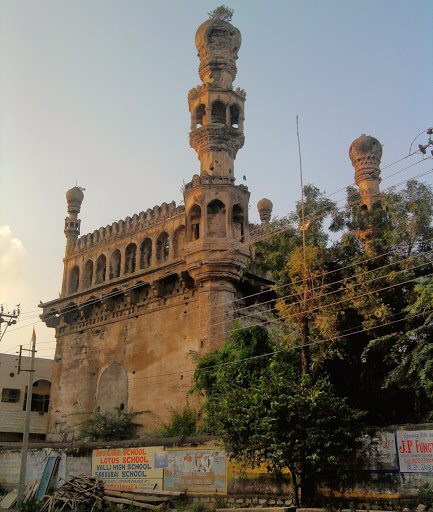
Mohammad Mirza is a travel writer and a social media executive from Hyderabad. He is currently based in the Middle East. His Instagram page “Mosques of India” is stocked with images of abandoned mosques with striking architecture that has remained elusive to the imaginations of present-day craftsmen.
Ten years ago, walking through the bustling street of Shaikpet in Hyderabad, thirty-year-old Mohammad Mirza was distraught to see the sight of a tumbledown Shaikpet mosque. Once, the Shaikpet mosque would echo with prayers, stirring the hearts of many. Seeing the plight of the mosque, Mirza started on a journey to research and write about the abandoned “Mosques of India.”
His aim is for the Archaeological Survey of India (ASI) and Muslim Waqf Boards to recognize these mosques as state-protected monuments.
Picture Courtesy: Muslim Mirror
“I started writing about the abandoned mosques of India in lockdown. I am a history junkie and I read vastly on architecture,” Mirza told TwoCircles.net.
“I didn’t want to post the images of the mosques alone. I wanted to create awareness about their poor and dilapidated condition. I also try to extensively research and write about the historical significance and the cultural heritages of these mosques,” he said.
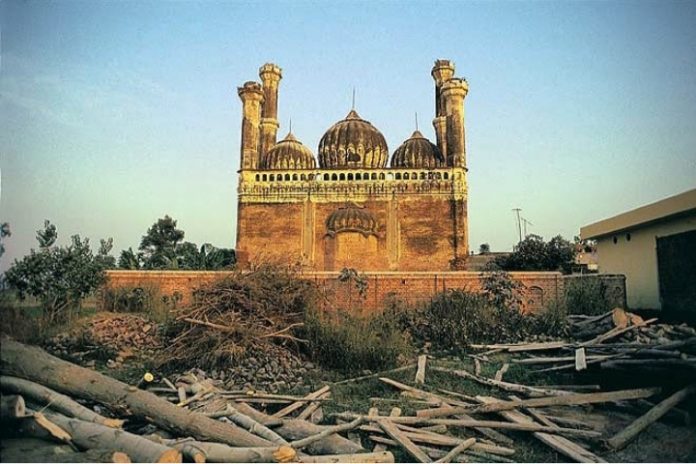
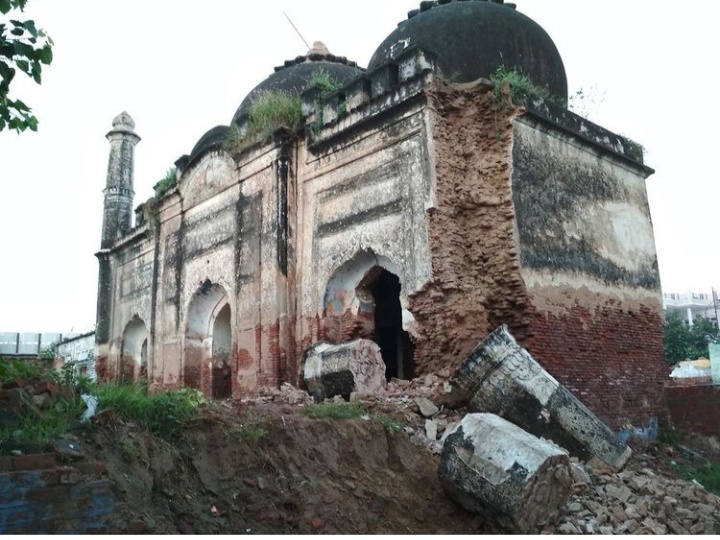
His page features an assortment of solitary mosques, which include the Palaiya Jumma Palli, one of the oldest mosques in India located at Keelakari in Tamil Nadu, which has a semblance of Dravidian Islamic Architecture and was constructed around 628 – 630 AD, the Akbari mosque in the sleepy town of Kalanaur, Punjab. The Akbari mosque is speculated to be the coronation place of Akbar the Great. Each mosque featured on the page has a unique ‘unknown’ history but are in ruins at present.
Picture Courtesy: Gurmeet Singh
“The Arabic calligraphy and inscriptions are still intact in some mosques, but most of the mosques are in a very bad condition. The minarets and domes are broken. The walls of the mosques have plants and trees growing out of their fissures, and sometimes they are just cloaked in algae,” says Mirza.
Mirza archives the heritage of these mosques by doing ‘short series’ items on these old and abandoned mosques. “The short series helps people to focus on a particular place filled with heritage,” he says.
In his first series, he wrote about eight different “Abandoned Mosques of Haryana” (as he calls it). It featured mosques from the villages of Gondar, Fatehabad, Kahni, Turkiawas, Meham, Dujana, Urlana Kalan and Jalmana.
“Sadly today these mosques are encroached and used as residences and cowsheds. Mosques used to be a house of prayer for Muslims. There are no Muslims in these small villages to worship in these mosques as they have migrated during the partition,” he says.
In one of his series, Mirza writes that Haryana is blessed with so many historical monuments, and “there is perhaps no other state in India where historic monuments are left to vagaries of nature like they are in Haryana.” He is talking about a forsaken mosque of Fatehabad, Haryana.
Mirza says that these mosques are the symbol of India’s pluralism and they must be preserved. “Not only mosques, I see many historical monuments in ruins too. Conserving the architectural heritage of a place depends upon the state’s recognition of its value,” he said.
Mirza says that “we must rebuild all these mosques so that our future generation can see all of this great history of their predecessors.”
“Hopefully, Muslims can visit and transfer these mosques hopefully,” says one of the followers on his page.
Mirza’s work is in line with Adopt a Heritage (2018) scheme, which was jointly established by the Ministry of Tourism, Ministry of Culture and Archaeological Survey of India. The project faced repercussion for its public-private partnership to sustain the monuments of cultural heritage and for selecting the sites based on tourist footfall. Activists had then sought to take into consideration the need to preserve and manage such cultural heritage before the adoption policy.
“These mosques are not just cultural heritage, they have religious significance too. The respective estates must give recognition to them and bring them under their protection,” says Mirza and adds, “I always wanted to be an armchair historian.”
source: http://www.twocircles.net / TwoCircles.net / Home> Lead Story / by Shalini S, TwoCirlces.net / March 31st, 2021
Bengaluru-based collector Sunil Baboo has acquired maps that show the battle plan of the Third Anglo-Mysore war, which Tipu Sultan lost.
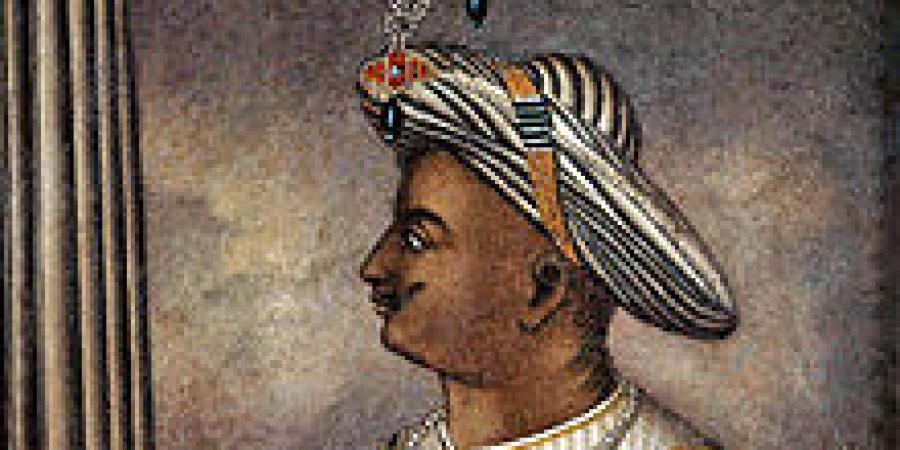
A painting of Tipu Sultan used for representational purpose only
Bengaluru :
Sunil Baboo, a Bengaluru-based collector, has a penchant for procuring items of historical significance. The latest additions to his private collection? Maps detailing the British battle plan to corner Tipu Sultan.One of the maps, engraved by J Cooke, a man who worked under the British, shows the battleground of the Third Anglo-Mysore war that lasted between February 5-24, 1792, and saw Tipu’s defeat.
Sunil Baboo | Ashishkrishna HP
He acquired the map during a trip abroad. He met a French woman named Christine Champlaine, whose great-grandfather served in the French army and came into the possession of the maps of the 1792 battle. “I bought them from her in early 2020,” Baboo says.The map details the seige of Seringapatam (now called Srirangapatna), and the position of the various troops on the side of the British, and the positions of British generals.
It shows the locations of Nizam’s forces, the Nawabs of Arcot, and the Marathas, vis-a-viz Loll Baug, Shair Ganjaum, Dowlet Baug (Daulat Bagh), Tippoo’s Tent, Powder Works, Hyder’s Mausoleum, Palace, Pavilion, River Cauvery, and Carigaut Pagoda.
“They cornered Tipu even before he realised it. Cornwallis went on to conquer all of Tipu’s forts – Nandidurg, Savandurg, Uttaradurg, Manjarabad fort, Ballari fort, Krishnagiri fort and others. Also, Tipu had a sense that his own people were turning hostile. There were instances of his own people falling for the lure of money from the British,” says Baboo.
In 2018, he acquired a lithograph titled ‘Taking of the City of and Fort of Seringapatam’ from a dealer of antiquities in Canada. Created by French painter Jean Duplessi Bertauz, the piece illustrates Tipu’s final battle. “It shows the slyness with which the British laid siege to Seringapatam, cornering Tipu from every side. In fact, Napoleon Bonaparte, who was busy fighting wars in Europe, had offered to help Tipu, but it was too late,” says the 60-year-old.
Also engraved is the following text: “Tippoo perished with a great number of this followers and all his treasure fell into the hands of the conquerors. Colonel Wellesley commanded the reserve at the assault, and was afterwards nominated Governor of the City.”Baboo, who used to run an export business, is drawn to history. “I have a passion for documenting antiquarian documents, and maps that represent the past and which shaped our present,” he says.
source: http://www.newindianexpress.com / The New Indian Express / Home> Cities> Bengaluru / by Sanath Prasad, Express News Service / April 06th, 2021
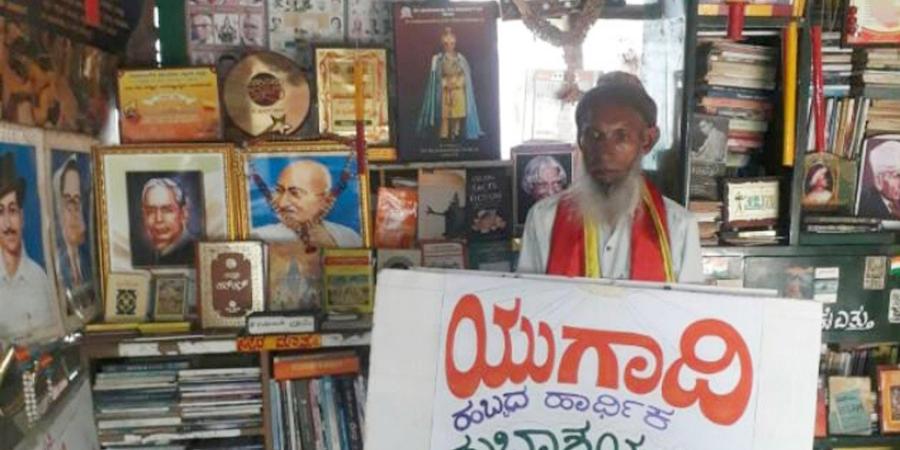
Syed Isaaq in front of a portion of the library (Photo | EPS)
Syed Issaq, a daily wage worker, had collected more than 11,000 books for his library, 85% of books were in Kannada.
Mysuru :
In a tragic incident, miscreants have allegedly set ablaze a public library run by a 62-year-old daily wage labourer that had a collection of 11,000 books including three thousand copies of Bhagavad Gita, in Mysuru on Friday.
Syed Isaaq had become a popular face among the residents of Rajiv Nagar and Shanti Nagar in the city as he took up a bold step of setting up a library giving free access to all the residents in the region for the last 10 years.
Deprived of education, Isaaq worked as a bonded labourer before turning into an Under Ground Drainage (UGD) cleaner and did odd jobs to earn a livelihood.
“At 4 am, a man residing next to the library informed me that there was a fire inside. When I rushed to the library which is just a stone’s throw away distance, I could only see them being reduced to ashes,” said Isaaq in teary eyes.
With an intent to help inculcate reading habits among the people and also encourage them to learn Kannada, Isaaq had set up this public library in a shed-like structure inside a corporation park in Rajiv Nagar second stage near Ammar Masjid. Every day, over 100-150 people would visit his library. Issaq would purchase over 17 newspapers including the ones in Kannada, English, Urdu and Tamil.
Nearly 85% of the books in his library collection were Kannada while several were English and Urdu. “The library had over 3,000 exquisite collections of Bhagavad Gita, over a 1,000 copies of Quran and Bible besides thousands of books of various genres which I sourced from donors,” he says.
Though he did not spend money from his pocket, he used to spend nearly Rs 6,000 for the maintenance of the library and on the purchase of newspapers.
Following this incident, Issaq approached the Udayagiri police station and lodged a complaint against the miscreants. Police have filed an FIR under the IPC section 436 and have launched an operation to nab the culprits.
However, the incident has not deterred Issaq. “I will not cow down. I will rebuild the library from the scratch”.
“I was deprived of education and I want to ensure that others should not face my plight. I want people to learn, read and speak Kannada and will rebuild it again,” he said.
source: http://www.newindianexpress.com / The New Indian Express / Home> States> Karnataka / by Karthik KK , Express News Service / Myuru – April 09th, 2021