Fatima Rafiq Zakaria was awarded the Padma Shri in recognition of her work in education in 2006
Aurangabad, Maharashtra:
Fatima Rafiq Zakaria, a Padma Shri awardee, renowned journalist, academician and chairman of Maulana Azad Educational Trust and Khairul Islam Trust Mumbai, passed away at the Bajaj Hospital in Maharashtra’s Aurangabad due to age-related illness on Tuesday noon. She was 85.
Besides being affiliated to the Maulana Azad Educational Trust and Maulana Azad Education Society, Ms Zakaria was also the executive vice-chairman of the Board of Governors of the Trust’s Institute of Hotel Management which is run in collaboration with the Taj Group of Hotels.
Ms Zakaria, who had played an eminent role in the field of education, was also honoured with the Sarojini Naidu Integration Award for Journalism in 1983.
She was awarded the Padma Shri in recognition of her work in education in 2006.
source: http://www.ndtv.com / NDTV / Home> All India / by ANI / April 06th, 2021
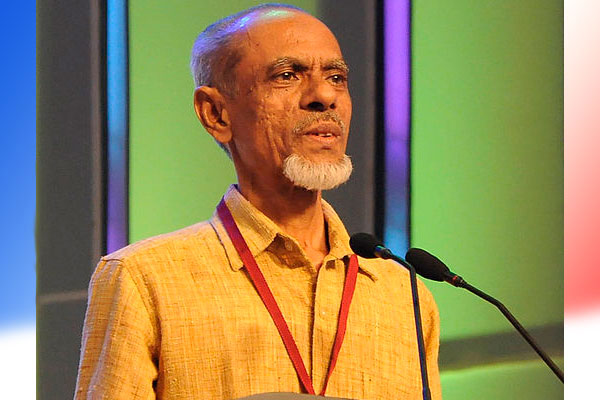
Prominent Islamic scholar and former Vice President of Jamaat-e-Islami Hind Professor KA Sidheeq Hassan passed away today at the age of 75. He was the chief architect of Vision 2026, a flagship project of the Human Welfare Foundation, a public charitable trust working for the development of Muslims.
Prof Sidheeq Hassan worked as an educator in various educational institutions including University College, Thiruvananthapuram and Maharaja College, Ernakulum.
He served as the President of Jamaat-e-Islami Hind, Kerala from 1990 to 2005. Earlier he had held the positions of Chairman of Alternative Investment and Credit Limited (AICL), founding chairman of Baithuzzakath and sub-editor of Probodhanam Weekly.
Sidheeq Hassan was born in Koottil in Eriyad in the Thrissur district of Kerala and was one of the contributing founding members of Madhyamam Daily, a prominent newspaper in Kerala.
He was conferred with many prestigious awards including the Imam Haddad Excellence award, Islamic Online Star of 2010 by Islam Online and Ebrahim Sulaiman Sait Foundation Award.
He is survived by wife VK Zubaida, sons Faslurrahman, Sharafuddeen and daughter Sabira.
source: http://www.thecognate.com / The Cognate / Home> News / by Ghazala Ahmad / April 06th, 2021
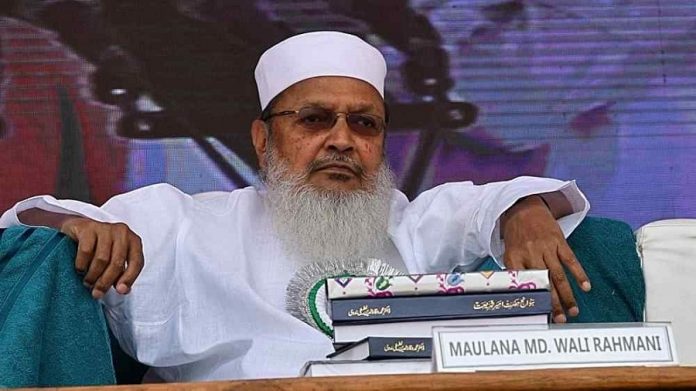
Maulana Wali Rahmani | Photo Courtesy: Clarion India
What set Maulana Wali Rahmani, an Indian Sunni Islamic Scholar, academician and founder of Rahmani30, apart was his efforts towards the promotion of education among Muslim youth. Although Rahmani was a multi-lingual man, he had evident love for the Urdu language. In February this year, he launched a campaign for education among the Muslim community and promotion of the Urdu language.
The well-known torchbearer of India’s Muslim community, who strove to work for the promotion of education, Maulana Mohammad Wali Rahmani would have turned 78-years-old on June 5 this year. On April 3, Maulana Wali Rahmani breathed his last at a Patna hospital after a brief illness and other complications.
Such was his repute and respect among the community that he had 8.5 lakh followers who took the oath of allegiance to him as “Sajjada Nashin” of Khanqah Rahmani in Munger in the Indian state of Bihar. Rahmani became “Sajjada Nashin” of Khanqah Rahmani, Munger in 1991 after the death of his father Sayyid Minatullah Rahmani. At present, Rahmani was the Secretary-General of All India Muslim Personal Law Board (AIMPLB). He was Ameer-e-Shariat, or the head, of the renowned religious organization Imarat-e-Shariah of Bihar, Jharkhand and Odisha. However, what set him apart was his endeavour in the field of education. His organization, Rahmani30, founded in 2008, was his gift to the Muslim community of Bihar, and the country.
Had there been no Rahmani30, hundreds of students might not have heard about him and many poor Muslim students could not have realized the dream of making it to India’s top engineering institutes; the IITs or the Indian Institute of Technology.
The Rahmani30 has since then expanded to NEET or the National Eligibility cum Entrance Test for medical education. Top accountancy and Law entrance tests have also been included now.
Rahmani30 is modelled on Super30 founded by famous mathematics teacher Anand Kumar of Bihar who started selecting 30 poor students and grooms them for IITs. Super30 was a big success. So is Rahmani30. Since its inception, Rahmani30 had the services of Bihar senior police officer Abhayanand, who retired as DGP Bihar. Every year test exams are held for the selection of Rahmani30 and the selected candidates are provided with free residential coaching with food.
Maulana Wali Rahmani was a political personality. His proximity with political leaders got him brickbats too. He was elected to the Bihar Legislative Council on April 7, 1974, and continued till 1996. In 1984 and 1990 he was elected as deputy chairman of Bihar Legislative Council. He was criticized after his (in)famous Deen Bachao Desh Bachao (Save Islam, Save Country) rally at Patna in 2018. Just after the rally, one of its organizers were declared as the candidate from Nitish Kumar’s party for the Bihar Legislative Council. Maulana Rahmani was accused of compromising with Nitish for ‘a seat in Bihar council.’
He, however, was also praised for his bold statements before the top political leaders when the issues related to the Muslim community were discussed.
His birthplace Khanqah Rahmani is a well-known religious place that was founded in 1909 by his grandfather Maulana Mohammad Ali Mungeri, who was a co-founder of Nadwatul Ulema, Lucknow. Maulana Wali Rahmani’s father Maulana Minatullah Rahmani was also a renowned religious scholar who also held the post of General Secretary in All India Muslim Personal Law Board.
Maulana Rahmani got his initial education at Rahmania Urdu School, Jamia Rahmani in Munger, Bihar and then proceeded to Nadwatul Ulema and Darul Uloom Deoband. He also studied at Bhagalpur University which is now known as Tilka Manjhi Bhagalpur University in Bihar.
At the age of 22, Maulana Rahmani joined ‘Naqeeb’, a weekly published by Imarat-e-Shariah. He also served at Jamia Rahmani.
In 1991, following the demise of his father, he was made Sajjada Nashin of Khanqah Rahmani.
He was made Ameer-e-Shariat at Imarat-e-Shariah in November 2015 and held the post till his last breath. Here too, Maulana Rahmani’s focus was on education. He also worked for the better medical facility at Sajjad Memorial Hospital being run by Imarat-e-Shariah.
Although Maulana Rahmani was a multi-lingual man, he had evident love for the Urdu language. In February this year, he launched a campaign for education among the Muslim community and promotion of the Urdu language.
He also campaigned for the upliftment of the Madrasas.
His biography Hayat-e-Wali penned by Shah Imran Hasan states, “Maulana’s untiring efforts and timely steps to save the country’s Madrasas are worth mentioning. He met several dignitaries, including the then Prime Minister Atal Behari Vajpayee and presented before him the case of Madrasas in the context of their roles in the country’s freedom struggle and nation-building.”
Maulana Rahmani was a man who loved to make friends in other Muslim organizations too. He kept Maulana Rizwan Ahmad Islahi, the young Ameer-e-Halqa (Bihar chief) very close to him. Maulana Rizwan recalls that when representatives of Muslim organizations went to meet Bihar Chief Minister Nitish Kumar, everybody wanted Maulana Rahmani to talk to him but he proposed his name (Maulana Rizwan’s). “Such was his generosity,” he said.
Maulana Rahmani will be missed at many places, including at AIMPLB and Imarat-e-Shariah. However, his absence would be felt most at Rahmani30. The passing away of Rahmani poses a challenge for both Imarat-e-Shariah and Rahmani30 to take his dream further.
source: http://www.twocircles.net / TwoCircles.net / Home> Lead Story / by Sami Ahmad, TwoCircles.net / April 05th, 2021
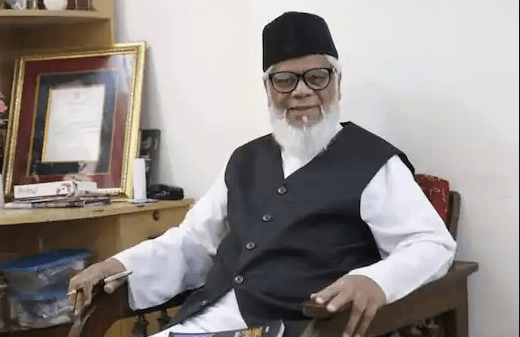
Well known educationist, intellectual, thinker and author of several books, Professor Anees Chishti has passed away in Pune at the age of 79. He was unsung hero of the community who made tremendous contributions in the progress of the community in the country. He will be also remembered for his dawha works as he translated Islamic literature into local Marathi language. He was a close confidant of late Maulana Abul al Hasan Nadvi who launched All India Tahreek e payam e insaaniyat with an aim to dispel misunderstandings about Islam. Chisty was one the pillars of this movement.
According to Anees Chishti’s family, he first suffered a heart attack and then later normal infected by COVID-19. During his treatment at Azam campus Unani hospital Pune He took his last breath and was buried on Monday, April 5, after Isha prayers at Muhammad Jamia Hussaini Masjid in the city.
As news of his demise spread, condolence messages flooded on social media. Many important personalities expressed their grief and sorrow who acknowledged the scholarly and social services of Anees Chishti.
Chisti was born on February 6, 1943 in Pune. His father Shakeel Ahmad was a freedom fighter. He was educated in Pune and Sholapur. Pune is considered the brain of Brahminical forces.
Expressing condolences on the demise of Anish Chishti, PA Inamdar administrator of Azam Campus Pune, said his demise is a great loss to the nation. He said that Anees Chishti was recognized as an authority in Islamic studies and science and literature.
Munawar Pir Bhai from Pune termed the demise of Anis Chishti as a great loss of the society and said that he was a very capable and intelligent person. Traveled to many countries, he had a keen eye on Islam and Allama iqbal. And he described the death of Anis Chishti as his personal loss.
Talha, nephew of Anees Chishti, said that after the death of Maulana Wali Rahmani, he had gone to Lucknow to meet Maulana Rabi Hasni Nadvi.
After returning from the trip, his health deteriorated and on April 5, at around 5.30 pm, he passed away. The personality of Anees Chishti was a person with various attributes. He was a member of the Majlis-e-Shura of Darul Uloom Nadwa tul Ulema, Lucknow and member of the, All India Muslim Personal Law Board.
He was very close to Maulana Syed Abul Hassan Ali Nadvi, a thinker of Islam, and he was the General Secretary of the All India Tahreek e payam e insaaniyat. The movement was launched in the backdrop of Babri masjid dispute which had been used by the communal forces to spread lies about Muslims and Islam in the country.
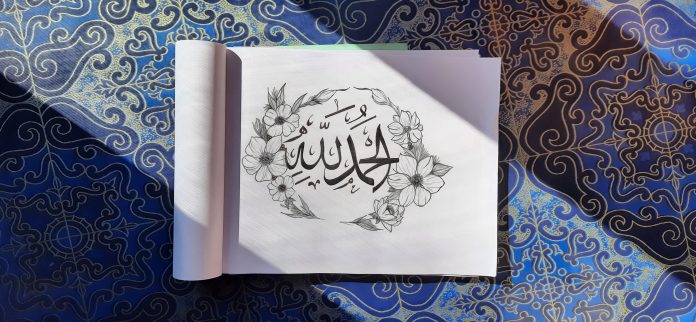
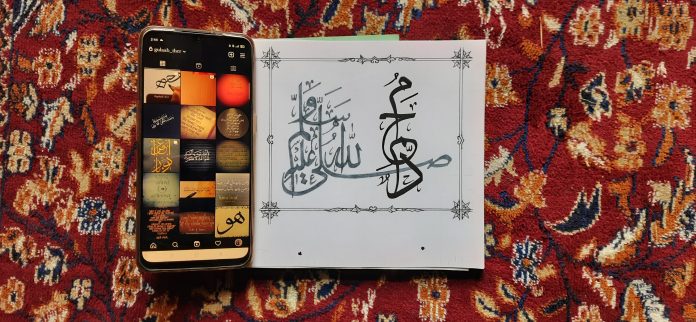
He was the author of many Urdu, Marathi and English books. His books have been translated into various languages. He was a connoisseur of calligraphy, a teacher of calligraphy, an Islamic scholar, and an educator. Apart from Urdu, many of his books have been published in Marathi.
Mirza Abdul Qayyum Nadvi, a bookseller and activist from Aurangabad, said that he had spoken to Anis Chishti two days before his death. More than 53 of his books have been published. Anis Chishti was fluent in many languages. These included Urdu, Marathi, Hindi, English, Arabic, Persian and other languages. He was a very good man, a man of knowledge, a good teacher, a good writer, a credible writer, an eloquent speaker, a guest lecturer on the panel of high-ranking training institutes. He has received numerous accolades for his books on education, and books on Muslim freedom fighters .and other books. In many countries, his Urdu and English language books are included in the Syllabus.
He trained soldiers at the Indian Institute of Education, College of Military Engineering Pune. He has delivered sermons and lectures on Islamic and scientific and literary topics in different parts of the country. He is survived by a daughter and four brothers. Arguably, his demise made the community further poorer as it was in the shocked after Muslim Personal Law Board General Secretary Maulana Mohammad Wali Rahmani in Patna just two days before.
source: http://www.muslimmirror.com / Muslim Mirror / Home> Indian Muslim / by Abdul Bari Masoud / April 07th, 2021
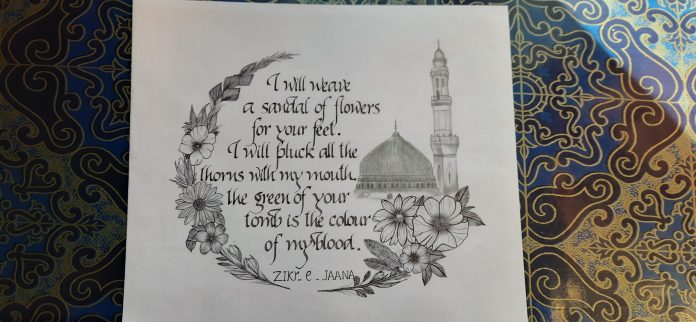
During Sultan Husain Shah’s reign, Mir Ali Haft Qalam came to Kashmir from Iran. He was a noted calligrapher. Bestowed with the title of Haft Qalam, Mulla Bakir Kashmiri was another famous court calligrapher of emperor Shah Jahan. Numerous Kashmiri calligraphers carried the legacy of calligraphy and passed it on to generations. Sobia Mushtaq is one such passionate lover of calligraphy.
Kashmir, which is often referred to as the land of Sufi saints, has always been famous for its rich culture and heritage. The values brought in by the scholars and saints hold great importance in the lives of the Kashmiri people. According to the Archeological Survey of India, one such art method i.e. calligraphy was introduced to Kashmir by the scholar saint Sharaf-ud-Din Bulbul in the fourteenth century A.D.
Despite the ongoing conflict and its severe impact on the mental health of the people, Kashmiri people continue to flourish with their centuries-old craft.
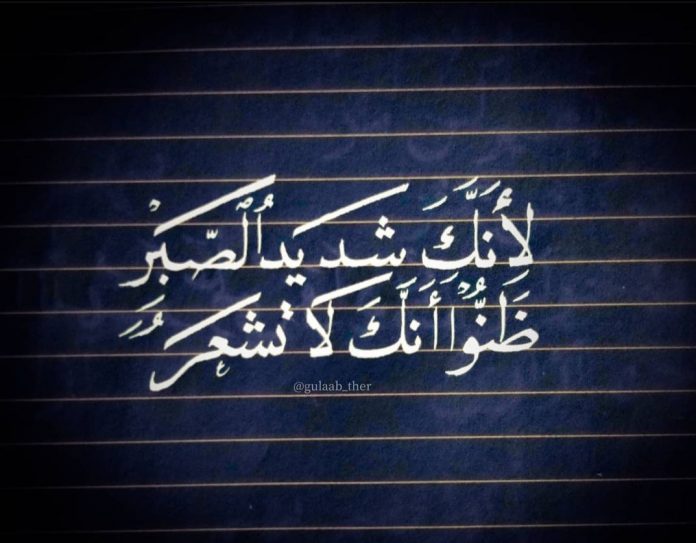
“The roots of Arabic calligraphy are strongly embedded in Kashmir. They connect us to our spiritual being,” says Sobia Mushtaq, a 23-year-old young calligrapher from the Bandipora district of North Kashmir. “Arabic Calligraphy is a way of connecting to God,” she adds.
Sobia started doing calligraphy when she was in 7th standard but had to leave it as studies took most of her time. Sobia says she was always passionate about the art of calligraphy. She completed her post-graduation in English last year and is currently preparing for competitive exams. After completing her PG, she decided to take up the art and started posting her calligraphy works on social media.
Soon people began to like her calligraphy and she started getting orders. She happily says, “People like my work and my family has always encouraged me to carry on with this artwork”. Whatever little money Sobia makes from her work, she buys pens, paint, ink and papers.
“Sobia has a thirst to learn everything about calligraphy. We are proud of her work,” says her sister. “She is passionate about her work. That is what brings sharpness in her writing,” her sister adds.
Sobia mainly does Arabic calligraphy. She used to make sketches but calligraphy is her main passion.
“Calligraphy enriches faith, connects me to the Quran. It helps me to strengthen my faith and draws me closer to Allah,” she says.
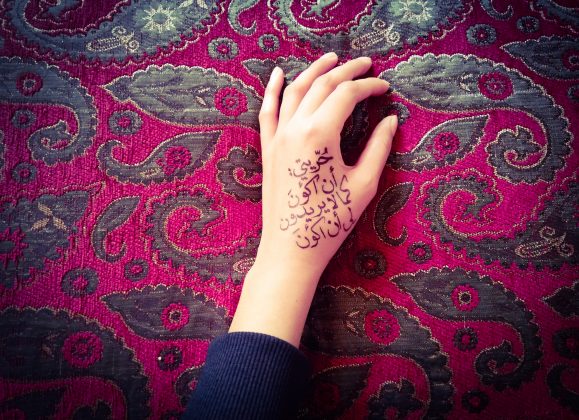
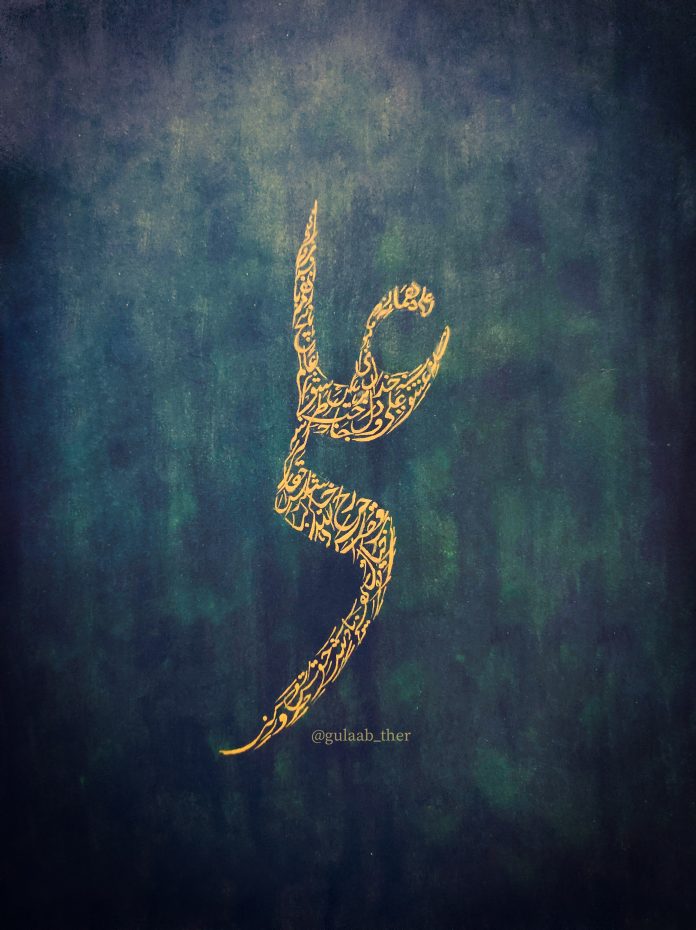
Sobia does name calligraphy, she likes to do calligraphy of resistance poetry, but her passion is in Arabic calligraphy.
With the emergence of technology, every design is a click away but, “what makes one a good calligrapher is practice and willpower.” Sobia opines, “The calligraphed artwork has its charm.” For Sobia, the smell of ink brings the hidden essence to the art.
Sobia, being a self-taught calligrapher says that she learns by practice and by seeing videos online but she is against plagiarism of artwork. “One should come up with something new. I have imitated and used the traditional techniques to convert them into modern calligraphy,” she said.
In one of the statements issued by the Archeological Survey of India, during Sultan Husain Shah’s reign, Mir Ali Haft Qalam came to Kashmir from Iran. He was a noted calligrapher. Bestowed with the title of Haft Qalam, Mulla Bakir Kashmiri was another famous court calligrapher of emperor Shah Jahan. Numerous Kashmiri calligraphers carried the legacy of calligraphy and passed it on to generations.
Arabic script and Kashmiri script are similar. “I write Arabic and with a slight change I write Kashmiri,” Sobia says while sharing her aspiration to do wall calligraphy in future. She wants to do calligraphy on the walls, tombs and shrines in Kashmir.
For Sobia, Arabic calligraphy is the best example of learning by doing.
Among many cultural artefacts that Mughal’s introduced in Kashmir, calligraphy is one of them. “These things are a part of our culture. Calligraphy is flourishing now and the young generation is inclined towards this art,” says Sobia.
The famous Spanish painter Pablo Picasso once said, “If I had known there was such a thing as Islamic Calligraphy, I would never have started to paint. I have strived to reach the highest levels of artistic mastery, but I found that Islamic Calligraphy was there ages before I was.”
Sobia says she does dual calligraphy combining modern backgrounds with Islamic calligraphy.
Frequent internet shutdowns in Kashmir have impacted every aspect of Kashmiri people’s lives.
“Under lockdown, we were not able to get our material and we were not able to deliver orders on the proper time, ran from ink and other items,” Sobia says.
Talking about the other side of the internet shutdowns, Sobia says that it helped her to focus more on her work. “This seclusion, without the internet, helped me to devote myself to this art,” she says.
Sobia wants the younger generation of Kashmiris to learn this art. “It tells us about our faith. Whenever I write down any verse, I search for the meaning and try to understand it before writing. This is how it enhances my faith,” she says.
The pens like kamish, bamboo, celi, java handam are expensive and none of them are available in her district. She usually orders her pens from a store in Srinagar, the summer capital of Kashmir. Elkhatt Store in Srinagar is the store that provides pens and ink for calligrapher lovers. Sobia proudly says that she started with a set of Rupees 200 basic pens and she still uses them.
“Tools don’t make an artist but the artist makes the tools,” Sobia says. Sobia lives in Bandipora and she hardly gets the paper there. Either she orders online or goes to Srinagar to get her calligraphy equipment.
“If one has the will they can do good calligraphy with the basic available resources. When people DM me asking about my art and the technique used, I happily share with them,” she says.
“The artists don’t reveal their secrets, but I think they should reveal the secrets so that this art could flourish and more people may come forward. If they share their art and secrets their art will propagate otherwise that will be confined to themselves. All it takes the practice and technique to handle the brush and tools,” she adds.
Sobia wants to open a calligraphy store one day. “It is important to get orders. This enhances confidence and also helps to get resources,” she says.
source: http://www.tcnpositive.net / TwoCircles.net / Home>TCN Positive / by Musheera Ashraf, TCNpositive.net / March 05th, 2021
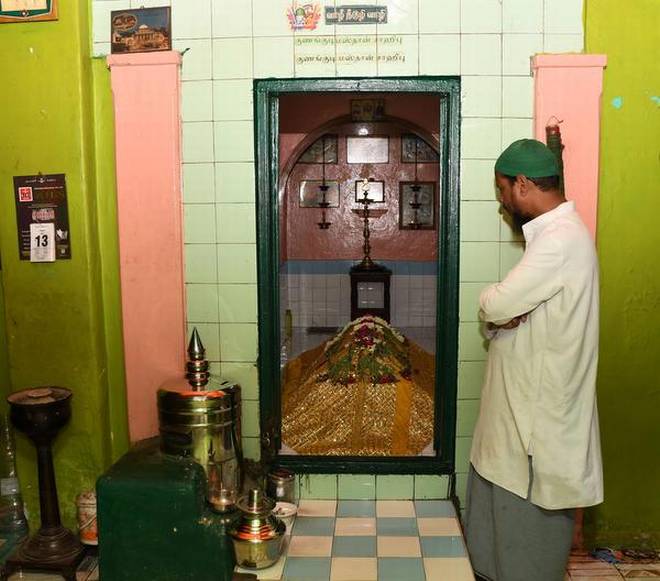
The Hazarath Gunangudi Masthan Sahib Dargah (Kunangudi Mastan Sahib Dargah) at Royapuram in Chennai | Photo Credit: B. Jothi Ramalingam
Written with a knowledge of grammar and aesthetics, their songs are immortal
If you think of the Muslim link to Carnatic classical music, Sheikh Chinna Moula and his descendants and disciples are the first that come to mind. In the 1970s, T.M. Abdul Azeez was a violin accompanist on the Carnatic platform. He is now settled in Kerala, where he teaches music. Abraham Pandithar’s Karunamirtha Sagaram (1917) lists a few Mohammedan names as performing artistes though it is difficult to fathom now if they were performing in the Hindustani or Carnatic styles.
Gulab Mantil is one — he claimed to be a descendant of Mian Tansen of Akbar’s Court and was under the patronage of the Sivaganga rulers. He was adept at various instruments. On Chottu Mian there is no information other than the fact that he was a good singer of Hindustani Music. Nannu Mian and Mirali are listed as brothers, who were noted for their skill on the dholak. Closer home, at Tondiarpet we have the dargah of Kunangudi Mastan Sahib who is propitiated with music of the Sufi variety.
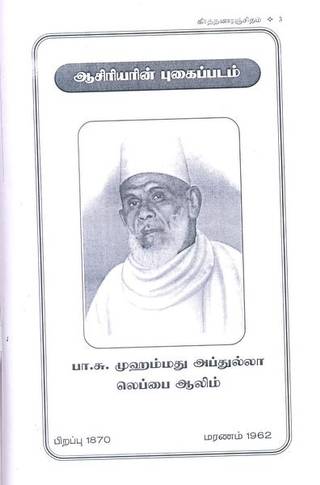
Given this background, it was a revelation when PAK Mohammad Sulaiman walked in with PS Ilyas of Kayalpattinam into the Music Academy a month or so ago. The latter had with him a precious possession — a fragile copy of a book published in 1909. Titled Kirtanaranjitham, it was a compilation of songs composed by his grandfather and Mohammad Sulaiman’s great grandfather, PS Muhammad Abdullah Labbai. It was printed at the Kalarathnakara Press, Madras.
Famous jeweller
A preface to the book gives details of the composer’s antecedents. His grandfather, Sheikh Sadakatullah was a Kazi (judge) at Kayalpattinam and had the privilege of moving about in a palanquin. That made him Pallakku Labbai to the locals. His son, Muhammad Suleiman Labbai got into the precious stone trade and his three sons, of whom the composer was the second, followed him into the business. The first and third sons set up offices in Colombo while Muhammad Abdullah Labbai (1870-1962), the composer, moved to Bombay. He made such a name for himself in the business that jewellers referred to him as Abdullah Jauhari. But his attachment to the dargah where the family prayed, the Shahibu Appa Thaikka at Kayalpattinam, was such that he eventually moved back to take care of it. He is also buried there.
Muhammad Abdullah Labbai has composed around 90 songs as per this book. It is also stated in the preface that the composer presented all of these at the dargah. What is interesting is that some of the songs are still being sung there, though the tunes have changed over time. The book sadly lacks notation (it must be remembered that notation in print was not common practice in the early 1900s). But ragas and talas are provided for every song. The popular ragas are all there, with preponderance for usage of Khamas, Mohanam and Kalyani. There are certain ragas that are not easy to identify. Names such as Desikam, Karnataka Desikam, Mohana Thodi and Nilakambodi are puzzling.
The composer was clearly well aware of the laws of composition and follows the requisites of prosody and alliteration. The language used is Manipravalam — a mix of Sanskrit, Tamil and Urdu/Persian. The bulk of the songs are in the usual kriti structure of pallavi, anupallavi and charanam. The last named are usually three and in some songs, four in number. The mudra of Abdullah appears in all the pieces.
Perusing the songs, you see all the familiar themes of Tamizh Padams — the lovelorn maiden yearning for union with the Supreme, the sending of messages to the divine via swans and companions, berating the Beloved for His heartlessness, and songs of surrender. Besides these, there are songs in the Thevaram format and some structured as Kannis. Certain songs are on specific locations where holy personages are buried, in the manner of kshetra kritis. These include Kayalpattinam, Manjakollai, Kizhakkarai, Saragam/Ervadi in Thirunelveli District, Cannanore in Kerala and Kandy in Sri Lanka.
The book follows the format for music publications of its time. There are benedictory verses in form of kappu, kanni and viruttam. Besides, like the ratha bandams that Tamil scholars of yore indulged in when patterns like chariots could emerge from the way they wrote verses, Muhammad Abdullah Labbai has worked on calligraphy by way of a Chithirakkavi Kattalai Kalithurai. His scholarship came in for praise from several Muslim men of letters, all of whom wrote verses in his praise, which were included in the first edition.
The 1909 publication was reprinted in 1963. This was done with the support of the family business in Colombo. Hussain Bhagavatar of the Panchalingapuram Jam’ath kept the songs in circulation for much of the 20th century. The descendants of the composer are now in the process of bringing out a new edition.
source: http://www.thehindu.com / The Hindu / Home> Society> Faith / by V. Sriram / June 14th, 2018
Khan was among the 21 cine personalities who were remembered during the ceremony’s ‘In Memoriam’ segment.
Late Bollywood actor Irrfan Khan (Photo | PTI)
Los Angeles :
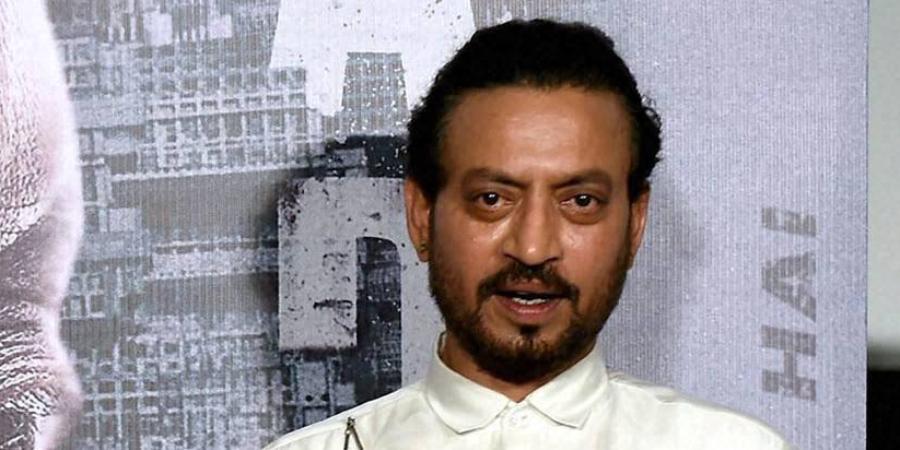
The 2021 edition of the Producer’s Guild of America (PGA) Awards honoured the late Indian star Irrfan Khan during its “In Memoriam” segment but got his name wrong.
The awards, considered as an Oscar bellwether, were held virtually on Wednesday.
Khan was among the 21 cine personalities who were remembered during the ceremony’s “In Memoriam” segment.
However, the pre-taped production of the awards committed a gaffe with the actor’s name as it read ‘Irrif Kahn’ instead of Irrfan Khan, reported Variety.
Another typo was spotted when the name of “Minari” star Steven Yeun, who was one of the presenters at the event, was misspelled as ‘Steven Yuen’.
Khan, who straddled both Indian and international cinema with equal elan, died in April 2020 at the age of 54 following a two year-long battle with a rare form of cancer.
In Hollywood, he featured in blockbusters such as “Inferno”, “A Mighty Heart”, “Life of Pi”, “Amazing Spider-Man” and “Jurassic World”.
The “In Memoriam” segment of PGA Awards also paid to tributes to Hollywood great Kirk Douglas, who died at the age of 103 in February 2020, and “Black Panther” star Chadwick Boseman, who passed away in August at 43 after a private four-year-long battle with cancer.
Other prominent names in the segment included Harry Bring, Sue Bruce-Smith, Allan Burns, Kevin Burns, Stuart Cornfeld, Charles Gordon, Buck Henry, Thomas L Miller, Tom Pollock, Rebecca Ramsey, Carl Reiner, Gene Reynolds, Pamela Ross, Ronald Schwary, Lynn Shelton, Fred Silverman and Jamie Tarses.
source: http://www.newindianexpress.com / The New Indian Express / Home> Entertainment> English / by PTI / March 25th, 2021
According to the INTACH’s listing of heritage structures in the national capital, Jharna was built around 1700 in which additions were made subsequently by later rulers of Delhi.
The tomb of Bijri Khan is located on the Venkateshwara Marg. (Photo| EPS)
New Delhi :
Two inconspicuous heritage sites Jharna, a Mughal era garden in Mehrauli and the Tomb of Bijri Khan in RK Puram are set to get a new lease of life.
The Indian National Trust for Art and Cultural Heritage (INTACH) will develop and promote these historical buildings, victims of urban sprawling, as venues for cultural and literary events under the ‘adopt a heritage scheme’.
The archaeology department of the Delhi government and INTACH have also signed a memorandum of understating (MoU) for regular upkeep and sprucing up of their surroundings. Vikas Maloo, head of office (archaeology), said that the department would soon start working on a plan to develop these site for events.
“We will determine what needs to be done apart from basic amenities such as pathways, installation of dustbins, and toilets. Some requirements are site-specific, which are to be ascertained. Hopefully, both the places will be available for the events soon,” said Maloo.
According to the INTACH’s listing of heritage structures in the national capital, Jharna was built around 1700 in which additions were made subsequently by later rulers of Delhi.
The walled garden earned its name from a waterfall, which was constructed to drain off excess water from Shamshi Talab located in its vicinity. Mughal kings Akbar Shah II and Bahadur Shah Zafar added two pavilions to the place.
The Lodi-period mausoleum of Bijri Khan is located at a raised mound along Venkateshwara Marg. Khan was probably a noble. Apart from this fact, no significant information is available about the tomb and the person buried at the site. The grave inside the sepulchre has no inscription.
As per the MoU, the sites, once ready, will be available for cultural events and activities such as Sufi musical recital, poetry symposiums, book readings, theatrical plays and also for products launches. The officials, in the know of the matter, said that INTACH will tie up with different organisations and corporates for their better maintenance and create awareness about their significance.
“The idea is to promote and bring more footfalls to small monuments. The events, majorly connected with culture, will pave the way for their popularity. They can be utilised for art exhibitions, book launches, musical programmes, and other purposes. Corporates can be roped in to run a cleanliness drive etc. The association will result in their better upkeep and make people more aware of the heritage of Delhi,” said Ajay Kumar, project director, INTACH (Delhi chapter).
The sites will be available for corporate or private events on nominal charges. INTACH will ensure proper illumination and facilities such as a sitting area, benches, kiosks for refreshments, and signage or information panels about the history of the site.
source: http://www.newindianexpress.com / The New Indian Express / Home> Cities> Delhi / by Parvez Sultan, Express News Service / March 21st, 2021
Marakkar Arabikadalinte Simham director Priyadarshan is a proud father as his son Siddharth Priyadarshan bagged a National Award for Best Special Effects in Mohanlal-starrer.
Marakkar Arabikadalinte Simham is directed by Priyadarshan. (Photo: Mohanlal/Instagram)
The team of Marakkar Arabikadalinte Simham is in a celebratory mode as the Mohanlal-starrer won Best Feature Film award, Best Special Effects award and Best Costume award at the 67th National Film Awards ceremony, which took place in Delhi on Monday.
The actor dedicated the National Award “to the glory of the Indian Navy.” The Malayalam superstar celebrated the win with his team and shared the pictures on his Instagram account.
Expressing his emotions, the 60-year-old said, “Hearty congratulations to all the National Award winners. Happy and elated to hear the fantastic news…. Marakkar- Arabikadalinte Simham (Marakkar – Lion of the Arabian Sea) has bagged the National Award for best feature film.
My Congratulations to Team Marakkar and the Captain of the ship priyadarshan for this honour. My sincere thanks also to all who supported us on this labour of love. I join Aashirvad Cinemas in celebrating this award and dedicate it to the glory of the Indian Navy.
Dedicating this overwhelming moment to all such fathers out there in the world aspiring to see their children being succesful and happy. Thanks @Mohanlal, @antonypbvr, Team Marakkar and to all those who supported me . 2/2
For the filmmaker Priyadarshan, the win was also a moment of pride as a father as his son Siddharth Priyadarshan won an award for Best Special Effects. Overwhelmed with the win, Priyadarshan dedicated the awards to all fathers who aspire to see their children achieving success.
“It is an affectionately proud moment for any father to see his children getting recognised for excellence in their chosen field of activity. Dedicating this overwhelming moment to all such fathers out there in the world aspiring to see their children being succesful and happy. Thanks @Mohanlal, @antonypbvr, Team Marakkar and to all those who supported me,” the director tweeted.
Suniel Shetty, who played a pivotal role in the film, said that he is “super proud to be a part of this National award winning film.” Celebrating his very first “National Award-winning film,” Suniel thanked Priyadarshan, Mohanlal and the entire team of Marakkar- Arabikadalinte Simham.
“Big big congratulations to my baby, Chandu, Sidharth Priyadarshan for winning the award for the Best VFX. Once again congratulations Team @MarakkarMovie,” he concluded.
Marakkar Lion Of The Arabian Sea stars Mohanlal as a decorated commander in Zamorin’s naval force. The film also stars Pranav Mohanlal, who plays the younger version of the superstar.
The film, made at an estimated cost of Rs 100 crore, also stars Prabhu, Manju Warrier, Keerthy Suresh and Kalyani Priyadarshan among others.
source: http://www.indianexpress.com / The Indian Express / Home> Entertainment> Malayalam / by A. Kameshwari, New Delhi / March 24th, 2021
Arif Shaikh had a long stint as a journalist with over 40 years of experience in Marathi, English, Urdu and Hindi journalism.
Aurangabad :
Veteran English and Urdu Journalist Arif Shaikh passed away in a private hospital following a brief illness here on Monday evening, family sources said.
Shaikh was 70 and is survived by his wife, two sons and a daughter.
Shaikh’s last rites were performed at the Masjid Ganje Shaheedan late on Monday night, followed by his burial at the Ganje Shaheedan cemetery.
Shaikh had a long stint as a journalist with over 40 years of experience in Marathi, English, Urdu and Hindi journalism.
He started his career in 1970 with Ajintha Daily, and worked in Marathwada, Aurangabad Times and United News Of India before joining the Indian Express in Mumbai, where he worked for over 15 years.
Later, he joined the Mid Day in Mumbai besides working with Hindi Daily Citizens. He also launched an English language weekly, Public Express, in Aurangabad.
Shaikh was the recipient of many state and district level awards for excellence in journalism. — IANS
source: http://www.clarionindia.net / Clarion India / Home> India> Indian Muslims / by IANS / March 09th, 2021