Board chairman Moulana Sahfi Saadi said that the Wakf Board has decided to bring awareness among people of the Muslim community on the importance of getting education.
Image used for representational purposes (File | EPS)
Kalaburagi :
The Karnataka Waqf Board has decided to establish 10 degree colleges for women at 10 places across the state, including Kalaburagi, Yadgir and Raichur districts, said board chairman Moulana Sahfi Saadi on Sunday.
Addressing a press conference here, Saadi said that the Waqf Board has decided to bring awareness among people of the Muslim community on the importance of getting education.
To prepare youths from the Muslim community to face competitive examinations, including IAS and IPS, the Waqf Board is also constructing a well-equipped coaching centre for which it has acquired 30,000 sqft land near Lal Bagh in Bengaluru.
The foundation stone for the centre will be laid in June. Philanthropist Jiya Ulla Sharif has announced to donate Rs 15 crore for the centre.
“The government has sanctioned Rs 2.5 crore for the construction of a degree college and hostel in Tumakuru,” he said. To a question, he said the Waqf Board will conduct a survey of the new properties of under its purview shortly.
source: http://www.newindianexpress.com / The New Indian Express / Home> State> Karnataka / by Express News Service / May 30th, 2022
The couple decided to donate its 28-cent ancestral land to LIFE Mission, the Kerala government’s flagship housing scheme for the landless.
Haj (Photo | PTI)
Pathanamthitta :
Aranmula residents Jasmine and Haneefa were making arrangements for their long-cherished dream of going on haj and were prepared to sell their land to raise funds for the trip when they had second thoughts.
Instead, the couple, married for over three decades, decided to donate its 28-cent ancestral land to LIFE Mission, the State government’s flagship housing scheme for the landless.
The couple’s decision came after it saw the plight of a neighbour-family living on a rented premises and found it difficult to cremate the body of a family member who died recently.
“We were planning to sell our property and use the funds for haj pilgrimage. But, in the past couple of months, we saw some incidents in which certain families find it difficult to cremate their family members as they don’t own a property. Such incidents made us rethink our Haj plans,” Haneefa told PTI.
He said recently, a person passed away in his locality and a community leader donated his four cents of land to that family to conduct last rites and cremation.
“After that incident, we decided to make use of the land to help the needy instead of going for haj,” Haneefa said.
Local Self-Government Minister M V Govindan hailed the decision of the couple and said it was an inspiration to society.
Minister Govindan said the couple was an inspiration to the forward journey of society which needs to embrace every human being.
“People like Haneefa and Jasmine have set an example of humanity and are role models for society,” Govindan said.
Health Minister Veena George on Sunday visited the house of 57-year-old Haneefa and received the agreement to hand over the property for the Life Mission from the couple on behalf of the Aranmula Grama panchayat.
The land, owned by 48-year-old Jasmine, was received under the ‘manasodithiri mannu’ campaign of the Left government, Govindan said.
“Till now, the government has received 926.75 cents of land in 13 locations for the Life Mission scheme. Also in 30 locations, 830.8 cents of land have been assured for the Life Mission. The project has also received a sponsorship of Rs 25 crore to construct 1,000 houses,” the Minister said.
Govindan said he hopes more people would come forward to help the poor and draw inspiration from the couple.
The Left government has till now handed over 2,95,006 houses to beneficiaries under the Life Mission scheme, he said.
He also added that 34,374 houses are currently under construction.
There are 27 housing complexes that are also under construction, he said.
source: http://www.newindianexpress.com / The New Indian Express / Home> Good News / by PTI / May 29th, 2022
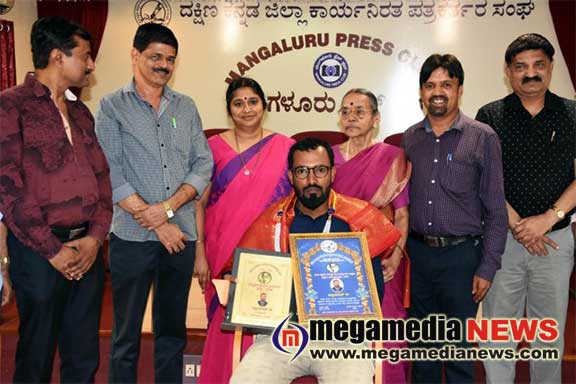
Pa Gopalakrishna Memorial Award 2018 for ‘Best Rural Reporting’ was presented to Journalist Imtiaz Shah Tumbe at Patrika Bhavan.
His article on Kodagu natural calamity, published in Vartha Bharati, was selected for the award.
Shah, a sub-editor in Vartha Bharati, said he had stepped into the field of journalism without any proper background. He said his parent organisation had honed his skills and provided him with an opportunity. “I feel privileged to receive the award.”
Dakshina Kannada District Information and Public Relations Senior Assistant Director K Rohini presented the award to Shah.
Speaking on the occasion, Rohini said the family members of veteran journalist late Pa Gopalakrishna, who had instituted the award, had set an example for others.
DK District Working Journalists’ Association Srinivas Indaje presided over the programme. Secretary Ibrahim Adkasthala, Mangaluru Press Club President Annu Mangaluru, Patrika Bhavan Trust President K Ananda Shetty, Pa Go’s spouse Savitri and senior journalist Manohar Prasad were present.
source: http://www.megamedianews.com / MegaMedia News / Home / March 02nd, 2019
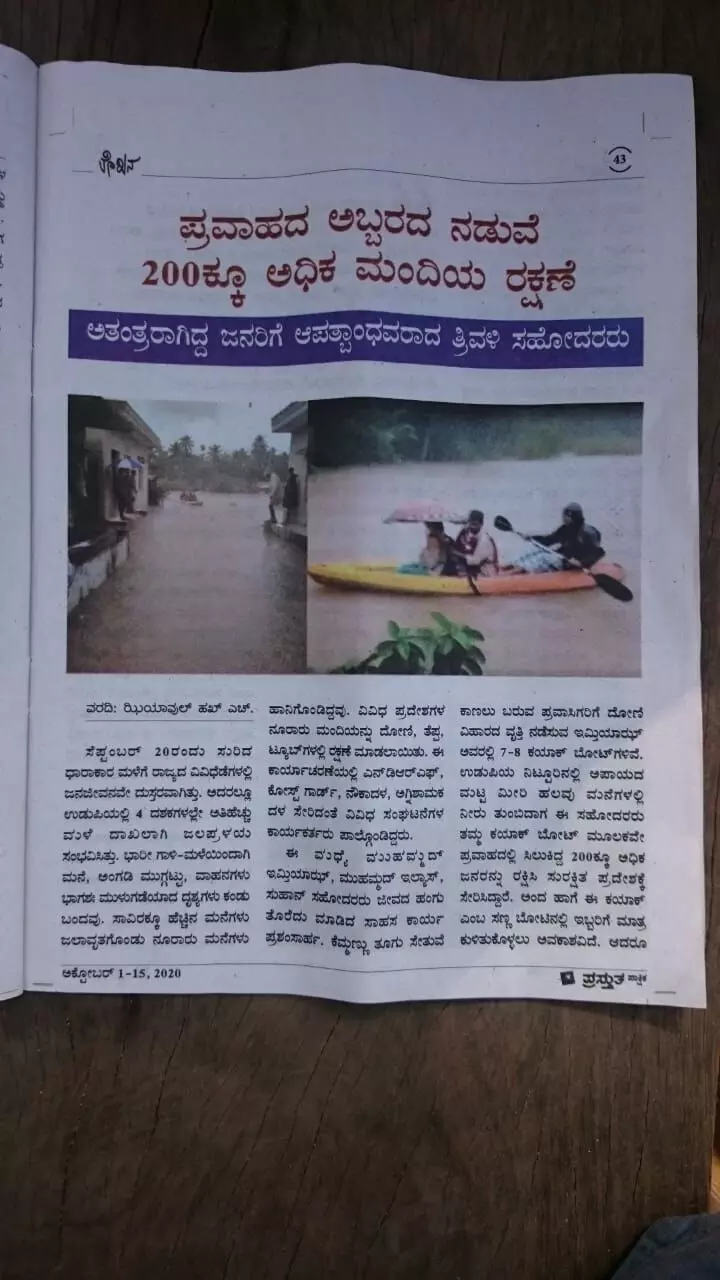
Imtiaz rescued 250 people from floods on his kayak last year, making him an instant hero in Udupi. However, this also led to a run-in with some local influential Hindus.
Udupi (Karnataka):
When Imtiaz brought his kayak home to Udupi’s backwaters from Oman two years ago, he thought it would make it easier for him to relax in the evenings.
Little did he know of the midnight call he would receive on 20 September, 2020, and how his kayak would save the lives of 250 people – but also land him in trouble with some local influential Hindu groups.
Last year, the district of Udupi witnessed the worst floods in 36 years. Thousands of houses were washed away or inundated as incessant rains led to the swelling of the Suvarna river. Imtiaz, whose house is a few feet away from the bank of the river, will never forget that night.
“It had been raining for two days. At 2 am, we saw the river embankment had broken. That’s when we realized this was no ordinary storm. We waded to our boats, tied them up as best we could, and tried to get some sleep. At 3 am, I got a frantic call from the city. There was a man on the other side who said 15 people were trapped in a house and begged me to rescue them,” he said.
Imtiaz had never done any rescue work before. Before that night, the 34-year-old had spent time as a labourer in the Gulf and was a small-time shopkeeper in Udupi, offering coconuts and soda to tourists. The only reason why he had received the SOS call in the first place was that it was known among locals that his kayak would have been anchored somewhere near the Kemmanu hanging bridge.
According to Imtiaz, he was the first person to start kayaking in Udupi, even though now he has company. “
My brother and I took two kayaks and rescued 250 people between 4 am and noon that day. We had to row through such difficult places – trees had fallen onto the water – that no engine boat could have gone there,” said Imtiaz.
An NDRF team from Mangalore, whose engine boat had got stuck in the water, was also returned to shore by Imtiaz and his brother.
“Two aged people were clinging on to the roof, water had reached up to their shoulders. It took me 45 minutes to get them onto my boat,” related Imtiaz.
When Imtiaz and his brother finally came to the shore after eight hours of rescue work, Udupi MLA Raghupati Bhat and some other officials were at the spot to congratulate him.
However, when reports of his efforts came out in the newspaper the next day, Imtiaz was surprised to see that it was mentioned that his kayak had been donated by a local temple committee.
“The newspaper people must have done it for publicity. My brother sent a WhasApp message to his friend saying that the paper had made false claims, which became viral. Then the people from the temple committee came to my house and threatened me. I said sorry just to get it over with,” said Imtiaz.
On November 1, Imtiaz received the Rajyotsava award – Karnataka’s second highest civilian honor – from the Chief Minister for his bravery. An event was organized in his honour in Udupi. A poster set up for the function currently lies torn behind a bush in front of Imtiaz’s house.
“I just want to run my business, being a hero cannot be my day job,” he said.
FULL STORY + SHOCKING IMPACT IN THE END | 200+ Life saved in Kayak | India Udupi |Kemmannu Channel / source: YouTube.com
source: http://www.thebridge.in / The Bridge / Home> Others / by Dipankar Lahiri / December 29th, 2021
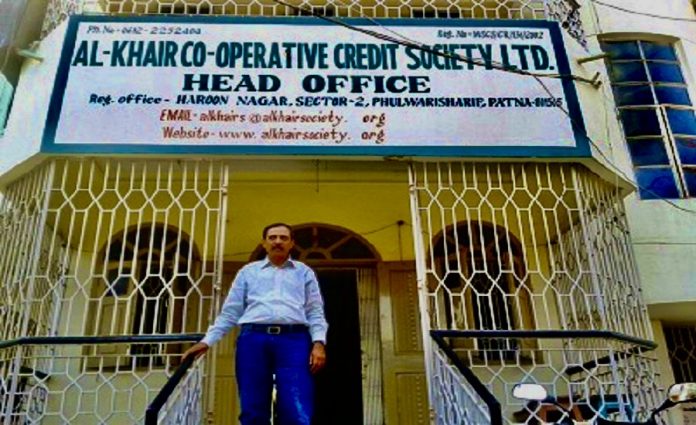
Head office of Al-Khair Society in Patna, Bihar. | Picture: Clarion India
Headquartered in a small building in the state capital Patna, Al-Khair Co-operative Credit Society, with thirteen branches in four states, has transformed lives by loaning money to low-income groups at zero interest rate.
Patna (Bihar) :
For 18 years, 51-year-old Kamala Devi used to sell vegetables at her small shop in Patna, Bihar, to support her family. The business wasn’t doing well and when in need of cash she would borrow money from a local lender at a 20 percent interest rate per month. Paying back this money at this interest rate was an extra burden. She found a way out when she came to know about the Al-Khair Co-operative Credit Society, a registered society based in Patna that loans money to low-income groups at zero interest rate.
In 2012, she borrowed Rs 10,000 from Al-Khair with zero interest and a one-time nominal service charge. With this money, which she had to repay by easy installments of Rs 50 per day, Devi started selling readymade garments at her shop. Her business improved. She paid back the loan amount in one year. Happy with the result, she took two more loans to expand her business.
“I am planning to borrow Rs five lakh from Al-Khair after repaying a loan of three lakh twice in the last three years. My goal is to further expand my business with the help of my elder son,” Devi told TwoCircles.net.
Besides lending her money to help her business, Al-Khair also loaned her money to buy a laptop for her younger son, who works in a private company.
“My family is settled now and our days of hardships are over,” she said.
Devi is one among 29,000 members of Al-Khair Co-operative Credit Society, a registered body under the Multi-State Co-operative Society (MSCS) Act 2002.
The society has 13 branches across Bihar, Jharkhand, Uttar Pradesh and New Delhi. Its beneficiaries include vegetable vendors, ready-made garments shopkeepers, medicine shop owners and Dhaba (eatery) owners etc.
Launched in 2002 by Arshad Ajmal (then chairman of Al-Khair Charitable Trust), Dr Badurl Hoda, Syed Shamim Rizvi and a few others, it employs 125 people as its staff. The need for such a society was felt after a detailed survey in 2001 conducted by S.B. Sinha, a Harvard University expert, revealed that “only 10% of people who were in need of loans had access to commercial banks.”
In order to become a member, one is required to buy at least 10 shares of Rs 10 each.
Managing Director of Al-Khair Naiyer Fatmi told TwoCircles.net that “Al-Khair has disbursed loans of Rs 113 crores since its inception.”
Fatmi said that they levy a one-time service charge ranging from 3.5 to 8.5 per cent.
Helping hand to low-income women during pandemic Nearly 35 percent of Al-Khair’s members are women. In 2012, Al-Khair started a branch in Mahendru, Patna that is run entirely by women. 42-year-old Shama Parween of Dargah Shah Arzan neighborhood is a member at this branch. She runs a small eatery near a school in Sultanganj, Patna.
In 2019, she became a member of Al-Khair by depositing Rs 500 per month from her husband’s savings.
“During the countrywide Covid-19 lockdown in March 2020, managing our household expenses became difficult as there was no work,” Parween, a mother of two daughters, told TwoCircles.net. As she was a member of Al-Khair, it only took a week for her to avail a loan of Rs 25,000.
She said she found it easier to repay the loan as the field staff from Al-Khair collected Rs 100-200 every day from her.
The hassle-free loans offered by Al-Khair, which take around two weeks to disburse after submitting basic documents, are popular among low-income groups. Its door-to-door system of collection is also found to be a matter of ease for its members.
Rajesh Sahu, from the Madhubani district of Bihar, is a vegetable vendor in Gomti Nagar, Lucknow in Uttar Pradesh. In 2012, he started his small shop with a loan of Rs 3000 from Al-Khair.
Sahu told TwoCircles.net that he was introduced to Al-Khair by his brother-in-law who was a beneficiary. “There is no hassle with Al-Khair. They don’t ask for too many documents and their charges to disburse loan is reasonable unlike where interest is charged which gets compounded,” he said. He is currently repaying his loan of Rs two lakhs, which he had taken in March this year, by depositing Rs 800 to 1000 every day.
Despite its popularity, Al-Khair is finding it difficult to increase its number of branches. The last branch was opened in 2014 at Jamia Nagar, New Delhi which remains its only branch in the national capital.
Fatmi said they have been waiting for almost five years for approval to open their five new branches, which include three in Bihar and two in Jharkhand. Earlier, the decision to open any new branch under MCMS Act lay with the Board of Society, Government of Bihar but after the demonetisation in 2016, the authority was delegated to Registrar, Co-operative in New Delhi under the Central government.
“Our application is lying with them from 2016. We just hope that it gets approved,” Fatmi said.
Sami Ahmad is a journalist based in Patna, Bihar. He tweets at @samipkb
source: http://www.twocircles.net / TwoCircles.net / Home> Lead Story / by Sami Ahmad, TwoCircles.net / May 26th, 2022
One such is a miniature version that can be worn as an amulet
Ramzan marks the revelation of Koran and families go into a huddle reading it through the night. The Abul Kalam Azad Oriental Research Institute in Public Gardens is now hosting an exhibition of copies of some rare Korans.
One of them has been created in Hyderabad with Persian and Urdu translation and explanatory passages on the side. Another Koran is a miniature version which could be worn as an amulet. “This is among the 5,000 Koran amulets commissioned by Hasan Nizami, a legatee of Nizamuddin Aulia of Delhi. It is a priceless object as very few are in circulation,” informs S.M. Ahmed Ali of the institute.
Then there is a Koran which is a gift of Reza Shah Pehlavi, first Shah of the House of Pahlavi of the Imperial State of Iran, when his wife visited the city in 1960. It has the Persian translation along with the Arabic original.
A few facsimile copies show how different writing styles have evolved. A 7 th century Koran in Kufic script is without the diacritical marks. “This is one of the earliest copies and unique. It will be difficult to read as we are used to seeing the sound markers,” adds Mr. Ahmed.
source: http://www.thehindu.com / The Hindu / Home> News> National> Telangana / by The Hindu Bureau / Hyderabad – April 14th, 2022
By directly procuring ingredients such as wheat, raggi, millets and almonds needed for products directly from farmers, Shamila ensures a profit for them as well.
Shamila with her husband Muhammed Shahabaz
Ernakulam : :
With adulterated food posing a serious hazard, staying healthy now depends as much on trustworthy sources as on a balanced diet. Worried parents face a difficult time trying to get their children to eat nutritious food.
Doctor-turned-entrepreneur Shamila Shahabaz, 30, is aiming to make life easier for such parents. ‘Mama Papa Zay’, Shamila’s venture, aims to provide a variety of fully homemade and preservative-free products for children, right from eight months old. By procuring ingredients like wheat, ragi, millets and almonds directly from the farmers, the venture is earning profits for them as well.
“The idea struck me when I became a mother,” said Shamila, who is also a certified child nutritionist.
“People, generally, don’t have the habit of reading labels and ingredients before buying a product. This should change. You will stop buying so many products just by reading the ingredients list such as added sugar, artificial flavours and preservatives. It shocked me too and I wondered what to feed my baby. When I started sharing my recipes on social media after my pregnancy, people asked me whether I could make the products myself on a larger scale. Now we are getting orders from all over the world.”
Local farmers are benefiting greatly from Shamila’s initiative. “Kannankaya is the key ingredient used to make banana powder. We have a few local farmers cultivating it, and we directly deal with them. Shops charge Rs 35-40 per kg for the fruit. We pay Rs 20-25 directly to the farmers, who thus get a better deal than selling their produce in the market. Millets, ragi, nuts and other ingredients are similarly sourced from farmers in Salem and Mysuru,” said Mohammed Shahabaz, Shamila’s husband.
“We are playing a small part in trying to transform our society’s health as a whole, by cultivating healthy food habits. This is just a small step, we hope to be known as a trustworthy source of nutritional food for children. Young mothers should never find themselves in the quandary I was in, to identify unadulterated baby food,” said Shamila.
source: http://www.newindianexpress.com / The New Indian Express / Home> Good News / by Anuja Susan Varghese, Express News Service / May 22nd, 2022
A view of the dargah of Moinuddin Chishti in Ajmer
Ajmer’s dargah of Moinuddin Chishti is undergoing massive restoration work
The dargah of Moinuddin Chishti, fondly remembered as Khwaja Garib Nawaz, or the benefactor of the poor, in Ajmer, will, in two years’ time see a restoration and an incorporation of modern facilities. Considered a holy place of hope, where people from different denominations believe their prayers will be answered, the dargah was built in the 13th century. The tomb was constructed in wood, later covered with a stone canopy. In 1579, Akbar reconstructed the sanctum sanctorum and built the dome. It was renovated in later years by Jahangir, Shah Jahan, and Jahanara.
The project, a part of the CSR wing of Hindustan Zinc Limited, is headed by architect Surbhi Gupta, a heritage management consultant. At present, the dargah that was organically built with various materials, ranging from brick and marble to sandstone, is seeing restoration and redevelopment of the interiors of the Mehfil Khana, widening of gates, structural consolidation, facade work in the courtyards, cleaning of stone surfaces, and new terracing in lime concrete.
“There is no single language of design or material as the dargah was never planned systematically,” says Surbhi, working on one of the most important pilgrimage sites of South Asia with members of her studio Rasika that specialises in heritage management.
The square structure of the royal darbar (Mehfil Khana),was built in 1888 AD. She says it “has been painted over as a part of living tradition. The idea is to bring out its character as a space meant for performances. The architectural character needs to be revived to bring back the original identity of the structure. The patterned ceiling will be designed on the lines of Kashmiri Khatambandh (a woodwork ceiling with a carved geometric pattern), and Mughal stone inlay flooring,” says Surbhi.
Work is also going on at the famous Shahjahani Gate, built by the Mughal emperor Shahjahan to mark the expansion of the dargah complex beyond the Buland Darwaza.
The project — under the Swacch Bharat Abhiyan — also revolves around sanitation, cleanliness, and waste management within the dargah’s periphery. The work entails providing clean drinking water for pilgrims, building toilets, and kiosk management.
“Every day, seven tonnes of rose petals are wasted. For the flower-waste disposal, a compost waste converter has been installed.” As the Khwaja was known far and wide for his large-heartedness and hospitality, the dargah distributes degh ka khana (food from a cauldron) comprising rice, almonds, cashew nuts, raisins and ghee. “The food is prepared in two big deghs , which were made during Mughal emperor Akbar’s reign. A retort packaging machine (sterile packaging of plastic and foil) has been installed to increase the shelf life of food from three hours to three months.”
Feeding into the Swacch Bharat Abhiyan, Surbhi says that her team is working on the revival of wudu (Islamic ritual purification) points so that pilgrims can wash their hands, face and feet before offering namaz. Right now, the overflow leads to a cesspool of water. “We are also building newer ones that are aesthetic as well as functional,” says Surbhi, who from her days in college at CEPT, Ahmedabad, has been interested in heritage structures.
She chose Chunnamal ki haveli in Old Delhi, as a research project. “On the ground floor were shops, first and second floors were residential spaces. It had five chowks (internal courtyards). And it was built as an organic edifice over many decades during the 18th century,” she says.
Meanwhile, she hopes to look at the parts around the dargah. “The approach street is famous for food, craft and gota work done on the chadar laid at the dargah by devotees. We have proposed a facilitating centre that includes a large shopping space, kiosk, and toilets inside the complex,” she says.
source: http://www.thehindu.com / The Hindu / Home> Society> History & Culture / by Madhur Tankha / Septemeber 03rd, 2019
Samajwadi Party leader Azam Khan is greeted by supporters after his release from jail in Sitapur on May 20, 2022. | Photo Credit: PTI
Supreme Court had invoked Article 142 to grant him interim bail
The Uttar Pradesh police’s efforts to keep Samajwadi Party stalwart Mohd Azam Khan in custody were interrupted as the SP leader walked out of the Sitapur Jail on Friday after more than two years in custody.
While invoking its powers under Article 142 of the Constitution of India to grant him the relief, the Supreme Court had outlined the circumstances under which Khan was implicated in the 88th FIR against him.
To begin with, the court noted that even though this FIR was registered in March 2020 and a charge sheet filed, the U.P. police did not consider implicating Khan in the said case until the Supreme Court started hearing his case this year.
Moreover, the court also noted that while opposing interim bail to Khan in this case, the police had alleged that he had threatened the investigating officer of the case. However, it also pointed out the “sheer coincidence” in the timing of this threat, which was registered by the police as a General Diary entry at 3:04 a.m. on May 17, only hours before the top court was to hear the matter.
Noting that Khan was implicated in this case 1 year and 7 months after a charge sheet had been filed, the court said, “It is not as if that the allegations which are now sought to be made against the petitioner (Khan) could not have been made at that point of time.”
When Khan had approached the Supreme Court earlier this year, there were 87 criminal cases pending against him, of which he had secured bail in 84. As the top court started hearing his plea regarding the delay in bail being granted in the remaining three cases, he was further granted bail in two of them, leaving just one more case for him to get relief in as of the beginning of May.
It was at this point that the U.P. police acted to implicate Khan in the 88th case, where he was not an accused or suspect till May 5, when the police first requested to summon him in the case. As the Supreme Court was told on May 6 that the Allahabad High Court would soon deliver its judgement in the last remaining case, the Additional Chief Judicial Magistrate (Rampur) on the same day passed an order remanding Khan in custody in the 88th case.
While hearing Khan’s case last week, the Supreme Court had also noted a pattern in the police action against him, orally pointing out that the 9-time SP MLA was being arrested in a fresh case every time he was granted bail in a previous one to prolong his incarceration.
Khan, once among the most powerful ministers in the SP-led U.P. government, faced a barrage of FIRs soon after the Bharatiya Janata Party came to power in 2017, the first of which came on allegations of forging his son’s birth documents. The bulk of the FIRs (81 out of a total 88) then came in 2019, immediately before and after the Lok Sabha elections that year, all in quick succession.
As per the most recent election filing in 2022, charges have been framed against Khan in just 14 of the 88 cases.
Therefore, considering that he had been granted bail in 87 cases and the circumstances under which he was implicated in the 88th case, the Supreme Court invoked its power under Article 142 for the second time in two days to grant interim bail to him.
The top court had just a day before invoked the same powers to free Rajiv Gandhi-assassination convict A.G. Perarivalan.
Article 142 gives the Supreme Court sweeping powers to pass any such orders or decrees as it may deem fit in the interest of ensuring that “complete justice” is done in any cause or matter pending before it.
These powers are rarely invoked by the court and it has done so notably in its Ayodhya-Ram Janmabhoomi land dispute judgement in 2019, in 1989 while asking Union Carbide to pay $470 million in compensation to Bhopal gas tragedy victims, and in 2016 while banning the sale of liquor within 500 metres of state and national highways in a bid to curb driving accidents.
source: http://www.thehindu.com / The Hindu / Home> News> National> Other States / by Abhinay Lakshman / New Delhi – May 20th, 2022
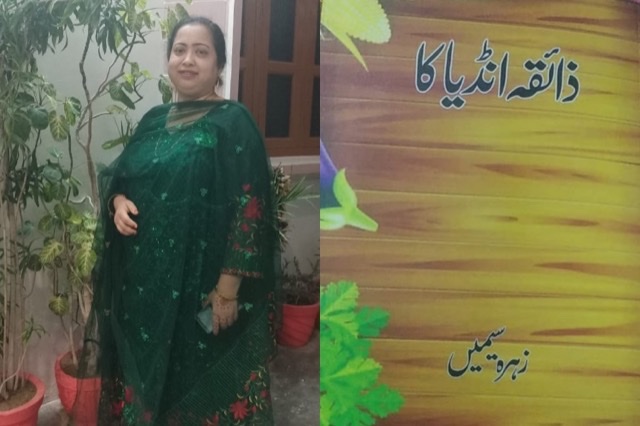
Zohra Seemee(L), her recipe book “Zaykah India Ka”
The month of Ramazan has entered its last leg and thus it is possible that the items on the Iftaar table at dusk must be getting mundane. Here, Awaz-the Voice spoke with Zohra Seeme, author of “Zaykah India ka” and founder of NGO Social Pride Welfare Society about how to pep up the Iftar platter for the family.
“I learnt cooking after I got married..”, was Zohra Seeme’s reply to how and when she learnt how to cook. Zohra said as shewas distributing ration on behalf of Mahila Panchayat (an NGO she collaborates with) to the needy when Awaz the Voice reached her for a tete-a-tete.
Here’s her top dishes that can be tried this Ramazan:
Potato-Chicken Patty: potatoes boiled and mashed properly are used as a base that are then filled with minced meat of either chicken or mutton. Minced meat or keema that is prepared by roasting it with bare minimum spices and a dash of onions till cooked properly.
Chane ki dal ke pakodas with Keema (Gram flour fitters filled with minced meat): preparing the gram flour dough by kneading it with a bit luke warm water, add salt to taste, take small portion, roll it flat, fill it with minced meat (as done with potato chicken patty) and just deep fry it or bake it (whatever suits you best).
Zohra says, “I was the youngest at my place, thus I never touched a thing, but after I got married, my partner ate less but rich food, thus my journey of preparing food started..” “I don’t particularly follow any book, I believe in intuition rather..”, she replies when asked about her mantra behind the delicious recipes.
She adds, “I make up mind as and when I enter the kitchen, I try to think of flavours in my mind and when they click, I try to lay them on the dining table..”
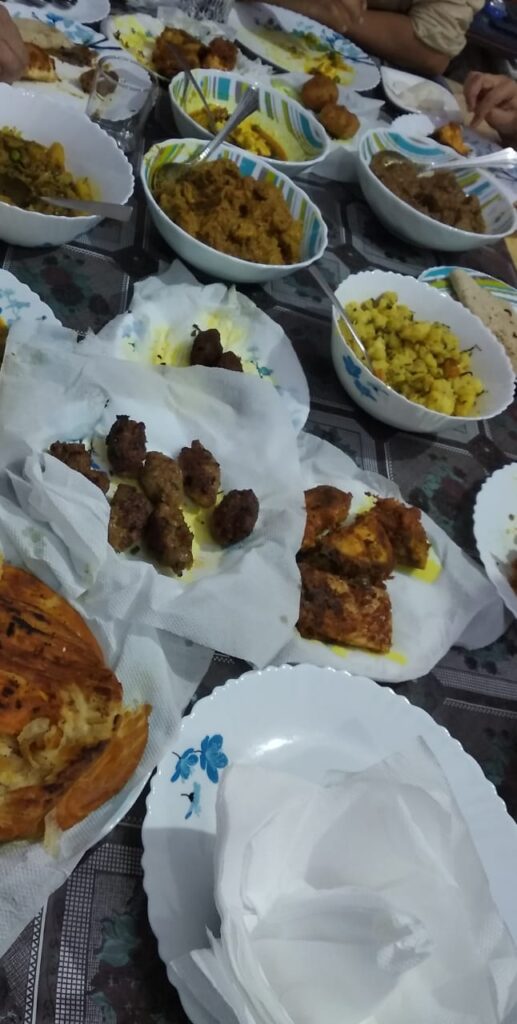
A complete iftar table as laid out by Zohra Seemee
Asked about some oil-less, health conscious recipes she says, “ well, there’s Ghugni (a local name for chana dal soaked overnight and prepared with a dash of lemon, salt, black pepper, and finely chopped onions, tomatoes..”
A healthy potpourri can be prepared by taking sprouts of your choice(soak black gram, green lentils, yellow gram overnight), and just add lemon, salt, black pepper and salad of your choice.
When asked about an all time favourite recipe of her kids she says, “I prepare chicken roast, that is one recipe that is loved by all..”
Here’s the recipe: boil the preferred choice of meat with salt, garlic, ginger and water. Separate the water from the meat when tender. Add a pinch of fine flour (maida), edible food colour and either pan fry or deep fry the same. When done it is served with preferred salad dressing.
source: http://www.awazthevoice.in / Awaz, The Voice / Home> Women / by Shaista Fatima, New Delhi / April 24th, 2022