Category Archives: Community Involvement / Social Issues

Tirurangadi’s paraplegic literacy activist Rabiya honoured with Padma Shri

Tirurangadi (Malappuram District), KERALA :

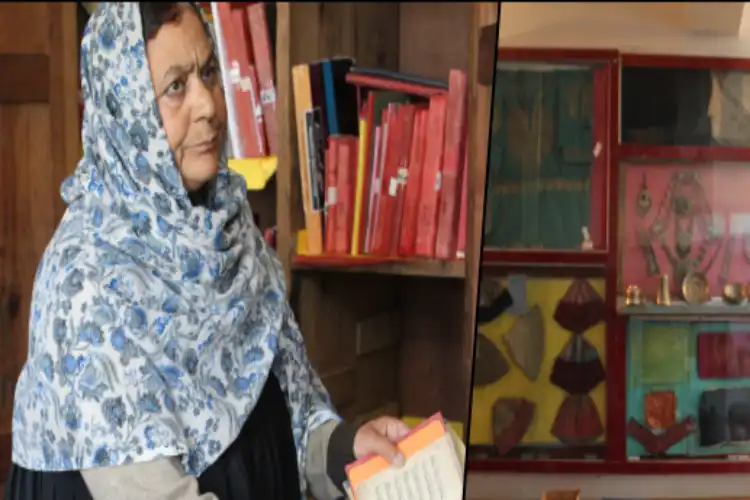
KV Rabiya
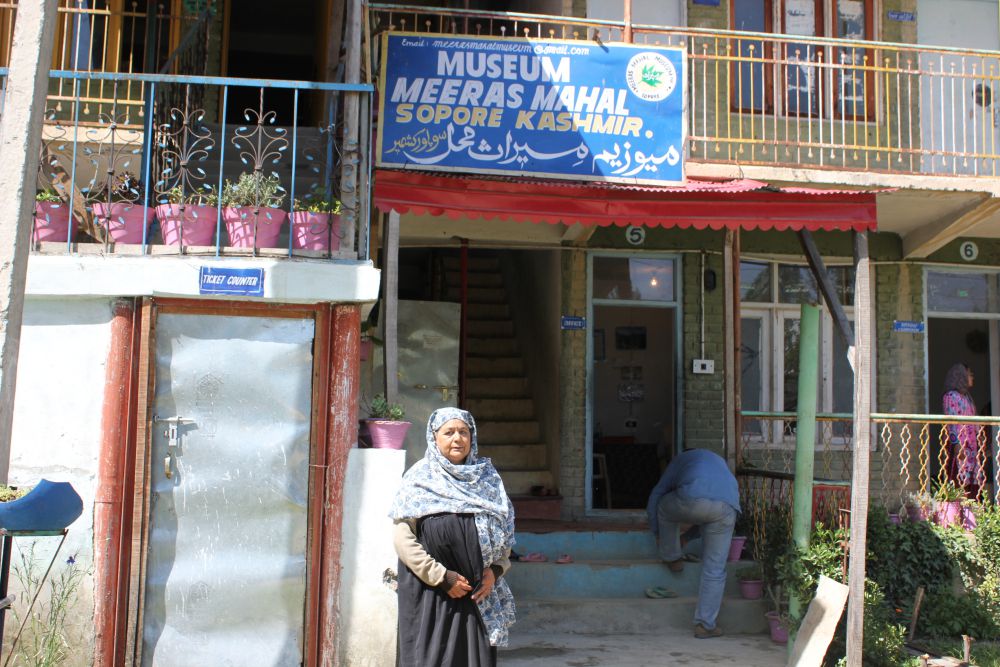
Rabiya with her relatives in Vellanakkattil house

Tirurangadi:

One of the highest civilian awards Padma Shri came in search of KV Rabiya who is a staunch literacy activist in Tirurangadi. Though 56-year-old Rabiya is paraplegic, she pursued her literacy mission without fail by sitting in a wheelchair. 

Rabiya’s house on the banks of the Kadalundi river is also a cultural centre for the people of Tirurangadi. She had dealt with several works including that of the library, palliative care, rehabilitation of physically challenged persons and women, and issues related to family conflicts. 

She developed early symptoms of paralysis when she was studying in class 9. Life was difficult as her mother had 6 daughters including Rabiya to look to look after.

Her uncle took her to school during high school and she joined PSMO college in Tirurangadi later for pre-degree course. But she could not attend the examination as she got completely immobilised six months before the exams.

Still determined, Rabiya completed graduation and post-graduation via distance education. Along with this, voracious reading also added her strength.

Even before the government deployed its literacy mission, Rabiya Rabiya started to teach the people in her locality.

Meanwhile, she survived cancer too. 

Rabiya was honoured with many awards including the National Youth Award of 1993. She was the daughter of the late Vellinakkattil Moosakutty and Biyachutti. She is now living with her sister’s family at her residence.

source: http://www.english.mathrubhumi.com / Mathrubhumi / Home> News> Good News / by Shaneesh Moozhikkal / January 26th, 2022

Hammad Ahmed is new Chancellor of Jamia Hamdard

NEW DELHI :

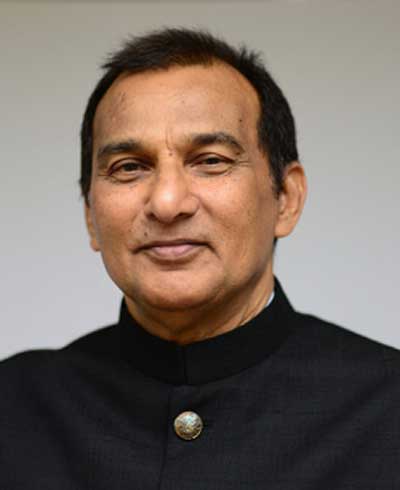
Prof. (Dr.) M. Afshar Alam, Vice Chancellor presents a bouquet to Hammad  Ahmed   Chancellor of Jamia Hamdard.

New Delhi: 

Hammad Ahmed, Co-Chairman, Hamdard National Foundation (India), President, Hamdard National Foundation (India) – HECA, and Chief Mutawalli (Trustee) of Hamdard Laboratories India (Foods), has been appointed as Chancellor of Jamia Hamdard (Deemed to be University).

In the Vice Chancellor Board Room, Jamia Hamdard, the Chancellor was greeted by Prof. (Dr.) M. Afshar Alam, Vice Chancellor, Prof. Iqbal S. Hasnain, former Pro-Chancellor, and. Syed Saud Akhtar, registrar, in the presence of various Deans of Schools, Dy. Registrar, Chief Proctor, DSW, FSA, Executive Engineer, and other senior officers of Jami

Hammad Ahmed is also a well known philanthropist, man of wisdom and exemplary character. He is one of the founding members of Hamdard National Foundation at its inception in 1964; he brings with him infinite wisdom and experience. Over more than 50 years, he has forged Hamdard National Foundation into one of India’s most prominent and respected charitable organizations. Hammad Ahmed’s quiet modesty hides the magnitude of his achievements in introducing new initiatives for contributions to society, and his relentless commitment to the charitable cause has improved the lives of countless people.

Late Janab Hakeem Abdul Hameed, the founder of Hamdard National Foundation and Jamia Hamdard, instilled in him a lovely and motivating personality. Hammad Ahmed’s gentle modesty belies the immensity of his contributions to society through the introduction of new initiatives, and his unwavering commitment to the charity cause has benefited the lives of countless people.

He has been involved in Jamia Hamdard before its recognition as Deemed University status in 1989. Over the years, he has served in the Executive Council, Finance Committee and various other advisory bodies of the University and has championed the growth of Jamia Hamdard through sustained personal attention and interest.

Since joining Hamdard Laboratories India as its Sales and Marketing Head in 1973, he has overseen a meteoric rise in business and the Hamdard name, in the process establishing himself as one of India’s prominent business leaders.

Educated in Sherwood College, Nainital, and then in Cornwall, UK and New York, USA for further studies, Hammad Ahmed has inculcated a strong sense of discipline in his life and work, and the results are self-evident.

source: http://www.muslimmirror.com / Muslim Mirror / Home> Indian Muslim / by Special Correspondent / January 26th, 2022

M.K. Faizy re-elected as national president of SDPI

NEW DELHI :

M.K. Faizy addressing National Representative Council of Social Democratic Party of India was held on 22, 23 November 2021 in Chennai.

New Delhi/Chennai :

M.K. Faizy has been  re-elected as national president of SDPI in a meeting of National Representative Council of Social Democratic Party of India which was held on 22, 23 November 2021 in Chennai, Tamil Nadu.

Representatives from various states were present in the Council wherein review of party activities, discussions on global and Indian Socio-Political situations, issues and intervention, etc were conducted.

The New Office Bearers and National Working Committees comprising total members of 45 were elected for the term 2021-24 in the Council. Adv. Sharfuddeen Ahmed, Mohammad Shafi and B.M. Kamble as Vice Presidents , Elyas Muhammad Thumbe, Abdul Majeed Faizy, Seetharam Khoiwal and Yasmin Farooqi as General Secretaries, Alfonse Franco, Riyaz Farangipet, Tayedul Islam, Abdul Sathar, Faizal Izzuddeen and Runa Laila as Secretaries and Abdul Ravoof Indore as Treasurer of the party.

Abdul Majeed Mysore, Dehlan Baqavi, Dr. Mehboob Shareef Awad, Abdul Waris, P.Koya, Mohammad Mubarak, Rizwan Khan, Dr. Nizamuddeen, Ashraf Moulavi Muvattupuzha, P. Abdul Hameed, Roy Arakkal, Abdul Hannan, Adv. K.P.M. Shareef, Gurujanth Singh, Ashfaq Hussain, Sadashiv Tripathi, Ashok Jadhav, Sayeed Saadiya, Mohammad Farooq Tanjavur, Mohammad Kamil, Zaheer Abbas, Umar Farooq A.S, Mohiyudeen Chennai, Mohammad Ashraf Mangalore, C.P. Abdul Latheef, Adv. Shameem Akthar, Munawwar Hussain Chathurvedi, Dr. Zafar Ubaid, Kausar Banu, P.P. Moideen Kunhu were elected as members of National Working Committee for the term 2021 – 24

The Council was concluded with a grand felicitation program attended by the cadres and supporters of the party.

source: http://www.muslimmirror.com / Muslim Mirror / Home> Indian Muslim> Politics / by Muslim Mirror Network / November 26th, 2021

Delhi HC Refuses to Entertain Plea to Ban Salman Khurshid’s Book

UTTAR PRADESH / NEW DELHI :

The petitioner alleged that Khurshid has misused his fundamental right to freedom of expression in a very complex manner as it is not absolute.

Congress leaders Digvijay Singh, P. Chidambaram and Salman Khurshid at the launch of ‘Sunrise over Ayodhya’ book on November 10. Photo: Facebook.

New Delhi: 

The Delhi high court Tuesday refused to entertain a plea seeking direction to the Centre and Delhi government to ban the sale and publication of Congress leader Salman Khurshid’s book Sunrise Over Ayodhya: Nationhood In Our Times.

A bench of chief justice D.N. Patel and Justice Jyoti Singh pulled up the petitioner for not impleading the author of the book or publication house as a party to the plea, saying he was a chance taking petitioner who has filed the plea for publicity.

“You want a complete ban on the book but you have not made the author a party. You may ask any heaven or sky. We may dismiss it with costs. You are not joining the author as a party. Stop doing this activity in court. Why are you feeling so shy and not joining the author as a party. We will not give you any chance, this is a deliberate move. These are all chance-taking petitioners. It is for publicity,” the bench said.

After some time, the petitioner’s counsel sought permission to withdraw the petition and file a fresh one with proper averments, annexures and joining proper persons as parties.

The court allowed him to withdraw the petition and disposed it of as withdrawn.

“He has no courage to join Salman Kurshid as a party, what type of PIL (Public Interest Litigation) he will argue. If you are so much worried about the name of the author or the senior advocate, you should not have filed the PIL. These are blackmailing or publicity petitions. This is a waste of time PIL,” the bench said.

Petitioner Rakesh, in his plea through advocates A.K. Dubey and Pawan Kumar, alleged that Khurshid has misused his fundamental right to freedom of expression in a very complex manner as it is not absolute and carries with it special duties and responsibilities towards public interest.

It said there are 90 crore Hindus in the country and if anyone takes offence of such statements made in the book, it could become a law and order problem in society.

“Salman Khurshid has written in the chapter that Sanatan Dharma and classical Hinduism known to sages and saints was being pushed aside by a robust version of Hindutva, by all standards a political version similar to the jihadist Islam of groups like ISIS (Islamic State of Iraq and Syria) and Boko Haram of recent years,” it said.

Khurshid’s new book on the Ayodhya dispute was released recently.

On November 17, an additional civil judge here had refused to grant an ex-parte injunction on a lawsuit by Hindu Sena president Vishnu Gupta to stop the publication, circulation, and sale of the book for allegedly hurting sentiments of a large section of society.

While declining interim relief, the trial court had said the author and publisher had the right to write and publish the book.

(PTI)

source: http://www.thewire.in / The Wire / Home> English> Books> Government> Law / by PTI / November 30th, 2021

How America Celebrated Haidar Ali In 1781

Mysuru, KARNATAKA :

On 19 October 1781, a British land force led by Charles Cornwallis surrendered to George Washington, America’s Commander in Chief. Nine days later Cornwallis’ surrender, along with that of Haidar Ali’s victories in India, was celebrated at Trenton, New Jersey. Photo: John Trumbull – http://www.aoc.gov/cc/photo-gallery/ptgs_rotunda.cfm, Public Domain, https://commons.wikimedia.org/w/index.php?curid=1379717

Hyder Ally (Anglicised version of Haidar Ali) was a popular exotic name in the 1770s when the fledgling United States of America was fighting for its independence from Britain. There were racehorses named after this ruler of the Mysore Kingdom in South Asia as well as his warrior son Tipu Sultan.

In the early 1780s, Haidar Ali’s bravery was invoked in one of the earliest documented recruitment for the US Navy. A ship named after him gave the USA one of its greatest naval victories during the same time. His name was chanted on the streets of America, in 1781. Let’s travel back in time to understand this.

In 1775, a great upheaval shook thirteen British colonies on the east coast of North America as its residents rose against the Government of Great Britain, declared independence and flew their own flag (1, 2). Apparently, the first flag of the Union, now the US national flag- the Stars and Stripes, sent to the state of Maryland was hosted on a sailboat by teenager Joshua Barney at Baltimore in October 1775. Barney had just started his service with the US Navy.

Rocket Warfare, by Charles H. Hubbell (1898–1971) captures the humiliation of the British at the Battle of Pollilur (Sep. 1780) by Mysorean war rockets.

A few years later- in 1780, in the far-away Mysore Kingdom, the East India Company was suffering one of the worst reverses in its military history. This was at the hands of Haidar Ali and his son Tipu Sultan who were supported by the French, an ally of America. The humiliation of the British at the Battle of Pollilur in September 1780 reverberated in America where the news reached the country (3). On 19 October 1781, the British land force led by Charles Cornwallis surrendered to the Americans led by George Washington  (incidentally a decade later in India, Cornwallis gave EI Company and its Indian allies victory over Haidar Ali’s son Tipu Sultan in the 3rd Anglo Mysore War). Nine days later Cornwallis’ surrender, along with that of Haidar Ali’s victories in India, was celebrated at Trenton, New Jersey. The town on that day was decorated with American colours. Inhabitants including the Who’s Who attended a service at the Presbyterian Church, where a discourse highlighting the occasion was delivered by a Reverend. In the afternoon the gathering drank 13 toasts accompanied with a discharge of artillery, number eleven of which was for ‘The great and heroic Hyder Ali, raised up by Providence to avenge the numberless cruelties perpetrated by the English on his unoffending countrymen, and to check the insolence and reduce the power of Britain in the East Indies‘ (ibid., ref. 3).

The other toasts were raised and artillery was discharged for the below. Quote:
1. The United States of America; 
2. The Congress; 
3. The king of France; 
4. General Washington and the American army; 
5. The Count de Rochambeau and the French army; 
6. The Count de Grasse and the French fleet; 
7. General Greene and the Southern army; 
8. The friends of liberty throughout the world; 
9. The memory of Generals Warren, Montgomery, and all the other heroes who have fallen in the defence of the liberties of America; 
10. Peace on honorable terms, or war forever; 
12. The governor and State of New Jersey; 
13. The glorious 19th of October, 1781. At seven in the evening the company retired, and the rejoicings were concluded by a brilliant illumination.
Unquote. (ibid., ref. 3).

Hyder Ally and America’s struggle to reclaim its seas from the British

Sketch of action between American naval ship USS Hyder Ally and English warship General Monk in 1782. 
Source: Life of Commodore Joshua Barney, Hero of the US Navy (1776-1812), 1912.

Despite this, America was far from being an independent nation. The British still ruled the seas. They kept a keen watch on the ships entering and exiting the ports of northeast USA, often capturing the vessels and looting goods. General Washington an American sloop-of-war was captured by Admiral Arbuthnot, and placed in the king’s service under a new name The General Monk, which was then used to pirate American ships. By 1782 the commerce of Philadelphia City, as well as the ordinary life of the residents of the coast and nearby streams, was deteriorating. The fledgling American Union was not in a position to protect the affected vessels. Therefore the State of Pennsylvania, at its own expense, fitted a number of armed vessels that operated in waters leading to Philadelphia. The state purchased Hyder Ally, a small sloop (single mast ship) equipped with sixteen six-pounder guns to help protect the American vessels. 23-year old Lieutenant Joshua Barney, now in the US navy, arrived at Philadelphia where he was honoured with the command of Hyder Ally (4). Assigned with recruiting men, Barney used a poem penned by Philip Morin Freneau to attract young American men to the ship. The poem exalted Haidar Ali’s bravery against the British with the following lines (5):

Come, all ye lads who know no fear,

To wealth and honour with me steer

In the Hyder Ali privateer,

Commanded by brave Barney.

From an eastern prince she takes her name,

Who, smit with freedom’s sacred flame,

Usurping Britons brought to shame,

His country’s wrongs avenging;

Come, all ye lads that know no fear.

With hand and heart united all

Prepared to conqueror to fall.

Attend, my lads! to honor’s call —

Embark in our Hyder-Ally!

And soon Barney led a force of a hundred and ten men. On April 8, 1782, he received instructions to protect a fleet of merchantmen to the Capes just before the sea, at the entrance of Delaware Bay. Dropping the convoy at Cape May road he was awaiting a fair wind to take the merchant ship to sea when he saw three ships (6) which he realised were waiting to plunder the convoy. Barney immediately turned the convoy back into the bay, using Hyder Ally to cover the retreat. Soon the bigger General Monk under the command of Captain Rogers of the Royal Navy nearly doubled his own force of metal, and nearly one-fourth superior in number of men caught up with Hyder Ally. Despite being fired upon, Barney held Hyder Ally’s fire till within pistol shot when both the two vessels got entangled. A short but desperate fight ensued. Lasting 26 minutes, it resulted in the lowering of flags by General Monk indicating her surrender. Both vessels arrived at Philadelphia a few hours after the action bearing their respective dead. The Hyder Ally had four men killed and eleven wounded. The General Monk lost twenty men killed and had thirty-three wounded including Captain Rogers himself, and every officer on board, except one midshipman ! (7)

‘Surrender of Baillie to Hyder Ali, 1780’, illustration from Cassell’s Illustrated History of England (20th century), 1780.

A hero is celebrated

Philadelphia burst in celebrations. Ballads were made upon this brilliant victory and sung through the streets of the city! And echoing with Barney’s name was that of Hyder Ally (ibid., ref. 1).Here are some lines:

And fortune still, that crowns the brave

Shall guard us over the gloomy wave —

A fearful heart betrays a knave!

Success to the Hyder-Ally!

While the roaring Hyder-Ally

Covered over his decks with dead!

When from their tops, their dead men tumbled

And the streams of blood did flow,

Then their proudest hopes were humbled

By their brave inferior foe.

A small sword with mountings of chased gold- the guard of which on the one side had a representation of the Hyder Ally, and on the other the General Monk was ordered by the Legislature of Pennsylvania and a vote of thanks was passed for Captain Barney in 1782. This gold-hilted sword was presented to him in the name of the state by Governor Dickinson. Source: Life of Commodore Joshua Barney, Hero of the US Navy (1776-1812), 1912

In 1782 the Legislature of Pennsylvania passed a vote of thanks to Captain Barney and ordered a gold-hilted sword to be prepared, which was afterwards presented to him in the name of the state by Governor Dickinson. It was a small sword with mountings of chased gold- the guard of which on the one side had a representation of the Hyder Ally, and on the other the General Monk (ibid., ref. 1). Barney was the last officer to quit the Union’s service, in July 1784, having been for many months before the only officer retained by the United States.

Barney was sent by the American Government to Paris. A reception was given in France him as a hero of dashing naval exploits during the Revolutionary War (8). A painting representing the action between the two ships was executed in 1802 by L. P. Crepin in Paris by order of Barney, while in the service of the French Republic. The same was presented by him on his return to the United States, to Robert Smith, Esquire, then secretary of the navy (9). The painting is now in the United States Naval Academy, Annapolis, Maryland (ibid., ref. 1).  Barney was an intimate friend of Count Bertrand, one of Napoleon’s generals (ibid., ref. 2). Napolean incidentally had an alliance against the British with Haidar Ali’s son Tipu Sultan, during the latter’s lifetime (10).

Barney was appointed a Captain in the Flotilla Service, US Navy on 1814 April 25 (11). He took part in seventeen battles during the Revolutionary War and in nine battles during the War of 1812. A British Musket-ball lodged inside his body in battle at Bladensburg, Maryland in August 1814 (12). He passed away on December 1, 1818, aged 60.

The world today is considered a global village thanks to the scaling down of boundaries between nation-states and individuals alike. But it may surprise us even in the 18th century seemingly local political events and humans made an impact on lands and societies far away. The name Haidar Ali, after an adventurer from an obscure place in the erstwhile Kingdom of Mysore who gave many a lesson in military and political strategies to global colonial powers of England and France, echoing across the proverbial seven seas in distant North America for nearly a century is a testament of this (13, 14).

Painting of Commodore Joshua Barney at Independence Hall, Philadelphia,  Life of Commodore Joshua Barney, Hero of the US Navy (1776-1812), 1912.

70 years after Hyder Ally’s victory over General Monk, James Cooper wrote “This action has been justly deemed one of the most brilliant that ever occurred under the American Flag. It was fought in the presence of a vastly superior force that was not engaged, and the ship taken was in every essential respect superior to her conqueror.” (ibid., ref. 4)

Sources/ Notes:

1. Barney, Mary., A biographical memoir of the late Commodore Joshua Barney, 1832, Mary was a sister of Joshua Barney. Her book provides in-depth information about the latter’s personal and military life. Born on July 6, 1759, 13-year old young Philadelphia Joshua Barney set sail on his maiden merchant ship journey to Ireland in 1771 with his brother in law Captain Thomas Drysdale. He sailed back home the following year and made trips to ports in Europe again. He set sail for Nice, France in December 1774 during which journey Captain Drysdale died. He took control of the ship which needed urgent repairs and therefore docked at Gibraltar, Spain instead. In a few months, he sailed to Algiers, Algeria from Alicant, Spain to deliver Spanish troops during which he witnessed the annihilation of these troops by the Algerians which made him return to Alicant soon. He immediately set sail across the vast Atlantic Ocean for Baltimore, USA. As he entered the Chesapeake Bay on 1st October he was surprised by the British Sloop of war Kingfisher. An officer searched his ship and informed him that Americans had rebelled and that battles were being fought. He was fortunate enough to escape detention.  Returning to Philadelphia he was determined to serve the Americans fight against the British. At that time a couple of small vessels were under at Baltimore ready to join the small squadron of ships stationed then at Philadelphia and commanded by Commodore Hopkins. Barney offered his services to the commander of the sloop Hornet, one of these vessels. He was made the master’s-mate, the sloop’s second in command. A new American Flag, the first ‘Star-spangled Banner’ in the State of Maryland, sent by Commodore Hopkins for the service of the ten gun Hornet, arrived from Philadelphia. At the next sunrise, Barney unfurled it in all pomp and glory. In 1776, Robert Morris, President of the Marine Committee of the Congress offered him a letter of Appointment as a Lieutenant in the Navy of the United States in recognition of his efforts during a naval battle engagement in Delaware.
2. Adams, William Frederick., Commodore Joshua Barney: many interesting facts connected with the life of Commodore Joshua Barney, hero of the United States navy, 1776-1812, 1912. Adams provides a good summary of Mary Barney’s book in this book.
3. Moore, Frank., Diary of the American Revolution, Volume 2, 1860.
4. Cooper, James Fenimore., History of the Navy of the United States of America, 1853.
5. Freneau., Poems written and published during the American Revolutionary War, 1809.
6. Two ships and a brig- a sailing vessel with two masts.
7.  As explained by Barney himself in his painting of this war commissioned later.
8. Bowen, A., The Naval Monument,1815, Concord, MA. This book gives an account of the reception received by Barney in France. 
9. The painting was accompanied by a description, in the handwriting of Commodore Barney, which is reproduced in Mary Barney’s book. 
10. Ahmed, Nazeer., https://historyofislam.com/tippu-sultan/ (downloaded October 13, 2017). 
11. Record of Service, Bureau of Navigation, Navy Department, United States Navy.
12. The conduct of Commodore Barney, at the Battle of Bladensburgh, was appreciated by his military opponents as well. He was wounded in the engagement and was taken prisoner by General Ross and Admiral Cockburn but paroled on the spot. At the time of his death in 1818, the ball was extracted and given to his eldest son.  For the valuable services of her husband, Congress granted Mrs. Barney a pension for life.
13. Goold, William., Portland in the past, 1886. This book has information on at least one more well-known ship named Hyder Ally built in the US in the 1800s after the one described in this story. This ship, like many other US ships, resorted to pirating British ships in the Indian Ocean all the way up to the island of Sumatra and around the Cape of Good Hope in South Africa in the run-up to the British-American War of 1812. 
14. Corbett’s Annual register (1802) documents the ship ‘Tippoo Saib’ registered in Savannah, Georgia, the southernmost of the 13 colonies that declared independence from the British in 1776 and formed the original ‘United States of America’.

source: http://www.thecognate.com / The Cognate / Home> History / by Ameen Ahmed / December 27th, 2021

Mappila Haal: Celebrating 100 Years Of Malabar Uprising

KERALA :

This year marks the 100th anniversary of the eventful Malabar Uprising of 1921.

In this historic context, SIO Kerala has come up with a new venture: an interactive virtual exhibition titled ‘Mappila Haal’.

‘Mappila Haal’ is a comprehensive creative expression of the Malabar Uprising enabling the viewer to travel through the revolutionary days and nights.

SIO acknowledges the memories, discussions on various factors and celebration of the Malabar Uprising as a crucial socio-political engagement.

History is not merely a record of the past. For any community, history is a decisive factor in their present life. That is why history is said to be a never-ending dialogue between the past and the present. Historical narratives play a major role in shaping contemporary socio-political perspectives and imaginations.

Every community should have a deep understanding of their history, and they should record and promote it. Failure to do so will result in the tragedy of having to live in a history written by others. That condition will adversely affect their future. Because their history written by the mainstream-dominant ideologies will be understood as the real one. If the dominant powers decide to marginalize or annihilate any community forever, they will use history as an easy tool. For that, they will do injustice to history in two ways. One is to hide and erase the rich history of that community, and the other – to present a distorted narration of it.

How Islam and Muslims were treated in colonial historiography is an apt example of this. The colonial powers hid the prestigious and glorious history of Muslims all over the world.  Later, colonialism defined Islam and Muslims in their own way, based on which the history of Muslims was written – Islam is primitive, it was spread in the world by sword, Islam is utter terror, Muslims are savage, bloodthirsty, war-loving, violent and dangerous. Based on this definition, they presented a distorted version of world Muslim history. In doing so, they sought to create a public perception that the very presence of Muslims would be dangerous to any nation and all forms of social and political expression based on Islam reflects extremism and terrorism. The aim was to make people believe that they were the ones who needed to be eliminated. Thus, this narrative became a justification for all violence, injustice and genocide against Muslims. This is how history itself becomes the greatest instrument of oppression. It is in this colonial narrative that the roots of present-day Islamophobia too lie, be it global, national or in Kerala. 

Here comes the relevance of the remembrance and celebration of the Malabar Uprising. This is a time when Hindutva politics is gaining strength and the Sangh Parivar is working on the genocide of Muslims. Hindutva forces use the history of Muslims in two ways to facilitate ethnic cleansing: One is the attempt to erase the history of Muslims in India and to uproot the glorious roots of Muslims in this country. Second, to distort the history of Muslims in India into an anti-Hindu history. Through these two forms of violence against history, Hindutva quickly finds pace for its racist propaganda.  In other words, the Hindutva forces are trying to create a public conscience that the Muslims are a group that came from somewhere, that they have no roots in this country, that the history since their arrival here is one of violence, that their presence is a danger to the country and therefore they should be eradicated. The question of how one’s mind allows Muslims to be lynched to death in broad daylight turns irrelevant there.  When a person believes that Muslims deserve to be killed, he will not feel any remorse for killing them. 

In this particular political context, there is a special significance for popularizing and celebrating the memories of the Malabar Uprising.  By remembering the Malabar Uprising and the fighters involved within, we are also positioning ourselves against the Hindutva ideology.  The British colonial powers portrayed the Malabar Uprising as fanatic aggression. Such a propagation was quite natural because it was a battle against them. However, the Sangh Parivar is also propagating the Malabar Uprising as a brutal anti-Hindu massacre, inciting hatred against Muslims in its name and using the history of the Malabar Uprising as fuel to accelerate the aforesaid process of genocide.  In 1921 itself, the Hindutva forces propagated the Malabar Movement as a Hindu genocide and used it as a fertilizer for the formation of the RSS. 

Moreover, the historical point of the Malabar Uprising is constantly disturbing Hindutva politics in many ways.  One of them is that the Malabar Uprising reminds us of the crucial role of Muslims in the anti-colonial struggles that led to the formation of the nation of India.  Another is that the Malabar Uprising was also a struggle against the upper caste hegemony which is the foundation of Hindutva politics. That is why the Sangh regime’s dictionary of martyrs cannot include the names of the Mappila fighters. Therefore, remembering and celebrating the Malabar struggle is a strong statement against Hindutva politics.

The memory of the Malabar Struggle is also a memory of our own glorious tradition.  It also gives us an idea of ​​how strong and deep our roots are in this land.  It shows the pivotal role played by our ancestors in the freedom struggle of this country, social renaissance and civilizational development.  For the Muslim community in India, this memory and realization will provide the energy to move forward with self-respect in the face of several crises.

The Malabar Uprising had two main stages. One was the struggle against the colonial British forces. Second, the struggle against the feudal and caste lords who oppressed and exploited the peasants and lower castes like slaves. The extraordinary struggle led by Ali Musliyar and Variamkunnath Kunhahammad Haji shook the foundations of the colonial powers and the caste leaders. It instilled a new dream of liberation in the oppressed masses. It was these two brave leaders who gave direction to the Malabar Uprising in which thousands of agricultural workers and labourers rallied. Many non-Muslims too took part in the Malabar Uprising along with the Mappilas.

We also need to think about the theological factor that motivated the Mappilas to fight. The Islamic faith was the basic factor that inspired the Mappila warriors to take their own lives and go to battlefield. It is a part of the Islamic faith to stand for justice and to fight against injustice, discrimination, slavery and exploitation. The Qur’an and the Sunnah teach us to fight for the victims of injustice. It is part of Tawheed (monotheism) that slavery and obedience are permissible only to Allah. Believers do not accept slavery or obedience before another. And they believe that the struggle for truth and justice is Jihad in the way of Allah. The scholars of Malabar passed on these divine lessons of justice and liberation taught by Islam to the common Mappilas. That is how the struggles against the occupying forces and caste lords took place in Malabar from the sixteenth century onwards.

Indeed, a cosmopolitan component was involved in the Malabar Uprising. After a short gap, the anti-colonial struggle in Malabar gained momentum again in 1921, with the advent of the Khilafat Movement. Even the national movement became popular as a result of the influence of the Khilafat movement. The Khilafat movement and the political ideology of the Khilafat acted as a new force in the anti-colonial anti-caste struggle. Globally, western modernity strengthened its political power by overthrowing the Ottoman caliphate. It was on the basis of these political convictions that the Mappila community, having global perceptions, embraced the Khilafat movement.

The historical narratives formed by the dominant ideologies can be defended and overcome only when studies are carried out in the light of such different elements involved in the Malabar Uprising. In particular, it is imperative in modern times to enable a critical reading focusing on the agency of the warriors, theological thought, social position, and decolonization. The SIO came up with the idea of ​​a virtual exhibition based on the conviction that such alternative narratives and analyzes focused on these considerations should be brought to the fore.

In the context of the 100th anniversary of the Malabar Uprising, SIO’s main objective through this virtual exhibition is to look at the history of Kerala’s Muslim intellectual and struggle history through an alternative perspective, to enable the production of knowledge about it, and to celebrate it politically and culturally. This can only be comprehensive when the various narratives that have been formed post rebellion are critiqued and analyzed from a realistic perspective. This is a continuation of the knowledge politics that SIO has been raising from time to time. We mark this interactive virtual exhibition as a continuation of the knowledge politics that SIO promotes through its rejection of hegemonic ideas and its critical reading of knowledge such as history, politics, theology and aesthetics.

The virtual exhibition will be available on a mobile application with a feast of video contents, paintings, calligraphy, digital art, rare archives, exclusive photos, the timeline of the uprisings of Kerala Muslims, different narratives on the Malabar Uprising, articles, profiles, events and graphical maps of the places of rebellion.

‘Mappila Haal’ will also be marked as a critical alternative to the colonial and savarna narratives which portrayed the long intellectual and revolutionary tradition of Malabar against the colonial and caste powers as fanatic and barbaric.

You can download the app both on Google Play and on the App Store.

Amjad Ali EM is the President of the SIO Kerala. The original article was published in Prabodhanam weekly published on Dec 24, 2021 (Volume 78).

Note: The original article had used the word ‘rebellion’, which we have changed to ‘uprising’

source: http://www.thecognate.com / The Cognate / Home> History / by Amjad Ali E M / January 03rd, 2022

Hafiz Aiman of Malegaon appointed Imam at Makkah mosque

Malegaon, MAHARASHTRA / Makkah, SAUDI ARABIA :

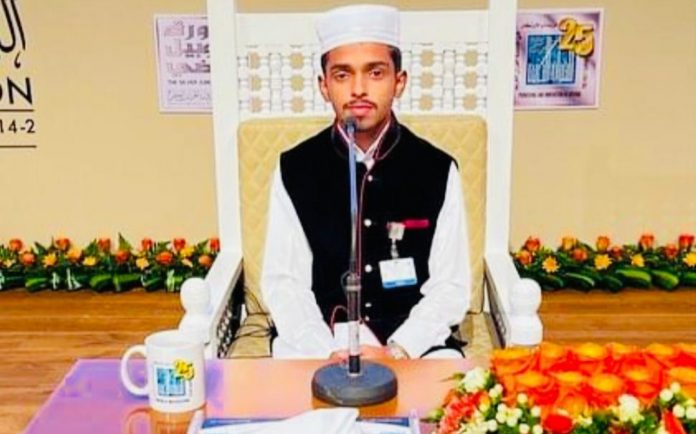
Hafiz Aiman, who has been selected for the respectable post, is persuading graduation at Umm All Qura University Makkah in Saudi Arabia

Hafiz Aiman and Masjid Al Awali in Makkah, Saudi Arabia

Malegaon: 

Marking a remarkable and proud moment for India, Hafiz Aiman of Malegaon – the Muslim dominated city in North Maharashtra known for scholarship and textiles , has been appointed as Imam in a mosque in the sacred city of Makkah al-Mukarramah.

Imam is a person who leads five daily prayers Muslims offer in mosques. Hafiz Aiman, who has been selected for the respectable post, is persuading graduation at Umm All Qura University Makkah in Saudi Arabia.

“I joined as an Imam at Al Awali Mosque in Makkah on December 18, 2021”, Hafiz Aiman told ummid.com in a WhatsApp call.

Masjid Al Awali, also known as Masjid Kulliyatul Lugha, is located some 15 kilometres to Masjid al-Haram – the Grand Mosque which is home to Holy Kaaba, and some 9 kilometres to Umm al Qura University Campus in Makkah.

Though it is not the first time when an expatriate or a student of foreign-origin has been appointed as Imam in a Saudi mosque, it is a rarest of rare moment as the Kingdom follows a very strict rule while making appointment to the post.

What makes appointment of Hafiz Aiman as Imam in Saudi Arabia mosque even more significant is also because of the Quality Assessment and Quran Recitation skill requirement for the post that are of very high standards.

After early education and complete memorisation of Holy Quran with Tajweed at Jamia Mohammadia Mansoora in Malegaon, Hafiz Aiman got admission in February 2019 for higher studies at Umm al Qura University Makkah on merit basis.

At home in Malegaon for annual holidays, he got stuck here for more than a year after the pandemic broke out – attending online classes and simultaneously rendering his duty as Imam at Jame Masjid Ahle Hadees Motipura. He had returned to Saudi Arabia in December last when Saudi Arabia lifted the travel ban on flights from India.

Incidentally, Hafiz Aiman’s younger brother Osama and elder brother Abdul Moeed too are Hafiz and acclaimed Qaris. Abdul Moeed also has to his credit the tag of being the first student from Malegaon who got admission at Islamic University of Madinah for higher studies.

Watch: Hafiz Aiman recites Holy Quran

The siblings’ Father Qari Abdul Mateen and Grandfather Qari Abdus Samad are also acclaimed Qaris. Qari Abdus Samad was in fact a regular invitee as judge at national and international level Quran recitation competitions till his death in March 2013.

“The entire family of Hafiz Aiman is hailed for its contribution towards teaching of Quran and Tajweed”, Faizee Shahid, who looks after the management of Jame Masjid Ahle Hadees Motipura, said.

“His appointment as Imam at a mosque in Makkah is not only rewarding for the family but also a proud moment for all of us”, he added.

source: http://www.ummid.com / Ummid.com / Home> Life & Style / by Ummid.com Staff Reporter / January 05th, 2022

Trip with an all-woman team helps Koyilandy native to discover her innate self

Koyilandy, KERALA :

The team had 15-members, all women, of whom Shahana had acquaintance with only a single member, Suhaila T, the trip coordinator

Shahana Nizar with children at Pandhi Ka Par village in Rajasthan

Kozhikode :

The story of 32-year-old Shahana Nizar has a slight similarity to Mudrita, the noted Malayalam novel of 2021 penned by Jisa Jose. Mudrita unfolds through the train trip of nine women who were strangers to each other but got together through an online group. Shahana’s maiden 10-day trip, without the company of her family, to Rajasthan by train concluded on December 30. 

The team had 15-members, all women, of whom Shahana had acquaintance with only a single member, Suhaila T, the trip coordinator. 

Hailing from a conservative Muslim family of Koyilandy and mother of 10-year old and four-year-old boys, she had many odds against taking such a trip. But finally, she pulled it off. “Till the moment I boarded the train from Kozhikode railway station, I was not sure I would make it. There were so many obstacles. But my passion for travelling self-liberating me besides, the solid support from my spouse made it happen,” beams Shahana. 

The group had 16-year old Haniya Haris to 39-year old Kadeeja, who were from Kozhikode and Kannur districts. Resorting to a budget tour, the women used public transport service and stayed mostly in youth hostels and residences of acquaintances in Rajasthan.

“It was difficult for me to travel in train for so many days. I was a person who loathed using public toilets. But during the trip, I had to even spend my period days on the train. Surprisingly, I myself adjusted to all of these due to the sheer pleasure travelling gave me. After reaching home and looking back, I found I had discovered myself, the liberal soul in me who wants to fly farther, recharge and come back,” says Shahana, an English Literature graduate. 

“Don’t want to be like mother’

Shahana reminisces that throughout her life, she saw her mother tied up in domestic chores and taking care of kids and her husband at home. “Watching her life, I had taken a strong decision then that I will not be like her. That spark was within me which poured out in the form of musings and scattered lines on Facebook. But there was not an attempt till now. But for my marriage, I think I cannot make a free trip without the ‘care’ of family or relatives. Now, I am brimming with confidence and ready to backpack any moment,” she says. 

While Shahana was on tour, her four-year old son was hospitalized for a day but she came to know it after reaching home only as her husband Nizar Mullasserry managed it. 

The women team’s travel was not all smooth. They had to run with heavy bags through railway platforms in Ajmer in odd hours and many such hardships. The team roamed around Mount Abu, Jodhpur, Ajmer, Udaipur, Barmer and had spent wonderful days at remote Rajasthani villages like Pandhi Ka Par and Viradka Par. 

source: http://www.newindianexpress.com / The New Indian Express / Home> States> Kerala / by Amiya Meethal / Express News Service / January 24th, 2022

Syed Ishaq rebuilds library in Rajiv Nagar in Mysuru

Mysuru, KARNATAKA :

The decorated public library rebuilt by Syed Ishaq.   | Photo Credit: M.A. Sriram

It offers more than 1,300 books in various languages

More than nine months after the public library he started in Rajiv Nagar in Mysuru was destroyed in a fire accident, Syed Ishaq, the 64-year-old daily wager, has managed to put in place a makeshift structure in the same place to house his collection of books.

The public library rebuilt with corrugated metal sheets was inaugurated on the occasion of Republic Day in the presence of seer of Suttur Mutt Shivarathri Deshikendra Swamiji, Mysuru MP Pratap Simha, former Mayor Ayub and representatives of various Kannada organisations on Wednesday.

Though Mysuru City Corporation (MCC) and the Department of Libraries, Government of Karnataka, had promised to rebuild the library, the promise had remained unfulfilled for various reasons, forcing Mr. Ishaq to take up the construction of the library through the funds he had received from people’s representatives including former Minister Zameer Ahmed Khan, Mr. Pratap Simha, Minister for Cooperation S.T. Somashekar and others.

The rebuilt library now offers the reading public not only more than 1,300 books in various languages particularly Kannada, but also daily newspapers in Kannada, English and Urdu. Mr. Ishaq is hoping to accommodate hundreds of more books that had already been collected and donated to the library by various people and organisations.

After the library was destroyed in an accidental fire in April last year, MCC, Department of Libraries and Mysuru Urban Development Authority (MUDA) had jointly decided to take up the responsibility of constructing a full-fledged library. While the MUDA offered the plot of land for construction of library, the process of construction of the building continued to be delayed, much to the disappointment of Mr. Ishaq.

Mr. Ishaq, who professes his love for Kannada and passion for spreading knowledge among the locals, continued to subscribe for a total of 18 newspapers, besides bringing a small collection of books from his house nearby to the library every day and taking them back.

But, during the rainy season, he used to struggle to keep the books and newspapers dry. As the construction of the full-fledged library by the government continued to be delayed, he decided to put up a shelter and took up the construction of a makeshift structure using the funds donated by the people’s representatives and others.

“About 100 to 120 people come to the library every day to read the newspapers and books. With the new structure in place, I expect the numbers to go up to 170 to 180 every day”, he said.

While he had spent around ₹4 lakh for the makeshift structure, Mr. Ishaq said the donations amounted to around ₹3.5 lakh. “I raised the remaining money by cleaning drainages, painting and doing other odd jobs”, he told reporters after the inauguration of the make-shift structure on Wednesday. Mr. Ishaq said he would like to appeal to the government authorities against making “false promises”.

source: http://www.thehindu.com / The Hindu / Home> News> States> Karnataka / by Special Correspondent / Mysuru – January 26th, 2022

Police officers conferred with Distinguished and Meritorious service medals

KARNATAKA :

A total of 21 police personnel including three IPS officers from Karnataka have been awarded Police Medals by the Union Home Ministry. The Centre on Tuesday, the eve of Republic Day, announced 939 police medals for Gallantry, Distinguished Service and Meritorious Service.

B. Dayananda, Director, State Intelligence Bureau and R. Hitendra, Additional Director General of Police (Crime and Technical Services) have been selected for the Police Medal for Distinguished Service.

B.R. Ravikanthe Gowda, Joint Commissioner (Traffic, Bengaluru) is among the 19 officers selected for the Police Medal for Meritorious Service.

Other medallists posted in the city include Kumara D., ACP, Halasuru sub-division, Shekhara B.K., Dy.SP, CID, Bengaluru; K.N. Yashawantha Kumar, Dy.SP, Cyber Crime, CID; Krishnamurthy S, Police Inspector, KLA, Bengaluru; C.S. Simpi, Special Assistant Reserve Sub Inspector, 1st Battalion, KSRP, Bengaluru; H.R. Munirajaiah, Assistant Sub Inspector, Crime Section, Joint Commissioner Office, G.V. Venkateshappa and Head Constable, State Intelligence, Bengaluru.

Across Karnataka, police officers selected for the prestigious medal include Janardhana R, Commandant, 5th battalion, KSRP, Mysuru; Ravi Prasad P, DySP, Hunsuru subdivision; Venkatappa Nayaka H. Olekar, DySP, Sindhanur sub-division, Raichur district; Malleshaiah M., DySP, Anekal sub-division; BM Gangadhar, ACP, CCRB, Kalaburagi city; Dastagir Mohammed Haneef Ghori, Assistant Reserve Sub Inspector, District Armed Reserve, Belagavi; Maruthi Shankar Jogadandakar, Assistant Sub Inspector, District Crime Record Bureau, Gadag; Vijaya Kanchan, Assistant Sub Inspector, Mangaluru east police station; Shankar Rao Maruthi Rao Shinde, Head Constable Khade Bazaar police station, Belagavi; Lingarajappa, Head Constable, N.R. Sub division, ACP office, Mysuru.

The medals will be presented by the President of India on the occasion of Republic Day.

source: http://www.thehindu.com / The Hindu / Home> News> States> Karnataka / by Special Corrrespondent / Bengaluru – January 26th, 2022