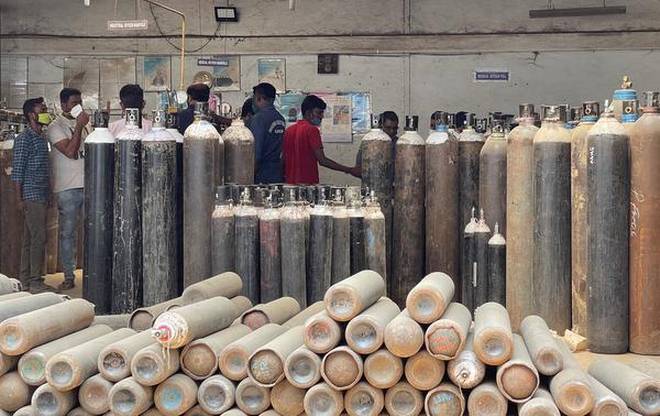
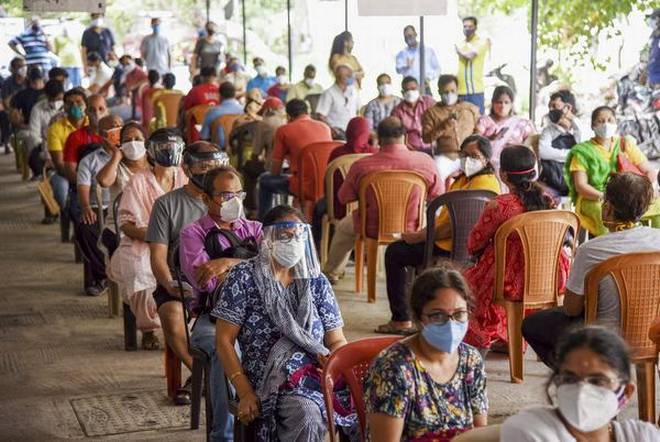
People wait outside an oxygen production unit at Peenya Industrial Area in Bengaluru, after many hospitals ran out of oxygen and beds with ventilators. File photo for representation. | Photo Credit: K. Murali Kumar
Bangalore Medical College and Research Institute 1992 batch doctors liaise with volunteer groups to offer services
Doctors living across the world — all alumni of the Bangalore Medical College and Research Institute (BMCRI) from the 1992 batch — have now banded together with a coalition of volunteer groups to offer end-to-end COVID-19 management for patients in Karnataka, particularly in Bengaluru.
While the Karnataka COVID-19 Volunteers Team (KCVT), with over 500 members, has set up a helpline (080-47166115) which counsels patients, refers them to doctors for tele-consultation, helps in home management and to find hospital beds, Mercy Mission is operating two COVID-19 care centres and has a tie-up with the HBS Hospital in Shivajinagar for critical care. While the helpline and tele-consultation with doctors is available for patients across the State, other on ground facilities are in the city.
“There are over 50 doctors, most of them from BMCRI 1992 batch, and many living in the U.S. and the U.K., who are offering free tele-consultation for COVID-19 patients. I have been doing this for a week now. Most cases are manageable at home. What patients need is guidance and some confidence,” said Umesh Nareppa, a senior cardiac surgeon at Vikram Hospital in the city, and an BMCRI 1992 batch alumnus.
Fund raising
The doctors abroad have also raised funds to the tune of around ₹2 crore and sent 250 oxygen concentrators to the city for patients who need them during home isolation.
Another BMCRI alumnus, H.V. Vasu, who is coordinating the KCVT, said the helpline also has over 100 trained counsellors and will follow patients through the entire course of the infection, advising them with course of treatment, diet, tele-consultation with doctors and try to organise oxygen, hospital beds, if need be. “We have helped book more than 200 beds in the last few days, all through diligent follow-up with the civic body,” he said.
Meanwhile, the KCVT and BMC-92 have partnered with Mercy Mission, another network of NGOs is also running helplines organising oxygen, beds, food and even cremating COVID-19 patients, and for hospital infrastructure. “We have a tie-up with Al Ameen Hospital and HBS Hospital, both in Shivajinagar. While we refer mild to moderate patients to Al Ameen Hospital, we are partnering with HBS for critical care. Mercy Mission is also looking at partnering with CSI hospital, also in the same area, for which talks are in initial stages. Meanwhile, Mercy Mission has partnered with a hospital in Hassan,” said Ali Shariff, who is coordinating these efforts. Patients who need hospital care are being referred to these hospitals.
Mercy Mission is also looking to reactivate the over 40 on ground triaging centres it operated last year in the city’s slums, with focus on vaccination this time. “There is vaccine hesitancy in the slums and we need to send in motivators who have earlier worked in these slums to get people to take the jab. Vaccine coverage is inequitable and low in these pockets. Once we are assured of vaccine supply, we will begin these centres, where we will also take up triaging for COVID-19 cases,” said Mr. Shariff.
source: http://www.thehindu.com / The Hindu / Home> News> States> Karnataka / by K.V. Aditya Bharadwaj / Bengaluru – May 16th, 2021
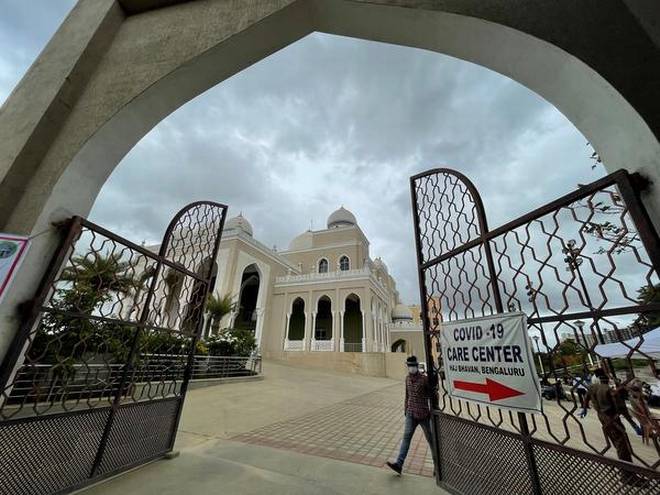
A 100-oxygenated-bed facility was inaugurated at Haj Bhavan COVID-19 Care Centre in Bengaluru on Saturday. | Photo Credit: Murali Kumar K
8 doctors, 12 nurses, 12 housekeeping staff, data operator posted at the CCC
As many as 100 of the 400 beds at the COVID-19 Care Centre (CCC) in Haj Bhavan in Bengaluru have been converted to oxygenated beds. The facility was inaugurated by Minister for Revenue R. Ashok on Saturday. The Minister told reporters that in the second phase, 50 beds each would be converted to ICU and HDU beds.
According to a press release, 8 doctors, 12 nurses, 12 housekeeping staff and a data operator have been posted at the CCC, which is also a triaging centre. For emergency purposes, 2 ambulances are on standby.
Mr. Ashok said that to mitigate the oxygen shortage supply in the city, all CCCs have been equipped with oxygenated beds. Over 800 oxygen concentrators have been delivered to the CCCs apart from ‘Oxybuses’ to support patients. “Every day, we are striving to increase 100 oxygen beds. This will cut down the oxygen problem in the city,” he said.
CCC with 46 oxygenated beds
A COVID-19 Care Centre with 46 oxygenated beds has been established at the Kempegowda Community Hall, near Nandini Layout, in Mahalakshmi Layout Assembly constituency. The facility, which is also a triage centre, was inaugurated by Union Minister D.V. Sadananda Gowda and Minister for Excise K. Gopalaiah on Saturday.
Mr. Gowda said the CCC will be operational from Sunday. Three oxygen mobile vans have been making the rounds of the constituency to provide oxygen to patients in critical need, he said and added that a systematic plan is in place to contain COVID-19 in the city.
source: http://www.thehindu.com / The Hindu / Home> News> Cities> Bengaluru / by Special Correspondent / May 16th, 2021
The Maulavi of Faizabad managed to keep the city free from British rule for almost a year until his death at the hands of British agents on June 5, 1858.
Faizabad (Ayodhya District), UTTAR PRADESH :
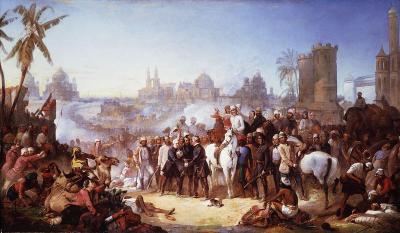
The Relief of Lucknow, 1857, by Thomas Jon Barker. Photo: Wikimedia Commons
Ahmadullah Shah, born in 1787, more famously known as Maulavi of Faizabad, was one of the leading figures of the great Indian revolt of 1857. In the Awadh region, Maulavi Ahmadullah Shah was known as the ‘Lighthouse of Rebellion’. Hailing from a noble warrior family of Awadh in Faizabad, he grew up to be a political leader committed to armed revolutionary insurrection against British rule in India.
During the freedom struggle, Maulavi made Faizabad the centre and launched revolts in all of the Awadh region. He made the local mosque Masjid Sarai located in Chowk area of Faizabad his headquarters. As he liberated Faizabad and the larger part of Awadh region, he used the premises of this mosque to hold meetings with rebellion leaders.
Maulavi Ahmadullah Shah kept Faizabad free from British rule for almost one year, until his death at the hands of British agents on June 5, 1858.
According to researcher and historian Ram Shankar Tripathi, “With being a practicing Muslim, he was also the epitome of religious unity and Ganga-Jamuna culture of Faizabad. In the revolt of 1857, royalties like Nana Sahib of Kanpur, Kunwar Singh of Arrah fought alongside Maulavi Ahmadullah Shah. Maulavi’s 22nd Infantry Regiment was commanded by Subedar Ghamandi Singh and Subedar Umrao Singh in the famous Battle of Chinhat.”
Tripathi narrates, “Maulavi wanted Raja Jagannath Singh of Pawayan, a zamindar in district Shahjahanpur of Uttar Pradesh, to join the anti-colonial war. On June 5, 1858, with prior appointment, he went to meet Raja Jagannath Singh in his fortress-like house. On arriving at the gate, he was greeted with a volley of gunshots from Jagannath Singh’s brother and retainers. The Maulavi breathed his last on the spot.”
“The martyr’s head was severed and carried in a piece of cloth with blood still oozing from it to the district magistrate, Shahjahanpur, by the zamindar. The district magistrate was at lunch with his friends. But the depraved feudal lord rushed in and presented the severed head of the hero on the dining table of the district magistrate. With a reward of Rs 50,000, he returned home, flying atop the flag of loyalty.”
According to another historian Roshan Taqui, “Maulavi use to bring out revolutionary pamphlets mobilising the masses to do ‘Jihad’ against the British. Maulavi was arrested by the British in January 1857 and was held captive in Faizabad, but three months before the revolt broke out in Lucknow on June 3, he escaped and launched a war against the British in Awadh region including Faizabad, Lucknow and Shahjahanpur.”
“During the revolt, the revolutionaries appointed him as chief of 22nd Infantry Regiment that fought the famous battle of Chinhat in Ismailganj of Lucknow on June 30, 1857, against British forces led by Henry Lawrence. Britishers were badly defeated in this war,” informed Roshan Taqui.
British officers like George Bruce Malleson and Thomas Seaton have made mentions about courage, valour, personal and organisational capabilities of Maulavi Ahmadullah Shah. Malleson has repeatedly mentioned Ahmadullah in the History of Indian Mutiny, a book written in six volumes covering the revolt of 1857.
source: http://www.thewire.in / The Wire / Home> History / by Arshad Afzal Khan / June 05th, 2018
Hafiz Azeemuddin is part of the only Muslim family in Rajanpur village.
Rajanpur Village (Ayodhya ), UTTAR PRADESH :
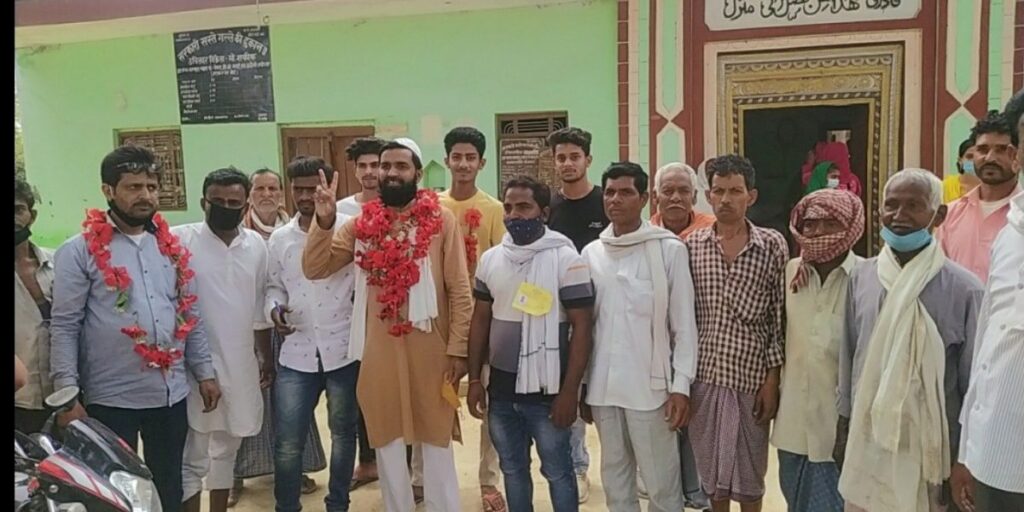
Hafiz Azeemuddin after winning the election. Photo: Special arrangement
Ayodhya:
In an unprecedented show of brotherhood that reaffirms the syncretic soul of Ayodhya, a Muslim cleric who is part of a lone Muslim family in Hindu-dominated Rajanpur village in Ayodhya district won the gram pradhan election with a thumping margin, defeating six other candidates in the fray — all from the majority Hindu community.
Hafiz Azeemuddin, who considers the panchayat poll victory as his Eid gift, attributes his success to his Hindu brethren, who reposed faith in his leadership. This win, however small it may be, once again buried the concept of majority-minority vote-bank politics in what may be considered the symbolic epicentre of Hindutva — Ayodhya.
Azeemuddin and his 27 family members are the only Muslim voters in the village. He received 300 of the total 600 votes polled. “I am sure that of the 200 votes I secured, only 27 will be from Muslims – because in my village there are only 27 Muslim voters,” Azeemuddin told The Wire.
Rajanpur village, which comes under the Mawai police station area of Rudauli assembly constituency in Ayodhya district, has proved that bonhomie and trust between Hindus and Muslims continues to live on.
Azeemuddin is a farmer by profession and graduated from an Islamic madrasa. He also taught in a madrasa for ten years before moving on to take care of his family’s 50-bigha farm.
Reacting to this election result, where Hindu voters came together in favour of a Muslim candidate, Girish Rawat , a local, said, “This is an example of how the fabric of communal harmony is intrinsic to our society.”
“We have not voted on the base of religion, we have voted for the person who would be good for us. Despite being religious Hindus, we voted for a Muslim cleric. This shows to what extent our souls are secular,” said Shekhar Shau.
“It is a manifestation of our pluralism. It is quite obvious that our idea of a syncretic India survives despite all the odds. Let us strengthen such bonds of harmony and fraternity,” said Athar Hussain, secretary of the Ayodhya Mosque Trust.
source: http://www.thewire.in / The Wire / Home> Politics> Religion / by Arshad Afzal Khan / May 12th, 2021
Out of the 10 Muslims from different political parties who contested in the Puducherry 2021 elections, one candidate – A. M. H Nazim from the DMK (Dravida Munnetra Kazhagam) won the Karaikal South seat with 17,042 votes.
The other Muslim candidates who contested include A Mohamad Kassim, R Anifa and C K Ummer Master from SDPI (Social Democratic Party of India), N Sharmila Begum, M Faritha Begum, and A Mohamed Yousuf from NTK (Naam Tamilar Katchi), S Mohamed Seedique from AMMK (Amma Makkal Munnetra Kazagam), A Fazil from DMDK (Desiya Murpokku Dravida Kazhagam), Adv V P Abdul Rahman from AINRC (All India N.R. Congress) and two independent candidates- Mohamed Saleem and Reyaz Ahmed.
In the Puducherry elections, the All India NR Congress won ten seats and its ally BJP six seats. The AINRC alliance is set to form the next government in Puducherry. The Congress-led Secular Democratic Alliance (SDA) saw DMK win six seats, while the Congress was reduced to two seats.
Vidarbha has been a fertile soil for many social reformers and intellectuals. It has played an active role in the nation’s destiny and its social, cultural and political rivulets have flown into and enriched the great sea of national civilization. One such luminary who emerged from Yavatmal was Kazi Syed Karimuddin. He rose to be a great criminal lawyer of the region and played a critical role in the drafting of the Indian constitution.
Kazi Karimuddin was born on 19 July 1899, at Darwah in Yavatmal district of Maharashtra to Kazi Syed Nasiruddin and Dayanath Begum. He had his school education at Mohamedan High School, Amravati. He graduated from Morris College, Nagpur and obtained his postgraduate degree in economics from Aligarh Muslim University. He later qualified for law. He married Qadirunnisa Begum (May 24, 1926) .
Kazi Karimuddin had an active presence in social, legal, judicial and political circles in Yavatmal. He was Vice Chairman, District Council (1924-28) Sub-judge (1928-31) President, Anjuman Middle School (1932-37) and Public Prosecutor (1939-45). He was member of Constituent Assembly (1947-50) and of Madhya Pradesh Assembly (1947-52) (at that time Madhya Pradesh was known as the Central Province). Following that, he was a member of the Rajya Sabha (the upper house of the Indian Parliament) from 1954 to 1958. He died on 14 September 1977.
Kazi Karimuddin moved an amendment in the Constituent Assembly on the lines of American Constitution to make right to privacy a fundamental right but Dr. B.R. Ambedkar gave it only reserved support. Article 20 provides that no person shall be convicted of any offence except for violation of a law in force at the time of the commission of the act; that no person shall be prosecuted and punished for the same offence more than once; and that no person accused of any offence shall be compelled to be a witness against himself.
Endowed with rare forensic skills, Kazi Karimuddin’s vast experience and insights gave him an uncanny knack for unraveling the anatomy and pathology of crimes. He was always apprehensive of the pervasive scope of the intrusive lens of the state as well as private agents. He considered privacy a vital constituent of a healthy constitutional polity since India’s large population of minorities had become vulnerable due to the emerging communal situation.
He wanted that the following be added as clause (4) in article 20: “ The right of the people to be secure in their persons, houses, papers and effects against unreasonable searches and seizures shall not be violated and no warrants shall issue but upon probable cause supported by oath or affirmation and particularly describing the place to be searched and the person or things to be seized.”
He said: “This is very important amendment. You will be pleased to find that this finds place as article 4 in the American Constitution and in the Irish Constitution there are clauses (2) and (5) which are similar and in the German Constitution there are article 114 and 115 on the same lines. In the book of Dr. Ambedkar—Minorities and States—on page 11, item No. 10, a similar provision has been made. What is the situation in India today? …Arrests are made without warrant and searches without justification. We are being governed by lawless laws and there is no remedy for the redress of grievances on account of unauthorized arrests and searches.”
Dr. Ambedkar pointed out that this clause was already in the Criminal Procedure Code, and was therefore a part of Indian law, but also acknowledged that it may be desirable in the interests of personal liberty to ‘place these provisions beyond the reach of the legislature’. Despite Ambedkar’s support the amendment was negatived.
However the Karimuddin amendment in the Constituent Assembly re-emerged through the process of judicial engineering in Kharak Singh v. State of U.P where the court discussed the relationship between surveillance and personal liberty (personal liberty being guaranteed by the Constitution) and found that unauthorised intrusion into a person’s home would interfere with her right to personal liberty. The court recognised “the right of the people to be secure in their persons, houses, papers, and effects” and declared that their right against unreasonable searches and seizures was not to be violated.
Kazi Karimuddin was also the key persona in the deliberations on the Uniform Civil Code in the Constituent Assembly. He argued: “The people outside and the members of the Constituent Assembly must realize that a Muslim regards the personal law as part of the religion and I really assure you that there is not a single Muslim in the country—at least I have not seen one—who wants a change in the mandatory provision of religious rights and personal laws, and if there is anyone who wants a change in the mandatory principle, or religion as a matter of personal law, then he cannot be a Muslim.”
Kazi Karimuddin had three sons and five daughters. Though he was a staunch opponent of the UCC, he was a very progressive and forward-looking Muslim who educated his children at the country’s premier educational institutions. Since Yavatmal did not have adequate facilities for higher learning, he sent his daughters to Hyderabad to pursue postgraduate courses at Osmania University which was a renowned educational hub for women.
His sons-in-law also excelled in their respective fields: Nizamuddin Ahmed (LLM) was trained in UK in Labour Law and retired as Deputy Commissioner- Labour, Maharashtra; Syed Mukassir Shah was former Chairman of the Andhra Pradesh Legislative Council; Justice M.M. Qazi was former Chairman of the Maharashtra Administrative Tribunal and retired judge of Bombay High Court; and Dr Mirza Basheer Baig was an orthopedic surgeon (FRCS) in UK.
The life of Kazi Karimuddin serves as a beacon to modern day Muslims who are now at the most challenging crossroads in history.
source: http://www.muslimmirror.com / Muslim Mirror / Home> Indian Muslim / by Moin Qazi / May 13th, 2021
A popular ambulance service the group ran during the COVID outbreak last year to cater to its residents, which stopped two months ago owing to a dip in cases, will be revived again in a week’s time.
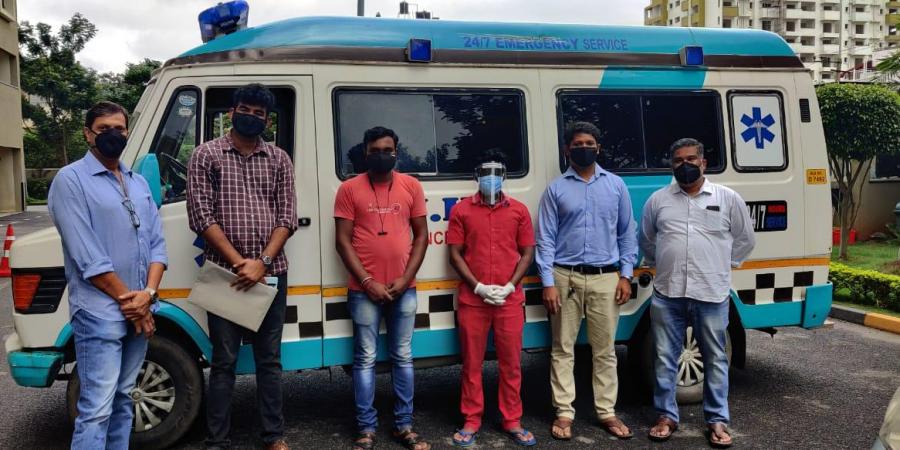
Changemakers of Kanakapura Road plan to revive its ambulance service for residents which was launched during the first COVID wave and later stopped (Photo | Special arrangement)
Bengaluru :
In light of the hardships experienced by the public to get taxis as well as ambulances during the ongoing pandemic, an umbrella organisation of over 60 resident welfare organisations in Kanakapura Road has decided to come to the rescue of residents. It will offer a car free of cost to help residents reach anywhere for treatment as well as revive the popular ambulance service it ran when the pandemic broke last year.
Speaking to The New Indian Express, Abdul Aleem, president of ‘Changemakers of Kanakapura Road’ said, “With COVID cases rising, we want to help out the nearly 30,000 residents who are our members. We facilitated arrangement of an Innova car through Sathya Sai Tourist service. Our group will bear the diesel and driver charges.”
Explaining the rationale behind it, Aleem said when members of the public use their own car to ferry their family members affected by COVID-19, there is a big risk to others using it. “We want to offer this alternative to them. We will be maintaining the vehicle in a fully sanitised condition so that it is safe for all to travel,” he said.
A popular ambulance service the group ran during the COVID outbreak last year to cater to its residents, which stopped two months ago owing to a dip in cases, will be revived again in a week’s time. “It costs us around Rs 2.4 lakh to maintain the vehicle supplied by J K Ambulance. We had collected Rs 60 per family to sustain the fuel and driver costs last time and plan to repeat it. We have three medical staff available 24×7 and 2 drivers to run the service,” he said.
A ventilator, suction apparatus, cardiac monitor, oxygen cylinder and infusion pumps are among the equipment in the ambulance.
There is a back-up arrangement with the provider so that if there is an emergency and someone has booked this ambulance, another would be supplied, he added.
source: http://www.newindianexpress.com / The New Indian Express / Home> Good News / by S Lalitha , Express News Service / May 13th, 2021
Citizens stand in a queue as they wait to receive a dose of COVID-19 vaccine, at ESIS Hospital in Navi Mumbai, on May 13, 2021. | Photo Credit: PTI
‘We have been providing free services with the aim of keeping humanitarian spirit alive,’ they say
Pune district has been the worst-hit in not only the State but also the country during the first and second waves of COVID-19. The district currently has nearly 95,000 active cases and is reporting nearly 15,000 deaths since March last year.
As the virus continues to wreak havoc and instil fear, there have been several cases in which relatives have refused to perform funerals of their kin or even help take the body to the ambulance.
In such cases, city-based activist Anjum Inamdar and his outfit, Mulnivasi Muslim Manch, have been performing yeoman service to ensure that these ‘orphaned’ bodies receive a proper funeral. Since last year, the Manch has performed the last rites of more than 1,300 COVID-19 victims, cutting across castes and communities.
With material support from the Pune Municipal Corporation (PMC), which has supported the group by supplying Personal Protection Equipment (PPE) kits, Mr. Inamdar and his 18-member team have transcended communal barriers with their exemplary service.
“As the deaths started mounting in Pune in late March-early April, our outfit was one of the first to respond to the then PMC Commissioner Shekhar Gaikwad’s call to NGOs to come forward and aid authorities in relief work… In many cases, funerals could not be performed as entire families had tested positive. It is in such cases that our outfit helped perform the last rites as per the tradition of a particular caste or community…We have even helped in the funeral of non-Covid victims,” Mr. Inamdar said.
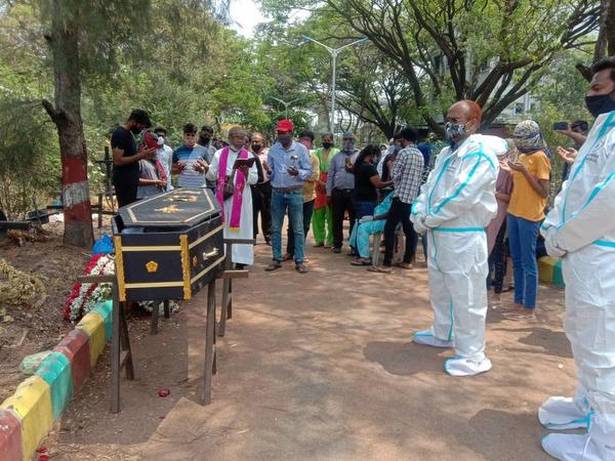
Mulnivasi Muslim Manch founder Anjum Inamdar (centre, in PPE kit) helping with last rites of a Christian person in Pune.
Manch acitivists have performed the last rites of Hindus – be they Brahmins, Lingayats, Telugus – as well as Sikhs, Christians and members of other communities as per their respective customs, much to the satisfaction of the relatives of the deceased.
“Our activists have fanned out across the State, working in Lonavla, Shirur, Jejuri, Lonand, as well as Satara, Navi Mumbai, Panvel, Raigad and other districts in the Marathwada region. We have also helped with the final rites of constables, health workers, doctors, journalists and notables like Maharashtra hockey player William D’Souza,” Mr. Inamdar said.
Their volunteers also facilitate online training of workers from different social outfits engaged in relief works across the State.
“We have been providing free services with the aim of keeping the humanitarian spirit alive and ensuring dignity even in death,” says Mr. Inamdar.
Helping hand
The Sikh community has time and again proved itself when it comes to opening up their hearts and purses for relief work. The Supreme Council Navi Mumbai Gurudwaras (SCNMG) is an umbrella organisation governing nine gurdwaras. Many of these gurdwaras are providing free rations and cooking gas to the needy, by collaborating with different trusts as well as using donations from individuals.
“We provide cooking gas and rations for a week or two from our gurdwaras in Panvel, Kharghar, CBD-Belapur, Nerul, and Airoli. Whoever needs rations can go there and they get what they need,” said Mehar Singh Randhawa, general secretary of the SCNMG. Last year too, these gurdwaras had ensured delivery of rations to the needy.
“This is public money and going back to the public. Our job is to deliver to the needy without discrimination,” he said. The SCNMG also provides cooking gas cylinder to the Covid-affected.
“Come with the Covid report and Aadhaar card. While a small cylinder is for free, we take a deposit for a big cylinder. The money is refunded when the cylinder is returned,” he said. When asked how many people have benefited, Mr. Randhawa modestly said the job was not for the purpose of keeping count and no record has been maintained.
Relief in kind
Not all relief work is about offering food, though. Anjumane Shiateali, an organisation that manages matters of the Dawoodi Bohra community in Mumbai, is providing service of a different kind. It has recently set up a Covid war room in Mumbai’s Bhendi Bazar area as part of its Project Rise initiative.
Taizun Bearingwala, a volunteer/coordinator at the war room, said they offer medical counselling, consoling and guide people to appropriate medical service. “We get calls from different parts of the country. We also have over 60 doctors who offer consultations,” he said. The war room has designed a medical form which is filled after talking to the caller.
The Anjumane Shiateali has been serving food to migrants workers and has undertaken other relief efforts under Project Rise initiative since the last 12 months.
Samajwadi Party MLA Rais Sheikh said that the Project Rise work is commendable. “The callers get advise on whether they need oxygen or ICU bed or home quarantine,” he said, adding that earlier the calls were from patients, but now the number of those seeking guidance on vaccination has seen an increase.
Not just in Mumbai, Project Rise has a presence in other cities of Maharashtra and the country.
They have converted a community school in Indore into a Covid care centre providing hospital beds, oxygen cylinders and day care. So far, over 500 patients have received treatment.
With the help of local authorities and agencies, Project Rise volunteers are supplying extra beds, medicine, oxygen supply in all six Primary Healthcare Centers (PHCs) and one Covid care centre in economically backward areas of Karjat. They are also providing protective gear such as masks, gloves, PPE kits and sanitisers for all medical staff and frontline workers. This is for a combined population of over 2.5 lakh people.
Their volunteers in Coimbatore and Chennai have been serving cooked meals to patients’ families, slum dwellers, at orphanage and old age homes since the last 51 weeks.
Financial and medical support is also being provided in Nagpur and Nashik in Maharashtra and small towns like Taloda and Mahuva in Gujarat, and Thandla in Madhya Pradesh. Villages in Mokhada, Maharashtra, are being supplied with daily water tankers, covering a population of over 1,650 people
“As part of the initiative, Project Rise volunteers across different parts of the country are mobilising a range of facilities from healthcare and oxygen cylinders to serving food, water and dry rations to vulnerable sections of society,” said Ammar Tyebkhan, member, Project Rise.
Space for vaccination
St Michael’s Church at Mahim, on the other hand, offered much needed space for vaccination. “There is palpable panic among people since the second wave struck. We can help people, but there is a need to instil confidence. This confidence will come only through vaccination,” said Father Lancy Pinto.
“As we realised the need for vaccination, we offered three options to our ward officer along with the local corporator. We offered the church’s premises till November this year to set up vaccination centre. It has a capacity to vaccinate 1,200 people a day,” he added.
Father Pinto said the church offered space knowing that vaccination would be a long process and would not get over in one or two months. “Therefore, we chose a spot which will not disrupt the activities of the church and the school,” he said.
Mumbai’s Siddhivinayak Trust, on the other hand, extended monetary help to the State government to fight the pandemic and also to provide aid.
“We have donated ₹5 crore to the Chief Minister’s Covid relief fund. In addition, we also donated ₹5 crore towards the Shiv bhojan scheme of the State government where free meals are given to the needy,” said Aadesh Bandekar, president of the trust.
He said further relief measures would be be announced after a meeting of office-bearers of the trust.
Recognising another gap, Lalbaugcha Raja, one of the most popular public Ganesh mandals in Mumbai, has been running its dialysis centre throughout the Covid period.
Balasaheb Kamble, president, Lalbaugcha Raja, said, “We ensured that the centre continues to run throughout the pandemic. While medical services are busy and loaded with work treating COVID patients, those requiring dialysis can come here.”
It has also held blood donation camps where over 15,000 bottles of blood were collected. “We also gave a call for plasma donation, through which we helped around 245 patients,” he said.
(With inputs from Shoumojit Banerjee, Alok Deshpande and Lalatendu Mishra)
source: http://www.thehindu.com / The Hindu / Home> News> States> Other States / by Mumbai Bureau / Mumbai – May 13th, 2021
Since Ramzan began, this team of volunteers has been heading out every morning at 3am to feed 500 others before they sit down for their own sehri.
Irfan Ahamad Z and Saddam Baig
Bengaluru :
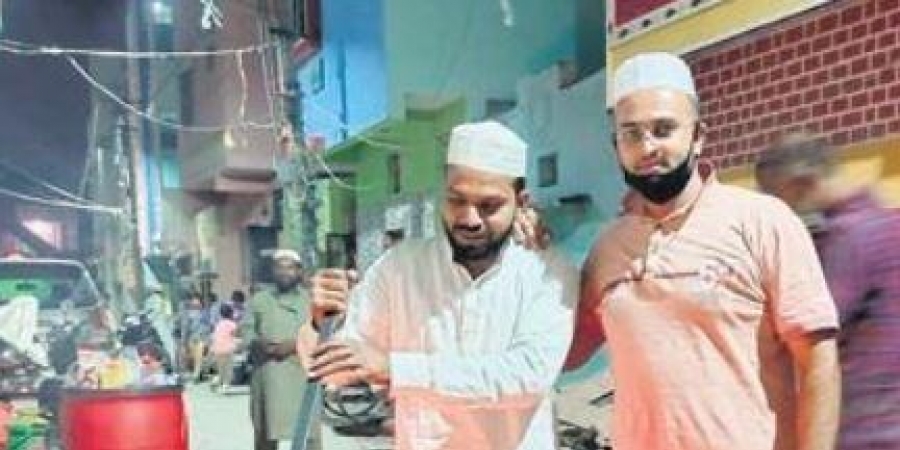
While many start to hit the sack at 11.30pm is when Saddam Baig jumps into action. Since Ramadan began, the advocate has been volunteering to distribute food for sehri (a meal consumed early in the morning before Muslims begin fasting during the holy month) to over 500 people in Padarayanapura.
A resident of the area himself, Baig says, “There are many slums around and the daily wage workers are struggling to get food these days. Baig took part in this initiative last year too, but then, there were more groups catering to different areas of the city such as Koramangala and RT Nagar as well.
Not wanting to give up the good deed this year, the 28-year-old decided to take it up again. The initiative has been started by Aayina Trust, a charitable organisation, but includes volunteers both from the trust and outside. Every day, the team has been packing food for those in need, with funds coming from their own pockets and through donations.
“We’ve had many people show their goodwill at this time. For example, our cooking team has three people, wherein the main chef takes only Rs 1,000 per day to prepare 100kg of rice, one type of chakna and one gravy,” says Baig, who is a trustee of Aayina Trust. Once the food is prepared by 11.30pm, the team gets to work with packing it and then heads out to distribute the meals at 3am, without catching a wink of sleep in between.
“I don’t sleep before because I know there are people depending on us. One day, we were 10-15 minutes late but when we reached, some of the families were waiting and they had tears in their eyes. They thought they wouldn’t be able to get a meal that day,” recalls Baig, adding that the team only sits down for their own sehri after the distribution to others in need is done. “I sleep less these days but it’s peaceful slumber. And helping others gives me energy to deal with the fatigue,” he adds.
Irfan Ahamad Z, who is the chairman of the trust, says they don’t want to keep the initiative limited to just Ramzan. “If the lockdown continues, we want to help during that time as well,” he says.
Baig adds, “So far, we haven’t faced any trouble despite the restrictions in place. Even the police personnel in our area are aware of our work and don’t mind us stepping out for it. We divide ourselves into teams of two and make sure not to disturb anyone.”
source: http://www.newindianexpress.com / The New Indian Express / Home> Good News / by Simran Ahuja , Express News Service / May 08th, 2021
‘Doctors for Humanity’ is the medical wing of the Jamaat-e- Islami Hind to keep young Muslims engaged in social service
Hubballi :
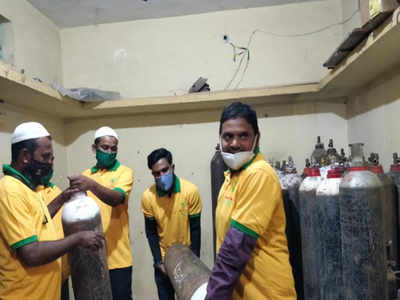
‘Doctors for Humanity’ started out with around 50 doctors. These doctors were assisted in their efforts by around 600 volunteers from ‘Humanitarian Relief Society’.
Most of the doctors and volunteers were from the Muslim community.
It was an initiative aimed at providing round-the-clock aid to Covid-19 patients and their families across the state — while doctors who are part of the initiative have been tending to patients struggling to receiving treatment, volunteers equipped with skills to deal with both natural and man-made disasters, lent invaluable support to the members of patients’ families, right up till helping them with the final rites.
Impressed with their selfless service, doctors and volunteers, from other communities, have flocked to join the group, and offering their services for those in this hour of crisis.
‘Doctors for Humanity’ is the medical wing of the Jamaat-e-Islami Hind to keep young Muslims engaged in social service.
Director Humanitarian Relief Society KM Ashraf said that the volunteers had thus far reached out to more than 1.86 lakh people , cutting across lines of caste and creed.
“They have provided ration kits, food and lending even financial support to the tune of Rs 5.3 crore when the lockdown was enforced last year. We revived the Covid-19 helpline in mid-April this year, and the doctors have been seeing around 100 cases a day. We have distributed food packets around 5,000 people, and performed the last rites of 84,” Ashraf told TOI.
Coordinator of Doctors for Humanity Dr Asifa Nisar said that the outfit counted professionals based out of Bengaluru, Ballari, Kalaburagi , Vijayapura and other districts.
“Many of them are engaged in counselling those calling for help. At least ten doctors are available round-the-clock. We are approached by at least 100 patients, on average, daily. Doctors and volunteers have dedicated numbers. Our volunteers have helped 393 patients get oxygen, and arranged beds for 132 more,” said Dr Asifa, adding that she had data only up till the end of April.
She pointed out that the Humanitarian Relief Society had been instituted to come to the aid of society in times of calamity – natural and man-made.
“All our volunteers are trained to handle emergencies. Since March last year, however, we have dedicated all our resources to the fight against Covid-19. We have been strictly following the government-issued guidelines. I am very pleased that members from other communities are also joining us in various districts,” Dr Asifa added.
source: http://www.timesofindia.indiatimes.com / The Times of India / Home> News> City News > Hubballi News / by Sangamesh Menasinakai, TNN / May 09th, 2021