As people gasp for oxygen at hospitals in Aravalli and Sabarkantha districts, a Muslim youth group, in collaboration with a local trust, has established a 30-bed COVID-19 Care Centre in Modasa town.
With cases rising at an alarming rate and all government as well as private hospitals at full occupancy, the centre has been started by Muslim Yuva Group and Maqdoom Education Trust of Modasa to cater to COVID-19 patients.
All beds have been equipped with oxygen support and senior physicians and other medical professionals have also been roped in to run the operation.
Set up with the sole objective of providing timely treatment to people, the centre will cater to patients irrespective of their caste and community, Naeem Meghraji of Maqdoom Education Trust told First India.
Trained medical professionals and paramedics will assist patients round-the-clock along with a team of physicians led by Dr Jamil Khan.
All patients admitted to the centre will be provided free medical treatment including medication and food for the duration of their stay, he added.
source: http://www.firstindia.co.in / First India / Home> Gujarat / by Bhavesh Barot / May 08th, 2021
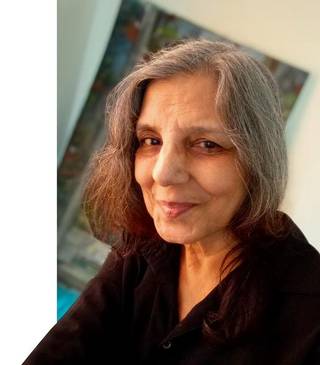
Yasmin Zaidi’s new artworks reflect on the COVID pandemic, isolation and grief
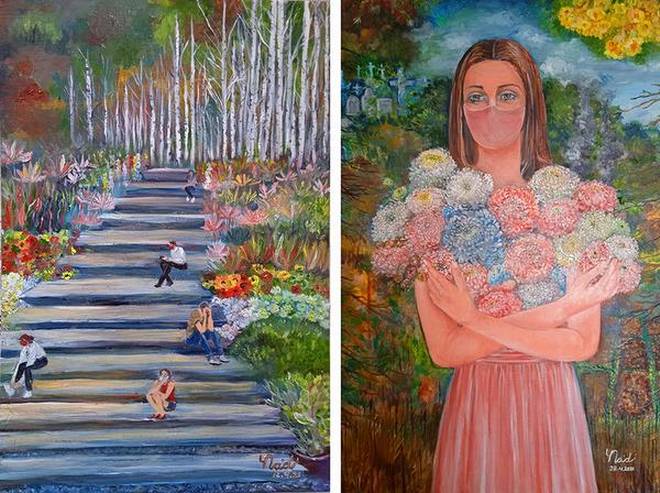
Yasmin Zaidi has begun to paint grief. It comes through in her two new works: one shows a young woman holding chrysanthemums in her arms, with graves behind; another has masked, socially distant people along a stairway (to heaven?).
She asked her family what to name them, and got a number of replies: Viral Apartheid 2021, Loveliness and Loneliness. “I realised that everyone is feeling personally involved during this pandemic… They will give their own names to the paintings,” says the 70-year-old artist who paints flowers and people.
Zaidi has lived across India — Firozpur Jhirka (in Haryana), JK Puram and JK Gram (in Rajasthan), Delhi and many more — where she worked as an educationalist through her life, mostly in administrative positions, though she trained as an English and Social Studies teacher. “I taught art sometimes because I was just able to,” says the hobbyist, whose home, when growing up, was filled with letters and pictures. Her father, Syed Ali Jawad Zaidi, was an Urdu poet and scholar, and her grandfather dabbled in art.
Yasmin Zaidi | Photo Credit: Special arrangement
She draws from the various elements of Nature she has encountered through life: The stairway in her current oil on canvas leads towards birch trees she retrieved from mental images of Kashmir. The red bottle brush and yellow tecoma in the ‘girl with chrysanthemums’ are from her ground floor flat in Mumbai, where she has a little garden. “My mother was very fond of gardening,” she remembers.
This time though, flowers have been used as a metaphor for the departed. Urdu poet Afzal Ahmed Syed’s Hamein Bahut Sare Phool Chahiye, which seems to allude to war and talks about how we need a lot of flowers to cover our dead, played in her head as she painted.
“When I paint, personal things come in — a book by Annie (her daughter, a writer), but the whole world was becoming personal,” she says of the shock waves that seemed to have affected everyone.
She hasn’t thought of selling: “I hardly think of the paintings as belonging to me.” She adds she wouldn’t know how to, and even if she did, it would go to COVID relief.
Right now, she’s recovering from a gall bladder surgery and is with her son in Pune. “I want to paint more, but I have run out of canvas, and it’s difficult to get it right now,” she says.
source: http://www.thehindu.com / The Hindu / Home> Entertainment> Art / by Sunalini Mathew / May 04th, 2021
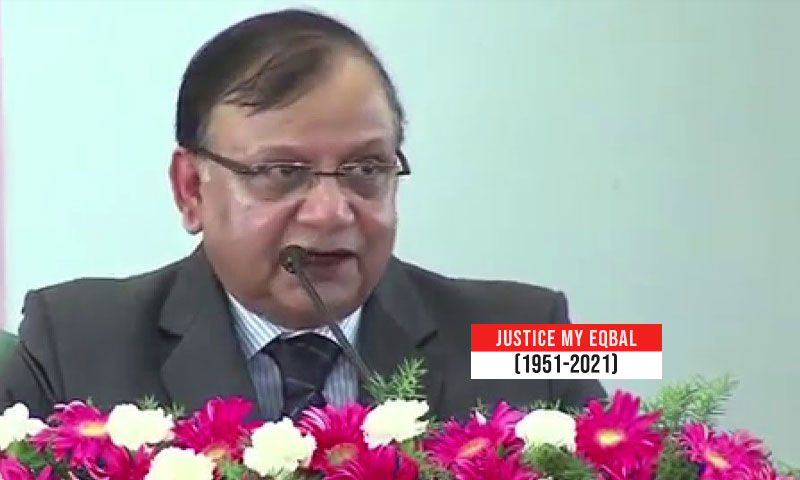
Former Supreme Court Judge Justice MY Eqbal passed away today morning at New Delhi.
He was a judge of the Supreme Court from 24 December 2012 – 12 February 2016.
Before that, he was the Chief Justice of the Madras High Court.
Chief Justice of India (CJI) N V Ramana has condoled the passing away of former Supreme Court judge M Y Eqbal before commencing the day’s judicial proceedings.
Justice N V Ramana, Hon’ble the Chief Justice of India expressed deep sorrow at the passing away of former Judge of Supreme Court Justice M.Y. Eqbal. Recalling his association with Justice Eqbal, Justice Ramana described Justice Eqbal as a conscientious professional who stood for humane values. He offered condolences to the bereaved family. When the Bench assembled in Court No. 1 this morning, Hon’ble the Chief Justice made a reference in this regard and offered condolences on behalf of the Supreme Court of India. Justice Eqbal passed away at a private hospital in Gurugram
Justice Eqbal was born on 13 February, 1951, passed B.Sc. from Ranchi University in 1970 and obtained LL.B. Degree in 1974 with distinction winning Gold Medal.
He started his career in Ranchi as an advocate in 1975 practising exclusively in civil side. He was appointed as a Government Pleader in the Ranchi Bench of Patna High Court in 1990. Later, he was appointed as a permanent Judge of the Patna High Court on 9 May, 1996 and then became the Judge of the Jharkhand High Court on 14 November, 2000.
Justice Eqbal, who was also associated with the Jharkhand Legal Services Authority, is the first Judge from Jharkhand to be elevated as a Chief Justice of any High Court in the country.
source: http://www.livelaw.in / Live Law / Home> Top Stories / Live Law News Network / May 07th, 2021
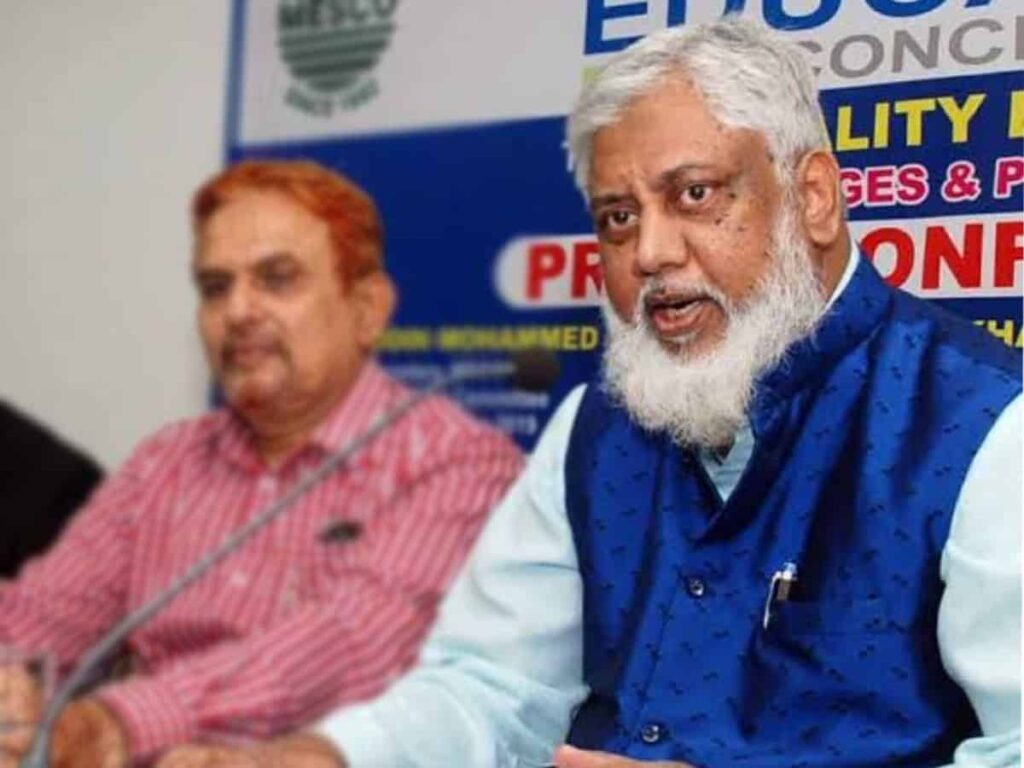
Well known social activist Dr Fakhruddin Mohammed has passed away this noon (May 5) following the second attack of coronavirus at a leading hospital in Hyderabad. He was 61.
According to family sources Dr Fakhruddin had returned home from the hospital after recovering from the first attack of COVID-19. But within a couple of days the attack recurred and he was rushed to the same hospital where could not survive.
Dr Fakhruddin was the Chairman of Muslim Educational, Social and Cultural Organisation that is popularly known as MESCO that was established in 1975 with the motto of serving the backward Muslim community through various ways.
Today MESCO is a major name in the field with a network of schools and colleges to its credit where thousands of students are enrolled.
Because of his active participation in matters related to education and social work, he was known across the country. He was also a consultant for setting up medical colleges. At one time he served as a member of Aligarh Muslim University Senate.
By setting up MESCO Diagnostic Centre in the Old City of Hyderabad with the patronage of senior medical practitioners, associates and other community leaders he was able to establish a chain of educational institutions.
He is survived by his wife, two sons and two daughters.
He was laid to rest after Isha (night) prayers.
source: http://www.siasat.com / The Siasat Daily / Home> News>Hyderabad News / by Usama Hazari / May 06th, 2021
Simply Rizwan to most of his friends and colleagues, a leading voice among the historians of Modern India, succumbing to the virus, academic life will no longer be the same
With the untimely death of Prof. Rizwan Qaiser, Rizwan for most of his friends and colleagues, a leading voice among the historians of Modern India, the academic life of the country and more so of the capital will no longer be the same.
While Jamia Milia Islamia, where he has been a key member of the Department of History and Culture and also an extremely energetic member of its Teachers’ Union , loses one of academic leaders, Jawaharlal Nehru University, under siege for some time anyway, loses one of its most loved alumni who represented the University in more than one sense: someone who thought scientifically about social issues, believed that a humane world could be built with the ideals of compassion, equity and a sense of justice, the virtues tried to be enshrined in our collective consciousness during the national movement for freedom, and someone ready to speak up against the divisive social and political forces.
Born and educated in Munghyr, Bihar, Rizwan came to Jawaharlal Nehru University in 1980. It was in the Centre for Historical Studies where he had his training in Modern Indian history, with Prof. Bipan Chandra, Mridula Mukherjee, K.N. Panikkar, Sabyasachi Bhattacharya, and many others who had made the Centre the location of a robust historiography on Modern Indian history.
Coming a couple of years after the Emergency and having experienced the student movements in Bihar as a young boy, Rizwan took to the new kind of history in no time but also took to the political life of the campus at this time. Though he later moved to the School of International Studies where he worked for his Doctoral thesis with the renowned Prof. Bimala Prasad and Prof. Uma Singh, he remained a steadfast historian of the Centre for Historical Studies mould, as for him the historian’s job was not over with merely arranging facts and interpreting them in a chronological manner in a sophisticated academic language.
The historian has to review one’s own historiographical premises as well of others and present one’s case in that ouvre, as it is here that presuppositions, prejudices, biases and premises of historians and the traditions of history are located. At least two generations of students of history in Jamia Milia Islamia were richer with these historical practices becoming a prevailing mode there given the active presence of such historians. Rizwan remained till the last its most vocal proponent.
This has also allowed him to emerge as the most articulate historian of the national movement and its different strands. He meticulously located the participation of the Muslim in general and nationalist Muslims in particular in the overall universe of the national movement. In his Doctoral thesis, he chose to concentrate on the idea, role and politics of Maulan Abul Kalam Azad, the quintessential nationalist Muslim that one could think of. His work was an examination of the ideological position of the nationalist Muslims and the predicaments they had faced when the Muslim masses joined the Muslim League as against the wishes and exhortation of the Nationalist Muslims against such a move.
Prof. Qaiser showed with a historian’s craft and meticulous attention to detail how his protagonist, Abul Kalam Azad was not after all a failure just because, as other historians like V.N.Dutta and Ian Douglas claimed, he could not carry his co-religionists to the national movement under the leadership of the Congress.
In fact, Prof. Qaiser showed how Azad’s ideological position, that Muslims while following their religious credo must embrace a secular political line, turned out to be socially the most valid position to take. To Prof. Qaiser, Azad was, since his emergence as a national leader of the Muslims in the 1920s, trying to build a consensus on the point where the concerns and angst of the Muslim community, born out of their general and particular location, could be alleviated within the Congress platform so that the Muslim need not seek other forums for such issues. Once the Muslim League emerges in the late thirties, Azad’s work, as Prof Qaiser shows, became more challenging as he had to think afresh and sometime not in a very friendly atmosphere within the Congress, to bring the younger generations of Muslims towards the Congress.
His becoming the President of the Congress in 1940 in many ways was an acknowledgement of the tough job that he had at hand. Prof. Qaiser maintained that Azad had developed an ideological position where Hindus and Muslims could coexist within the framework of a single nation with adequate amount of mutual cooperation and adjustment. The need for such adjustment became greater as the movement for Pakistan became deeper and sharper and the opposition to such demand too began to take intransigent position.
Azad, in his work came out as a historical figure, and not merely as a tragic one, or a literary genius as many others have tried to paint him. The previous historians who had worked on the Khilafat and Non Co-operation movement saw the flank of the Muslim leadership in the shape of Mohammad Ali or Abul Kalam Azad taking their historical places, somehow placing them in the context of the Muslim awakening. Further, the politics within the Muslim community as having to face the new realities of Indian politics and turning into some kind of sectarian politics had also been brought to the fore in earlier histories.
Where Qaiser diverged and made a lasting contribution with his book, Resisting Colonialism and Communal Politics: Maulana Azad and the Making of the Indian Nation (Manohar, Delhi,2011) was the fact that he placed the question of an ideological choice in politics at the centre of the historiography. Thus, Azad made a conscious choice in accepting an ideology which he thought was the ideal path for the Muslims to follow in their opposition to colonialism as well as accepting their role in defining the Indian nation. He held on to this despite being marginalised both by the Muslim masses who joined the League in large numbers, and within the circle of leadership in the Congress and yet, as Qaiser suggests, this ideological choice was the right one in hindsight as this provided a correct picture of the anti colonial feelings of the Muslim masses and their desire to be the part of a free nation. Muslim Communalism provided them a false idea and a false promise.
Communalism, for him, was a modern phenomenon and it used religion and yet communalism cannot be identified with the religious life of people, a line – very subtle at times – being taken by many historians of Muslim communities and Islam in South Asia.
Prof. Qaiser ‘s critique of the writings of Francis Robinson, Peter Hardy or Paul Brass was posited in this understanding. For Prof. Qaiser, modern history of Islam and more so the Muslims in India cannot bypass the issue of their fight against colonialism and their place in negotiating Indian Nationalism. His recent writings and lectures on Jamiat ul Ulema I Hind for example and their role during the 1940s in supporting the Congress and opposing the Muslim league for example, also underpinned Prof Qaiser’s continued emphasis on an appropriate historical trajectory within modern history for the Muslims and Indian nationalism.
.A social scientist and a socialist
Rizwan’s was also an acutely conscious historical persona steeped deeply in the cosmopolitan nature of Indianness. A proud Bihari who came out of the famed Zila School of Munghyr which once upon a time used to be an excellent institution and had already produced Indian’s pioneering historian of science, Prof. Deepak Kumar, Rizwan of late was also steering many good researches on the regional history of Bihar in modern times. He also had been noticing the inter regional differences in the nature of popular protest during the national movement in a recent lecture about how the elite and educated in Bihar actually were happy about the partition of Bengal, as they saw it was needed for the development of Bihar.
His consciousness was also shaped by his being part of the socialist students formation, Samata Yuvajan Sabha, which had produced most of the socialist leaders in the last century. He like thousands of students of his generations believed that a scientific secular and socialist society can be formed by the struggle of the youth. His was an active political academic life in the JNU where he even contested for the JNUSU presidential post in 1987 which also saw his ability to articulate a non communist socialist position for a general population. His was also a non compromising secular position and he intellectually tried to add his contribution to refine the secular position in the light of the actual politics that India was undergoing. One still remembers his visiting and holding meetings in villages for maintaining communal harmony during the Babri Masjid demolition days of 1992-3. He was in fact one of the founding members of the Sadbhavna Mission which Prof. Vipin Kumar Tripathy of IIT Delhi has been steering for almost three decades now.
In the light of the discussion on secularism, the author had asked him once about his steering the move to the granting of minority institution status to Jamia. He was asked whether that was not smacking of a political route to communal position; his answer to this was scientific and quite valid. Why do we assume that by giving an institution a minority status which is a legal status, the political and social outlook of the teachers and students will become communal?
When the country is going to celebrate its 75th year of Independence, it would be a pity that one of the finest and most articulate historians of the national movement will not be with us. His absence will be more acutely felt when we fight our battle for collective consciousness which has been showing enormously dangerous communal portents in the present.
source: http://www.nationalheraldindia.com / National Herald / Home> Obituary / by Rakesh Batabyal / May 03rd, 2021
What started as documenting his own life in Europe while pursuing his Masters gradually gained direction and came to focus on wildlife photography.
Hyderabad:
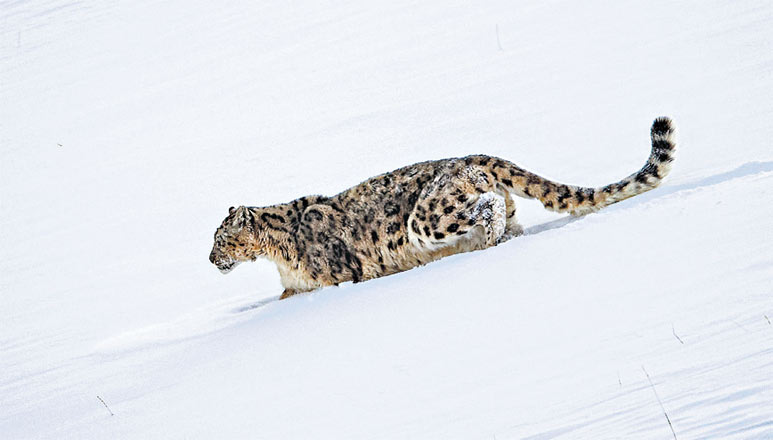
His photographs of a snow leopard from Spiti, Himachal Pradesh broke the internet, literally. Yet the man is still calm, unassuming.
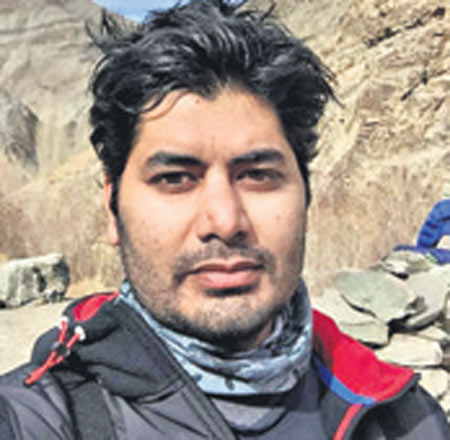
Ismail Shariff, Hyderabad-based nature and wildlife photographer, is known to wildlife and photography enthusiasts as the ‘Snow Leopard Man of India’. His long and passionate association with photography began in his student days. What started as documenting his own life in Europe while pursuing his Masters gradually gained direction and came to focus on wildlife photography.
Picking up his first camera in 2005, Ismail was treated to the magnificent sight of a huge male tiger in 2008 while on a trip to the Kanha National Park in Madhya Pradesh. That was the defining moment of his life. “It became one of the reasons for me to move back to India to pursue of wildlife photography and tourism here,” he said.
Ismail, an alumnus of the Hyderabad Public School, Begumpet, has been part of nine snow leopard expeditions in the last seven years with the recent one being in 2020, apart from several other wildlife expeditions. The first thing that strikes his mind about snow leopards is the long fluffy tail, blue eyes, thick fur and a true-blue cat attitude. Snow leopards are one of the world’s most elusive animals and the most common way to spot one is high up on the mountain ridges. After an hour or more of patient stalking in Spiti in 2017, he finally spotted a snow leopard passing by. The shots he posted on various wildlife photo websites are trending even today.
“I was obsessed with snow leopards ever since a photograph taken in 2012 by Dhritiman Mukherjee, India’s leading wildlife photographer,” said Ismail, adding that seeing the mysterious ghost of the mountains for the first time in Hemis National Park, Ladakh, was an unforgettable experience in itself.
Ismail said the snow leopard is a notoriously elusive creature. It is also listed as “Vulnerable” on the IUCN Red List since the global population is estimated to be between 4,000 to 6,000. India is believed to have less than 1,000. That adds stars to his journey from just another photographer to being called the Snow Leopard Man of India.
“There were struggles. My parents were expecting me to get a corporate job. But I chose photography as my career. It was tough initially, since you’ve to invest a lot of time and money with very uncertain returns to make a name. But at the end of the day, if you want to be successful, you have to be willing to work hard, even if it means making more than a few sacrifices along the way,” said Ismail, a Computer Science engineer from Central European University, Budapest, Hungary.
He moved to Paris to work there for two and half years before wildlife photography took over him.
Ismail, who has had solo photography exhibitions on Snow Leopards even in Los Angeles and New York, also indulges in fine art printing. He also works with the Snow Leopard Trust in helping raise funds for their conservation efforts.
source: http://www.telanganatoday.com / Telangana Today / Home> Hyderabad / by Sowmya Sangam / May 01st, 2021
After months of deliberation and alliance-formation in the run-up to the 2021 Tamil Nadu elections, Muslim parties including the AIMIM (All India Majlis-e-Ittehad-ul-Muslimeen), SDPI (Social Democratic Party of India), and IUML (Indian Union Muslim League) have not secured a single seat in Tamil Nadu.
Six Muslim candidates, however, from the DMK (Dravida Munnetra Kazhagam), AIADMK (All India Anna Dravida Munnetra Kazhagam), and VCK (Viduthalai Chiruthaigal Katchi) have secured seats in six constituencies- Nagapattinam, Palayamkottai, Papanasam, Avadi, Manapparai, and Velachery.
J. Mohamed Shanavaz from VCK won to AIADMK candidate Kathiravan in Nagapattinam. DMK candidates Abdul Wahab M, Dr Jawarihullah M H, Nasar S M, and Abdul Samad P won to AIADMK candidates in Palayamkottai, Papanasam, Avadi, and Manapparai respectively. Congress’ Aassan Maulaana won to AIADMK’s M K Ashok in Velachery.
SDPI fielded candidates in six constituencies – Alandur, Ambur, Tiruchirappalli (West), Thiruvarur, Madurai, and Central Palayamkottai, all of which it lost by a large margin to DMK candidates. AIMIM fielded candidates in three constituencies- Vaniyambadi, Krishnagiri, and Sankarapuram, which it lost to DMK and AIADMK candidates.
The Indian Union Muslim League in alliance with the DMK lost in all three contested constituencies – Kadaiyanallur, Vaniyambadi and Chidambaram.
“Aligning with Dravidian parties is an important factor to secure votes in Tamil Nadu elections. Though IUML allied with DMK, they contested under their independent symbol and not under DMK’s Rising Sun. In a land where Rising Sun and Two leaves are familiar, IUML probably failed in getting its symbol across or the message that it was in the DMK alliance. Perhaps there were other local factors too. However, the MMK (Manithaneya Makkal Katchi) contested under DMK’s rising Sun and won two seats,” Tamil Nadu-based journalist Kombai Anwar told The Cognate.
SDPI candidates Mohammed Thameem Ansari contested in Alandur, Umar Farook in Ambur, Abdullah Hassan Faizy in Tiruchirappalli (West) Naseema Banu in Thiruvarur, Sikkandar Batcha in Madurai, and Mohamed Mubarak in Palayamkottai. AIMIM candidates T.S. Vakeel Ahmed contested in Vaniyambadi, Ameenualla in Krishnagiri, and Mujibur Ragiman in Sankarapuram.
Asaduddin Owaisi’s AIMIM and SDPI had sealed an alliance with TTV Dhinakaran’s Amma Makkal Munnetra Kazhagam (AMMK) for the elections. Congress had joined hands with MK Stalin-led DMK and BJP with the AIADMK.
DMK secured the majority in the elections, with 159 seats, and AIADMK won 75 seats.
source: http://www.thecognate.com / The Cognate / Home> News / by Rushda Fatima Khan / May 04th, 2021
Dr. Salaam Musheer, noted social worker and former professor of the Bishop Cotton Women’s College in Bengaluru died Monday morning (May 3, 2021) after a short tenure in a hospital. He died of Covid. He was 68. He leaves behind his wife, two sons and a daughter.
An institution builder, Dr. Musheer set up ‘Buzurgon Ka Ghar’ (Home for the Aged) and ‘Apna Ghar’ (a home for the children) in Kolar almost thirty years ago. He also set up Millat group of institutions in Kolar which comprise a High School, a PU college and a Degree college. He founded “Ashiyana: The Home for Children”, in Lakshmi Layout on Bannerghatta Road in Bengaluru nearly 25 years ago. It is a facility patterned after SoS village where four to five kids are assigned to a female caretaker. The building of the Ashiyana Home was dedicated in the name of Janab Ibrahim Khalilullah Khan, a leading light of the Al-Ameen Educational Society. He also set up Muskan, a school meant to take care of children with special needs. It is located in Saraipalya, behind the Manyata Techpark in Bengaluru. He started a similar school (also named ‘Muskan’) in Kolkata nearly decade ago on the invitation of a philanthropist who dedicated four apartments for the purpose.
Musheer sahab hailed from Kolar, a town 70 kms east of Bengaluru. He did his B.Com from the Govt First Grade College in the small town and later added a post-graduate degree from Mysore University. He taught at the Al-Ameen Degree College for three years and later shifted to Bishop Cottons Women’s College which came up in the mid-1980s. He headed the Dept of Commerce for several years and retired from the College. He was later offered the Principal’s position at the Quwathul Islam Degree College which he served for nearly three years. During his tenure as a lecturer, he even earned a doctorate in Management Studies from the Annamalai University.
A man never to sit quiet, Dr. Musheer was deeply inspired by Christian missionaries and their social service organizations. He twice convened the All India Social Workers’ Conference. The first of these was held at the Al-Ameen Residential School in Hosakote while the second was held at Kolkata. During his college days, he conceived the idea of an Islami Baitulmal in Kolar and set up an institution that extended financial assistance to scores of deserving students. He was widely respected for his mentorship and took special care of Muslim girls in institutions where he served and guided them in studies, social etiquette, and careers.
A man alive to the contemporary needs of the society and ever in quest of modern methods of redressal, Dr. Musheer never shied of copying or emulating mores, manners, and institutional set-ups that appealed to him for their efficacy, humaneness, and transparency. ‘Buzurgon ka Ghar’ was a pioneering effort in that the Muslim community was not mentally prepared to have a dedicated facility for assisted living for the aged in those days. His efforts in this direction were initially criticized but later inspired several other social workers to set up such facilities in Bengaluru and elsewhere.
Only a day before dawn of the holy month of Ramazan, he convened a meeting of trustees of the Muskan where plans were chalked out to use the part of the facility (it has a space exceeding 12,000 sq. ft) for setting up a coaching centre for various competitive exams for Govt jobs. A month before that he drove us to Kolar where he had organized Abdur Raheem Memorial Lecture in order to commemorate the services of Kolar-based philanthropist and builder Janab Abdur Raheem, whose unstinted support enabled Musheer sahab in realizing several of his dream projects.
This writer had the privilege of travelling with him to Kolkata once and Berhampore and Murshidabad on another occasion where he held workshop to guide several social workers and institution builders in West Bengal.
A man with positive outlook and profound believer in action, Dr. Musheer would take upon himself the task of translating ideas into institutions if he determined that there was no other way of achieving the objective.
His death is a grievous loss for the community which is so deficient of role models. May his soul rest in peace! Ameen!
He was laid to rest the same afternoon in Kuddus Saheb Burial Ground in Jayamahal by mourners who gathered at a short notice.
source: http://www.thecognate.com / The Cognate / Home> Obituary / by M A Siraj / May 04th, 2021
Fuad Halim, doctor & son of ex-Bengal Speaker Hashim Abdul Halim, had drawn attention last year for providing dialysis services to the poor during last year’s Covid lockdown.
Doctor and CPM candidate Fuad Halim has donated plasma seven times in the past seven months, since recovering from Covid in August last year | Twitter | @fuadhalim
Kolkata:
A year ago, Dr Fuad Halim gained recognition and got appreciation for providing dialysis services to patients dependent upon it, at a time when the nation-wide Covid lockdown was making access to healthcare difficult for non-Covid patients.
He charges just Rs 50 for the procedure that usually costs anything between Rs 1,200 and Rs 2,000 at most hospitals. His patients, both Covid-positive and non-Covid, are mostly from the economically weaker sections of society.
The ‘Communist doctor’, who is a politician too and is also contesting the ongoing West Bengal assembly polls, is continuing the dialysis services at his small clinic near Park Street in south Kolkata.
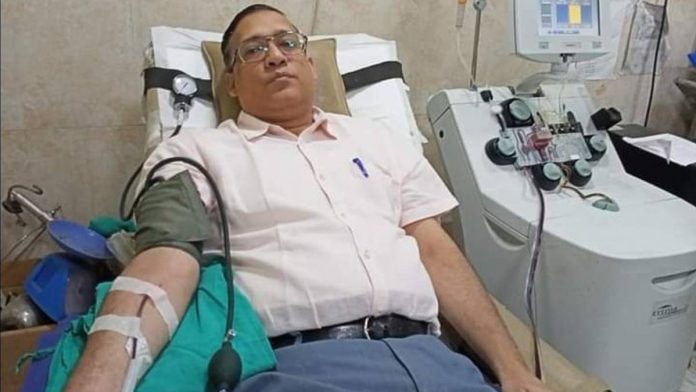
In the last seven months, however, Halim has also helped Covid patients in a different way — by donating plasma multiple times.
Speaking to ThePrint, Halim said he had tested positive for Covid in July last year, and spent two weeks in a hospital ICU, battling for life. Having fully recovered in August, he donated plasma for the first time in September, said the doctor.
Plasma is a component of the human blood that carries antibodies, and it is believed that plasma therapy can be effective in Covid treatment if it is used after checking for neutralising antibodies. Plasma can be donated within a gap of 15 days, and the donor can start giving plasma a month after recovering from Covid.
In the last seven months, Halim, 50, claims to have donated plasma seven times.
He is yet to get vaccinated against Covid — anyone who receives the dose cannot donate plasma for 28 days from the date of vaccination.
Son of late Hashim Abdul Halim, who had been Bengal’s longest serving legislative assembly Speaker, Fuad Halim is contesting the Bengal assembly polls as a candidate of the Sanjukta Morcha, an alliance of Congress, CPI(M) and new entrant Indian Secular Front, from south Kolkata’s Ballygunge constituency.
Halim wasn’t, however, seen holding big rallies. His campaign was more focussed on creating Covid awareness. The doctor-turned-politician claimed that his party opted for smaller rallies and concentrated on virtual campaigns.
‘Will continue donating plasma as long as health parameters permit’
“There are two aspects to my life — one of a politician and the other of a doctor. But there is an underlying similarity that bind the two. I became a politician to serve people and as a doctor I am medically trained to do certain specialised things for people. I will continue donating (Plasma) as long as my health parameters permit,” Halim told ThePrint.
According to Halim, an individual can donate plasma if the count of antibodies in the body match a certain level and his other medical parameters are complementary. “My antibody count is very high as of now. And I am still eligible for donation. I donated recently on Friday. I will need another 14 days to donate again, if my health parameters allow me to,” said the doctor-politician who donates his plasma at the Calcutta Medical College.
Plasma can be preserved for at least a year under ideal conditions and a packet of 500 ml plasma can save even two to three lives, he added.
Prasun Bhattacharya, head of Calcutta Medical College, said: “Dr Fuad Halim has donated plasma seven times, which is very rare and unique. Anybody with a high antibody count can donate plasma, but seven times is a very big number. He had very high number of antibody count, that is why we took his plasma. He has saved many lives.”
Dr Indranil Biswas, former medical superintendent and vice-principal of Calcutta Medical College, said, “It is difficult for anyone to donate plasma seven times. It depends on the immunoglobulin (antibody) a person has.”
Halim said he will go in for vaccination only when he is no longer able to donate plasma. “A second Covid wave has hit the country. People who were infected on and after 1 March, will only be eligible to donate from May. That is the protocol. Meanwhile, the need for plasma donors has skyrocketed. If I can save some lives, I will be happy to continue donating,” he added.
With a surge in Covid infections, his three-member team of doctors at his dialysis unit now first screen the patients for Covid. If anyone tests positive, they are admitted to MR Bangur Hospital, a government Covid-treatment facility. After two weeks of the detection of infection, his team starts with the patient’s dialysis.
Halim had contested the 2019 Lok Sabha polls from Diamond Harbour on a CPI(M) ticket. He finished a distant third with less than 1 lakh votes, while the winner, Chief Minister Mamata Banerjee’s nephew Abhishek Banerjee, got nearly 8 lakh votes.
(Edited by Poulomi Banerjee)
source: http://www.theprint.in / The Print / Home> India / by Madhuparna Das / April 28th, 2021
Forty-one-year old Tabassum Ali from Patna, Bihar is a single woman riding a Bullet motorcycle and works tirelessly for promotion of the rights of women in the state and country.
Patna:
On the morning of April 13, forty-one-year old social worker Tabassum Ali met with National Cadet Corps’s (NCC) group commander Brigadier Vinesh Rana at Patna, Bihar. Soon after, she had a meeting with Manish Mahiwal, a budding YouTuber, to discuss a play on the liberation of Bangladesh. Afterwards, she rushed to attend a civil society meeting to save India’s iconic Khuda Bakhsh Library in Patna from demolition. After the meeting, she came to meet a woman to discuss her legal case.
While attending to this busy schedule, she missed a meeting at Biharsharif, some eighty kilometres south of Bihar’s capital Patna to discuss the location issue of the minority girls’ hostel.
This is how a normal day goes for Tabassum Ali, one of the most visible faces in Patna.
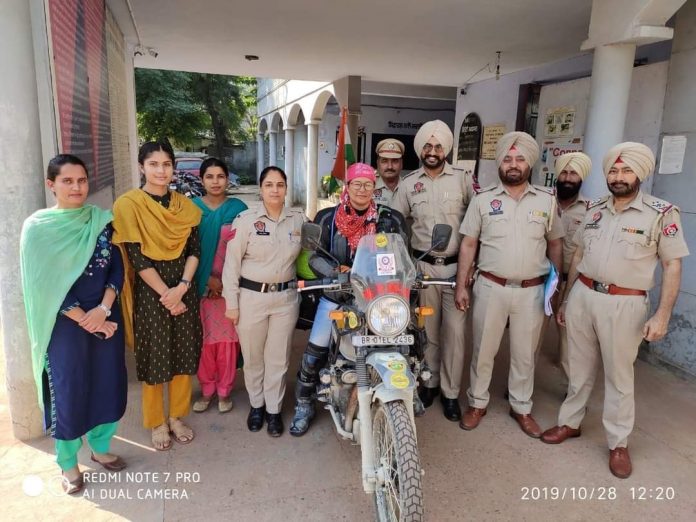
Tabassum is single with no children. Her family include social workers and people she helps with her social work. She rides a 450 cc Bullet motorbike, with all the gears a bike racer would have – helmet, gloves, and boots etc.
She wanted to be a commercial pilot and still nurtures that dream.
During her interview with TwoCircles.net, Tabassum’s phone kept ringing. She was getting calls from CRPF asking her for some sort of support and calls for donating plasma for a Covid-19 patient.
A few weeks ago, she attended a meeting of the Bihar Rabita Committee, an NGO working for the educational progress of the Muslim community in Patna. When its Secretary announced that Tabassum loves to ride her Bullet, every head moved towards her. But this doesn’t deter her.
Social work and adventure are Tabassum’s two passions. Her love for social work started in New Delhi where she came to know about a minor rape victim who was being treated at Ram Manohar Lohia Hospital. She recalls, “Ignorant of her trauma, the girl always smiled after meeting me. This made me weep and I resolved to work for such girls.”
Her NGO ‘Make a New Life’ works for rape survivors.
Among many cases she has fought, one was a legal case for a newly-wed Muslim girl of Fatuha in Patna district. The girl was sent back to her home by her husband for no valid reason after only six days of marriage. It had come to fore that the girl’s husband was already married and his previous wife was alive. He had lied to the girl’s family that his wife was dead. The girl was divorced after a few months. Tabassum fought the case from Mahila Thana (police station meant for women) to the court. The girl’s Khala (mother’s sister) was known to Tabassum. This got Tabassum involved in the case and she succeeded in getting a compensation of Rs 9 lakhs for the victim.
Tabassum talks about another case of an 8th standard girl who was raped but the “police were not registering a case against the accused.” It was only after Tabassum intervened that an FIR was registered and the accused was arrested.
Tabassum’s ride on her Bullet for doing social work may seem smooth but she says the journey of her life has been bumpy.
Born to a Muslim father and an Anglo-Indian mother in a remote town of Jhaha in Bihar, she studied in a Railway school till class 6. She was moved to a girl’s school after much persuasion to study till matriculation.
“Unfortunately, I could not write the exams as the examination centre was away. Next time, I failed in one subject,” she said.
Tabassum was finally able to pass the matriculation exams on her third attempt.
To qualify for a commercial pilot course, she studied mathematics in her Intermediate and passed the examination of I.Sc but somehow could not qualify for the pilot course.
Meanwhile, she got married. Her attempt to start a new life in the national capital New Delhi with her husband was short-lived. She soon separated from her husband.
Being a single woman now, she worked as HR help and gave tuitions. Finally, she decided to move to Patna and reunited with her family with the help of some relatives.
“I love adventure,” she said.
She has travelled to 29 Indian states on a bicycle, covering nearly 12800 kilometres in 173 days, to create rights awareness among women. For two years, she has worked as a volunteer in AIIMS, New Delhi at its cancer centre for children.
Satyanarayan Madan, a well-known social worker from Patna describes Tabassum as “one of the most fearless and dedicated social workers of Bihar.”
source: http://www.twocircles.net / TwoCircles.net / Home> Lead Story / by Sami Ahmad, TwoCircles.net / April 30th, 2021
.webp)