Gulzar said Rahat Indori was in total rapport with the new generation and times.
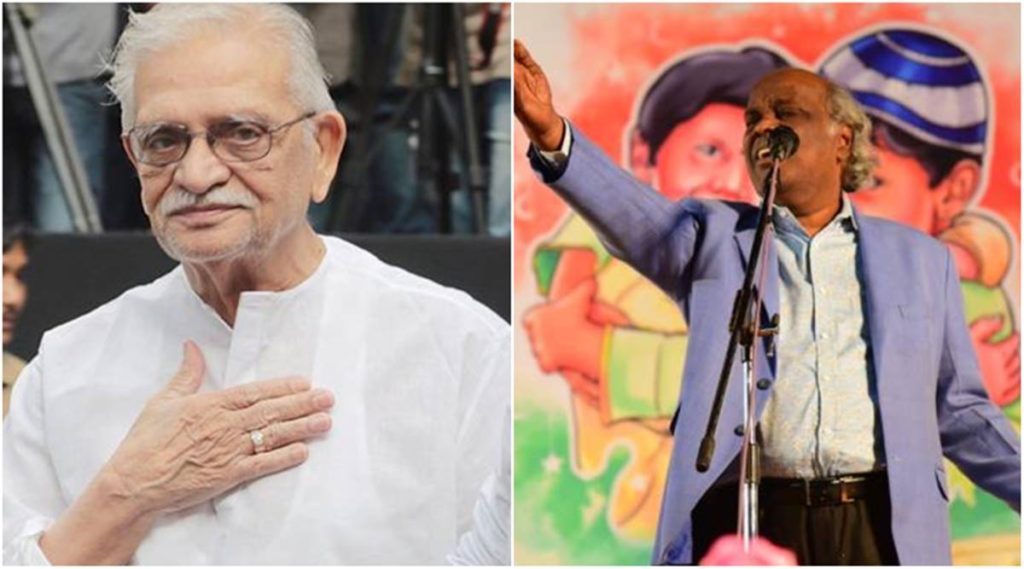
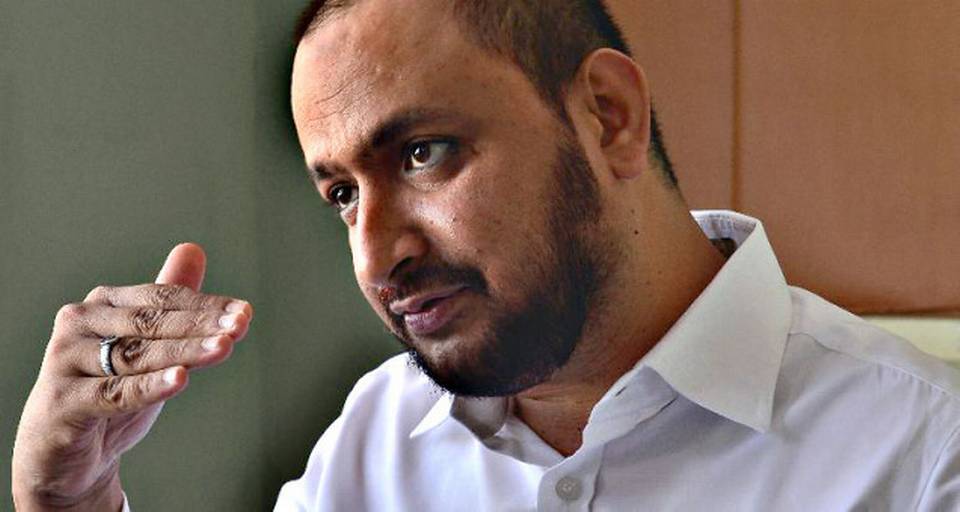
Legendary poet Rahat Indori passed away on Tuesday. (Photo: Express Archive, Rahat Indori/Twitter)
Noted lyricist-poet Gulzar said the death of Urdu poet Rahat Indori, who passed away following a heart attack on Tuesday, is a loss which cannot be quantified.
Indori, 70, was admitted to a hospital on Tuesday morning in Indore after he tested positive for COVID-19.
“It is an unquantifiable loss. He was one of a kind. It’s as if somebody has left a void in our Urdu mushairas which can never be filled. Woh jagah ko khali kar ke chale gaye. It is not a big loss, it is a total loss,” he told PTI.
He remembered Indori as someone who would steal the thunder at mushairas (poetry symposium).
“Wo toh lutera tha mushairon ka. A happy-go-lucky man who was the ‘jaan’ (soul) of mushairas,” Gulzar said.
Gulzar said Indori was in total rapport with the new generation and times.
“He was very relevant. People of all ages used to wait for his turn at mushairas. One mostly comes across romantic shers in mushairas, but all his work that he read was about the sociopolitical and contemporary climate,” he added.
Asked when he last spoke to Indori, the 85-year-old legendary lyricist said it is difficult to recollect, but it seems as if they spoke just the other day.
Gulzar said his friend, filmmaker Vidhu Vinod Chopra, who worked with Indori on Mission Kashmir, would often tell him about work, including his songs Bumbro and Dhuaan Dhuaan on the 2000 film.
“I would love it and talk to him (Indori). Jab bhi koi aacha sher sunn liya, phone kar liya, daad de di (Whenever I would hear a good sher by him, I’d call him up to congratulate him),” he remembered.
With a 50-year career in poetry, Indori was known for the lyrics of songs like Dekh Le from Chopra’s Munnabhai MBBS ”(2003), Chori Chori Jab Nazrein Mili from Kareeb (1998), and Koi Jaye to Le Aaye from Ghatak (1996 ), and Neend Churai Meri from Ishq (1997). His lyrics were used in 11 Bollywood films.
source: http://www.indianexpress.com / The Indian Express / Home> Entertainment> Bollywood / by PTI, Mumbai / August 12th, 2020
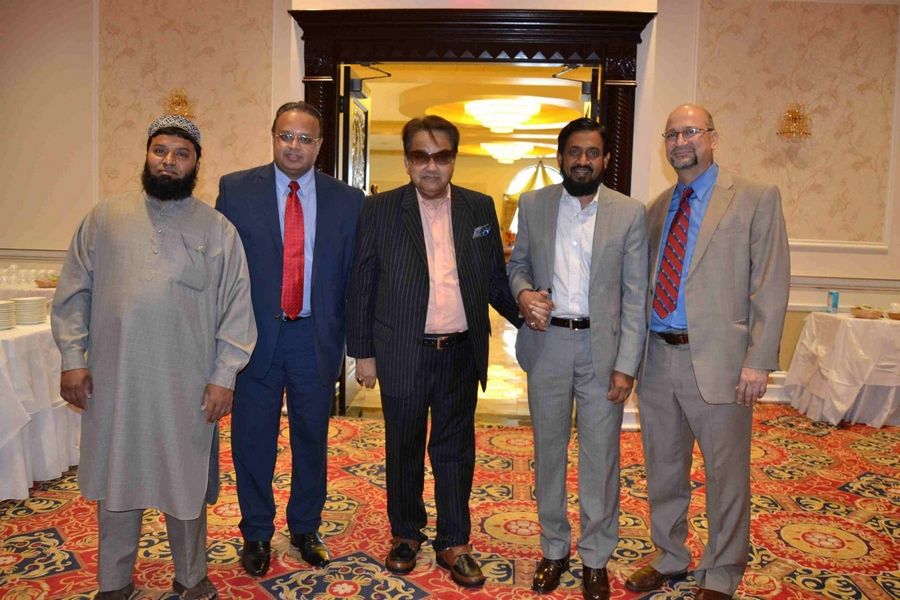
Khan Lateef Mohammed Khan, center, the editor-in-chief of the Munsif Daily, passed away Aug. 6 in Chicago. (Courtesy of Syed Ullah)
Lateef Mohammed Khan, who spent his life defending Urdu through journalism, books and lectures, died Aug. 6 at a local Chicago hospital. The 80-year-old worked in journalism for more than three decades, getting his start at the Munsif Daily, an Urdu language newspaper.
The Munsif Daily is an Urdu language newspaper published from Hyderabad in India. Its editor-in-chief was Khan Lateef Khan till yesterday. The Munsif Daily Is the largest circulated Urdu newspaper in South Asia. The paper was owned by Mahmood Ansari, when Masood Ansari fell seriously ill, the newspaper was sold to Khan Lateef Khan in 1996, who became editor-in-chief. He started the first Urdu satellite TV channel in India.
He was chairman of the Sultan ul Uloom Education Society. Khan was known for bringing in a revolutionary change in Urdu publications in the city by reintroducing the Munsif newspaper in color print 23 years ago.
Ali Khan, president and founder of Urdu Semaj Chicago, shared his condolences and said, “He was a legend in our community and a very genuine, gracious man in person and an acclaimed columnist. Sad to hear of his passing away today. This is a total loss for the whole community.”
Many renowned personalities including Dr. Qutub Uddin, Iftekhar Shareef, Azeem Quadeer, Saleem Abdul Rehman, Ishaan Ahmed, Kaleem Hasan, Omer Haqqani and many others paid tribute to his service.
Khan’s funeral services will be at the Muslim Community Center in Chicago after Friday prayers. He will be buried in Chicago.
source: http://www.dailyherald.com / Daily Herald / Home / by Syed Ullah / August 07th, 2020
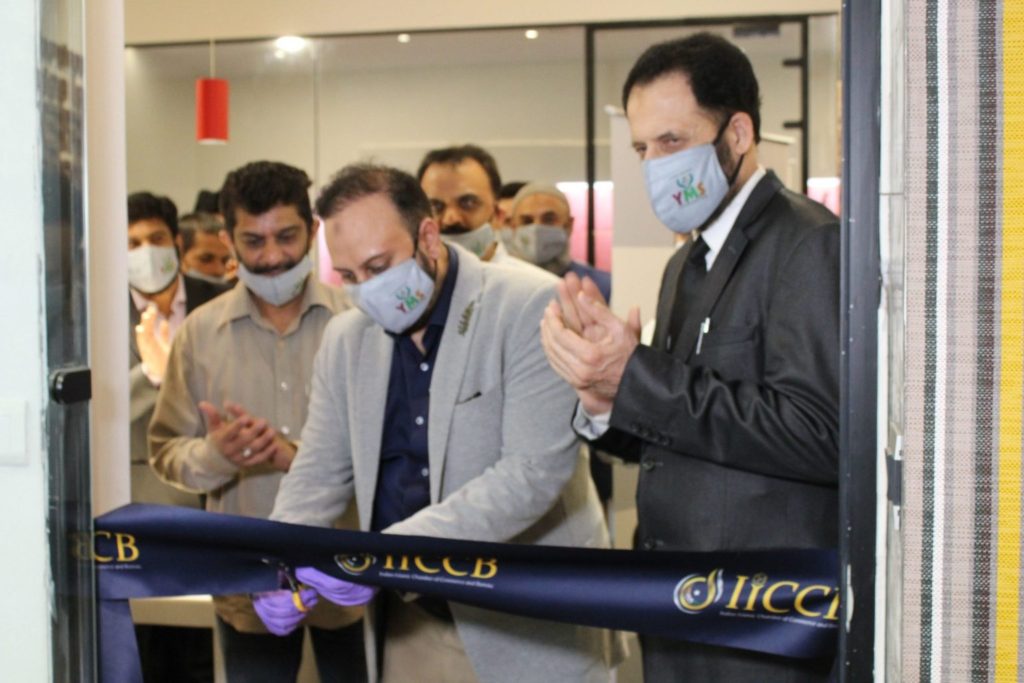
The Indian Islamic Chamber of Commerce and Bureau (IICCB) was launched on Thursday to provide support to Muslim businesses and entrepreneurs with resources, mentorship, networking and finance.
IICCB is a business chamber registered under The Indian Trust Act and is headquartered in Bangalore, with chapters in multiple states across India and in countries like the US, UK, Saudi Arabia, UAE and Canada.
The chamber aims to create a body of freelancers, SME’s, MSME’s, large corporates, professionals, consultants, start-ups, small entrepreneurs and to offer an industry-wide exchange of business ideas, exchange of opportunities, collaborations/partnerships, trade, investments, exchange of services, project funding, agent sourcing, overseas business expansion, rising funds, provide consultation, freelancing services & other advisory services to its members, according to Mr. K.M. Noorul Ameen, founder and patron the organisation.
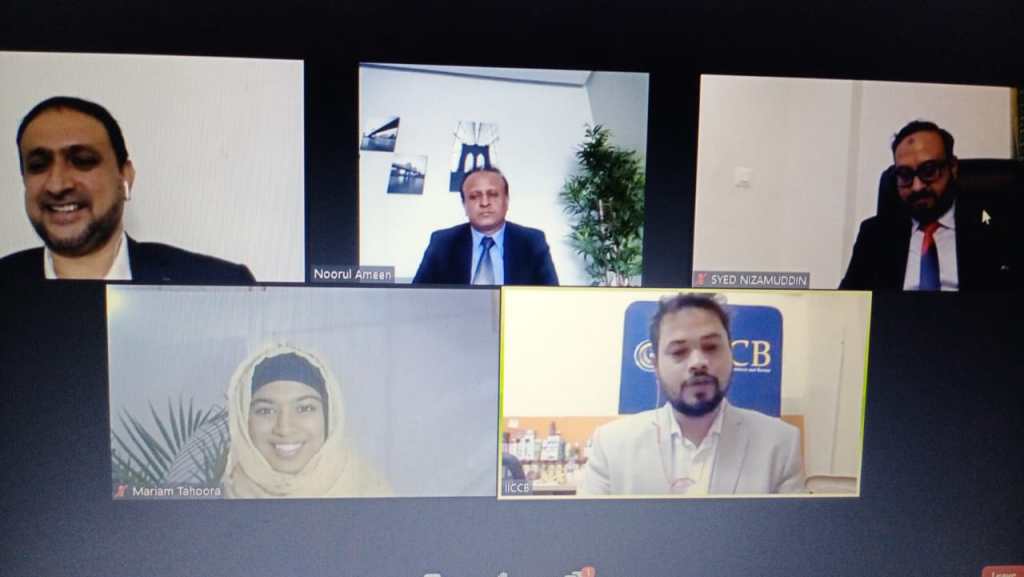
Considering the ongoing coronavirus pandemic, it was a virtual launch with over 400 attendees belonging to different backgrounds ensuring diversity.
The launch was led by Mr. Noorul Ameen who spoke at length about IICCB and its mission.
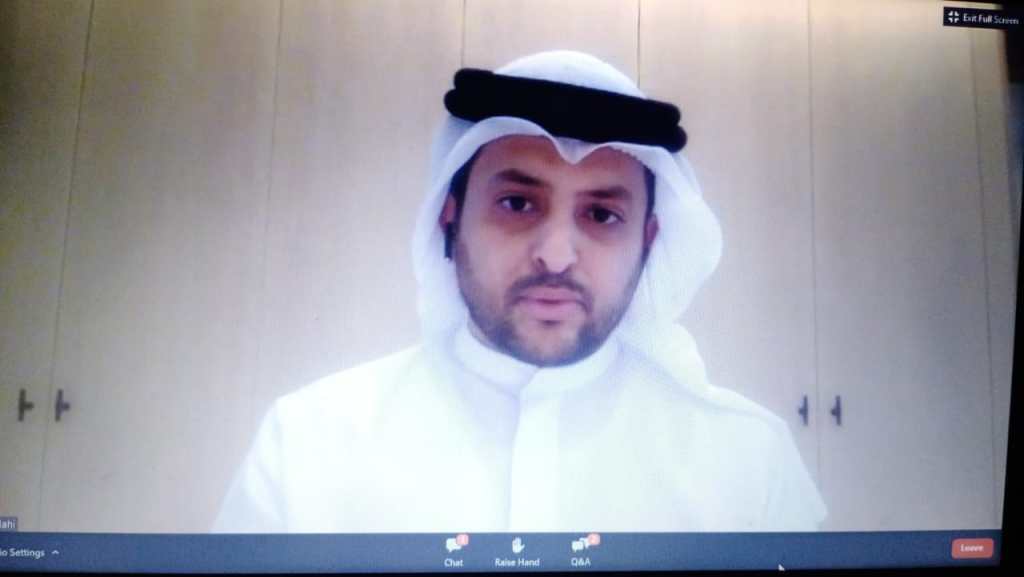
Ahmed Sultan Bin Harib Al Falahi, UAE Commercial Attaché to India.
Ahmad Sultan Bin Harib Alfalahi, UAE’s Commercial Attaché to India was the Guest of Honour for the event who expressed hope that the presence of a business chamber like IICCB in India will further enhance ties between India and UAE.
IICCB also aims to create awareness of business opportunities and promote ideas for national and international collaboration among its members.
The organisation is taking in registrations for new members on its website.
source: http://www.thecognate.com / The Cognate / Home> Business / by The Cognate News Desk / July 30th, 2020
Different strokes: Rafiullah Baig of the Handwriting Institute of India in Yediyur can pinpoint key personality traits based on handwriting. Photo: Karan Ananth |
With only a handwritten paragraph before him, Rafiullah Baig can tell you all about your key personality traits in just about ten minutes.
The words mean little to Baig, founder-president of the Handwriting Institute of India at Yediyur; he finds meaning in the pressure applied while writing, the size of alphabets, the slant, the variation and where a person starts and ends the stroke.
“It is an established science — a branch of psychology called graphology where the handwriting is analysed to gain insight into the subconscious,” said Baig.
Personality types
“The pressure of your writing is a direct indication of the intensity of your emotions. Writing of small size generally signifies a reserved and focused personality. Big writing is an indication of a vibrant personality. A leftward slant is a sign of an introvert. Straight letters indicate logical and analytical behaviour and a rightward slant indicates an emotional personality,” explained Baig.
Further, each letter is linked to a trait. “For example, crossing the ‘t’ at a lower level indicates low self esteem and a high ‘t’ bar indicates high self-esteem,” he said.
He then pulled out handwriting samples of Sir M. Visvesvaraya, Thomas Alva Edison, Mother Teresa and Albert Einstein to point out where they crossed their ‘t’s while writing — right on top.
“The letter ‘t’ alone could give you 22 different interpretations,” he added.
Like the body, alphabets can be divided into three categories: the upper, the middle and the lower. Letters ‘l’ and ‘t’ have upward strokes corresponding to the upper part of the body while ‘y’ and ‘p’ have lower strokes; ‘m’ and ‘o’ fall in the middle order.
It is after years of practice that Baig can judge a piece of writing and talk at length about the person who wrote it. Apart from a basic function of personality assessment, the science, he explained, could also be used in therapy, crime investigation, recruitment and health. “The kind of therapy differs with different age groups. We help children write clearly, legibly and fast. With adults, the focus is on personality development.” Psychiatrists, Baig explained, work closely with handwriting analysts to influence, change, and heal illnesses of the mind. “But what we cannot understand from the writing is sex, age, right or left handedness and it cannot treat a disease completely,” he added.
Prescriptions and personality
So why do doctors have such bad handwriting? Largely illegible and unreadable are doctors’ prescriptions but Baig said it was a misconception that they write illegibly.
“We were wondering the same and did research that involved close to 3,000 doctors. The writing on the prescription is unreadable because first, the names of drugs and their spellings are unknown and second, doctors would like to keep the name of a drug secret to prevent misuse,” he said. “Outside of their profession, doctors write very artistically.”
source: http://www.thehindu.com / The Hindu / Home> News> Cities> Benglauru / by Archana Nathan / April 18th, 2012
From government school teacher to life coach, Arif has come a long way while training thousands of students in Bengaluru.We trace his journey.
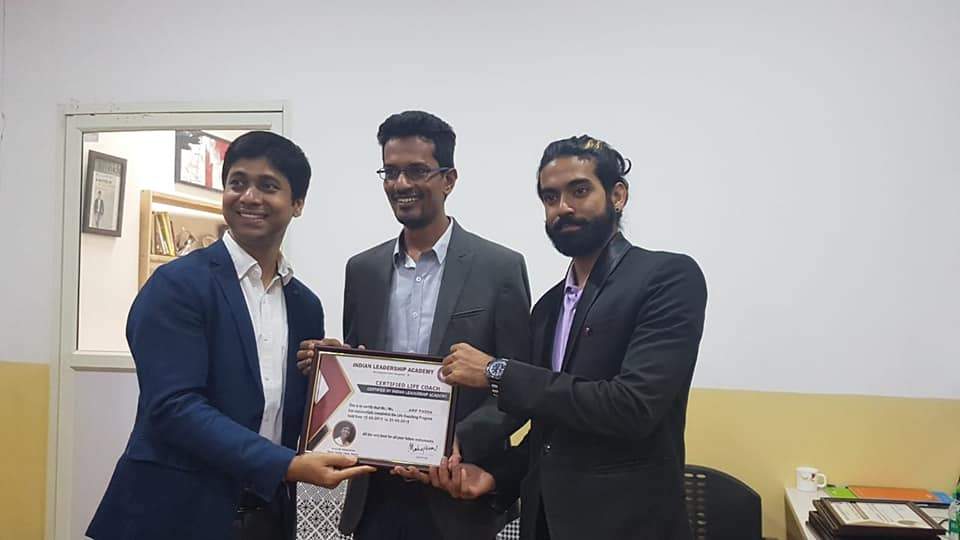
Arif Pasha certified by International Life Coach, Kaushik Mahapatra (pic: Arif Pasha)
A few years ago, when Arif Pasha had to drop out of BCom, he never imagined that he would become a life coach who trained students in soft skills, language and academics. Coming from a humble background, he was forced to drop out due to financial constraints. He later received training to become a medical transcriptionist and joined a multinational company. “My work involved converting all the voice notes sent by selected doctors in the US into transcripts. I earned a handsome salary but my interest was in guiding many young students like myself. One day, when I passed by a government school in Koramangala, I asked the principal if I could volunteer as a teacher. The principal readily agreed. After that, I slowly lost interest in my job, so, I decided to quit and take up teaching full-time,” says Arif.
Though his income was quite low and barely enough to make ends meet, Arif didn’t mind as he quickly became the students’ favourite teacher. “I discovered that innovation was missing in their education. Hence, I would spend two hours on the internet every day to learn innovative ideas to teach children. For example, all my lessons would be in the form of stories and real-life examples. I also do not use a stick while teaching children and it gave me good results in terms of response from students. Soon, even other teachers gave up using the stick,” says Arif, adding, “During my tenure in a government school, I was awarded as an outstanding teacher. The school had got good results in the final exams and they were happy with my efforts.”
Dream Merchant: Arif has trained over 35,000 students till date on the methods of achieving their goals
With that, Arif quickly realised that it was time for him to do more for students than just teach them. That’s when he remembered some of the soft skills he learnt during his corporate days — setting goals, planning time and working to achieve them. He then joined Arham Faraaz Leadership Academy in Bengaluru to groom his speaking skills, body language and storytelling skills, and after the completion of his training, he confidently approached a few schools to conduct goal setting sessions for students.
Narrating the story of his very first session, he says, “In 2010, I charged only `10 for each student. With a broken laptop in hand and a few students in class, I started speaking to them. During these sessions, I would explain to students why they have to attend school and what education can fetch them.” And where is Arif now? “As my work gained recognition, an educational institute in Mumbai gave me a boost to travel from Kashmir to Kanyakumari and work with different schools. Today, I have covered over 35,000 students across India in private as well as government schools. This year, my goal is to help and motivate 5,000 students. By 2025, my aim is to help 5 lakh students achieve their dreams.”
Arif says that these life coaching sessions help students transform themselves and they ultimately start performing well in academics. For example, last year, when he was working with the Rajeev Gandhi Public School in Bengaluru, he came across a girl who was not doing well in her studies and she feared facing the Board exams. Through various sessions of counselling, drawing study plans and helping her realise her potential, she was able to score 86 per cent in her class X exams. What better instance can one state to prove that his sessions have served their purpose?
His smart goal: Arif aims to train five lakh students by the year 2025
Arif has even trained under international speaker and author Syed Habeeb, who wrote the book The Warrior Within You. “I worked as a language trainer in a school called LifeBridge Finishing School. We helped engineering students present themselves in their interview and get placed. It was a 21-day residential training programme. On average, every third day, I conducted sessions to train students and teachers. Currently, I am training under Uday Kumar who is a Limited Liability Partnership coach. Aside from this, I am certified by the Indian Leadership Academy by Koushik Mahapatra as a Life Skills Coach and an LLP practitioner,” states Arif who is the founder and CEO of Live Your Dreams. His friend Abdul Afsar Baig handles the operations of the company.
Apart from training students and motivating them, Arif is specialised in training teachers and parents too. He explains, “During my sessions, I found out that many students are interested in achieving their goals but sometimes, their teachers and parents don’t cooperate. This brings down their motivation level. I designed a programme for seven days which includes training students, helping teachers draw their lesson plans, employing innovative skills of teaching, adopting technology to gel with the present generation and lending a ear to what students have to say. Meanwhile, parents play a key role in this as they learn about their children’s dreams and how they can help in achieving them.”
Here are a few tips that Arif gives students
No matter what people around you say, one should not stop thinking if they want to become a doctor, engineer, IAS officer, astronaut, singer or artist
Thinking alone won’t help. One should have strong will power and commitment to plan and work accordingly
Always tell yourself that you can do it instead of you can’t
Convert everything that you study into an image so that you don’t forget easily.
source: http://www.edexlive.com / EDEX / Home> People> Life Coach / by Rashmi Patil , Edex Live / July 20th, 2019
44 Muslims figure among the 829 successful candidates.
Bengaluru:
The UPSC results were declared on Tuesday (August 4) and 829 candidates were selected for the top civil services across the nation. Of the 829 successful, 44 are stated to be Muslims. Reports have however put the figure of successful Muslim candidates between 42 and 45. Of the total, 180 will be joining the Indian Administrative Services (IAS); 24 will be going for Indian Foreign Services (IFS) and 150 will be taken into the Indian Police Service (IPS).
The Residential Coaching Academy (RCA) under the Jamia Millia Islamia has claimed that 30 of its candidates were successful. Fourteen of them are Muslims. Twenty five of them were residing at the Academy while another five received the coaching while residing outside the campus. The Zakat Foundation of India has claimed that 27 candidates were successful. Of these 23 are Muslims. Six candidates coached by the Jamia Hamdard are among the successful ones. Of these two are Muslims. Last year, there were 28 Muslims among the 759 successful candidates.
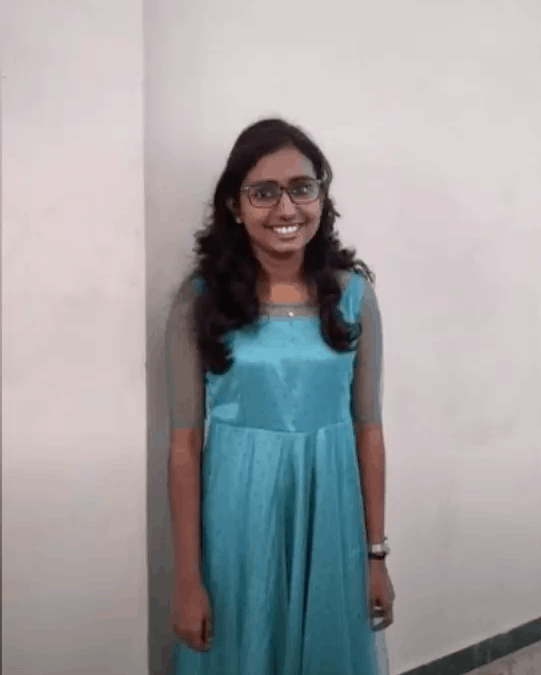
However, the results are disappointing from the angle of toppers. Only a single Muslim candidate, Safna Nazruddeen from Kerala has been awarded 45th rank. There is no other Muslim candidate among the top hundred. Jamia press released claimed that out of the 30 of its selected candidates, six are expected to get IAS, eight are likely to get IPS and remaining candidates will get IRS, Audit & Account services, IRTS and other allied services of Group-A. Six of the 30 candidates are girls. The RCA’s performance has dipped this year. Last year Junaid Ahmed emerged as the third rank-holder in the UPSC competitive exams. The RCA has so far produced 230 civil servants for the topmost bureaucracy. Besides, 285 of its trained candidates have been selected for various other Central and State Government services such as Reserve Bank of India, scheduled banks, Jammu & Kashmir State services etc.
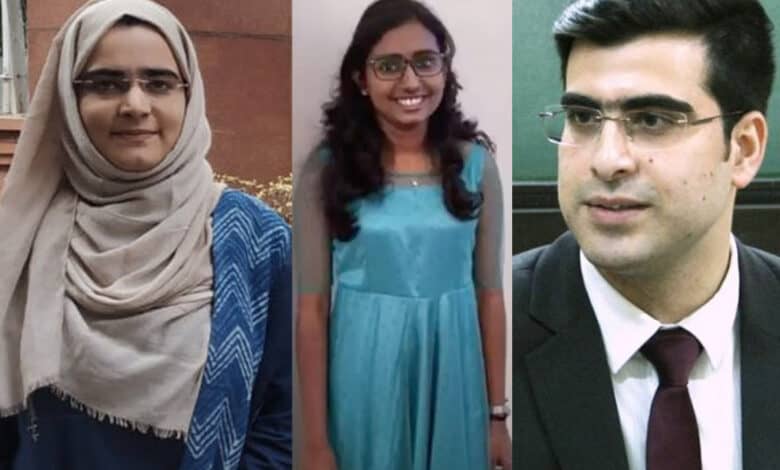
Safna Nazruddeen
The Muslim representation took a dip in 2018 when only 29 Muslims figured among 759 successful candidates. In 2017, there were 44 Muslims among 990 cleared for the services. It was in 2016 that the representation began showing upward trend with success of 50 Muslim candidates that year. Of the 50, ten figured among the top hundred. Since then the proportion of Muslims in the UPSC exams has hovered around 5%, a twofold increase from 2.5% for several decades. This is owing to concerted efforts by some institutions, notably Jamia Millia Islamia’s RCA, Zakat Foundation of India, Jamia Hamdard and the Central Haj Committee, Mumbai. However, majority of the successful Muslims this year are from southern States, although 60% of India’s Muslims live in Uttar Pradesh, Bihar, West Bengal and Assam (and their splinter states). This is where attention needs to be focused and efforts should be taken to improve standard of coaching in schools and colleges where the majority of Muslim students head.
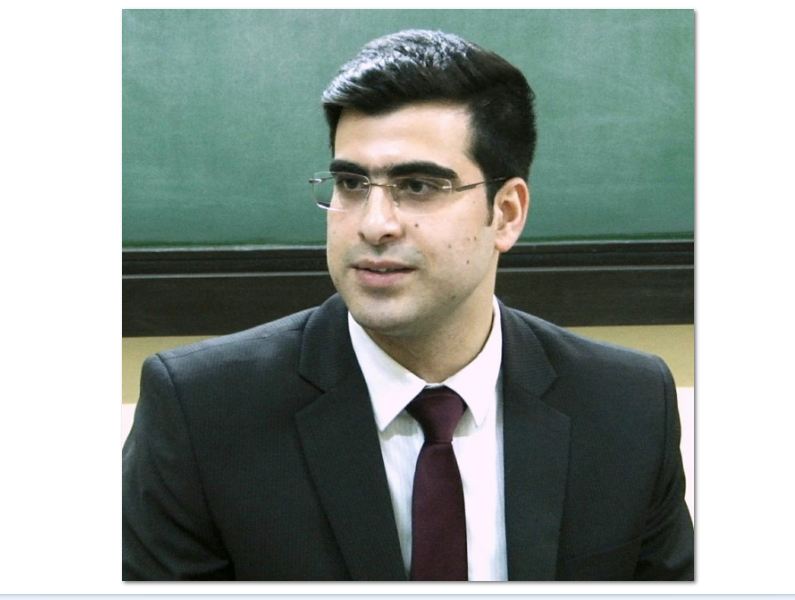
Among the successful candidates is Dr. Asrar Ahmed Kichloo, a 27-year old doctor from Dodda district of Jammu. He is one among the 14 who cracked the Civil Services exam this year from the State. He completed his MBBS from GMC in Jammu. He is son of a Veterinarian mother and a father who is a retired official from the Animal Husbandry Department in the State.
Dr. Asrar Ahmed Kichloo
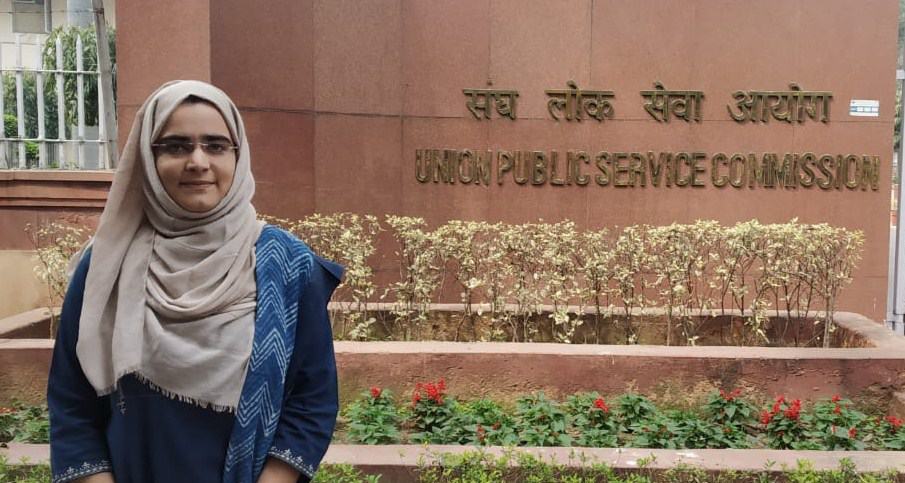
Kichloo told the media that he decided to go for Civil Services after he saw a man from a rural area in Jammu had applied cowdung on his wounds. He found to his horror that patients in rural areas in the State had to travel 24 hours to reach the doorsteps of a hospital and therefore resort to superstitious practices or approach quacks. Incidentally, a Muslim girl, Nadia Beig also figures among those who were successful from the State. Nadia hails from Ramhal village in Kupwara district of the State. At 23, she is the youngest to crack the UPSC. An Economics Honours graduate from Jamia Millia, Nadia had tried for the Civil Services for the second time. She took coaching at the RCA.
Nadia Beig
List of successful Muslim candidates for UPSC Result-2019
S. No.
Name
Rank
1
Safna Nazarudeen
45
2
Shaikh Mohd Zaib Zakir
153
3
Jithin Rahman
176
4
Rumaiza Fathima R V
185
5
Nongjai Mohd Ali Akram Shah
188
6
Samir Ahmad
193
7
Suthan Abdullah
209
8
Sofia*
241
9
Asrar Ahmad Kichloo
248
10
Noorul Quamer
252
11
Ajmal Shahzad Aliyar Rawther
254
12
Farman Ahmad Khan
258
13
Mohd Shafiq
292
14
Sufiyan Ahmed
303
15
Azharuddin Zahiruddin Quazi
315
16
Asif Yousuf Tantray
328
17
Ahmad Belal Anwar
332
18
Nadia Beig
350
19
Ashik Ali P I
367
20
S Mohammed Yakub
385
21
Shahul Hameed A
388
22
Shaheen C
396
23
Md Shabbir Alam
403
24
Aftab Rasool
412
25
Shiyaz K M
422
26
Ahamed Ashik O S
460
27
Mohammad Nadeemuddin
461
28
Syed Zahed Ali
476
29
Mohammed Danish K
487
30
Md Qamaruddin Khan
511
31
Maaz Akhter
529
32
Hassan Usaid N A
542
33
Mohammad Aaquib
579
34
Rehan Khatri
596
35
C Sameer Raja*
603
36
Faisal Khan
611
37
Saifullah
623
38
Sabzar Ahmad Ganie
628
39
Majid Iqbal Khan
638
40
Firoj Alam
645
41
Ruheena Tufail Khan
718
42
Rayeas Hussain
747
43
Mohammed Nawas Sharaf Uddin
778
44
Shaik Shoeb
823
45
Syed Junaid Aadil
M.A. Siraj is a senior journalist based in Bengaluru
source: http://www.siasat.com / The Siasat Daily / Home> Featured News / by M.A. Siraj / August 05th, 2020
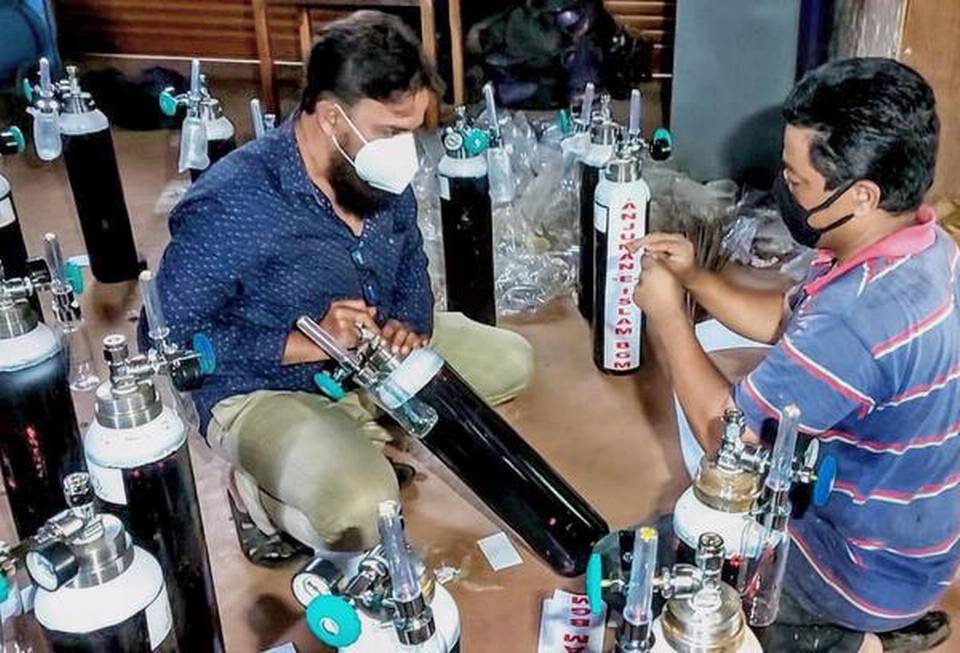
Volunteers from Anjuman-e-Islam preparing oxygen cylinders to be distributed free to COVID-19 patients in Belagavi
Some non-governmental organisations (NGOs) are helping poor patients battle COVID-19 by providing them free oxygen cylinders.
The Anjuman-e-Islam committee in Belagavi has tied up with industrial gas industries and plans to provide oxygen cylinders to the needy. The committee will provide 120 cylinders in the first phase. It plans to increase the numbers in the next few weeks.
“Our members wanted to help society in some way in the battle against COVID-19. Some of us observed that the number of bodies being cremated in the city had nearly doubled. We were getting around two bodies per day before June. But in recent weeks, it had shot up to four bodies per day. This was alarming and we decided to join the government’s efforts in helping patients,” committee chairman Raju Seth.
“A background study helped us understand that a large number of patients were from poor families. Some of them could not afford industrial oxygen supply, especially if they were home quarantined and needed cylinders. We have enlisted the services of volunteers and are providing door delivery of cylinders,” Mr. Seth said.
“We are supplying cylinders to people from all communities and faiths. We also have a list of doctors on call. We are sending them to the houses of those with symptoms who want advice on the epidemic, like whether they need a test or if they should choose a hospital or should stay home,” Mr. Seth said.
Residents of Belagavi and nearby areas can contact the committee’s volunteers Samiullah Madiwale on Ph: 7676686778 or Ameen Pattekari on Ph: 7676513526.
Holistic services
In Bidar, a group of organisations has come together to provide holistic services to people of the city and nearby areas. A helpline has been set up for free counselling and medical advice. The group can be contacted through Amir Pasha on Ph: 886197540, Yousuf Raheem on Ph: 9845628595 or M. Asaduddin on Ph: 7975298728.
Whenever a family feels that one of its members is having symptoms indicative of COVID-19, it can call these numbers to get its doubts clarified.
Then, a group of two volunteers will go to the family’s house with a pulse oximeter and a pamphlet on managing the disease.
Already, the volunteers have supplied around 50 cylinders and provided free counselling to 60 families till now. The group has also pressed into service two ambulances to ferry patients to hospital and to take them back home. All these services are given free.
Other organisations such as the Idgah Committee, Alimoddin Foundation, Rahim Khan Trust, Safa Baitul Maal, Jamiat Ahle Hadees, Jamaat-e-Islami and Pharmacists Association have joined hands in these efforts.
source: http://www.thehindu.com / The Hindu / Home> News> States> Karnataka / by Rishikesh Bahadur Desai / Belagavi – August 03rd, 2020
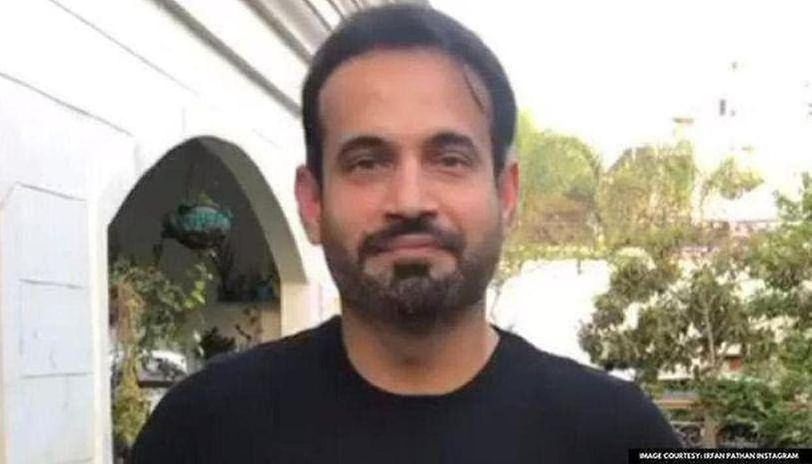
Former India all-rounder Irfan Pathan is the first cricketer to come forward to help the people who have been severely affected by floods in Bihar and Assam.
Image : Irfan Pathan Instagram
India has been severely hit by the COVID-19 pandemic with over 1.8 million people being tested positive for the deadly virus. To make matters worse, the states of Bihar and Assam are also tussling with floods for over two months now. Both states have been gravely affected by the floods with lakhs of people being forced to displace themselves and take shelter in relief camps. As many as 38,47,531 people have been impacted across Bihar and more than 25,000 people have taken to shelter homes.
Bihar and Assam floods: Irfan Pathan donates ration to 60 families
Amidst these testing times, the Mother Teresa Foundation has come to the rescue of people in Assam and Bihar in their fight against the catastrophe. The foundation has been urging prominent personalities from the Bollywood and the cricketing fraternity to come forward and help them in the noble cause.
And the first cricketer to come forward to help the people affected by floods in Bihar and Assam is former India all-rounder Irfan Pathan. The same was confirmed by Yahya Rahmani, who is a part of the Mother Teresa Foundation. Rahmani has also been involved in organizing Flood Donation Drive across Bihar. While speaking to Crictracker, Rahmani said that Irfan Pathan donated ration to 60 families of Bihar’s flood-affected people. He added that the packet consisted of essential items like Chana, Chura, Daal, Oil, Dettol and Rice.
This is not the first time that Irfan Pathan has come forward to help those in need. In fact, Irfan Pathan and Yusuf Pathan distributed 10,000 kg rice and 700 kg potatoes to the daily wage labourers in Baroda who were finding it difficult to make their ends meet due to the COVID-19 pandemic. Prior to that, Irfan Pathan and Yusuf Pathan had also distributed face masks to the public.
What is Irfan Pathan net worth?
According to trendcelebsnow.com, Irfan Pathan net worth is estimated to be around US$5 million (approximately ₹38 crore). His net worth comprises of his earnings from the Board of Control for Cricket in India (BCCI) as a former Indian cricket player. It also comprises of his various Indian Premier League (IPL) contracts with teams like Kings XI Punjab, Chennai Super Kings, Sunrisers Hyderabad among other franchises whom he represented over the years.
Disclaimer: The above Irfan Pathan net worth information from the Irfan Pathan House details is sourced from various websites and media reports. The website does not guarantee a 100% accuracy of the figures.
source: http://www.republicworld.com / Republic World.com / Home> Sports News> Cricket News / by Jatin Malu / August 03rd, 2020
After hanging up his boots, he decided to live in his village. People lovingly call him Munna in Ikhar.
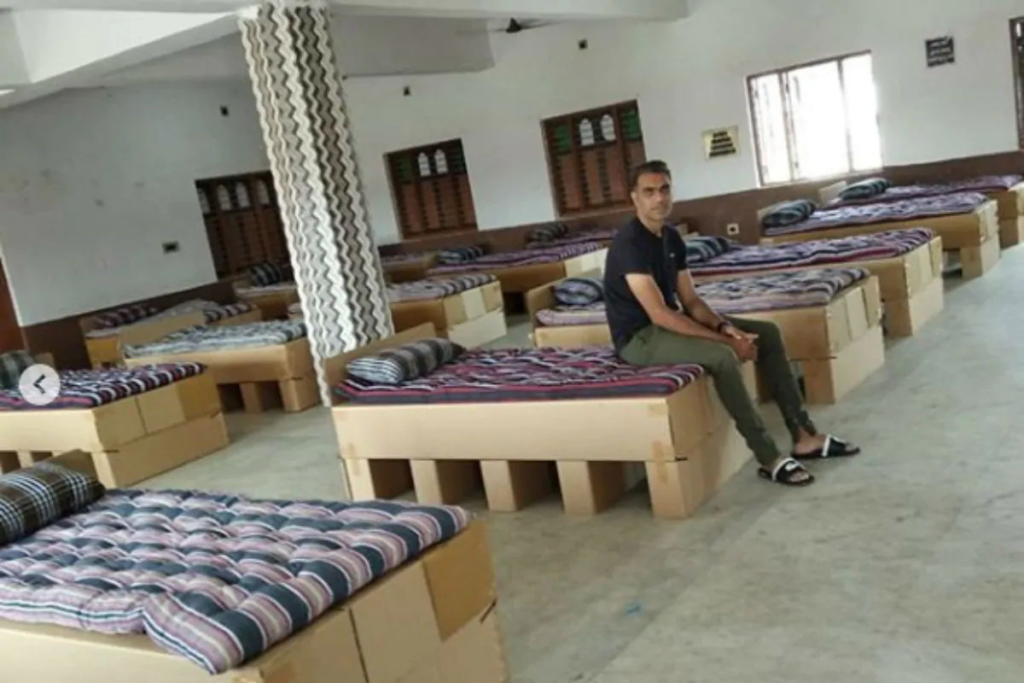
Former India cricketer Munaf Patel has informed that they are starting COVID-19 centre in their village Ikhar, located in Bharuch district of Gujarat.
Patel took to Instagram to spread the word about their new initiative. Sharing pictures of the newly set up COVID-19 centre, Patel thanked the health department and government officials.
The cricketer, who was the part of 2011 World Cup winning team, received appreciation from his former colleagues. Responding to his post, Gautam Gambhir asked him to keep up the good work. Gambhir said, “We are in it together.”
Pragyan Ojha replied “Well done Patel,” while Yuvraj Singh wrote, “Great work sarfi.”
In April, when four people tested positive for COVID-19 in Bharuch district, Patel decided to spread the message of social distancing to prevent the spread of the deadly virus, reported The Indian Express.
The local administration in view of the situation at that time asked the fast bowler, who is an influential figure in the region, to explain to people the importance of physical distancing.
Patel told the national daily that their village was sealed after surfacing four COVID-19 cases, adding that the panchayat and the committee which he is part of made sure that essential items reached homes.
He advised people in his village and district to not stay in groups and wash hands at regular intervals to keep the infection at bay.
After hanging up his boots, he decided to live in his village. People lovingly call him Munna in Ikhar.
source: http://www.news18.com / News18 / Home> Cricket Next / by Trending Desk / July 29th, 2020
Baroda, MADHYA PRADESH / Paris, FRANCE / London, UNITED KINGDOM :
If the proposal is passed, it will be the first time that non-white people will be featured on British coins or notes.
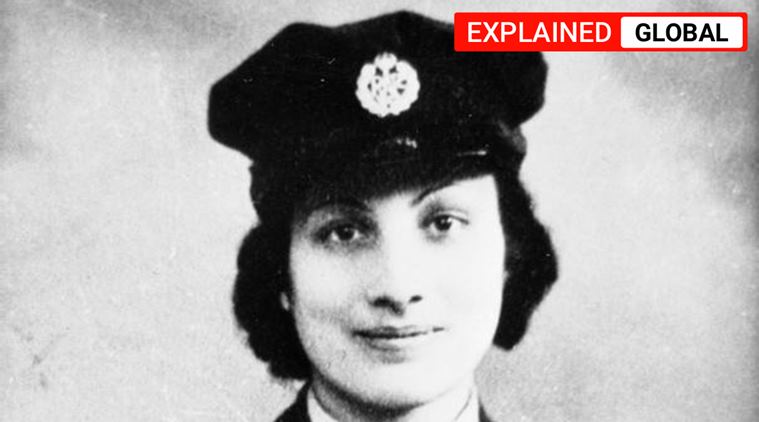
Born in Moscow to an Indian father and an American mother, Noor’s family moved to London and then to Paris during the First World War. (Source: Wikimedia Commons)
British media reported this week that Rishi Sunak, the Chancellor of the Exchequer, is considering a proposal to feature historical figures from the Black, Asian and minority ethnic (BAME) community of the country on a set of coins titled ‘Service to the Nation’.
If the proposal is passed, it will be the first time that non-white people will be featured on British coins or notes. The plan has been submitted to the Royal Mint, which is to come up with proposals and designs.
Zehra Zaidi of the advocacy campaign ‘Banknotes of Colour’, along with a group of historians and MPs, had written to the Chancellor proposing some historical figures. Among them were the Indian-origin British spy Noor Inayat Khan, as well as Khudadad Khan, the first soldier of the British Indian Army to receive the Victoria Cross. Khudadad Khan, who belonged to the Chakwal district of Punjab in present-day Pakistan, died in 1971.
The continuing Black Lives Matter protests in the United States , triggered by the killing of George Floyd by a police officer in Minneapolis in May, which have put a spotlight on the lack of BAME representation in the UK, and have compelled authorities to take appropriate steps.
Who was Noor Inayat Khan?
Born in Moscow to an Indian father and an American mother, her family moved to London and then to Paris during the First World War. Although Noor started working as a children’s writer in Paris, she escaped to England after the fall of France (when it was invaded by Germany) during the Second World War.
In November 1940, she joined the Women’s Auxiliary Air Force, an arm of the UK’s Royal Air Force to train as a wireless operator. She then did a stint at the secret intelligence organisation set up by Winston Churchill called Special Operations Executive (SOE).
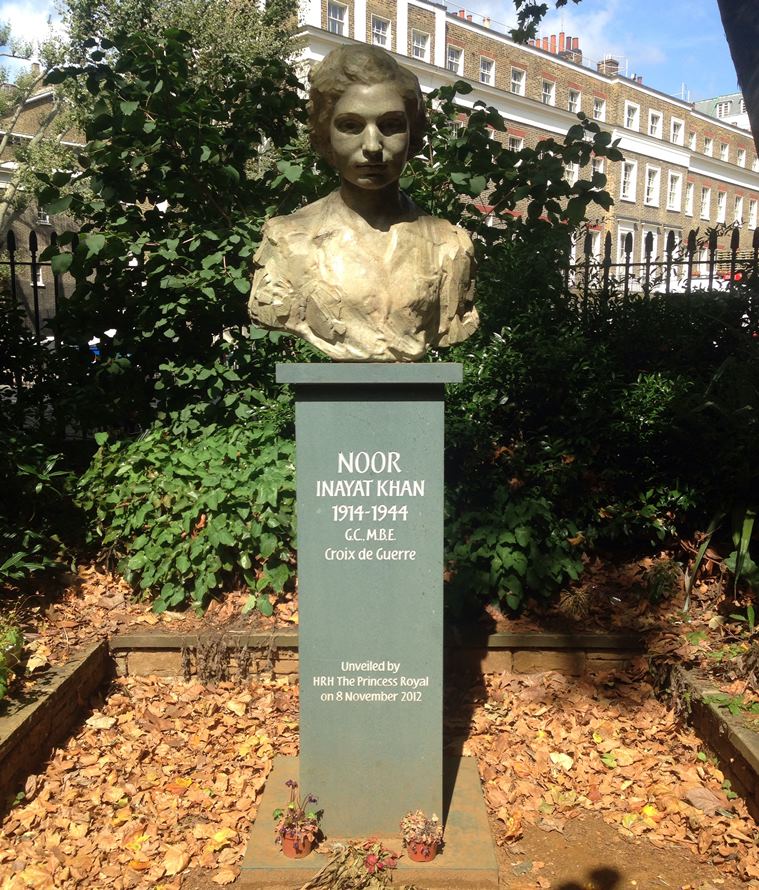
A bust of Noor Inayat Khan in Gordon Square, London. (Source: Wikimedia Commons)
She became the first radio operator to be sent to Paris to work for SOE’s Prosper resistance network under the codename Madeleine. She was just 29 then, and had signed up for a job in which people were not expected to be alive for longer than six weeks.
Even as many members of the network were being arrested by the Nazi secret police Gestapo, Noor chose to stay put — and spent the summer moving from one place to another, sending messages back to London, until she was arrested in 1943.
She was executed at the Dachau concentration camp in southern Germany near Munich. Noor was awarded the highest honour in the UK, the George Cross, in 1949, and the French Croix de Guerre with the silver star posthumously.
What was Noor’s connection to India?
She was connected to India through her father Inayat Khan. He was founder of the Sufi Order of the West, which is now known as the Inayati Order. He had migrated to the West as n Hindustani classical musician, and then moved to teaching Sufism.
Inayat Khan was born in Baroda. His maternal grandfather was the noted musician Ustad Maula Bakhsh Khan, who founded the music academy Gyanshala, which now serves as the Faculty of Performing Arts at Maharaja Sayajirao University. Maula Bakhsh’s wife, Qasim Bibi, was a granddaughter of Tipu Sultan of Mysore.
Inayat returned to India in 1926 and chose the site of his burial at the Nizamuddin Dargah complex in New Delhi. The Inayat Khan dargah still stands in a corner of the complex.
Besides being a GC, what other honours has Noor received?
In 2014, Britain’s Royal Mail had issued a postage stamp in honour of Noor as part of a set of 10 stamps in the ‘Remarkable Lives’ series. In 2012, a memorial with a bust of Noor was unveiled in London by Princess Anne. Shrabani Basu, author of ‘Spy Princess, The Life of Noor Inayat Khan’, and Chair of the Noor Inayat Khan Memorial Trust, had campaigned for the memorial.
In February 2019, Noor’s London home at 4 Taviton Street in Bloomsbury, the house that she left for her final mission, was honoured with a blue plaque. She was the first Indian-origin woman to be awarded the plaque.
How has Noor been represented in popular culture?
Various documentaries on women agents and the SOE have featured her story, such as Netflix’s ‘Churchill’s Secret Agents: The New Recruits’. In 2018, a play titled ‘Agent Madeleine’ premiered at the Ottawa Fringe Festival.
In 2012, Indian producers Zafar Hai and Tabrez Noorani obtained the film rights to the biography by Basu. In the film ‘Liberté: A Call to Spy’, an American historical drama, actor Radhike Apte played the role of Noor. The film had its world premiere at the Edinburgh International Film Festival last year.
source: http://www.indianexpress.com / The Indian Express / Home> Explained / by Surbhi Gupta / New Delhi / July 29th, 2020