Category Archives: Community Involvement / Social Issues

Gandhi’s last pilgrimage was to shrine of Indian Muslim mystic Bakhtiyar Kaki

GUJARAT / NEW DELHI :

Late Kushwant Singh’s account of the Mahatma’s last days, and pride in Indian Islam
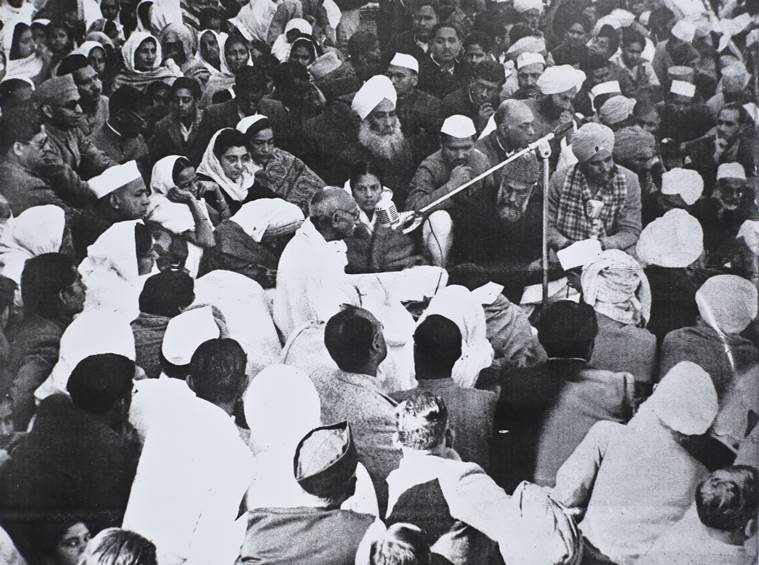
Mahatma Gandhi at a prayer meeting at the shrine of Qutbuddin Bakhtiyar Kaki

Hyderabad (Rahnuma) :

India’s most celebrated writer and former Member of Parliament, the late Kushwant Singh wrote in his book, published as “Notes on The Great Indian Circus”; “ It should be remembered that Mahatma Gandhi who conducted daily prayers where he was, did not go into temples and the last time he went to a place of worship was at the tomb of Qutubuddin Bakhtiyar Kaki.”

Born in 1173 AD, Khwaja Qutub Uddin Bakhtiyar Kaki was the most renowned Sufi mystic, saint and scholar of the Chishti order in the Indian subcontinent.

His mausoleum was the first dargah of a prominent Muslim in Delhi. He was a disciple and the intellectual successor of Moinuddin Chishti of Ajmer as head of the Chishti order. Delhi’s Qutb Minar, is said to have been dedicated to him.

Qutbuddin Bakhtiyar Kaki had a tremendous influence on Islam in India. As he continued, and developed the traditional ideas of Monism (non-dualism, Wahdat ul-Wujud, Advaita Vedanta), universal brotherhood and generosity.

His dargah located adjacent to Zafar Mahal in Mehrauli is the oldest dargah in Delhi.

Three days before he was shot and martyred, on January 27th, 1948, Mahatma Gandhi held his last public address at the shrine of Muslim sage Qutbuddin Bakhtiyar Kaki in Mehrauli.

The Partition caused an eruption of violence in Delhi which was refusing to abate. Delhi was overflowing with refugees, and people were afraid to leave their homes. During the annual Urs held at the dargah, a tradition observed for centuries – there were only a few Muslims present to mark the occasion.

In this perilous circumstance, Mahatma Gandhi held a prayer meeting at the shrine of Qutbuddin Bakhtiyar Kaki.

In his other book, “The Novel”, Kushwant Singh described the incident in the following manner: “ Gandhi bows to Kaki’s Tomb. The Mussalmans accompanying him request to, utter our Fateha. So the Mahatma raises his hand and recites: In the name of Allah the beneficent and the merciful.”

According to Singh, it was here that Mahatma Gandhi met Maulana Jamal Miyan Firangi Mahali (the son of Maulana Abdul Bari Firangi Mahali, whom Gandhi referred to as his brother), who recounted the entire meet to an Urdu newspaper upon his return to the city of Lucknow.

“ Maulana Jamal asked Gandhi how he knew Hazrat Bakhtiyar Kaki to which the latter replied, it was in fact, his father Maulana Bari who had introduced him to the great Sufi saint as the disciple of Hazrat Moinuddin Chishti Gareeb Nawaz of Ajmer “ recalled Adnan Abdul Wali Firangi Mahali, the great-grandson of Moulana Bari, referring to the reported incident.

Explaining the incident further, Gandhi had told Jamal how he was invited by Moulana Bari from Ahmedabad to Ajmer, in March 1922, where the Mahatma had his first experience with sitting in an authentic Chisti Qawwali.

“ The Ghazal being sung was composed by Maulana Mohammad Ali Jauhar and the Bihar secretary of the Khilafat Committee, Dr. Syed Mahmood was translating it to Gandhiji from Urdu to English, ” said Adnan. In awe of what unfolded before him during the event, Mahatma Gandhi enquired from Moulana Bari about Moinuddin Chishti’s intellectual successor Bakhtiyar Kaki. The Mahatma was apprised cordially on the life of Bakhtiyar Kaki by Moulana Bari.

Later in the year 1948, when Mahatma Gandhi visited Bakhtiyar Kaki’s shrine, the annual Urs celebrations that had been called off owing to rampant rioting were reinstated.

Marking the occasion, the Sikh brethren had performed Qawwali at the shrine under Mahatma Gandhi’s guidance.
Mahatma Gandhi’s endeavor for peace and harmony was his last fast-unto-death, signaling the riots to cease.

With pressure mounting from all sections of society to call off his fast, he laid down five conditions, of which the return of Kaki’s shrine to Muslims and that it be repaired by Hindus and Sikhs together was one.
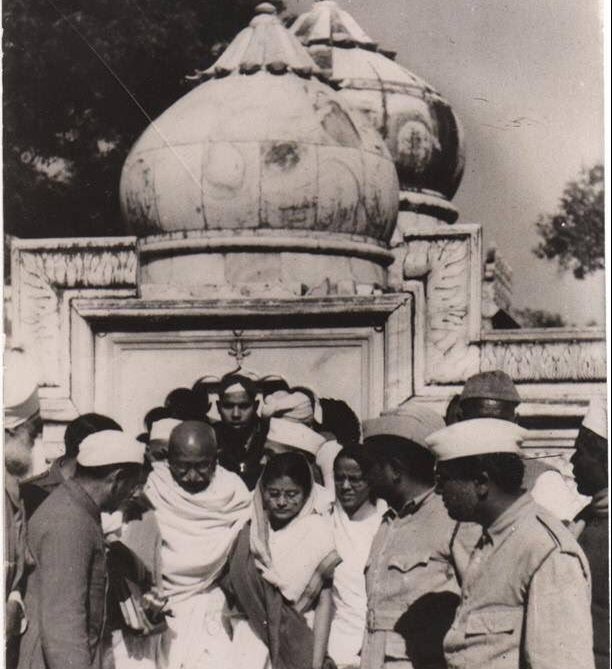
Mahatma Gandhi at the shrine of Qutbuddin Bakhtiyar Kaki

Rafi Adeen is a Contributing Editor for The Rahnuma Daily (TheRahnuma.com), the online English daily edition of The Rahnuma-E-Deccan Daily (ReDD), India’s oldest Urdu daily print newspaper. He can be contacted at rafi@therahnuma.com

source: http://www.therahnuma.com / The Rahnuma Daily / Home / by Rafi Adeen / November 13th, 2019
Welcome To Bengal, Where There Is Not One Or Two, But Thirty Muslim Professors Who Teach Sanskrit

WEST BENGAL :

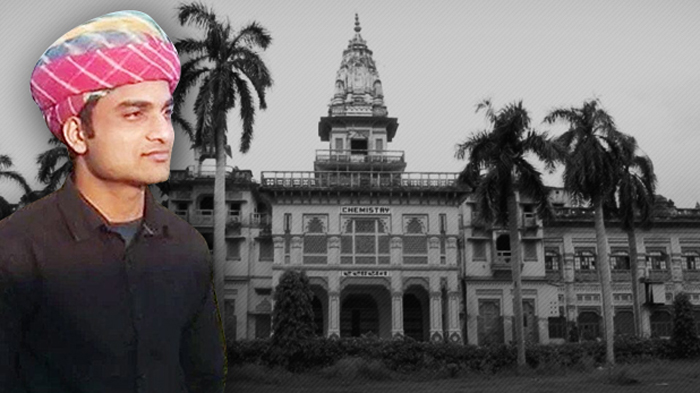
Firoz Khan and Banaras Hindu University. Courtesy: tv9bharatvarsh.com

Kolkata:

At a time when faculty members both present and past have even written to the President of India, Ram Nath Kovind, requesting him to intervene and stall the appointment of Dr Feroze Khan in Banaras Hindu University (BHU)’s Sanskrit Dharam Vidya Vigyaan department, West Bengal seems to embracing its Sanskrit professors hailing from the ‘other’ community, comfortably.

Going by a loose headcount there are at least 30 Muslim professors in West Bengal, teaching Sanskrit. Around 14 were recruited last year through College Service Commission and 12 this year. The most recent recruitment being of Ramzal Ali at the Sanskrit department of Ramkrishna Mission Vidyamandir, Belur. Speaking to eNewsroom, regarding his recruitment, he said, “I am in a state of shock with so many calls being made to me, seeking my comment. A Muslim learning Sanskrit is nothing new. There is a history to it. In every Sanskrit department across the state, you will find at least one Muslim student. Muslim Sanskrit teachers in Bengal, is also not rare.”

Perhaps Ali has a point. For, Dr Shaikh Sabir Ali, a gold medalist in Sanskrit from the University of Calcutta has been teaching the language for almost a decade now. Dr Ali, at present, teaches Sanskrit at the West Bengal State University, Barasat. According to him, Sanskrit, as a language is beyond Vedas and Upanishads.

Speaking from experience Ali said, “Every batch has at least one Muslim student in the Department of Sanskrit. In Kolkata, I presume, Rabindra Bharati University has a huge number of Sanskrit students.”  Dr Ali is also a topper from Ramkrisha Mission Vidyamandir.

He said, “There is more to this language, apart from the Vedas, Purans and Upanishads. This language has a rich literature and grammar too. It was these two that attracted me as a child. Luckily, my teachers encouraged me to take up this language for my higher studies. You, see one can’t make people take up a language simply based on one’s religion. History is a witness to many Muslims mastering this language.”

Speaking from experience Ali said, “Every batch has at least one Muslim student in the Department of Sanskrit. In Kolkata, I presume, Rabindra Bharati University has a huge number of Sanskrit students.”  Dr Ali is also a topper from Ramkrisha Mission Vidyamandir.

Rakibul Sk, assistant professor at SBS government college said, “I have never been discriminated on the basis of my religion, neither while I was mastering Sanskrit, nor while teaching it. I would like to add that while I hail from a small place like Jangipur, my place of birth has taught me that there is no religious attachment to any language. Hence, when I took up Sanskrit for my higher education, the Hindu neighbours of mine never raised an eyebrow. On the contrary, they were quite happy. The teachers who guided me to reach this position are all Hindus. It’s sad that today, we are discussing all this from a religious perspective.”

Adding to the experiences of Muslim Sanskrit teachers in Bengal, Rakibul Sk, assistant professor at SBS government college said, “I have never been discriminated on the basis of my religion, neither while I was mastering Sanskrit, nor while teaching it. I would like to add that while I hail from a small place like Jangipur, my place of birth has taught me that there is no religious attachment to any language. Hence, when I took up Sanskrit for my higher education, the Hindu neighbours of mine never raised an eyebrow. On the contrary, they were quite happy. The teachers who guided me to reach this position are all Hindus. It’s sad that today, we are discussing all this from a religious perspective.”

However, on being asked about the faculty members writing to the President of India, Ali, said, “I don’t want to open up a new controversy. But let me be very clear, there is a particular department of Sanskrit, which is accessible only to the Brahmin. Even Hindus from other sect are not allowed to enter that domain, so the question of a Muslim being appointed in that domain can be quite challenging. As per my knowledge, Dr Feroze Khan has been appointed in the Sanskrit Dharam Vidya Vigyaan department, which is the domain that I just talked about. I don’t want to get into a further debate, but I guess, his recruitment in the literature department wouldn’t have caused this huge controversy.”

Given the new twist in the story, it would be interesting to see President Kovind’s call on the letter written by the faculty members of BHU, seeking his intervention to stall Khan‘s recruitment, especially when earlier this year, he had awarded Padma Sri for Literature and Education to Sanskrit Scholar Mohammad Hanif Khan Shastri.

source: http://www.enewsroom.in / E News Room / Home> Let there be light / by Shabina Akhtar / November 27th, 2019

Tamkeen Shaikh – born Indian woman Conservative nominee for UK poll

Ahmedabad, GUJARAT  / Barking, UNITED KINGDOM :

Ahmedabad-born Indian woman Conservative nominee for UK poll

London (IANS) :

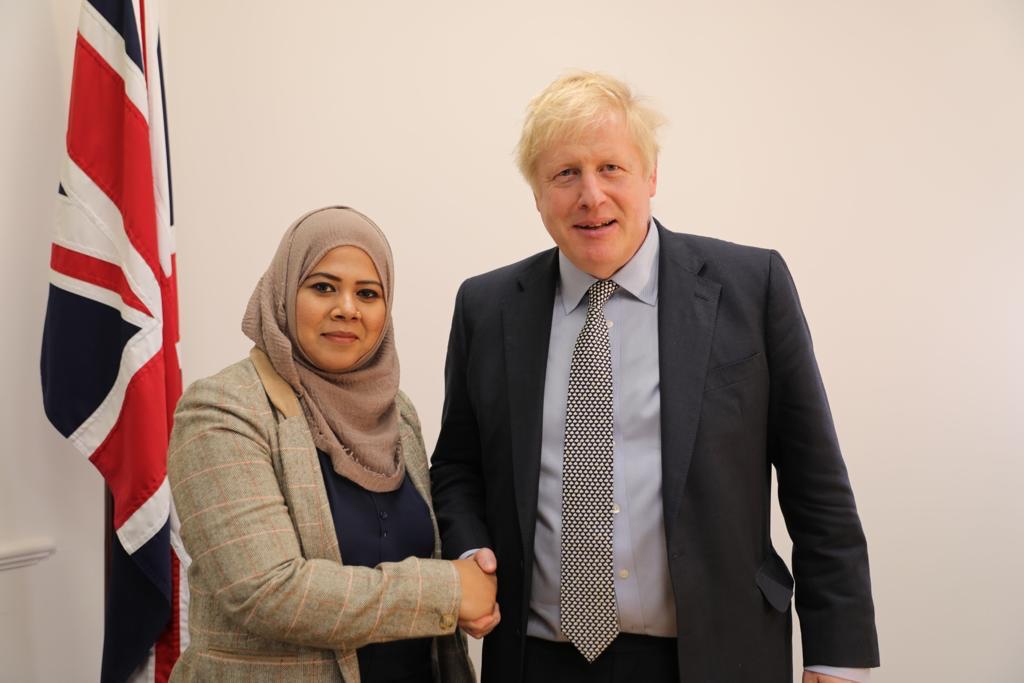
Indian origin Tamkeen Shaikh, born and raised in Ahmedabad, has been selected as the Conservative Party candidate for the Barking constituency for the December 12 UK elections.

“Delighted to be selected as the Conservative Party Candidate for Barking. Hard work begins now! #BlueBarking,” Shaikh, who studied and worked as a journalist in India before coming to the UK, tweeted on being named candidate.

A staunch supporter of Prime Minister Boris Johnson and Brexit, Shaikh left home 14 years ago for a Masters in media and management in the UK.

Married with two children, Shaikh is now working in the education sector.

She says: “The reason I have joined politics and particularly the Conservative Party is, it’s the best way to contribute to the society and the party believes in creating opportunities for business and innovation.

“Here the Parliament is pushing to have 50:50 representation of men and women and are encouraging women on a wider scale to get involved in politics. If elected my priority is to draw more investments in school, social enterprise, youth engagement, building family homes and care for the elderly.”

“The mantra that has worked for me is ato be consistent and persistent’ that will lead you to achieve your goals. Indians are a large economical contributors in UK and continue to do so. Indian community has integrated well within the community and are making huge progress in all sectors,” she adds.

“Like the majority of Barking residents, I voted Leave and I want to get Brexit done.

“You only have to look at the epidemic of fly-tipping, the state of Barking Station and our failing high streets to realise the Labour Party is failing us. We deserve better than Labour. I live in Barking, my children go to a local school and so I understand the needs of local people.

“We need an MP who will fight for more investment in our schools, improved care for the elderly and to give young people things to occupy them to keep them off the streets and give them a better future.

“I want to see a thriving high street that will benefit social enterprises and small businesses, providing jobs for residents. I am your local candidate representing the local people of Barking and I will get Brexit done,” she promised.

source: http://www.therahnuma.com / The Rahnuma Daily / Home> World / by IANS / November 26th, 2019

Youngest Muslim Woman Elected as Chairperson of Rajasthan’s Urban Local Body

Nagaur District, RAJASTHAN :

In the 55-member urban local body, Congress has 35 members and BJP 3 besides 17 Independents.

Jaipur :

Samrin of Congress party has been elected as chairperson of the Makrana Nagar Parishad in Nagaur district of Rajasthan.

The Makrana Nagar Parishad in Nagaur district of Rajasthan on Tuesday elected one of its youngest members – 26-year-old Samrin of Congress party – as its chairperson.

Samrin, who won from Ward 32, is a graduate and daughter of district Congress president Zakir Hussain Gaisawat. She was elected as Chairperson unopposed.

In the 55-member urban local body, Congress has 35 members and BJP 3 besides 17 Independents. The elections for the parishad were held earlier this month. In all, there are 40 Muslim councillors in the house, most of them from Congress.

For the post of chairperson, there were four candidates, including one from Congress, in the fray. All were women candidates. Three of them were Independents and withdrew their nominations before voting.

It was first time that Congress has won majority in this local body.

Muslim Members of Makrana Nagar Parishad in Nagaur district

Name

Age

Party

Rabban Ahmed

39

Congress

Abdul Sattar

45

Congress

Mahadi Hasan

55

Congress

Shokat Ali

63

Congress

Rubina Bano

30

Congress

Shabnam Bano

33

Congress

Shabana

40

Congress

Rukhsana Bano

36

Congress

Islamuddin

39

Congress

Mohammad Aslam

54

Independent

Mohammad Adil

25

Congress

Najma Begum

40

Congress

Shahida

46

Congress

Shahida Begum

60

Congress

Niaz Mohammad

53

Congress

Shahnawaz

31

Congress

Farooq Ahmed

54

Independent

A Halim

38

Congress

Shahnaj Begum

33

Congress

Mumtaz Bano

38

Independent

Samrin

26

Congress

Farooque Ahmed

46

Congress

Faruk Ahmed

62

Congress

Parveen Begum

57

Congress

Iftekharuddin

64

Congress

Mohd Irshad

32

Congress

Jiaba Kausar

27

Congress

Zaida

48

Congress

Mohd Iqbal

33

Independent

Sirajuddin

36

Independent

Nasim

66

Independent

Saddam Hussain

26

Independent

M Aziz

38

Congress

Mohammad Khalik

26

Congress

Salam Bhati

60

Congress

Hajan Zubeda

54

Congress

Mohammad Madani

39

Congress

A Kayyum

44

Congress

Mohammad Afzal

39

Congress

Munifa Begum

40

Congress

source: http://www.caravandaily.com / Caravan / Home> Big Story / by Caravan News / November 26th, 2019

Breaking taboos

Kuwarpur Baghel (Hardoi District), UTTAR PRADESH :

ShikohZaidiMPOs26nov2019

Shikoh Zaidi is helping women in her village by providing easy access to their basic hygiene needs

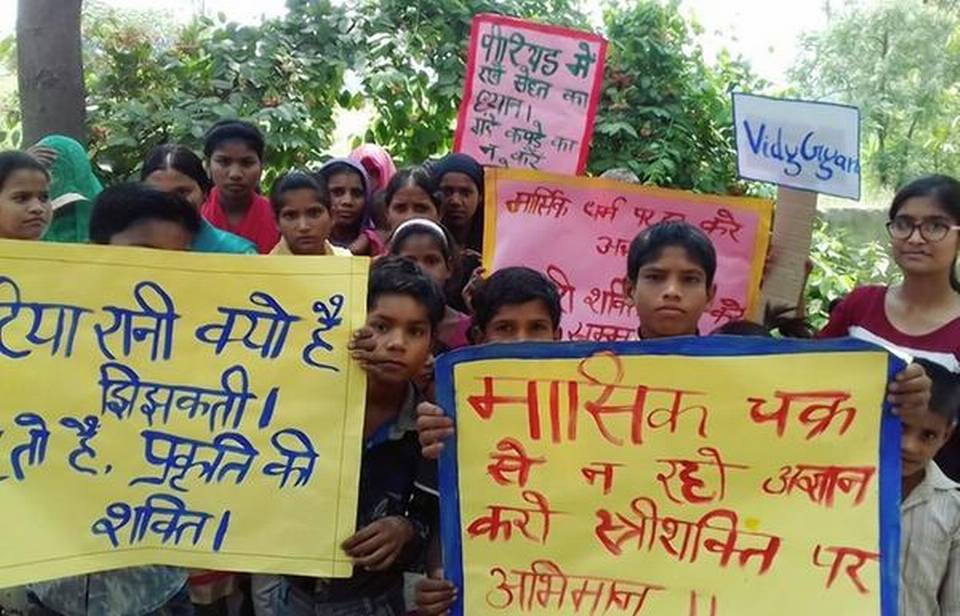
Shikoh Zaidi, a 16-year-old girl from Kuwarpur Baghel in Hardoi district of central Uttar Pradesh, has started a social initiative to break taboos around menstruation and spread awareness about menstrual hygiene, in her village. She was inspired by Deepa Narayan’s book on gender inequality titled Chup, which talks about an average Indian woman’s struggle in a patriarchal society.

Encouraged by her teachers at VidyaGyan, a school that offers free education to meritorious underprivileged students in Uttar Pradesh, Zaidi was inspired to do something to improve the lives of women in her own village.

SPECIAL ARRANGEMENT | Photo Credit: SPECIAL ARRANGEMENT

“The conservative outlook of my village doesn’t allow for a space where one can talk openly about these issues. However, with my father’s assistance, I was able to organise a campaign by writing slogans and collecting short videos around menstrual health and hygiene. My father and I went door-to- door to invite women and girls to create awareness,” says Zaidi.

“When I first demonstrated the use of sanitary napkins, they giggled and were amazed at the sheer sight of them. Some women were completely ignorant about this basic product. By the third screening, I noticed that women were engaging with me and clarifying their queries as well. Some girls had even started using it,” she adds.

No help

However, many women in the village cannot afford these products. “I wrote to the district magistrate to make free sanitary pads available to the women in our village. But, the authorities failed to keep their promises. Panchayat officials were also of no help,” laments Zaidi.

Many women are still using cloth and rags because free pads are only available in a shop that is 20 km away.

Nonetheless, Zaidi is creating awareness on methods to maintain hygiene and cleanliness during menstruation with the available resources. “I am planning to make a self-help group and install a sanitary pad making machine which will not only help in solving this issue but also provide employment to people in the village,” she says.

source: http://www.thehindu.com / The Hindu / Home> Initiative – Education / by Neha Rupeja / November 27th, 2019

24 Hours In Life Of Rofikul Islam: Quack-Quack, Hoot-Hoot — Of Ducks And Owls

ASSAM  :

Rofikul Islam is a professional wildlife guard and much in demand for his amazing knowledge of birds and animals. Delhi’s Deputy Chief Minister Manish Sisodia is among his top clients.

RofikulIslamMPOs22nov2019

Quack! The gander gives away the nest’s position behind an arbour of foliage. Mrs White-Winged Duck responds with a quick quack-quack. Rofikul Islam raises an arm, winks at his team. And they, finger on trigger, behold Assam’s state bird—so elusive and endangered that perhaps only 200 pairs rem­ain in the wild on this planet—with unabashed sideways glances of looky-loos. They go click, click, click. But the light is low; the sun has just yawned out on this island in the Jia Bhoroli, the livewire of Nameri national park straddling Assam and Arunachal Pradesh.

____________________________________

Will he stop prying into Mr and Mrs DUck’s private moments? He won’t.

____________________________________

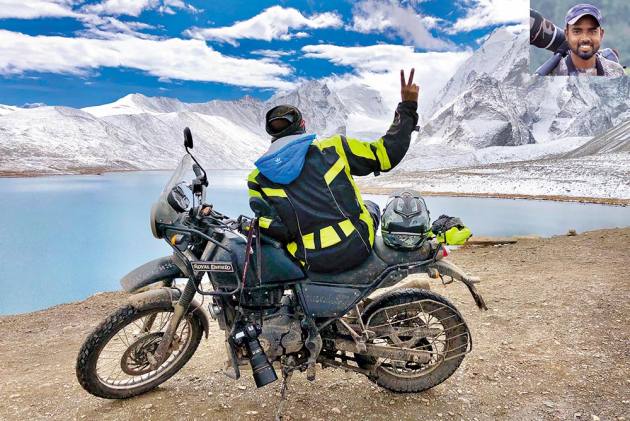
Rofikul, a professional wildlife guide with AllIndiaBirdingTours, has prepared well for the sortie. This morning is a long trek—boating, fording, and pushing their trusty legs to their limits. Waking up to a burst of tweets, retweets, pa-chip-chip-pa-tip (sounds like potato chip and dip?), breakfast is hearty in the camp. “By noon, the team logs nearly 80 species of birds,” says Rofikul, a Kaziranga nat­ive who turned 30 this November. Growing up near the fam­ous park helped him hone a guide’s primary asset: like telling a Crested Kingfisher from a finch by their calls. Booked through the year, his adventures are on unplumbed land—jungles on the Assam plains, in the Northeast’s hills and snowcapped Sikkimese mountains. His guest list? Long and impressive; includes Delhi deputy CM Manish Sisodia.

Back to camp, lunch,  another exp­edition (short; sundown gathers pace), tea/cookies/Maggi, and it’s almost time for dinner around a bonfire. The thatch-and-bamboo cottages, the snug beds wait invitingly. But the guardian owl is on his nightly run. Hoot hoot! Everything screeeeeee-s to a halt.

source: http://www.outlookindia.com / Outlook / Home> Magazine> National / by Rituparna Kakoty / November 21st, 2019

Bushra Arshad creates history; busts all myths; clears UPSC

Saurikh Village (Kannauj), UTTAR PRADESH :

BushraArshad01MPOs22nov2019

Bushra Arshad is being lavished with praise for achieving 6th rank in UPPCS, after the results were recently announced, and for being selected as SDM. This girl from Saurikh village is the only Muslim participant to become SDM in UPPSC-2017. She is the same Bushra Arshad who scored 277th rank in UPSC, results of which were announced in July, and subsequently was selected for the IRS, but she was not satisfied with her achievement.

She is not satisfied even with her latest achievement shows her grit and passion to achieve her dream of being in top 20 in IAS. The reality, however, seems that Bushra is fond of breaking the myths and proving the stereotypes wrong.

Her family, relatives, and husband all believe that she will not settle for anything less. They have a good reason for their belief: If a village girl, married with kids, after four surgeries and overcoming the pain of those surgeries, could score such a high rank in one of the prestigious exams and stamp her presence, then everything is possible for her.

Bushra smiles and reacts: Though we could find exemplary achievements from persons faced with each of those obstacles, my facing every one of those hurdles, probably, resulted in my being strong-willed in my quest.

Bushra’s father is a farmer and her mother is a housewife. A lone brother and a sister are also well-educated.  Both parents are graduates. But Bushra, in her mother Shama’s words, is definitely the “Extra-ordinary” one, packed with talent and way better than us.

Bushra graduated at the age of seventeen and a half. She had an MBA degree before she turned 20. She completed her studies up to class XII from Kannauj and went to Kanpur for graduation.

BushraArshad02MPOs22nov2019

Bushra says that she wanted to give the UPSC exam right away, but couldn’t since she didn’t meet the minimum age requirement. Her mother says that Bushra was admitted directly into the second class at the age of four and a half years. She adds “She already had learned so much at home itself that she never came even second (in her class).” She says Bushra is habituated to be a topper. My multi-talented daughter topped in everything”.

““Make this girl a collector” was the constant advice of anyone and everyone who visited us to my Abbu and Ammi,” says Bushra. “It got me fixated. (Again) Since I did not meet the minimum age requirement of UPSC, I prepared and appeared for JRF test.”

She cleared JRF in her first attempt and achieved a Ph.D. in Distress Management from AMU and that’s how the title “Doctor” got associated with her name. Right after that, she married Asmar Hussain. A little while later Engineer Asmar Hussain and Bushra moved to Saudi Arabia. Asmar started his studies at Jazan University, while Bushra obtained a high-ranking position. Leaving a well-placed position and an excellent package that came along with it, Bushra returned to India along with her husband.

Bushra says, “There was only one reason for our return to India, limitless love and ‘patriotism’, I often used to contemplate that the knowledge that I gained in my country through its residents, the skills born from that knowledge ought to benefit the same citizens, and that is their right.”

Her husband, Asmar Hussain, says that after this he took up a job at Coal India, they had two children. His wife underwent four major surgeries. It has been ten years since, but her desire to become a collector from within egged her constantly.

Bushra adds: “I did my job honestly. I did my duty as a mother. I also performed the responsibilities of a wife without neglecting my husband. I did not use the excuse of constant pain after surgeries to set me back and now I am appointed a deputy collector.”

Asmar Hussain, who is pursuing a Ph.D. from AMU, is a resident of Aligarh. He says that Bushra sits in the front seat of the car as a habit. Once she sets her sight on something, she achieves it at all costs.

Mohammad Akmal, a youth from Kannauj, says, “In four months, this is the second news that a girl from Saurikh has made history.Four months ago, this same girl did wonders. Bushra’s success proves that  excuses are for weak-willed people. She is truly an example of positivity and she is the talk of Kannauj ”.

source: http://www.twocircles.net / TwoCirlcles.net / Home> Indian Muslim> Lead Story> TCN Positive / by Aas Mohammed Kaif , TwoCircles.net / October 29th, 2019

Faith no barrier

Srinagar, JAMMU & KASHMIR :

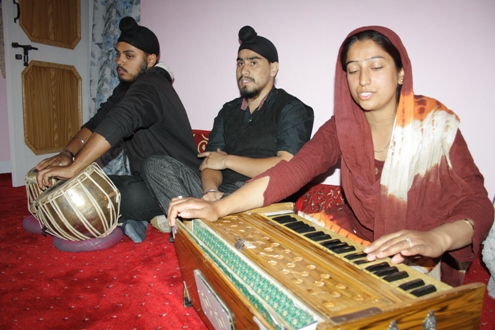
A Muslim woman is taking Sikh boys and girls in Srinagar closer to their religion by teaching them kirtan singing. Tasleema Langoo is a regular at Gurduwaras and finds applause even in the Golden Temple. Shazia Yousuf reports.

TasleemaLangoo01MPOs22nov2019

As she recited a shabad from Guru Granth Sahib at the Golden Temple Amritsar, almost everyone was engrossed in the melody of the kirtan. As soon as she finished, an old woman came towards her, almost crying, kissed her hands and hugged her.

“Now you are the voice of Sikh women. You have done what no girl could do, you are the honour of your Sikh community now.” The old woman said while taking off her golden earrings and gifting these to her.

She didn’t know the girl she was praising was a Kashmiri Muslim.

It is a three year old incident, but Tasleema Langoo’s association with kirtan is almost two decades old. The 26-year-old from Shaheed Gunj Srinagar has been teaching Kirtan to Sikh boys and girls since she was 14. She is perhaps the only kirtan tutor for the community in Srinagar.

She comes from a family of musicians. Her great grandfather sang for Maharaja Pratap singh, her grandfather Ghulam Qadir Langoo was a court singer of Maharaja Hari Singh. Her uncles and aunts have worked as musicians with Radio Kashmir. Tasleema’s father Abdul Majeed Langoo teaches music at Women’s college MA road.

Tasleema was five or six years old when some Sikh girls approached her father for learning music for religious purposes. “They were my father’s students from college. They would call him Langoo Veerji and wanted to learn harmonium and tabla from him for kirtan singing. I was the youngest daughter and would follow him like his shadow, watching and observing him,” Tasleema says while composing a shabad for her students at her Alochi Bagh residence where the family has recently moved in.

Every morning, Sikh girls would come with a shabad from Guru Granth Sahib and Tasleema’s father would compose it for them, “I would sing with them. Though there was music in every room of our house, but kirtan would excite me most,” she says.

It went on for many years. The students kept changing. And Tasleema’s love for kirtan compositions kept growing. She insisted on joining her father’s class where she would help his students in playing instruments who in turn would write shabads in Urdu (Arabic script) for her, “I was first hesitant, I thought it is disrespecting to sing something we don’t believe or mean. But she loved and respected it more than them,” says Tasleema’s father Majeed.

The class swelled with every day. It was now Tasleema who would sing to the compositions of his father for the students. “They were thrilled to hear her mesmerising voice that they couldn’t find in their community for years. Even the parents of students would come to listen,” says Majeed.

In 1998, when Tasleema was in 8th standard, she decided to start her own coaching class. “By now I was fully trained. The only difficulty was reading Granth Sahib in Punjabi. My father got a Urdu version from Amritsar for me,” she says. Tasleema says, she would start her day with morning prayers (Namaz) and recitation from Quran. “Then I would open Granth Sahib, memorise a new shabad and compose with the help of my father, for my students.”

In 2000, Tasleema left her studies after high school. The same year she gave her first performance in a gurdwara. Tasleema sang in the Gurdwara at Lal Chowk Srinagar on the invitation of a Sikh family. “First not many people were attentive, but when I sang, they were all humming and praising in Punjabi language.” She could hardly understand their words and kept pleading the family not to reveal her Muslim identity.

But when they came to know of her Muslim identity, she earned many blessings. More and more invitations for kirtan darbars followed. “There are two to three invitations in a month. On Sundays I sing in Chatti Padshahi Gurdwara. I sang in many kirtan darbars outside the state. People invite me to sing at Baisakhi and other festivals,” she says.

In 2001, a known singer Harjinder Singh spotted her in Chatti Padshahi gurdwara and advised her to go to Radio Kashmir. She went for an audition, qualified, and began singing kirtans for Radio Kashmir.

Afterwards, late Ghulam Nabi Sheikh encouraged her to go for Kashmiri auditions too. She did and thus began to sing in Kashmiri too for the radio.

Most of her time, however is spent in teaching. She has taught more than 200 Sikh boys and girls. At present she has 15 students. She charges Rs 300 each. And what about her neighbours and relatives. How did they react?

“Our home in Shaheed Gunj was adjacent to mosque. Once I was singing loudly with my students when the mosque imam entered our house. I was ready for a reprimand, but to my surprise, he gave his blessings and told me that I was doing a wonderful job by maintaining communal harmony at a time when our place needed it most,” she says.

Tasleema, however, gave in to her apprehensions in testing times. After the Chattisinghpora Massacre in which 36 Sikhs were killed by unidentified assailants, she stopped her classes. However she could not keep herself away for long and resumed her classes.

For the small Sikh community of Kashmir, she is a saviour of their traditions. “You cannot imagine what she is for our community. It is she who teaches us verses from our holy book every day,” says her student Supinder Singh of Bemina, a postgraduate student at University of Kashmir.

“We never feel she is different from us, she absorbs herself in every verse,” says another student, Manpreet Singh, an engineering graduate.

In 2007, when her magical voice reverberated in the Golden Temple,  Sikh religious leader, Harbans Singh visited her house to thank him. “He told me, ‘you are doing us a favour’ and he gave me some money as well,” she says.

source: http://www.kashmirlife.net / Kashmir Life / Home> Faith> Music / by Shazia Yousuf, Kashmir Life / June 27th, 2010

Book Negates Stereotype Image of Muslim Women

Nizamuddin Basti, NEW DELHI :

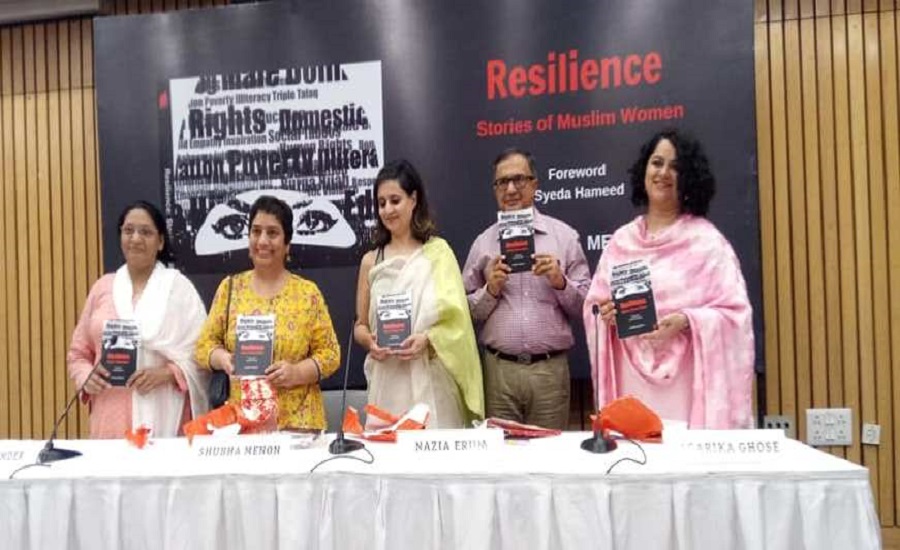
The book “Resilience: Stories of Muslim Women” was released by noted journalist and author Sagarika Ghose at a function at the India International Center, New Delhi on Wednesday. — Photo: Caravan Daily

‘Resilience: Stories of Muslim women’ released in New Delhi

New Delhi :

At a time when her stereotypes as meek and submissive entity are used by a political class to further its agenda, a new book catches Muslim woman in her multidimensional persona and in the process blasts many a myth surrounding her. In each of the varied fields of human endeavour, these Muslim women have come out in flying colours.

The book “Resilience: Stories of Muslim Women” was released by noted journalist and author Sagarika Ghose at a function at the India International Center here on Wednesday in the presence of many woman activists.

Speaking on the occasion, Ghose said the book negated the stereotype image of Muslim women as it illustrates that no matter what the economic impediments or social taboo, given the means and empathy Muslim women could also scale the height of success.

The book explores the lives of 11 resilient Muslim women who fought against all odds and got the opportunity to study in a tiny adult education centre. She congratulated these women and lamented in the scientific age woman have to face many odds and discrimination in every community.

The book release ceremony was followed by a discussion on the condition of women moderated by Nazia Erum, author and media advocacy head of Amnesty International India.

Social activist Shabnam Hashmi, the spirit behind the success of these women, said the book is like fresh air in the present political environment of the country in an oblique reference to the Modi Government’s push for enacting controversial Triple Talaq law which seeks to criminalise a civil matter like marriage.

She claimed stereotypical images of Muslim women are being used to further marginalise the minority community.

In early 1980, we started teaching the Nizamuddin Basti girls but it was a bumpy journey as girls had to struggle against severe hostility from the Basti residents whom Muslim girls going to study was “ anti-Islam or anti-Deen”, she added.

Shubha Menon, author, who documented the life of girls and women of Nizamuddin Basti, Delhi, said these were mostly dropouts or had not studied at all. She said she was touched by their stories and decided to bring the brighter side of the Muslim women.

On the occasion, many of these women narrated their stories of struggles.

Farida, who is a daughter of a Maulvi attached to Tablighi Jamaat, said she fought patriarchy, gender bias, poverty, and triple talaq to become a graduate.  She said there was no discrimination on the basis of gender at home as her father loved her much but did not in favour of sending her to school.  She told she was made to wear a burqa at 9, married off at 13 abandoned with two children at 16.

Farida, who now runs an NGO, has a sister Syeda whose story is also the same. “Both the sisters married to two brothers, unpaid labour in their matrimonial home, sloggers, beaten at the whims of a cruel matriarch, bearing children and hardship in one go. Their father, a Maulvi of Tablighi Jamaat, caught between the demands of his fellow Jamaatis and love for his daughters. The two sisters return home with meager belongings plus four pairs of mouths to feed. Then from rock bottom poverty, they extricate themselves. Their horizon widens and they rise and thanks to Seher Study Centre”.

Ayesha said she not only fought for her education but brought up her son to be an MBA and her daughter a Master in Science.  Mussarrat, who now works for an international NGO, told that her grandmother kept her locked at home.

Other women Asma, Ishrat, Parveen, Shahjahan, Farhat, Parveen,  and Najma’s stories are similar but not identical.

Shabnam said the mentors of Seher Study Centre in the Basti; teaching, counselling, chatting, encouraging the oppressed girls to break out of their fetters and manacles and ultimately from their cloisters.

From verbal threats to lathis, they not only bore them but spun them around to give great leverage to the girls they were grooming, she said.

The book, which chronicles the stories of successful women, also highlights the Markaz versus the Dargah which is another contradiction of the Basti. Stories of the Dargah dot the entire book. For example, Nizamuddin’s disdain for power is a poignant anecdote. Rulers of the Sultanate, Tughlaqs and Khiljis were not permitted to enter the Pir’s Khanqah. The Saint’s priority was not to pay obeisance to the ruler but to feed the poor and indigent no matter of what faith or of what caste while the Markaz propagates orthodox Islam. The author does not deride one practice at the cost of the other. Their parallel existence may occasionally clash but seldom becomes a major eruption.

She makes the reader a partner in her adventure as a reader is taken through the winding gulleys, narrow stairs, tottering houses, all the time surrounded by a mass of humanity; namely Muslims who live and breathe Nizamuddin. There is a constellation of girls who were transformed by the Seher Adult Education Centre. The stories unfold one by one.

The author Menon concludes that Seher comes out as a unique experiment, which not only transformed all those women who studied there but their future generations as well.

source: http://www.caravandaily.com / Caravan Daily / Home> Books / by Abdul Bari Masoud, Caravan Daily / August 29th, 2019

Oldest war widow Saira Bano, who never saw husband, dies at 103

Dhanuri Village (JhunJhunu District), RAJASTHAN : 

She passed away in Dhanuri village of Jhunjhunu district which has given the most number of war soldiers to the Indian army.

Saira Bano waited for six years for her husband's return only to find out that he was martyred
Saira Bano waited for six years for her husband’s return only to find out that he was martyred

Jaipur :

A chapter of sacrifice and dedication came to an end with the death of the country’s oldest, 103-year-old war widow, Saira Bano.  She did not see the face of her husband after marriage, yet dedicated her life to him after his martyrdom.

She passed away in Dhanuri village of Jhunjhunu district which has given the most number of war soldiers to the Indian army.

District Soldier Welfare Officer Parvez Ahmed, Alsisar SDM Dr Amit Yadav arrived to pay homage to her on behalf of the administration.

Although Sair did not go to war, her fight was not less than that of a soldier’s.

Saira Bano got married to Taj Mohammad Khan during the second world war in 1939. The procession reached Dhanuri village on the day of Nikah. But Taj had to immediately go on duty which he never returned from.

After 6 years of waiting, she came to know that he was martyred. Even after this, Saira did not go to her own home. She did not marry because she loved him so much that she wanted to keep his martyrdom alive.

In an interview given a while back, she had said that her husband, Saeed Taj Mohammed, went to fight in World War II and while they were married, her ‘gauna’ did not happen.

“What did my husband’s face look like,  I do not know till date, because I had never met him, had not even seen his face. After receiving the news of my husband’s death, my family and in-laws asked me to go for a second marriage, but I did not, because I wanted to remain in love with his martyrdom “, she had said.

Dhanuri village of Jhunjhunu is called the land of soldiers as there are soldiers in every household. Saira Bano was the Panch of Dhanuri village for 30 years.

The pension she received from the government was spent on teaching girls. In Dhanuri village, like Saira, there are 17 more bravehearts, whose husbands sacrificed their lives while fighting for the country.

Brigadier Ajit Singh Shekhawat, the General of the Kargil War, had recently visited Dhanuri village in Rajasthan, where he came to know about Saira’s story.

When he returned to Surat, he told his unit about her. It was then decided to honour her. In March 2019 Paramveer Shaheed Sahai Trust welcomed her. This was her first honour in Gujarat, with hundreds of people saluting her sacrifice.

source: http://www.newindianexpress.com / The New Indian Express / Home> Nation / by Rajesh Asnani / Express News Service / November 12th, 2019