Former Director General Central Council for Research in Unani Medicine (CCRUM) Dr Mohammed Khalid Siddiqui has been selected for Life Time Achievement Award on the occasion of World Urdu Day. World Urdu day is celebrated every year on November 9 on the occasion of the birth anniversary of the poet of the east Dr Allama Iqbal by Urdu Development Organisation and United Muslim of India.
This year the function will be held at Ghalib Academy. The programme will be presided over by veteran journalist Jalaluddin Aslam.
National convener World Urdu Day Dr Syed Ahmed Khan told that those who have been selected for the award are Dr Azizullah Sheerani for Munshi Prem Chand Award for constructive literature, Moin Shadab Delhi for Hafeez Meerathi Award for poetry, Dr Razaur Rahman Aakif Sumbhuli for Maulana Ismail Meerathi award for children’s literature and Dr Imran Andaleeb for Qazi Adeel Abbasi award for literature.
source: http://www.siasat.com / The Siasat Daily / Home> India> News / by Rasia Hashmi / September 24th, 2018
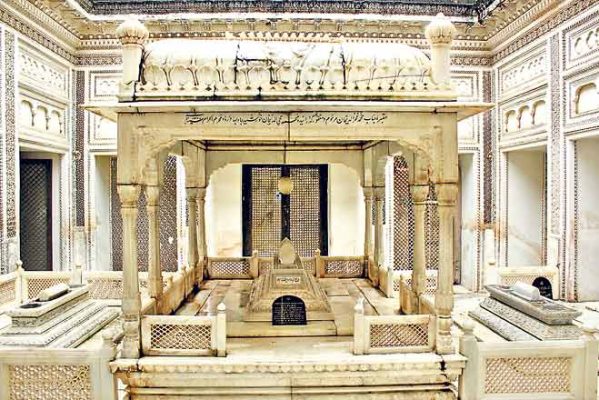
The Paigah Tombs not only symbolise the nobility’s love for magnificient edifices but also represent different styles of architecture.
Tucked away in the quiet bylanes of the Phisal Banda suburb near Owaisi Hospital, Santosh Nagar, is an architectural marvel, a serene mausoleum which is the final resting abode of erstwhile Hyderabad’s celebrated nobility – The Paigahs. The word Paigah, which means pomp and rank in Persian, was a title given by the second Asaf Jahi Nizam of Hyderabad to the estate of Abul Fateh Khan Taig Jung Bahadur in appreciation of the royal services rendered by him. He was also conferred with the title of Shams-ul-Umra, which gives the tombs their name.
Although the Paigahs were noted and rewarded for their contribution as army officers, ministers and aristocrats, Sir Viqar-ul-Umra is popularly remembered as the man behind one of the finest masterpieces of Hyderabadi architecture – the Falaknuma Palace. Legend has it that the 6th Nizam Mahboob Ali Khan loved the palace so much that Viqar-ul-Umra gifted it to him.
One such masterpiece symbolising the Paigahs’ love for architectural edifices are the Paigah Tombs. The spectacular beauty of the mausoleum is said to have earned it a title of the Taj Mahal of South India among connoisseurs of art and architecture. The Paigah Tombs also include a mosque where prayers are held every day.
The Paigah Tombs were constructed in the late 17th century, and later it was made a family maqbara by his son Fakhruddin Khan Amir-e-Kabir – I. Later, some additions were also made by Sir Viqar-ul-Umra, Sir Asman Jah and Sir Khurshid Jah. The tombs are magnificent structures decorated in stucco work and represented the Mughal, Greek, Persian, Asaf Jahi, Rajasthani and Deccani style of architectures.
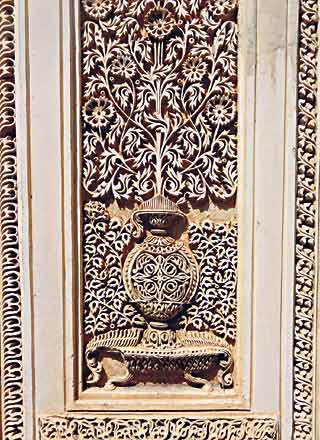
The geometric designs in the Paigah Tombs are unique and the perforated screens are examples of the finest craftsmanship. Some screens have flowers and motifs of fruits; others have serpents, drums, and vases.
There is a great amount of effort put into the detailing of the walls, arches, pillars and even of the graves. Floral and geometric patterns are characteristic of medieval Islamic architecture.
The most striking element of the Paigah Tombs is the intricately carved teakwood doors as entrance to each tomb. The carving of the doors is so fine and so regal it only makes one wonder the way art was encouraged and appreciated in the Asaf Jahi era.
The tomb of wife of Khursheed Jah is the most beautiful of the tombs with exquisite marble inlay work. One can still see the hollows in the marble carvings where precious gems were once encrusted on the grave.
Nawab Bashir-ud-Daulah’s grave stands out with a beautifully carved marble chowkhandi which is adorned by a carved mysterious green stone. Legend has it that the lighting doesn’t strike the place where it is placed.
The Paigah Tombs are under the care of the Department of Archaeology and Museums. As one of the most marvellous symbols of Hyderabad’s rich culture and royal heritage, the Paigah Tombs deserve nothing less than the government’s attention to ensure that it is not just preserved and valued but also promoted and highlighted.
Historian Dr Anand Raj Varma says, “I don’t see much improvement and restoration taking place at the Paigah Tombs; it is in the same state for years now. If you see the entrance, it’s in a very shabby state. There is no significant deterioration but there is also no tourist attraction or promotion of Paigah Tombs either. Most people don’t even know that the Paigah Tombs are located there.”
However, says the historian, the contribution of Rahmatullah, the caretaker of the Paigah Tombs, is appreciable as he keeps it going thanks to his passion and love for the Paigah family and the tombs. “The Tourism Department or the government should take this up as a project. It is the heritage which connects us our past and to our present. It is our treasure, heritage our virasat, and it should be protected,” he adds.
Mohammed Safiullah, managing trustee of The Deccan Heritage Trust, says, “The Paigah Tombs are in desperate need for restoration as the structure is in a dilapidated state and deteriorating. Some places have grown moss all over. The government should invest in the restoration of the Paigah Tombs because there is a scope of return on investment. Once proper restoration work is done, there will be easily about a 1,000 visitors every day.”
A nominal entry ticket would become a means for generating revenue which would help in future maintenance. Simple things like a cafeteria, a souvenir shop and proper toilets could make it more tourist-friendly.
(The writer is a heritage enthusiast)
source: http://www.telanganatoday.com / Telangana Today / Home> SundayScape> Telangana Diaries / by M D Taher Hussain / November 25th, 2018
The 25-year-old crafts teacher, who follows the Muslim faith, conducts daily classes on Hindu epics and prayers for her students, many of whom hail from Muslim families, in Old Hubballi area.
Hubballi :
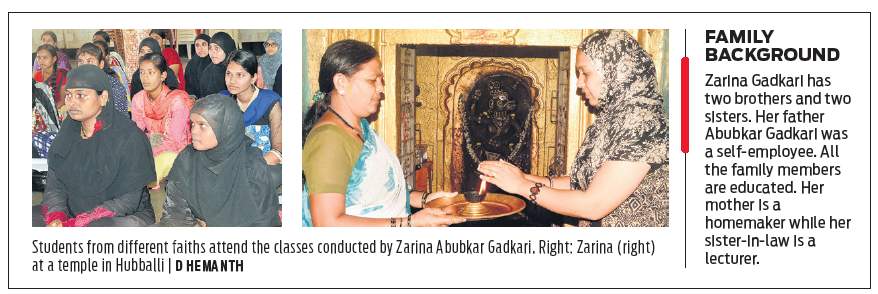
Zarina Abubkar Gadkari is quietly practising what most people only preach — spreading communal harmony. The 25-year-old crafts teacher, who follows the Muslim faith, conducts daily classes on Hindu epics and prayers for her students, many of whom hail from Muslim families, in Old Hubballi area.
Zarina, a teacher at Spoorthi Rural Skill Development Training Centre, which provides free training to women in craft-making and sewing, conducts her spirituality class on the premises every evening. She does not charge anything for the lessons, which include Sanskrit verses, songs and stories from the Ramayana and the Mahabharata, and hymns on gods such as Ganesha and Hanuman.
Hailing from Jamkhandi in Bagalkot district, Zarina started learning devotional songs and shlokas after getting inspired through the Ramayana and Mahabharata serials on television. When she joined the training centre as a craft teacher, she also started singing and teaching them to students.
”It’s a wonderful feeling to recite the shlokas,” she says. “Sanskrit words never seemed difficult to me while I was learning them, and my family members gave me big moral support,” adds Zarina, who performs namaz every day, and also visits the church and reads the Bible.
“When I go to Bengaluru, I visit St Mary’s Basilica in Shivaji Nagar. It is one of my favourite places, and my family members also visit it with me,” she says, adding that such gestures from her family lend her huge moral support.
“We live in a country where communal harmony is everything, and each of us must work hard to achieve it,” she says.
The number of students in her classes has only increased over time, and they love every minute of it.
“I have been attending the classes of Zarina madam for over six months and she is a role model for many,” says Nasereen Attar, a student. “We never faced any restrictions in our homes about attending classes related to Hinduism. In fact, our parents encourage us to learn new things,” she adds.
Most students hail her as a motivating figure. “Her way of teaching and her commitment to religious harmony, besides her reciting of Sanskrit verses, left me stunned,” Shynaz Nadaf, another student, says. “It’s surprising to see Zarina madam perform namaz and as well as have darshan at temples,” Shreya M pitches in.
Zarina’s endeavour is praised by her colleagues too. “Her work shows that attachment to a religion is no hindrance to good work. She is a good human being,” says Mukthambika Narebol, a co-worker at the institute.
Zarina was introduced to the Ramayana and Mahabharata through teleserials by her parents when she was a child. She got interested in reciting the mantras and shlokas when she started teaching at the Spoorthi centre, where daily prayers are conducted.
“I also practised other verses like the Hanuman Chalisa and Gayatri Mantra. Initially, I faced problems in pronunciation but within 2-3 months I was able to recite them well in Sanskrit,” says Zarina, who draws a lot of strength from her family.
While her father Abubkar Gadkari is self-employed, her two brothers and two sisters are well-educated too, and her sister-in-law is a lecturer.
Zarina feels that the task of uniting people of different faiths has assumed greater significance today. “We live in the world’s largest democratic and secular country where all religions exist together. But in recent times, society has seen changes after the social media took the front seat,” she says.
Greater onus rests on the youth to build a cohesive society, adds Zarina. “Several young lives are going waste by getting involved in violence triggered by communal hate. We must also educate women about the ill-effects of religious divide, and bring awareness about nation-building activities,” she says, admitting that the task, however, is far from being easy.
source: http://www.newindianexpress.com / The New Indian Express / Home> States> Karnataka / by Kiran Balannanavar / Express News Service / November 25th, 2018
Mariam Rauf urges schools to include personal safety education in syllabus
As an impressionable child, Mariam Rauf — a 22-year-old life skills and English language educator from Kottayam — never knew what paedophilia was. It took her many more years to realise that she herself had been one of its victims.
Abused on multiple occasions between the age of 3 and 14, the ordeals surely left an imprint on her.
Confused, ashamed, and lost for years on end, she eventually managed to pull herself up and is now busy training children and adults about personal safety.
Driven by her own experiences of abuse as a child, Mariam has now kick-started a campaign to include personal safety education in schools. She feels this is achievable as there is a strong intent on the part of the government to clamp down on child abuse. It is unlikely to affect academics either as it may need only a couple of sessions in a year.
Online petition
As part of the initiative, she has also chosen to shed her right to anonymity and launched an online petition on Change.org, which opens up on her ordeal and makes an appeal to the State government to introduce compulsory training in Personal Safety Education (PSE) for students, parents, teachers, and staff of all government schools.
The petition is addressed to Education Minister C. Ravindranath and the Kerala State Commission for Protection of Child Rights (KeSCPCR).
“About 38,200 people, who have endorsed my petition thus far, believe it is possible. By realising it, I can save at least one child from undergoing what I had to face,” she says.
According to Mariam, personal safety education for children is about making them aware of their body and empowering them to express their discomfort in case of physical transgressions.
“For most of us, personal safety of our children is limited to the ‘Stranger-Danger’ equation, while the actual threat can come from even inside the family. All people can do their part by recognising the physical and emotional signs shown by a child who is being abused and the signs that an adult is abusing a child,” she said.
source: http://www.thehindu.com / The Hindu / Home> News> States> Kerala / by U. Hiran / Kottayam – November 20th, 2018
In Ajmer North, party fields Ammad Chishti from the Khadim community, which traces its descent to Khwaja Fakhruddin Gurdezi, who accompanied Khwaja Gharib Nawaz on his move to Ajmer around the year 1190.
At first glance, Syed Ammad Chishti looks like an urban professional, juggling career and family. But the 26-year-old is the second member of the Khadim community here to contest an Assembly election.
The community of nearly 800 families occupies a prominent position in the hierarchy of the famed 13th century dargah of Sufi mystic Khwaja Moinuddin Chishti here. It traces its descent to Khwaja Fakhruddin Gurdezi, who accompanied Khwaja Gharib Nawaz on his move to Ajmer around the year 1190.
As the custodians of the monument, the Khadims have unrivalled access to the inner sanctum and perform all the rituals and ceremonies at the tomb.
Religious service
As Khwaja Gurdezi was the Khadim-e-Khas (chief attendant) of Khwaja Gharib Nawaz, Khadims consider it their religious obligation to serve the tomb and receive all offerings.
The Mughal emperors, Hindu kings and later the British government had liberally granted jagirs (land grants), honours and rewards to Khadims.
Almost no Khadim family migrated to Pakistan during Partition, staying back to protect the shrine from pillage and plunder.
Abysmal conditions
Mr. Chishti, the youngest municipal councillor of the Ajmer Municipal Corporation, is contesting on Bahujan Samaj Party ticket in the Ajmer North constituency, where the historical dargah is situated.
“I represent the hopes and aspirations of not just the Khadims but all the people residing here,” he told The Hindu.
Syed M. Ayas Maharaj was the first Khadim to contest an Assembly election.
He won on Congress ticket in 1980, defeating Ramzan Khan of the nascent BJP by a margin of 2,825 votes.
Mr. Chishti points to the “pathetic condition” of the dargah area in the foothills of Taragarh, and the BJP government’s alleged neglect.
“We are supplied water once in three days in this area with a high population density. Pipelines from the Bisalpur dam were laid for Ajmer, but the water has been diverted to Jaipur,” he says.
It is not just the 45,000-strong Muslim electorate in Ajmer North that Mr. Chishti is banking upon. “Education Minister Vasudev Devnani has been elected thrice from here. Look what he has done, other than distorting history and changing the school curriculum. People are fed up,” he says.
Mr. Chishti says he will reach out to all the communities, let they be Sindhi, Vaish or Brahmin, with the promise of better living conditions and good governance.
Mr. Chishti, father of a two-year-old boy, says his political ambitions are rooted in his desire to bring about a change.
It was his father, Shamim Chishti, who had introduced the BSP in the dargah area. The young man went to Lucknow to meet party supremo Mayawati with a request for ticket. “Mayawatiji encouraged me to work for people’s welfare. She may address a public meeting in Ajmer on November 28,” he says.
Justice denied
Though Mr. Chishti does not mention it, there is an underlying bitterness among the Khadims over the government’s failure to punish the perpetrators of the 2007 blast at the dargah, in which three persons were killed.
Though the National Investigation Agency Special Court in Jaipur convicted two RSS functionaries in 2017, the RajasthanHigh Court suspended their life sentences and released them on bail.
While Wahid Angara Shah, secretary of the Anjuman Khuddam Syedzadgan, a Khadims’ representative body, says politics should be kept out of dargah affairs, Anjuman member Sarwar Chishti, who had lodged the complaint in the blast case, alleges that the NIA had weakened the case after the change of government at the Centre in 2014.
source: http://www.thehindu.com / The Hindu / Home> Elections> Rajasthan 2018 / by Mohammed Iqbal / Ajmer – November 23rd, 2018
Two decades after taking an initiative for promotion of girls’ education in his native town, a Mumbai-based entrepreneur is testing his fortunes in the Assembly election in the Sikar constituency in the Shekhawati region of Rajasthan .
The Excellence Knowledge City for Girls, established by Wahid Chowhan, has made the dusty district of Sikar one of the educationally advanced ones in the State.
Mr. Chowhan, 70, has been fielded here by the Rashtriya Loktantrik Party, which was floated by Hanuman Beniwal, Independent MLA, recently. Mr. Beniwal wants to create a third front in the State, where the BJP and the Congress have been elected alternately since 1993.
Mr. Chowhan’s college offers free tuition, books and uniforms to girls, and the curriculum is a mix of madrasa teaching and mainstream subjects.
It is probably the first institution which has introduced Sanskrit along with Urdu and Arabic as the languages taught.
While seeking votes, Mr. Chowhan speaks of the difficulties he had faced when he started the college. The local people had suspected that he wanted to corrupt the minds of innocent Muslims or he intended to set up a five-star hotel.
“From the earlier imbalance of girls being deprived of education, we have now reached the opposite extreme. Girls are now highly educated compared with boys,” he says.
The initiative has given an impetus to girls’ education in Sikar. “No girl, especially in the minority communities, stays at home. With higher education, they are all moving up the social ladder,” social activist Ashfaq Kayamkhani says.
Open to both Muslim and Hindu girls, the college offers education in mainstream subjects from science and humanities to business administration. Muslim girls can opt for the madrasa curriculum.
Mr. Chowhan is pitted against Ratan Jaldhari, MLA and BJP candidate, and Rajendra Pareek of the Congress, who was defeated in 2013.
source: http://www.thehindu.com / The Hindu / Home> Elections> Rajasthan / by Mohammed Iqbal / Sikar – November 24th, 2018
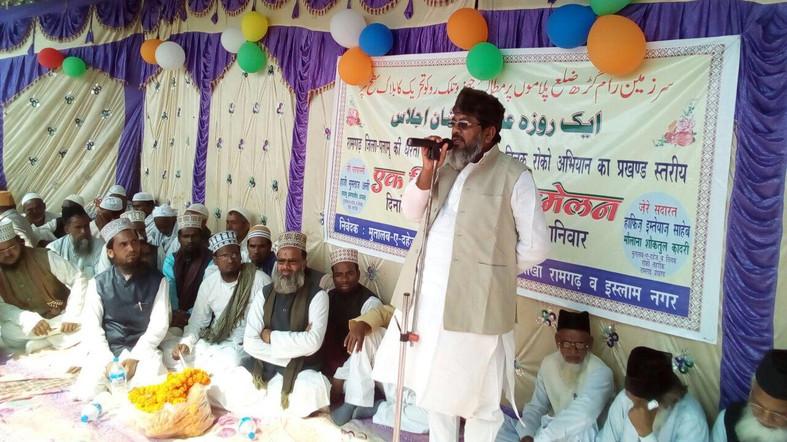
Haji Mumtaz Ali addressing anti-dowry campaign in India’s Jharkhand state. (Supplied)
A man in India has launched a massive campaign against dowry, one of the biggest social evils claiming hundreds of lives every year in the country. Such is the impact of the campaign that close to 1,000 Muslim families have now returned dowry to the bride families, expressing regret over their conduct in public and vowing not to repeat it in future.
The credit to this unique campaign straightway goes to Haji Mumtaz Ali who has launched the campaign in the eastern Indian state of Jharkhand. The success of the campaign is underlined from the fact that villages after villages are joining it every day, openly taking an oath not to accept dowry in future.
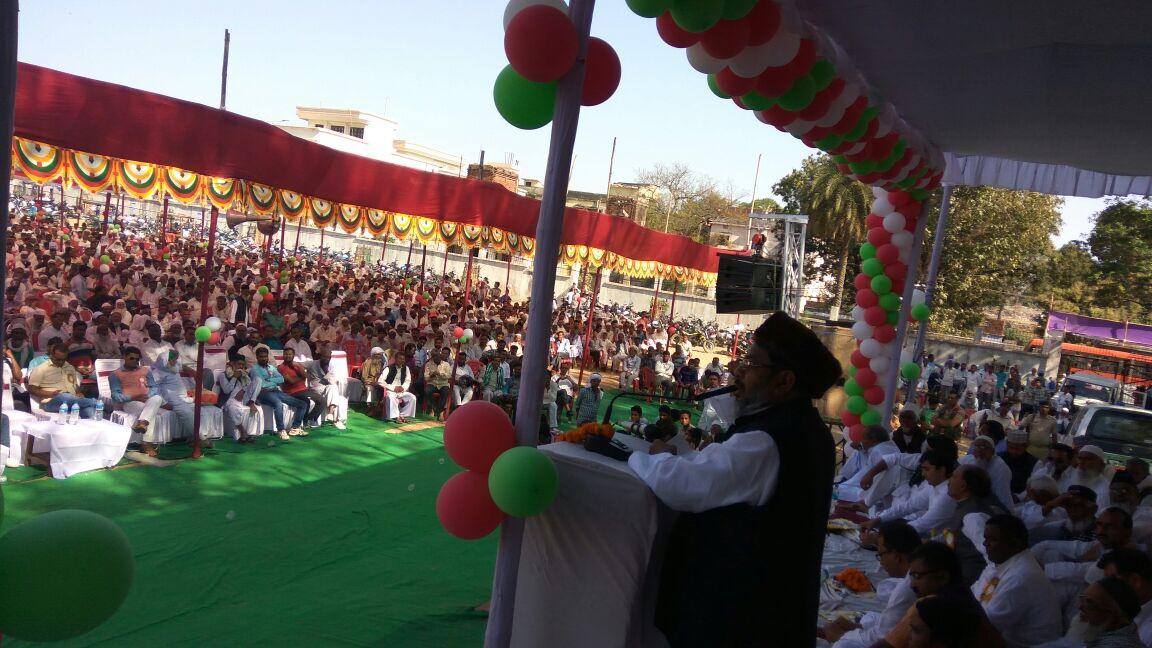
Initially, the campaign was started in Palamu district but now it has gone beyond its boundary and spread to several others districts as well. But what’s further fascinating about it is that the campaign is not limited to any particular community only as the Hindus too have lent a wholehearted support to this campaign, joining the anti-dowry rallies in large numbers.
“I am happy to inform you that what started as a silent campaign against this social evil two years back has now turned out to be the mass movement. Now it’s not limited to any particular area or the community only but Hindus too are joining us in large numbers,” said Ali who happens to be the brainchild of the campaign.
The peak of the campaign was when the Muslim villagers began returning dowries years after they had taken them at the time of their son’s wedding. (Supplied)
Rs 60 million returned
The peak of the campaign was when the Muslim villagers began returning dowries years after they had taken them at the time of their son’s wedding. According to Ali, close to 1,000 Muslim families have returned dowries worth Rs 60 million to the brides’ families so far, impressed by his appeals to give up dowry.
One of them was Nizamuddin Ansari who returned Rs 40,000 to the bride families. “I regret about taking dowry from my daughter-in-law’s families but feel proud to return it now,” Ansari told an anti-dowry meeting held in Palamu recently.
However, the campaign didn’t reach at this level all of a sudden. Ali had to work hard, day and nights for months during which he held more than 100 such meetings and rallies in entire Palamu division to convince his community members not to take dowry, braving sweltering heat and chilling winter.
But what compelled him to launch the campaign? “I saw many families getting destroyed under the impact of dowry although it was not initially prevalent in Muslim families. I came across many poor families selling their ancestral properties or taking loans on high interest to arrange money to solemnize wedding of their daughters”.
“What was terrible this money was being wasted on arranging decoration, DJ, orchestra and various types of dishes; it was not being used for important works! So I decided to launch a campaign in the society, sooner the better,” Ali said, in a telephonic interview on Thursday.
“I was aware of the economic status of my co-villagers. I knew their financial background just wouldn’t permit them for lavish wedding. They were doing so just because they had taken dowry from the brides’ families. So it was necessary to alert them,” he said.
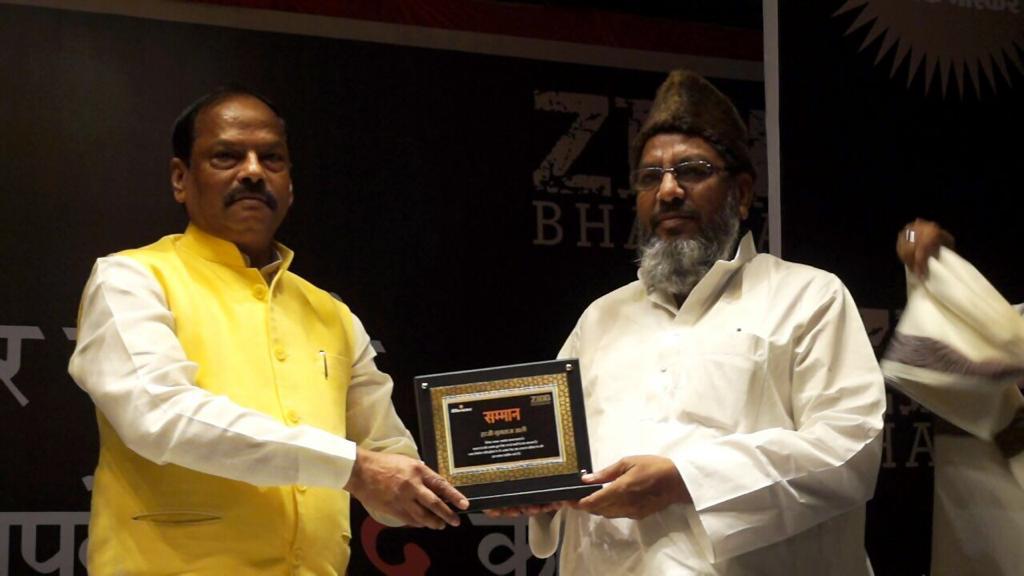
Haji Mumtaz Ali being honoured by Jharkahnd Chief Minister Raghubar Das. (Supplied)
Crowds of villagers
Eventually, Ali launched the campaign in April 2016 but got encouraged to focus on it after seeing huge crowds of villagers attending his each rally and meeting.
“I told the Muslim villagers to fear from the almighty and swear in the name of Allah not to take dowry in future and this ultimately clicked,” Ali revealed, describing his campaign as a “huge success”. Recently, Ali was honored by Jharkhand chief minister Raghubar Das for his campaign against dowry.
Ali is happy to tell that villagers are now opting for “dowry-less” marriages. “Now, the general masses have taken over my campaign. This indicates the success of my campaign, Ali remarked, with his voice exhibiting satisfaction and delight.
Dowry has been claimed hundreds of lives every year in India. As per an official report, a total of 24,771 dowry deaths were reported in India in between 2012 and 2014 with Uttar Pradesh taking the lead with a maximum of 7,048 deaths. This information was given to the Lok Sabha in a written reply by federal minister for Women and Child Development Ministry Maneka Gandhi in April 2016.
The minister further told the House that India recorded 348,000 cases of cruelty by husband or his relatives during this period with the West Bengal topping the chart with 61,259 such cases, followed by Rajasthan (44,3111) and Andhra Pradesh (34,835), as per the National Crime Records Bureau data.
source: http://www.english.alarabiya.net / Al Arabiya – English / Home> Features / by Manoj Chaurasian / Special To Al Arabiya English / November 08th, 2018
Firhard Hakim, a state minister, is all set to take up the additional role.
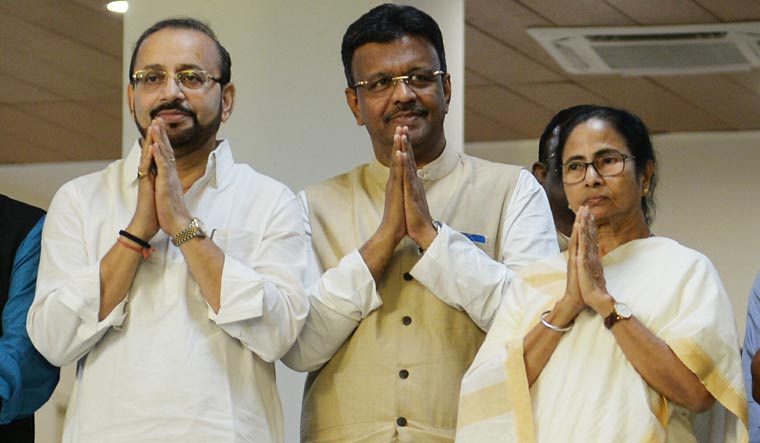
Firhard Hakim and Atin Ghosh along with West Bengal Chief Minister Mamata Banerjee | Salil Bera
For the first time since independence, a Muslim face is all set to become the mayor of Kolkata. Firhard Hakim, the municipal affairs and urban development minister of West Bengal, is all set to take up the additional role of the mayor of the 94-years-old corporation. Chief Minister Mamata Banerjee has also decided to change the deputy mayor by replacing incumbent Iqbal Ahmad with Atin Ghosh, a Member Mayor-in-Council (MMiC).
It was a role reversal in Kolkata corporation as Banerjee had earlier chosen a Hindu mayor and a Muslim deputy mayor. Syed Muhammad Usman, a Bengal Praja Party member, was the last Muslim mayor of Kolkata in undivided Bengal which had comprised of West Bengal and East Bengal (now Bangladesh). The party was formed by A.K. Fazlul Huqe, who later became the home minister of Pakistan and then the governor of East Pakistan (now Bangladesh)
Hakim is known to be very close to Banerjee and her nephew Abhishek.
A meeting of the corporation councilors was called on Wednesday evening to get Hakim elected. Interestingly, Sovan Chatterjee, who resigned as mayor earlier in the day, has not been invited despite being a councilor.
Chatterjee was very careful while addressing the media shortly after sending his resignation to the corporation chairperson through his personal security staffers. He did not lash out at Banerjee, but hinted at many things
Terming his association with Banerjee for last 40 years as an emotional one, Chatterjee said, “That full moon looks like a burnt chapati today.”
When asked about his future plan of action in politics, Chatterjee said that he continues to be a member and MLA of Trinamool Congress.
“But I would have no hesitation if Mamata di asked me to resign from both,” said he. Replying to a question on whether he would be joining the Bharatiya Janata Party, as such speculation is in the air, Chatterjee said he would not respond to every other rumour.
“You would come to know what would be my future course of action at an appropriate moment,” he said.
Differences between Banerjee and Chatterjee were evident from the words of the latter, who said that instead of resigning on his own, “an instruction was sent to me to resign from the state cabinet”.
“For the last 40 years, whatever she asked me to do, I did all of them even without applying my mind. I am such a follower of her,” Chatterjee said.
After Mukul Roy, he is the second political heavyweight in Trinamool Congress who has distanced himself from Banerjee.
Chatterjee also denied reports that his relation with a college teacher was the reason behind his resignation from the ministry and as the mayor.
“In fact, I am totally in the dark on what the reason was,” said he.
Sources, however, said that Chatterjee would not jump off the TMC boat immediately. He will wait and watch before finalising the future course of action.
source: http://www.theweek.in / The Week / Home> News / by Rabi Banerjee / November 22nd, 2018
The structure lies in neglect | Photo Credit: Serish Nanisetti
Forgotten and vandalised tombs show the sorry state of heritage
The tip came last week. “There are these maqbaras in Balapur. One of them is double-storied, like that of Jamsheed Quli Qutb Shah. They must belong to someone important. We could climb up and the decoration is largely intact,” said P N Praveen, who teaches architecture. He sent a location map. A satellite map showed a square open area with two round structures.
The location turned out to be beyond the Barkas area in Old City. Beyond the shanty town of Rohingya refugee camps is the open area where the two domes pierce the sky. If shouts and laughter echo from one side where children gather to play cricket, on another side a Greater HyderabadMunicipal Corporation vehicle comes to dump garbage from the surrounding areas. “I make four or five trips per day,” says the driver of the garbage tipper. When the garbage reaches a certain height, he sets the heap alight. The fire and smoke envelop the area.
The two domes are raised on a square platform. The small, low and squat, more ornate dome would easily fit into the landscape of the Qutb Shahi tombs complex at the foothills of Golconda Fort. The other one appears to be double-storied, but with something amiss with the symmetry. “It lacks a defined parapet with battlements,” says Prashant Banerjee, a conservation architect after seeing a photograph.
“These tombs belong to the Qutb Shahi era. Two Sufi saints Bhole Shah and Bhale Shah are buried here. Over time people have vandalised and removed all signs of the graves but they are buried inside the tombs,” said Muhammad Shareef, who is secretary of the Roushan Ud Dowla Masjid, that abuts the tombs. A sign painted in Telugu speaks about the property being under the care of the Waqf Board. How these two tombs slipped out of the net of the memory of the city is anybody’s guess. The tombs are from a layer of history which hasn’t got much attention from historians.
Golconda/Hyderabad has been attacked multiple times. After Aurangzeb’s final conquest, he oversaw its sack by staying put near the eastern side of Charminar. All the glorious palaces draped with glazed enamel tiles with seven colours were pulled down in the hunt for the fabled treasure.
One of the Qutb Shahi palaces was a seven-storied one which was a marvel for even a well-heeled traveller like Jean Baptiste Tavernier. Now, nothing of that era remains, save the four ceremonial arches, the Charminar and the fountain in the royal piazza. Later, Hyderabad was subjected to a series of raids by the Marathas. The sacking, the raids, the unsettled conditions meant that the once grand city and its surrounding areas slipped into a state where people were only bothered about saving their life and limb. Not surprisingly, religious and spiritual monuments survived intact and in some cases emerged grander and more powerful. But how these two tombs in Balapur, despite being associated with Sufi Saints, slipped into disuse and became a den for vagabonds remains a mystery.
source: http://www.thehindu.com / The Hindu / Home> News> Cities> Hyderabad> Living Hyderabad / by Serish Nanisetti / November 17th, 2018
Working in tandem with Savitribai Phule, Fatima had to not only take on high caste Hindus but also faced fierce opposition from orthodox Muslims who opposed the idea of equal education for all.
Are you in favour of education for girls? To even ask this question in today’s socio-political milieu seems ridiculous, considering that this is not only enshrined in our Constitution but supported by mainstream public discourse.
There are numerous government programmes and schemes dedicated to the education of the girl child, irrespective of class, caste or religion. Admittedly, there are parts of this country where this idea and subsequent socio-economic progress is actively discouraged. However, more than 150 years ago, it wasn’t even a part of the mainstream socio-political discourse, and in fact, those pushing for it were met with intense hostility and social boycott.
Those with even a cursory knowledge of the history behind education in India will have heard of Savitribai Phule, who valiantly fought against the oppressive hierarchies of caste and gender to challenge untouchability and educate girls, among other critical social interventions.
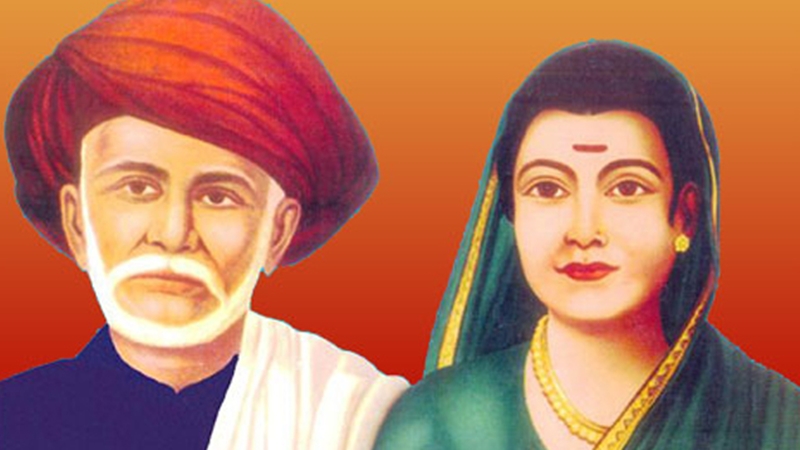
Along with her husband Jyotirao Phule, they fought against caste discrimination, the scourge of untouchability and worked towards the emancipation of women and reform of Hindu family life in present-day Maharashtra during the 19th century. They were among India’s first major social reformers.
Jyotiba and Savitribai Phule (Source: Free Press Journal)
But how many people know about the Muslim woman who made Savitribai’s bid for girl education possible? Not many, one would argue, and that isn’t their fault considering little is known about her life history.
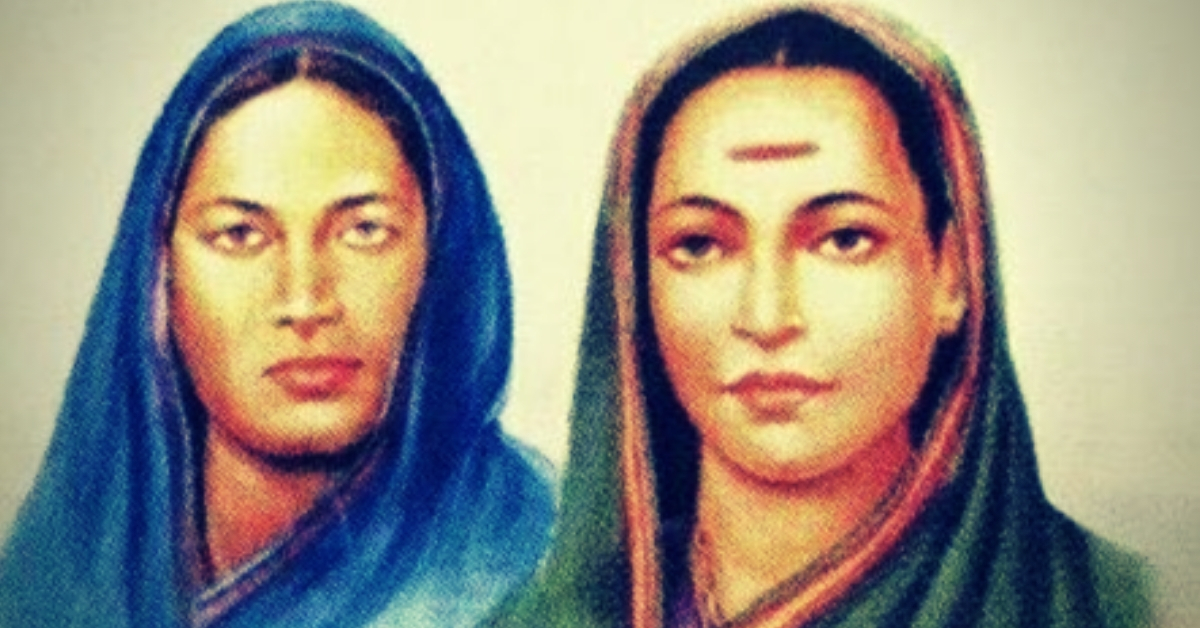
What we do know is her name was Fatima Sheikh, and she is widely recognised as the first woman Muslim teacher in India, who also worked with Savitribai to establish the first school for girls at her own house, alongside her brother Usman Sheikh in 1848.
The story begins with the Phule couple attempting to educate members of the lower caste communities, particularly their women, at their home in Pune.
Considering that education at the time was the preserve of only upper caste men, the very thought of educating women and lower castes was anathema, and the Phule couple were given the choice of either stopping work or leaving their home. They chose the latter but were offered refuge by Fatima and Usman at their home in the Ganj Peth area of Pune (then referred to as Poona).
At a time when everyone including their own kin abandoned these social reformers, Fatima and Usman not only gave them an opportunity to rekindle their ambition to uplift those on the margins but also sheltered them. At the Sheikh household, Fatima helped Savitribai to set up the first school for girls in Pune called the ‘Indigenous Library.’
According to archives from the era, it was Usman (inspired by the Phules) who encouraged his sister to not just educate herself but also spread its gospel to all members of society.
Fatima Sheikh (left) and Savitribai Phule. (Source: Twitter/Tanvir Salim)
Not only was Fatima risking the wrath of caste Hindus, but also orthodox Muslims, as both groups at the time were deeply opposed to the idea of equal access to education. Nonetheless, this didn’t deter Fatima, who not only undertook training alongside Savitribai but also soon after began teaching others.
“Defying all norms, Fatima and Savitribai set up the school and even went to a training institute, to become professional teachers,” says this account from Feminism in India. They were soon joined by social reformer Saguna Bai, who helped Savitribai open another school and would subsequently go onto chart her own education movement for the marginalised.
Through her time with Savitribai, Fatima had taught in all the five schools that the social reformer couple had opened, and continued to do so until 1856 when Savitribai was afflicted by illness and was compelled to move back to her mother’s house. We don’t know much about her life post-1856.
“When Fatima and Savitribai started going to schools which were established by Jyotiba, people from upper caste community used to harass and abuse them. They were stone pelted and sometimes cow dung was thrown at them as it was unimaginable for the upper-caste community to see lower castes of the society getting educated. Fatima Sheikh and Savitribai didn’t pay attention to these hindrances and continued their work,” writes Siddhant Mohan, editor of Two Circles. Aside from such hostility, there are even reports that some had attempted to take their lives.
Despite the challenges before Fatima, she maintained her pursuit of approaching every household in her neighbourhood and community, asking families and encouraging them to give their girls a shot at a decent education, irrespective of faith.
Having said that, there isn’t too much historical or archival material to ascertain what happened to Fatima after 1856, and even the question of when she was born remains up for debate although her birth anniversary is celebrated across social media forums on January 9. With no real male figure in Fatima’s life aside from her brother, there are indications that she went against the norm of marriage and subsequent patriarchy and orthodoxy she would have to endure. Nonetheless, her work with Savitribai isn’t disputed, and one can only imagine the kind of resistance she faced.
Last April, members of the depressed classes celebrated Dalit History month, and on that occasion an internet archive Dalit History said:
“The friendship between Fatima and Savitri was one of respect, compassion and synergy. Throughout their time together, Savitri would often mention her in her letters to Jyotirao with affection and concern. Their friendship lives today in the form of the work they have done in creating both foundation will and actual structures for the upliftment of the marginalised.”
Today, every educated Indian woman owes a debt of gratitude to Savitribai Phule and Fatima Sheikh.
Fortunately, there have been attempts to recognise her work and contribution. Aside from her association with the Phules, the Maharashtra State Bureau of Textbook Production and Curriculum Research took cognisance of her contribution in their textbooks in 2014.
Fatima Sheikh played a crucial role in ensuring that children, irrespective of gender, caste or religion, had access to education, and the results are there for everyone to see.
(Edited by Gayatri Mishra)
source: http://www.thebetterindia.com / The Better India / Home> Education> History> Women / by Rinchen Norbuwangchuk / September 19th, 2018