Category Archives: Community Involvement / Social Issues

Man Breaks Ramadan Fast To Save 8-Year-Old Thalassemic Child

Gopalgang District , BIHAR :

The boy was rushed to the emergency of Sadar hospital by his father. The patient complained of uneasiness and weakness, and required immediate blood transfusion.

Patna :

A Muslim man in Bihar chose humanity over religious customs, broke his Ramadan fast to donate blood to an eight-year-old Hindu thalassemic boy and saved his life. Jawed Alam on Tuesday donated blood to Rajesh Kumar in Gopalganj district, a district health official said.

The boy was rushed to the emergency of Sadar hospital by his father. The patient complained of uneasiness and weakness, and required immediate blood transfusion.

There was no blood matching Rajesh’s blood group available in the blood bank. They said it would take at least two-to-three days to arrange it.

The boy’s condition deteriorated quickly. His father had travelled some 200 km from the Kuchaikote area and was fast losing hope as he waited in the corridors of the blood bank.

It was then that a hospital sweeper and cleaner, informed Anwar Hussain, a member of District Blood Donor Team (DBDT) about the child.

Mr Hussain requested his friend Jawed Alam, an active member of DBDT to rush to Sadar hospital.

“When my friend Anwar requested me to donate blood to a seriously ill thalassemia patient, I politely informed him that I was observing Ramzan fast.

“But he convinced me to arrive and consulted doctors. At first even the doctors refused my offer as I was fasting,” Mr Jawed said.

“They agreed only after I took their advise, broke my fast and consumed fruit juice and some solids,” the young Muslim man in his 30s said.

He said: “My religion teaches me to help a fellow human first, so I broke my fast and donated blood to save little Rajesh. Islam preaches that humanity is bigger than everything.”

Thalassemia is a blood disorder and a thalassemic patient needs blood transfusion after every three-to-four weeks.

source: http://www.ndtv.com / NDTV / Home> Sections> All India / by Indo-Asian News Service / May 23rd, 2018

The Calligrapher’s Den

Amritsar, PUNJAB :SaraiAmanatKhanMPOs24may2018

His was the hand behind the Arabic inscriptions on the Taj Mahal, which have captivated tourists from across the world.

But today, the mausoleum and the dwelling of Amanat Khan, the calligrapher of the Taj Mahal, lies in decay, neglect and encroachment.

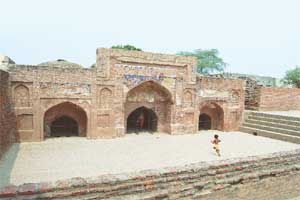
Sarai Amanat Khan, about 29 kilometres south-east of Amritsar on Tarn Taran Attari road, was built by Khan in 1640, where he lived a reclusive life following the death of his elder brother Afzal Khan, the prime minister of Shah Jahan.

But here too, Khan, who came to India from Iran in 1609 and whose real name was Abdul Haq before being conferred the title of “Amanat Khan” by Shah Jahan for his impressive calligraphy, has left the imprint of his craft — the sarai has beautiful Islamic calligraphy inscribed on its fading blue and yellow tiles.

Sarai Amanat Khan was also a guest house, where travellers on the Lahore-Agra route on the Grand Trunk Road would stop for rest in the middle of a long strenuous journey. They would live in the small rooms inside the sarai, and pray in the adjacent mosque and large courtyard.

Today, Sarai Amanat Khan is dilapidated — the Nanakshahi bricks are falling off, and the eastern gate is in disarray; some 800 feet below it is Khan’s ruined tomb.

The sarai is in the middle of a densely populated village, also named after Amanat Khan.

With several shops in its immediate vicinity, the Archaeological Survey of India-protected monument is a site of rampant encroachment. Several families live inside the rooms of the sarai illegally, and claim to have been doing so since Partition. “I was born here,” says 50-year-old Ranjit Singh. “People have been living here since 1947. There had been talks about giving us alternative land and compensation, but those have not materialised,” he adds.

source: http://www.archive.indianexpress.com / The Indian Express / Home> Archive / by Navjeevan Gopal, New Delhi / July 29th, 2012

Subedar Abdul Sattar attains martyrdom in the holy month of Ramzan

Mawa Village, Nagaur District, RAJASTHAN :

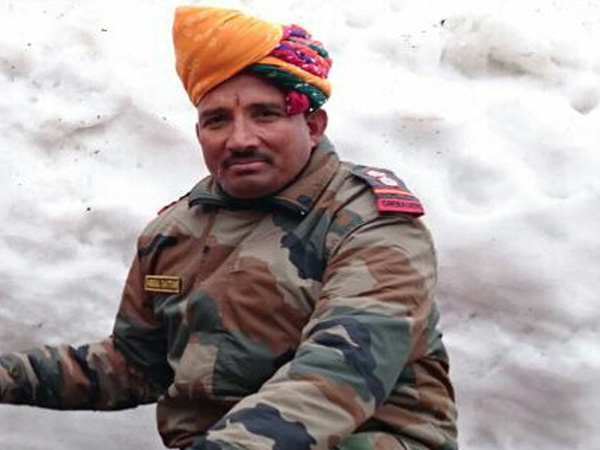
Subedar Abdul Sattar

Srinagar (Jammu and Kashmir) [India]

A Subedar in the Indian Army took his last breath on Sunday, attaining martyrdom during the holy month of Ramzan, after he had sustained burn injuries to around 50 percent of his body while trying to prevent a weapons cache from getting razed by a fire in Jammu and Kashmir’s Gurez.
Subedar Abdul Sattar belonged to 13th Batallion of the Grenadier Regiment.
On May 12 the fire started in the camp of the unit where Sattar, was posted. Within minutes, the whole store of the unit was engulfed in fire, and once he saw it, there was no second choice but to fight.
He plunged into the inferno and managed to pull out the ammunition and weapons, but in the process sustained burn injuries, and was immediately rushed for medical treatment.
Major General Dilawar Singh (Retd), while speaking to ANI said that the training and ethos of the Armed Forces motivates a soldier to accomplish extraordinary feats and to rise above the boundaries of religion and caste.
“A soldier serves the country and the tricolour. Brave hearts like Subedar Sattar is the glowing example of how a soldier can do extraordinary when the testing times come and they can sacrifice even their lives,” he said.
The injured soldier was later taken by a helicopter to Srinagar, where he was admitted to the Army Hospital (Research & Referral). He fought for his life for eight days and passed away on May 20.
The soldier hailed from the village Mawa near Didwana in Nagaur District of Rajasthan. His mortal remains were taken to his village for burial with state honour. A total of 5000 people, including villagers and Army officials congregated to pay their homage to the martyr.
Minister Yunus Khan and MLA Thakur Manwar Singh of Ladnun attended the funeral. The soldiers from the nearby areas were also present to pay their tribute.
More than 300 serving and ex-servicemen of the Grenadiers attended the last rights.
Chief Minister Vasundhara Raje spoke with the father of the soldier.
The commanding officer of the unit, Colonel Ghosh said, “The loss of Subedar Abdul Sattar is irreparable. His memory will always be etched in our hearts. I wish to assure all elders and fellow officers that from here on, his family is the battalion’s responsibility and we shall look after them for the rest of their lives.”
He is survived by his wife Muni Banu, five daughters and one son. Sub Abdul Sattar’s youngest child, son Danish (six-year-old) laid the wreath. It is widely believed in Islam that death during the holy month of Ramzan is doubly blessed, Subedar Sattar will, no doubt, rest in peace. (ANI)

source: http://www.aninews.in / ANI / Home> News> India / May 24th, 2018

‘Urdu’s Space In Kalina Not Byculla’

Mumbai, MAHARASHTRA :

In 2014, the Congress-led government had sanctioned Rs 10 crore for the construction of an Urdu Bhavan at Mumbai University’s Kalina campus to promote the language

The state govt’s proposal to set up a centre for the language outside of the university, where it even has an allocated space, has language lovers crying foul

In 2014, the Congress-led government had sanctioned Rs 10 crore for the construction of an Urdu Bhavan at Mumbai University’s Kalina campus to promote the language. Land was allocated and bhoomi poojan was performed. However, the project never saw the light of day.

Cut to present: The state government has proposed building the Urdu Bhavan in Byculla,. “The bhavan will come up on a 10,000 sqft area near the Agripada police station. And, if we get a larger FSI, we will be able to construct a four-storeyed structure with state-of-the-art facilities. We have asked the Centre to provide us with R50 crore for this,” says advocate Waris Pathan, All India Majlis-e-Ittehadul Muslimeen (AIMIM) legislator from Byculla, who has been at the forefront of getting approvals for this project. As per the proposal, the bhavan will have a library, convention centre, a girls’ hostel and will offer a range of new courses. “The Urdu readership in Byculla is high so it will see a lot of traction,” says Pathan

‘It’s not a Muslim language’
Yet, the news of the bhavan coming up at Byculla has lovers of the language divided. Members of Jai Ho Foundation, a charity organisation in Kurla, have written a letter to the Union Minority Affairs minister Mukhtar Abbas Naqvi, CM Devendra Fadnavis, Governor C Vidyasagar Rao, education minister Vinod Tawde and MU VC Suhas Pednekar, requesting them to reconsider the location. “We want the centre to be built inside the varsity because that will make it more accessible to students. By constructing it in a Byculla bylane, they are propagating the misguided notion that it’s a Muslim language,” says Jai Ho’s president Afroz Malik. Presently, the MU has a bhasha (language) bhavan dedicated to Marathi and Sanskrit.

There have been talks about building a Hindi bhasha bhavan as well. Malik says Kalina is a strategic location which makes it convenient for people commuting from both the suburbs as well as from South Mumbai. Moreover, setting it up in a healthy academic atmosphere will only help promote the language, he adds. “MU has people enrolling from all walks of life. It also has students from overseas. Urdu will get more exposure,” he states.

A matter of space
Meanwhile, the land allocated to the Urdu Bhavan at Kalina remains vacant. This is in stark contrast to the buzzing Urdu department, which has seen a sharp growth in the number of students as well as non-teaching staff. “The increasing curiosity around the language has translated into more people signing up for courses. The MA course sees more enrolments,” Dr Sahab Ali, head of Urdu department, says. Presently, the department has an overall strength of 200 students. While Dr Ali is happy to learn of a bhavan coming up in Byculla, he says it’s not enough. “I would want the centre to be built here because we are running out of space to accommodate students,” he says. The Urdu department at MU was established in 1982.

In 2013, Dr Ali had written to the Department of Minorities Affairs requesting the need for a bhasha bhavan to cater to the growing needs of the language. The request received the green light in 2014. The change in ruling parties resulted in the project languishing for years.

Farid Khan, convenor of Urdu Caravan, an NGO that promotes Urdu language and culture, says he sees merit in NGO Jai Ho’s stand. “I believe a language will thrive in an academic setting.”

source: http://www.mid-day.com / mid-day.com / Home> News> National News / by Anju Maskeri / May13th, 2018

Alumni association formed at Jamal Mohamed college

Trichy, TAMIL NADU :

A.K.Hussain of Ahamad Brothers of Tiruchy was unanimously elected as president.

Tiruchy:

Former students of Jamal Mohamed college (JMC) of Tiruchy formed an alumni association recently for which A.K.Hussain of Ahamad Brothers of Tiruchy was unanimously elected as president. In a release at Tiruchy on Tuesday, Hussain said while Abdul Aleem, founder of the Ant-Dowry Association of Koothanallur was elected as secretary, Riyaz of Tiruchy was elected as treasurer.

Basheer Ahamed and Dr. Gobinath of Tiruchy were elected as vice-presidents and Mohammed Ismail and Dhanraj of Tiruchy as joint secretaries. In addition to this, a seven member executive committee has been formed with auditor Murugan, Nazeer Ali, Padmanabhan, Senthilkumar, advocate Madhani, Akbar Ali and B.G. Naidu Balaji, he added.

Hussain said that old students working and settled abroad had already formed and were running the JMC alumni associations in various countries including at Malaysia, Singapore, Kuwait,Saudi Arabia and Chennai in TN and giving scholarships to poor students of JMC. They were also helping to improve infrastructure and construct new buildings for the college. The newly formed Tiruchy based alumni associati-on of the JMC also will follow the footprints of the existing alumni associations, he added. Secretary of the JMC Dr. Khaja Najummudeen, assistant secretary Jamal Mohamad Sahib and others greeted office bearers of the newly formed alumni association.

source: http://www.deccanchronicle.com / Deccan Chronicle / Home> Nation> In Other News / Deccan Chronicle / July 15th, 2015

IAS officers bag excellence award

Hyderabad, TELANGANA :

Several civil servants and other officers have been selected for the Telangana Excellence Awards-2018 for excellence in public administration, innovation, instituting flagship programmes, land records updation, IT initiatives in governance, solid waste management etc. in individual capacity or for working in groups.

They include Commercial Taxes Commissioner V. Anil Kumar and Principal Resident Commissioner of Telangana Bhavan at New Delhi G. Asok Kumar, Nalgonda Collector Gaurav Uppal, Buddhaprakash Jyothi, Adilabad Collector D. Divya and Adilabad DMHO Rajeev Raj, GHMC Commissioner B. Janardhan Reddy, Mancherial Collector R.V. Karnan and HMWSSB MD M. Dana Kishore, Suryapet Collector K. Surendra Mohan, Karimnagar Collector Sarfaraz Ahmed, DMHO Rajesham and Mohammed Aleem, Commissioner of Health and Family Welfare Karuna Vakati, Jagtial Collector A. Sharath, RDO Ganta Narender and Medipally Tahsildar N. Venkatesh and Peddapalli Collector Alagu Varshini, Asifabad Collector Prashanth J. Patil, Sircilla Collector D. Krishna Bhaskar.

source: http://www.thehindu.com / The Hindu / Home> News> States> Telangana / by Special Correspondent / Hyderabad – May 19th, 2018

Soldier Rafi laid to rest

Chandole Village, Guntur, ANDHRA PRADESH :

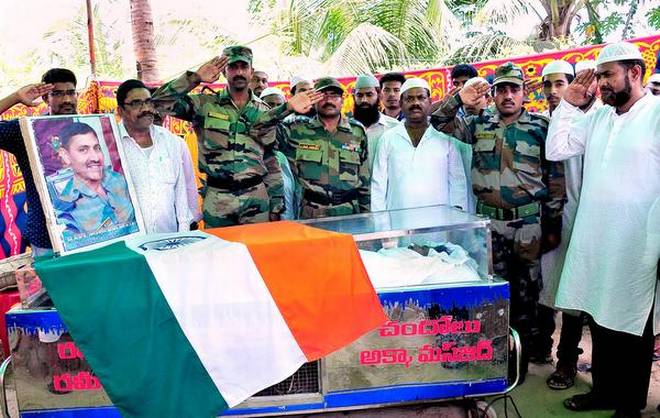
Military honours: Army personnel paying last respects to Havildar Rafi Mohammad at Chandole . | Photo Credit: T_VIJAYA_KUMAR

He died in a landslip in Kargil-Leh sector on May 15

A pall of gloom descended on the village on Friday as the mortal remains of Havildar Rafi Mohammad, EME corps, were laid to rest with full military honours.

Army personnel, NCC commanding officer G.M Rao, revenue divisional officer, Tenali, Mandal Revenue Officer and MLC Annam Satish Prabhakar, Bapatla, visited the house and offered their condolences.

Rafi, who got married five years ago, was supposed to come to his native village in the first week of June for a month to stay during Ramzan.

But, he died in a landslip that hit Kargil-Leh sector on May 15; he was in a recovery vehicle that got caught in the landslide and plunged into a gorge tumbling into a depth of 3,000 feet.

Rafi’s body was found the same evening while the body of another soldier is yet to be traced.

The youngest of five brothers, Rafi had a passion to serve in the Army following in the footsteps of his elder brother Md. Arif. Soon after completing his Intermediate, Rafi was selected as a sepoy and within five years, rose up in the ranks to become Havildar. Rafi used to help educate children from economically backward families.

source: http://www.thehindu.com / The Hindu / Home> News> States> Andhra Pradesh / by P. Samuel Jonathan / Chandole – May 19th, 2018

Why China is eyeing an Indian mechanic’s car that runs on water

MADHYA PRADESH :

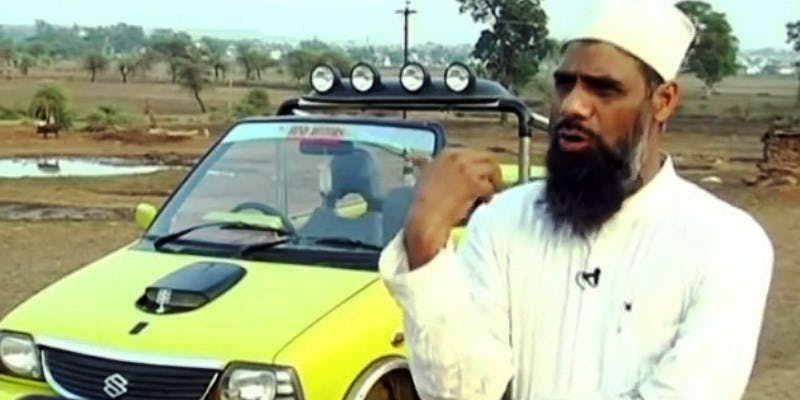
44-year-old car mechanic Mohammad Raees Markani from Madhya Pradesh has invented a car that runs on water.

This 12th pass took five years to develop the final product. The car runs on acetylene gas, which is formed from a chemical reaction between calcium carbide and water. Raees now has a patent for his water car. According to Mirror, Raees has been modifying an 800 cc engine for the last five years – and now believes he has made the scientific breakthrough. The eco-friendly car uses a mix of water and carbides.

Raees who has been a mechanic for the last 15 years told Mirror, “The gas is used for several industrial purposes including welding and portable lighting for miners. But in my case, I am using it to propel the car engines . I have made other changes to the engines, which helps the overall performance of the car. So basically, it is just about the water.”

“The market for environmentally friendly cars is getting bigger and automobile companies around the world are looking for eco-friendly ways to reduce pollution. So a car like mine can be a good alternative. It costs close to nothing to operate and it is environment friendly,” added Raees.

Image : Pultan
Image : Pultan

The Chinese automobile companies have invited Raees to develop the idea further. All the companies that are interested in Raees’s water car project will have to meet his one condition – any plant to make new cars will be established only in his hometown in Madhya Pradesh. “I want things to change in my hometown. So this is where my work should continue,” Raees stated.

Also, watch the video on Raees by History.

source: http://www.yourstory.com / YourStory / Home> Think Change India / April 11th, 2016

Three lions and Tipu’s Tiger

KARNATAKA / London, UNITED KINGDOM  :

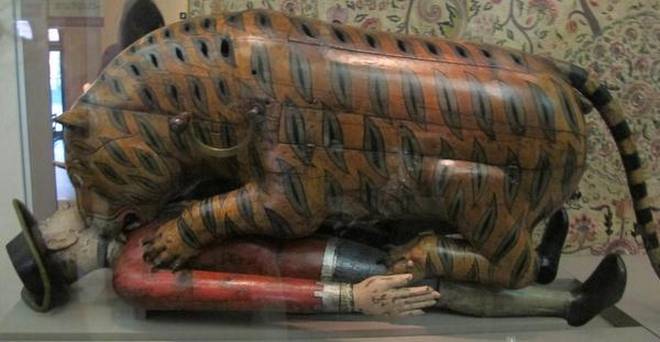
Could the Tiger’s position — now behind a glass case, its crank handle inaccessible to the public — be an apology for the disrespect permitted in East India House?

The artefact sitting in V&A was iconic, identifiable and far away from home

The day I saw Tipu’s Tiger behind its glass case at the Victoria and Albert Museum in London was a day of significance. That morning, after months of being cooped up in Oxford, some friends and I took the train to Marylebone and found the absence of dreaming spires refreshing to say the least. At noon, a friend from India was waiting for me on the other side of the busy Camden High Street. As we hugged amidst the crush of gliding Londoners, her muffled exclamation might have been: ‘It’s so crazy we’re meeting here of all places, so far from home.’

That phrase would be borrowed by me on two separate occasions during the day. In the evening, I stood before Julian Barnes at the Royal Institution and told him how I had read ‘A Short History of Hairdressing’ over and over again to teach myself the ‘architecture’ of a short story. I felt a potent urge then to parrot my friend. It was ‘crazy’ to see and hear Barnes in the flesh, so far from my bedroom in Kolkata, the only other place he had seemed real and, dare I say, attainable through his prose and through the material object, that is, his books in my hands, the only feasible rendezvous with the man.

I had never thought then it would happen: to have someone I studied so minutely sit before me and confess he didn’t think as highly of his short prose as I did.

Iconic meeting

The second occasion I was inclined to echo her words that day was when I stood in the South Asia section of the V&A before Tipu’s Tiger, which had always been relegated to the Did You Know section of our history books. It was not exactly like meeting an old friend or a revered author, but it bore all the characteristics of such a meeting. Like Barnes and my Kolkata friend, it was instantly iconic, identifiable from a distance, and a ready reminder of my distance from India. In fact, standing before the wooden automaton, slightly disconcerted, I addressed it and thought: ‘You are so far away from home.’

The possible inspiration for the mechanical figure seems fitting to some. Hector Munro Jr, whose father defeated Tipu’s father Hyder Ali in the Second Anglo-Mysore War in 1781, was mauled by a royal Bengal tiger at Saugor Island in 1792 and died from the injuries. This must have seemed like divine intervention to Tipu, a wrong set right. The carved and painted, almost life-size, wooden musical automaton was created for the Sultan, whose personal emblem was a tiger and whose hatred of the British was well-known.

The last laugh

With the fall, however, of Seringapatam and the execution of Tipu in the Fourth Mysore War of 1799, the Tiger travelled from the music room of Tipu’s summer palace to the Company’s East India House at Leadenhall Street in London, where the public was given access to view and play with it.

Its wooden body with a keyboard embedded in the flank was thrown open to the English masses who came in and played ‘God Save the King’ and ‘Rule, Brittania!’ upon it. If Tipu thought he had been mocking the Englishmen with the Tiger, they were now having the last laugh.

I deal with issues of empire and post-colonial anxiety almost on a daily basis, especially in a place like Oxford, especially on a course called World Literatures in English. Of course, when I first saw it, I silently demanded a restoration of the tiger to its previous owner, to its previous nation. My anger at seeing the Tiger in an English museum, so far away from home, was justifiable. The Tiger was not borrowed. Nor was it touring, as it had to New York’s MoMA in the 50s. Instead, it was a ‘permanent’ acquisition at the V&A.

Of collaborations

For every Indian schoolchild, the Tiger, just an artefact but nonetheless awe-inspiring, was not an affordable train or flight away, like Fatehpur Sikri or Sher Shah’s tomb.

For me, the Tiger’s distance from my home was a reiteration of the national and racial distinctions not only of the Anglo-Mysore variety, but also of the Jadavpur-Oxford type that I faced every day. Besides dodging questions like ‘If you’re from India, how’s your English so good?’ for the past few months, I had had to clarify to a white friend who subsisted on the chic-ideal of Zadie Smith that India has Bengalis too, and no, I did not have relatives in Brick Lane, not that I knew of anyway.

Seeing Tipu’s Tiger that day catalysed a recollection of an afternoon in 2016 in the Victoria Memorial Hall with Thomas Daniell and his nephew William. Their tranquil scenes of India, while in stark contrast to the ferocity of the Tiger, do something interesting.

The English hands of the Daniells reproduce the Indian hands of the architects behind the buildings and locations they sketch. Their canvas becomes a surface of Anglo-Indian collaboration, similar to how it is conjectured that the mechanics of the Tiger have an Indo-French history.

This recollection, and the subsequent contemplation on collaboration, made me think of several works of restoration that the V&A carried out upon the Tiger, especially after the bombing of London in World War II. Could this act of restoration be seen as an act of reparation? Could the Tiger’s position — now behind a glass case, its crank handle inaccessible to the public — be an apology for the disrespect permitted in East India House?

The Tiger, so far from home, is an icon that reminds me of a past based on plunder and pillage by the nation it sits in. Yet, its 18th century splendour has weathered war and wear so well. Do present acts of safekeeping obliterate the violent history of its, for want of a better word, theft?

I am persuaded to wonder if the Tiger is now a collaboration between Tipu’s Mysore craftsmen and its modern conservationists in England and if I should be thankful for the restoration. Are the acquisition and conservation of an Indian object in a British museum and the works of British painters displayed in a Calcutta museum an instance of transnational collaboration and exchange? But in the case of Tipu’s Tiger, this then also begs the question: how long is too long before we forget that what is ‘acquired’ is what was once ‘removed’ from its home?

The writer, a Felix Scholar, is studying World Literatures in English at Oxford

source: http://www.thehindu.com / The Hindu / Home> Society> History & Culture / by Rohit Chakraborty / May 05th, 2018