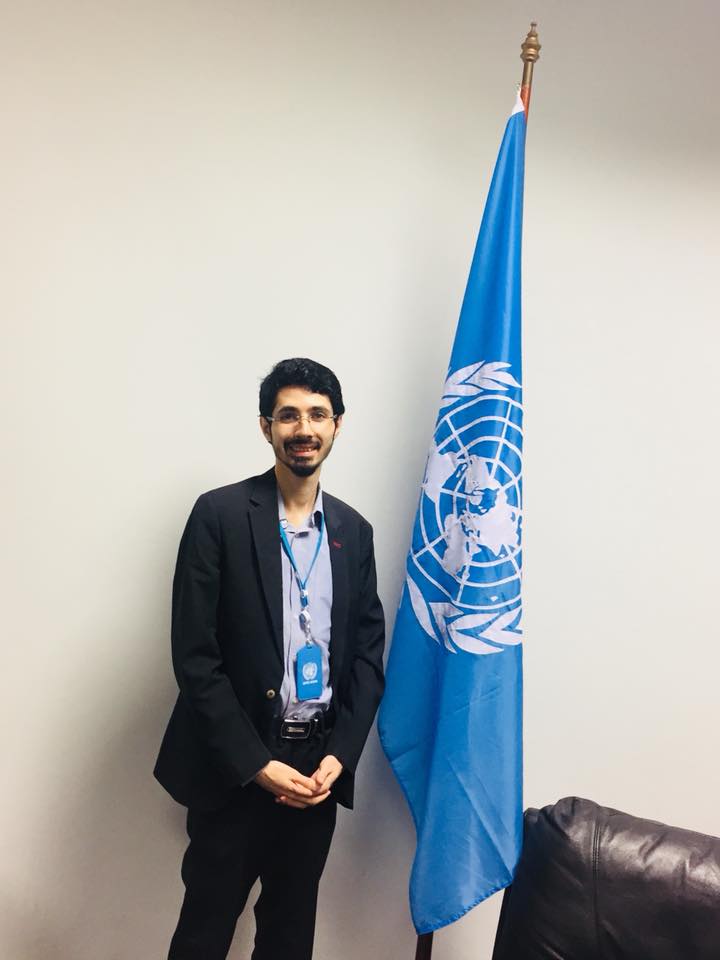
Affan Yesvi, a young social activist from Kashmir participated in a 3 days United Nations Global Sustainability Development Goals SDGs Conference – A global preparatory meet in support of SDG7 at 2018 High-Level Political Forum in Bangkok, Thailand.
Pertinent to mention that at a very young age he founded a non-profit organization by the name of ‘The Inner Call – a forum for Evolution, Development and Awareness’ in 2009. The organization has been contributing in spheres of mental health, environment protection, women empowerment, youth activities and social research, with the sole aim of promoting human values. The organization has also organized various legal awareness camps.
The United Nations High-level Political Forum on Sustainable Development (HLPF), serving as the central platform for follow-up and review of the 2030 Agenda for Sustainable Development.
To help provide a solid substantive foundation for the review of SDG7, a global preparatory meeting in support of the review of SDG7 at the 2018 High-Level Political Forum, jointly organized by United Nations Department of Economic and Social Affairs (UN DESA) and United Nations Economic and Social Commission for Asia and the Pacific (ESCAP), was held from 21-23 February 2018 at the United Nations Conference Centre in Bangkok, Thailand. (KNB)
source: http://www.kashmirnewsbureau.com / Kashmir News Bureau / Home / Jammu & Kashmir / March 01st, 2018
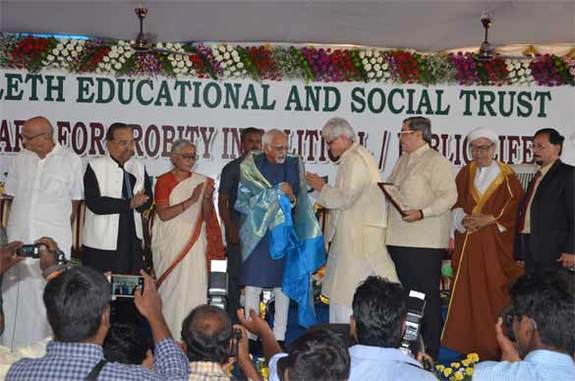
Quaide Milleth Award For Probity In Political/Public Life (2018) to Hamid Ansari and Aruna Roy
Chennai:
The Quaide Milleth Educational and social Trust instituted the Quaide Milleth Award for probity in Political\Public Life in the year 2015, to commemorate the 40th Anniversary of the Trust. This award shall be presented every year to people with exemplary track record and commitment to India’s Constitutional, Democratic, Values, Secularism, Pluralism, inclusive and service for marginalized people.
Furtherance of the Honour taking place every year, with which this year the jury endeavoured and found the people who are thriving to serve for the Nation and being the part to make democracy strong.
Under the auspices of Alhaj. M.G. Dawood MiaKhan Sahib, The General Secretary and Correspondent of the Quaide Milleth Educational and Social Trust has bestowed “The Quaide Milleth Award for Probity in Political/Public Life” for this year to His Excellency Honourable Dr. Mohammad Hamid Ansari, Former Vice President of India and Smt. Aruna Roy, Social Activist & Founder of Mazdoor Kisan Shakthi Sangathan.
The Award Presentation Ceremony held at Quaide Milleth College, began with the Qiraath (Citation of Quran Verses) followed by salutation to Tamil Thai Vazhthu.
Dr. A. Rafi, Principal of the College, welcomed the gathering for the Award Ceremony. He shared the brief history of the college with the milestones it has reached by highlighting the facts that the college has achieved 89% of placement last year and heir the NAAC certification recently. Then he marked the achievements of the dignitaries and their exertion rendered for the society.
Then, Padma Bushan Janab. Moosa Raza, I.A.S (Retd.), Former Secretary to Government of India and Chairman S.I.E.T., was called upon to preside over the Award Ceremony. In his presidential address he mentioned the Awardees as the “Children of India” who are awarded by The Quaide Milleth Educational and Social Trust. He also added by stating that Hamid Ansari is a very humane who respect people and excellent in performing his duties. He (Hamid Ansari) has done a commendable job when he was an Indian ambassador for Saudi Arabia by bringing investments from these countries. And he added that “The whole world will listen to him when he is silent”. Moosa Raza also brought Aruna Roy’s contribution to a broad day light. She has championed “The Right to Information Act” and “The Right to Education”
The above two recipients of the prestigious award were felicitated by Shri.Gopalakrishna Gandhi, Former Governor of West Bengal, Dr. Mufti Khazi Salhudeen Mohammed Ayub, President of QUEST, Rev. Bishop Dr. Devesagayam, Church of South India (Rtd) and T.K. Rangarajan, Rajya Sabha Member.
Shri.Gopalakrishna Gandhi ironically commented that at the present scenario people with Probity and Honesty are to be searched.
Dr. Mufti Khazi Salhudeen Mohammed Ayub went to the root of this award giving, which has been derived from the altruistic life and ideals of Quaide Milleth Sahib.
Rev. Bishop Dr. Devesagayam has applauded the idealism of the recipients and requested the future generation to imbibe the same.
T.K. Rangarajan, appreciated the leadership qualities of both the awardees.
The felicitation was followed by the citation of the award by Alhaj. M.G. Dawood MiaKhan Sahib. He emulated the values of Quaide Milleth for constituting this unique award. He reminded and compared the fact that as a politician Quaide Milleth abided the Law, respected the Constitution of the country and at the same time he remained uncompromising on his values and Policies. But today’s politics has become the place for corruption. He added the Quaide Milleth Award is not just to Honour but also to introduce the great minds to the society and to recognise their admirable contribution to the Nation. He also brought in the history of Quaide Milleth that he was the Leader of Masses due which he was elected as Member of Loksabha for 3 consecutive period without going to the constituency. He requested Mohammed Hamid Ansari to resume his work as the Nation requires his service. He called Aruna Roy as “Women of Intolerant” because she is intolerant towards the fascism, against the one who oppresses and discriminates the downtrodden.
A minute of silence was observed to honour the demise of The Senior Journalist Gniani and National Herald Editor and Chief Mr. Neelabh Mishra.
Smt. Aruna Roy, proclaimed her gratitude for receiving the award in the name of Quaide Milleth – Member of Constitution to promote Secularism. She expressed that Quaide Milleth was her Ideal who taught her the Constitution. She questioned the Powers that “Why are you afraid of pluralism?” and she emphasised one Nation, one thinking, one Ideology concept is not possible in a secular country like India. She felt and interrogated that “What happened to the Nation”, nowadays people with Ideas of difference are assassinated like Bansare, Dhabolkar, kalpurki, Gouri lingesh who are the activists and journalists. She criticised the fact that 73% of India’s wealth is with just 1% of people. She explained to the crowd that “Information is power”. When the Information is open to public it will construct good governance. Today there are 60 lakh beneficiaries of RTI, she believed that it will increase the accountability of every person who is in power. She encouraged the voices against the corruption and inequality through non-violence. She concluded that “QUAIDE MILLETH AWARD 2018 FOR PROBITY IN POLITICAL\PUBLIC LIFE, is really to recognise the real Indian to speak the truth to Power”.
Dr. Mohammed Hamid Ansari expressed his humility through his discomfort rather in receiving the award than giving it. He said that “In spite of differences of manner, food and faith we are equal as citizens of India”. He cited the article “51A the Fundamental of Duties” and articulated that it was created by executive judicial body to delineate everyone’s duty. He emphasised that “The common man has given the responsibility to the politicians to make Laws, discuss public difficulties and execute accountability”. He urged to the Judiciaries to discharge their duties quickly and fearlessly. He insisted that “Our duty is to ensure that the institution created by constitution should be safe guarded and protect public property”. He completed his speech with his humble words that “I did not do any unusual and I was taught to follow the rules”.
The 4th annals of QUAIDE MILLETH AWARD Ceremony confined with the Vote of Thanks delivered by Janab. M.H.B. Thajudheen, EC Member, QUEST. (Press release)
source: http://www.milligazette.com / The Milli Gazette / Home> Online News> National / March 02nd, 2018
Prof SS Shameem cycled 2,140 kms across Malaysia to spread awareness on the Polio Virus and global eradication of the disease.
The World Health Organization reports Polio cases have decreased by 99 percent across the world since 1988. Yet, even if one child contracts the disease today, the fear of it spreading to 200,000 cases a year lingers.
While awareness campaigns, and health camps, have achieved much in terms of spreading awareness, one man embarked on a solo journey on his bicycle, riding the length and breadth of Malaysia, to spread the word.
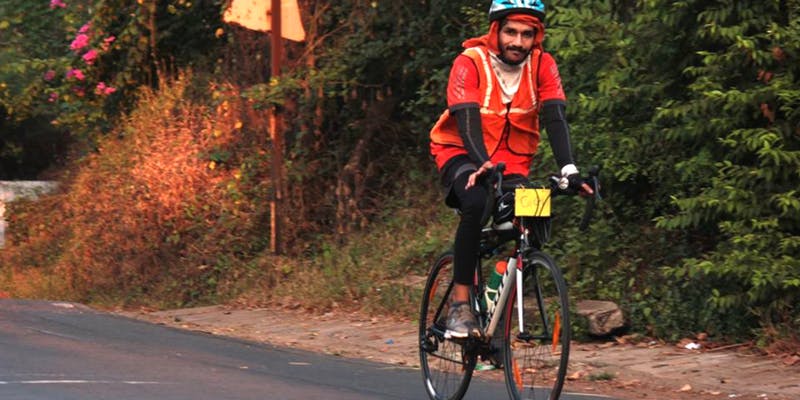
SS Shameem, an assistant professor in the Department of Computer Applications in Manipal Institute of Technology, Karnataka, who is posted at Manipal International University, Malaysia, cycled 2,140 km over two weeks from January 31 to February 14 to spread word on eradication of polio.
“Malaysia was declared a Polio-Free country a decade ago; but as it’s known – polio can spread anywhere, anytime unless properly taken care of. I am currently located at Malaysia; so it was decided that the expedition would be held here. Earlier, I had done similar events back in India for causes like Green and Healthy India, among others,” says Shameem.
The campaign
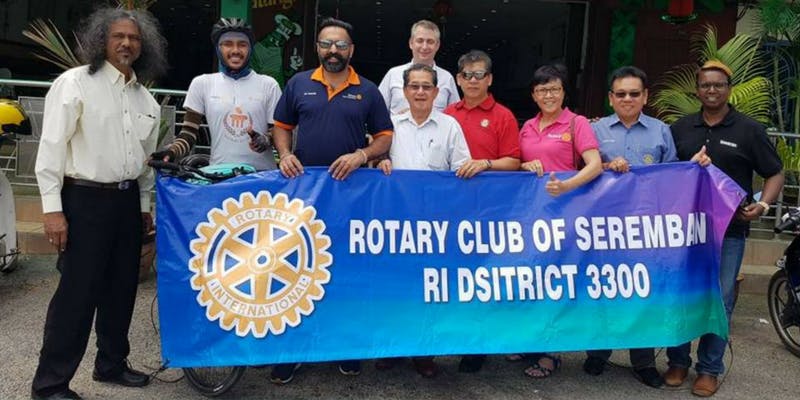
The cycling campaign helped raise Rs 3 lakh (over 18,000 Malaysian Ringgit) for the global EndPolio mission of Rotary International. Operation Polio Eradication by Manipal is a movement by Manipal Academy of Higher Learning and Manipal Global. Shameem’s cycling expedition also promoted the institution’s Green-Health Awareness Campaign.
“Globally, most governments and NGOs are working on eradicating polio from the face of the earth. But we’re still yet to achieve 100 percent on this. As long as there’s one case, it can spread. Rotary International has been working tirelessly for many years with its EndPolio mission. This cycling expedition was in association with Rotary’s initiative. Manipal, having a strong presence in the medical sector in Malaysia as well, promoted this expedition for the same cause,” Shameem said.
In India, which reported its last case of polio virus in 2011, awareness to ensure the disease doesn’t make another appearance is imperative. Once known as a hotbed for the virus, various pulse polio campaigns led to the successful eradication of the disease.
“A lot of initiatives were taken; but as all would agree, content on an official document and facts/reality have a lot of difference. Much work is needed on the ground level; which needs lot of funding, and more importantly public awareness. At least, I can do my part through such cycling expeditions and campaigns,” he adds.
His journey also translated into a knowledge sharing space, where misunderstandings about the disease were cleared and information spread.
For the love of cycling
While there are many methods to spread awareness on health issues, Shameem believes that to reach out to as many people as possible, one needs to travel. To support the cause of polio eradication, he cycled 100-200 km a day. He began the two-week voyage from Nilai, passing through Kuala Lumpur, Rewang, Taiping, Ipoh, Penang, Perlis, Kedah, Mersing, Johor, Bahru, Muar, Melacca, Tampin, Seremban, before ending it at Nilai. The expedition covered the whole of Malaysian mainland.
“The attempt caught people’s attention and they wanted to know more about it. That serves our purpose. Also, seeing a solo effort of riding 100-200 km per day, 2000+ km straight, people helped out; which helped in our EndPolio Fund-raising campaign. I don’t think we could have gotten a better response, or raised more money in a Greener way, through a mode other than this.”
Back in India, Shameem has had successful cycling expeditions. In 2016, he rode solo from Kanyakumari to Kashmir, covering a distance of 3200 km in 23 days. His other feats include a solo 1500 km expedition from Bengaluru to Odisha in eight days in 2015, a group stint from Manipal to Jaipur covering 2500 km in 20 days in 2016, and from Okha to Dibrugarh, covering 3200 km in 19 days in 2017.
At the Manipal Institute of Technology, Karnataka, students, alumni and staff have created cycling clubs, and participate in various local and national circuits. Shameem believes the youth needs to be enthused about cycling and using it as a means to create greater community engagement.
“I love cycling. I like to push myself beyond limits; I want to try the tough things. Exploring places on cycle defines me; and that’s why I do it.”
From the cyclist’s journal
The only concerns were wildlife and reptiles. A particular 250 km stretch in northern Malaysia is full of mountains and thick forest, with no trace of human life for miles. Wild-pigs, elephants, even tigers are seen roaming freely on highways. I was lucky to have not encountered any at all. I was carrying two small knives at hands’ reach while cycling on the stretch. – Shameem
source: http://www.yourstory.com / YourStory.com / Home> Social Story / by Deepika Rao / March 02nd, 2018
‘Everyone is equal, whether you’re poor or rich, it doesn’t matter’, says Ashraf ‘Sherry’ Thamarassery.
Ashraf ‘Sherry’ Thamarassery, who volunteers his time helping repatriate the dead from the Emirates, has helped repatriate 4,700 bodies from the UAE and recently helped send the remains of Indian actress Sridevi back home to Mumbai. Jon Gambrell / AP Photo
Away from the camera flashes and the eyes of her millions of fans in India, the actress Sridevi’s body made its way to a simple mortuary in Ajman, where one man helped sign out her remains to return home.
Listed only as “ASHRAF” on the official paperwork in Dubai, Ashraf ‘Sherry’ Thamarassery is a 44-year-old Indian from Kerala who has become a ferryman of sorts for those who die here in the Emirates.
From indebted labourers to the moneyed elite, Thamarassery has helped repatriate 4,700 bodies to 38 countries across the world. He views it as a noble responsibility.
“For them, you or me, it’s all the same and everyone is equal. If someone dies in their room, they will take them to the hospital and then to be checked at the police mortuary,” Mr Thamarassery said.
“It’s the same process, whether Dubai or Sharjah or any emirate. Whether you’re poor or rich, it doesn’t matter.”
Sherry offered shrugs when talking about Sridevi, saying he helped repatriate five bodies on Tuesday, including the famed Bollywood star’s.
It’s hard to overstate the power Sridevi had over the imagination of many in India.
Starting out as a four-year-old child star in south Indian regional movies, she later became known for her impeccable comic timing as well as her dancing skills.
She appeared in hundreds of films, perhaps most known for her song-and-dance Hawa Hawai routine in the 1987 film Mr India, in which she joyfully prances around in an almost-elastic set of whirls, twirls and silly faces.
She smashed into the male-dominated movie industry to become her own star.
The 54-year-old Sridevi, only known by one name, which means “Goddess” in Hindi, died in Dubai while in the UAE for a wedding. Police and prosecutors say she drowned in a hotel bathtub after losing consciousness, calling her death accidental. Police officials also have said the actress had alcohol in her system at the time of her drowing.
News of her death dominated India’s newspapers and many television networks, with coverage ranging from the restrained to the lurid. One TV station aired a segment showing a reporter talking about her death while laying in a bathtub, while others had computer-generated graphics imagine the scene. Many newspapers chose not to mention she had alcohol in her system, while a hashtag #LetHerRestInPeace emerged on social media.
While Indian officials quickly cancelled her passport and prepared the other documents, Mr Thamarassery said the necessary police clearance slowed Sridevi’s repatriation. He said he has received hundreds of calls from journalists, officials and others in the interim.
When the clearance came, Mr Thamarassery travelled to a government-run mortuary in Dubai and there officials embalmed her corpse as he handled paperwork for her and three others.
On Tuesday night, Mr Thamarassery returned home to the apartment he shares with his wife and daughter in Ajman. There, he runs a mechanics shop but focuses largely on his philanthropic efforts.
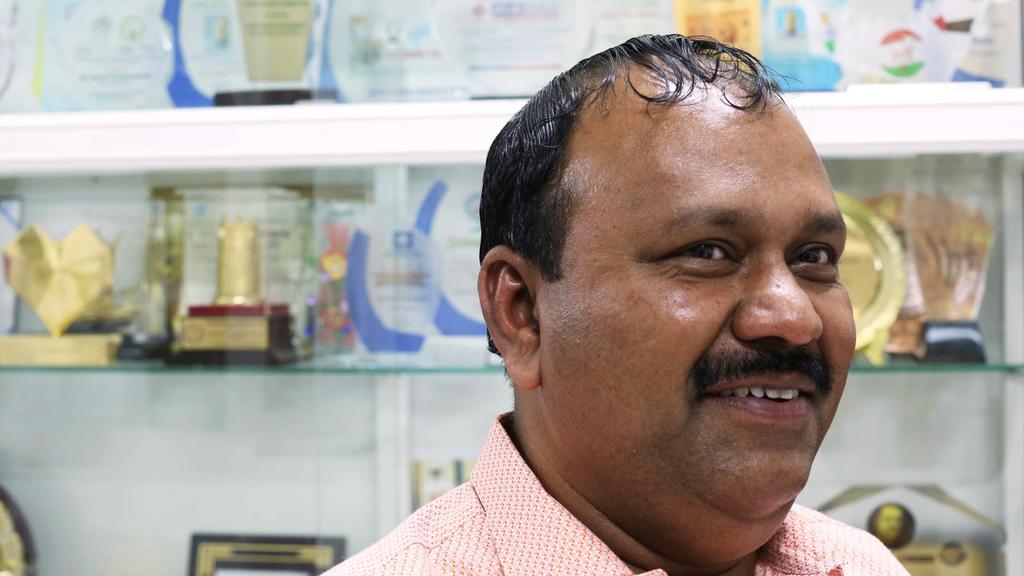
Shelf upon shelf in his home bears honours and awards. A framed picture hangs on the wall showing him meeting Indian Prime Minister Narendra Modi.
“I do this to earn blessings, but also when someone dies here, people don’t know how to manage the repatriation procedures,” he said. “That’s why I do it.”
All the while, his phone never stopped ringing, some of them undoubtedly new calls for his help.
source: http://www.thenational.ae / The National / Home> UAE / by Associated Press / February 28th, 2018
Sameena Mustafa has had a successful career as a real estate broker working with nonprofits and small businesses in addition to a rising profile in the city’s comedy scene. In 2015 she cofounded Simmer Brown, a South Asian comedy collective. But the 2016 election made her take a hard look at the local political arena and decide to get involved. Now Mustafa, 47, is one of three Democratic primary challengers to incumbent Fifth District U.S. representative Mike Quigley, who’s held that office for nearly a decade. Mustafa believes he’s out of touch with the progressive values that she sees to be increasingly animating the district. If she wins, Mustafa would be the first Muslim woman in Congress and the first Indian-American woman to represent Illinois.
Here at the Reader we’re familiar with your comedy work. Have you always been doing comedy alongside your real estate career?
I started comedy in 2014, and that’s the newest venture. Real estate I started in 2003. I was still working full-time while I was performing. Comedy is a late-night venture, as it were, so it’s not something that would conflict with business meetings.
I had been creative when I was younger. I wrote poetry, and I wrote in high school. So I had that creative side of me, and it was one of those things where someone was like, “Take a class at Second City!,” and it was fine. I took another one and a friend suggested, “Hey, if you like this but you want something a little bit different, try this women-only stand-up and storytelling class,” and that was the Feminine Comique. My graduation was four years ago, my comedy graduation. I never actually performed onstage before that graduation. It was so different from anything I’ve done in terms of writing. I did debate in college, so I had no problem speaking in public, but this is very different—it was me bringing my political ideas, my creative side, and my comfort with being in front of people. Immediately I had an affinity for it. I really enjoyed it. I was nervous the first time I was onstage, but I loved it.
I can’t find any of your stand-up on YouTube. Is there a reason for that?
I see comedy as something you do. It’s something you can be doing for 20 years and still be learning and evolving—it’s like any craft. To me it was more important for people to come to shows. I didn’t want to do, like, a Facebook live. It was more about having the interaction and immediacy. We’re essentially creating an experience, a community in real time.
You’re running against an incumbent who’s held this seat for nearly a decade. Some would say that it’s not a great strategy for a first attempt at political office. Why did you decide to spend your time and money on a race that’s really stacked against you?
The electorate is looking for a different type of leader, one that’s grassroots, connected to the community, that isn’t somebody that’s been selected for them. If you look at the last ten years, Democrats have lost over 1,000 seats on every level including the White House. So it’s one of those things where all the data is pointing against your assumptions, yet you’re still holding those assumptions? To me this was a district, this was an incumbent that was important enough to challenge because we have a completely different environment than we did two years ago. And so to have someone in that seat who doesn’t advocate for the values of the voters of the Fifth District was an opportunity to bring that, to bring that leadership.
And having lived in the district as long as I have and had immediate contact with people from all walks of life and different parts of the district—you get a sense of what people value. When you’re in an environment like a comedy show, it’s a flash focus group. It’s not hard to figure out what people are thinking and feeling and what they care about. Mike Quigley refused to do a town hall following the inauguration, which was something being done by Republican lawmakers across the country. And I thought: Why is my Democratic congressman, in a very Democratic district, refusing to do them?
You’ve been living in the district for 30 years. When did you first learn anything about your congressman? And can you describe your relationship with the congressman over the years?
I knew who he was and, frankly, because he has never been challenged, I voted for him. I knew he had the baseline: he was pro-choice, he was pro-LGBT. Then when I started looking at my stack of leaders up and down the ballot and started thinking about the issues I cared about and started doing some research on some stances that Mike Quigley had taken, it occurred to me that he may be good on those two issues but there’s so many issues on which he is falling short. Or, frankly, is in opposition to the values that I hold and that the voters hold in the district. Mike Quigley is not someone who sticks his neck out on issues.
If you were elected, you’d be the first Muslim woman in Congress. What goes through your mind as you consider that prospect?
It would certainly be a milestone, but I’m optimistic that people in Democratic politics are increasingly accepting of leaders irrespective of their religion, gender, or ethnicity and are looking for candidates who stand with them on the issues and share their values. More doors are opening for candidates who have something to offer but who historically have not had opportunities to serve.
In light of the conversation that you participated in with the Reader last year, talking about feminism and intersectionality in what would be considered a nonmainstream way, how are you bringing your political consciousness as a feminist committed to intersectionality to this very mainstream political arena?
It’s in how I’ve organized my campaign, it’s in how I’ve talked about the issues. . . . I gotta tell you, we’ve talked to thousands of voters, and this is a progressive district. So when you approach them, they assume you’re agreeing on some baseline principles. Are you pro-choice? Are you pro-LGBT? Do you support the Dreamers, immigration reform? Are you going to be supporting health care access for all? This is something I’ve found is resonating with voters.
On the intersectionality piece per se, I have made it a point to have a very inclusive team. The majority of the leaders on my team are women and women of color. Those are the kinds of things that resonate with volunteers, with donors, with voters.
And are you also mentally preparing yourself to step into an electoral political space which requires compromise and working with people who have a radically different political understanding of things?
I’ve spent the last 13 years advocating for people and organizations that are founded on values—nonprofits that are working on important issues like immigration, sexual assault survivors. It’s something where I’m literally negotiating against people who don’t necessarily share those values and they are not really committed to those outcomes. And they have their own agenda, and they have their own profit motive, specifically in the space of commercial real estate.
As it relates to being a public figure and having criticism—I’ve been doing it for the last six, seven months. I have put myself out there in a way that’s public, and in some ways it was an extension of what I was doing in the arts community. Because when you’re onstage, you’re essentially saying, “I am open to anything. I’m declaring my values, I’m declaring my beliefs, and I welcome you to challenge them.” But I’m not shying away from being a public figure.
You’ve talked about how problematic gerrymandering is, how it creates this strange monoculture of an electorate in one particular district. Is there anything you’ve been either pleasantly or unpleasantly surprised by as you’ve been campaigning around the absurd contours of the Fifth District?
I know this district, this is the district I grew up in, my parents have lived here for over 40 years, and I felt confident in my knowledge of what the values were that I held and that were shared by the voters. And one thing that I keep getting positive reinforcement on is how much, despite the gerrymandering, how much the voters and the district value diversity and believe in inclusion and view it as one of our strengths. I’m getting phone calls, e-mails, and messages from people who are saying, “We want to help you, we support you, we share your values and we want to see a leader like you represent us.” It’s humbling, and it’s an honor. This has been an incredible opportunity to connect with people on values and policies that they care about.
source: http://www.chicagoreader.com / The Chicago Reader – TheReader / Home> News> Politics> The Best of Chicago / by Maya Dokmasova / February 27th, 2018
An alumnus of SMJN post graduate college in Haridwar has written a book “Muslim Vayask aur Media” which dwells of the views of the community members regarding their presentation in the media.
Dhanesh Dwivedi says that in his study, about 80 percent of adult Muslims in parts of Rajasthan, said that they felt as if media is not playing a positive role and at times is totally indifferent to them. This is based on an analysis of data from a 2014 survey conducted by research scholar Dwivedi.
A voracious writer, Dwivedi has worked as technician and interpretor of Russian language in Indian Air Force for almost 10 years. He conducted a survey of 600 Marwar Muslims, from the areas of western Rajasthan including Jodhpur, Jaisalmer, Barmer and Uttarlai in Hindi and his research work got published by Maulana Azad foundation. His questionnaire of 50 points was distributed at various Madrasas and other Islamic institutions where adult Muslims could understand Hindi language.
“On the question if the world looks upon Muslims with a different outlook and whether propaganda was being aimed at defaming Islam, 52 per cent opined that the media was responsible for negative propaganda while 30 per cent said that media was totally indifferent with 18 per cent of the responders terming the media’s attitude as positive,” said Dwivedi.
On the question of whether Muslims were treated as votebanks by political parties, 66 per cent replied in affirmative and 15 per cent in the negative while 19 per cent said that they did not know. Drawing conclusions from the study, Dwivedi says in his work that the heat is felt by Muslim community members, which is a matter of concern. The electronic media must rethink on how they can create a positive attitude towards the Muslim community members.
He told this correspondent that the adult Muslims he questioned in his study seemed to be much contented with the print media in comparison to the electronic media. Also, the young Muslim generation appears less interested in Urdu language and the print media can come forward to generate their interest in the language in some way, he added.
The secretary of Marwar Muslim Educational and Welfare Society, Mohammad Ateek opined,”In the past four years, the neglect factor towards the Muslim community has increased. The condition has worsened than what Dhanesh Dwivedi has highlighted in his book. It is pure vote bank politics being played with us.
source: http://www.dailypioneer.com / The Pioneer / Home> State Editions> Dehradun / by Radhika Nagrath, Haridwar in Dehradun / Monday – February 05th, 2018
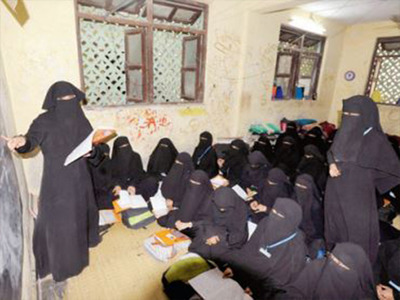
Over a dozen students, all clad in burqas, are in a small classroom.Their teacher, dressed identically, keeps a close watch.Everyone is on the floor while books on Hadith (traditions of the Prophet), commentaries on the Quran and tomes on fatwas line the walls.
This is the Madrassa Jamiatul Mominath in Moghalpura, which is the city’s first and only institute that trains women to become muftias. Instruction is imparted in the Darul Ifta, or fatwa department.
Fatwa is an opinion that Muslims seek on a range of subjects, including marriage, menstruation, divorce, adoption, property issues, and rituals like namaz and roza.Countless madrassas in the country–such as UP’s Darul Uloom Deoband–run training courses, but most of them are for men.
“There are several questions that women hesitate to ask muftis. We thought women would be more comfortable discussing their issues with muftias. That’s why we introduced this one-year course 12 years ago,” said Hafiz Mastan Ali, Jamiatul Mominath’s founder.
Set up in 1991, the madrassa has 2,500 students today , of whom 400 are hostellers. The muftia course began with only five girls, but this year, the department is training 15.So far, the madrassa has produced 318 muftias.
The fatwa department’s head, Nazima Aziz, said making girls muftias is empowerment. “Once an alima (female graduate) completes fazila (post-graduation), she is eligible for the fatwa course.”
Aziz explained that the course is divided into five segments: prayers, women’s personal issues, limitations (what women can and can’t do), property issues and current issues. ” A fatwa is given in the light of Quran commandments and the Prophet’s traditions. Muftis try their best to be neutral while giving judgments on disputes. If someone is not satisfied with the decision, he or she can consult another mufti or muftia,” she said.
The girls share Aziz’s opinion on the importance of their role. A muftia in the making, Suraiya Shakeel Khan wants to help women. “I can guide people on religion.” Khadeeja Fatima feels she would get more respect in the community once she becomes a muftia. Most of them, like Aziz, are in favour of setting up more Darul Iftas for women across the country .
Interestingly, Aziz and her students backed the All India Muslim Personal Law Board (AIMPLB)’s stand on triple talaq. “Talaq in one sitting should be discouraged, but it cannot be banned as that will be tantamount to interference in sharia laws,” said Mohammed Hasnuddin, head of Mominath’s fatwa department for men. “We don’t agree that talaq is a sword dangling over the heads of women. It’s an option to end an oppressive marriage and should be used as last resort.”
source: http://www.timesofindia.indiatimes.com / The Times of India / News> City News> Hyderabad News / by Mohammed Wajihuddin / TNN / January 09th, 2017
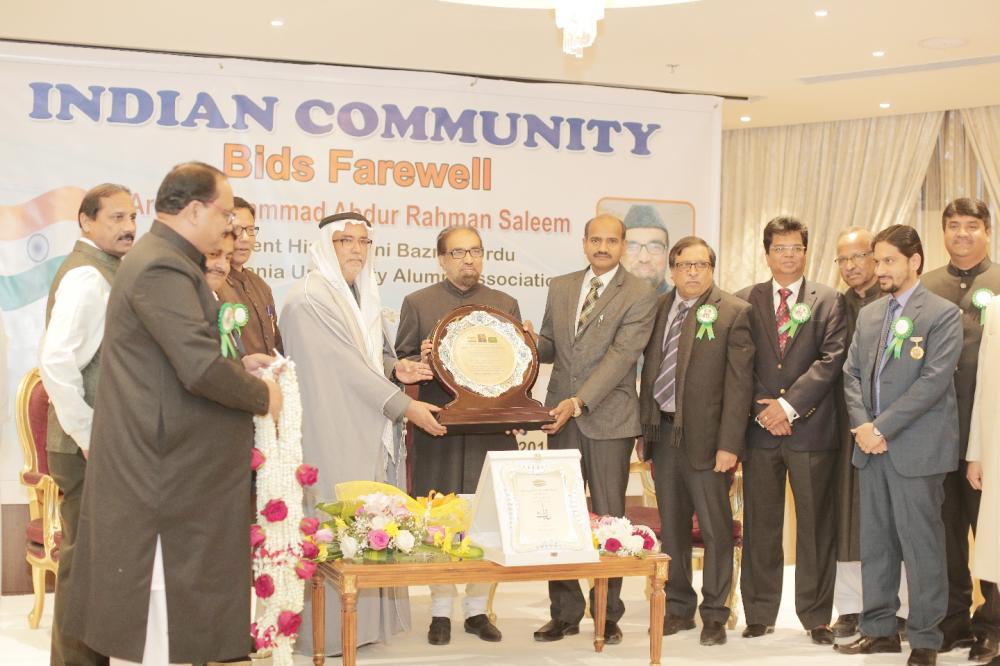
The Indian community here bid farewell to longtime resident and senior NRI Arch. Mohammed Abdur Rahman Saleem, who is leaving the Kingdom after over four decades here.
Saleem who spent 43 years in the Kingdom, was a prominent social activist and promoter of the Urdu language and culture. He established different cultural and social organizations and organized many cultural events.
Saleem was the torch bearer of Urdu culture and tradition. After successfully establishing many organizations he formed the Toastmasters Club in Riyadh. Bazm-e-Urdu Toastmasters Club (BUTMC), which is successfully running with many youth joining it to excel in linguistic skills along with personality development and public speaking abilities.
By organizing elocution competitions for the students of Indian schools in Riyadh, Saleem was successful in attracting students to get interested in and opt for Urdu in their studies.
Chief Guest Dr. Hifzur Rahman Azmi, First Secretary, Embassy of India Riyadh, said, “Nowadays people with positivity are rarely found in our society whereas Saleem is a multi-faceted person who is filled with positivity. He dedicatedly works likes an organization in himself, and has organized many events on a grand scale. Even the Embassy needs the help of different organizations to arrange such events. In addition to organizing cultural events for entertainment, he has striven for many constructive works and events; elocution competition for school students is one such example.”
Rahman also disclosed that Saleem holds the credit of organizing the first Republic Day Mushaira in Riyadh, over 25 years back, under the banner of the Indian Embassy. His organization was associated with all the Mushairas organized by the Indian Embassy as he regularly felicitated all the poets.
Saleem successfully tried to link the people from all parts of India and managed to make an excellent group of like-minded people and hoped that his team will carry forward his legacy, he added.
In his welcome address THH and OUAAAR President Mohammed Qaiser said, “As an architect Saleem played an important role in giving beautiful buildings to this country. In addition to his professional commitments, his services and contributions towards the Indian community and for the promotion of Urdu were remarkable.”
K.N. Wasif read out a sketch about Saleem and said that he always was for justice among all and hence represents the justice of Jahangir. Ghouse Arsalan also read another sketch titled “Hindustani Tahzeeb ke Me’maar” (Architect of Indian culture) and said, Saleem truly represented the Deccani culture and tradition in the Kingdom and in USA.
Firasat Ali Khusro paid poetic tribute to Saleem’s long services and contributions. He said Saleem always did good deeds and never showed off, and it is very rare to find such humble people in the current period.
Taqiuddin Mir presented a humorous sketch “Pati Patni Aur Woh” about Saleem’s addiction to mobile and using social media to get in touch with all his friends. The community leaders from all parts of India spoke on various aspects of Saleem’s personality.
Zaigham Khan from Aligarh said that Saleem is Baba-e-Urdu of the Kingdom and will be remembered here for the long time. Ghazanfar Ali Khan said that Saleem has been the cultural ambassador of India to the Kingdom for over four decades.
Ghizal Mahdi appreciated Saleem’s affection for the Urdu language. Representing Jamia Millia Islamia, he said, Jamia played an important role in freedom struggle and its founders laid emphasis on education through mother tongue. Due to this factor Mahdi had long time association and friendship with Saleem.
Prominent Businessman Nadeem Tarin said that Saleem and his associates played an important role in introducing Hyderabadi community to the north Indian community, especially Aligs. Due to this a new impetus was prominent among both the communities and it was evident with the successful and historical events arranged and attended by all these communities.
AIUS President Dr. Mohammed Ashraf Ali appreciated the contributions and services of Saleem as he invited many prominent personalities from India and offered a platform to the community to interact with them.
Senior banker Shahid Ali Khan recalled his long time association with Saleem. Vice President Hindustani Bazm-e-Urdu Eng. Abdul Hameed introduced Saleem with the help of PPT presentation. Prominent Businessman Mir Muzaffar Ali was the Guest of Honor.
Saleem thanked the organizers, speakers and attendees for the marvelous display of love and affection for him. He promised that he will continue to strive for the promotion of Urdu wherever he goes. He announced that he will try his best to start Urdu Toastmasters Clubs in Hyderabad and USA.
On this occasion Mubibb-e-Urdu award was presented to Saleem. The organizing committee members presented him a memento of appreciation in recognition of his contributions and services.
Floral bouquets and gifts were presented by different organizations — Deccan Cultural Association, All India United Society, Ghazal Sara Group, Telangana NRI Forum, Paradise Group, Bazm-e-Farogh-e-Urdu and Bihar community.
Organizing committee members Aftab Nizami, Mohammed Mubin, Sohail Siddiqui, Mohammed Kaleem, Syed Ateeq, Aliuddin Ahmed, Shakeel Mah presented freshly prepared beautiful garland specially arranged for the event.
Mohammed Farooqui Shahbaz conducted the proceedings, while Dr. Shoukat Pervez, principal IISR proposed the vote of thanks. Hafiz Abdul Malik recited verses of Holy Qur’an at the start of the event. — SG
source: http://www.saudigazette.co.sa / Home> Saudi Arabia / Riyadh – February 22nd, 2018
HAM leader Shahid Ali Khan (file photo) / Patna Daily
Patna:
Former Bihar Minister and senior Hindustani Awam Morcha (HAM) leader Shahid Ali Khan died of a massive heart attack on Thursday during his visit to Ajmer Sharif in Rajasthan where the 54-year old politician had gone to pay a visit to the tomb of Khwaza Moinuddin Chishti.
Party spokesperson Danish Rizwan informed the press in Patna about the sudden passing away of Khan’s death.
Khan was elected to the state Assembly for the first time in 1990 from Sitamarhi on Janata Dal ticket, the forebearer of the current Rashtriya Janata Dal (RJD). At the time, he was the youngest person ever to be elected to the Bihar Assembly.
He was re-elected from the same constituency in 2000 under the RJD ticket and won twice as a Nitish-led Janata Dal – U candidate in 2005 and 2010 from Pupari and Sursand constituency. He held different portfolio under Nitish administration that included the Minority Welfare, IT, and Law departments.
He later resigned from the JD-U and joined hands with former Chief Minister Jitan Ram Manjhi pledging allegiance to the HAM.
Khan leaves behind his wife and three daughters along with other family members.
Chief Minister Nitish Kumar, HAM President Jitan Ram Manjhi, former ministers Brishan Patel, Mahachandra Prasad, and JD-U state President Vashisht Narayan Singh were among many who expressed their condolences to the grieving members of the family calling it a huge loss for the state.
Khan had hit the headlines in 2014 when rumor of his alleged links with Indian Mujahideen terrorist outfit led to an investigation against him. He later, repeating a famous line from Bollywood actor Shah Rukh Khan’s film ‘My Name is Khan’, said “I am Shahid Ali Khan and I am not a terrorist” in the state Assembly.
The so-called investigation did not go anywhere as Chief Minister Nitish Kumar, at the time, called it a conspiracy by the ‘communal Bharatiya Janata Party (BJP)’ to malign a member of the minority community and a minister in the Nitish government.
The Chief Minister has announced a state funeral for the former minister.
Aysha Mahmood, alumnus of St Joseph’s HSS, is campaigning for safe keep of 150-year old building.
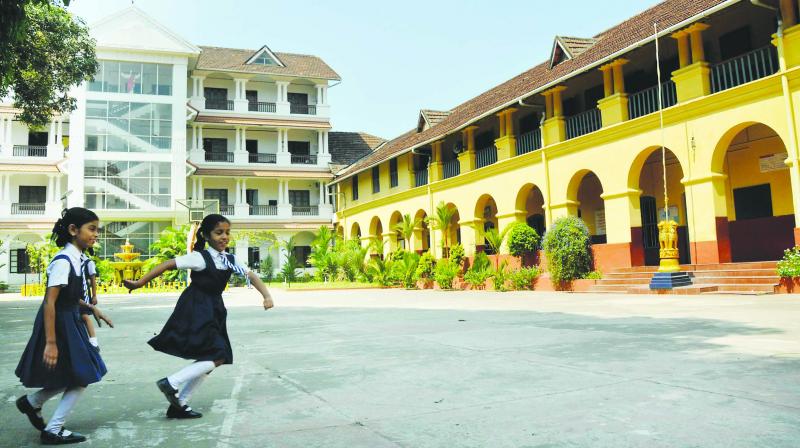
Children at St Joseph’s Anglo Indian Girl’s Higher Secondar School, the first school for girls in Malabar, built in 1862. (Photo: Venugopal)
Thiruvananthapuram:
It was a chance meeting. Aysha Mahmood had come to her hometown, Kozhikode, to take part in the Offir Food Fest. She has been settled in Taiwan for a while, but couldn’t stop reacting to stories from home that shocked her.
Two years ago, she heard her beloved alma mater – St. Joseph’s Anglo Indian Girls’ Higher Secondary School – will have its oldest building demolished. A few of the alumni had then got together, spoke to the school and the idea had slowly died down. Now, after a chance meeting with someone she knew, Aysha heard the plan was back on.
Frantically, she gathered together some of the old girls who studied there, tried talking to the school, and finally had to start a petition online to save the old, old school – 155 years old.
“Some time back they celebrated the 155th anniversary of the building, now they are planning to pull it down, and in its place, build a glass and steel structure,” she says, remembering another old building that is no longer there. It was the boarding house where Aysha had spent many happy days. The building had a library in the centre which had a lot of really old Reader’s Digest magazines.
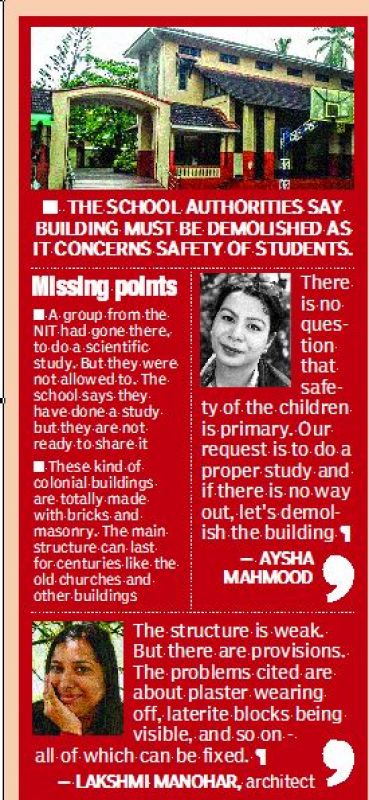
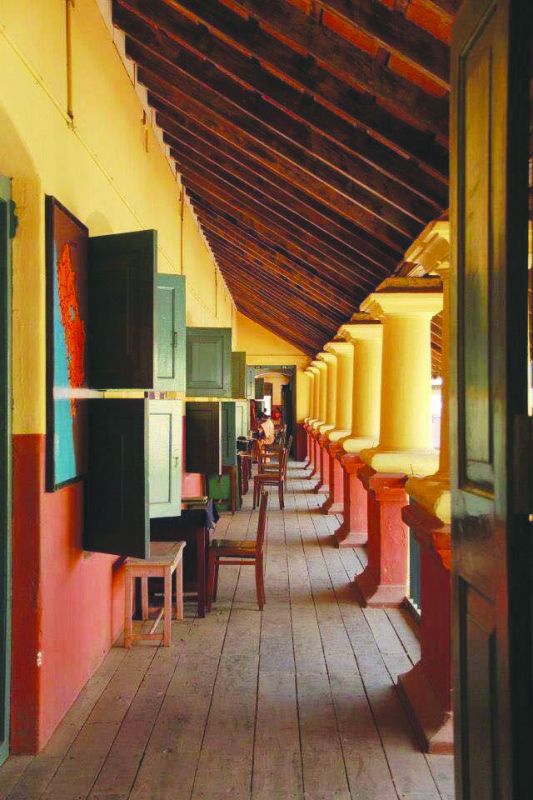
It was not accessible to the girls. But like in Enid Blyton novels, the girls found an old door from their dressing area that led to the library. Aysha’d sneak in, after opening the rusty hinge, and stay there with her torch or a candle, reading those old, old Reader’s Digest magazines.But that building and the library had got pulled down. Now there is only the original convent and this building they are planning to demolish, left of the first school for girls in Malabar, built in 1862. “We have very few 100 plus year old buildings left in Kozhikode. One reason they give for demolishing the building is space constraints. That they cannot have smart classrooms there. But there are architects interested in conserving it, who say, it can be done. We could add modern amenities, restore the building. A group from the NIT had gone there, to do a scientific study. But they were not allowed to. The school says they have done a study but they are not ready to share the report.”
The school has been giving the reason that it concerns the safety of the students. “But we feel that is an excuse,” says Abdul Hameed, an electrical engineer who runs an architectural consultancy. He got involved only because of his love for his hometown.
“We suggest we can get the best structural engineers from NIT, to ascertain the safety of the building. And then do a programme to restore it. The funding – can be thought out later. These kind of colonial buildings – were before concrete, so it is totally made with bricks and masonry. The main structure can last for centuries like the old churches and other buildings across the world. But maintenance should be done.”Abdul, with the collector, the new building’s architect, and a few others are planning to meet the headmistress on Monday. “Lots of people are calling. Venu IAS, former tourism secretary, K.K. Muhammed, former ASI director, have all shown their interest,” Aysha says.
Her petition has collected 2574 signatures as this is written. But she adds, “There is no question that the safety of the children is primary. Our request is to do a proper study and if there is no way out, let’s demolish the building.”There might be a way out. Architect and another alumnus of the school Lakshmi Manohar has just come back from a visit to the school on Saturday evening.
“We just wanted to meet the old teachers and find out what the issue is. According to us, the structure is weak. But there are provisions. They showed us the old classrooms. There are more students now, so the space is less, to take class. It is all congested. Their requirements need one or two floors more to the building. The question is whether the structure has the strength to withstand the extra floors. That’s what we should evaluate. The problems they cite are about the plaster wearing off, the laterite blocks becoming visible, foundation troubles, and so on – all of which can be fixed. But I am not a conservation architect. We should bring a technical expert to study the condition and tell what the situation is,” she says.
‘A collective memory which shaped Kozhikode society’
The St. Joseph’s building, since 1862, has played an undeniable role in making education attainable and accessible to girl children from all walks of life- par caste and creed. It contains the collective memory of thousands of women and girls, panning almost six generations. It has played alma mater to a large section of Calicut society- ensuring quality education. Keeping that heritage alive is of high importance.
Those interested in the demolishing of the building may be of the opinion that it affects the modern outlook of the management or that it is a threat to the safety. Both concerns can be addressed if the right people are involved.
There is a large Architects Guild active in Calicut that specialises in the restoration and strengthening of historical and heritage buildings. We must be prepared to give them a chance to present their expert opinion and help in this matter. The professors of NIT Architecture Department have made known their availability and deep interest in studying the building and presenting their proposal for the same.
While it does need some work, respected architects who have assessed it generally opine that the building is structurally sound. They feel that it could be refurbished at a cost lesser than that required for demolishing and rebuilding.The restoration will only add to the historical value and character of the school. A building that is 150 years old must be considered an asset to the city. In a world where characterless and soulless skyscrapers and steel-glass embodiments are dime a dozen, buildings like these serve as a place of solace for the soul and soothing to the sight. They embody our past and our culture. Caretakers of our colonial architecture and history must know that the St. Joseph’s School and its many buildings are rich and heavy with these values.To conclude, I think preserving buildings like these is essential because of the collective memories, Calicut and its people attach to it.
Generations are emotionally attached to this school building in which they have spend a big part of their childhood. It has had a formative and a positive role to play in all our lives and it will be the saddest day in our lives to see it being pulled down. (Excerpts from the online petition of Aysha Mahmood)
source: http://www.asianage.com / The Asian Age / Home> India> All India / CRIS / February 23rd, 2018