Of the total 1,099 successful candidates in the final list of the Union Public Service Commission (UPSC) examinations, 50 Muslims have made it to this year’s result, with Bilal Mohiud Din Bhat from Kashmir bagging the tenth rank. The number of Muslim candidates is higher than last few years.
In 2016, 36 Muslims had cleared the exams, while the number stood at 38 in 2015, 34 in 2014 and 30 in 2013.
Along with Bilal, nine Muslims have made it to the top 100 ranks. Those in top 50 include: Muzammil Khan (22), Sheikh Tanveer Asif (25), Hamna Mariyam (28), Zaffar Iqbal (39) and Rizwanbasha Shaikh (48). Seventeen Muslims feature in the Top 500.
The selected UPSC candidates are recommended for various government posts which include Indian Foreign Service (IFS), Indian Administrative Service (IAS), Indian Police Service (IPS) and several other allied services.
Although Muslims comprise 13.4% of total population, they are dismally represented in the top government services, often due to lack of education and unavailability of resources. They account for about 2% in the civil services.
The Union Public Service Commission (UPSC) declared the final result of the 2016 civil services examinations on Wednesday evening. Like previous years, this year too a woman, Nandani KR, has topped the exam. Others in the top five are Anmol Sher Singh, Gopala Krishna, Sauyma Pandey and Abhilash Mishra.
Successful Muslim Candidates for UPSC Result-16
S.No.
Name
Ranks
1.
BILAL MOHI UD DIN BHAT
10
2.
MUZAMMIL KHAN
22
3.
SHAIKH TANVEER ASIF
25
4.
HAMNA MARIYAM B A
28
5.
ZAFFAR IQBAL
39
6.
RIZWANBASHA SHAIK
48
7.
SHEIK ABDUL RAHAMAN S
62
8.
ARIF AHSAN
74
9.
SYEED FAKHRUDIN HAMID
86
10.
BISMA QAZI
115
11.
SUHAIL QASIM MIR
125
12.
S M QASIM ABIDI
177
13.
RAZEEM K
191
14.
GAUSH ALAM
206
15.
NAHAS ALI
359
16.
MD ADIL ASHRAF
435
17.
PATHAN ADEEB DAULAT KHAN
450
18.
SAQIB YOUSUF
472
19.
HASEEN ZAHERA RIZVI
509
20.
JABEEN FATHIMA J
525
21.
ANAM SIDDIQUI
538
22.
SHEIKH SAMI UR RAHMAN
554
23.
MOHAMMAD ARSHAD
556
24.
MINHAJ UDDIN NIZAMI
584
25.
SHAIK SHAHABAAZ HANOOR
603
26.
INABAT KHALIQ
604
27.
FAISAL JAVAID
610
28.
HARIS BIN ZAMAN
646
29.
IRAJ RAJA
674
30.
EZAZ AHMED
697
31.
EHJAS ASLAM S
704
32.
REHNA R
735
33.
MANER NASIR IQBAL
753
34.
ABDUL RAHEEM A
755
35.
NASEEF ABDUL KADER
781
36.
MUHAMMED SHABEER K
805
37.
ANAYAT ALI CHOWDHARY
808
38.
DANISH AGASTAM
814
39.
JABBAR
822
40.
TASLEEM AHMED
827
41.
SHARDUL
828
42.
MD MUSTAQUE
836
43.
RENA JAMIL
882
44.
SHUHAIB T
885
45.
SHAHANSHA K S
897
46.
MUHAMMED HANEEF
898
47.
MD SARFARAZ ALAM
904
48.
MD SARFARAJ ALAM
1028
49.
SAJAD BASHIR
1042
50.
AMIR BASHIR
1087
51.
UMMUL KHER
420
source: http://www.twocircles.net / Two Circles.net / Home> Indian Muslim> Lead Story> Youth / by Raqib Hameed Naik , TwoCircles.net / New Delhi – May 31st, 2017
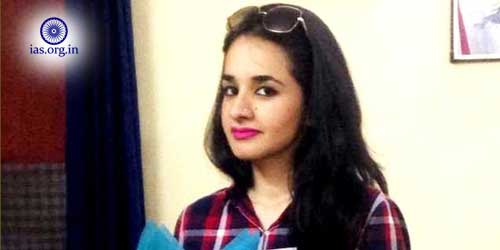
26-year-old, Farah Hussain became the second Muslim from Rajasthan to crack the Union Public Service Commission (UPSC) Civil Services Examination in her second attempt. Selection of a female Muslim candidate in the prestigious Indian Administrative Services is not an easy task. Among the very few women who have surpassed this massive barrier is Farah Hussain who got 267th position in UPSC 2015.
Like every other girl, Farah Hussain dreamt of many roles to become after growing up. As a child she wanted to be a doctor, and then in her teen age she decided to enter a beauty pageant. But she ended up doing something quite different from all these, as Farah Hussain chose the discipline of law and studied a 5 year law course in Government Law College in Mumbai and became a criminal lawyer instead.
Farah Hussain said, “I will try to serve the nation will complete honesty. I will try to work particularly for children and women. As far as giving to the community is concerned I am ready to provide every possible help to competitive exam candidates. I will try to create awareness among people and inspire them.”
In 2007, Jaipur’s Aslam Khan became the first Muslim from Rajasthan to get into the all-India services. She is posted as the additional deputy police commissioner in Delhi.
Family Background of Farah Hussain
Farah Hussain belongs to a minority Muslim group Kayamkhani that is found mainly in the central and northern Rajasthan districts of Sikar, Jhunjhunu, Churu, Nagaur and Bikaner. Her family belongs to Jaipur, Rajasthan and are currently living at Dausa.
Farha’s family is full of administrative officers – her father Ashfaq Hussain is the district collector of Dausa, her uncle is retired as an Indian Police Officer and another uncle is a Joint Secretary in the State Government. Her uncle and father were promoted to the all-India Services from the State Cadre. Her mother is a housemaker and her elder brother is practising lawyer at Rajasthan high court. Two of her cousins are Rajasthan Administrative Services (RAS) officers and her sister-in-law is awaiting her RAS results.
Right from the beginning it was there in the family that Farah Hussain too have to go in the same field. Seeing her father and the family atmosphere she too decided to become an IAS officer and serve India.
Farah Hussain said, “I am really glad that I was born in a well educated family. My father always said that for a person to attain anything big he must attain education. Education is real wealth and with its help a person can attain great heights in life. It is sad that Muslim parents do not give attention to their daughter’s education. We Muslims blame the government for everything but we don’t try hard enough ourselves to attain our right.”
Educational Background
Farah Hussain is an alumna of Ajmer’s Sophia School, Jodhpur. Farah Hussain studied the five-year integrated law course at Government Law College in Mumbai from Mumbai University and was the only one from her batch to find a place in the team of one of the country’s top lawyers, Mahesh Jethmalani.
Farah Hussain opted out of a coaching institute she joined in Delhi. “I feel coaching is a waste of time. I realised that in a month and ejected,” she says.
Attempts
Farah Hussain achieved this success in her second attempt and has beaten every religion related stereotype by becoming the second Muslim who cleared UPSC Exam 2016. She wrote the Mains of Civil Services Examination in 2013 but didn’t get a call for the interview round in her first attempt. Farah Hussain got 267th rank in the UPSC Exam and is waiting for allotment of service before she decides if she will take another attempt to better her rank.
Advice for Aspirants
First of all you should decide what you have to do.
Work hard.
Honestly working hard in the right direction is the key to ace any examination.
The percentage of Muslims is always very, the reason behind that is very few Muslims are able to qualify UPSC examination. First of all there is lack of education in Muslims. A big flaw is that they are not well informed about the examinations they should appear in. If they will not sit in competitions how will they succeed. Muslim fathers prime concern is to get their daughters married. This is wrong. Parents should encourage their daughters for attaining higher and higher education so that they can attain something great for themselves and also make their parents proud.
source: http://www.syskool.com / Syskool / Home> People / by Prafull / May 24th, 2016
Beswa Village, Fatehpur Tehsil (Sikar District), RAJASTHAN :
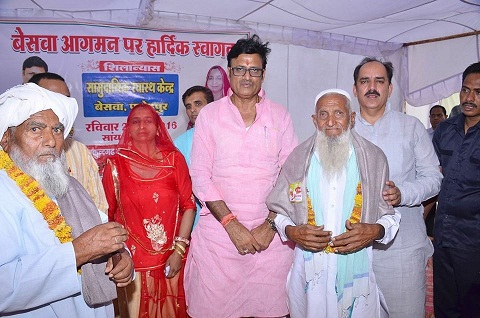
In a rare humanitarian gesture, two Muslims farmers of Rajasthan have donated their land for the building a government hospital in their area. The hospital will come up in Beswa village, in the Shekhawati region of Sikar in the state.
Recognizing the contribution of the two farmers — Asghar Khan and Hakim Ali — State Medical and Health Minister Rajendra Rathore visited the Beswa village on Sunday and laid the foundation stone for the Community Health Centre. He sanctioned Rs. 3 crore on the spot from his department’s budget for the CHC.
Villagers were all praise for the two farmer-brothers, who have donated their land measuring eight bighas, situated at a prime location on Mukundgarh Road. Beswa Sarpanch Zarina Bano said the hospital would have a minor operation theatre and a labour room in addition to regular treatment facilities.
Asghar Khan, 68, who has been tilling the land since his youth, told media that he could not see the difficulties of people in the rural area who had to traverse long distances during medical emergencies.
source: http://www.theindianawaaz.com / The Indian Awaaz.com / Home / by Ashfaq Kayamkhani / May 31st, 2016
Last year he gave 15 acres to set up a PG study campus
A.P. Bapu Haji
Malappuram :
“There is nothing worth writing about me” says A.P. Bapu Haji, an octogenarian landlord who has been on a land donation spree for years. For Haji, 84, who hails from Adakkakundu village near Kalikavu in Malappuram, donating vast areas of his own land is nothing but sharing the grace of God with fellow beings. He hates publicity for that.
Haji is busy with the works of old care homes for the aged and downtrodden, which are being built in three acres of land he donated. Haji has spent nearly Rs 1 crore for the Hima care homes named ‘Sneha veedu’ for the elderly who have nobody to look after. Ten such homes are nearing completion in his village.
The story of Haji is moving. In 1974, he donated five acres of land for setting up a high school in his village. Last year, he gave away 15 acres of land for a charity organisation to set up a post-graduate study campus near Kalikavu. Haji and wife lead a humble life with farming and have no children. There are many labourers around him to look after his farming. “I consider that this is my duty,” Haji sums up his charity acts.
Haji was recently in the news when the head of CRPF inspector Harjinder Singh, posted in Kalikavu as part of the elections, called on him to praise him for his exemplary services.
source: http://www.deccanchronicle.com / Deccan Chronicle / Home> Nation> In Other News / by N M Salih, Deccan Chronicle / May 18th, 2016
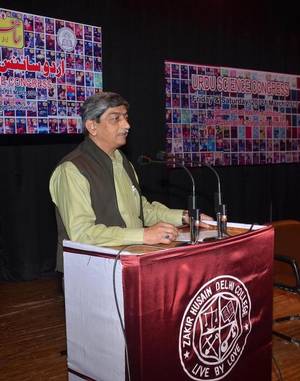
Mohammad Parvaiz at the first Urdu Science Congress in New Delhi in March 2015. Photo: Special Arrangement
A 23-year-old Urdu science magazine uses popular science to inspire progressive thought
Mohammad Aslam Parvaiz likes to describe a process that is a combination of four of his passions — botany, education, philosophy and religion. “The roots imbibe water and nutrients from the soil. The leaf photosynthesises, produces food, retains just enough for its own sustenance and sends the rest to the parts of the tree that need that food. This is the natural world’s law of diffusion — movement happens from the region of high concentration to the region of low concentration. If we see the tree as our community, that is how resources should flow too,” says Dr. Parvaiz, publisher of the magazine Urdu Science.
The first issue was launched at the World Book Fair in New Delhi in 1994. It dealt with AIDS and the myths surrounding condoms. In the last 22 years, the magazine has covered a gamut of subjects including water conservation and the need for a National Water Policy, common ailments and how to prevent them, sex determination, balding, sleep, life on Mars, and animation.
“Science is very effective in feeding the intellectual hunger of young people.Only with knowledge can they think for themselves and learn to analyse the religious scripts that they memorise. Most often it is the children of the poorest Muslims who attend madrasas. With only religious texts to lead them, and if they can read only in one language, how can you expect them to develop their personality and prosper in society?” asks the mild-mannered crusader, at present the Vice-Chancellor of Maulana Azad National Urdu University (MANUU) in Hyderabad.
In the campus, boulders display signages with scientific information and many trees carry their botanical names. “A person will absorb anything that is part of his environment,” he said to the graduate, post-graduate and doctoral students at the inauguration of an Urdu writers’ workshop. As an Urdu-medium student in a madrasa in Delhi, young Parvaiz hardly found any books or magazines in Urdu that could satiate his curiosity. In the Sunday markets of old Daryagunj, he used to find Russian books translated into Urdu, and that is how he discovered Benjamin Franklin. As a high-school student, he set up a science lab in his house. Years later, when he became the principal of Zakir Hussain College, he started a new venture in another corner of his house — Urdu Science.
“Survival depends as much on physical health as on intellectual growth, and sadly, the low potential for growth for poor students in madrasas is a problem across our subcontinent,” he says. An active member of the Modernization of Madrasa Education Project, he says that it is “ironic and tragic that clerics who lead our prayers and teach us about religion and the Koran do not have the means or the knowledge to impart a broad and progressive education. They accept that religious education is not enough, and many of them are now waiting for progressive teachers and educators to come forward and teach at madrasas.”
Having completed a PhD in botany, Dr. Parvaiz started writing in Urdu for Quami Awaz, then edited by Mohan Chirag. Noticing that most Urdu-medium students opted for the humanities, he wanted to popularise science. As a first step, he started a society called the Anjuman Farogh-e-Science, with patrons like Nobel Laureate Prof. Abdus Salam, Jamia Hamdard founder Hakeem Abdul Hameed, and Jamia Hamdard Chancellor Saiyid Hamid. The not-for-profit organisation held its first Urdu Science Congress in New Delhi in March 2015 and the second in Aligarh, this February.
“Urdu was a language of poetry and literature. People of different faiths patronised Urdu. But in those days, and even today, information in the language was very limited. And that is why I started this organisation and this magazine. My wife Shaheen helps me with proof-reading. And now I also have assistance from my colleague Dr. Tariq Nadwi.” Dr. Parvaiz is proud that the magazine has attracted enough Urdu science writers to contribute, and the magazine has so far never had to translate an article from another language. Issues from 2005 are available on the Academia.edu website.
Translation is an important key to dissemination of knowledge, agrees Parvaiz. He is on a personal mission to compile a glossary of scientific words in English, with meanings explained in Urdu. Sharing a slice of history, he says, “Delhi College was started as a madrasa by Ghaziuddin Khan. Here, mathematician Master Ramchandra and Maulvi Zakaullah translated many of the Western scientific texts into Urdu through the Vernacular Translation Society. It was there that I studied and later became the principal. I started Urdu Science when I was there. And I feel very humble that I now head MANUU, the university aiming to promote Urdu.”
A voracious reader of both religious texts and international science, Parvaiz says, “Science helps us interpret the Koran in many ways. And that is as relevant today as it was when the first issue of Urdu Science was launched.”
Mala Kumar is a children’s author, editor and freelance journalist.
source: http://www.thehindu.com / The Hindu / Home> Literary Review / October 15th, 2016
The Congress on Monday appointed Fairoz Khan, who hails from a remote village in Ramban district of Jammu & Kashmir, as the new president of the National Students Union of India (NSUI), the party’s student wing.
Congress vice-president Rahul Gandhi, who is in-charge of the frontal organisations of the party, recommended his appointment after personally interviewing those shortlisted for the post.
Speaking to Hindustan Times, the 28-year-old said, “‘I come from a village which is still devoid of electricity and proper roads.” “I come from a family with no political background. My father is a junior engineer in public health engineering department and my mother a housewife,” he adds.
Eldest among four siblings, Fairoz of Pogal Paristan shifted to Ramban for higher education and later, he did BSc from Bhaderwah Degree College and plunged into politics. He studied law from Jammu University in 2012 followed by masters in political science. Presently, he is pursuing post graduate diploma in human rights and duties education from Jammu University’s law school.
Khan, who loves soulful songs of Nusrat Fateh Ali Khan, remained NSUI national general secretary for four years from 2012. He was also the first elected national delegate of the NSUI from Jammu & Kashmir.
source: http://www.hindustantimes.com / Hindustan Times / Home> India / by Ravi Krishna Khajuria, Hindustan Times / June 12th, 2017
A Babur-focussed Uzbeki cultural project is using a common heritage to create a dialogue.
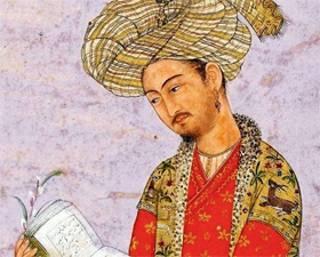
In July 1501, the great-great-greatgrandson of Timur (Tamerlane), Zahiruddin Muhammad Babur — the founder of Mughal empire — left his home in Fergana Valley in present day Uzbekistan. Five hundred years on, the Uzebki government is tracing his journey to India and his Indian connections as part of Cultural Legacy of Uzbekistan in Art Collections of the World project which began last year.
An effort to piece together the country’s history, researchers are connecting with international museums documenting the antiquity and artifacts connected to them. Till date, the Uzebki government has released 10 volumes and several short films on the cultural legacy of Uzbekistan with the help of information from leading museums in Russia, North America and Australia. “What they are doing is a first. They are not raising a dispute or demanding return of any antiquity. Instead, they are taking a holistic approach — using the common heritage to create a dialogue instead of stoking controversy,” says independent commentator Shashtri Ramachandaran, who participated in a two-day congress on the study organised by the Uzbek government.
An average Indian will be more familiar with United Kingdom, having followed their parliamentary and administrative methods or would be familiar with the cultural milieu of the United States, having developed an appetite for American TV shows. But barring academics, few are aware of the shared heritage between India and Uzbekistan that spans across centuries. A team of researchers from Uzebkistan visited the National Museum this April to piece together this lost history. “Their aim is to document material related to the Mughal era primarily. Once they present a formal proposal which is vetted by the Ministry of External Affairs and Ministry of Culture, they can start documenting work,” said Dr BR Mani, Director General, National Museum, who met with the Uzbekistan’s Ambassador last week to discuss the project.
The Uzbeki interest in the founder of the Mughal dynasty comes at a curious time, given that Babur’s successor Aurangzeb’s name was removed unceremoniously off Delhi’s roads for being an “invader”. Union Minister V K Singh even suggested that his grandfather Akbar should meet with a similar fate. In February this year, the BJP-led government in Rajasthan backed a proposal to rewrite history taught at the university level to attest that Rajput warrior-king Maharana Pratap won the Battle of Haldighati against Akbar’s Mughal army led by general Man Singh, despite historical evidence suggesting otherwise. In the same vein, RSS ideologue Indresh Kumar recently suggested that Babur and his army general Mir Baqi should be tried in court for destroying Ram Mandir in Ayodhya.
History suggests that Babur lived in India for only four years and died at the age of 47 in 1530 after successfully ousting Ibrahim Lodhi (in the Battle of Panipat in 1526). But his legacy lived on. The Babri Masjid demolition in December 1992 triggered the campaign to decry the Mughals as invaders. “Labeling the Mughals as “invaders” is bogus, historically. But Hindu nationalists do not use this label as a historical claim,” says Professor Audrey Truscke, who received severe backlash over her recent book Aurangzeb: the Man and the Myth. She adds that maligning Mughals is only a means to fuel “anti-Muslim sentiment in the present”. “It is a shameful business, especially at a time when vigilante violence against Muslims is on the rise,” she adds.
Babur was not Indian, even less an Uzbeki. He tried at least thrice to win Samarkhand but failed. “Babur took Samarkand one last time with help from the Safavids of Persia in 1513. However, as he had to publicly acknowledge his support for Qizilbash Shiism, his subjects turned against him,” explains Professor Ali Anooshahr from the History Department of the University of California.
During his time in India, Babur influenced architecture, culture, warfare and even introduced Indians to the sweet melons of Fergana. When Babur reached India, he was disappointed that the only fruit available was mango. It is said that he personally monitored planting of watermelons and musk melons. “In Babarnama, Babur writes about the apricots and pomegranates of Marghilan, fruit trees of Isfara, the melons of Bukhara, and the apples of Samarkand. He also recalled with pleasure, the various flowing rivers and brooks in that region,” adds Prof Anooshahr.
At the museum, the Uzbeki experts are particularly interested in manuscripts of the Holy Quran, scribed in Uzbekistan, which were presented to the Mughal emperors, as is evident from the royal seals on the cover page. Also of interest are 15 illustrated folios of the Baburnama. He wrote his autobiography in Chagatai language, the spoken language of the Andija-Timurids. It was during the reign of Akbar that the work was completely translated in Persian. According to Prof Anooshahr, the most comprehensive copy of the original is the Hyderabad manuscript. “Although I do not know where exactly that copy is located right now,” he adds.
The Uzbeki researchers are now looking at sources beyond the National Museum. “It is gratifying to realize that the culture of such a great country is connected with ours. We are planning to publish a couple of albums in India, depending on the results of our work,” said Professor Andrey Zybkin, the Uzbeki project coordinator.
Few sites of the Babur era have stood the test of time. Some of them include, West Delhi’s Babur era mosque, the Babri Masjid and Ram Bagh in Agra. But it is not just the Mughal era that is of interest. India and Uzbekistan go as far back as the Kushan Dynasty. The Kushan Empire, spanning an area of 37 lakh kilometres, extended from Bihar to southern Uzbekistan. It was an era when the Indian sub-continent saw extraordinary exchange of art and ideas. “At present we do not have first-hand information on the Kushan period artifacts found in Uzbekistan. It will be interesting to see how the pottery, social behaviour and culture changed from Fergana valley to Mathura,” Dr Mani added.
Apart from the Mughals and Kushans, there are other points of convergence between the two nations. Gujaratis had close trade ties with Uzbekis, so did Parsis and Armenian Christians. Professor A K Pasha from JNU explains that somewhere this search for their history is part of a “resurgence of old identity”. “For years, the Uzbeki culture was subjugated and overpowered by Russians. The Islamic feeling is growing which is why they want to resurrect their old identity,” explains Pasha.
source: http://www.mumbaimirror.indiatimes.com / Mumbai Mirror / Home> Others> Sunday Read / by Sobhana K Nair, Mumbai Mirror / June 18th, 2017
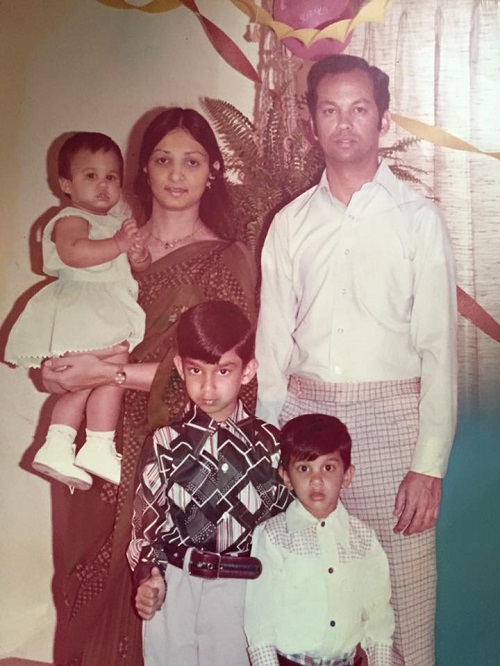
The author, his wife and three children circa late 1970s in North Dakota.
This is Day 22 of the 2017 #30Days30Writers Ramadan series – June 17, 2017
by Syed Husain
It was in the summer of 1976, following my post-doctoral assignment at Stanford Research Institute in California, I was offered a faculty position at University of North Dakota, School of Medicine. Although it was a tempting offer, leaving San Francisco and moving to Grand Forks with three small children was a difficult thing to consider.
Recalling the Persian proverb, “Mulk-e-Khuda Tang Neest, Pa-e-mera Lung Neest” (The Kingdom of God has no limits and no broken legs do I have to limit my travel), I decided to accept this offer – though I knew a Muslim community to draw on for support in North Dakota would be virtually nil.
A leap of faith indeed, but as a Muslim, I had a firm belief in my Creator and my destiny.
As we started our journey across the country, it was full of amusement and excitement. We only had ourselves to rely on – myself, my wife, and my three children, ages seven, four and one. The passage through Yosemite with tall redwoods, the majestic Grand Tetons, the enchanting Yellowstone National Park, the amazing Mount Rushmore and the Badlands was an experience to behold.
Finally, we arrived in the small college town of Grand Forks. And, we found the people of this land of Aurora Borealis, sun-dogs, snow and tumble-weed to be friendly, hospitable and compassionate.
After settling in the faculty housing, my priority was to find out how many Muslims, including students, were on campus. As the Ramadan was approaching, I wondered if they had facilities to pray and observe Ramadan. Surprisingly, I found only one another Muslim faculty and a handful of students with no place to worship. Later, I located four more families in a radius of fifty miles from Grand Forks that became the “core group” of Muslims in the area.
In this isolation, as Ramadan arrived, we made frantic calls to Chicago, Montreal, Minneapolis and Winnipeg to confirm the sighting of the moon. To determine the duration of fast and follow the fiqh ruling, we decided to follow the times in Winnipeg, the closest city with a sizable Muslim population. Those were long days — we were fasting for 19 hours a day with the sun setting around 9:45 p.m.
The University had appointed me as Muslim Faculty Adviser, and I was able to get space in the student union for our Jummah prayers and iftars. This small community had no provision for halal meat and no place to buy spices and other ingredients to prepare our food. A good Samaritan in the community located a farmer, who helped us sacrifice a heifer or a black angus.
This farmer became the source our halal meat supply for the rest of our stay (15 years) in North Dakota. Families would share the meat and drive to Winnipeg or as far as Chicago to get condiments and other supplies. The spouses in this small core group got together and started preparing meals, iftar and sahoor for their families and for students as well on weekends. We began to feel the baraka (blessings) of Ramadan in this newly formed community.
Fasting was difficult, but we managed and grew closer as a family (and as a married couple) in doing so. When we finally made it to iftar time around 9:45 p.m. and broke our fast, my wife and I (we were the only ones fasting in our family in the ‘70s) were grateful. Our children would beg us to take them to McDonald’s for ice cream after we prayed Maghreb and ate dinner, around 10:30 p.m. at night, but it was hard to get the energy to do so.
The nights we rallied and took them were very special to all of us – small treats that meant so much to our children and to us.
The summer season in North Dakota is short, sweet and very precious. It was amazing to see farmers busy harvesting crops under floodlights into the wee hours of the night. Our neighborhood on the outskirts of Grand Forks bordered a large farming field. The rumbling noise of trucks hauling beetroot and sunflower seeds were a reminder to us to get up for our sahoor.
I recalled my childhood days back in Hyderabad, India, when at sahoor time hawkers pass through Muslim neighborhoods singing local folklore, breaking the quiet of the night as these trucks did and reminding the community that sahoor time was soon to end.
Our children (and the daughter of one other Muslim family in town) were the only Muslim students in their schools. The school authorities were kind, compassionate and understanding. They were cognizant of the Islamic principles and provided our children with a private bathing facility and a place to worship. This was back in the 1980s in an educational community that probably had never seen or interacted with Muslim kids before.
Alhamdulillah, this conducive, inclusive and inter-faith understanding of the teachers and the school district authorities nurtured a healthy, positive civic atmosphere and a sense of belonging for our children. Our children use to wait eagerly for the arrival of Ramadan and for the celebration of two Eids.
These occasions were a real source of joy to these few host Muslim families and their children and to the small group of students. We celebrated Eids in a church, in an International Students’ Home on campus and in our homes.
This was our Little Mosque on the Prairie much before the celebrated television show.
This was our forging of an American-Muslim experience in a community that sometimes didn’t understand us, but developed friendships and deep relationships with us based on love, kindness and mutual respect.
In our sojourn of 15 years (1976-1991) in North Dakota, we also saw swings in the population of Muslim students and in the community due to graduations, termination of University of North Dakota’s Pilot Training programs with Gulf Airlines and Saudi Arabian Airlines and faculty transfers/retirements. In recent years, the economy of North Dakota has improved greatly due to oil exploration in Williston Basin.
The city of Fargo (one of the largest cities in North Dakota, about an hour away from Grand Forks) has seen a sizeable number of Muslim immigrants arriving. The city of Grand Forks also has its share and has seen a surge in new arrivals. We wish them all a Happy Ramadan and Eid Mubarak.
Syed Husain, Ph.D. is a retired professor of Pharmacology at the School of Medicine, University of North Dakota and a retired Scientific Review Administrator at the National Institutes of Health in Bethesda, MD. He now has eight grandchildren forging their own American-Muslim experience.
source: http://www.patheos.com / Patheos / Home> altmuslim / by Syed Asif, Guest Contributor / June 17th, 2017
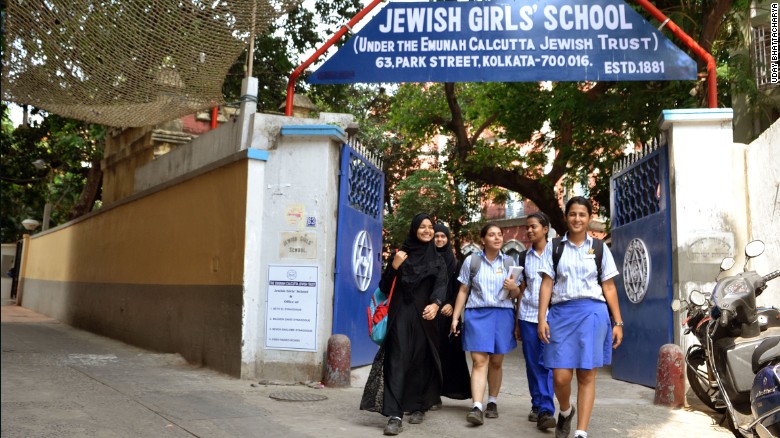
Muslim girls, some in the burqa and some in the regular uniforms, leave the Jewish Girls School in Calcutta.
Editor’s Note : Anik Basu is a Kolkata-based independent journalist.
Kolkata, India (CNN) :
When Mitana Alexander bid goodbye to Kolkata’s Jewish Girls School in 1975, she was its last Jewish student. The bulk of the others were Muslims.
But it was not the steady influx of Muslim girls in the preceding two decades that moved Alexander’s parents to take her out of the school, she says.
They were worried because she was last remaining occupant of a Jews-only dormitory, as most Jewish girls they had known had migrated to Israkel, America or Europe “with their folks.”
“They (school authorities) had to retain a matron just for me,” recalls Alexander, now aged 50. “I would be alone in the dormitory at night and my parents started panicking. Muslims had nothing to do with my leaving.”
Author-scholar Jael Silliman, whose children are settled in the US, says development in India and the outside world in the 1940s-50s led to an exodus of Jews from Calcutta.
Distinctly Kolkata
The swelling ranks of Muslim girls in the Jewish school offer a glimpse into the deep ties between Kolkata’s Muslim and once-thriving Jewish community.
More than 1,200 of the nearly 1,400 students are Muslims, as is the school’s vice principal and half the faculty.
The change began in the 1950s, when there were not enough Jewish families needing an institution set up specifically to instil Jewish values.
As Jewish enrollment petered out, the authorities decided to admit children of other faiths. The biggest response came from the Muslims of nearby areas.
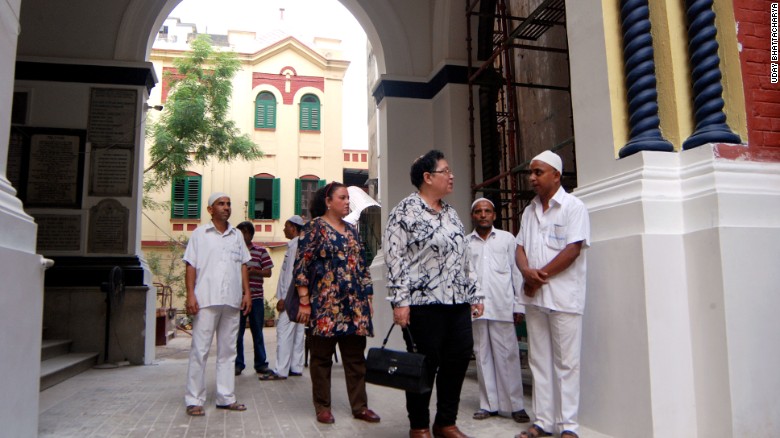
Aileen Jo Cohen (foreground) and Mitana Alexander talk to Muslim caretakers at one of Calcutta’s three synagogues.
Today, there is very little “Jewish” about the school, save for perhaps its name, the Star of David on the school gates, the school uniform and notebooks, and portraits of Jewish patrons on the walls.
Authorities have made available a “changing room” for Muslim girls whose parents frown upon their stepping out in public in school skirts.
These students leave home in the burqa, change into their uniforms once in school, and put on the burqa when leaving. “Our parents don’t like it if we bare our legs,” says senior student Zara Ahmed, 17.
“The school has come to symbolize Jewish-Muslim harmony in Kolkata,” says managing trustee Aileen “Jo” Cohen.
The harmony is visible elsewhere too; the city’s three synagogues — the smallest of which boasts of more chairs in its prayer hall than there are Jews in Kolkata — are looked after by Muslim caretakers.
Muslims also help with the dressing of bodies for Jewish burials and outside the Magen David Synagogue, Muslim bangle sellers wearing the topi (the Muslim prayer cap), have set up kiosks on the bustling footpath.
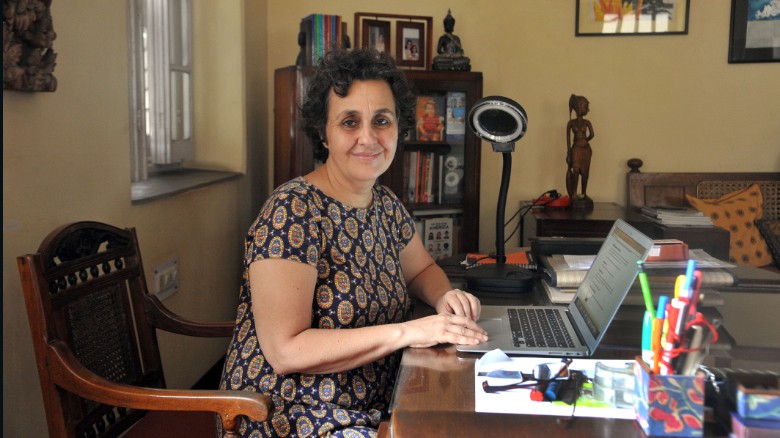
“The close ties and positive working relationships between Muslims and Jews are deeply rooted in the local context of Kolkata,” says Jael Silliman, 62, a city-born Jewish scholar and author, and a former Associate Professor of Women’s Studies at the University of Iowa.
Exiting Kolkata
The first Jew to arrive in Kolkata, on August 4, 1798, was Shalom Ha-Cohen. A native of Aleppo, Syria, Shalom was initially the court jeweler to a Muslim prince in northern India.
Shalom’s prosperity attracted other Jews from West Asia. According to community records, the population of Jews “of Arabic disposition” expanded to 600 by the 1830s. That number stood at around 4,000 when India gained independence from British rule in 1947.
However, soon after the community started emigrating en mass, beginning the end of a 200-year association with the city.
“A combination of national and global events in the ’40s and ’50s led to a very rapid dissolution of the community,” says Silliman, whose two daughters settled in the US.
With India’s independence, British settlers began returning to England, Israel came into being in May 1948, and the fledgling Indian government’s Socialist policies were perceived as not being conducive to business.
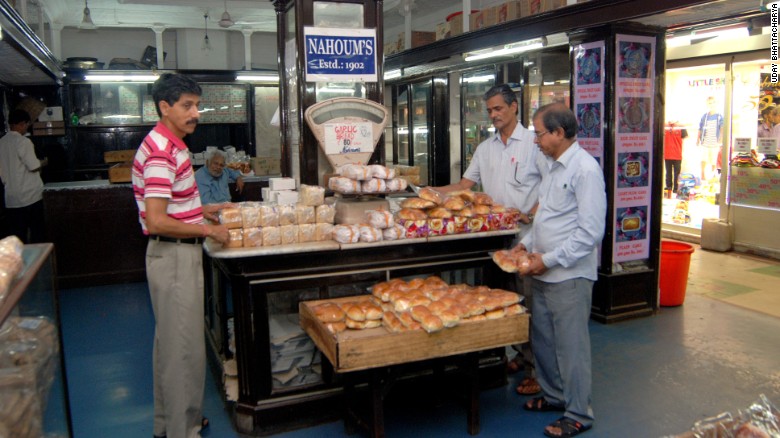
Muslim workers at the 115-year-old Nahoum’s confectionary, founded and owned by Jews, in downtown Calcutta.
Today, the number of Jews in Kolkata stands at 22, the middle-aged Alexander being probably the youngest.
And it is left to the likes of the Jewish Girls School Vice-Principal Abeda Razeq to keep those ties alive.
Her father’s best friend at college was a Jew, whose family runs the 115-year-old confectionary store Nahoum’s, and their friendship, which continued beyond college, first exposed Razeq to Jewish culture.
The two families exchanged gift hampers during their respective festivals and Razeq learnt of the similarities and differences between kosher and halal cuisine.
She even helped out at Nahoum’s at Easter and Christmas: a Muslim girl at a Jewish bakery wrapping cakes during Christian festivals in a predominantly Hindu city.
The Nahoum family has shrunk to just one member now, who spends much of his time abroad, and the workers — many of them Muslims — run the show.
Razeq did her dissertation on Kolkata’s unique Jewish-Muslim relationship, and wishes she had the time to complete her doctorate on it.
“It’s a rich subject,” she says.
source: http://www.edition.cnn.com / CNN / Home> Region> Asia / by Anik Basu / June 16th, 2017
Two policemen –Sajjad Ahmad and Shabbir Ahmad– were killed in separate attacks by militants in Kashmir in last 24 hours.
Unidentified militants fired upon two policemen outside mosque after namaz in Hyderpora, resulting in injuries to both. One of them, Sajjad Ahmad, succumbed to his injuries on Friday.
This was the second attack by militants on policemen in the Kashmir valley.
Earlier on Thursday, militants shot dead a policeman in south Kashmir’s Kulgam district.
Constable Shabir Ahmad was shot outside his residence at Bogund in Kulgam, a police official said.
The cop was rushed to a local hospital but he did not survive.
The terrorists, however, managed to escape the scene after firing. A search operation was also launched to track them down.
Terror attacks aimed at security forces have increased in the Kashmir Valley, in the recent times.
A cordon and search operation was also launched at Arwani village in Jammu and Kashmir’s Kulgam district on Friday after security forces received intelligence inputs about the presence of suspected terrorists in the area.
Militants had carried out a series of attacks on security forces on Tuesday in Kashmir, in which 13 jawans were injured and four service rifles looted. The attacks — four in south and one in north Kashmir — came in a span of four hours.
A grenade was hurled at a CRPF camp at Ladiyar in Tral area of Pulwama district. 10 paramilitary jawans were injured in the attack.
In the second attack, the militants opened firing on the security personnel guarding the residence of a retired high court judge at Anchidora in Anantnag district, resulting in injuries to two cops.
The third attack took place on a CRPF camp at Padgampora in Pulwama, but no one was hurt in it as the grenade hurled by the militants exploded mid-air.
The militants also hurled a grenade at Pulwama police station, resulting in minor injuries to a policeman.
Another attack took place near Bomai in North Kashmir’s Sopore, but no damage was caused.
(With inputs from agencies)
source: http://www.abplive.in / ABP / Home> ABP Live> India / by ABP News Bureau / June 16th, 2017