Category Archives: Community Involvement / Social Issues

The fight has not left Cavalry Khandan of Jhunjhunu

Nuah Village (Jhunjhunu District), RAJASHTAN :

CavalryKhandaanMPOs30mar2017

Jaipur :

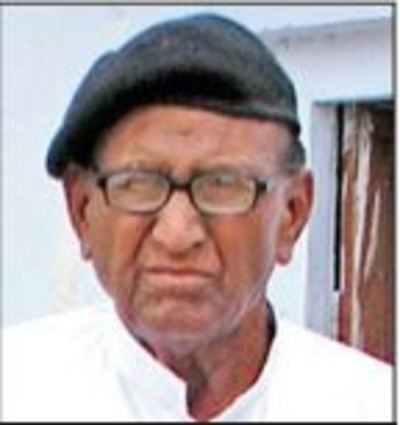
Eighty five-year-old Muraad Ali Khan, a native of Nuan village in  Jhunjhunu district of the state, gets all animated whenever trouble starts brewing on the border.

His family, popularly known as ‘Cavalry Khandan’ (Cavalry family), and his six cousins had participated in India-Pakistan wars in 1965 and 1971. Though all his cousins died over the past three years following old-age problems, Ali is an active participant in the ongoing discussions and debates on deteriorating Indo-Pak relations.

Some hours after the Indian Army carried out the surgical strikes in Pakistan occupied Kashmir (PoK), 10 days after the Uri outrage, TOI spoke to Ali for his reactions to the conflict.

Not surprisingly, Ali, who has been following developments through television and newspapers like the rest of the country, was happy and congratulated the government of India and Army. “I must congratulate our forces for the act. I think our Prime Minister Narendra Modi’s tactics to isolate Pakistan is yielding results and the cancellation of the SAARC summit is proof fir it,” Ali said on Thursday.

His cousins — Captain Mohammed Ayub Khan, Captain Gaus Mohammed Khan, Captain Mohammed Sadiq Khan, Captain Yusuf Khan and Captain Gulaam Sarvar — had served the Indian Army in the 1965 and 1971 wars against Pakistan in various capacities.

He is the only surviving member of the ‘Cavalary Khandan’ who had served the Indian Army as a subedaar.

Captain Ayub was a Union minister who died on September 16 following a massive cardiac arrest. He was 85 and a recipient of Vir Chakra for his acts of valour during the 1965 India-Pakistan war. Ali’s village Nuan has at least one member from every family serving in the Army in various capacities.

“My opinion of the ongoing scenario is that India should isolate Pakistan financially, diplomatically and should continue with these surgical operations. They don’t deserve any mercy,” he added. In between, he wanted to know the number of casualties in surgical operations carried out by India. “Humari fauj Pakistan ki harqaton ka maqool jawab de sakti hai (Our Army can give appropriate answer to Pakistan). Humare sabr ka imtihaan na le Pakistan (Pakistan should avoid testing our patience),” he added.

Mohammed Shariq Khan, son of late Captain Sadiq Khan, who works as a teacher, said, “Whenever he (Ali) gets news of an army man being martyred, he gets pumped up. His blood pressure goes up. All his brothers had done a lot for the country. Our village has a good number of Qayamkhani muslims and from other communities who had fought in battles with Pakistan.”

source: http://www.timesofindia.indiatimes.com / The Times of India / News Home> City News> Jaipur / by Ashish Mehta / TNN / September 30th, 2016

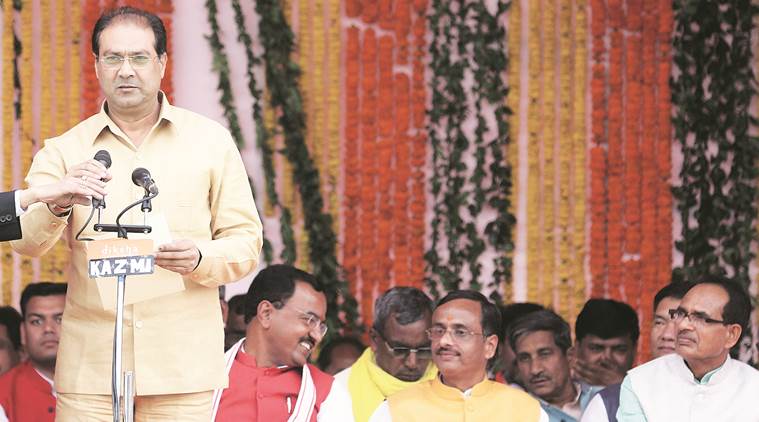
Who is Mohsin Raza, the lone Muslim face in Yogi Adityanath’s cabinet?

UTTAR PRADESH :

Before making his foray into politics, Raza tried his hand at cricket, modelling, and is a known socialite in Lucknow. He has had the odd TV acting stint and even tried his luck at an entry in Hindi films.

Mohsin Raza taking oath of office in Lucknow on Sunday.

The  Bharatiya Janata Party fought the Uttar Pradesh Assembly election on a carefully crafted electoral strategy that was meant to polarise and consolidate Hindu vote. The party didn’t field any Muslim candidate out of the 403 in the elections. But, firebrand leader Yogi Adityanath, who took oath as Uttar Pradesh Chief Minister on Sunday, has included a lone Muslim leader in his cabinet – Mohsin Raza. Though he may seem the odd entrant into Adityanath’s cabinet, the multifaceted Raza, crowned Prince of Lucknow in a pageant in mid 1990s, has a more interesting past than most seasoned politicians.

Before making his foray into politics, Raza tried his hand at cricket, modelling, and is a known socialite in Lucknow. He has had the odd TV acting stint and even tried his luck at an entry in Hindi films.

Raza is married to Fozia Sarwat Fatima and belongs to a zamindar (wealthy landowners) family that hails from Safipur town in Uttar Pradesh’s Unnao district. He was born on January 15, 1968 in Lucknow.

Raza trained at the MRF Pace Foundation based in Chennai and went on to play two matches in the Ranji Trophy representing Uttar Pradesh. He didn’t have a great showing as a bowler picking only 4 wickets in 2 first class matches with an average of 42.75. Batting figures were worse with five runs scored in two first class matches. His first class cricketing career ran between 1987-89.

Raza has alo participated in beauty pageants and in 1995 he won the Prince of Lucknow crown. He also acted, though not in a prominent role, in the Doordarshan’s acclaimed TV series ‘Neem ka Ped’ written by award winning lyricist and poet Rahi Masoom Raza starring thespians like Pankaj Kapoor and Arun Bali. He persistently kept trying his hand at Hindi film industry but did not get any break.

In 1999, he was made the chairman of Congress’ sports cell but after he was given the position of convener, rifts emerged and it meant his stay had come to an end. He suspected foul play against him and felt it would be best to leave.

His wife fought local elections independently a few years ago and lost by a margin of 125 votes. Then, in 2010, Raza floated his own political outfit by the name of Safipur Vikas Manch but that did not prove to be a successful endeavour.

After so many failed attempts, he joined the BJP ahead of the General Elections in 2014 and was made the party spokesman in 2016.


Kutchi Memons go a long way back

KERALA :

The Kutchi Memons who came here in 1815 first settled in Mattancherry

Kochi:

If a phrase can describe the Kutchi Memon community in Kochi it is great cultural resilience. In rebuilding their lives, so far away from the place of their origin, the first generation Kutchi Memons here demonstrated a remarkable ability to flourish in the face of greatest of odds.

“I just wonder how they made it to Kochi,” says Javeed Hashim of the Abad Group of companies of his great grandfathers who arrived in Kochi from Kutch, in Gujarat early in the 19th century.

Would it have been by sea? Or, over land? Whichever way they came, they showed great spirit. The same spirit of perseverance and enterprise that stand them in good stead to this day. Mr. Hashim is just one example of the way generations of Kutchi Memons, a close-knit and mostly endogamous community, have rebuilt their lives in their new homelands becoming ever closer to the societies that accepted them and at the same time, keeping alive the flame of cultural identity and social coherence. he language is a big factor that has kept our identity intact, says Mr. Hashim. “At home I speak Kutchi, and the moment I am out, I have to switch either to English or to Malayalam,” he says. Kutchi is a language closer to Sindhi than Gujarati. The Kutchi Memons who came here in 1815 first settled in Mattancherry, the hub of business and nucleus of the old city. They have now spread out into other parts as the city grew over the decades.There are about 500 families of Kutchi Memons in Kochi, says Rasheed Usman, president of the Kutchi Memon Association.

Religious festivals like Eid and social occasions like marriages are times when the community cements its unity. On days of religious festivals there are family get-togethers at places that are fixed by communities in each locality, says Dr. Sadath Sait, a Homoeopath.

And marriage celebrations last more than a week with the pre-marriage celebrations bringing together relatives and friends in large numbers to the homes of the bride and groom. While the community members have more or less adopted the local dress code, the older people still love to wear their traditional dresses. Dr. Sait says that the Kutchis love their food and though have adopted the local food in many ways, the mix of masalas or the preparation of Biriyanis etc differ a lot from the local practices. The Kutchi Memon Association and the Cutchi Memon Jamath are engaged in both charity work and also in helping the more needy members of the community. The Kutchi Memon Association lays great stress on helping people to attain higher education, says Adam Essack, the Association Secretary.

The Kutchi Memons have made their mark both on the political and business fronts in Kerala. Ebrahim Suleiman Sait and G. M. Banatwala, both from the Kutchi Memon community are examples of great innings in politics.

source: http://www.thehindu.com / The Hindu / Home> National> Kerala / by K.A.Martin / July 25th, 2008

Ayub Khan: A war hero who rose to become a union minister

Nuah Village (Jhunjhunu District) , RAJASTHAN :

AyubKhanMPOs22mar2017

Jaipur :

A decorated soldier of the 1965 Indo-Pak war who rose to become a union minister, Capt Ayub Khan was laid to rest at his village Nuah in Jhunjhunu district with full military honours on Friday. He was born in 1932 in a Kayamkhani Muslim family of soldiers. His grandfather and father too served the Indian Army and now his cousins and their sons are continuing the family tradition.

Capt Ayub, the state’s first Muslim to win a Lok Sabha election and twice be a Congress MP from Jhunjhunu, was also a recipient of the Vir Chakra from President Dr S Radhakrishnan for destroying four Pakistani Patton tanks and capturing one in the Sialkot sector of J&K. Prime Minister Lal Bahadur Shastri had hugged the brave soldier and remarked, “I never met the Pakistani President Gen Ayub Khan but I’m proud to meet the Indian Ayub.”

In the 1965 war, Ayub was posted in the Sialkot sector that was under Lt-General P O Dunn. The 26th Infantry Division was ordered to capture Sialkot. The 18th Cavalry’s Bravo squadron, led by Risaldar Ayub Khan, was ordered to clear the Sialkot Road from Pakistan’s occupancy. The squadron moved upfront facing enemy fire. On September 9, the squadron confronted a large column of Pakistani forces with Patton tanks.

The Pakistani tanks attempted to encircle Indian troops, so the squadron commander ordered his troops to turn about and check the enemy encirclement. Ayub moved back and headed to close up with the enemy tanks that were threatening to cut off Indian troops from the rear. Ayub led from the front and destroyed four tanks before Pakistan could realize that an Indian troop had turned back to attack it.

In 1983, Ayub retired from the army and was granted the rank of Honorary Captain. Later, he joined politics and became a union minister in the cabinet of Prime Minister PV Narasimha Rao. Ayub Khan chose to wear white kurta-pyjama and sported the black army cap of the 18th cavalry, minus the crest. At 84, Capt Ayub used to sit at home and enjoy life with his family. He was no longer active in politics, as he hated the present day caste-based politics.

source: http://www.timesofindia.indiatimes.com / The Times of India / News Home> City> Jaipur / by Prakash Bhandari / TNN / September 17th, 2016

Meet Najima Bibi, First Muslim Woman To Fight the Manipur Elections

Wabagai (Thoubal)  MANIPUR :

“Women bow down to men because they are uneducated. Lack of education deprives them of their political right.”

Najima Bibi is the first Meitei Muslim woman to contest an assembly poll. Credit: Amanat Khullar

Wabagai (Thoubal), Manipur:

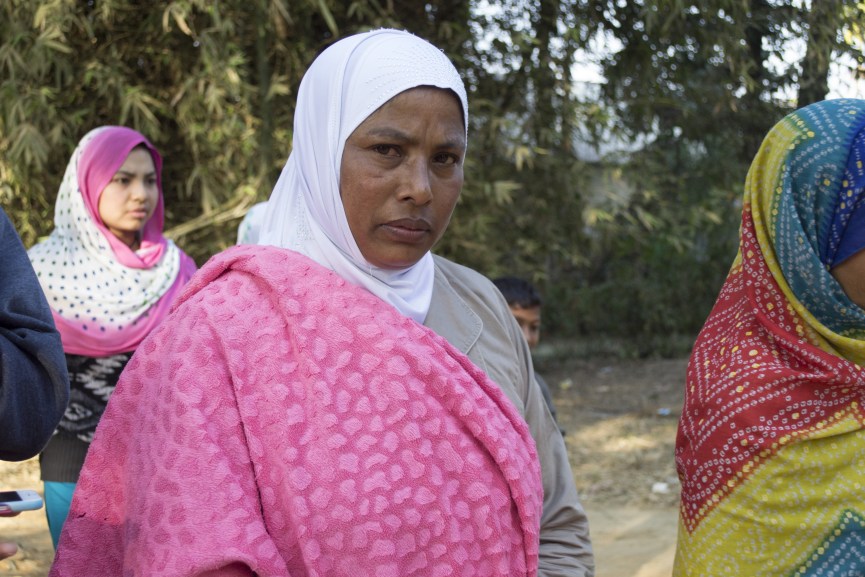
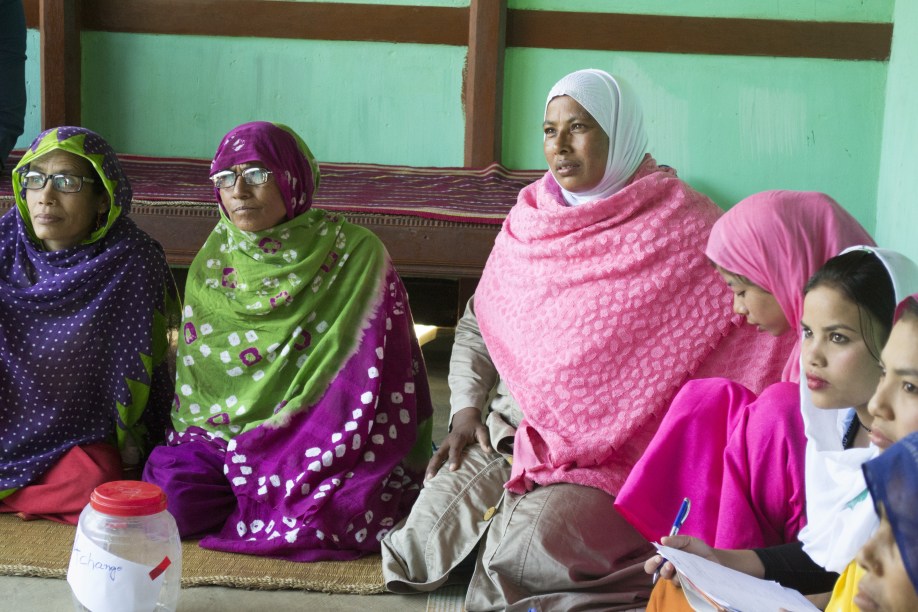
Donning a brown abaya and with a white synthetic cloth clutching her forehead, Najima Bibi sat on a mat on the mud floor of a neighbour’s hut with a cluster of men and women, both young and old, surrounding her.

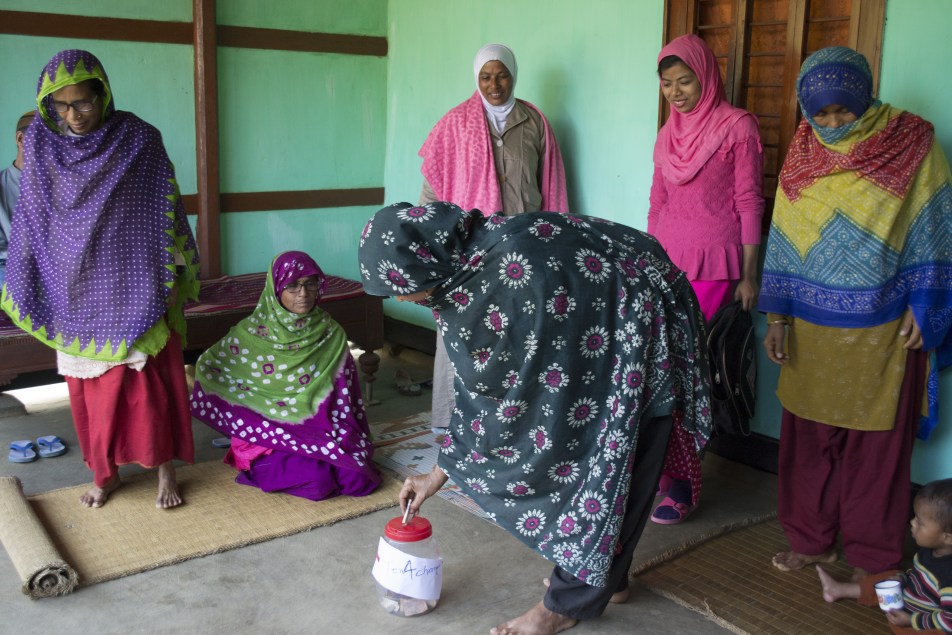
A used plastic container with a bright red lid filled with ten rupee notes sat in front of the 44-year-old who scanned her surroundings with a slight smile.

With the words ‘Ten4change’ scrawled in blue ink on a paper taped to it, the container served as a donation box. By the time Najima ended the community meeting, each one of those present had made their contribution for ‘change.’

Just as cups of lukewarm black tea – a definite afternoon pick-me-up – were being handed out by the owner of the hut, Najima passed around forms listing questions about the basic facilities in the village and about the expectation of the people from their representative.

Community members make donations to Najima Bibi’s party – PRJA. Credit: Amanat Khullar

Najima, also known to many as Najima Phundreimayum, has been a social activist for over 15 years in and around Santhel Mamang – the leikai (colony) she belongs to in the Wabagai area of Manipur’s Thoubal district. After years of activism, she changed gears and decided to contest the upcoming Manipur assembly elections.

Alternating between contemplating and then hurriedly jotting down their answers, a few seemed a bit unsure of what to put down in the form and what to leave out. Even as they began returning the filled sheets of paper to her one by one, it became apparent that she didn’t quite need such thermometers to measure the ills of the poor people of her Muslim community, particularly the womenfolk. The level of comfort between her and them was obvious.

Yet, these forms are seen as a key for gauging the mood and expectancies of the people who would choose between her and three other major candidates in the March 8 elections in the Wabagai assembly constituency.

Even though forms are often seen by voters as a novelty in Manipur, Najima – a first-time contestant in an assembly election – felt that “They are vital.”

“The answers will help me focus more on what exactly they are seeking from me as a contestant, and if I win, as their representative in the assembly,” she reasoned.

For those unfamiliar with the candidates in the fray for the upcoming elections in the state, Najima’s immediate introduction to them would be as the Wabagai seat contestant from the anti-AFSPA activist Irom Sharmila’s party, Peoples Resurgence and Justice Alliance (PRJA). She is also the treasurer of PRJA.

She is also someone who has made her name in Wabagai as an intrepid trendsetter among the Meitei Muslim women. A dynamic woman to have challenged her conservative background to demand her gender rights, she has been a relentless voice for women’s empowerment within her community.

However, her name would go down in history for something even more exceptional – being the first Muslim woman contestant of Manipur.

Stepping into the public life as a woman has never been easy, not even in the Northeast, where the general myth about women being relatively more empowered than in the rest of country looms large.

“My struggle has been long and lonely. First, I was mildly taunted for what many saw as breaking rules set for girls in our community, and then gradually it turned into serious opposition,” she said.

Across Santhal Mamang leikai, billboards announcing various government schemes weren’t hard to spot. Stuck to the walls of the mud huts were also posters asking the villagers to “break silence” on the “war crimes in Syria” and the “genocide of the Rohingyas” in Myanmar – the country that Manipur shares a border with.

A few labourers have been repairing one end of the main road that runs through the leikai and which is broken in several parts.

The main road in Najima’s constituency of Wabagai in Imphal. Credit: Amanat Khullar

On being asked about the repair work, Najima smiles and says, “That’s the reason I am contesting elections. There’s only patchwork in the name of development by the people’s representatives.”

“I have been working against domestic violence faced by our women, for our right to food, etc. We are poor people. We have many problems. We can get effective results from various government schemes that already exist if our representatives are supportive of us. But what we get is only ample show of money power and muscle power by the MLAs and people connected to them.”

When Sharmila announced the launch of her party, Najima resolved to join her. She had her reasons. “I thought this would be the best way to expand the scope of my work. What I have been doing at an individual level could be done in a bigger way if I can be the MLA,” she told The Wire.

Najima, unlike most women from her community, found her voice by dint of her sufferings. If being the only girl in her class was an assertion of her right to educate herself early in life, being the first girl in her family to have completed the tenth standard was certainly an eyebrow raiser, among relatives and others.

When Najima was about to be married off aganst her wishes, she did what she knows best – defy. “I ran away to marry a man I met only twice before. That marriage turned out to be a disaster.”

Within six months, she took another step which women from her community would usually avoid a talaq.

Thereafter, day-to-day survival taught her a lesson on self-reliance. She initiated ‘Cheng Marup’, a rice thrift fund for the women of her leikai.

“Everyday, the women in the group would take out one handful of rice from the quantity to be cooked in their homes. These were collected and kept in my house, and twice a month, whoever’s turn came, she would get the entire rice and would sell it to earn some money. It was looked at with suspicion by many people in the leikai as I was divorced and our saving was considered a theft. But we kept it running. Slowly, people realised its benefits,” she recalled.

Najima made small moves to claim her space in her conservative society, like riding a bicycle.

Outside Najima’s house in Wabagai in Thoubal. Credit: Amanat Khullar

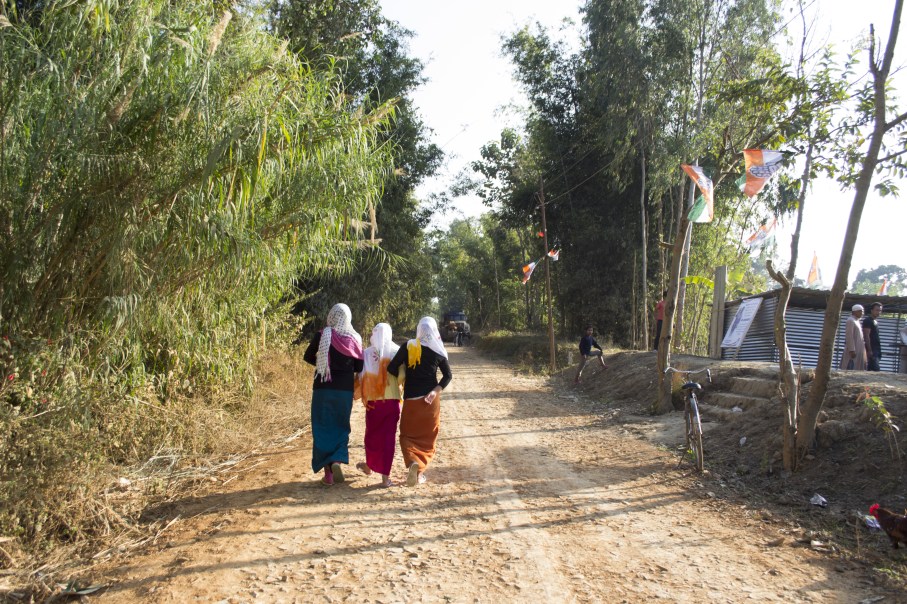
“Even now, everyone makes fun of me when I ride a bicycle to the meetings but I don’t mind. Muslim women were not allowed to ride a bicycle just to slow them down. I realised that I can begin fighting most of it off by just riding a bicycle. Alongside, I was also able to make it on time everywhere and get a lot of things done,” she said in a recent campaign meeting with women voters of her constituency.

Soon after she announced her decision to contest the polls, she was met with a warning from local clerics. “They not only warned me against contesting the elections but also said if I do, I would not be given space for my grave in the local kabristan. They also warned that anyone who supports me or talks to me would meet the same fate,” Najima told The Wire.

This, however, was not the first time that the clerics had declared a fatwa against her.

“After attending a workshop on gender by an NGO in Imphal in 2001, I realised what I had experienced and what many of my fellow women had experienced daily was gender violence. I began to help out such women,” she said.

“I now run a destitute home for such women here. All such activities led to a fear in the minds of the clerics that I am turning into a follower of Meira Paibi (a powerful women’s rights organisation in the Meitei community). They tried to stop me but couldn’t. So in early 2006, the clerics announced on the local loudspeaker used for namaaz that all women self-help groups in the area were banned on religious grounds. They named me for provoking women, still I didn’t bother. Then they issued a fatwa as per which I was stopped from taking water from the local pond. No shopkeeper would sell me goods. I defied it too and went to bring water from the pond.”

Najima surrounded by women from her community. Credit: Amanat Khullar

Her defiance led some people to beat up her present husband, twice. “I am proud of him, he chose to stand by me,” she said.

A few months later, the matter was settled after the intervention of Jamiatul Ulama, Manipur and some other Muslim organisations that sided with her for helping Muslim women get empowered.

For the present fatwa, Najima countered the contention that such a call from them had come only because she was a woman. “There is a leadership crisis. I have been raising questions on the distribution of ration through the PDS system. This ban by the clerics is one of the tools used by the local politicians to stop me from contesting the polls. Else, those in power run the risk of getting exposed,” she said.

The sitting MLA from Wabagai, Fajur Rahman, who is from the Congress party, is also contesting the elections. Taking on him is yet another stalwart, U. Deben, a former MLA. Then there is the BJP rebel candidate Habibur Rehman, who is contesting as a Janata Dal (United) candidate. Rehman was the vice-president of BJP’s state minority morcha.

So where does she see herself in this complicated fight?

“I know I am fighting formidable forces; they know many a trick to win elections. It is the biggest struggle for me to convince the voters about what is actually good for them. But I am confident to surmount it with the help of my supporters,” she replied.

Irrespective of who wins, the fact that Manipur is seeing in its elections the participation of a woman from its sizeable Muslim community for the first time in the 70 years of independence, is certainly notable.

What took so long for this to happen?

“The main problem is, ours is a male-dominated society, women are afraid of confronting men. When they say you can’t contest elections, it becomes the final word,” she said. “Women bow down to men because they are uneducated. Lack of education deprives them of their political right.”

source: http://www.thewire.in / The Wire / Home> Gender / by Sangeeta Barooah Pisharoty and Amanat Khullar  / February 24th, 2017

‘I used to scratch the letters ‘IAS’ on the desk’

Kuttiyadi (Kozhikode) , KERALA :

“It was quite unusual in our community (for girls to be educated and independent) but my father was different.

“For him, education was of utmost importance.

“I wanted to be a part of the nation building process and I felt I would be able to contribute positively if I became an IAS officer.”

Atheela Abdullah, 29, talks to Shobha Warrier/Rediff.com about how she achieved her dream.
Atheela01MPOs22mar2017

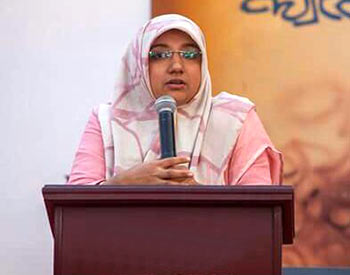
Atheela Abdullah (pictured left) grew up in a small village in the Malabar region of Kerala where Muslim girls were not generally encouraged to study or work. Her father, however, encouraged his wife to work and his daughters to study and pursue their dreams.

He worked in the Middle East and her mother, a school teacher in the village, took care of their children.

Although Atheela studied medicine, she wanted to become an Indian Administrative Service officer. Her husband, who was her classmate at medical college, encouraged her to follow her dream.

Thus began the inspiring story of a young mother — Atheela has two small children — and her single-minded pursuit of her dreams, discovers Shobha Warrier/Rediff.com.

Growing up in a village

I grew up in Kuttyadi, a small village near Kozhikode in Kerala.

My mother was a school teacher and, till Class IV, I studied at a primary school there. After that, my father sent me to a boarding school in Kozhikode because he wanted his children to study in a good English medium school. My elder brother and sister were already in boarding school.

My father wanted both his daughters to grow up into independent women. This is quite unusual in our community (for girls to be educated and independent) but my father was different. For him, education was of utmost importance. He used to tell us how he met a German lady in the seventies who advised him to give his children the gift of education.

My father never differentiated between his son and his daughters.

The atmosphere at the boarding school helped develop my interests like reading, elocution, essay writing, participating in quizzes and debating.

A passion for nation building

In school, I used to scratch the letters ‘IAS’ on the desk; it was the only way I revealed my hidden desire.

I wanted to be a part of the nation building process and felt I would be able to contribute positively if I became an IAS officer.

Sometimes, I thought of becoming a scientist instead and contributing to the nation like Abdul Kalam but I knew I didn’t have the scientific temperament that is needed. So, I decided to be an administrator.

It was unusual for a girl from a middle class Muslim family in a small village, who had never seen an IAS officer, to dream of becoming one.

The options available to me as a student were to either become an engineer or a doctor. I chose the latter as I felt I would be able to do something for the community as a doctor.

Joining medical college

I joined the MES Medical College in Perunthalmanna. Believe me, I would scribble ‘IAS’ on the desk here too, perhaps to remind myself that it was my ultimate dream.

Though I was studying medicine, my reading involved a wide range of topics. I spent a lot of time in the library reading magazines and newspapers.

Meeting her husband

I became friends with Rabeeh, (the man she would marry, Dr Rabeeh V) who was studying medicine in another college, because of the interests we shared. He used to write, while I was a public speaker.

I was 23 and doing my house surgency (internship). My parents were looking for a match for me. Rabeeh and I thought, why not get married? After all, we were from the same community and shared the same interests. Our relationship started off as a literary bond, we became good friends and, after four years of knowing each other, we got married.

By then, I realised that my interest did not lie in giving injections and prescribing medicines. My passion lay in working for the community; at the same time, I knew I did not want to study community medicine.

Even as a medical student, what interested me was talking to patients, understanding their background and needs, and their socio-economic condition. I felt there was a gap somewhere that needed to be filled.

In January 2011, I completed my studies.

From medicine to IAS

My husband was extremely supportive of my desire to become an IAS officer. He told me that though we had not seen anyone from our community achieve such a dream, if I were to achieve this, I would motivate more women to become IAS officers. Both of us want women from our community to come to the mainstream and be independent.

It was at that time that one of Rabeeh’s friends got selected as an IPS officer. We went to meet him to take his advice on how to prepare for the examination. He asked me a couple of questions and I could answer them so he asked me to go ahead and write the exam.

I went to Delhi to attend a three-month coaching class. Rabeeh came along to help me find a place to stay. He was with me for 10 days. He was preparing for his postgraduate entrance exam then.

When I returned, I took up a job as a pathology tutor in a medical college. This time, I decided to support the family as Rabeeh was preparing for his examination.

I didn’t have much time to prepare for the preliminary exam but I didn’t find it difficult; in fact, it was easier than my medical examinations. Here, I was studying subjects I really liked — English, social science, etc.

I knew I was risking my career in medicine but I was prepared.

Luckily, I got through in the preliminary examination in the first attempt itself. For the next two months, I prepared for the main exam. I was in Delhi for a month to prepare for the public administration paper; the other optional paper was medical science which I had studied in medical college.

This time, I stayed at the Hamdard Study Circle, which the government had started for the minorities in India; it is a free study circle.

While I wrote the mains, my husband wrote his PG exam.

The Attapadi community centre

As we did not have children then, we decided to work at the Attapadi community centre, which is a rural tribal area. The experience was an eye opener; we were exposed to a government system that didn’t work. We also understood some of the deficiencies in the system when we saw a tele-medicine unit worth Rs 4 crores lying unused.

We felt really helpless when we were unable to treat emergency cases. Nobody wanted to work there. At times, when you needed a workforce of 60 people, you had only six people to work with.

The mains hurdle, cleared!

While I was at Attapadi, the mains results were announced; I had cleared it. It was time for another trip to Delhi for another round of coaching. This time too, I stayed at the Hamdard Study Circle. The coaching, which lasted for a month, was quite helpful.

Though I was pregnant and had all the uneasiness connected with it, I tried to forget the difficulties and concentrated on the preparation. I didn’t want to waste an opportunity. I wanted to prove to the family that I could achieve whatever I want to and also do what was expected of me as a daughter, wife and daughter-in-law.

I knew was charting a new course for someone like me in our community. As the first one, I had to work hard to prove myself so that, tomorrow, perhaps my daughter will have it easy. There was no question of my complaining about anything as I liked taking up challenges and coming out victorious.

Facing the interview board

My interview was scheduled in April 2012. I was four months pregnant then.

They asked me a lot of questions on the kind of work I was doing at Attapadi and also about the tribes there, their lifestyle, their traditional occupation, the common health problems they face, etc. They also asked me about the role of technology in medicine, my opinion on euthanasia, etc.

They wanted to know why I wanted to be a civil servant when I was comfortable with the profession I was in. I told them that I always wanted to be a civil servant; it was a dream that I had carried with me from the time I was in school.

I was quite hopeful after the 30-minute interview.

When the results were out, I had secured a rank of 230.

I think I am the first Muslim woman from the Malabar area to become an IAS officer.

Becoming a mother
Atheela02MPOs22mar2017

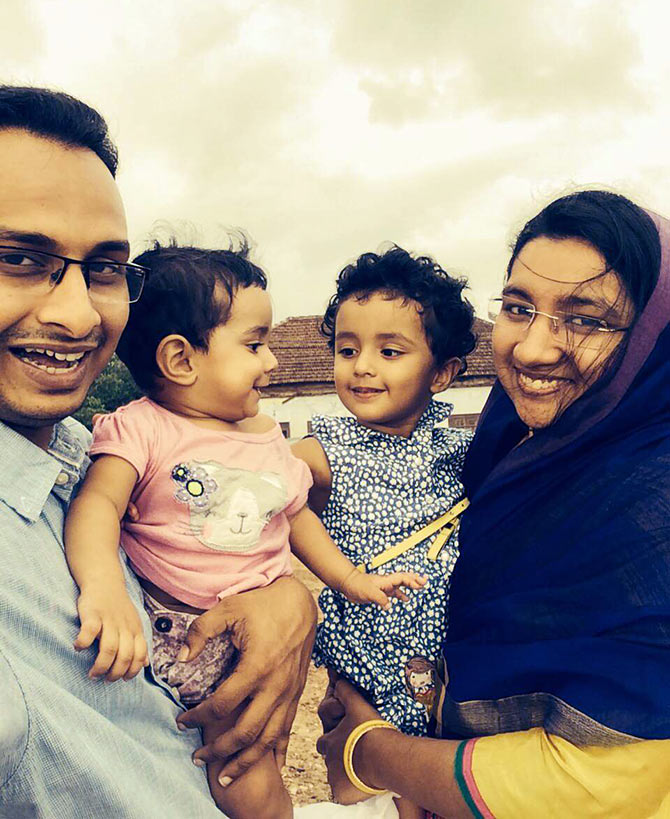
I couldn’t complete my training as I had to take leave for my first delivery. I went back after my child was born and completed the training.

I was posted as assistant collector at Kannur for a year. By then, I was pregnant with my second child. After my second maternity leave in 2014, I was posted in the Tirur sub-division as an assistant collector. I could not complete my training at Mussorie — I have eight months left and will be leaving soon to complete it — as I had to go on maternity leave.

Childbirth and bringing up children come with a lot of sacrifices and responsibilities for women, but I feel they still have the ability to have a successful career.

I am glad this happened at the beginning of my career so I need not take breaks later. I hope to focus on my career in the years to come. I am able to manage both the kids reasonably well with support of my husband and our family.

It is extremely important to have the support of your husband if you want to chase your dreams. My husband is extremely proud of me and encourages me to be independent. If he sees someone really smart, he urges me to be as smart as him/her.

Wearing a hijab

People ask me why an independent woman like me wears a hijab. You won’t believe it, but I didn’t know till now that what I wear is called a hijab.

I grew up in northern Malabar, which is a very conservative area. All Muslim women wear a thattam (the cloth with which you cover your head) here. I have seen my grandmother and mother wear a thattam. I’ve worn a thattam since I was a school kid. When I wear a sari, I just cover my head with the sari.

I never wore the headgear which the Arabs use.

Just because I am an IAS officer now, should I change the way I dress? I believe that as long as the Constitution gives you the freedom to follow your traditions and beliefs, I can dress the way I always have.

I can say that these things have never come in the way of my job as a doctor or as an IAS officer.

For the first time in my life now, I am asked questions about the way I dress. I feel I need not answer such questions. According to me, we shouldn’t waste time talking about such symbols.

India is a great country that allows you to be what you are. That is the beauty of our country. I don’t think any other country gives this kind of personal freedom to an individual.

Even when we were growing up, my father had told me I should have the willpower and strength of character to move forward even if something pulled me backwards. So people commenting on the way I dress do not bother me. What matters to me is my integrity.

Those who influenced her

What guided me forward are the teachings of Mahatma Gandhi who, according to me, was a yogi and a bhakt.

It is because of the influence he had on me that I want to serve my country.

Our country is fortunate to have three great people to guide us; Mahatma Gandhi, Bhagat Singh and Abdul Kalam.

Kalam, according to me, was a yogi like Mahatma Gandhi.

But the three people who have helped me realise my dream are my father, mother and my husband.

Working as an IAS officer

The experience I had at Attapadi made me all the more determined to be in the system and make a difference, even if it is a small one.

Although we are a very developed civilisation, we have not been able to bring the entire population to a desired level socially in the last six decades. Many more people have to be part of the nation building process; only then we can make our country a developed country for all.

A good politician can also bring about positive changes in the society but I was not sure if I could be a politician.

Nobody has told me anything negative about being in the civil services, I have only positive views about it.

I have just started my career and have only idealistic thoughts in my mind, which I know is unrealistic. I would say, let me have my idealistic thoughts till I face reality!

Advice to the young

~ Have faith in yourself and work hard.

~ You should have the will power and strength to face adverse situations. You should always be focused.

~ The positive energy you get from your family only adds to your contribution. Your efficiency improves if you have very good support from the family.

~ Don’t ever think about what society or others think about you; believe only in your ability.

Photographs: Courtesy Ateela Abdullah

Shobha Warrier / Rediff.com

source: http://www.rediff.com / rediff.com / Home> Getahead / by Shoba Warrier / September 30th, 2015
Remembering Syed Shahabuddin – Muslim Heart, Indian Mind

Ranchi (JHARKHAND) formerly BIHAR /  NEW DELHI :

His arrival on the political scene as an articulate Muslim leader was no ordinary event in the journey of the Indian republic.

Syed Shahabuddin, 1935-2017. Credit: Youtube

Writing an obituary of the writer, diplomat and politician Syed Shahabuddin is actually an exercise in writing of the journey of Muslims in the Indian republic. The much maligned gentleman was somebody who could never be ignored. As a very bright student of physics in the academically brighter phase of Patna University in the first decade of India’s independence, he drew the attention of his teachers. The memoirs of his professors, Mohsin and Kalimuddin Ahmad, describe Shahabuddin’s promise in glowing terms. Soon thereafter, he became known for the leadership he provided to a student movement in 1955, including leading a 20,000-person march to wave black flags against Jawaharlal Nehru when he visited Patna – in protest against police firing on students.

He managed to get a job as a lecturer at the same time as qualifying for the civil services in 1957. He ranked second among all the aspirants, with a particularly high score in the interview section, and joined the Indian Foreign Service. Many delicious legends were fabricated around the kind of questions he was asked and his witty responses. His success not only inspired many students, but also helped overcome the trepidation among Muslims about their place in India after Partition.

While a section of Hindus looked upon Muslims as potential fifth columnists, a section of Muslims was also not very confident of the inclusionary-pluralist democracy that was being built up under Nehru. Notably, even as a student, Shahabuddin too was contributing towards this task of nation-building. With some ‘socialist’ leanings, though not formally with any party, his activism allowed certain critiques of the Nehruvian consensus to be heard.

He paid a price for this activism, though a minor one. Owing to Shahabuddin’s involvement in the student agitation of 1955, he had to wait for police/intelligence clearance and therefore could join the services a little later than his other batchmates. Legend has it that Nehru himself finally cleared the file.

In the late 1970s, the hegemony of the ruling Congress came be challenged by the socialists, Shahabuddin became restless within the confines of bureaucracy. He decided to quit government service and join politics.

Until then, Indian politics lacked a pan-Indian Muslim leader with well informed and articulate views. Although Maulana Azad had occupied an important position, he was part of the Nehruvian consensus and did not challenge it. Nor were academics looking at the worrying economic and educational locations of Muslim communities and their disproportionately inadequate share in the structures and processes of power. A few exceptions existed, such as the volume on castes among Muslims edited by Imtiaz Ahmad in the late 1960s and the works of Uma Kaura and Mushirul Hasan looking at the marginalisation of Muslims by the Congress under majoritarian pressures in 1970s, but these were rare.

None of the important dissenting voices in Indian democracy, whether Ram Manohar Lohia (1910-67), the defender of the lower castes, Jai Prakash Narayan (1902-79) nor the Left were paying attention to this issue.

Shahabuddin saw this vacuum in Indian politics and adventurously jumped in to fill it. His arrival on the scene as an articulate Muslim politician was no ordinary event in the journey of the Indian republic. As he stormed in, with his enviable articulation and abilities invoking constitutional values and spirit, he was almost matchless. He could not be dismissed, but he could be maligned as a sectarian, conservative and even communal reactionary. Often, he gave his critics grounds to do so. His stand on the gender issue in the Shah Bano case, where he stood on the side of the clerics, and on free speech, by asking for Salman Rushdie’s Satanic Verses to be banned are particularly problematic as the repercussions continue to play out today. On the issue of caste among India’s Muslims too, he was dismissive of pasmanda activists, although unlike many ‘reactionary’ Ashraaf, he never denied the reality of caste-based oppression and discrimination in Indian Islam.

His critics had little time for complexities and he was frequently clubbed with people like Maulana Bukhari, the Shahi Imam of Jama Masjid in Delhi, despite there being little to compare the two in either democratic legitimacy or point of view.

Throughout the 1980s and ’90s, Shahabuddin, through his English monthly, Muslim India, a journal of “Research, Reference and Documentation”, kept articulating and disseminating the concrete (as well as emotive) issues of concern to Indian Muslims, besides contributing  extremely powerful, informed and passionate editorials. Putting together news reports and views from across periodicals, the magazine also carried parliamentary speeches, interventions, government reports, book reviews, personality profiles and statistical data demonstrating the under-representation of Muslims in various sectors of the economy and employment, and many other crucial areas. This was done with candid, coherent, persuasive prose, laced with facts and figures, and at times beautified with apt Urdu couplets.

The title of the monthly he had chosen turned out to be provocative, as this expression is said to have been used in certain documents of the Muslim League in late colonial India. But the sharp (and cunning, if I may say) mind of Shahabuddin had a very strong defence in the English grammar. He explained that in the expression ‘Muslim India’, the former is  an adjective and the latter a noun. Thus, ‘Muslim India’ would grammatically put emphasis on the Indian identity of someone just happening to be Muslim. It was more patriotic than the expression ‘Indian Muslims’, wherein more emphasis was on Muslim (who happened to be Indian). Hence, he preferred ‘Muslim Indian’ to ‘Indian Muslim’.

Besides making interventions in a range of journalistic and academic periodicals, including even the ‘provocative’ English monthly, Debonair, Shahabuddin’s Muslim India carried very powerful editorials on almost every issue which touched the Muslim segment of Indian democracy. Nobody before and after him could muster that much of courage, conviction, energy and determination to do all these, that too all alone. Yet, he found enough time to reply to all the letters he received. He religiously wrote and dispatched letters.

The editorials that had particular impact are worth recalling. In July 1994, he wrote on Lalu Prasad Yadav’s brazen Yadavisation in Bihar at the expense of his core and unflinching support base – Muslims. The argument was well made, even by the standards of Shahabuddin’s characteristic articulation, with so much data damning the Lalu regime on almost every aspect of governance. Predictably, soon after, he left the Janata Dal. In July 2000, he published another editorial on the problems of governance at the Aligarh Muslim University (AMU) and their possible remedies. This was meant as advice from a senior IFS officer to a junior one, Hamid Ansari, who had joined as the vice chancellor of AMU. Yet another important editorial was on the 1988 Act making Jamia Millia Islamia (JMI) a central university. He called the Act a “swansong” for JMI. He later expanded this editorial and wrote a long essay,  ‘How to revive the spirit of Jamia Millia ‘,  in the Milli Gazette in 2010. Focussing on the AMU Act 1981, the lawyer in him kept arguing that the legislated Act did not provide AMU with minority status, though it did have minority character.

In the final years of his life, many of his projects remained unfinished. The tragic and mysterious murder of his only son Parwez (an IIT alumnus and a promising scientist) in the US in 2005 had perhaps broken him from within, even though he did carry on with his life as bravely as ever. He never got around to finishing it but the title he chose for his autobiography was Muslim Heart, Indian Mind. Perhaps that is the best way to remember him by.

Mohammad Sajjad is an associate professor at the Centre of Advanced Study in History at Aligarh Muslim University and the author of Muslim Politics in Bihar: Changing Contours.

source:  http://www.thewire.in / The Wire / Home> Politics / by Mohammad Sajjad / March 09th, 2017

She lost her legs but not will to be a doctor

Mumbai, MAHARASHTRA :

Raushan Jawwad
Raushan Jawwad

______________________________________________________________

HIGHLIGHTS

  • The law allows only people with “up to 70% handicap” to study medicine, she was found to be 88% handicapped
  • Raushan lost both of her legs in a train accident, moved the Bombay high court to study medicine

________________________________________________________________

Mumbai :

In an instance of triumph of will over circumstances, Raushan Jawwad, the fiesty 24-year-old from Jogeshwari who lost both her legs to a train accident in 2008 and later moved the Bombay high court to study medicine, managed to get the prefix of “doctor” attached to her name on Tuesday evening.

Jawwad Shaikh, her vegetable vendor father, and mother Ansary Khatoon, a homemaker, had tears in eyes when they saw people clap for their daughter while she was being conferred with the MBBS degree during the convocation ceremony.

Nine years after the accident, Raushan has become the first doctor in her family.

A bright student, she scored 92.15% in her Class X exam in 2008. A few months later, on October 16, 2008, she was pushed out of a crowded local train near Andheri station. She was on her way home after writing her college exam papers at Bandra’s Anjuman-i-Islam Girls College in the train when she fell on to the tracks and lost her legs under the moving train. Hearing Raushan’s screams, some commuters pulled the chain and the train was stopped. It took her a year to pull herself out of the trauma and resume her education.

“I am thankful to Allah for giving me the courage to continue my studies. I am now preparing for MD entrance. I want to start a hospital in my ancestral village in Azamgarh where many people face medical problems due to non-availability of good hospitals,” Raushan told TOI on Wednesday. She has expressed willingness to work for the poor in villages near Mumbai too. Last year, Raushan secured a first class in the final-year MBBS exam at KEM Hospital.

While the law allows only people with “up to 70% handicap” to study medicine, she was found to be 88% handicapped post the accident. To continue her education, Raushan had to put up a fight. She approached the Bombay high court seeking its intervention to secure an admission. Despite qualifying for the entrance exam, the government found her “unfit” to study medicine. The then high court Chief Justice Mohit Shah directed the state to give her admission. “When she can come all the way to court, why do you think she won’t be able to come to class?” asked Justice Shah.

Raushan stays with her parents, an older brother and younger sister in a 10-by-10-foot rented room in a Jogeshwari chawl.

“While studying at KEM, I used to stay in a college hostel. All my classmates, colleagues and teachers helped me a lot. The credit for my success goes to them too. They would always be very helpful and I never felt disabled when in their company,” said Raushan. When TOI first reported the accident, several people came forward to help Raushan financially. But her family did not even have a bank account.

source: http://www.timesofindia.indiatimes.com / The Times of India / News> City News> Mumbai News / by Mateen Hafeez  / TNN / March 12th, 2017

Sahul Hameed Ujire new president of Al Ameen Association Dammam-Jubail unit

 Dammam (SAUDI ARABIA ) / Ujjire (Dakshina Kannada) KARNATAKA   :

Dammam :

The third annual general body meeting of  was held on February 23. The programme began with Qirat by Maher Mohammed.

Imam of Ujire Central Masjid, Abu Sufyan H I Ibrahim Madani, Hamed Saeed Al Ghamdi, Anwar Hussain Goodinabali, Kamaruddin Goodinabali, Amjad Khan Polya, Qasim Tolhath president of Al Ameen Riyadh unit and Usman Kotrody senior vice president of Al Ameen Dammam-Jubail unit were the chief guests at the function.

Dammam-Jubail unit president, Sahul Hameed Ujire welcomed the audience and the chief guests. Vice president S A Azeez of Al Ameen Dammam-Jubail Unit anchored the programme.

Azeez S A delivered a brief introduction of the educational and other activities carried out by Al Ameen Association Ujire and explained how Al Ameen worked all these years back home. He also thanked each and every member of the unit.

Ubaidullah Ujire, general secretary, presented the audit reports.

Qassim Tolhath, appreciated the efforts of the unit and took up the responsibility to dissolve the old committee and announce the newly formed committee. He also wished the new committee.

Sahul Hameed Ujire was named president unanimously for the third time.

Abu Sufyan H I Ibrahim Madani Imam of Ujire Central Masjid expressed his gratitude to all the members and thanked them for their dedicated service to the community.

Hamed Saeed Al Ghamdi, Anwar Hussain Goodinabali and Kamaruddin Goodinabali called on the office bearers to exercise their team spirit and tireless effort to serve the community and their complete dedication toward the noble cause.

Ubaidulla Ujire proposed the vote of thanks.

Al Ameen Dammam-Jubail unit executive committee members for the year 2017-2018 are as follows:
Sahul Hameed Ujire (president), Azeez S A (general secretary), Usman Kotrody (vice president), Ubaidulla Ujire (vice president), Farook Alankar (treasurer), Mansoor Kuntini (joint secretary) Siddik Charmadi (joint secretary) and Asif QTF (auditor).

Advising committee:
Yakoob U A, Yusuf U H, Mohammad Ali and Bava Hussain

Executive members:
Mehboob, Salahuddin, Mohammed Anees, Irfan, Hudaifa, Suhail, Zameer, Mansoor Athaje, Hameed Athaje, Abdullah Muguli, Rafeeq Muguli, Abdul Khader Halepete, Rafeek vital, Ashraf Bellur, Amjad Khan, Raheem Arkula, Yusuf Vitla, Ibrahim Khader, Mohammed Iqbal and Shamsuddin.

source: http://www.daijiworld.com / DaijiWorld.com / Home> Middle East / Thursday – March 02nd, 2017

Survivor of cancer shows the way ahead

Bantwal (Dakshina Kannada District), KARNATAKA :

When 30-year-old Abdul Jabbar Ponnodi from Bantwal of Dakshina Kannada district was 20 years old and wanted to complete his UG course like many of his friends, he developed back pains.

Abdul Jabbar Ponnodi

For nearly one-and-a-half years, he went to a local doctor and lived on painkillers. However, after two years when the pain increased, scanning and other medical tests revealed that Abdul had developed ewing sarcoma, a rare form of cancer.

Speaking to Bangalore Mirror, he said, “Gradually my legs lost strength, I lost bladder control. I was bedridden. I was operated upon, and after radiation therapy as well as chemotherapy for nine months, my condition improved. With almost two years of physiotherapy, my legs started regaining strength. With the help of special shoes, I started moving around, started using the scooter and also started working as a salesperson in a mobile phone shop.”

For almost seven years, he worked at the mobile centre. At the same time, he also started emceeing for programmes, worked on developing a mobile application for an online portal and was active on social media as well as writing short poems.

“Unfortunately, again there was a growth near my lungs last year. It was about 12 cm, but with medicines it was reduced to one cm. I was on medication for the next six months, only to notice the growth increase to 14 cm. With chemotherapy, it has been reduced to 8 cm. I have more sessions of chemo to go,” he said. In the last ten years, he has been counselling patients at a private nursing home and has also formed a WhatsApp group where they collect funds to help needy patients.

“Whenever I get to know that someone in a family or friend or relative is suffering from cancer, I go and speak to them. Disease should be restricted to the body and not to the mind. The body can be treated, but not the mind. It is important for people to follow a diet that has more natural food and avoid preservatives,” he said.

source: http://www.bangaloremirror.indiatimes.com / Bangalore Mirror / Home> News> State / by Bangalore Mirror Bureau / March 01st, 2017