Category Archives: Community Involvement / Social Issues

No Raman effect: How his dream died a quiet death

Madras / Bangalore (KARNATAKA ) :

Sir C V Raman had planned to set up a scientific institute in 1959 on a four-acre land in Madras.
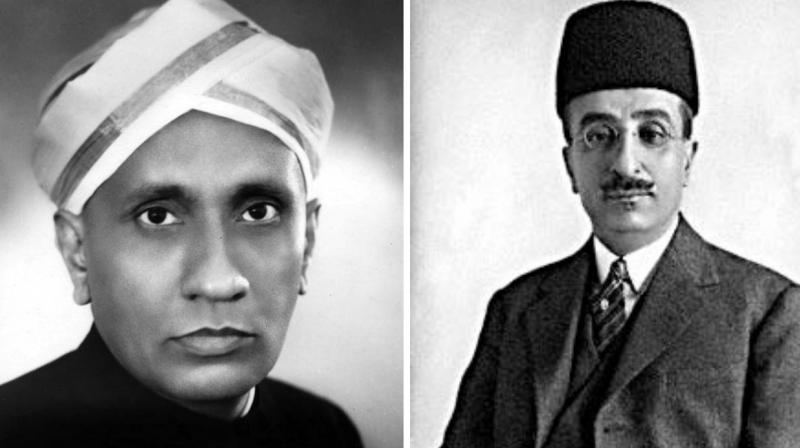
Sir Raman has clarified that he was not sent out of Mysore, but came from Calcutta to Bangalore in 1933, and received support from the Dewan for his scientific work.

Bengaluru:

A research institute – complete with a lab, a science museum, a science library, a lecture hall and office rooms – was late Nobel laureate Sir C.V. Raman’s idea of giving something back to Madras (Chennai), a city where he commenced his scientific career, and to make a “distinct contribution” to the scientific life of the city, but it has remained an unfulfilled dream.

Sir Raman planned the second institute in 1959, 11 years after establishing Raman Research Institute (RRI) in Bengaluru, on a four-acre land parcel owned by him in Mylapore (Madras), where “scientific work of the highest standard could be carried on”.  He estimated that the research institute could be built with a budget of a couple of lakhs of rupees and carry on work with a minimum recurring expenditure of Rs 2,000 a month. “My confidence in the usefulness of the proposed institute is indicated by my preparedness to find from other sources one half of the capital expenditure proposed and also to meet one half of the recurring expenditure necessary for the next five years. If the Government of Madras could see their way to make an equal contribution, the construction of the institute could be immediately taken up and proceeded with,” states the renowned physicist’s letter dated August 18, 1959, to the late C. Subramaniam, minister for finance education, Government of Madras,  unearthed by Deccan Chronicle on the eve of National Science Day, observed on February 28 to mark the discovery of ‘Raman Effect.’

Subsequent correspondence between Mr Subramaniam and Sir Raman point at the state government’s willingness to support the proposed institute, but with a suggestion that the Nobel laureate write to the Union government for non-recurring expenditure of the project. “I may say, however, that subject to the condition that the assistance to be given by the Government of India, if any, will be taken into account in fixing the actual grant, this Government will be willing to meet a maximum of half the non-recurring cost of establishing the research institute and to make a suitable annual recurring grant for five years in the first instance,” reads the late Mr Subramaniam’s reply.

With the erstwhile Madras government listing several conditions as part of the grant-in-aid code for half grant towards construction of the institute and repeated suggestions for securing the Union government’s financial support, Sir Raman’s subsequent letter to Mr Subramaniam points at his reluctance to seek help from New Delhi. “My past experience and present knowledge of the attitude of the Central Government in matters concerning scientific research alike indicate that any application for a building grant made to that Government for the proposed institute would be met with a refusal. Not until the institute has been fully established and proved itself useful would the Central Government feel at all inclined to extend a helping hand to it,” mirrors his disinclination to write to the Centre.

Sources in RRI Trust said Sir Raman had adopted a similar stand vis-à-vis RRI and the Union government. “It was only after Sir Raman’s demise that the Union government offered aid to RRI, and the Trust invited his son Prof V Radhakrishnan to head RRI,” sources added.

Sir Raman came to the rescue of Dewan Ismail
Another set of letters, exchanged between Sir Raman and Sir Mirza Ismail, the Dewan of Mysore, in 1939, illustrates how the Nobel laureate rushed to support the latter in the wake of an article published in “The Hindu Outlook”, accusing the Dewan of favouring Muslims in appointments in Mysore state.

Sir Raman has clarified that he was not sent out of Mysore, but came from Calcutta to Bangalore in 1933, and received support from the Dewan for his scientific work.

“Throughout this period, I have received nothing but kindness and consideration from Sir Mirza Ismail on all occasions, and indeed I have had reason to feel most grateful for the fact that he has held the high office of Dewan of Msyore during these years,” reads Sir Raman’s letter in response to an article published by Krishna Lal Anand in “The Hindu Outlook” on September 14, 1939, with a headline “Muslim Dewan over Hindu state.”

source: http://www.deccanchronicle.com / Deccan Chronicle / Home> Lifestyle> Viral and Trending / by B R Srikanth, Deccan Chronicle / February 28th, 2017
After years of neglect, glass top to complete Satkhanda.

Lucknow, UTTAR PRADESH :

Wikimedia Commons
Wikimedia Commons

Lucknow :

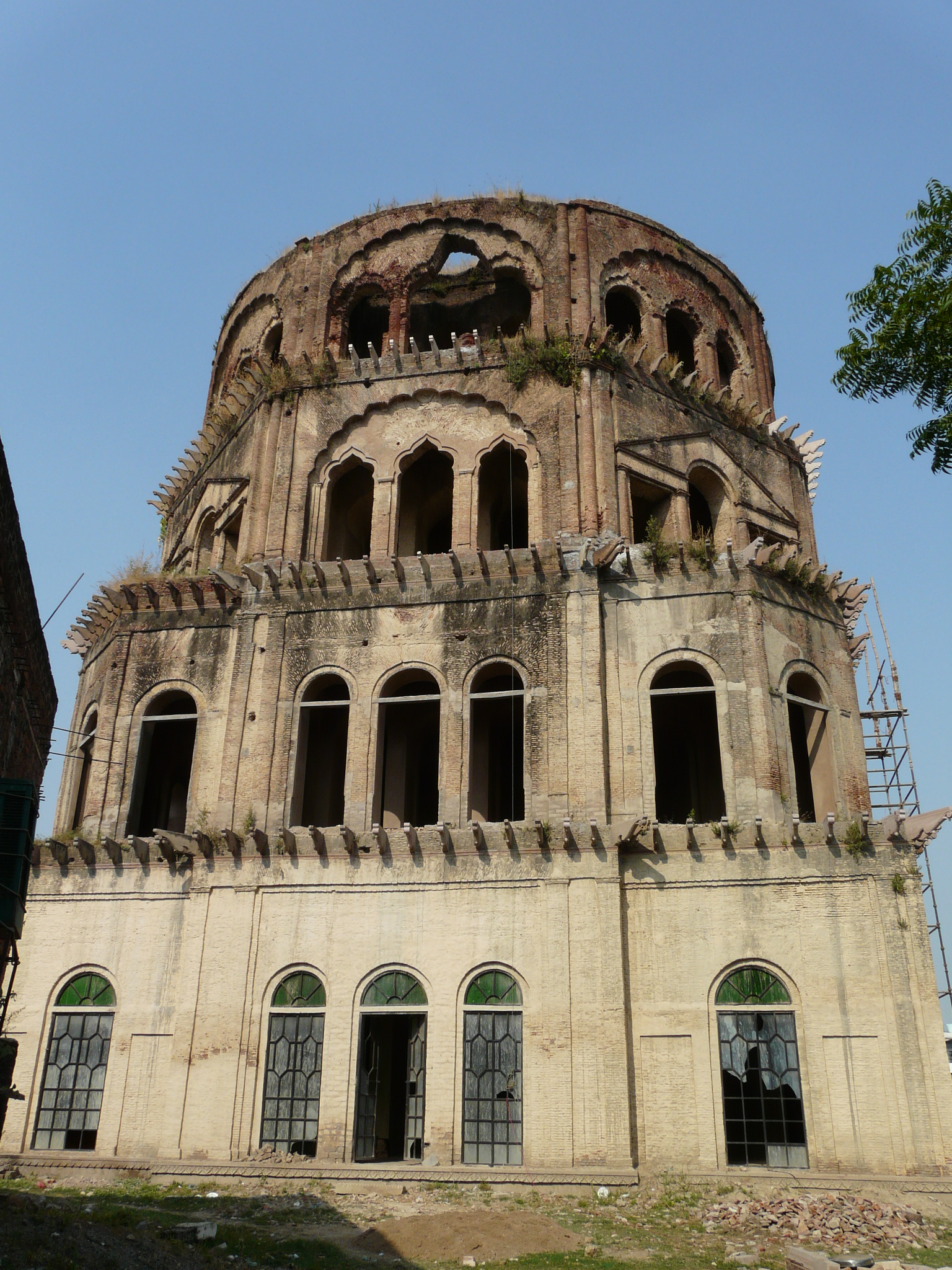
The 177-year-old iconic Satkhanda in Husainabad area of old Lucknow is finally going to live up to its name, of ‘seven storeys’, with the proposed glass roof to the monument taking shape, completing the unfinished Nawabi era structure. The iron storeys which will hold the glass have already come up. Part of the Husainabad beautification project, it is likely to be completed in six months.

Conserving the interiors of the monument along with keeping its circular staircase intact, the building will now provide people with an aerial view of the beautified area through the 360-degree glass facade. With a roof on top now, the monument won’t be subjected to rain water either.

“The plan is to conserve the monument and let people experience the building in its original form. Even though the glass roof covering will be on the uppermost storey, it will give the viewer the experience of being on the seventh floor because of the elevated height. The roof on top of this will be flat,” said Tracy, who is part of the Noida-based architecture firm working on the plan.

The Satkhanda, originally meant to be seven-storey-high was built in 1837 by Mohammad Ali Shah, the third King of Awadh, for moon-sighting by clerics. However, with his death, the monument was left incomplete at just four storeys. Considering it a bad omen, no other ruler bothered to complete it.

In the initial phase of the beautification work in 2014, only the park around then dilapidated monument was part of the plan. Converting the empty ground into a park with light fixtures, fountains, swings and a bridge was completed around November, 2014. Between 2011-13, restoration work on Satkhanda started. An approximate Rs 50 lakh was spent on the initial restoration that included getting rid of encroachment, grouting cracks, restoring parapet brackets, construction of a new roof and a Chhota Imambara-inspired dome. However, apart from removal of encroachment, nothing else was done then.

source: http://www.timesofindia.indiatimes.com / The Times of India / News> City News> Lucknow news / TNN / February 28th, 2017

Yakub Bee, an angel for the aged

Warangal, TELANGANA :

“Starting from two persons in 2007, we now provide shelter to 100 people,” says Mr Ali.

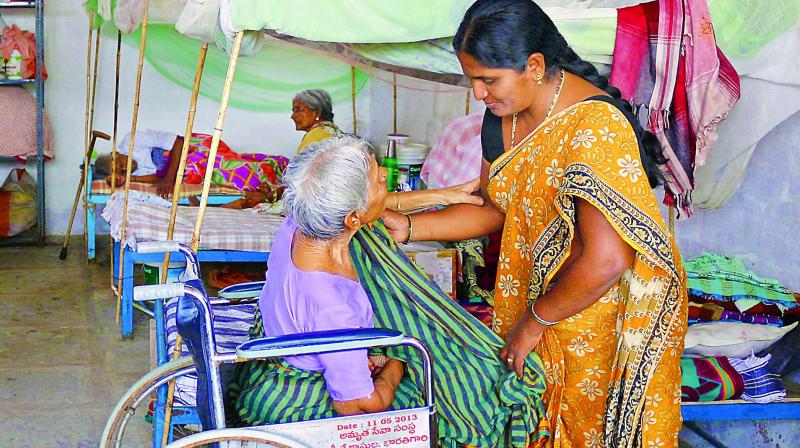
Yakub Bee helps dress a handicapped elderly lady, resident at the Sahrudaya old age home on Monday. (Photo: DC)

Warangal:

“Extending service to the needy is what makes my day; awards and applause subdue the anxiety and restore my confidence,” says Yakub Bee, the founder of Sahrudaya Old Age Home in Hanamkonda.

Yakub Bee and her husband Mahboob Ali have opened their home for elderly homeless and destitute people since 2007. Recognising her services, the World Peace Festival Society International (WPFSI) has conferred on her the Shanthi Dhootha award.

Yakub Bee lavishes love and affection on her charges and recognises no religious or social barriers. She looks after the food and medical needs of her charges and when it was required even performed the funeral rites of a Hindu man when her husband was not there to do it.

“Most of the people living in our home have been abandoned by their children. Some of them have no memory of their whereabouts. Such people deserve to be cared for. There is no human being in this world who does not deserve to be loved. It gives me immense satisfaction to be able to help such people,” says the compassionate lady.

Yakub Bee, who hails from Ellanda village in Wardhannapet mandal, used to work as a tailor. Her husband Mahboob Ali used to do petty jobs. Mahboob was inspired by a rickshaw-puller who ran an old age home in Khalsa in Amritsar.

“Starting from two persons in 2007, we now provide shelter to 100 people,” says Mr Ali. The WPFSI, founded in 1997, is based in Warangal. Its aim is to celebrate and encourage the pluralistic character of the Indian nation. People’s poet Kaloji Narayana Rao and Telangana ideologue, the late K. Jayashankar, have been involved in the formation of this society.

Yakub Bee will receive the award along with film maker Dr K. Vishwanath and historian Dr Lingala Pandu Ranga Reddy in Warangal on Tuesday.

source:  http://www.deccanchronicle.com / Deccan Chronicle / Home> Lifestyle, Viral and Trending / Deccan Chronicle – Anudeep Ceremilla / February 28th, 2017

He cremates Hindus, buries Muslims, scorns communalism

Faizabad (Ayodhya) – UTTAR PRADESH :

His long kurta-pyjama is caked with mud as the almost 80-year-old Mohd Shareef crosses over several mounds in the  Taadwali Takia cemetry in Rakabganj to reach a green coloured room on the other end.

Hanging outside the room are three boards that proclaim “Lavaris mayyat/matti ka ghuslkhana” (bath of destitute unclaimed bodies).
Breezily, he unlocks the gates and walks into a room that has seen the last rituals of hundreds of bodies, Hindus and Muslims alike some with heads and some without, some reeking of the hours that had gone by since death befell them and some smothered in blood.

“Pradhan Mantri ji ka logo ko baantne wali baat kehna bilkul bhi sahi nahi tha. Hum Hindu aur Muslim dono ki mitti gale se lagate hain aur ye log sabko alag karna chahte hain (The Prime Minister should not say things that are divisive. I hold dear bodies of both Hindus and Muslims and these people want to divide us all),” remarked the old man who has, for the past 25 years, been performing the last rites of unclaimed bodies in Faizabad which has five assembly constituencies, including Ayodhya, that will go to polls on Monday (February 27). Since 1992, he has performed last rites of over 25,000 unclaimed bodies.

Shareef Chacha, as he is famously known, was referring to Prime Minister Narendra Modi’s recent ‘shamshaan and qabristan’ statement in a rally in Uttar Pradesh (UP) where he said that if land is allotted to cemeteries, it should be given for cremation  grounds too, implying that the Samajwadi Party favours Muslims.

“Ye sab vote ke chakkar mein neta log bolte hain par Hindus se hee izzat bani aur badhi hai meri. (These politicians make such statements for votes but it is only because of Hindus that I have earned respect in what I do). Our blood is one and my love is not restricted to a particular caste and religion,” he said, while commenting on the present political scenario as he flipped through the numerous photographs and award certifications received from both government and non-goverment entities.

Ask him why he chose this form of service and Chacha recounts his son’s death in February 1992. “He was my elder son Mohd Raes Khan (25) who had gone to Sultanpur to work as a chemist but went missing for a month. The Ramjanmabhoomi movement, that led to the demolition of Babri Masjid in December 1992, was brewing at that time. Raes was found murdered, his decomposed body in a sack. “Police located me through his shirt label that had the tailor’s name. It was then that I decided to not let any unclaimed body lying off the road to be devoured by stray animals,” said the old man who juggles being a cycle mechanic and shunting between graveyards and cremation grounds every day.

Since then, the man has been fulfilling the task with a few neighbours and supporters. “But these politicians and governments don’t do anything. They honour me but extend no monetary help to the cause or to me. Raes was my sole earner and now I live in a rented tin-shed with my depression-struck wife, a son who is into bad habits and is mentally disturbed and a daughter. My two other sons, who live separately, gave up on me because of the work I do,” he said. “Only a few days back, many candidates came here to ask for vote and to take me in their cars for campaign. I told them that I need a stronger light for the room to perform last rite rituals at night, and I haven’t heard from any of them since,” he added, dejected.

With hardly enough to make the ends meet, it’s cash donations and shrouds that help Shareef Chacha continue with his service. As a routine, he covers every police station, nearby hospitals, railway stations and mortuary for any unclaimed body. It is only after a body has been in the morgue for 72 hours that it is handed over to Chacha.

“I am old and have had to keep helpers. Santosh at the ghaat burns the bodies with Hindu rituals that I send him and others, like Mohd Ismail and Shyam Vishwakarma, and some boys help me bury the dead. Sometimes, they don’t even charge for their own labour, like for babies.

But resources are difficult. For burying a Muslim, Rs 5,000 are needed, while for a Hindu cremation around Rs 3,000-3,500 is required for 350 kg of wood,” said Chacha.
It is only when he hears the Azaan that Chacha takes a few moments out of his service. “No Hindu ever asks me to stop cremating Hindu bodies, instead I’m always invited and honoured as a special guest to their wedding and pujas. To all those who prosper in the name of communalism, where is the communal fight of Ayodhya and Faizabad?” he asks.

source: http://www.timesofindia.indiatimes.com / The Times of India / News> City News> Lucknow News / by Yusra Husani / TNN / February 25th, 2017

A bronze statue to celebrate a visionary civil servant

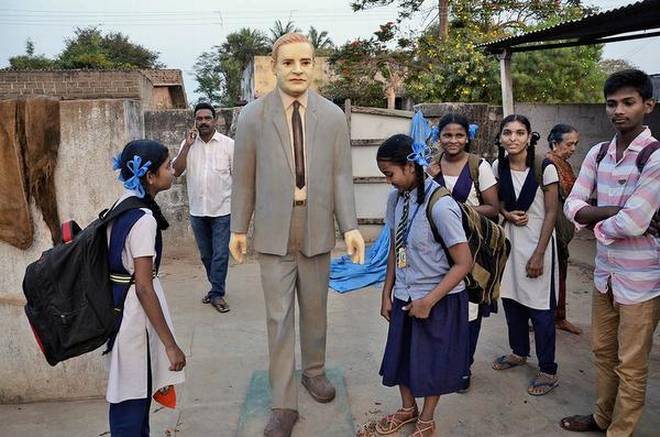
In fond memory: Villagers of V. Venkatayapalem looking at the statue of late Zaheer Ahmad to be installed at a housing colony, in Khammam district. | Photo Credit: G_N_RAO

V. Venkatayapalem residents steeped in the memory of Zaheer Ahmad

The residents of V. Venkatayapalem in Raghunadhapalem mandal are steeped in the memory of Zaheer Ahmad, a former Hyderabad civil service officer, who contributed his mite for the development of the village through multiple landmark initiatives.

The name of Mr. Ahmad, who was in-charge of the erstwhile Hyderabad State, and his development initiatives conjure cherished memories of the past.

V. Venkatayapalem was among a few villages adopted by the former bureaucrat around seven decades ago. He earned a reputation of being the visionary officer who laid a strong foundation for the holistic development of the village.

The spacious housing colony, scenic park, water tank, and verdant high school campus stand testimony to the approach of the officer.

Park named after him

In an effort to keep alive the memories of Mr. Ahmad, the villagers named the park after him and mooted installing a bronze statue of his in the park.

“Zaheer Ahmad developed our village in all spheres by constructing spacious houses, each measuring 350 sq. yards, on 17.5 acres for the weaker sections, upgrading the local school into a high school, constructing 60 feet-wide roads, and developing a spacious park,” said Y. Hanumantha Rao, a resident of V. Venkatayapalem.

A statue of Mr. Ahmad is ready for installation in the colony, he said, adding that they have already consulted sculptors in Rajahmundry in neighbouring Andhra Pradesh to make a bronze statue of the officer.

“He used to come to the village occasionally on a horse, traversing a tough terrain, with a deep sense of attachment,” recalled Ramulamma, a resident.

“Our village has produced nearly 400 government employees, most of whom work on the Nagarjunasagar project (NSP),” said Hemalatha, the sarpanch of the village.

The residents owe a lot to Mr. Zaheer and former Chief Minister Jalagam Vengal Rao, who made invaluable contribution to the growth of the village, said another villager.

“The modernisation of the old minor lift irrigation scheme by the present TRS regime helped restore the full irrigation potential of the project to an extent of 1,320 acre,” he said.

source: http://www.thehindu.com / The Hindu / Home> News> States> Telangana / by P. Sridhar / Khammam – February 21st, 2017

Doing good better

Chennai, TAMIL NADU :

GiveAwayIndiaMPOs23feb2017

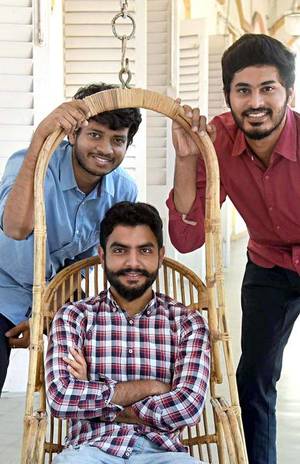
GiveAway India, a crowdsourced platform founded by three city-based youngsters, channelises donations for the disadvantaged

It was the fag end of November 2015 and Chennai was beginning to reel under the onslaught of torrential rains. Though the floods were yet to hit the city, rooms in Amir Mahal, the 18th Century palace and residence of the current Prince of Arcot, had already begun to resemble a warehouse. Groceries packed in cartons covered every square inch of space as three youngsters worked round the clock, trying to coordinate sourcing and delivering of relief material. Within their first week of operations, they had groceries worth ₹2.5 lakh and an alphabetic database of the city.

By the time the December floods came, they scaled up efforts and managed to get 25,000 packets of biryani from Paradise Hotel in Hyderabad via air and road to help the countless who were marooned in the city.

With corporates such as Big Basket, Foodpanda and Snapdeal coming on board to pitch in, the trio — Mohamed Asif, Fahd Khaleel Wallajah and Nareshwar Sivanesan — managed to mobilise large quantities of food, raincoats, mosquito repellents and groceries for those in need. Wallajah, the nephew of the current Prince, Nawab Mohammed Abdul Ali Azim Jah, along with close to 35 other volunteers and Amir Mahal staff mobilised relief efforts for the flood hit.

Crowdsourced help

That was only the beginning for them. The events of December 2015 and their efforts to help fellow Chennaiites sparked the idea for a sustainable system to continue helping those in need.

And that is how GiveAway India — a product crowdsourced platform that channelises donations to the needy — began. “While GiveAway was set up in September 2015, the idea to formally create a single web or app system, where donors and beneficiaries come together, came about after the floods,” says Wallajah, the nephew of the Nawab of Arcot and co-founder of GiveAway India.

For three months since its inception, GiveAway focussed on sourcing spare food from restaurants and parties and distributing them among the homeless with the help of volunteers. But the floods gave impetus to what was a fledgling movement. “During the floods, we’d managed to convince corporates to donate and also come on board to encourage their users to donate to charity, since the prices of essentials sky-rocketed during the rains,” says Asif, adding that partners such as Big Basket and Snapdeal put out a message on their websites asking users to buy products from them that would go to charity. “When we decided to scale up operations and turn GiveAway India into a more sustainable venture, we spent six months researching what needs had to be addressed,” says Asif.

“We got a team in place; went back to all the corporates to try and convince them to come on board on a long-term basis. It took a lot of convincing to get some of them to agree.” According to Sivanesan, the effort was to create transparency and, “not replicate what is already out there”. Finally a month ago, GiveAway India went live as a web and mobile-based platform. “The platform caters to homes and orphanages across the city and also has a pan-India presence. These homes and orphanages can enter requirements on our site, which are posted after verification. Beneficiaries can choose the cause they would like to donate to. Both the beneficiaries and donors are not charged anything by us,” says Asif. The causes supported by GiveAway India are many — from football programmes for slum kids in Nagpur, woollens for the homeless in Karnataka and relief for drought-hit Maharashtra to elephant welfare programmes in Tamil Nadu. “We also support women’s issues, acid attack victims, people with blindness and deafness. Essentially, what beneficiaries do is donate to these causes by buying products on our site that are then sent to them,” explains Asif.

Their portfolio

They also plan to introduce a feature that will allow users to choose an occasion (such as birthdays, anniversaries or memorial days) to donate to a particular charity. “For instance, many people would like to do something for the needy on such occasions. We can facilitate that through our website. If the donor wishes to be present on the occasion he/she can choose to do so as well,” says Wallajah. In the one month since they went live, GiveAway India has been able to facilitate close to 1.5 lakh transactions. “We’re now in talks with a leading hospital for medical facilities for those in need,” adds Sivanesan.

The Road Ahead

  • As GiveAway India grows from strength to strength, the three co-founders have their future plans chalked out. “In the next three quarters, we want to get every home and orphanage in South India on our platform and then focus on strengthening our pan-India presence. We also plan to introduce geo-tagging to let you find an NGO or cause that is in your locality. And we’re on the lookout for investors who can not only fund us, but also mentor us,” says Asif.
  • For details, log on to www.giveawayindia.org


source: http://www.thehindu.com / The Hindu / Home> Sci-Tech> Technology / by Ranjani Ranjendra / February 21st, 2017

Bengaluru had its first date with air show a century ago

Bengaluru, KARNATAKA :

HIGHLIGHTS

  • Bengaluru had its first date with an air show 106 years ago
  • In 1911, Jules Wyck and Belgian adventurer Baron Pierre De Caters were the two pilots who brought their aircraft to Bengaluru

__________________________________

Bengaluru :

As the curtains were drawn on the 11th edition of Aero India on Saturday, thousands who thronged the Yelahanka Air Force Station need to know that they are not the first patrons of such a show. In fact, they are not even the first generation.

Bengaluru, India’s aviation capital, had its first date with an air show 106 years ago. February 3, 1911. Cricket hadn’t become the religion it is today in India. The Chinnaswamy Stadium was a barren land, and parts of Bengaluru were still a functional cantonment.

While people from districts neighbouring Bengaluru had made their way back then to catch what the organizers had called a “miracle in the skies,” Bengaluru’s quest for the flying machines remained intact in 2017 with at least three lakh people reported to have visited the aero show.

In 1911, Jules Wyck and Belgian adventurer Baron Pierre De Caters were the two pilots who brought their aircraft to Bengaluru, for a show that garnered a huge response. “But police had been prepared to handle the crowd here, after things had gotten slightly out of hand in Kolkata,” historian Vemagal Somashekar said.

If the elaborate preparations of the organizers a century ago are any indication then it only shows that a lacklustre event, like the 2017 edition of Aero India — just 53 aircraft on display and four aerobatic display teams — may fail to garner similar response in the coming years.

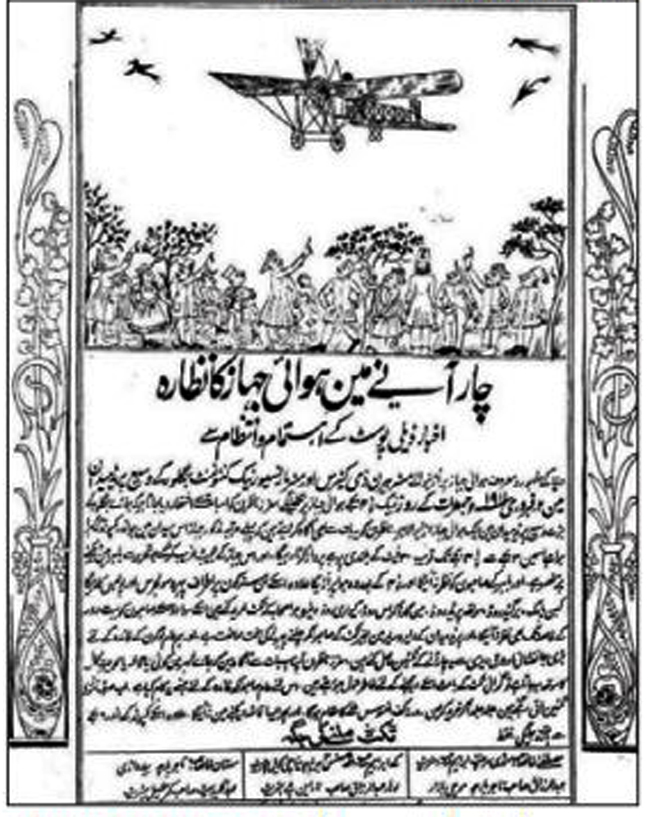
(The poster in Urdu, issued by merchants and businessmen from the Baidwadi (present day Shivajinagar) area. Photo Credit: fly.historicwings.com)

The fact that organizers did not reveal the right number of aircraft at Aero India 2017 is an indication that even they know it. When TOI enquired about the details of the show and the preparations in the run-up to the show, Mayaskar Deo Singh, director, Defence Exhibition Organisation, the nodal government agency organizing the show said: “An official release with final numbers on participation and other details will be issued so that there is no confusion.”

The official release days before the show had claimed that the number of aircraft participating would be 72, as many as the 2015 show, rated much better, had seen. Answering a specific question, defence minister Manohar Parrikar, however, had said on February 14: “There are 53 aircraft participating…”

Also, there are ways to watch the show for free, hundreds of citizens who stood with their cameras on terraces, the highway, some even got hospitality at villages around the air base.

But organizers in 1911 had figured out a plan for such free viewers. A poster in Urdu, issued by merchants and businessmen from the Baidwadi (present day Shivajinagar) area, reveals that the organizers, who had learnt that people would not buy tickets as they thought planes could be spotted even otherwise, had organized the show in such a way that only those with tickets (worth 25 paise each) had a one-hour exclusive.

“…Between 3.30pm and 4.30pm the planes will fly at a height of just 30 metre which only the ticket holders can see. For a few minutes after 4.30pm, the planes will fly a little higher,” reads a translation of the poster documented by the state archives department.

Mustafa Khan (mandi merchants, Ibrahim Sahib Street); Abdul Razak (businessman, Modi Road); Ibrahim Sahib (Meenakshi Kovil Street), Abdul Razak Sahib (steel merchant, Narayan Pillai Street) and Mastan Khan from Baidwadi (present day Shivajinagar) were the men who had signed off on the poster —they are an indication of how Bengaluru had a good trade set-up.
While TOI got a look at the poster, permission to take a photograph was denied. The poster, which has been sourced from fly.historicwings.com, further reveals as Somashekar had pointed out.

Police had been ordered to patrol major roads leading to the venue such as South Parade Road (now MG Road), Brigade Road and Church Street and even in Cubbon Park.

source: http://www.timesofindia.indiatimes.com / The Times of India / Home> News> City News> Bangalore News / Chethan Kumar, TNN / February 20th, 2017

Duo overcome hurdles, succeed

Lucknow, UTTAR PRADESH :

DrSharmeenMPOs20feb2017

One is a doctor and the other is a counsellor and their team has achieved, what many others could not even with an army of workers.

Dr Sharmeen Ahmed and Anita Shukla are a team which has changed the family planning scene in Uttar Pradesh’s Allahabad district, about 200 km from Lucknow. They have been working relentlessly for the past seven years overcoming barriers of religious beliefs and misconceptions surrounding planning of families in the district. “I was the junior most doctor at the District Zanana (women) Hospital when I joined in 2010-11 and was sent for training for implanting Postpartum Intrauterine Contraceptive Device (PPIUCD) to roll out a pilot project in Allahabad,” says Ahmed.
“It was an important programme and I knew that its success would go a long way in achieving the objectives. I personally liked the programme very much,’’ Ahmed says. Fortunately, she has got an able companion in Anita Shukla, who is not only a counsellor but also a hard working professional. No wonder the two were able to form a formidable team.

Anita said that record keeping and monitoring had not been very effective then and even the government did not prioritise the PPIUCD programme. She, however, firmly believed that it would be very helpful for the beneficiaries and took immediate steps to complete the work.

They have been serving the people since then, particularly the lower-most strata of society, who needed counselling and services. Ahmed has been awarded by the state government for the highest number of insertions. Her average insertions have been around 390 annually.

But her work was never an easy one. With so many myths and misconceptions surrounding the family planning programme, it was really challenging if not impossible task to persuade people and achieve the goal, she says.

What makes it difficult are religious beliefs and illiteracy, she says. “The biggest problem with the people is illiteracy. Their religious beliefs also sometimes turn out to be an impediment,” she said.

“Most people have not read the Holy Koran because they are not literate and depend on others for interpretations. These interpretations by others may not always be correct. so when I counsel them, I cite Koran and interpret it for them which works most of the times,” Ahmed explains.

There were other problems also which she had to face while doing her job. Persuading husbands and mothers-in-law is even more difficult. “I had to face opposition from the beneficiaries’ husbands and mothers-in-law. They at times got very angry at the mere mention of the family planning. After agreeing to the family planning, sometimes the beneficiaries back out at the last moment,” she said.

Ahmed said that there were very few women in the community, who would take decisions on their own. On majority of occasions it is the husband, mother-in-law and rest of the family who decide, she adds.

Ahmed has trained counsellor Anita Shukla. “I have taught Anita how to counsel and what are the possible set of questions that a lady would come with which need to be answered with logic and even religious overtones but without any coercion because fertility and the number of children is the right of a woman which cannot be violated,’’ she explains.

Now, the situation is that she is the most sought-after family planning specialist in the district with women coming to seek Ahmed’s advice after hearing from others particularly from her own community which, she feels, is an achievement for her.

Counsellor Anita Shukla says 80% service seekers are victims of myths and misconceptions around planning families while 5% are just stubborn. “These myths and misconceptions must be removed if we want to make family planning programme a success,” she said.

Incidentally, Anita has also been awarded by the state government and was asked to share her experiences at a high-level meeting of officials. “We have to think of newer ways to convince people that family planning and contraception use are not against religious norms. We receive complaints like the woman does not like doing household work after insertion!

There are times we have to deal with really difficult people and there are some women who come and get it removed also. One day a woman said her neighbour had told her that the IUCD moves around in the body. I had to tell her then that the uterus was like an earthen pot with just one opening. We have no choice but to respect their decision,” Anita explains with a hearty laugh.

Though Anita and Ahmed did achieve what many others could not, they also realise very well that their task was far from over.

“We have miles to go before we sleep. Family planning is the need of the hour for a country like India and without the cooperation of the people it can not succeed. We need to work in as a team and make persuasive efforts keeping in mind the sensitivity of the people. The same religious beliefs that are often cited as obstacles can be used by us to achieve our goals,” Anita added.

source: http://www.deccanherald.com / Deccan Herald / Home>  Special Features / by Sanjay Pandey in Lucknow / February 19th, 2017

History repeats itself

Chennai, TAMIL NADU :

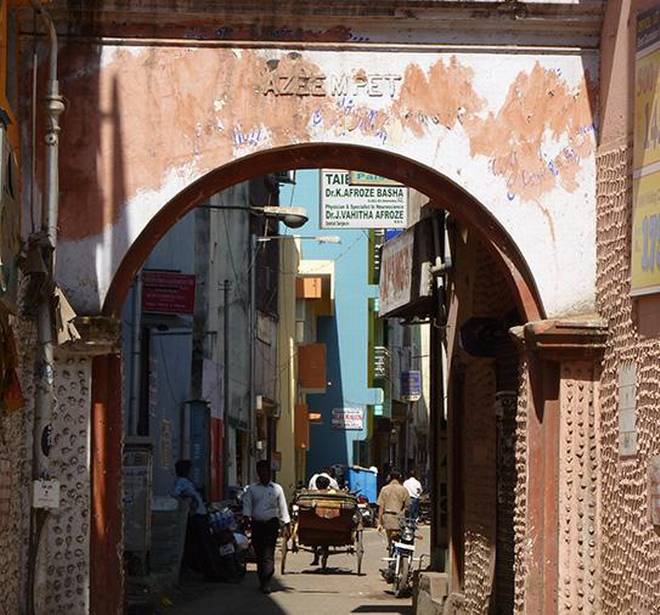
Kaman Darwaza in Chennai | Photo Credit: Kombai Anwar

Madras was in the eye of a power storm, 200 years ago

An ailing or aged ruler triggering a political crisis is not something new in Indian history, but what is interesting about the recent drama that unfolded in Chennai has its parallels to a power struggle that Madras was witness to a little more than 200 years ago. The drama then too had an ailing ruler, various aspirants including a ‘sister’ scheming to take over power upon his death, and a Governor keenly assessing the situation.

The only visible token of the dramatic events that unfolded in 1801 when Umdatu’l-Umara, the Nawab of Arcot, died, is a nondescript arch with the name ‘Azeempet’ chiselled on it, that still stands on Chennai’s Triplicane High Road, a few yards away from the Walajah Mosque. It is a reminder of sibling love that turned bitter and ultimately led to the dramatic fall of the House of Arcot, paving the way for the East India Company to establish itself firmly in the saddle and change the course of Indian history. Old timers remember this arch as the gateway, ‘Kaman-Darwaza,’ to the palace of Sultanu’n-nisa Begam, the daughter of Nawab Muhammad Ali Walajah and sister to Nawab Umdatu’l-Umara.

Nawab Umdatu’l-Umara, who succeeded Muhammad Ali Walajah upon the latter’s death in 1795, was very fond of his sisters, especially his senior sister (meaning the eldest of his younger sisters) Sultanun’n-nisa, also known as Buddi Begum. Sultanu’n-nisa was equally fond of her brother so much so that, out of concern for his safety, and to ward off evil, she used to send everyday a rupee coin to the Nawab, which he would dutifully tie it on his upper arm.The Nawab very often spent his evenings at the palace of his senior sister, listening to musicians, watching a dance recital or just having dinner. He had a room in her house, where the Nawab met with his officers and others. It was widely believed that Sultanu’n-nisa was the actual power behind the throne. Somewhere down the line, Sultanu’n-nisa had assumed that her son Raisul Umara would succeed her brother to the throne. But she was not the only one eyeing the throne, as the Nawab himself would lament – “I intend my son for the throne; Sayful Mulk (the Nawab’s younger brother) intends that the throne is for him; my senior sister has in mind that her son is meant for the throne after me; and the firangs (foreigners – the East India Company) are waiting for their opportunity. But it shall be as the Supreme Ruler wills.” The Nawab wrote a will on his deathbed, making his son Tajul Umara his successor, a move that enraged his sister, who felt betrayed. It was an opportunity too good to miss for the firangs, who were looking for an excuse to take over the Carnatic entirely.The English used the simmering anger of Sultanu’n-nisa and spread the rumour that a coup against the Nawab was in the offing. With the connivance of Nawab’s Diwan, Col. Barret, they surrounded the ailing Nawab with the Company’s troops.

When Nawab Umdatu’l-Umara died in 1801, a bitter Sultanu’n-nisa would not forgive her brother. She refused to let the coffin pass through the Kaman-Darwaza. It had to be left the whole night with guards in a hall opposite the arch. After failing to persuade his aunt to let the coffin through, Tajul Umara, son of the deceased Nawab, decided to break the wall behind Nusrat-mahall and send the coffin to Trichy, to be buried next to the tomb of his grandfather Nawab Walajah.

This power struggle enabled Governor Edward Clive to make a man of Company’s choice as the next Nawab, a man who was willing to sign away the Kingdom, which the young Tajul Umara, the rightful successor, refused to do. Umara’s cousin Azim-Ud-Daula was anointed as the next Nawab. Tajul Umara died within a few months. Sultanu’n-nisa and her son left for a Hajj pilgrimage and chose to settle down in the holy city of Karbala in Iraq, where she eventually died.

Two hundred years later, the arch still stands, a mute witness to the bitter power struggle that not just led to the tragic fall of the House of Arcot .

Kombai Anwar is a writer, photographer and film maker.

source: http://www.thehindu.com // Th Hindu / Home> Society> History & Culture / by Kombai S. Anwar / February 17th, 2017

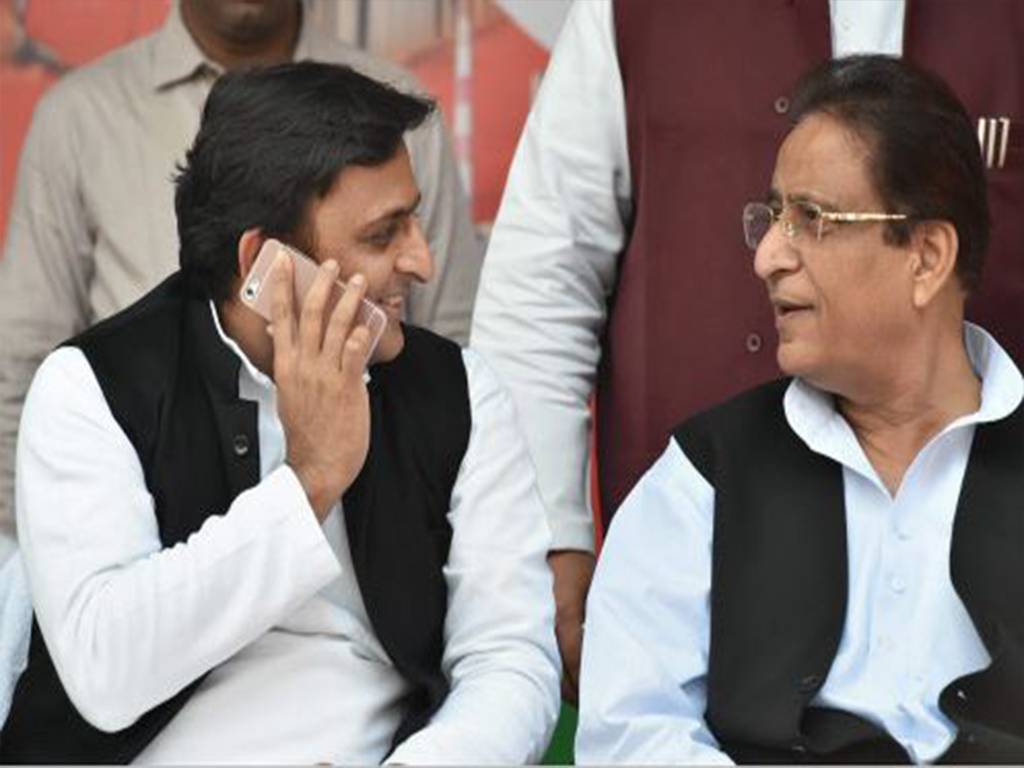
Azam’s son relies on dad’s star power

UTTAR PRADESH :

Azam Khan
Azam Khan

Rampur :

On the way to Maswasi Village, where Azam was to hold a public meeting, Abdullah explains that he could have opted any other “easy” seat to launch his political career but his decision to contest from SwarTanda was taken because of public demand. “After the election commission imposed a ban on my father during the Lok Sabha elections in 2014, I addressed the public for the first time from Swar on the request of chief minister Akhilesh Yadav.Since then, the public has been demanding that I should contest from here and bring development to the area,” said Abdullah, while showing roads, drains, bridges and electrification of few villages completed under his direction in the past three years.

“No candidate was interested in contesting from here, but I took it as a challenge and will create a record by defeating the nawab,” he added.

Abdullah, Azam and their convoy stopped at Maswasi village, where a crowd of nearly 10,000 was waiting for the two leaders to arrive.The father-son duo was given a grand welcome with the bursting of firecrackers and slogan-shouting.

In his two-minute speech, Abdullah said, “During campaigning, a man asked me when the road in his area would be constructed. And when I told him that the project had already been passed, he didn’t believe me as politicians from Noor Mahal (residence of the royal family of Nawab) and BJP always made false promises.”

Azam started his speech saying that his son does not have the experience of a seasoned politician but that Abdullah will soon learn the tricks of the trade.

“A family has always oppressed you and the time has come to show your power.Whatever money , clothes and food, they (royal family) have are yours,” said Azam.

After the end of the event, the local leaders pleaded to make way for Azam and his son to return to his vehicle.The crowd followed him even when he was seated in his car. They ran beside the car to shake hands with Azam and Abdullah as they drove out of the rally ground. In Swar-Tanda constituency, SP leader Azam Khan’s 26year-old son, Abdullah Azam Khan, will take on BSP’s Nawab Kazim Ali Khan, who is the present titular head of Rampur and four-time MLA.The junior Khan is relying on his father’s star power to draw votes. TOI trails the SP leader on one of the five evenings he promised to campaign for his son.

source: http://www.timesofindia.indiatimes.com / The Times of India / News> Chennai News> Kanpur News / Priyangi  Agarwal / TNN / February 10th, 2017