Category Archives: Community Involvement / Social Issues

On the Sultan’s Trail

KARNATAKA :

by V. Shoba

V Shoba follows the footsteps of a warrior king and listens to the voices of admiration and anger that echo his still volatile legacy

————————————————————–

In the green, hilly tracts of Kodagu, a small district in Karnataka bordering Kerala, the past is urgent, pressing. A king’s ghost has been summoned again, so his story can be rewritten to suit the age. Tipu Sultan. Perhaps no other Indian king has been mummified by as much subjective judgement. Invariably, he is either a justified villain or an unjustified hero, a tele-serial star or a wanton killer of Hindus. In Kodagu, where Tipu is believed to have put thousands to the sword, a destabilising interrogation of his legacy recently claimed two more lives, over 200 years after the king perished in the British siege of Srirangapatna in 1799. Even as the Karnataka government’s plans to celebrate Tipu Jayanti on Deepavali day—10 days ahead of his date of birth, 20 November—predictably met with opposition from Hindu organisations, the Muslims of Kodagu, many of them descendants of migrants from Kerala, appropriated him as their hero overnight.
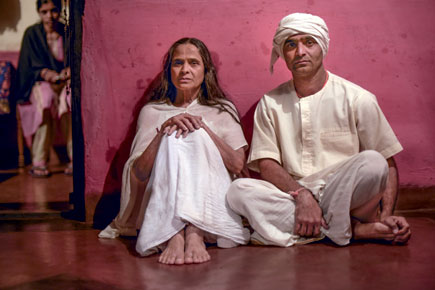
DS Kuttappa’s widow Chinnamma and son Dani

On the appointed day, the communities clashed violently in the tourist town of Madikeri, the headquarters of the district, resulting in two unfortunate deaths: 65-year-old DS Kuttappa, the district organising secretary of the Vishva Hindu Parishad, was killed when he fell or was pushed from, depending on who you believe, a height during the riot; and 22-year-old Shahul Hamid from Siddapur was shot while returning in a truck from Madikeri. Observers blame the deaths on police and administrative negligence, but the reality of the unrest in Kodagu runs deeper.
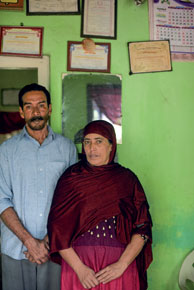
Naseer and Kulusu, Shahul Hamid’s bereaved parents


From his perch in Srirangapatna near Mysore, Tipu Sultan—and before him, his father Haider Ali—had repeatedly attacked Kodagu in the 1780s in order to secure free passage to Malabar. His incursions into Coorg, replete with the plunder and destruction of temples—a common practice in medieval times even among Hindu rulers—were time and again thwarted by native Kodava warriors, but the region eventually succumbed to the assaults. According to historical accounts, Tipu then ordered ‘both the slain and the prisoners, with the women and children, to be made Musalmans.’ “Kodavas were deeply scarred by Tipu’s excesses but they did not give up. They had their tiri-toks—country guns—and they were skilled at guerrilla warfare. For Tipu’s army, the leeches alone proved a deterrent,” says Addanda C Cariappa, a writer, actor, theatre person and former president of the Karnataka Kodava Sahitya Academy, who is working on a book in Kannada on Tipu Sultan. His pride in the community’s martial heritage and its achievements in the military soon dissolve into alarmism as he talks about the shrinking Kodava population. “We are a dwindling race with a population of just 1.25 lakh. Soon, we will be the Kashmiri Pandits of south India. The religious turbulence of Tipu’s reign is partly to blame,” Cariappa says.

There is no love lost between Kodavas and the erstwhile ruler of Mysore: they will tell you that Tipu was no son of the soil; that he preferred Persian to Kannada and wanted to propagate Islam across south India; and that his epitaph in Srirangapatna and the inscription on his sword commemorate him as a sultan who lived and died for the faith. This, then, was the majoritarian cultural sentiment that formed the backdrop of the Tipu Jayanti celebrations in Kodagu. The Siddaramaiah government has been accused of inciting riots for political gain in a district where all the legislators—two MLAs, KG Bopaiah and Appachu Ranjan, and Prathap Simha, the lone MP from Kodagu—belong to the BJP. Conspiracy theorists go to the extent of alleging that a law-and-order crisis was precipitated by the Siddaramaiah camp to show the new home minister of the state, G Parameshwara, in poor light. Whatever the provocation, the celebrations marked a dark day for communal harmony in the state.
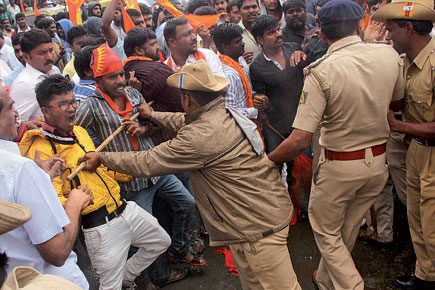
A scuffle breaks out during the Tipu Jayanti celebrations in Madikeri (Photo: KPN)

It is dark when we halt at Kuttappa’s house near Madhapur, about 20 km north-east of Madikeri, at the end of a long, snaking drive through banana and paddy fields. The sitting room is bustling with local reporters, Sangh Parivar activists and Kuttappa’s scampering grandchildren. His son Dani wears a dhoti and an unreadable expression. His mother sits unmoving in a corner, her long hair undone,face buried between her knees. “Father knew his life was in danger. But anything could have happened in Madikeri that day and he could not stay away,” says Dani, who works at a factory in Madikeri and is an RSS activist. “They beat him and stoned him, then pushed him to his death. There are eyewitnesses who saw what happened near General Thimmaiah Circle.” The police are awaiting the autopsy report that may throw light on the cause of his death.

On that Tuesday morning, a few thousand people carrying Tipu flags marched towards Town Hall, where his birthday was to be celebrated. The 2,000 policemen who were later deployed to keep vigil over the small district—4,100 sq km of it—had not yet been called in; the district administration was wholly unprepared for trouble. As supporters of the Social Democratic Party of India (SDPI) and Sangh Parivar activists hurled stones at one another, the situation quickly spiralled out of control and the police resorted to a lathi charge. “The Muslims came armed with stones and swords,” alleges Dani. Soon, he is no longer talking about the death of his father, but building a case against “radical Muslims” who, he alleges, have destroyed the peace of the region.

Kodagu is a peaceable place where enmities that lay buried in the dim mists of the past are not easily kindled. Before the flare-up around Tipu Jayanti, the Sultan’s exploits here were largely forgotten—although, if you visit enough Kodava homes, you will have occasion to pet dogs named Tipu. The last time there was a Hindu- Muslim clash in Kogadu was in December 2001, when miscreants vandalised the Harishchandra temple at Palur, about 20 km from Madikeri. Angry Hindu mobs gathered in town, blocking roads and attacking Muslim worshippers; Section 144 was eventually imposed. Like most riots, the 2001 incident reeked of political opportunism and widened the space between Kodagu’s communities. This is happening again now, thanks to a king who has captured the fancy of a nation in search of heroes. Tipu introduced land reforms and modern banking. He abolished alcohol and donated to temples. He was the last Indian ruler to consistently rebel against the British. Yet, large sections of Kodavas do not hesitate to judge an 18th-century ruler by 21st-century morals. “He killed Hindus and converted them. These people who want to celebrate him—what are they celebrating exactly?” Dani asks.

“The problem is that people think in terms of religion in this country,” says actor and playwright Girish Karnad, who received a death threat on social media after remarking that Bengaluru International Airport would have been named after Tipu Sultan, and not after city founder Kempegowda, had the king been Hindu. “It is not as though our politics has changed in 200 years. We still see leaders using atrocities to build their careers. At least Tipu Sultan did not commit these atrocities against his people. I can’t see how what he did was more condemnable. The people of Mysore were happy with him,” he says.
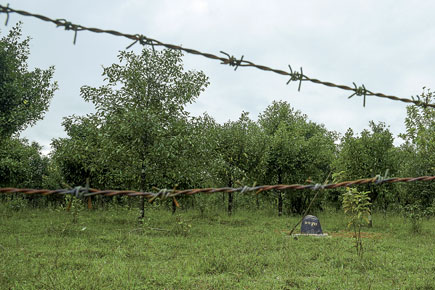
A memorial at Ayyankeri, a Karnataka village 6 km from the temple town of Bhagamandala, marks the location of Tipu Sultan’s alleged massacre of Kodavas (PHOTOS: DIPTI DESAI)

On the banks of the Cauvery at Ayyankeri, a village 6 km from the temple town of Bhagamandala on the road to Madikeri, is a patch of flat forest land planted with kodampuli (Malabar tamarind) trees. A barbed wire fence separates it from private land where rising water levels have made cultivation difficult; consequently, a lush pastoral meadow stretches all the way down to the river, its waters screened from sight by a thin line of trees. Inside the fence stands a small, rounded black stone with the date ‘13.12.1785’ painted on it, next to the words ‘Holocaust of the Humans’. Visiting what is described to me as the Auschwitz and Jallianwala Bagh of Kodagu, I am struck by the absence of history around it. No one in the neighbourhood has heard of Devattiparambu, the grounds where Tipu Sultan is said to have massacred over 30,000 Kodavas on a single day after inviting them to a feast. Yet, Kodavas like Addanda Cariappa are convinced that this is where the king all but wiped out a thriving, fearless people. Cariappa’s book is to be released on 13 December to commemorate the incident. “We used to call this area periya parambu (big ground). The NCC camped here in the 1950s to build a bridge,” says Abdul Rahman, a villager who owns some land next to the river, speaking in Malayalam. “A couple of months ago, some people from the Codava National Council [which has been campaigning for ethno-linguistic tribal minority status for Kodavas] came and looked around for a place to install the memorial. Since this is forest land, they thought it would be safe here,” he says. Rahman and his neighbours attended the Tipu Jayanti celebrations in Madikeri because they were puzzled at the calumny suddenly hurled at their village. Tipu allegedly converted thousands of Kodavas, whose descendants are now known as Kodava Mappilas. Muslims living in Ayyankeri, however, say their ancestors migrated from Kerala. “We have a mosque here that is said to date back 300 years and there are no records of conversion by Tipu Sultan in these parts,” says Rahman. “Nor is there any proof that this was Tipu’s killing field.”

Was Tipu really a monster of ego and a jihadist? Or could he have liberated India from the imperialists? “How does it matter? Lives have been lost,” says Abdul Naseer, the father of Shahul Hamid. “We have lost our only son.” In a small house with green walls, Naseer and his wife Kulusu contemplate their misfortune. “Shahul worked at a Toyota showroom in Bengaluru. He had come to Siddapur to apply for a BPL card so that we could get a discount on his sister’s kidney stone surgery in Mangalore,” says Kulusu. “He did not know a thing about Tipu. He just hitched a ride back home from Madikeri.” About 300 Muslim youth from Siddapur, Kodagu, attended the event, and most of them have since fled the area fearing arrest. “There are no youth in town today. There is fear. The police keep coming back with inquiries,” says Naseer. Police have made over 60 arrests so far and filed 35 cases. A magisterial probe has been ordered. “The people who killed my son go scot free even now,” Naseer says. He flew in from Dubai, where he works as a driver, when he heard his son had been shot. “I remember thinking, ‘It is a bullet to the head, he won’t make it’,” says Naseer, who has no plans to return to the Middle East. “There is no one to earn for,” he says.

While the Madikeri incident may have been precipitated by an unmindful government decision, there is a discernible trend of Muslim radicalisation in Kodagu, says KB Ganapathy, editor-in-chief of Star of Mysore, a widely- read evening newspaper. “I grew up in Kodagu. Muslim women never wore burkhas until a few years ago. Just two years ago, a women’s college in Virajpet took issue with students suddenly appearing in burkhas. The women in turn asserted their fundamental right to wear them, and eventually the parties came to the compromise that they could wear the burkha till the college gate but no further,” he says. “In this situation, the Congress may well be trying to capture the Muslim vote.”

In Srirangapatna, the anniversary of Tipu Sultan’s death is celebrated with much gusto. Followers waving banners with his emblem—a blazing sun amidst tiger stripes— participate in a procession from his mosque to his grave, where they smear sandal paste on the tomb. “I have attended many of these processions—called urs—and they have been peaceful. It is when you politicise the celebration that problems occur,” Ganapathy says. He has argued against idolising Tipu over other kings who fought the British. “Why doesn’t Mamata Banerjee celebrate the birthday of Siraj-ud-Daulah, the last independent Nawab of Bengal? He lived before Tipu’s time,” the editor says.

Tipu was a multicultural icon, a proto-nationalist who understood the future and respected other religions, says leftist historian KN Panikkar, who wants the country to remember him “not as a Muslim ruler but as a ruler of Mysore who gave us an anti-imperialist legacy”. Must we celebrate kings in democratic India? A king is not a perfection of noble qualities. He may fight an intercontinental cast of foes, but he is first and foremost fighting for his territory. “Freedom as we know it today was not part of Tipu Sultan’s imagination,” says Addanda Cariappa. “Just as it was not part of the imagination of the Peshwas or the Rani of Jhansi. They all fought for themselves.”

‘Happy is the country that needs no heroes,’ wrote Bertolt Brecht. Let us live up to the perils of the era and not drag a long-dead ruler to court with us.

source: http://www.openthemagazine.com / OPEN / Home> Cover Story / by V. Shoba / November 27, 2015
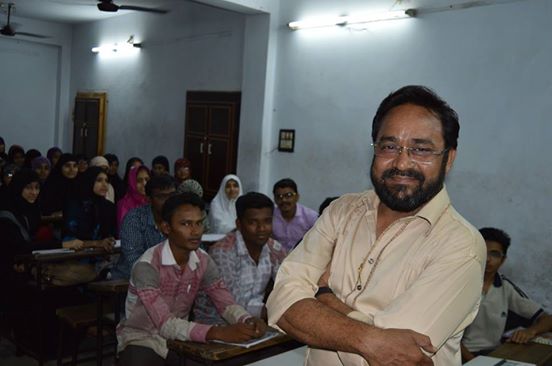
This Professor Has Been Giving Free Coaching to Students of Competitive Exams for Last 10 Years

Ahmedabad, GUJARAT :

“While I offer this service for free, I do ask for something in return from my students – a promise that they will pass on the kindness by helping other needy students. It might surprise you, but I don’t have to spend a single rupee on faculty as all my past students are training my current students,” says Professor Hidayat Saiyed of Ahmedabad who believes that if you have knowledge, you must share it.

From a time when he could not succeed in a competitive exam because of the lack of money to afford proper guidance, to today when he is guiding students free of cost, in 13 centres all over Gujarat – this is his story:

ProfHidayatMPOs24jan2017

Meet Professor Hidayat Saiyed who is an epitome of kindness. He runs Sarovar Education Society. The social work he has been doing since last one decade is beyond appraisal.

“After completing my college I decided to appear for competitive exams but I couldn’t afford private coaching classes and nobody was their to guide me. Lack of proper environment and guidance made me fail in exams just by few marks. This incident left a big impression on me and I thought that there would be so many young and bright students who want to appear for career-oriented examinations but do not have the financial means to secure admission in coaching classes. And soon I decided to start this social activity to train students for exams without charging a penny from them.

I started training my first batch of students for Gujarat Public Service Commission exams in the year 2006 in a small rented house and to my surprise out of those 24 students, 18 cleared the prelim exams and 1 of them got selected for the job. This gave me a big boost. Soon some young boys who were doing odd jobs in our locality came to me and said that if we get proper guidance than even we can clear such competitive exams. This success boosted my desire to set up an institute where I could give free guidance to needy students.

So in the year 2008, I officially started this Institute and at present we have 13 centers all over Gujarat with 1000 students being trained for the competitive exams. While I offer this service in free, I do ask for something in return from my students- A promise that they will pass on the kindness by helping other needy students. It might surprise you, but I don’t have to spend a single money on faculty as all my past students are training my current students.

In our community usually girls don’t come out and appear for such exams but I am proud to say that I’ve managed to break that stereotype and today 60 percent of my students are girls and remaining are boys. There are girls who have been posted in different parts of Gujarat and are getting finest of jobs. Those who get selected for jobs donate reading material and have even helped set up a well-equipped library for students.

My classes are open for anyone who cannot afford coaching. There was this one time a female student in my class had reached the final stages of a competitive exam when her parents decided to get her married. Two years later, she delivered a baby but her husband died in a road accident and she returned to her parents’ house here. She was shattered and upset. Her mother brought her to me and I encouraged her to resume studies. Soon she passed four competitive exams and today she works with Employee’s State Insurance Corporation. So what I am trying to say is that students dedication and professors proper guidance can change students lives. Every young fellow has an undying desire to study and get a good job, it’s just that they don’t get a helping hand.

Any Message?

If you have knowledge then share it among the students. If you have money then put it for the good use. Make the best use of what you have and try to help as many people as you can. You only get one life, don’t waste it on useless thing instead be useful to others. ”

source:  http://www.thebetterindia.com / The Better India / Home> Education> Unsung Heroes / by Tanaya Singh / 2016

The people from Isfahan

Alinaqipalem, ANDHRA PRADESH :

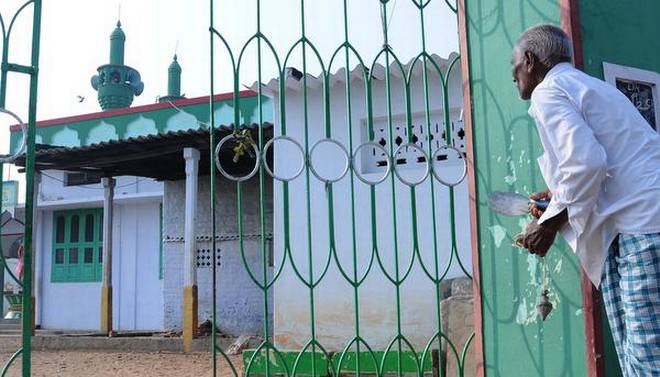
Mirza Miyani Jani, 60, offers prayers in front of one of Alinaqipalem’s two mosques, holding on firmly to his tools of trade. Photo: Ch. Vijaya Bhaskar | Photo Credit: Ch. Vijaya Bhaskar

A village in Andhra Pradesh where every family is Shia and everyone is a mason

Every day before the sun rises, almost all the villagers of Alinaqipalem in Andhra Pradesh’s Krishna district set off for work with their lunch boxes and tool kits. Work could take them to Vijayawada, Challapalli or Machilipatnam, where they will lay stone and cement for homes and buildings all day and return home by sundown. They have been doing this for generations now, for Alinaqipalem is a mason’s village, with almost all the 450-odd families here involved in construction work. In fact, till a few years ago they were all masons without exception, but slowly they are beginning to take up other professions.

The remote and idyllic Alinaqipalem has another distinction — the village has only Shia families. Surrounding villages call it ‘Turakapalem’ or the village of Muslims.

According to oral history, Abul Hasan Qutb Shah or Tani Shah, ruler of Golconda and the last of the Qutb Shahi dynasty, invited Mullah Mohammed Ali from Isfahan in Iran to come to India to teach his children. This was some 330 years ago. The mullah’s eldest son Haider Ali Naqi Isfahani and two families later settled down in this part of Krishna. They were soon followed by more families and a small hub of Shias emerged gradually. The village derives its name from the first settler and is called Alinaqipalem or Ali Naqi’s village.

Over the years, the villagers married local people, lost their Iranian features and forgot their mother tongue. Today, no one understands or speaks Persian or Arabic, except the two imams who offer prayers at the village’s two masjids. Both men are in their mid-40s and they went to Isfahan and Najafi, respectively, for their training.

The villagers speak Urdu, liberally laced with Telugu. Nothing of Iran remains, either architecturally or culturally: they have neither the multi-storeyed buildings made of red clay as in Iran’s Abyaneh village nor the yellow clay-coated buildings of Masouleh. The only thing remotely Iranian are the occasional posters of Ayatollah Khomeini that I came across every now and then on the walls. “Khomeini is our religious leader. So the photographs,” said Mirza Mohammed Ali, 69, a village politician.

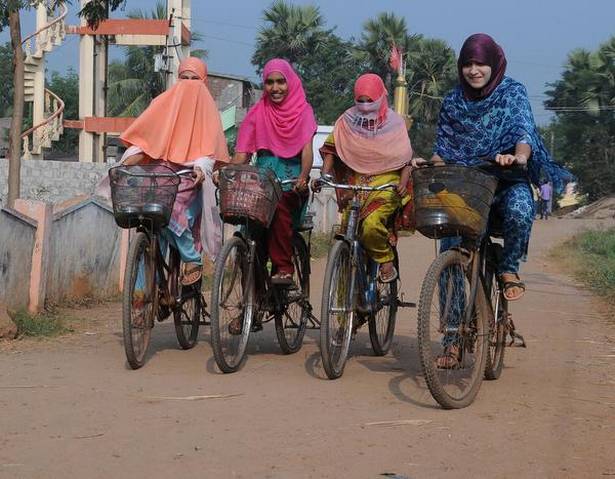
Girls cycle to school wearing colourful hijabs in Alinaqipalem. Photo: Ch.Vijaya Bhaskar | Photo Credit: Photo: Ch.Vijaya Bhaskar

Most of the villagers I spoke to didn’t remember how and when masonry became the village’s chief occupation. And then I found 57-year-old Mirza Javad Hussain, headmaster of the local school. We sat in the balcony of his neat, double-storied building covered with printed tiles and he told me the story of how some 120 years ago, one Azgar Ali from Pedana village, not so far away, introduced masonry work here.

“Until then,” said the bespectacled and bearded Hussain, “the villagers here worked as carpenters and ironsmiths.” Hussain is one of the few villagers with a modern connection to the Middle East — he was one of five persons from India to go to Baghdad in 2013 to participate in Jashn-e-Sabr-o-Wafa, the birthday celebrations of Imam Hussain, the grandson of the Prophet.

Mohammed Abbas is 22 and a mason. He dropped out of school as a teen. Ali Haider, who taught him in school, remembers him as “enthusiastic and eager to learn new things.” But Abbas is happy with his lot. “My grandfather used to be taapi maestri (mason). So was my father and now I am one too,” he said with a laugh. Others have been more ambitious. About 60 to 70 of his peers have gone off to West Asia to work on building sites.

***

According to revenue records, Alinaqipalem is really only a hamlet within Choragudi village. The families here don’t own any land and don’t farm. A couple of small shops stock all their needs. Mantada, 15 km away, is their closest transit hub. They take a share auto or bus from the Alinaqipalem junction to get there. The roads are not great and the bus services infrequent.

The nearest government health centre is at Veerankilakulu, 7 km away, and pregnant women are rushed to Uyyur, 22 km away, for an obstetrician. For everyday illnesses, there’s a registered medical practitioner who visits every day.

Sarpanch Ali Akbar says Alinaqipalem has been neglected. “We are trying to develop the village with available funds.” He complained about wanting a Shia qazi and is proud that the mosques were not handed to the Wakf Board but are managed by the villagers.

Alinaqipalem looks reasonably prosperous. Almost all the houses are brick and mortar (with cement bags as window curtains!) and there are only a handful of thatched roofs in sight. Those who can afford it, engrave their doors with quotes from the Koran. Every home has a television while some also have air-conditioners and two-wheelers. The headmaster has a car, and many homes have grapevines and flowering shrubs. The two mosques are well maintained, each with a pond stocked with fish. Each year, fishing rights are auctioned and the funds go to the mosque. Every villager pays Rs. 200 for the imams’ upkeep.

The newer mosque is shaped like an old three-paisa coin, a hexagon that fits the dimensions of the land available. Indeed, villagers now call it the ‘three-paisa mosque’. “The design was approved as the Qibla is the direction that should be faced during Salah prayers,” said Ali.

The Islam preached here is moderate and modern. The imams ban neither Western dress nor television. “Without television and knowledge of the outside world, they will remain ignorant,” said the imam, Mirza Ibrahim Ali Isfehani, “But I ask them to avoid serials and focus on the news.”

Elderly men wear dhotis and a local adaptation of the kurta, but the younger generation is in jeans or trousers. Women wear saris and don headscarves when they venture outdoors and cross the road when men walk by.

Ali Isfehani himself is resplendent in a long, white thobe flowing from shoulders to ankles, an imamah or white turban wrapped flat on his head, and the aba, a black, sleeveless, open cloak that is mandatory for an imam. As he spoke to us, couplets or noha in praise of Imam Hussain wafted from his tape recorder. Two steel cupboards were lined with religious texts, a few rosaries and phials of ittar.

Even though most of the villagers are school dropouts, they appear to have imbibed some progressive thinking from the mosques. “We are even advised informally to practise family planning,” said Ali. And long before the government came up with the Dulhan scheme, the villagers had drawn up their own plan. Elders and religious heads convene a meeting when a marriage is arranged in the village and everyone makes a contribution to the girl’s family towards wedding costs. In fact, in recent years, girls have completed schooling and a few are employed as teachers in neighbouring villages.

Alinaqipalem is a tiny bit of Iran that has now become completely Indian, whether in clothes, customs or even the villagers’ facial features. Sadly, not a trace remains of Iranian cuisine, with the only giveaway being the rotis the villagers eat a couple of times a week.

Soon, it might cease to be a mason’s village too. Already, a few of the younger men have studied engineering and medicine and are working in countries like Canada. Some have become teachers, some have joined the police. For the time being, however, masonry remains their mainstay. I asked Abbas if, given a chance, he would resume studies. He smiled shyly and said, “I get Rs. 400 to Rs. 500 a day now. What job will fetch me this kind of money?”

subbarao.gavaravarapu @thehindu.co.in

source: http://www.thehindu.com / The Hindu / Home> Society> Cover Society / by G.V. Subba Rao / January 20th, 2017

American federation of Indian Muslims pledges Scholarships worth Rs.4 crore; gives Excellence Awards for Luminaries

NEW DELHI  / Nuh ( Mewat)- HARYANA  /  U.S.A.  :

Educational Excellence Celebrated at AFMI’s Silver Jubilee Convention in Delhi

American Federation of Muslims of Indian Origin’s Silver Jubilee convention held at the Kedar Nath Sahani Auditorium in New Delhi Dec.31-Jan.1st celebrated the accomplishments and marked a milestone in the organization’s history. The convention was held in co-ordination with the Delhi Youth Welfare Association.

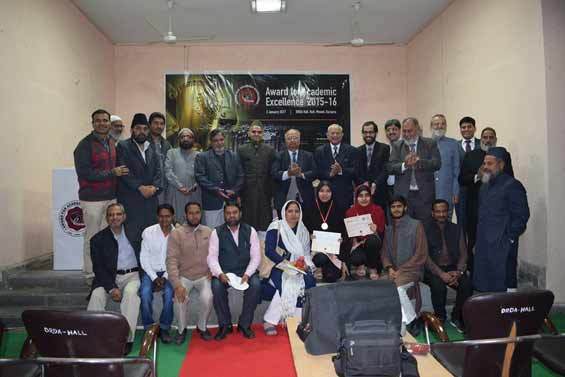
More than 120 Muslim students from across India were awarded with gold, silver, and bronze for attaining meritorious distinction in the board exams. In addition, the prestigious Sir Syed Ahmed Khan Award conferred about leading Mumbai philanthropist Dr. Abdul Kader Fazlani Sopariwala. The Mir Taqi Mir Award was given to Mr. Sanjiv Saraf, founder of the popular web portal www.rekhta.org, for his contributions in promoting the Urdu language. The website now features more than 22,000 titles of Urdu books.  Excellence Awards were given to former Chief Electoral Commissioner S.Y.Quraishi and the historic Anglo Arabic Senior Secondary School.

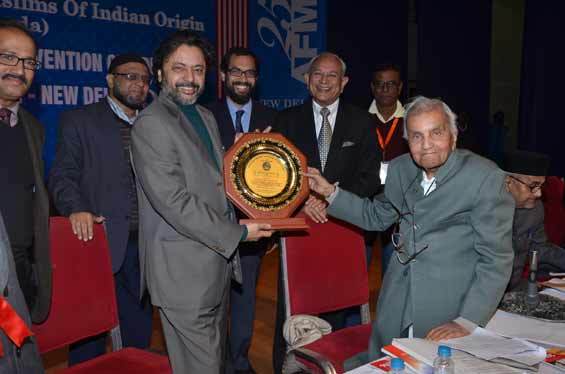
Sanjiv Saraf accepting his award from Justice Sachar

In a first for AFMI convention all the medallists were interviewed by Dr. Fazlani’s philanthropic organization and scholarships worth Rs.4 crore were pledged.

Awards to top students were given at the hands of Delhi Deputy Chief Minister Manish Sisodia. He praised the work of AFMI and that more such efforts need to be undertaken to uplift the society. He mentioned that education remains the top priority of the Delhi government with as much as 25% of the state government’s budget dedicated to it.

AFMI’s flagship awards program has been instrumental in spreading awareness about educational excellence and empowerment across the country. Dr.A.R. Nakadar, AFMI’s founding trustee, said that the fruits sown by AFMI at its inception are now bearing fruit. He said that due to such efforts there has been a remarkable improvement in the educational scenario of Indian Muslims. Citing the latest census reports, published in Indian Express, he stated that there has been a 98.8% increase in the number of Muslim graduates between 2001 and 2011. During the same period the Indian Muslim literacy rate has increased from 59.1% to 68.5%. He said that the day is not too far when, through the collective efforts of all, AFMI’s dream of 100% literacy will be realized.

Dr. Nakadar urged the students to not to rest on the laurels but to use the award as a motivational tool to attain even grater heights of educational excellence. He also asked them to not to forget those who have been left behind and to spread the message of educational empowerment everywhere.

AFMI’s incoming president Dr. Khutb Uddin, a practicing psychiatrist from Indiana, in his remarks applauded the students for their hard work. He urged them to not to be distracted by negative thoughts and to focus on their education.  He also pointed out that everyone from the individual to the government should be involved in raising the quality of education in the country and that it should be everyone’s top most priority.

The inaugural session of the convention was addressed by Justice Rajinder Sachar, Mr. Anil Swarup, Secretary Education & Literacy (Government of India), Mr. Naseem Ahmad, Chairman of National Commission for Minorities, and convention chairman Mr. Mohammad Naeem, president of Delhi Youth Welfare Association. The session was ably moderated by AFMI Trustee and leading scholar Dr. Aslam Abdullah.

The convention was also addressed by Prof. Akhtarul Wasey (Vice Chancellor of Maulana Azad University, Jodhpur); Mr.Siraj Hussain, IAS, former VC Jamia Hamdard,  Dr. S.Y.Qureshi (former Chief Election Commissioner), Justice Fakhruddin, Mr. Ali Quraishi (New Mexico), Mr. Tayeb Poonawala (New York), Mr. Siraj Thakore (Canada), Mr. Farhad Rahmani, Mr. Ayub Khan, Prof. Janaki Rajan, Dr. Shabistan Gaffar, Mr. Mohsin Siddiqui, Mr. Suhel Tirmizi (Editor, Gujarat Today), Dr. Husain Nagamia (Florida),  Mr. Shafi Lokhandwala (Detroit), Mr. Khalil Ahmad,  etc.

The convention also featured an AFMI Alumni session in which previous year’s medalists spoke on their experiences after winning the award. They also offered their guidance for the students in choosing their career pathways. Among those who addressed this session include Dr Nurul Islam (pediatric cardiologist), Mrs. Darakshan Khan (IT consultant), Dr. Suhail Qureshi (oncologist), Dr. Naseem Ahmed (Orthopaedic surgeon), Dr. Nabeel A.K., Ms. Samreen Siddiqui, Mr. Uzair Khan, among others.

In his closing remarks Dr. Nakadar thanked all the organizers and volunteers of Delhi Youth Welfare Association, under the leadership of Mr. Mohammad Naeem, for organizing a very memorable convention.

A seventeen member delegation of the American Federation of Muslims of Indian Origin, led by Dr. A.R.Nakadar, met the Vice President of India Mr. Hamid Ansari on January 2, 2017 and appraised him of AFMI’s activities. Mr. Ansari appreciated the efforts of AFMI and the concerns and care of NRIs for improving the quality of education in India.

An AFMI delegation met the Deputy Chief Minister of Delhi Mr. Manish Sisodia on January 3rd and discussed the current situation of education in Old Delhi.

AFMI’s Regional Awards Program in Mewat

AFMI02mpos24jan2017

AFMI held its regional awards program in Nuh, Mewat in coordination with the Human Welfare Foundation. One of the key organizers of the program is Uzair Khan, a former AFMI medalist, who is now carrying its message to the interiors of Mewat region. He is presently pursuing MBA from Jamia Millia Islamia.

Reviving  Delhi’s Educational Institutions

AFMI’s NRI delegates visited a number of educational institutions in Old Delhi which have held aloft the banner of education among trying circumstances. The schools visited include Anglo Arabic Senior Secondary School, Mazhar ul Islam School, and the Fatehpuri School. AFMI’s governing board will soon formulate a a plan for help in the revival of these historic institutions.

source: http://www.milligazette.com / The Milli Gazette / Home> Online News> Education and Careers / January 23rd, 2017

On the Kutch food trail

London / Kochi, KERALA :

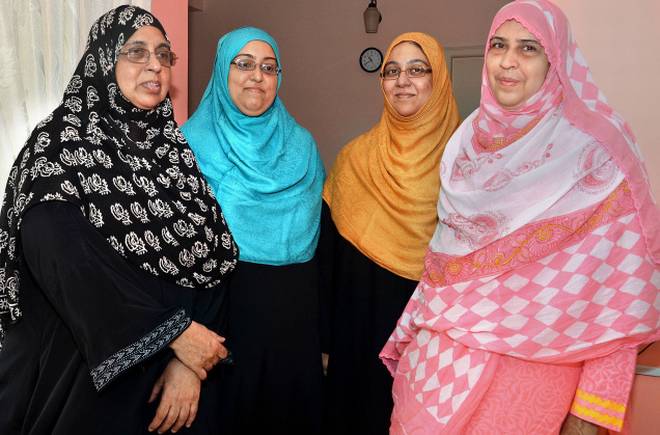
Together for food : From left, Sajida Aslam, Ruqia Suhaib, Nazia Tamir and Munira Munir from ‘Cutchi Kitchen’. Photo :Thulasi Kakkat

‘Cutchi Kitchen’ documents Kutchi cuisine through memories and recipes.

Almost 200 years ago, Sajida Aslam’s grandfather moved to Alappuzha from the Kutch region of Gujarat. Seventy-five years ago, her father moved to Kochi, where she was born among the growing community of Kutchi Memons in the city. Today, Sajida’s daughter, Shazia Wahid, is the founder of ‘Cutchi Kitchen’ — an initiative that documents through history and memories, the rich cuisine of the migrant community.

‘Cutchi Kitchen’ runs a website and a catering service primarily of Kutchi delicacies, with world cuisine as well. While Shazia runs the website from her present home in London, her mother Sajida, aunt Munira Munir Sait, sister Nazia Tamir and cousins Ruqia Suhaib and Sabiha Munir man the local orders from their homes in Ravipuram and Kaloor. “Shazia was inspired to begin ‘Cutchi Kitchen’ after she left the country,” says Ruqia, “She gave us all the first big push and we’ve completed almost a year now.”

‘Cutchi Kitchen’ opens with Shazia’s tribute to her ummima’s (maternal grandmother) special Kutchi chicken biryani. It is a detailed affair with three layers of rice sandwiching chicken in between, and served with raita. This recipe has been a favourite in our family for three generations for its minimal standing-by-the-stove time, writes Shazia. While two generations of Sajida’s family are involved in the daily workings of ‘Cutchi Kitchen’, Ruqia and Nazia say their children have taken a keen interest too, often chipping in with the preparations and tasting.

‘Cutchi Kitchen’ now has an active Facebook presence with over 3,000 fans and several followers on Twitter too. “We try and post at least once a day — either tips, or full recipes,” says Nazia. Thus far, they’ve had two online competitions too — the more elaborate one after they completed 100 recipes.

Their popularity rose most during the Ramzan fast, when they put together nine special Iftar menus, each with six dishes from starter, drink and main course to dessert. One of the highlights of these menus was their falooda recipes. While Sajida created an unusual falooda pudding made from China grass and cut into diamonds once set, Munira prepared the falooda drink, served cold and with jelly or ice cream. The menus were then released as an e-book.

The fasting season also brought with it almost daily orders for homemade frozen chicken fillets, samosas and rolls that only have to be fried before consumption. Their most ordered dish was also ‘Cutchi Kitchen’s’ most prized recipe — the goond jo laddoo, a powdery, sugary dessert served for auspicious occasions, given to brides before weddings and to mothers after deliveries. Explains Sajida, “The goond (acacia gum) has medicinal properties, and though the recipe for the laddoo is simple, it takes years of practice to get the mixture to hold right without giving way or being too sticky.” Sajida and Munira are the only ones in the family who prepare the laddoo, even today, as the next generations are still grasping the knack.

Changing rituals

Time has changed much among the Kutchi Memons, says Sajida. Old, prolonged rituals have turned brief, and with it, the associated foods have morphed too.

For example, by tradition, the peeti (haldi) ceremony for brides lasted several days and the household favourite was muthiya, a steamed rice dumpling dish that could be served dry or with gravy. “I remember my ummima sitting and shaping the muthiyas all by herself, not trusting anyone to make them correctly with her special mix of spices and ingredients,” writes Shazia. Peeti ceremonies now are associated more with quicker dishes such as kaaja (a badusha-like savoury) and paalchaya, a condensed milk-based drink. Hot favourites are also the Kutchi koottan (a dal curry served with pathiri), beef kofta (boneless beef meatball curry), buttery, cookie-like nankhatais and mitta ghatia, a deep-fried flour-based snack.

Sajida counts among her most prized possessions, a kombi, a 100-year-old bandini shawl bordered by gold, traditionally placed over the bride’s head at weddings. What they also cherish is their Kutchi language — a conglomeration of Sindhi, Gujarati, Urdu and Hindi, reflective of the community’s wide travels.

“We still speak it at home and though it has no specific script, all our children have learnt it too alongside Malayalam, Hindi and English,” says Sajida in fluent Malayalam. Someday, they hope to bring out a book of their family’s recipes. For now, ‘Cutchi Kitchen’ conducts workshops on their food, alongside those on Arabian recipes and world cuisine. Find the ‘Cutchi Kitchen’ at www.cutchikitchen.com

source: http://www.thehindu.com / The Hindu / Home> Food / by Esther Elias / November 14th, 2013

Nawab who misses the royal culture

Hyderabad, TELANGANA :

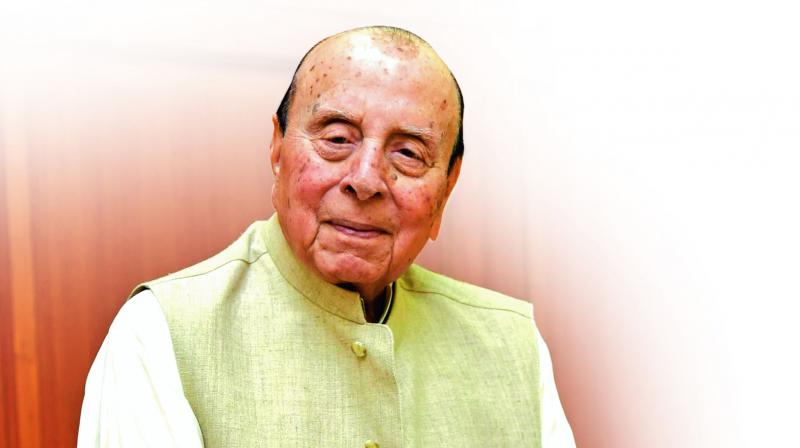
At 92, Shah Alam Khan visits his office daily and tries his best to preserve Hyderabad’s culture.

Shah Alam Khan, one of Hyderabad’s royals who is still referred to as ‘Nawab’.

At 92, Shah Alam Khan, one of Hyderabad’s royals who is still referred to as ‘Nawab’, is gracious enough to stand up to welcome you into his study at the Hyderabad Deccan Cigarette Factory in Musheerabad. What’s more, he eloquently reminisces on the “good old days” when Hyderabad was still ruled by the Nizams.

“Life was not expensive at all. I once saw a goat being sold for four rupees… four rupees!” he says incredulously. With seven sons, Alam’s family has, over the years, expanded their businesses in various fields but one thing that they all take pride in is ensuring that the Nawabi and Hyderabadi culture isn’t forgotten.

Alam’s son Mehboob Alam Khan is a well-known food historian and connoisseur who has helped preserve the Hyderabadi Mughlai cuisine that the city is famous for. Working with various restaurants, Mehboob helps them maintain authenticity in their recipes.

“Hyderabad was known for two things — biryani and sherwani!” says Alam, and says that training today’s chefs is all that is required to bring back the lost culture. “The cooks in our city know only a little bit of this and that. But our womenfolk know a lot of recipes,” he says.

Sipping a typically Hyderabadi cup of chai, he talks about growing up in the Cantonment area in Secunderabad and moving on to study at the Jagirdar College — what’s now known as Hyderabad Public School. “We had the best of Continental as well as Mughlai food. Even the schools served amazing food, that we didn’t even get at home!” he remembers.

Alam then pursued a Bachelor’s degree in Economics and Political Science from Osmania University, where he says his professors helped mould his life: “I can’t forget the way my English teacher, Prof Doraiswamy, taught us. When the results came out and I passed, I went to his house and fell at his feet.”

The lessons came in handy when he took over the reins of a cigarette factory from his wife Begum Abida Khader’s father in 1945. “When I used to hoist the flag during ceremonies, I’d tell them that this is the place where you as well as me fill our tummy. If there’s a quarrel in the house between the husband and the wife, then your house is not good. If there’s a quarrel in the factory, it’s not good for the industry,” Alam explains.

Alam still goes to office every day but has one regret: Not doing enough to preserve Hyderabad’s culture — “I once had the opportunity to address the old boys’ association of Osmania University in Karachi. And I told them with tears rolling down my cheeks that I can’t believe that the association is here… it should have been in Hyderabad. And with it, you have also taken away our culture.”

source: http://www.deccanchronicle.com / Deccan Chronicle / Home> Lifestyle> Viral and Trending / Deccan Chronicle – by Christopher Isaac / March 18th, 2016

A.R. Antulay, Maharashtra’s first Muslim CM, is dead

Ambet District (Raigad) – Mumbai, MAHARASHTRA :

Mumbai :

Congress veteran Abdul Rahman Antulay, Maharashtra’s first Muslim chief minister and a former central minister, died here Tuesday following prolonged illness, his nephew said. He was 85.

Antulay passed away at the Breach Candy Hospital where he was admitted a few days ago.

He is survived by his wife Nargis, son Naved and daughters Neelam, Shabnam and Mubina, said nephew and son-in-law Mushtaque Antulay.

Known as ‘Barrister Antulay’, he was the state’s first Muslim chief minister, from June 1980 to January 1982 and a loyalist of then Congress president and prime minister Indira Gandhi.

The party’s most prominent face in the Konkan region, Antulay served as a union minister in 1995 and later in the UPA-I government of prime minister Manmohan Singh.

“We plan to hold the funeral ceremonies Wednesday in his village Ambet in Raigad district,” Mushtaque Antulay told IANS.

This is the second Congress veteran to die in Maharashtra after former union minister Murli Deora expired in Mumbai Nov 24.

Maharashtra Chief Minister Devendra Fadnavis condoled the demise of Antulay.

“Maharashtra has lost a leader who worked for the interest of the common man,” Fadnavis said.

Political leaders cutting across party lines, including former chief minister Manohar Joshi of the Shiv Sena, paid glowing tributes to Antulay. – IANS

source: http://www.weekendleader.com / The Weekend Leader / Home / Mumbai – December 02nd, 2014

Inside India: a teacher’s battle to get girls into male school

NEW DELHI :

It has been a tough battle for Faiza Nisar Ali who helped steer the entry of girls into the male bastion of the Anglo-Arabic School.

New Delhi

It has been a tough battle for Faiza Nisar Ali who helped steer the entry of girls into the male bastion of the Anglo-Arabic School.

Her struggle of that of many other Muslim women created history when the school admitted girls for the first time this year in its more 300-year-old existence.

Ms Ali’s fight began in March when she was appointed to prepare a feasibility report on why Muslim boys and girls should study under the same roof.

She had to contend with numerous pitfalls along the way, including frantic phone calls from community hardliners trying to dissuade her, being blamed for scripting something “un-Islamic”, countless sleepless nights and the trauma of a miscarriage.

“After months of research, consultations with educationists, psychologists and parents, I concluded in my report that co-education among Muslims would result in greater progress and help them in the later stages of life,” Ms Ali, who has been the business studies teacher at the same school for more than six years, told IANS.

She recounted the events with moist eyes.

“After the report was done, the staff became very resistant. The teachers went against me and I was held liable for being un-Islamic,” she said.

The report spoke on how co-education could boost academic performance of both the sexes, the structure of the Anglo-Arabic school, located as Ajmeri Gate, in the old quarters of Delhi, and its importance. The report also highlighted that Muslim parents wanted their girls to go to a co-ed institution.

Despite facing internal resistance from the predominantly male school staff, the managing committee of the school on March 26 decided to open its doors to girls.

However, the landmark decision did not end Ms Ali’s agony. While her family was supportive, the mental pressure due to the angry reactions sent her to hospital.

Then eight weeks pregnant, Faiza went through a miscarriage.

“I had this invisible pressure about how to face colleagues in the school. I had gone through a lot, but I did not want to leave it in the middle,” the mother of a five-year old said, adding that her “mother had even suggested [she] distance herself from all the activities”.

Her cause to turn the school coed gained strength when a Jawaharlal Nehru University student, Fatima Alvi, filed a petition in the Delhi High Court.

On May 24, the court backed their cause. The school management swung into action and has so far admitted more than 30 girls in Classes 6 to 11.

For many Muslim girls studying in nearby girls’ government schools, the move is a dream come true as they can switch to the Anglo-Arabic School that has had among its students Liaqat Ali Khan, the first prime minister of Pakistan, Sir Syed Ahmad Khan, founder of Aligarh Muslim University, JN Dixit, former national security adviser and foreign secretary.

Burqa-clad Darakshna Fatima, 17, beams with joy for having made it to the school.

“I lost my father 6 years back, since then my mother has been the pillar of strength for me,” Darakshna, who aspires to become a chartered accountant, told IANS.

The Class 11 student added, “Our relatives had reservations, but I am proud that my mother fought for my education.”

Darakshna’s sister Gulafshan has also secured admission to the school, that started off as Madrasa Ghaziuddin around 1692.

However, Ms Ali says the fight is not over yet. Though girls have been admitted, the resistance among many staff members remains.

“Let’s hope there is an attitudinal shift and changes begin to happen,” Ms Ali said.

source: http://www.thenational.ae / The National / Home> World> Asia / IANS / June 04th, 2017

No Living Moghals, for now

Hyderabad, TELANGANA ( formerly ANDHRA PRADESH )

Hyderabad :

The City Civil Court has granted injunction order stopping the telecast of the documentary film, `Living Moghals,’ produced by the Public Service Broadcasting Trust.

The documentary, which has been screened on various TV channels, has attracted flak from the descendants of the last Mughal emperor, Bahadur Shah Zafar, for projecting Princess Laila Umahani and her two sons as the only surviving heirs. Taking objection to the `misleading’ documentary, Prince Yakub Habibuddin Tucy, great grandson of Bahadur Shah, and 34 other members of the family approached the court and obtained the injunction order, pending disposal of the suit.

Prince Habibuddin told presspersons here on Sunday that both print and electronic media were giving a wrong picture showing Princess Umahani and her sons — Ziauddin Tucy and Masihuddin Tucy — as the surviving heirs. The fact was that Umahani’s elder sister, 88-year-old Princess Hussan Jahan Ara Begum, her children and grandchildren were also present. There were at least 55 Mughal descendants living in the city alone.

“All this is being done with an ulterior motive,” Prince Habibuddin said. He said all the descendants of the Mughal family wherever they might be living should come under the banner of Mughal Emperors Family Society so as to preserve their identity.

source: http://www.thehindu.com / The Hindu / Home> Southern States> Andhra Pradesh – Hyderabad / by The Hindu Staff Reporter / Monday – December 09th, 2002

The Subaltern Speak

Mumbai, MAHARASHTRA :

A Mumbai-based voluntary group launches a diary about the contribution of Indian Muslim women.

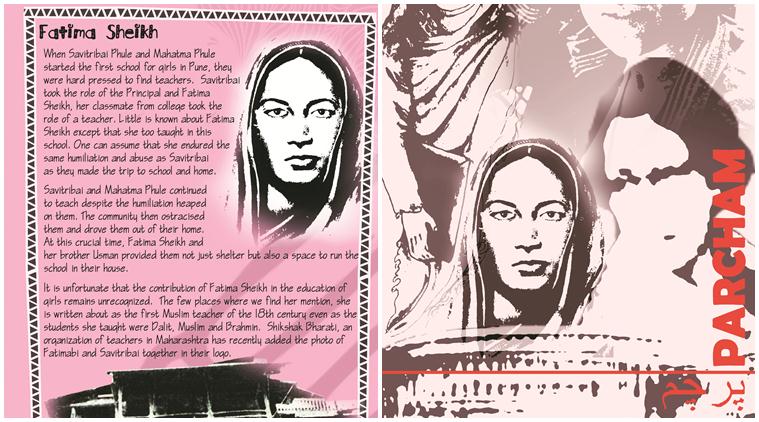
(From right) Book jacket of the diary; one of the inside pages that acts as a separator

Earlier this week, several Indian intellectuals and feminists paid homage to Savitribai Phule on her 185th birth anniversary. The contribution of the social reformist towards women’s rights, especially in the field of education, is now being recognised. However, Fatima Sheikh continues to be an elusive figure in Indian history. A diary introduced by Parcham Collective — a voluntary group in Mumbra in Thane district — celebrates Sheikh and several other pioneering Muslim women, who have contributed to society but have remained largely unacknowledged.

“In a political environment when the minorities in India, especially the Muslims, are having to prove their allegiance to the country, we hope this diary will reiterate that we aren’t the ‘other’,” says Sabah Khan, one of the co-founders of Parcham Collective, which attempts to break stereotypes based on religion, class, caste and gender. Active since 2012, they have been working with girls and have been successful in using football among adolescents to reclaim public space for the feminine gender and also bridge the gap between Hindus and the dominant Muslim population of Mumbra.

In the diary, Sheikh, a 2016 organiser, is the first Muslim woman, among six. Savitribai’s classmate from college, she not only taught at her school but also gave the Phule couple shelter when they were ostracised by the society for their work. The other women include Rokeya Sakhawat Hossain (1880-1932), Nazar Sajjad Hyder (1894-1967) and Rashid Jahan (1905-1952), among others. Their stories appear with illustrations and act as separators between the diary pages.

The idea of a diary, says Khan, came up earlier in 2015 during a discussion on Muslim women and their contribution to society. “At a time when education of the Muslim girl child is an issue and girls often drop out of school in Mumbra, we wanted to highlight women as role models who would inspire people,” says Khan.

The Parcham Collective team had been trying to unearth names and information of such women for a long time; the information had been tough to come by. It took them three months of research, tapping feminists such as Uma Chakravarti, and the names started to come up.

So there is Rashid Khan, a gynaecologist and writer, who was an inspiration to writers such as Premchand, Ismat Chughtai and Faiz Ahmed Faiz. A member of the Progressive Writers’ Movement, Rashid spoke about the oppression Muslim women faced everyday. As for Begum Qudsia Aizaz Rasul (1908-2001), few are aware that the Indian Women’s Hockey Cup is named after her. A politician from a privileged family, her key contributions include fighting for the abolition of the zamindari system and encouraging sports among women.

This is their first diary, but Parcham Collective wants to make it an annual project, using it to talk about subaltern women. They hope to dedicate the 2017 diary to Muslim women across the world in the arena of sports. “While the diary has been welcomed by feminists, we believe the real success of the project will be if common people purchase it and gain from it,” says Khan. Buyers can visit Parcham Collective’s Facebook page page and place an order for the diary.

source: http://www.indianexpress.com / The Indian Express / Home> Lifestyle> Book / by Dipti Nagpaul D’Souza / January 07th, 2017