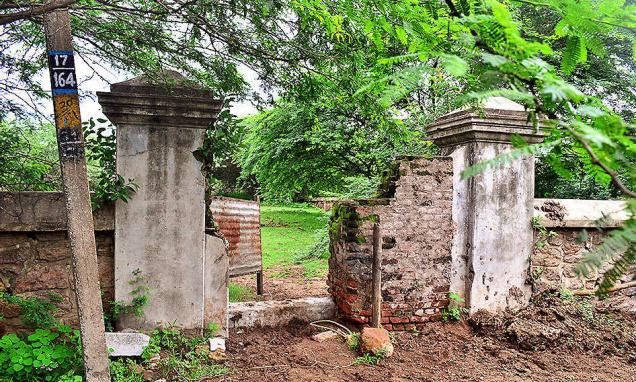
The two-storey mansion where the Hyderabadi noblewoman once stayed is now in ruins.—Photo: T. Appala Naidu
Mansion where noblewoman Khair-Un-Nissa stayed is now a cattle shed
In April 1807, Hyderabadi noblewoman Khair-Un-Nissa was given shelter in a two-storey mansion with a mesmerizing view of palms, fishing canoes and breakers of the Coromandal coast, according to ‘White Mughals; Love and Betrayal in 18th Century India’ by William Dalrymple.
Now, the view of the mansion, which was then residence of East India’s agent in Masulipatam, Alexander, resembles a small jungle, with a cattle shed within the stonewall in the Bandarkota area in Machilipatnam.
Khair-Un-Nissa, most excellent of the women had stayed in the mansion with her mother Sharaf-Un-Nissa for nearly two years during her exile. After Mir Alam, Hyderabad Nizam, died in January 1809, Khair-Un-Nissa and her mother appeared to have returned to Hyderabad.
Outlawed after love affair
Colonel James Achilles Kirkpatrick, the British Resident in Hyderabad (1797-1805), fell in love with Khair-Un-Nissa, and married her in January 1801. Citing disgrace to her family, Khair-Un-Nissa was ordered by Mir Alam that she would not be allowed back to Hyderabad on her way back from Calcutta, where she spent some months, mourning the death of her husband Kirkpatrick. He was 41.
Widowed at 19, Khair-Un-Nissa had to live outside the Nizam’s dominions and thus she had to stay in Masulipatam as suggested by her husband’s assistant, Henry Russel. Nestled between the Dutch fort and an armoury, the mansion has been erased from the memory of the people of Masula and become home for cattle.
The Machilipatnam Municipality’s survey records show that the nearly two-acre site of the mansion is now under the control of private people. “We do not know any history attached to the land. The entire site has been distributed among the 12 members of our family, Vemoori family,” Vemoori Badri toldThe Hindu . Mr. Badri’s family uses this historical site as shelter for their cattle.
“Until 1979, the two-storey British building was in good shape with rooms with spiralling space. It has disappeared on the site over the years. Possession and transfer of right over the site by locals remains a puzzle for me,” local historian and then Masula Revenue Inspector Mohammed Silar told The Hindu . Most of the protection wall and entrance gates to the British site were collapsed. A thatched cattle shed raised on the pillars of the old construction welcomes the visitors.
source: http://www.thehindu.com / The Hindu / Home> National> Andhra Pradesh / T. Appala Naidu / Machilipatnam – July 02nd, 2016
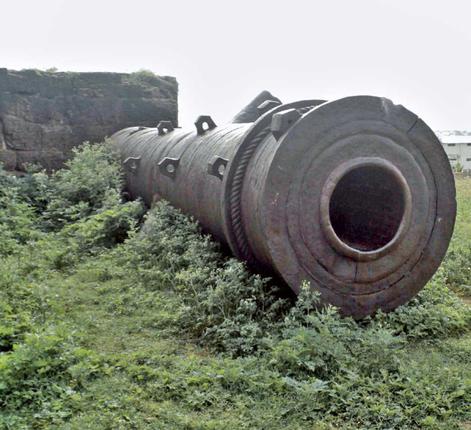
The Mustafabad cannon at Allapur Gate and Landa Qasab cannon, in Vijayapura, are facing neglect.
Some of the massive and marvellous cannons belonging to the Adil Shahi era here are decaying because of lack of efforts to preserve them.
While only a few giant cannons have been preserved at Nakkar Khana, the main pavilion of the Gol Gumbaz, at Malik-e-Maidan, some others are left there in the open.
The cannons at Mustafabad near Allapur Gate, a few hundred metres from the Gol Gumbaz, are in the worst shape.
The cannon was earlier placed on the fort wall. Over a period of time, the wall collapsed owing to lack of maintenance and the giant cannon fell on the ground.
The authorities have not made any efforts to locate it to a better place where it could be preserved. They are now getting gradually buried under a heap of garbage and human waste.
Similar is the condition of the Landa Qasab cannon near Kirti Nagar and Ali Burj.
While a signboard has been placed by the Archaeological Survey of India near the Landa Qasab cannon, the one at Mustafabad does not have one.
According to historians, these cannons played a significant role in protecting the boundaries of the Adil Shahi empire from enemies.
They were strategically placed on towers where security men could keep a watch on the entry of enemies.
source: http://www.thehindu.com / The Hindu / Home> National> Karnataka / Firoz Rozindar / Vijayapura – June 30th, 2016
Newly elected MLC Rizwan Arshad, who arrived in city to day was given a rousing welcome by Congress activists at the Toll Gate in front Columbia Asia Hospital.
He was later taken to City Congress office on Sayyaji Rao where he was felicitaed.
City Congress Committee President T.S. Ravishankar, District Congress Comittee President B.J. Vijaykumar and others were present.
source: http://www.starofmysore.com / Star of Mysore / Home> General News / July 02nd, 2016
It is said that Shah never asked his followers to shun their own religion and this is the reason why he had a great number of Hindu followers.
What is common among Dewa Shareef in Uttar Pradesh, Ramdevra in Rajasthan and Powa Mecca in Assam?
These are some of the lesser-known shrines revered and frequented by people of all faiths and since ages have been portals of peace, tolerance and harmony.
The Dewa Shareef shrine of Haji Waris Ali Shah in Barabanki, hardly an hour’s drive from Lucknow, draws the faithful from across many strands of religion.
“The air around the place is liberal and the word intolerance an abomination. Why else would people leave their religious preferences behind and with baskets full of flowers, sweets and colourful shiny chaddars in their hands and wish in their hearts, make a beeline for the shrine of the Sufi saint,” says an article ‘The Sufi of Dewa’ in the latest issue of Equator Line magazine titled ‘Liminality of Faith’
It is said that Shah never asked his followers to shun their own religion and this is the reason why he had a great number of Hindu followers.
The very first foundation of the shrine was laid by Kanhaiya Lal and many more Hindus came forward after that.
Both Hindu and Muslim devotees contributed equally to the monument that it is today.
The Ramdevra shrine, about 12 km from Pokhran, is holy to both Hindus and Muslims.
“Ramdevra, the final resting place of Baba Ramdev, or Ramsha Pir as he is called by Muslims, is probably the only temple in the country with an intriguing assortment of devotees,” says another article ‘A Syncretic Oasis in Pokhran’
“One of the most puzzling features of the temple is the number of mazars inside. There are tiny gravestones representing the graves of children and large ones signifying the graves of adults… These are graves of people who had been close to Baba Ramdev. Among these graves, in the sanctum sanctorum, is the samadhi of the saint himself.”
Powa Mecca in Hajo near Assam’s main city Guwahati is the seat of Sufi saint Peer Ghiyasuddin Auliya.
“Earth was brought from Mecca to lay the foundation of the masjid. The locals believe that a pilgrim to this shrine earns a quarter of the blessings bestowed on someone performing Haj at Mecca. The place — Powa (quarter) Mecca — has derived its name from this belief. It is indeed significant that Hindus, Muslims and Buddhists all find this place holy and come here for pilgrimage,” writes noted Bangladeshi author Selina Hossain in ‘Faith Synthesis’
“More so, they say that the mythical bird Garuda, the carrier of Lord Vishnu, flew off the hill. After flying some distance, it stretched its wings and hovered over the place; it is now called Pakhimela market. A saint named Ourjo also sat in prayer there. The place is said to have been inhabited by the asuras. The most devious among them was Hayasur; his face resembled that of a horse.
“The saint had prayed to Vishnu that the asura be slain so he could pray in peace. Vishnu rode Garuda to defeat the asura in Hajo. This form of Vishnu is now called Haigrib. In a gesture of gratitude, Ourjo established the Haigrib temple here, bonding the two religions forever in an uninterrupted harmony,” she writes.
“Faith, unspoiled by outside interventions, has an openness that its seekers find reassuring,” says the magazine’s editor-in-chief Bhaskar Roy.
The issue also profiles Ajmer and Nizamuddin dargahs, Banke Bihari temple and Bavar Swamy’s empty shrine at Sabarimala among other shrines.
source: http://www.thehindu.com / The Hindu / Home> National / PTI / New Delhi – June 28th, 2016
A horse-drawn cart goes past poplars on a highway at Narbal, 15 km north of Srinagar.
Srinagar :
Mathematician Fozia Qazi has undertaken a campaign to protect the trees that are in danger of being axed in large numbers in the valley.
With around 16 million poplar trees facing the axe in Kashmir Valley following a High Court order, noted mathematician Fozia S. Qazi has started a campaign to “dispel the myths” that led to the systematic felling of the trees synonymous with the Valley landscape for decades.
In 2014, the Jammu and Kashmir High Court first banned the sale, purchase and plantation of female Russian poplars (Populus deltoides) following a public outcry and medical warnings that their cotton shedding laden with pollen, during late spring was the main cause of allergies in Srinagar.
Chopped down
Thereafter, lakhs of poplar trees were cut down across the Valley. A compliance report submitted to the court by the Deputy Commissioners of Kulgam and Pulwama district in June this year claimed that it targeted felling of six lakh poplars.
Dr. Qazi, Associate Professor of Actuarial Mathematics at Islamic University of Science and Technology, believes that the High Court’s decision to fell poplars is not only an “exceptional exercise but also a misinformed decision.”
Dr. Qazi, who is filing a petition before the court against the felling, has organised a meet of experts to collate scientific data on the subject and create mass awareness.
Backing Dr. Qazi’s contention that poplars are not the main cause of allergy in Kashmir during April and May, Dr. Dr. Naveed Nazir Shah, Consultant and Assistant Professor at the Department of Chest Medicine of the Government Medical College, Srinagar, said: “Poplar-induced allergy stands at number six as a cause of allergy. While dust remains the main cause, it is followed by lawn grass, deodar, kikaarand chinar pollen.
“Also, the size of its cotton is big enough to enter human body. There is no connection to prove that the poplar was the main cause of the allergies.”
Instead of felling the trees, Dr. Sajad Gangoo, an expert from Sher-i-Kashmir Institute of Agricultural Sciences, argues that pruning these trees during autumn would cut down cotton circulation by 80 per cent in spring.
Key to rural economy
Dr. Qazi, a doctorate from the Syracuse University in the U.S., argues that poplar trees are central to rural economy here.
“The tree grows faster [than the local species]. It’s a source of livelihood for many because fruit boxes are made of it,” she pointed out and said that while “it consumes water, purifies it more than any other tree and could be helpful for water bodies too.”
Poplars live up to 40 years and mature in just three years. They attain height up to 20-30 feet.
“Given its height, poplars stand distinctly in the landscape of Kashmir and dot most highways, forming a mesmerising canopy and fast becoming a tourist attraction too,” Ms. Qazi said.
source: http://www.thehindu.com / The Hindu / Home> National> Other States / Peerzada Ashiq / Srinagar – June 24th, 2016
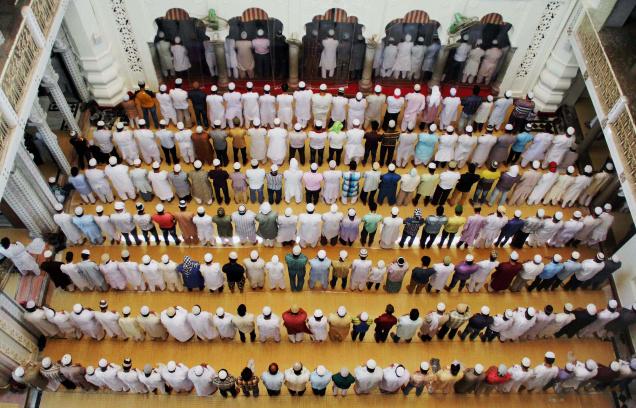
‘Taraweeh’ prayers are exclusive to the month of Ramadan. Photo: PTI
Qualified reciters of the Quran from North India are in great demand in to lead the Taraweeh prayers in South Indian mosques during Ramadan
Of all the months in the lunar Islamic calendar, Ramadan stands out for its focus on spirituality. Through dawn-to-dusk periods of voluntary abstinence and prayer, the Muslim is expected to feel closer to God.
Ramadan is also believed to be the month when the Quran began to be revealed. So the recitation of verses from the holy book in Arabic assumes greater importance during this month. It is a common practice for observant Muslims to try and finish at least one complete reading of the Quran at home. This is also carried out by imams (prayer leaders) who conduct the late-night Taraweeh prayers in mosques during the month.
With the emphasis on the most sonorous rendition of the Quran, management committees and clerics attached to mosques and other places of congregational prayers in Ramadan take an extra effort to find Aalims (scholars) who have memorised the 6,666 verses of the holy book and are skilled in reciting it in a semi-musical style. A person who has perfected memorising the book is known as Hafez, and one who has mastered the art of recitation, as Qari.
In South India, Islamic institutions often invite qualified reciters of the Quran from the North specifically to conduct the Taraweeh prayers during Ramadan.
North Indians are considered to be better in Arabic pronunciation because of the semantic and phonetic affinity that their regional languages – Hindi, Urdu and Hindustani – have with the language of the Quran.
In Tamil Nadu, cities like Chennai, Tiruchi, Madurai and Salem have been hosting imams from Uttar Pradesh, Bhopal and Bihar to lead Taraweeh prayers for several decades.
“The imam’s talent is important in holding the congregation’s interest,” says Mohamed Meeran Misbahi, Secretary, Tamil Nadu Jama’at-ul-Ulema Sabai, a state grouping of Islamic scholars. The Tenkasi native has been officiating as imam at the Kader Mosque in Tiruchi’s Gandhi Market area for the past 20 years. “Many worshippers visit mosques just to sample the different styles of sermons and Quran recitation during Ramadan, so the clerics have to make an extra effort to keep the people engaged,” he adds.
On average, depending on his professional expertise, a prayer leader can earn from Rs. 8,000 to 15,000 per month. During Ramadan, the income is boosted by donations from the congregation.
Historic link
The erstwhile princely kingdom of Rampur (now a part of Uttar Pradesh) has been maintaining a link with Tiruchi that started in 1952, when Saudi Arabian national of Indian origin, Moulana Qari Hafez Mohamed Ismail Sahib Mujaddidi Madani, was invited to conduct Taraweeh prayers at the Mohammadi Jama Masjid in Tiruchi by the then-Nawab of Arcot.
“My father led the Taraweeh prayers from 1952 to 1974. He died during a prayer service in 1974, and was buried in Tiruchi,” says his son Qari Moulvi Rashid Mujaddidi. The cleric, an Indian citizen, had conducted Taraweeh prayers at the Chowk Mosque from 1960 to 2006. Though he has cut down his engagements due to his advancing years and health problems, the cleric still visits the city during Ramadan, and this year, is officiating as a Taraweeh imam at a private mosque in Singarathope.
His son Salman, who is also an imam, reached Tiruchi a day before the month’s commencement (by the sighting of the crescent moon) was announced, in early June.
“I don’t speak much Tamil, but I have got only love and affection from the people of Tiruchi,” says Moulvi Rashid, who has also worked as an Arabic lecturer in Rampur. “I always tell people to come and visit Tiruchi and learn how different communities can live in harmony. ”
South-side sojourn
For Moulana Hafez Abdul Rab Qassimi, a suggestion by his friend brought him from his village Mansoorpur, Uttar Pradesh to the Bangali Street Mosque in Woraiyur in 1972. “I was a young man when I started leading the Taraweeh prayers here; now I am almost 68. I will continue to come as long as I am physically able to,” says Moulana Abdul Rab, who makes a three-day rail journey via Moradabad, Delhi and Chennai to reach Tiruchi every Ramadan.
Accommodation for the visiting imams is usually provided within the mosque premises. Congregants provide the food for breaking the fast (iftar) and pre-dawn meal (suhour).
It is Moulana Zia-ur-Rahman’s first year as the Taraweeh imam at the Tennur mosque. A graduate of Qurannic studies from Hyderabad, the 27-year-old will return to his native Leela Baran village in Bihar shortly before Eid-al-Fitr, the festival that denotes the end of Ramadan. “The atmosphere in Tiruchi is very peaceful and conducive to prayer,” says the imam.
Quest for authenticity
Despite the continuing patronage of North Indian imams, many South Indian institutions have come up in the interim to create a new talent pool of young Muslim clerics with a comparable expertise in Quran recitation.
“International qirat (recitation) competitions and a wider exposure to different styles have led to more Muslims opting to study this discipline more seriously,” says Moulana Hafiz Mufti Ruhul Haq, principal, Jamia Anvar-ul-Uloom Arabic College, Khaja Nagar.
The college offers Arabic-medium courses in Quran recitation, Islamic jurisprudence and the study of the Traditions (Hadith) of Prophet Muhammad.
“Besides mosque duties, we also train our students in computer skills in English, Arabic and Tamil, so that they can have a wider range of employment opportunities,” says Moulana Ruhul Haq. Taraweeh
The emphasis on certification has increased the number of younger clerics, with institutions attracting students not just from the South, but also the North.
Like any profession, individual talent is ultimately the deciding factor in religious orders too.
***
Fact file
In Arabic, Taraweeh is the plural of tarweeha, which means to rest. In the context of Ramadan prayers, it means to take rest between every four rak’at (units) of praying. Services need to have more than two periods of rest in order to qualify as Taraweeh.
Taraweeh prayer units across the Muslim world range from 8 rak’ats to 20 rak’ats.
Taraweeh is exclusive to the month of Ramadan. However, unlike the compulsory (fardh) five prayers of the day, participating in Taraweeh daily is not obligatory. In fact, Ramadan-specific prayers are meant to be conducted only after the compulsory night prayer (Isha).
source: http://www.thehindu.com / The Hindu / Home> Features> Metroplus / by Nahla Nainar / Tiruchi – June 24th, 2016
The AIITEA will hold its first meeting on June 30 on the ITC Infotech campus
Amid the opportunities and growth prospects, the problems faced by employees of the information technology sector are among the least addressed. The struggles within these workplaces often get sidelined or swept under the carpet by the ‘terms and conditions’ of the company. Consequently, employees often have little say in such matters.
Now these unhealthy workplace practices have forced IT employees to join hands to make a forum where they can address their issues.
The All India Information Technology Employee Association (AIITEA), a registered body meant to take up and resolve problems faced by people in the IT sector, is going to have its first meeting on June 30, on the ITC Infotech campus to announce in the open its arrival in the IT city.
SyedMuqeem, head of AIITEA and one of the founder members of the association, said: “There is a general perception that unions and associations are for blue-collar people, but there are many instances where the IT employees, the so-called white-collar staff, face workplace-related problems, but there is no group to support them.”
“Most associations that have been formed earlier either play in the hands of the big multinational companies or have failed to take up the issues faced by the employees in the sector, and take it to a logical conclusion. This void that the industry has created over a period is what we are trying to fill up. Our main aim is to ensure equal employee representation in resolving employee grievances,” said Muqeem.
Bengaluru, deemed India’s IT capital, is home to 35 per cent of the 8 million IT employees and in the last financial year, it clocked around 1 lakh crore in software exports. But beneath this glitter is a dark cloud looming and that is the ever-deteriorating state of the IT employees.
A global study done by the National Institute of Mental Health and Neurosciences (NIMHANS) says 50 per cent of employees in India Inc are under stress and around 30 per cent software engineers in the city show signs of psychiatric disorder. One in every 20 employees has contemplated suicide.
The fast pace at which the IT industry is progressing has its own side-effects and employees are at the receiving end. Muqeem said that till date “we have helped resolve around 15 cases where the employee was being harassed by the employer, but on an average we receive 15-20 complaints per week, but the fear of losing one’s job, coupled with the feeling that engaging with an association might hamper future growth prospects is what is keeping many from coming out in the open”.
source: http://www.bangaloremirror.com / Bangalore Mirror / Home> Bangalore> Others / Bangalore Mirror Bureau / June 27th, 2016
In the 2014 polls, Mr. Sayeed defeated Congress candidate Mr. Shah by 6,000 votes and the margin has doubled this year.
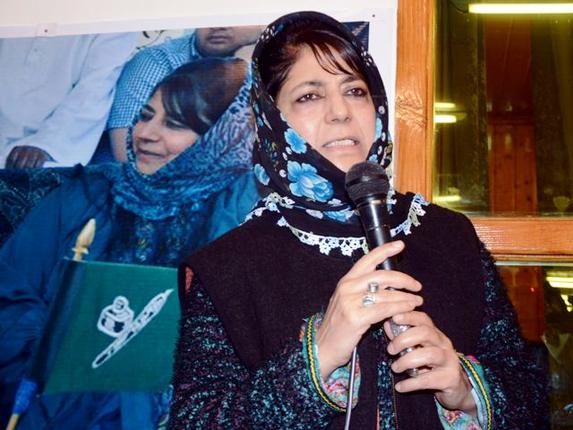
Chief Minister Mehbooba Mufti on Saturday won the Anantnag Assembly seat by 12,085 votes, driving home a point that her popularity remains unaffected by the Peoples Democratic Party’s decision to join hands with the BJP in Jammu and Kashmir.
Of 28,500 polled votes, the PDP candidate Ms. Mufti has secured 17,701 votes, followed by Congress’ Hilal Shah with 5,616. National Conference (NC) Iftikhar Misger stood a distant third with 2,811 votes.
The PDP’s winning margin has considerably gone up in Anantnag despite the NC and the Congress pegging its campaign on the anti-BJP wave and cornering Ms. Mufti over her alliance partner.
In the 2014 polls, Mr. Sayeed defeated Congress candidate Mr. Shah by 6,000 votes and the margin has doubled this year with 12,000 lead by Ms. Mufti.
Earlier in the day, the counting was stopped immediately after the first round results were announced because of the Congress’ protests.
“An Electronic Voting Machine (EVM) was not properly sealed and should not be counted at all,” alleged Mr. Shah, as he and his supporters left the counting hall in protest.
However, after 15 minutes the counting was restarted.
The NC also alleged EVM tampering. “A lot of EVMs in Anantnag (were) without mandatory seals/locks. Electoral staff says since teachers were incharge, their inexperience is the reason!” alleged NC spokesman Junaid Azim Mattu, who later congratulated Ms. Mufti on her victory.
However, district magistrate Syed Abid Rasheed Shah refuted the allegations of tampering of EVMs.
The Anantnag seat, which fell vacant after sitting chief minister Mufti Muhammad Sayeed died on January 7, went to polls on June 22. Around 28,500 voters participated in the election out of 80,000 registered voters, with poll percentage pegged at 34 per cent, down by five per cent compared to the 2014 Assembly polls amidst separatists’ boycott call.
Considered bastion of the PDP, it’s Ms. Mufti’s fourth win to the State Assembly from south Kashmir since 1996, when she started her political career as Congress candidate and contested from Bijbehara constituency.
She was also elected to the Lok Sabha from Anantnag Parliament seat in 2014 general elections but returned to the State politics in April this year to take over as the State’s chief minister after her father’s demise.
source: http://www.thehindu.com / The Hindu / Home> National> Other States / Peerzada Ashiq / Srinagar – June 25th, 2016
Around 3am during the month of Ramzan, a group of people from Andhra Pradesh carrying drums and sticks shout in Urdu: “Those who are asleep, wake up, declare your loyalty to God and get up to eat the dawn meal”.
This is like an alarm for Muslims in Udupi to have their ‘Sehari’ and start the fast. These people, called ‘Athala Kotti'(fakir), have been following the tradition for the last four decades. They will do this for 30 days and on Eid-ul-Fitr, Muslims offer them money, food and clothes. The offering is considered as their monthly earning.
These folks are not invited to one place and keep changing places every year. A few of them prefer to visit the coastal district every year.
However, the importance of ‘Athala Kotti’ is decreasing year by year as people are now more depending on alarm clocks and mobile phones to wake up. Earlier, there was no such facilities and these people used to go to each Muslim family and wake them up. Keeping the ancient tradition, some Muslims still prefer to wake up by listening to their voice.
Nazeerulla Shah Khalifa Raphayi from Anantapur district, a member of the group, said, “I have been coming to Udupi for years. We use drums made from animal skin. We sing songs and hold the lamp while moving from one house to another. We start the journey at 2.30am every day and continue till 4am. After the duty, we choose a Muslim house, and in that house we have our Iftar (evening food). The Muslims in the coastal district are used to our visit.”
“We never demand anything from people. This is considered as a service to God. During the month, some of us go to dargas across the country and dedicate their service there,” he said.
Munavvar Alifa, a member of the group, said: “Earlier, there were only few houses here; now, the number of houses has increased, so responsibility is more as we have limited time to wake them up. Even Hindu families give us offerings here.”
According to tradition, the first fakir in Islam was Bilal bin Rabah, who lived between the sixth and seventh centuries, used to wake up believers with his clear voice. Since then, the role passed down from generation to generation, until it became formalized at the beginning of the ninth century.
A person was appointed to carry out the role in every neighbourhood during the month of Ramzan.
source: http://www.timesofindia.indiatimes.com / The Times of India / News Home> City> Mangalore / TNN / June 24th, 2016
Members smile during a rehearsal break The group is performing qawwali at Goethe Zentrum for World Music Day Celebrations. Photo: G. Ramakrishna
A group of women qawwals share their experiences and the issues they highlight in their qawwalis
Hyderabad :
Away from the hustle and bustle of the bazaars in Charminar, a quiet lane in Sultanshahi resonates with qawwal claps and inside Shaheen Resource Centre, the chatter and laughter of young girls fills the air.
Amidst the harmonium preludes, the group wearing cheery yellow duppattas and feather caps sing a qawwali — Kab tak mera maula, dil mera pukara hai, shaadi meri marzi se kabhi hoti nahin hai, mujh ko kya pasand hai koi poochta nahin hai... Clearly this is not a regular qawwali where singers confine their performances to a spiritual context. The lyrics here carry a message that’s contemporary and temporal though it’s packaged in familiar qawwali tunes.
Jameela Nishat of Shaheen Resource Centre Photo: G. Ramakrishna
Jameela Nishat, the founder of Shaheen talks about using qawwali as a beacon of change. “Women are not given space in public; they are allowed to write poetry but not allowed to perform in public. This is our effort to bring a change in that mindset,” she shares.
A feminist Urdu poet who writes the songs which depicts reality, Jameela encourages women to take a step towards this change. As a result, the group from Shaheen has performed qawwalis at schools, colleges and other events for three years now.
Sania Fatima, a staff teacher and volunteer, shares the impact of qawwalis. “When we perform for special days like a Mother’s Day or Women’s Day, we intersperse the songs with messages like ‘beti bachao beti padao’ and highlight the abuse women face daily in their lives. The response is amazing as qawwalis are enjoyed by all,” she points out. Some popular tunes of classics like Tere mehfil mein kismet, aajmaake hum bhi dekhenge from Mughal-E-Azam have been used with lyrics changed to highlight contemporary social issues.
Tackling themes like dowry, education, taking care of one’s health, being independent and making life’s choices; lyrics in the songs asks tough questions. Sultana, who is a graduate, believes qawwalis can be used as instruments of change.
Zehra Jabeen recalls the experience of performing qawwali recently during the ‘Salaam Telangana’ event at Ravindra Bharati. “The crowd was restive and making lots of noise; it did not stop even when we started the qawwali. But within a few seconds, there was pin drop silence and they heard us with full attention.” .
It is a mixed group, comprising members of various ages and stages in life. A first year student Swati Kulkarni is also part of the group. “I have knowledge of music but singing a qawwali was new. Everything, from the costume, changing one’s voice, to singing in rhythm to the claps was different,” she smiles. The cheerful group looks forward to the qawwali performances.
“It is a big challenge to come out and stand courageously on a platform to sing. We hope our songs inspire many others too,” chips in Sania, the lead singer, and adds, “We brush aside minor issues of high notes and low notes. We make our voices heard as a group.”
The rehearsals for a forthcoming performance over, the girls break into a smile. “When we wear the costume and sing in rhythm, we feel so excited that we forget the world.”
(The group is performing as part of World Music Day celebrations at Goethe Zentrum on June 26; Entry: Free)
source: http://www.thehindu.com / The Hindu / Home> Features> Metroplus / by Neerja Murthy / Hyderabad – June 24th, 2016