Category Archives: Community Involvement / Social Issues

Suraiya Hassan weaves magic, wants to revive dying textile art

Hyderabad, TELANGANA :

“Mrs. Suraiya Hassan?”

“Haan ji, bol rahi hoon. Boliye..”, the grand old lady of Indian weaving greets me into the conversation.  Engaged in revival work of four different textile forms of Aurangabad, Suraiya has a fascinating tale to narrate.

SuraiyaHassan01MPOs24apr2016

Her journey began soon after she finished her Intermediate. Suraiya joined the Cottage Industries Emporium, a government institution where she learnt the art of salesmanship and production of textiles and handicrafts. It was a great learning experience spanning well over four years, says Suraiya.

It was while working here that a professor from a foreign country, Suraiya says it would be London, came to their Emporium and she was put in charge of showing her around. “She touched and felt everything and was so impressed with me describing the importance of each and every fabric and handicraft product that she thought I was wasting my time here,” says Suraiya on a lighter note recalling her toddler steps into the weaving industry. Eventually it was this lady who introduced Suraiya to her mentor Pupul Jaykar, of the Handloom Handicrafts  Corporation of India in New Delhi.

It was a move Suraiya had not contemplated in life and it truly got her where she perhaps wanted to be. “Maine kabhi aisa socha nahi tha, lekin ye ek achchi opportunity thi, so I decided to go along,” says Suraiya (I had never thought of such a career move but when opportunity came knocking, I didn’t say no).

It helped that she had her uncle (chacha) Abid Hassan Safrani living in Delhi. He was with the Ministry of External Affairs initially and at one point was personal secretary to the legendary Netaji Subhash Chandra Bose, recalls Suraiya.
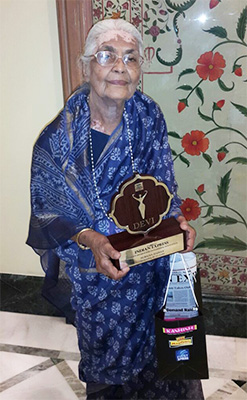
Suraiya Hasan was recently honoured with the Devi Award

Her association with Bose’s family

Suraiya was soon introduced to the Bose family through their ladies. From casual visits, the journeys


Little did she understand the importance of being married to Bose’s nephew except that Aurobindo too was a busy politician. “He was a trade union secretary with many big companies,” says Suraiya of her husband. She however, never got a chance to meet Subhash Chandra Bose.
became personal and Suraiya got to know the family from close quarters. She then got married to Aurobindo Bose, Subhas Chandra Bose’s nephew.

From Delhi back to Hyderabad

After superannuation, Abid Hassan moved to Hyderabadand bought some land there. He was the one who called Suraiya back to the Nizam’s city and asked her to set up an independent handloom production unit.

“I wasted no time and got to my hometown to set up this unit. It was an exhaustive task but I would say worth the effort,” says Suraiya. It was here that she started work on the revival of four signature Persian fabric forms native to Aurangabad – Paithani, Jamawar, Himroo and Mashru. Thus was born Suraiya’s Weaving Studio, Suraiya’s weaving unit in Hyderabad.

During my visits to Aurangabad, I had seen many artisans work tirelessly on keeping this art alive, but in a very small way, often at their own homes. I therefore decided to make this sector a little organized in the hope that this dying art will have people following it

While she concentrated on her art, her husband used to visit her in Hyderabad when he had free time on his hand.

She is still in touch with the Bose family though the visits have dwindled in number after her husband passed away.
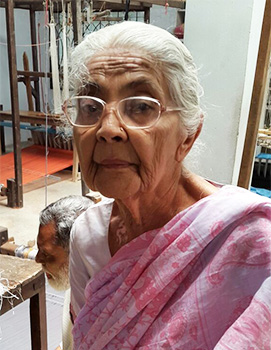
SuraiyaHassan03MPOs24apr2016

Social enterprise

Suraiya selected a group of people to pass on her art. It was the widows, with no place to go to and children to feed that she thought would be her right target audience. “I used to sit with them for hours together and help them pick up the nuances. To train one artisan easily takes close to 3-4 months on an average and I later got an expert to help me with the training part. Doing it alone was becoming a Herculean task,” says Suraiya.

While she created an opportunity for widows to pick up the art, she helped by setting up a school in the same compound for their children. Called the Safrani Memorial High School, this institute houses classes for students from Nursery to Std 10, where children of her artisans attend school free of cost.

Aged 84 now, Suraiya says she has lots of work yet to do. When she is not supervising the work of her artisans, she goes to teach students in her school. She takes pride in the fact that they have all performed well and some have even gone abroad.

Well this love for education is not by chance, Suraiya says she would have inherited it from her father. He after all was the proud owner of Hyderabad Book Depot on Abids Road, most likely the first book store in Hyderabad which stocked foreign publications.

source: http://www.her.yourstory.com / YourStory.com / Home> Her Story> Inspiration / by Saraswati Mukherjee / January 12th, 2015
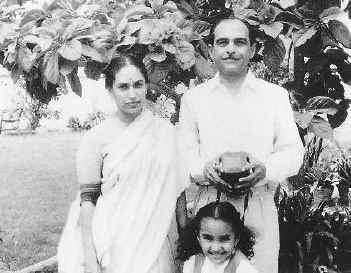
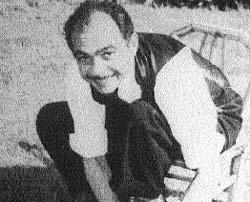
On a slow boat with Safrani

Hyderabad, ANDHRA PRADESH (now TELANGANA) :

by Geeta Doctor

“He never ever mentioned his life with the INA, let alone the story that he had been the one to coin the greeting ‘Jai Hind’. To the rest of the world he might have been a freedom fighter, but to us he was always `Uncle Safrani’.”
Much loved Uncle...
Much loved Uncle…

To the rest of the world he might have been a freedom fighter and a soldier who fought alongside Netaji, but to us he was always “Uncle Safrani”.

Only much later did we realise that his real name was Zain-al-Abdin, or Abid Hasan as he preferred to call himself and that the stories he told us of his days in the Indian National Army were actually true.

“Compared to us, Safrani was a man of the world,” says my Mother looking back on the first time they met him, in 1948, on board a ship that was taking them to start the first of the Embassies that were just being opened.

Safrani was bound for Cairo, my parents were due to get off at Genoa and make the rest of the trip by land to Paris.

What they did not know then, was that they had been booked on a cargo ship. Some cabins had been hastily converted to accommodate First Class passengers. It would take the long route, going up the Persian Gulf, stopping at various ports to unload goods.

For my young parents who were leaving the country for the first time, with two small girls, my sister Surya who was two years old and myself, who was five, on a ship belonging to the Sindia Steamship Company as it was known then, Safrani was a wonderful guide. They had never left the shores of India.

He on the other hand was not only a member of the old Hyderabad elite, but had also studied for a while in Germany and travelled all over South East Asia, as Secretary to Subhas Chandra Bose.

“Safrani was one of those men who could make friends with all kinds of people. He was all over the ship. When it docked he would be the first to get off and go straight to the bazaars and return by evening with all manner of beautiful things. He was also a scholar who spent long hours with his Persian and Urdu poetry. There was nothing he did not know and seeing how raw we were, he made it his business to educate us in all the finer points of life. For instance, when we docked at the port of Basra he ran ashore and bought so many carpets that he ran out of money. But this did not worry him, he just made arrangements to borrow money on credit so that he could buy more. ” recalls my Mother.

In the evenings when the ship was at sea, he would take us to the top most deck and point out the stars to us and whisper stories to us about all the ancient sailors like Sindbad who had crossed these very seas. To us, he would become like Sindbad the Sailor himself. During the day, dolphins would follow us racing by our side, while as we made our way into Aden, where the local Indians received us like fabulous guests that had been sent by the newly Independent government of India to conquer the world, Safrani showed us how to be gracious in accepting the hospitality of strangers, who could also be family.

At Port Said, he transformed himself into an Arab prince, bargaining with the chattering hordes of intrepid vendors who climbed up from their small boats into the ship, teaching my parents to sip bitter coffee from small glasses and to taste the sticky sweet lumps of baklava.

By the time the ship sailed into the Mediterranean, Safrani had become the perfect European gentleman, as debonair as David Niven, as effusive as Signor Peperino, with his flowing moustache and his ability to charm the ladies, with his manner of bowing down to kiss a hand. Or as was the case with us to imprint our tender young cheeks with moist and noisy lip-smacking kisses. He became for us the kissing Uncle.

It was also a way in which he kept track of some of his possessions, the beautiful carpets, the pieces of porcelain and small paintings that he had left with us, just as a token of his friendship he said. “I want you to enjoy them as long as you like and when I need to sell something , I will come and collect a carpet or two.”

We were the guardians of his generosity. For though he bought beautiful things with the lavish style of an oriental Pasha, his house was always so full of people that he had quite often to sell them to keep the coffers flowing.

He left one ceramic vase with us. It still stands on a pedestal in a corner, converted now into a lamp stand, its deep blue and copper red tones changing colour with the reflection of the light. “It’s a very rare vase from China. Don’t ever sell it,” he advised, though he himself regularly sold many of his most cherished possessions.

When we lived in Geneva, he happened to be in Berne. His boss at that time was a dog-lover of epic proportions, so every evening as we stood beside him and listened, he talked to the dog, a large Alsatian, who had been left behind in his care, in Urdu, on the telephone.

On another occasion, he told us how the dog had finally died and he was “Chief Mourner” the had conducted the funeral honours. “It was a very touching occasion. I was so moved, I jumped into the open grave and recited some prayers over the dog’s body that I held in my own arms, before laying him into the earth,” he told us. Since he was laughing so much at the memory, we never knew whether any of this was true. Or whether like all the stories he had told us in the past, they were the stuff of the legendary quality that he wove around himself.

“He never mentioned his life with the INA, let alone the story that he had been the one to coin the greeting, “Jai Hind!” remarks my Mother, “Though it sounds very typical of him. He was a free spirit.”

Much later when one of us was passing through Denmark, where he was the Ambassador, we enjoyed the full force of his hospitality. He drove to the airport himself and though when we reached his house, it seemed to be so full of guests that evening, he had to find a room for us, right up in the attic. But as ever it was a fabulous evening. The dinner when it arrived was as full and rich as one of the tables from the days of the old Hyderabad style hospitality. He always managed to have as a hostess, one of his beautiful nieces from Hyderabad, who would quietly attend to the guests and see that no one was without food and drink.

When it was over, he insisted that we should go and enjoy the “Tivoli Gardens,” that was the star attraction of Copenhagen. As we looked at the giant Ferris wheels and the nightly display of fireworks exploding over the skyline of the City, Uncle Safrani had become like Barnum, a grand ring-master presiding over the “Greatest Show on Earth”.

And then we did not see him again.

We had heard that he had returned to his family home after retirement and become a gentleman farmer.

This is my final memory of him.

On a visit to a silk weaving unit on the outskirts of Hyderabad I found that someone had started a small farm, and on it a school for the children of the nearby village.

The owner, who had died some time back had created an enchanted garden of fruit trees. The fields next door were covered with jasmine bushes, dotted with fat creamy jasmine buds, that the children from the school came to harvest in the early morning. The air was filled with their fragrance as all over the field the butterflies were busy doing their own kind of harvesting.

One of this man’s nieces, a really beautiful woman even in her later age, was running a weaving centre. She was pre-occupied in reviving some of the old Hyderabadi silk and cotton weaving traditions and did not have much time to talk. On her table was a photograph of a familiar face, the same moustache, the full lips ready to form themselves into a kiss, the all embracing smile, the jaunty glint in the eye.

“Safrani!” I exclaimed.

The beautiful niece, still glowing in her old age looked at the picture. “My Uncle” she said, quietly.

source: http://www.thehindu.com / The Hindu / Home> Young World / by Geeta Doctor / Online Edition / Saturday – March 23rd, 2002

Jai Hind Safrani

Hyderabad, ANDHRA PRADESH (now TELANGANA ) :

When we talk of “Freedom Fighters”, we generally mean those people who fought for the independence of India within the country. Many Indians fought for the freedom of the country from outside India too.

Indian National Army

It was Captain Mohan Singh, an Indian officer of the British Indian Army, who first set up the Azad Hind Fouj (Indian National Army) on the defeat of the British by Japan on February 15, 1942.

AbidHasanBMPOs24apr2016

Abid Hasan

A young enthusiastic and courageous man from Hyderabad also joined this force. His name was Zain-al-Abdin Hasan. He preferred to be called Abid Hasan and later became known as Abid Hasan Safrani.

Abid Hasan’s mother Hajia Begum was anti-British, so her children were sent to Germany for higher studies. And Abid went to do a degree in engineering.

Meeting with Bose

Netaji addressed a meeting of Indian prisoners of war in Germany and asked them to join the INA. Abid met him and was inspired by the charismatic leader. He told Bose that he would join him after finishing his studies. Netaji said tauntingly that if he was caught in such small considerations, he would not be able to achieve anything big in life. Stung by that remark, Abid decided to give up his studies. He became Netaji’s secretary and interpreter.

Abid Hasan was made a major in the INA. Netaji wanted an Indian form of addressing each other. Abid first suggested “Hello” and was snubbed for that. He later suggested “Jai Hind”, which Netaji liked and adopted it as the formal manner of greeting for revolutionaries and members of INA.Later Nehru used it in his Independence Day address from the ramparts of the Red Fort.

The Indian National Army

INA provided a common kitchen for its soldiers irrespective of their religious affiliations. But there were many differences of opinion within its ranks. One of the controversial issues was the design of the national flag. TheHindus wanted a saffron flag, while the Muslims insisted on green. Later the Hindus gave up their insistence. Abid Hasan was impressed by this gesture that he decided to append “saffron” to his name. Since then, he became to be known as Safrani.

After the famous trial of the INA, all the members of the INA were released. In 1946, Safrani came to Hyderabad and joined the Congress Party. The party was riven with factionalism. Disgusted, he gave up politics and joined the Bengal Lamp Company. He was posted at Karachi. On the partition of India, he came back to Hyderabad.

Diplomatic career

In 1948, he was taken into the newly created Indian Foreign Service. On retirement in 1969, he returned to Hyderabad. Safrani passed away in 1984 at the age of 73.

source:  http://www.thehindu.com / The Hindu / Home> Features / Online Edition /  by Narendra Luther / Saturday – October 20th, 2001

How Netaji’s aide coined the slogan Jai Hind in a German POW camp

Abid Hasan’s grandnephew recounts the story behind creation of a salutation to replace religion-based greetings for Indian soldiers.

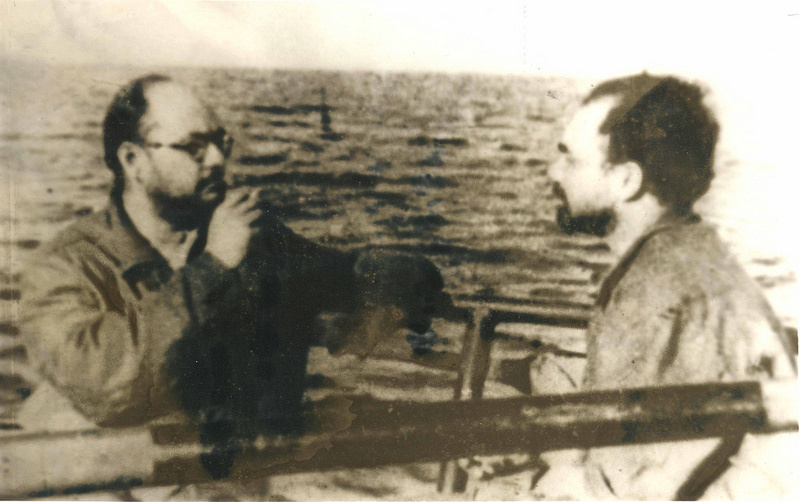
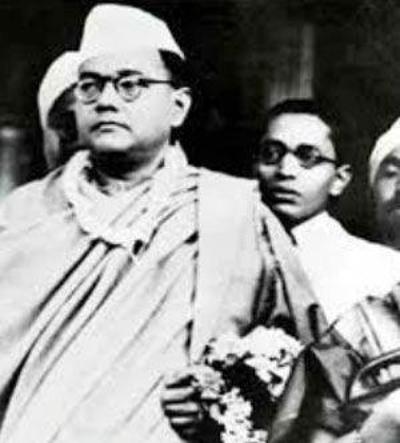
Image credit: Photo courtesy: Anvar Alikhan | Netaji Subhash Chandra Bose with his aide Abid Hasan during their journey to Japan from Germany in 1943.

Netaji Subhash Chandra Bose had a problem. It was 1941. He was in Germany, and was spending a lot of his time in the Konigsbruck prisoner-of-war camp, trying to recruit Indian soldiers captured by Rommel’s army in North Africa into his new Azad Hind Fauj.

But what troubled him was that the soldiers of the Indian Army had historically been organised into regiments based on ethnic and religious lines – the Rajputs, the Baluchis, the Sikhs, and so on. And even here, in the prisoner-of-war camps, they tended to cluster into their own little ethnic and religious groups.

Netaji, however, was very clear that his new Azad Hind Fauj would be a completely integrated army with men of every community and caste fighting shoulder-to-shoulder for an integrated India. After all, how could it be any other way?

But to integrate the soldiers was a complex issue that had to be tackled at many levels. For starters, each community greeted each other with their own salutation: the Hindu soldiers said, “Namaste” or “Ram, Ram ji”; the Muslims said, “Salaam alaikum”, and the Sikhs said, “Sat Sri Akal”. Netaji believed the first thing he had to do was to replace these religion-based greetings with a common salutation that would help bond everybody together.

And this task he entrusted to his aide, Abid Hasan.

The great rallying cry

Hasan was a Hyderabadi who’d been a disciple of Mahatma Gandhi as a teenager, and had spent time at his Sabarmati Ashram. Later, when his contemporaries all went to university in England, Hasan chose to go, instead, to Germany. And it was there that, in 1941, he met Netaji, and dropped out of engineering college to became his aide.

Now, pondering over the task Netaji had set him, Hasan was wandering around the Konigsbruck POW camp, when he overheard two Rajput soldiers greet each other with “Jai Ramji ki”. And that triggered off in his mind the idea of “Jai Hindustan ki”.

This, in turn, led to the shorter, more rousing “Jai Hind”.

Netaji was delighted with Hasan’s idea, which worked so well that “Jai Hind” soon went beyond its original brief to become a rallying cry of the Indian National Army. Later, of course, it would be adopted as the national slogan when, at the time of Independence, Jawaharlal Nehru raised it, stirringly, at the Red Fort.

It is ironic now, in the time of the Bharat Mata ki Jai controversy, to think that Jai Hind was a slogan created specifically to help unite the people of India, rather than divide them.

Later, in 1943, when Netaji was searching for an anthem for his Arzi Hukumat-e-Azad Hind, or the Provisional Government of Free India, he decided on Rabindranath Tagore’s poem, Jana Gana Mana. But to make it more accessible to the common man, Netaji wanted it translated from Tagore’s classical Bengali into simple Hindi. And for that, once again, he turned to Hasan, along with two other INA officers, Mumtaz Hussain and JR Bhonsle, while the tune itself was composed by Capt Ram Singh. Netaji’s vivid brief to them was, apparently, that when the anthem played, it should be so rousing that auditorium itself should shatter in half to reveal the sky above.

It is a mark of the kind of man Netaji was, to combine such a wide sweep of vision, with such minute attention to its details.

Chalo Dilli!

So what became of Abid Hasan?

When Netaji made his historic escape from Germany to Japan by submarine in 1943, he took Hasan along with him. It was the longest submarine voyage in history till then, beginning in the Baltic Sea in a German submarine, transferring off the coast of Madagascar into a Japanese submarine, and then sailing across the Indian Ocean to land in Sumatra, nearly four months later (a voyage that is interestingly portrayed in Shyam Benegal’s The Forgotten Hero, with Rajit Kapur playing the part of Hasan). From Sumatra the two of them were then flown in a Japanese Air Force plane to Tokyo.

Netaji Subhas Chandra Bose with his aide Abid Husain on their famous voyage from Germany to Japan in 1943. Photo courtesy: Anvar Alikhan

Hasan (by then Major Hasan) fought in the historic Battle of Imphal in 1944 – which Netaji believed would be the INA’s great breakthrough into the plains of India at the head of General Mutaguchi’s 15th Japanese Division, culminating in his dream of “Chalo Dilli!” But, unfortunately, everything went wrong.

A spy code-named Silver tipped off the Allies about the attack. The Allied defenders fought back with unexpected desperation; the monsoon broke early, and torrential rains cut off the INA’s and Japanese supply lines, while the Allies managed to supply their troops by air. The expected defection of Indian soldiers from the Allied side to the INA didn’t happen; instead, demoralised INA soldiers and officers began to surrender to the Allies. Also, significantly, the Japanese, invincible until now, were, for the first time, under real pressure on various fronts, both geographical and metaphorical. The tide of the war had imperceptibly, but decisively, turned.

The four-month-long Battle of Imphal (along with the Battle of Kohima nearby) has been voted the greatest battle fought in the history of the British Army. But what that meant for the Indian National Army was that instead of leading to an advance upon Delhi, the battle ended with the long, dejected retreat back to Rangoon, which Hasan orchestrated.

That last, fateful flight

In August 1945, Hasan was one of the key aides whom Netaji picked to accompany him on his final flight, along with SA Ayer, a minister in his Cabinet; Colonel Habeeb-ur-Rahman, his secretary; Colonel Pritam Singh; Colonel Gulzara Singh and Debnath Das. The plan was that they would fly together from Singapore to Tokyo, via Bangkok, Saigon, Taipei, and Manchuria.

But at Saigon Netaji suddenly asked Hasan to remain behind to finish some work, and meet up with him in Tokyo. Ultimately Netaji took off in a Japanese Mitsubishi Ki21 bomber, accompanied only by Rahman.

And the rest we know.

Or don’t know.

It all depends, essentially, on your point of view. (Although it is interesting to note that the top INA officials who were closest to Netaji say that he died in the crash.)

At the end of the war, Hasan was imprisoned by the British and, along with other close Netaji associates, was grilled by British Intelligence about Netaji and his plans. But like the others – including Habeeb-ur Rahman, Pritam Singh and John Thivy, founder of the Malayan Indian Congress – he refused to talk. Some of them were taken away and never seen again; nobody knew whose turn would be next.

After Independence, Hasan joined the newly-formed Indian Foreign Service, and took on the surname Safrani (after the saffron colour in the Indian flag). He would ultimately retire as Ambassador to Denmark – the coast of which he had quietly slipped past at the start of his secret submarine journey to Japan in 1943.

After Independence, Abid Hasan joined the newly-formed Indian Foreign Service, and took on the surname Safrani. Photo courtesy: Anvar Alikhan

He also happened to be (and it’s now time for a disclosure) a favourite grand-uncle of mine.

I asked him once, in an unguarded moment, what really happened to Netaji, and he said, “Arre beta, yeh sab bilkul bakwas hai.” This is all complete nonsense.

But was he telling me the truth?

Or was it just a cover-up for some secret he didn’t want to reveal?

I suppose I shall never know.

We welcome your comments at letters@scroll.in.

source: http://www.scroll.in / Scroll.in / Home> Remembering History / by Anvar AliKhan / Sunday – April 24th, 2016

Compering was an art for poet Ahmad

Lucknow, UTTAR PRADESH :

Lucknow:

A poet, a novelist, a teacher and a champion of stylising compering into an art, Prof Malikzada Manzoor Ahmad breathed his last in the city on Friday. The 87-year-old, a well known face in the literary settings of the city was highly eulogised for creating a uniquely independent genre of ‘nizaamat’ (compering) for the thousands of poetry events he mastered with his spontaneous wit and humour.

Buried at night in the Fatehmi graveyard in Khurram Nagar on Friday, Ahmad, born in 1929, was a native of Faizabad. He had moved to Lucknow in the early ’60s as a lecturer in Lucknow University’s (LU) Urdu department from where he retired in 1989 after 30 years of service.

“Before him, compering a mushaira was just a sub-standard job. He transformed it into an art. His literary articulation and spontaneity, his wit and the way he weaved sarcasm and humour are unmatched to this date,” shared Prof Anis Ashfaq, former head of LU’s Urdu department who was also Ahmad’s student. Ashfaq also said that he was the one and the only person who exemplified compering and with him the golden period of the new art has gone.

A man who donned many hats, Ahmad also wrote poetry and several novels, including his biography ‘Raqs-e-Sharar’ wherein his narrative too was praised of bearing a uniquely creative style. “Even though my father was a man of the English language, Urdu was his passion and mission. He was a proponent of composite culture,” said Ahmad’s son Malikzada Javed.

Ahmad had served as the chairperson of the UP Urdu Akademi and Fakhruddin Ali Ahmad Urdu Memorial Committee. He also held a senior post in the All India Urdu Rabita Committee and was a receiver of the 2015 Ghalib Award for literary services to Urdu. He was condoled on his death by chief minister Akhilesh Yadav, Mulayam Singh Yadav and minister Azam Khan.

source: http://www.timesofindia.indiatimes.com / The Times of India /  News Home> City> Lucknow / by Yusra Husain / TNN / April 23rd, 2016

Students devise ways to conserve energy

Thiruvananthapura, KERALA :

ConserveEnergyKERALA22apr2016

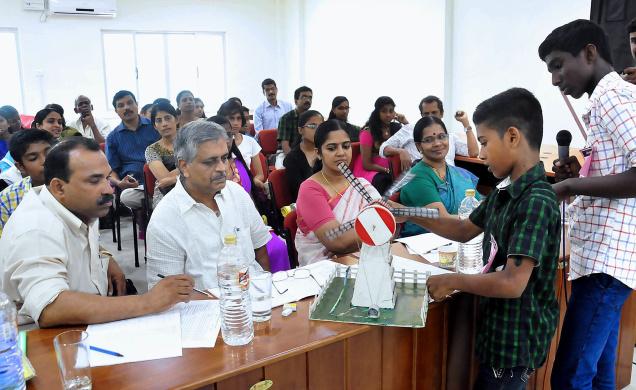
Innovative ideas developed by students for energy conservation were on display at the Kerala State Student Energy Congress 2016.

Thirty-seven teams from various districts participated in the event organised as part of the ‘Smart Energy Programme’ of the Energy Management Centre (EMC) on the centre’s premises. Hundred-odd upper primary and high school students from all over the State attended the one-day congress held as part of the EMC’s energy conservation programme.

Aparna V.S. and Kavitha K.M., students of Holy Angels School, Thiruvananthapuram, came up with an idea of converting mechanical energy into electrical energy at a low cost.

They turned a bicycle into an exercise bike which can pump water and generate electricity. Arathy Ramesh and Sreekutty Udayakumar from the Aluva educational district bagged the first prize in high school section. Ayisha and Alsa Bin Shahul Hameed from Kozhikode got the first prize in upper primary section.

S. Somanath, Director, Liquid Propulsion System Centre, gave away the prizes at a function presided over by K.M. Dharesan Unnithan, Director of EMC.

source: http://www.thehindu.com / The Hindu / Home> News> Cities> Thiruvananthapuram / A Correspondent / Thiruvananthapuram – April 21st, 2016

Six historical buildings awarded

Hyderabad, TELANGANA :

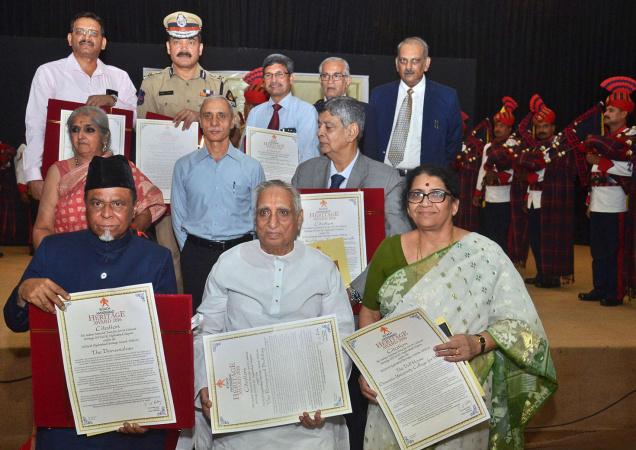
IntachHydMPOs22apr2016

The Indian National Trust for Art and Cultural Heritage (INTACH) on Monday awarded six historic buildings and their managements for efforts to conserve them.

“For its associational value as the birthplace of Hyderabad’s very own magic potion and as memorial to the legacy of Hakeem Farooqui, the Karkhana Zinda Tilismath is acknowledged,” reads the citation of the award given to the historic structure in Amberpet. Five other structures – the St. Francis Xavier church in Yapral, Ramgopal building on M.G. Road, Heritage Artillery Collection and Ranbir Hall at Artillery Centre in Golconda, Equestrian Centre Hyderabad Mounted Police in Saifabad, and the headquarters of AIMIM in Darussalam – were given awards.

A special citation was made for Doll House, a replica of the Residency Building that is now the Koti’s Women College.

The award to Equestrian Centre was in consonance with this year’s World Heritage Day celebrations themed by UNESCO to recognise sports heritage. In this context, the INTACH’s representatives recounted the contributions of noted sports personalities S.A. Rahim, the coach of India’s football team who led the country in Melbourne Olympics in 1956, and tennis player Ghouse Mohammed Khan.

Arjuna awardee Mir Khasim Ali was the event’s chief guest.

INTACH recognised the structures for their restoration and re-use while keeping intact their historic value. Reciting couplets of legendry poet Amir Khusro and Mirza Ghalib to describe importance of history and heritage structures, Air Commodore Suresh Badyal, the guest of honor at the event, said the armed forces have contributed to conservation of heritage structures and that organisations like INTACH should continue to conserve more structures.

INTACH convenor Sajjad Shahid recounted threats perceived to heritage, including the development of Metro Rail opposite the State Assembly and through Sultan Bazaar, while decrying G.O. 183 that allegedly robbed 160 heritage structures, rock formations and other historic precincts of legal protection that was accorded to them. Mr. Shahid informed the gathering that the High Court has stayed the order.

source: http://www.thehindu.com / The Hindu / Home> News> Cities> Hyderabad / by Staff Reporter / Hyderabad – April 19th, 2016

Netaji’s driver becomes oldest human alive at 116 years

Azamgarh, UTTAR PRADESH :

File photo of Netaji Subhash Chandra Bose.

Azamgarh :

With rumors amuck of late freedom fighter Subhash Chandra Bose making an appearance as the mysterious godman Gumnami Baba, Netaji’s driver Colonel Nizamuddin is now set to make headlines by opening a bank account at the ripe old age of 116-years.

According to Colonel Nizamuddin alias Saifuddin’s voter identity card and passport, which he produced as proof of identity before the State bank of India for opening the account, he was born in 1900.

In February this year, a Japanese man, who was believed to be the oldest man alive, passed away at the age of 114.

That way, Colonel Nizamuddin is the oldest human being alive on the planet right now as he completes 116-years 3 months and 14 days on Sunday.

Another startling aspect is that Colonel Nizamuddin’s wife, Ajbunisha, is 107 years old and the couple have opened a joint account with SBI.

Locals and the district administration were delighted to know about Colonel Nizamuddin amazing feat of being the oldest man alive. They are, infact, proud of the fact that such an elderly person is part of their neighbourhood.

source:  http://www.timesofindia.indiatimes.com / The Times of India / News Home> India / ANI / April 17th, 2016

Sri Mahaveera Ahimsa Award Conferred on Dr. Khader

Mysuru, KARNATAKA :

Sri 108 Munishree Pavanakeerthi Bhattaraka Muni Maharaj is seen conferring ‘Sri Mahaveera Ahimsa Award’ on noted Homoeopath Dr. Khader during the 2615th Janma Jayanti celebrations of 1008 Bhagawan Sri Mahaveera Theerthankara organised under the aegis of Sri Mahaveera Seva Samsthan at Sri M.L.Vardhamanaiah Smaraka Bhavan on Chadragupta Road last evening as Padmashree Jaina Mahila Samaja President Sheela Anantharaj, Sri Mahaveera Bhavan Construction Committee President M.A. Sudhirkumar, Sri Digambara Jain Samaj President S.N. Prakash Babu, M.L. Jain Boarding Home Secretary Madan Kumar, Sri Mahaveera Seva Samsthan Vice-President M.R. Sunil Kumar, Ajit and others look on.

Mysuru :

“Born as a human being, one should practice the habit of letting other living beings also live in peace,” said city’s noted Homoeopath Dr. Khader, who has been touring rural areas propagating the message of non-violence for the past 10 years after turning a vegetarian at the age of 15.

He was speaking after being conferred with ‘Sri Mahaveera Ahimsa Award by Sri 108 Munishree Pavanakeerthi Bhattaraka Muni Maharaj at a function organised by Sri Mahaveera Seva Samsthan as part of 2615th Jayanti Mahotsava of 1008 Bhagawan Sri Mahaveera Theerthankara at Sri M.L.Vardhamanaiah Smaraka Bhavan on Chadragupta Road in city last evening.

Regretting that 30 to 40 percent of those manufacturing biscuits and chocolates use fat extracted from animals, he added that consumption of bakery items also lead to sugar-related and respiratory ailments, which need to be curbed at once by using vegetarian products.

Former Mayor and Ekalavya Awardee (for Kho-Kho) N.Prakash was also felicitated on the occasion by the Seva Samsthan.

source:  http://www.starofmysore.com / Star of Mysore / Home> General News / April 20th, 2016

Juma Masjid to be opened for women

Kottayam, KERALA :

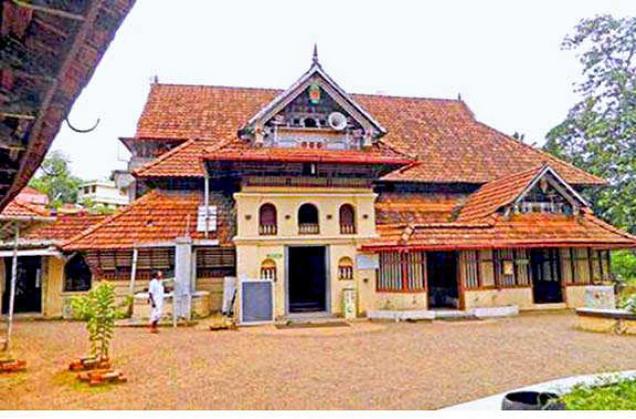
UNIQUE CONSTRUCTION:The age-old Juma Masjid at Thazhathangadi.

Mosque built by preacher from Arabia

The age-old Juma Masjid at Thazhathangadi, believed to be among the 11 mosques constructed by Malik bin Dinar, the eighth century religious preacher from Arabia, will, for the first time, be opened for women.

Timings

Women believers can enter the mosque on April 24 and May 8 from 8 a.m. till 12 noon and then from 1 p.m. till 3.30 p.m. and later from 4.30 p.m. till 6 p.m. The timings have been regulated so as not to interfere with the religious rites, a press note said on Tuesday.

The unique construction attracts tourists from far and wide, but women have not been allowed to have a peek into the richly carved interiors, made primarily of wood, so far, said C.M. Yousuf, secretary of the Thazhathangadi Muslim Jamaath, in the press note.

The Juma Masjid, considered one of the most beautiful places of religious worship, reflects the heritage of Kerala temple architectural styles and showcases the rich sculptural styles of Arabic architecture.

The mosque also houses the centuries-old sundial, sacred writings from the Quran embossed in wood, the stunning Maalikappuram and the richly carved facades and many more objects of interests.

According to Mr. Yousuf, researchers and tourists used to arrive to have a look at the unique structure, but so far women have been denied permission.

There have been appeals from the local people for such a permission. It was against this background that the Juma Masjid committee decided to allow women to enter the mosque, he said.

source: http://www.thehindu.com / The Hindu / Home> National> Kerala / by Special Correspondent / Kottayam – April 20th, 2016