Category Archives: Community Involvement / Social Issues

Lions region meet held

Mysuru, KARNATAKA :

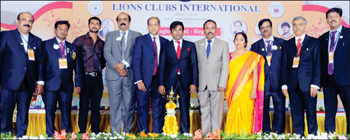
Dr. Bellipadi Shyam Prasad Shetty, who inaugurated the Regional Meet, is seen with (from left) Lion Mohammed Nasir, Lion Sayed Ismail, Cine Actor V. Chandan, District Governor Lion C. Hemanth Kumar, Nur Alam Choudhury, Region Chairman Lion R.Y. Arun, Lion Lady Hemalatha Arun, Lion V.S. Sheshadri, Lion Sriprakash and Lion N. Subramanya.

Mysuru :

The Region Meet of Region VIII of Lions Clubs International, Dist. 317 A, was held at the GLN Convention Hall in city recently. In all, 745 delegates have registered and attended the Meet.

Dr. Bellipadi Shyam Prasad Shetty, the Head of the Department, Cardio Thoracic & Vascular Surgery, JSS Hospital, Mysuru, who was the chief guest, delivered his keynote address on the theme ‘Hrudayada Araike, Namma Haraike.’

He advised the gathering to spread the message of Heart Care as heart ailment is the biggest killer in the world. He further wanted everyone to follow a strict and healthy food habit and adopt a life style of compulsory exercise of atleast half an hour per day and refrain from bad habits of smoking and consumption of liquor and other harmful drugs.

Lion C. Hemanth Kumar, Dist. Governor of Lions Clubs International, Dist. 317-A, Nur Alam Choudhury, Founder and CEO, Prestige Constructions LLC, Ajman, UAE and V. Chandan, Cine Actor & Runner-Up of Bigg Boss – Season 3 also attended the programme as guests of honour.

Various service activities worth about Rs. 8 lakh were carried out on the occasion, including donation of a Maruti Van to Vikala Chethanara Abhyudhaya Seva Samsthe, T.K. Layout, Mysuru.

Chethan and Nur Alam Choudhury have expressed their willingness to join the Lions Movement in appreciation of the yeoman services that the World’s largest NGO has been rendering to the real needy in the society.

Lion R.Y. Arun, Region Chairman, presided over the meeting. Lion N. Subramanya welcomed. Lion P. Rajan introduced the chief guest. Lion Sriprakash proposed a vote of thanks. Lion S. Achutha and Lion Lady Veena Sriprakash compered the programme.

source: http://www.starofmysore.com / Star of Mysore / Home> General News / February 28th, 2016

This Man Wants to Make Mysuru’s Ring Road Cooler

Mysuru, KARNATAKA :

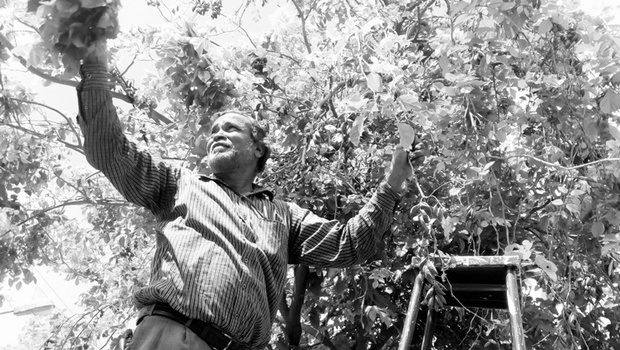
Hyder Ali Khan of Kalyangiri in Mysuru

Mysuru :

Thandi Sadak in Haldwani, Uttarakahand, is famous for lush green trees and pleasant breeze.

Here, a man is on a mission  to make the Ring Road as city’s Thandi Sadak.

It started with one Honge tree sapling at Idagh Maidan 16 years ago.

Now for Hyder Ali Khan of Kalyangiri, life’s sole aim is to plant maximum saplings.  Khan has already created green canopy in several schools and public parks by planting nearly 2,500 saplings and is knocking at the doors of the government for help to increase green cover in the city. He plans to plant the saplings of certain selected trees on the  stretch of the Ring Road beginning from the Mysuru-Bengaluru intersection.

In the initial stage, he wants to plant 925 saplings in the one-km stretch. He approached MUDA officials seeking support for his mission.

“A green canopy can be created on the highway which benefits motorists immensely. If I get permission from the government, I intend to plant wild Almond Trees (Kaddabadami) along the one-km stretch of the Ring Road. It takes four years to complete the project. If we can do this, Mysuru will become a role model for other cities and towns in the country,” he said.

“I had worked as fitter for 27 years. One day, when I got exhausted while riding my bike, I sat beneath a roadside tree and felt immensely relaxed and rejuvenated. It was then I decided to plant trees. Nothing gives me more satisfaction than planting trees,” he said.

He planted 313 saplings of Honge tree at the famous Idagh Maidan in the city, thereby creating a green canopy. Today 15,000 people can sit under the shade of the trees at the Maidan.

He has created such green pandals in several schools too.

“The Thandi Sadak of yesteryears had introduced in Mysuru by  Wadiyars; a portion of which can still be seen inside zoo. We can convert the entire city into a green canopy and make the district more tourist-friendly, if we plant more trees,” he said.

source: http://www.newindianexpress.com / The New Indian Express / Home> States> Karnataka / by K. Rathna / February 26th, 2016

K.K. Muhammed – Digger of truth

kkMuhammedMPOs27feb2016

KERALA :

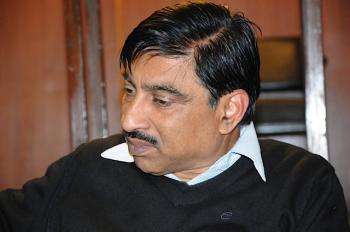
LAST year, a young journalist friend, Rajeev Mangottil, invited me to speak at the Onam Day celebrations at Jamia Millia Islamia. The name of this venerable institution is derived from the Urdu language in which Jamia means ‘university’ and Millia means ‘national’. That is where I first met the youthful-looking K.K. Muhammed, Director of the Archaeological Survey of India (ASI).

Rajeev whispered into my ears that Muhammed would soon be retiring and his story on him was scheduled to appear in the Malayala Manorama supplement. Since the Malayalam daily is fond of showcasing every Malayali as an achiever of sorts, I was not greatly impressed.

One reason why I underestimated him was that I have a poor opinion of the ASI. Just last fortnight a friend from Punjab SMSed to say that he had visited Nangal and seen the glass case which commemorates Chinese leader Chou en Lai’s visit and the discussions he had with Prime Minister Jawaharlal Nehru while formulating Panchsheel or the five principles of peaceful co-existence. I had visited the place a couple of times and was shocked by the fashionable sofa in the glass case. I checked and found that the two leaders had used caned, wooden chairs, which the officials concerned did not find impressive enough to be showcased.

In contrast, I saw at Potsdam, near Berlin, the large table and the chairs used by Stalin, Churchill and other victors of the Second World War, while deciding to divide Berlin into four zones and to constitute the United Nations, preserved in the same manner in which they were used, attracting thousands of tourists every year. But the first time I visited Shimla, I was unable to see the table and the chairs used by Indira Gandhi and Z.A. Bhutto for finalizing what is known as the Simla Agreement because no official had any clue about their existence.

Muhammed preferred to speak after J. Gopikrishnan, the ‘Pioneer’ reporter who unearthed the Spectrum scam, and I had our say. He spoke extempore and quoting the Vedas and the Upanishads, he took the listeners on a conducted tour of ancient Kerala, where the persecuted Jews found asylum and Semitic religious ideas flourished and enriched the native cultural practices and traditions. It was apparent that he had an excellent command of Sanskrit, the language of the gods. No, he did not say anything about the ASI or the work he had been doing.

He gave me his visiting card, which said that he lived in the Red Fort. He certainly could not have found a better place to live in than the fort the Mughals had built and from which they ruled the country. No other monument has witnessed history as the Red Fort from the ramparts of which the Prime Minister addresses the nation on Independence Day. It would not be an exaggeration to say that Muhammed breathes history and archaeology, rather than air.

So when I received an invitation for his lecture on the ancient churches of Goa at the Kerala Club, I could not resist the temptation to attend. What makes Muhammed stand out as an archaeologist is the passion he has for archaeology. We have all studied about Akbar the Great and Din-i Ilahi, the divine faith, he propounded by incorporating the best from Islam, Hinduism, Christianity, Buddhism, Jainism and Zoroastrianism.

It was at Ibadat Khana, the House of Worship, that the Emperor used to hold discussions with religious scholars. Miniature paintings that depict Akbar meeting Christian theologians exist. But where exactly was Ibadat Khana?

Mohammed studied the painting thoroughly and believed that it could be excavated at a particular spot in Fatehpur Sikri. He was in his late twenties and could not, therefore, convince his seniors, who all had a different belief. But he started excavating on the spot and found that the dome, the antechamber, the different layers and the gate depicted in the painting matched his excavation. It was a great archaeological discovery for which then Prime Minister Indira Gandhi congratulated him. What’s more, he also discovered a Christian chapel and a bazar in the same area.

Ask Muhammed and he will tell you that restoration of the 1300-year-old Bateshwar temple in Madhya Pradesh as the high-water mark of his career. He found hundreds of temples in a state of ruin, devastated as they were by an earthquake. Restoring them was a challenging task. Nobody seemed to be bothered. He had heard that dacoits would occasionally drop in to worship at the Hanuman temple there.

One day while returning to his workplace, he found a person smoking beedi in the temple. Muhammed rebuked him for smoking in a sacred place, little knowing that he was none else but dacoit Nirbhay Singh Gujjar! Fortunately, the dacoit did not pull his trigger and he left only after he was told by Muhammed that he belonged to the Gujjar-Pratihara dynasty that had once ruled the region.

He found that he could not carry on his work without the cooperation of the MP government, which was disinterested. Then he hit upon the idea of writing a letter to the then Rashtriya Swayamsevak Sangh (National Volunteer Corps) Sarsanghachalak, V.S. Sudarshan, telling him that though the BJP ruled the state, its government was not at all interested in restoring the ancient temples.

The RSS chief took up the matter with the Chief Minister, who ensured that he received the full support of the state government. He also had to contend with the mining mafia, which took a dim view of the restoration work. Finally, he was able to restore about 80 temples while the work is still going on.

I recently saw a documentary telecast by Asianet on the Bateshwar temple complex, which has started attracting tourists. Restoring a temple from the ruins is not an easy job. One should have a great knowledge of the art of temple construction. On TV, I heard Muhammed explain to the viewers how he came to the conclusion that a statue of Nandi could only have been at that particular spot. Rome was not built in a day. Nor had he learnt archaeology in a day.

Muhammed is modest when he says, “I have always been inspired by the Upanishads”. He knows important texts like Manasara Shilpa Shastra and Mayamata Vastu Shastra by heart. He is unabashed when he says: “I must have been a Namboodiri Brahmin in my previous birth”. I would have certainly believed him, if I had not heard his lecture on the ancient churches of Goa, where he was posted for about six years. He showed slides of various churches before and after restoration. That any ASI official could have done.

What no non-Christian could have done with such finesse was give a graphic account of the religious traditions and practices of Christians. He showed the picture of a temple, which gave Vasco da Gama the impression of a church. He went on to explain how the builders of churches in Goa liberally followed the motifs and styles used in Hindu temples and architecture.

For instance, lotus enjoys a pride of place in Hinduism. Vishnu’s feet are always qualified as the “lotus feet”. But in Christianity, no such importance is given to the lotus, which is like any other flower. Yet, he found that many of the churches in Goa sported lotus paintings and motifs.

There were many other features from Hindu temple architecture that were freely adopted by church builders. In temples, leftover water was always allowed to flow through a pipe the mouth of which resembled a crocodile’s. He showed with slides how the idea had been freely incorporated in church construction also. Of course, Muhammed had an explanation for it. The artisans who built churches came from the same class, which built temples in the area.

I was not surprised by Muhammed’s statement because a Malayalam journal had recently published a photo feature on one Govindan Gopalakrishnan, who specializes in mosque construction despite never having studied at a school of architecture, and never having seen the Taj Mahal, let alone the Jama Masjid in Delhi. He has so far built 88 mosques, including the magnificent Palayam mosque in Thiruvananthapuram and the strikingly beautiful ones along the highways in the state. Gopalakrishnan, who is a practicing Hindu, considers mosque construction as his “karma”.

Mohammed’s knowledge of church architecture was as splendid as his knowledge of the life and work of St. Francis Xavier, whose mortal remains are preserved in a church in Goa. When he spoke about him, I felt there was a devout Catholic in him.

And when he explained the various Stations of the Cross that he helped preserve in a church, and recited a line from the Bible “Elahi Elahi Lama Sabachthani” (My God, my God, why have you forsaken me?), I could see that he was overwhelmed by the enormity of emotions. I would not be surprised if he claimed that he was a bishop in his previous birth.

You and I may brand him as a Muslim or a Hindu or a Christian but Muhammed is a professional archaeologist, who ensures that wherever excavation is carried out, the local children and youth are involved in it so that when they grow up they will not leave vandal-like imprints of “Pappu loves Pappy” on the monuments they visit. In his case, wrong perceptions turned out to be far too costly.

When the post of Vice-Chancellor of Calicut University fell vacant, many knowledgeable people suggested Muhammed’s name but some thought that he was too close to the Sangh Parivar to be trusted with such a job. Instead, a person of lesser merit was chosen. Muhammed would not, however, be bothered for he knew that “an archaeologist is one whose career lies in the ruins”.

It was just the other day that historian M.G.S. Narayanan lamented that in Kerala, the Archaeology Department was headed by people who could not spell the word “archaeology” and would ask whether Alexander Fleming and Alexander Cunningham were the same.

For Muhammed, work is worship and it does not matter that he has not been adequately recognized for his contributions. However, he has many anecdotes to recount. Like the one of the time when he took President Barack Obama and his wife Michelle round the Humayun tomb and answered their questions.

Muhammed has in a recent interview expressed his distress over the low priority archaeology enjoys in the country. When he was in charge of the ASI’s work in Northern India, his budget was a puny Rs 6 crore. How many people know that it took 20,000 workers and artisans 16 years to construct the Taj in 1647-48 at a cost of Rs 50 lakh? This, when it is India’s tourism showpiece and the foremost Indian monument that spurs the international visitor to visit the country!

Do they know that parts of the Taj had fallen into disrepair? It was Lord Curzon, who ordered a comprehensive restoration project, which was completed in 1908. If anything, it shows how restoration is important for any historical site. Instead, we are good at spreading myths. One such myth is that Shah Jahan ordered the amputation of the hands of the architect of Taj Mahal in order to ensure that nobody made such a magnificent monument again. Another such myth is that the Emperor started building his own tomb on the other side of the Yamuna in black marble. Excavations across the river revealed no foundations.

Thus archaeology has its use in not only proving historical facts but also in exposing falsehoods. Muhammed showed how he transplanted a temple brick by brick using a numbering process. At the end of the project, not a single brick had become surplus. In retrospect, the most enduring image from the lecture was a gate, which he restored without spending a single penny from the state exchequer. Instead, he involved the local youth in the preservation work. They were only too happy to join him in his noble endeavor.

In all his pursuits, one thought that has guided Muhammed is “Om Lokah Samastah Sukhino Bhavantu”! (May all the people be happy!). What a pity that in a country where all and sundry are given Padma awards, a person like K.K. Muhammed has not been given such a recognition because to some, he is a Muslim and to some others, a Hindu. Rather like the poet Kabir over whose body the two communities fought only to find that he had transported himself to the realm of the sacred and the holy. K.K. Muhammed’s scholarship belongs to none, because it belongs to all.

The writer can be reached at ajphilip@gmail.com
Courtesy: Indian Currents

source: http://www.heraldofindia.com / The Herald of India / Home> Article / by A.J. Pinto / 2012
The Three Musketeers of Swachh Bharat Abhiyan in city

AutoSwachMPOs26feb2016

by M.L. Krishnaswami

Mysuru, KARNATAKA :

Prime Minister Narendra Modi has exhorted citizens to give a boost to promoting physical cleanliness of the towns and villages of the country and has directed his Ministries concerned to declare a few cities of the land as clean cities and giving them appropriate rankings. Thus our own city ‘Mysuru’ has been adjudged the Cleanest City in the tier-2 category. This has generated a high level of civic consciousness among the City Corporation and the Citizens.

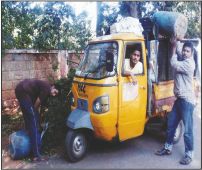
The successive Mayors, Corporators and the Commissioners of MCC have to be complimented for this award. But the ultimate responsibility for the success of this hazardous task greatly rests on the shoulders of the grassroot workers in the lowest rung of the whole set-up. In this article, with due apologies to the higher ones in the hierarchy, I am inclined to highlight this important segment. Where I live, this job is meticulously done by three youngsters, the garbage collectors, who come early every morning shouting ‘Kasa, Kasa’ on the streets to awaken the householders to bring the garbage bin or tub to their doorsteps to be collected by the above youngsters and dumped into the carting autos. I have somehow befriended these boys in my own way and my wife even gives them a cup of hot-tea, a welcome drink in the early winter morning. Now, a brief about the boys:

1) The auto driver is named Farhan, obviously a Muslim boy of a score of years in age, who says he has studied upto PUC and due to family problems has taken up this part-time job (from 5 am to 2 pm) to save a portion of his earnings to enable him take up and study for B.Com next year. He has plans to pursue higher education upto M.Com or MBA. What a brilliant idea for future plans to this very handsome and affable young boy.

2) Rangaswamy is the important member of this trio and has studied upto High School. He is married and has two kids pursuing school education. He has carved out higher education for his kids more so because he was denied an opportunity to pursue his studies further.

3) Varadaraju is the third boy who collects the street and household garbage and carries them upto the auto and hands it over to Rangaswamy to put them into the inner auto space. He also has some formal education.

The job of the above three youngsters is to assiduously scan the about one-and-a-half to two-square-kilometres of the area allotted to them for garbage collection and transport it to the nearest lorry assigned to the area for carrying it forward to the dumping yard for treatment and final disposal.

In this hazardous task, I guess Mysuru City must be collecting and disposing off hundreds of tonnes of dry street and household garbage every day. Proper planning for final disposal of the garbage thus collected on a daily basis must be a challenging task for the City Corporation authorities who should be complimented for the same. The next higher-ups like Health Inspectors and others involved in these monotonous and highly necessary daily activities should be complimented for a good job done for the ultimate well-being of the city. Proper planning and execution are the hallmarks of this stupendous task in continuing to maintain the health of the citizens.

In the above context, I would prefer to call the three youngsters as the “Foot Soldiers of the Swachh Bharat Abhiyan.”

Decades ago many extensions of the then Mysore did not have Underground Drainage (UGD) networks and my memory goes back to the Vontikoppal area which was one of them. My father’s uncle lived there. It was an area inhabited by college professors including Kuvempu. Hand collection and hand carting of domestic sewage was in vogue and thus came the idea of a conservancy lane in between the parallel rows of houses facing the main road. The collection and carting of this ignominious domestic garbage was done by members of a particular community, nicknamed scavengers. What a shame and black mark on the society? It is good for the society that this system has been abolished in most of the cities and towns. It is an improvement in social conduct that people belonging to all communities have joined the brigade of the ‘Swachh Bharat Abhiyan.’ The doors of this Abhiyan should open up and welcome youngsters from all communities in the country into its fold. Time is not far off for this to happen.

In olden days, when I was a boy, fairly big houses in the city would be having a reserved space in the compound corner called ‘Thippe’ and all dry and kitchen garbage would be dumped into it and cleaned almost every week, by municipal workers. This was a very good and welcome step in maintaining the health of the household members. This, however, is absent these days.

Now, in a lighter vein this ‘Thippe’ was also used to make fun of a lady member of the household who begets twenty- one children by a single husband. A small function would be arranged to commemorate this great event by asking her to sit on a carpet spread on this ‘Thippe’ and perform a small ‘Arathi,’ a mark of a mini-religious function to celebrate the event by inviting relatives and neighbours!! My father’s maternal uncle’s wife had this distinction (!) and she was nick-named ‘Papachi’ and whatever it meant I do not know. She bore twenty-one children to her husband !

Old order changeth yielding

Place to new

And God fulfils Himself

In many ways

The present generation of husband and wife normally have one child, if at all, and many forego the joy of parenthood and the reason they offer is “we want to enjoy life fully without obligations or hindrances.” Nobody will remain young for ever and when they get old, they regret their earlier decision, but it would be too late in the day.

e-mail: mlkswami@yahoo.in

source: http://www.starofmysore.com / Star of Mysore / Home> Feature Articles / Thursday – February 25th, 2016

Karnataka Urdu Academy Chairperson passes away

Bengaluru , KARNATAKA :

Dr. Fauzia Choudhry collapsed while speaking at a programme in Kannada Bhavan, Bengaluru

DrFauziaMPOs26feb2016

Mysuru :

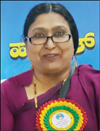
Dr. Fauzia Choudhry (52), Chairperson of Karnataka Urdu Academy, passed away yesterday in Bengaluru following a heart attack.

She leaves behind her husband, three daughters and a host of relatives and friends.

Dr. Fauzia Choudhry, who collapsed while delivering the presidential address at a programme held at the Urdu Library in Kannada Bhavan, was rushed to St. Martha’s Heart Centre, where she was declared brought dead.

Namaz-e-Janaza will be held today after Zohar at Masjid-e-Khadria, followed by the burial at Khudus Saheb Makhan in Bengaluru.

Condoled: MLA Tanveer Sait, Secretary of Mysore District Relief Committee Mohammed Mumtaz Ahmed and others have condoled her death.

source: http://www.starofmysore.com / Star of Mysore / Home> General News / Thursday  – February 25th, 2016

Cervical Cancer Less Among Muslim Women: Dr V Shanta

Sudha Raghunathan at Oncology meet  Martin Louis

Chennai :

Pointing out that cervical cancer is less among Muslim women, Dr V Shanta, chairperson, Cancer Institute WIA, attributes this to the religious ritual of circumcision practised by them.

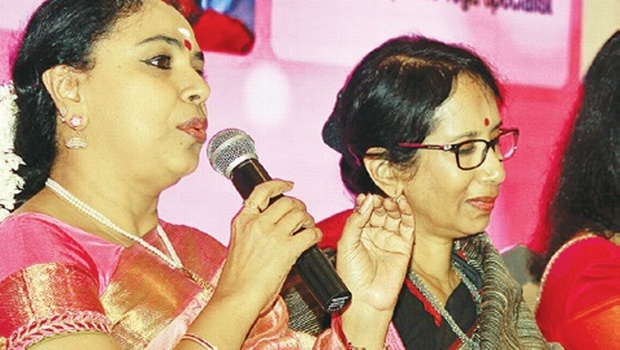
Addressing the gathering at a symposium on women’s oncology organised by Apollo Hospitals and National Cancer Institute of the  United States (USA NCI) on Monday, Dr Shanta says only 8.9% of the Muslim women have cervical cancer compared to 15.4% among the Christian women and 22.1% among the Hindu women against a total ratio of 1 lakh.

“The main reason for such a drastic change is the practice of circumcision and penile hygiene,” she adds. “Circumcision has a protective effect against sexual transmission of human papilloma virus (HPV), which is a causative agent in cervical cancer,” said a doctor at the symposium.

The country has seen an uneven literacy pattern which has affected cancer detection and curing, according to Dr Shanta. Various research have proved that uneducated adults are more likely to die from cancer than the educated as awareness is a big problem for illiterate people, she said.

Further, she says that there has been a decrease in cervical cancer among women in the urban centres when compared to rural areas. But city women have recorded an increase in breast cancer. Dr Shanta cited the figures of 2009-12 to show that cervical cancer reported in Chennai is only 16.5% when compared to 22.8% in rural areas. Likewise, breast cancer reported in the Chennai is 38.6% when compared to 15.1% in rural areas.

“This is because of education and socio-economic status of the people. The attitude among the urban populace is more towards the cure than prevention. Only when they realise that prevention is better than cure can the rates of cancer death be brought down,” she explained.

State health secretary J Radhakrishnan said that private and government hospitals along with NGOs are working together to fight oncology among women. He pointed out that around 1.09 crore women were screened for cervical cancer in Tamil Nadu out of which 3.7 lakh were found to have the the disease. Similarly, around 1.33 crore women were screened for breast cancer out of which which 1.64 lakh were found to have the disease.

A symposium titled ‘Marga’ focused on a road map towards women’s oncology care in India was held. It was pointed out that 35 million deaths occurred due to NCDs (non-communicable diseases) each year which is due to sedentary lifestyle, poor diet regime and high stress levels. While many schools had banned fast foods in their canteens, parents must avoid giving kids such items, they said.

source: http://www.newindianexpress.com / The New Indian Express / Home> Cities> Chennai / by Express News Service / February 23rd, 2016

A student and a corporator too!

Hyderabad, TELANGANA :

ShireenMPOs23feb2016

Clad in a burkha and with a scarf covering her head , Shireen Fatima looks like any other woman from the old city. But what distinguishes her from others is that she is a GHMC corporator representing Nawab Sahab Kunta division at the tender age of twenty one.

A D.Pharm student of Mesco College of Pharmacy at Mustaidpura, Shireen attends college and devotes her remaining daytime to ensure overall development of the ward. After nightfall she gets back to her studies. Her father Abdul Hannan, a well-known public figure in the area, guides her in the day-to-day affairs. AIMIM party president Asaduddin Owaisi is her role model. In an interview with The Hindu, she outlines her plans for her ward.

What are the main problems in your constituency?

See I represent an area which has many slums. There are quite many civic problems pertaining to sanitation, water scarcity and sewerage. A few storm water drains need to be widened or remodelled.

How are you going to solve them?

Along with my father I have prepared an action plan. I will be discussing with the Bahadurpura MLA Mohammed Moazam Khan and then meet the GHMC officials concerned to ensure their redressal. My emphasis will be on development of local government educational institutions.

I will also be writing to officials of various government agencies to increase the manpower allotted for the area so as to attend regular civic works including health and sanitation. People are also requesting for a library and I will take up the issue with the party leadership as a few thousand students will benefit if it is set up.

How will you help improve the city’s infrastructure?

I will cooperate with officials and other public representatives to ensure overall development of the city infrastructure. My main focus will be developing my ward.

source: http://www.thehindu.com / The Hindu / Home> News> Cities> Hyderabad / by Asif Yar Khan / Hyderabad – February 22nd, 2016

NFHRC branch opened

Vizianagaram, ANDHRA PRADESH :

National Federation of Human Rights Council opened its branch at Three Lamps junction in the town on Sunday.

Federation State president Mohd. Ali Sheik, who inaugurated the branch, said the council with an intention to create awareness among the general public about their rights as per the legislations in force and to standby those in distress would be setting up its branches at all district headquarters.

He said that Chief Minister N. Chandrababu Naidu too had given his consent for construction of the council’s own building.

State Bar Council vice-chairman Kolagatla Thammanna Setty, who was present, emphasised on the need to know about Right to Information Act, Consumers’ Act, Human Rights, etc. in detail to assert their rights.

source: http://www.thehindu.com / The Hindu / Home> National> Andhra Pradesh / Vizianagaram – February 22nd, 2016

Polling peaceful in Kodagu, Chikkamagaluru districts

Chikkamagaluru – Kodagu, KARNATAKA :

The zilla and taluk panchayat elections held in Kodagu and Chikkamagaluru districts were peaceful on Saturday.

The polling received a lukewarm response in plateau region in Chikkamagaluru district till afternoon.

Twenty-three per cent polling was recorded at Karthikere in Kuruvangi zilla panchayat constituency at 11 am. The polling percentage similar at Kalasapura in Ambale constituency at 11.30 am.

A 95-year-old Jayamma was carried to the polling booth by her son Siddalingappa at Pillenahalli.

The labourers left for their work after exercising their franchise in Malnad. The political parties had even arranged vehicles to ferry the voters to the polling booths at a few places.

District Congres Committee President D L Vijaykumar exercised his franchise at Balegadde polling station.

Report from Kodagu

Elections were held in 29 zilla panchayat and 50 taluk panchayat constituencies in Kodagu district.

A total of 117 candidates are contesting in the zilla panchayat election and 169 candidates are in the fray in taluk panchayat election.

Technical glitch was experienced was an elctronic voting machine at Athooru polling station at Somwarpet taluk. There was brisk polling since morning in the district.
Women and men were seen standing in long queues to exercise their franchise at Kedakal, Suntikoppa, Guddehosur, Nanjarayapatna, Kambibane, Chettalli, Nelyahudikeri, Siddapura, Ammathi, Moornadu, Mekeri and other areas.

Ninety-six-year-old Ponnamme arrived to exercise her franchise at Kedakal polling station.

Krithika, who excercised her franchise for the first time at Suntikoppa, said, “I am feeling happy that I have excercised my franchise for the first time. Voting is a sacred right.” Jayalakshmi, a first-time voter, expressed similar views at Guddehosur.

People were seen discussing about the election in groups outside 100 metre radius of a few polling booths in the district.

Deputy Commissioner Meer Anees Ahmmed visited Kadagadalu, Abhyathmangala, Chettalli, Nelyahudikeri, SIddapura, Makkandoor, Madapura, Athooru, Guddehosoor and other polling booths. The counting of votes will be held at 8 am on February 23.

source: http://www.deccanherald.com / Deccan Herald / Home> District / Chikkamagaluru – Kodagu / DHNS – February 21st, 2016

Leading Indian—origin Muslim cleric dies in UK

“He established Dewsbury as a centre for European Muslims in Britain as far back as 1978. He was also a strong believer in British home—grown Islam,” Mr. Ahmed said.

Gujarat – Drewsbury, West Yorkshire / United Kindgom :

An Indian—origin cleric who was the leader of Tablighi Jamaat sect in Britain and Europe, and who played an important role in the creation of Markazi Mosque, the European headquarters for the movement, has died aged 92.

Thousands on Sunday turned out for the funeral of Hafiz Yusuf Patel who died in Drewsbury, West Yorkshire, on Thursday.

Mourners came from across the UK and flew in from European countries including France, Germany, Spain and Portugal.

Patel had been invited from India in the 1960s by Gujarati Indian Muslims who wanted a religious guide for the movement.

“He was a pioneer, a visionary when it comes to the Islamic identity and the place of the Muslim community in Britain,” Ishtiaq Ahmed, of the Bradford Council for Mosques, told The Huddersfield Daily Examiner.

The cleric, who was the leader in Britain and Europe of Tablighi Jamaat sect, was instrumental in the creation of the Markazi Mosque in Dewsbury in the late 1970s. The mosque is now the European headquarters for the Tablighi movement.

“He established Dewsbury as a centre for European Muslims in Britain as far back as 1978. He was also a strong believer in British home—grown Islam,” Mr. Ahmed said.

After an open air service, relayed on a public address system, Patel was buried in a private ceremony at Dewsbury Cemetery. Free buses ran from surrounding towns for mourners to gather in the rain to pray side by side.

Patel is said to have gone door—to—door in the early years promoting the message of Islam and encouraging people to go to mosque.

The Tablighi Jamaat organisation was founded in India in 1926 and is closely linked to the conservative Deobandi school of Sunni Islam.

Estimates for its global membership range from 12 million to 80 million, with European members thought to number at least 150,000.

source: http://www.thehindu.com / The Hindu / Home> International / PTI / London – February 21st, 2016