Category Archives: Community Involvement / Social Issues

Recollections…: Of a Tete-A-Tete

Mysuru, KARNATAKA :

ProfDurraniMPOs21feb2016

by Prof. M.I.K. Durrani

Are you the one who has written the article about the Khans of Kodagu in Star of Mysore,” asked the stranger in a brusque manner as he suddenly made his appearance at the threshold of my office room as I was engrossed in checking the accounts, as the then ‘muthavalli’ (Manager) of Omer Khan Mosque.

“Yes,” I responded meekly, “but I am sure there wasn’t anything libellous or damaging in them! By the by, are you from the Police Department or from the Court with summons?”

“Oh no! Nothing of the sort; but excuse me, I will be back in two minutes,” said the intruder and made his exit as abruptly as he had made his entry. I was a bit flummoxed by the incident since never before had I been accosted by anyone in such a rude way. However, I reverted to my work on hand being sure that the two minutes would be having thousands of seconds in them and there wasn’t much apprehension of the likely re-appearance of the said apparition in the immediate future.

But I was thoroughly mistaken for the man with the lean and hungry look did return within two minutes as he had promised. I have always been a great respecter of punctuality, which is generally a very rare commodity among most of our people. I was on the verge of complimenting him in this regard when I noticed that, even before I could ask him to take the chair, he had just then made himself comfortable in the only other chair that was there, perhaps to have a cosy chat.

This time he had in his hand a large paper bag, obviously fetched from his vehicle parked outside. He inserted his hand into the bag and produced a series of photos of different sizes showing mostly men of an earlier era dressed up in anachronistic ensembles. He said that they were the pictures of his dad, grand-dad and great-grand-dad, who had descended from some migrants hailing from Afghanistan and that they had settled down in a small town of Kodagu.

I asked him what I was supposed to do with those pictures. He said, “I am coming to that. But look at this boy seated on the ground in front of his father. Isn’t he cute?”

“Yes,” I replied, “I think so.”

The visitor continued, “Can you guess who it could be?”

I said I was at sea.

“Oh Sir! Don’t you notice the resemblance?” he continued, “It’s me, and you see I still carry the remains of those captivating looks.” He was getting on my nerves and almost boring me to death.

“Alright, alright,” said I, mustering up all possible patience, “Come to the point, tell me what brought you here?”

“Yes Sir, yes Sir,” he answered, “I am about to broach the subject. I know it will be a child’s play for you. But I have come to ask you to do me a favour. I am sure you will oblige me.”

“Well, what is it?” I enquired.

“My dear Sir,” said the visitor, “My humble request to you is to write an article about my ancestors just as you have done in the case of the Khans.”

I didn’t wish to hurt him by summarily dismissing him; therefore I asked him to enumerate the achievements of his fore-fathers. He said that their paterfamilias had come to Coorg with almost nothing but by sheer hard work, initially as a labourer, had gradually become a coffee planter and bequeathed his vast property to his children who have multiplied into almost a clan.

But I told him that adding to the population by itself can’t be considered something to be exultant about. I asked him just to tell me whether their family as a whole had done anything worthwhile to be proud of. Had they been social workers and whether they had rendered service for the betterment of the community or had they been philanthropic and founded educational institutions and orphanages? Were they given an award in recognition of their meritorious services to humanity?

He replied that they hadn’t done any such thing but they just waited for the opportune time for such activities but unfortunately it didn’t present itself. But they waited, Sir, and you know that “they also serve who stand and wait.”

I said “I am sorry, it isn’t possible for me to write about people who never attempted or achieved anything for the greater good of the people at large.” And that’s that.

Then all of a sudden a thought seemed to have flashed through the mind of the visitor and he confided in me something remarkable concerning himself. He said that out of modesty he had not referred to his own great service to the community but the fact of the matter was that he was instrumental in bringing much happiness to many a family. He further elaborated that he was responsible for several marriages not only in the city of Mysuru but also in the neighbouring districts.

My curiosity was roused and I enquired whether he was a Khazi (Muslim Cleric). “No, no,” he replied, “I have been a match-maker and I have been responsible for several matrimonial alliances. People have great regard for me and always address me as Hazrath, Moulvi Saheb or Moulana, all terms of great reverence. I am also known as Haji though I have not preformed any Haj (Pilgrimage to Mecca). I take pride in this avocation of mine for which I am rewarded not only here, in this life but also hope to be appreciated in the hereafter for preventing men and women from living in sin.”

I appreciated him for his noble thoughts and still nobler profession but expressed my own fears about the immediate future of his profession since it appeared to me to be bleak. I felt that the need for a regular match-maker for the present day smart phone-savvy youths is redundant. Most of the present generation abhor the very idea of a third person’s intervention in the affairs of the heart.

They opine that where two is company, why should it get crowded by the presence of a third party? They make their own selection in such an irrevocable way that their doting parents are left with no alternative but to concede to their choice. And with the passing of time, the practice of arranged marriages will be a thing of antiquity and match-makers will be obsolescent.

Like a sensible man he concurred with me with regard to the bleak future staring in his face. Taking me into his confidence he confessed, “Sir, our business is steadily dwindling and that day doesn’t seem to be far off when we will have to shut up shop. Furthermore, there is too much of occupational hazard these days. Quite often in our job the first casualty is truth and when it is found out we become easy targets. So I have decided to quit and to go in search of pastures new.”

The meeting was becoming quite absorbing. I asked him what other occupation he was contemplating.

“Sir,” he replied, “the first thing I am going to do right now is to discard my outdated mobile phone and will immediately go in for the latest smart phone. Then all the vistas will be before my very eyes — vistas of a bright future that will be blinding in its promised magnificence.”

“And pray what would that be?” I enquired with rousing curiosity.

“You know Sir,” he continued, “the latest smart phone is equipped with all sorts of widgets like chatting, messaging, email, Bluetooth, Facebook, imo, WhatsApp and what not. With all these handy miracles at my finger-tips, don’t you think that I stand a good chance of enticing an heiress or a dowager’s heart?”

“What! Are you still unmarried?” I enquired.

“Yes Sir,” he replied, “I was all the while too busy finding life-partners for others but now time has arrived for me to say goodbye to my bachelorhood.”

He stood up and put all the photos in his paper bag. Then he came closer and catching my hand he kissed it reverentially. He thanked me for giving the indispensable inspiration. He was really overwhelmed, so overwhelmed that he hugged me and then exclaimed, “Thank You, Thank You and Thank You again.” And then he parted from me with sweet sorrow writ large on his face. And I felt happy, very happy for I had done my good deed for the day.

source: http://www.starofmysore.com / Star of Mysore / Home> Feature Articles / February 21st, 2016
Pages from History : South Indian Coinage

Mysuru, KARNATAKA :

by Prof. A.V. Narasimha Murthy, former Head, Department of Ancient History & Archaeology, University of Mysore

I had the good fortune of serving the Numismatic Society of India, Varanasi, as its President, Secretary and Editor. I used to attend the annual conferences of this Society regularly. I once noticed that scholars attending the Varanasi Conference from South India could be counted on finger tips. The reason, I learnt, was that North India was very far and travel would be difficult and many scholars suggested ‘Why not a South Indian Coin (Numismatic) Society be started?’ It was a good suggestion and I contacted Dr. R. Krishnamurthy, Editor of Dinamalar (Tamil Daily) from Chennai and he welcomed the idea but told me that his business as the Editor of a Daily would not allow him to devote full time and energy for this. But he hastened to add, ‘If you can take that responsibility, my full support to you is there.’

Prof. K.V. Raman of Chennai gave me his support. The Head of the publication of New Era, Dr. Srinivasan Srinivasan agreed to print and publish the Journal of the Society on the condition ‘I should be its Editor.’ I agreed and South Indian Numismatic Society came into existence in 1990. So far it has conducted 26 conferences at different centres in Karnataka, Andhra, Tamil Nadu, Kerala. This time it met at Thiruvananthapuram in Jan. 2016. About 150 Numismatists attended.

It was our good fortune that it was hosted by the Centre for Heritage Studies under the Cultural Affairs Department of Kerala. K.C. Joseph, Minister for Rural Development, Culture and Planning, who inaugurated the conference, extended full cooperation to this conference which was a success.

There was a time when barter was the system of trade. People realised its limitation and began using coins. Coins as such have not been noticed in the Indus Valley Culture. However, Rig Veda mentions coins like Nishka, Rukma, Khadi, in the sense of coins. But actually Nishka means a necklace and hence, it has been taken as a necklace made of gold coins (kasinasara). Anyway, that is the earliest coin of our country.

South India had a period which is generally referred to as Sangam age and it was considered as a literary imagination or even bunkum. Suddenly, Dinamalar Krishnamurthy discovered a coin belonging to a Sangam King called Peruvalathi. For the present, this is considered to be the earliest coin of South India. Barring this, the Satavahana (Andhra) coins are the earliest coins of Deccan and South India.

However, we have had uninscribed punch marked coins all over the country including South India and Karnataka. These silver coins had 5 symbols punched on them and one of them represented the government or the king. At this time, Roman merchants came to South India and gave their gold and silver coins and purchased our spices, especially black pepper, which was considered as an antidote for malaria. Thus the large number of Roman coins gave an impetus for the minting of coins in South India.

Kadambas of Banavasi are considered to the actual inaugurators of coinage in Karnataka. They issued what are called Padmatanka coins. A Padmatanka is a gold piece which has a central punch of a lotus or Padma with some symbols and letters like ‘Sri’ with or without the name of the issuer. The Pallavas of Kanchi issued their own coins in gold and copper. This system was continued by the Cholas of Thanjavur. They minted the portrayal of the king with Nagari or Tamil legends. Chola coins have been discovered in plenty as to fill up them, in gunny bags. In Andhra area, Vishnukundins minted coins. In Karnataka, the Chalukyas minted coins and their most popular coin is called Varaha. This word survives even today in traditional parlance. In fact, the coin name Varaha is a contribution of Karnataka in general and that of the Chalukyas in particular.

The Western Gangas of Talakad minted gold and copper coins with elephant as the important symbol. Unfortunately, Rashtrakuta coins have not been discovered in plenty. Later, Chalukya coins have been found in plenty. The Hoysalas minted coins in gold and copper. Vishnuvardhana minted coins with lion and the legend Talakadugonda symbolising the defeat of the Cholas. One interesting coin is the one which has a portrait of Saint Ramanujacharya. The Sevunas or the Yadava coins include those of Bhillama, Singhana and Ramachandra.

Kings of Vijayanagara introduced innovation in coinage. It is not only a golden age but a golden period for Karnataka coinage. Their coinage has been praised by foreign travellers also. They introduced legends in Kannada and Nagari. The most important coin of Krishnadevaraya are the coins representing Lord Venkateswara of Tirumala and Sri Krishna holding a lump of butter in his hands. Krishnadevaraya performed Kanakabhisheka to Balaji of Tirupati by minting gold coins which had the representation of Venkateswara with Sridevi and Bhudevi and his name in Kannada or Nagari. Nayakas of Madura imitated the coinage of Vijayanagara. Their coins contain legends in Kannada and Tamil.

We may turn our attention to the coinage of Muslim kings — the Bahamani dynasty, Adil Shahi dynasty and Barid Shahi Sultans. They minted coins with legends in Arabic and Persian on both sides. Hyder Ali and Tipu Sultan occupy an important place in Karnataka history. Tipu’s innovation in coinage is amazing. He established seventeen mints in different parts of South India and minted coins in gold, silver and copper. He gave each coin a name after the Islamic Saints. His gold coins contain the Persian legend ‘The religion of Ahmad is illumined in the world by the victory of Hyder.’ The reverse has the legend ‘He is the Sultan, the unique, the just, the third of Bahari, cyclic year Azal 2.’

The Wadiyars of Mysore (now Mysuru) began issuing coins with legends. The representation of Hindu Gods by Krishnaraja Wadiyar is unique. They also minted coins with portrayals of lion and elephant with legends in Roman, Kannada and Persian. Once the British took over, they began to follow the British coinage. After independence, the entire country, including South India, is following the system which we are now seeing. Thus, South India followed a unique system of coinage which has a history of over 2,000 years.

source: http://www.starofmysore.com / Star of Mysore / Home> Feature Articles / February 21st, 2016
Workshop on ‘ Agricultural Finance ‘

Bengaluru, KARNATAKA :

Dr. T.N. Prakash Kammaradi (second from right), Chairman, Karnataka Agriculture Price Commission, Government of Karnataka, Bengaluru, is seen releasing a brochure during the inauguration of workshop in city this morning. Also seen are (from left) AIR Mysuru Programme Executive N. Keshavamurthy, AIR Bengaluru Station Director M.A. Ahmed and AIR Mysuru Programme Head M. Raghavendra.

Mysuru:

A one-day workshop on ‘Agricultural Finance Management’ organised by Prasar Bharati – India’s Public Service Broadcaster, All India Radio (AIR), Mysuru, on the eve of Radio Kisan Divas, began at Central Institute of Indian Languages (CIIL) auditorium, Manasagangotri, this morning.

Speaking after inaugurating the workshop, M.A. Ahmed, Station Director, AIR, Bengaluru, said that AIR Mysuru ‘Kisan Vani’ programme has been a hit among the farming community.

Giving a brief on the objective of observance of Radio Kisan Diwas, Ahmed said that the programme has enabled the farmers to get clarifications for their doubts and problems. He called upon the farming community to maintain a balance between expenses and income and to utilise available resources in a most judicious manner.

Karnataka Agriculture Price Commission Chairman Dr. T.N. Prakash Kammaradi, who delivered the keynote address, explained the meaning, scope and significance of agricultural finance. Pointing out that Agricultural finance deals with the financial aspects of farm business, including macro and micro financial aspects of an agricultural economy, he observed that such workshops, seminars, etc., will help the farming community to improve productivity, increase profitability and fulfil their long term goals.

Since Indian Agriculture is capital intensive, the farmers’ dependence on lending Institutions, such as banks, has considerably risen, Kammaradi said and called upon the lending institutions to come together with society in setting an overall framework in which the individual farmer can appropriately manage his finances.

Noting that natural disasters and other calamities have put the farmers at great risk with crop loss and un-remunerative prices, he expressed displeasure over media’s hyped reporting whenever prices of agricultural and horticultural commodities shoot up and at the same time remaining silent when prices of agricultural produces crash, resulting in great loss to farmers.

He called upon banks and other financial institutions to chalk out the best cash flow analysis that helps the farmers in determining period wise quantum of loans needed and a proper repayment channel that benefits the farming community.

Stating that agricultural production in the country stands at 250 million tonne per year, he called upon the farming community to judiciously use farm savings and not to spend on unproductive assets.

source: http://www.starofmysore.com / Star of Mysore / Home> General News / February 15th, 2016

6th National Science Film Festival : EMRC wins Two Awards for Documentary Film

Mysuru, KARNATAKA :

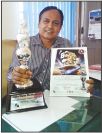
Syed Kaleem, Senior Producer of EMRC

Mysuru :

 Educational Multimedia Research Centre (EMRC), attached to University of Mysore, won two national awards for the documentary film titled ‘DGWT – A cause for Concern,’ in the recently held 6th National Science Film Festival organised in Mumbai. The institute won the Silver beaver award which carries a trophy, a citation and Rs. 50,000 cash prize and also the best graphics award carrying a trophy, a citation and Rs. 30,000 cash prize.

The documentary was directed by Syed Kaleem, Senior Producer of EMRC, Mysuru and Former Director of EMRC, Odisha. This is the second National Award won by Syed Kaleem. The first one was in 2001 for the film on the life of Kodava’s titled ‘Kodavas, The highlanders.’

The best graphics award was received by Chandra Kumar, graphic artiste of EMRC, Mysuru. The film was photographed by Keerthi Kumar, sound effects by Badrinarayana and Somashekar was the Technical Director. The narration of the film was done by Beliappa.

The film highlights the grave danger caused due to depletion of ground water and its long time impact on ecology and environment.

source: http://www.starofmysore.com / Star of Mysore / Home> General News / February 15th, 2016

The Most Innovative Math Teacher Contest – FINALS

Bangalore , KARNATAKA :

Our six finalists, Basavaraj Rodda, Akkamma Aralikatte, Hafiza Begum, Savita Maleda, Iranna Patil and Geeta Basarakod put their best foot forward today in the FINALS of The Most Innovative math Teacher Contest by Akshara Foundation .  February 14th, 2016.

source: http://youtube.com

Workshop on Agricultural Finance

Bengaluru , KARNATAKA :

Mysuru :

Mysore Akashvani, in association with Prasar Bharati and Indian Broadcasting Service, has organised a day-long workshop on Agricultural Finance Management at CIIL on Hunsur Road at 10 am tomorrow (Feb.15).

Bengaluru Akashvani Station Director M.A. Ahmed will inaugurate the workshop.

Mysore Akashvani programme Chief M. Raghavendra will preside.

Karnataka Agricultural Price Commission Chairman Dr. T.N. Prakash Kammaradi will deliver the keynote address.

source: http://www.starofmysore.com / Star of Mysore / Home> In Brief  / February 14th, 2016

Baba Fasiuddin: TRS youth leader to Deputy Mayor

Hyderabad, TELANAGANA :

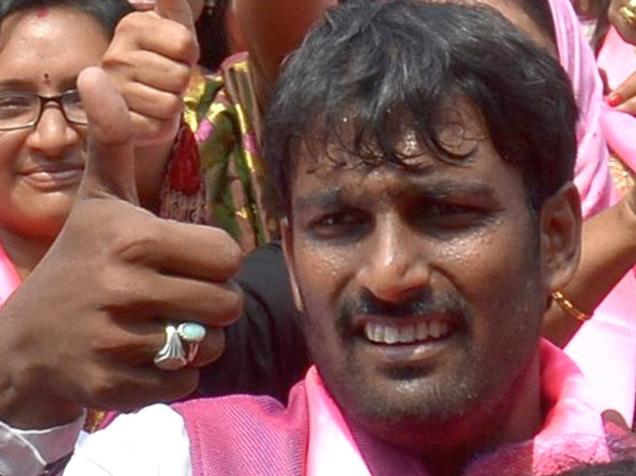
Borabanda Corporator Deputy Mayor, Mohammed Baba Fasiuddin at Gun Park Matyrs' Memorial in Hyderabad on Thursday. - Photo: Nagara Gopal / The Hindu
Borabanda Corporator Deputy Mayor, Mohammed Baba Fasiuddin at Gun Park Matyrs’ Memorial in Hyderabad on Thursday. – Photo: Nagara Gopal / The Hindu

Borabanda, Hyderabad:

The newly elected Deputy Mayor Mohammed Baba Fasiuddin represents the Borabanda Ward of Greater Hyderabad Municipal Corporation. He was unanimously elected as Deputy Mayor as only one nomination was filed.

A graduate in Commerce, Mr.Fasiuddin played a key role in the Telangana movement as well as in the student and youth wings of the Telangana Rashtra Samithi. He is a close confidant of Chief Minister K. Chandrashekar Rao. His father is a retired Government employee.

His family hails from Polcharam Mandal in Medak District. He is presently the president of the TRS Student wing of Greater Hyderabad unit. His mother was an employee in Osmania Hospital. Mr. Fasiuddin is married and has a son and a daughter.

source: http://www.thehindu.com / The Hindu / Home> Cities> Hyderabad / R. Ravikanth Reddy / Hyderabad – February 11th, 2016

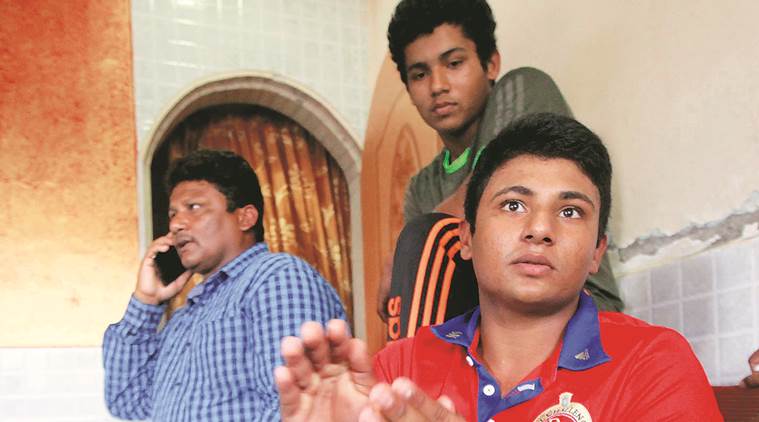
The God-Fathers: The story of Sarfaraz Khan’s father

Sarfaraz’s father, Naushad, was stung when Iqbal Abdullah, who he had picked from a UP village and housed at his small home in Mumbai, rejected him.

Despite financial hardships, Naushad always supported his son’s passion.

Mumbai, MAHARASHTRA :

“Abbu, Arjun kitna naseebwala hai na? He’s Sachin sir’s son, and has cars, I-pads, everything.” He didn’t mention it as a lament. Sarfaraz Khan was right though. On the face of it, Arjun Tendulkar was of course more fortunate than many others. And Naushad could do little but nod in agreement.

Like any father, it wasn’t what he wanted to hear from his son, regardless of how true it was. But Sarfaraz never let him mull it over. For, he ran back almost immediately, wrapped himself around Naushad and said as an instantaneous afterthought, “Abbu main usse zyaada naseebwala hoon. Aap din bhar mujhe time dete hai. Uske papa use time hi nahi de paate (I’m more fortunate than him. You can devote the entire day to me. His father is not able to give him any time).”

Recalling that conversation, Naushad’s eyes well up and his generally authoritative voice gets wobbly. Sarfaraz’s words not only meant that the two were on the same page in terms of pursuing their maksad (ultimate goal). They also belied Naushad’s biggest fear. That he was pushing his son too far in his quest to keep up a vow he’d made in the face of a ‘betrayal’ that he never quite came to terms with.

 Long before Sarfaraz took steps towards cricketing stardom, Naushad had dreamt the same dream of producing a cricketer at the highest level with Iqbal Abdulla—the star pick among many young, poor kids he’d plucked out from the clutches of poverty and brought to Mumbai. He had even kept the boy from Uttar Pradesh in his 225 sq. ft. Kurla home, getting his wife, Tabassum, to cook and clean for him.
Abdulla, like Sarfaraz has subsequently done, would go onto play the U-19 World Cup for India as well as become an IPL star. But according to Naushad, he would also turn his back on the man who’d been his unrelenting benefactor as soon as it was time to show the necessary gratitude.
It came to a head during their ‘final meeting’ at the same house that Abdulla called home for seven years that would once and for all drive a wedge through their relationship.
“That is when he spoke those unforgettable words, Mere mein kabiliyat thi, main khela. Tumhaare mein talent hai toh apne bachchon ko khilaake dikhao na. (I had the ability, so I played. If you have the talent, then make your son play and show the world,” recalls Naushad, his eyes turning red.
Rather than react with any hostility, Naushad took Abdulla’s challenge up. It lit a fire in his belly, and became a drive to make his own son reach the level that he had brought Abdulla to. It wasn’t that Sarfaraz wouldn’t have made it this far without the two growing apart, but it certainly has been a major motivating factor in his meteoric rise in the last half-a-dozen years. It was also an episode that turned Naushad into a shayar, and he can barely go a few minutes without spewing his shers.
The real force behind it though has been Naushad’s all-encompassing, almost overbearing, grip over his son’s life, both on and off the field. Growing up, the Western Railways’ Class 4 employee was used to odd jobs. The track-pant selling business that he partook with Sarfaraz as his apprentice enhanced the mutual respect between father and son.
“Sarfaraz still starts crying when he talks about those days. There used to be one lot in front of me, one between Sarfaraz and I, and one that he would carry on his shoulders. We would get completely wet on the bike, but still make sure we did enough business on Fashion Street,” says Naushad.
The money made from there was used entirely on running Macho Cricket Club-based on a nickname he earned during his playing days for an acrobatic diving catch at National Cricket Ground-and Abdulla’s finances. The Rs 2,000 he earned from his Railways job would run the house.
 The rest of his time was spent in perfecting Sarfaraz’s game.
Naushad would spend hours dishing out throw-downs, paying opposition teams to come play friendly games in which Sarfaraz would bat the whole innings regardless of whether the team lost or not. These days, it’s with his youngest, Musheer. Moeen, the middle son, has been taken off cricket and is now pushing himself to be the Ajit Tendulkar of the family.
Sarfaraz though, would find himself a constant tag of ‘problem child’ — something that didn’t sit well with Naushad. But a meeting with Bharat Arun, present India bowling coach who was in-charge of the U-19 team two years ago, changed Naushad’s own opinion about his son, he reveals.
“He said, ‘have you seen the circus? First comes the lion, everyone claps. Then the elephant comes and plays a few cricket shots. Everyone claps. Then why do you need the joker? Sarfaraz is the one you need when everyone else is shivering and is intimidated by the opposition. Don’t restrict him, that’ll kill him,” recalls Naushad.
And as it’s turned out, Sarfaraz today not only stands on the cusp of being the most valuable player of the U-19 World Cup, he also shares the RCB dressing-room with Abdulla, which in Naushad’s eyes is a sort of denouement to a saga that has dictated his life.
 “I don’t see it as a victory. Our ultimate goal is playing for India. It’s like saying we have reached Ratlam en route to Delhi,” he says.
But like he showed last year, Sarfaraz has taken a step up by impressing everyone including AB de Villiers, that reinventor of the batting wheel, in RCB colours, especially playing the scoop shot audaciously even off fast bowlers. But it is a shot that his father had brought into vogue back at a time when nobody had seen it in India.
Unfortunately, like Naushad reveals now, it was too far ahead of his time and cost him a place in the Mumbai Ranji team. He grew up playing cricket in a cowshed, diving around on cow-dung, and like his son is today was a belligerent striker of the ball with a penchant for bravura. But he does regret having turned down offers from other states once Mumbai stopped showing interest in him. A mistake he didn’t make when Sarfaraz found himself in the same spot last year. He immediately moved him to Uttar Pradesh, who he represented this season in the Ranji Trophy.
Aakhon aakhon mein raha,
Dil mein utar kar nahi dekha
Kashti ke musafir ne samundar nahi dekha
Aur jab se main chala hoon, meri manzil pe nazar hai
Aankhon ne kabhi kilometre ka pathhar nahi dekha
This he believes is the sher that captures his life the best. And he can’t help himself but punctuate each line with a dramatic pause. In many ways, Naushad, who also sold toffees and cucumbers in trains, has banked on his own life story to shape Sarfaraz’s career.
No wonder it’s mirrored it in many ways already. But he is aware of the fickleness of the sport he calls his best and only friend. He no longer believes that there is no way back for him and his ambitious family if Sarfaraz doesn’t make it.
Says Naushad, “We came from the slums, used to stand in queues for the toilet where my sons would be slapped and overtaken. We came from nothing and will go back to nothing. Sarfaraz told me the other day, ‘Abbu so what if this doesn’t happen. We can always go back to selling track-pants.”
source:  http://www.indianexpress.com / The Indian Express / Home> Sports> Cricket / by Bharat Sundaresan / February 14th, 2016

Fahad the youngest corporator

Hyderabad, TELANGANA :

Uppugada, Hyderabad :

Fahad Bin Abdul Samad from Uppuguda set a record on Thursday when he became the youngest municipal councillor in the country to take oath.

At 21, Mr. Fahad beat his nearest rival by 4,000 votes on AIMIM ticket to get elected to GHMC’s Council of 150 corproators. He attributes his entrance into politics and early electoral success to his father, a former corporator of the ward, and his party leaders. The minimum age to contest in a local election is 21 years.

“The party was keen on promoting educated youngsters. Doctors, pharmacists and engineers are today among those elected from AIMIM,” said Mr. Fahad, who is pursuing his final year of civil engineering. Entry into politics was a pleasant surprise for the youngster who said he had to drop his plans for education abroad.

“I had planned to pursue masters abroad. But I will now pursue education here,” he said, quickly adding that politics and education will not clash. “Nearly a third of my ward comprises people under poverty line. Besides discharging regular duties of a corporator to ensure civic infrastructure, I want to help the poor get education,” he said.

source: http://www.thehindu.com / The Hindu / Home> Cities> Hyderabad / by Rohit P.S / Hyderabad – February 12th, 2016

B’luru advertiser puts his faith & funds on billboards

Bengaluru, KARNATAKA :

SalaamCentreMPOs11feb2016

Bengaluru:

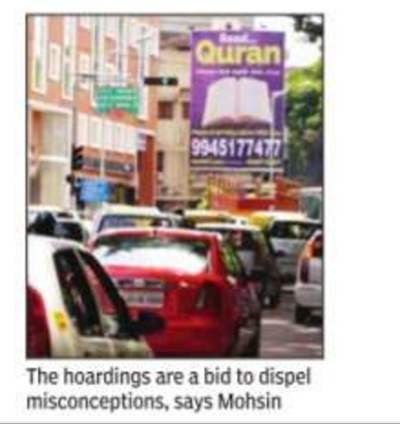
For months now, citizens of Bengaluru, the eastern parts in particular, have been seeing huge billboards at vantage points with the tagline, ‘Islam: Facts Vs Fiction’, offering a free copy of the Quran from the advertiser.

Passers-by wonder who’s leasing out the space and why, and having read the message, move on.

Syed Hamid Mohsin, who runs an outdoor advertising business, was known for his love of cars, buying the latest models of luxury cars every year. Six years ago, he found himself facing serious questions.

“There are more than white, and those seen at dargahs, about love jihad and extremism, and other issues.”

He founded the Salaam Centre in 2008 and turned to dispelling misconceptions about Islam and fostering inter-community harmony through the use of billboards, social media and other channels.

His book on Islam has been translated into Hindi, Kannada, Tamil, Telugu and Marathi.

“The usual question from 100 misconceptions about Islam,” said the 50-year-old.

“I’ve tried to explain the difference between Pakistan’s national flag, which is green and intelligence sleuths and the judiciary and others is:where do I get funds for such work, and for the plush office on Bannerghatta Road?’ Mohsin said.

A Bengaluru business man has got billboards posted at key points across the city to dispel misconceptions about Islam and spread the message of communal harmony .

“Outdoor advertising gives me my bread and butter and the income from it is funnelled here. I have a bungalow and a Mercedes Benz which I haven’t changed in six years. Earlier, I used to have two luxury cars and change these every year . Instead of paying an EMI of Rs 1lakh on cars, I decided to do this. I don’t want to go into philanthropy or give educational scholarships because others are doing this,” says Syed Hamid Mohsin, who runs an outdoor advertising business. “I keep the hoardings for short periods as people get bored,” he said.

source: http://www.timesofindia.indiatimes.com / The Times of India / News Home> City> Bangalore / TNN / February 11th, 2016