Category Archives: Community Involvement / Social Issues

Love, loss and longing: The journey of a Princess

Hyderabad, ANDHRA PRADESH (present TELANGANA) :

PrincessNilouferMPOs08jan2016

Princess Niloufer, the beloved daughter-in-law of the last Nizam of Hyderabad, may have left the city shortly after the Police Action in 1948. But even a good six decades later, she continues to be an enigma that at once intrigues and haunts Hyderabadis. On her centenary year, even as a photo exhibition by Birad Rajaram Yagnik attempts to reveal unknown vignettes of her life, and a documentary film on her is being worked on by historian Arvind Acharya, Hyderabad Times looks back at the dramatic life of the much loved princess of the city of Pearls. Surely, it was nothing short of a movie!

A fairytale set in 19th Century

When Niloufer Farhat Begum Sahiba was born in Istanbul, in January 1916, the Ottoman Empire was already fast crumbling. When she was barely a toddler, the Ottoman surrender was formalised aboard a British warship (October 1918). And by the time she was seven, the 700 year-old empire had officially fallen. In the backdrop of this downfall, the princess had to leave her fairytale life in Istanbul behind, and move to France with her mother in 1924, never to return. aged eight at that time, Niloufer would go on to lead a very ordinary life, learning to read and write French along with Urdu. Her exercise books had her learning about geography of the world. she stuck bits and pieces of the map in separate pages, oblivious to what the future held for her — a future where she would be remembered as the beloved princess of three cities. And yet, hold reign over none.

The romance with Hyderabad

Cut to 1931. In Hyderabad, Mir Osman Ali Khan, the seventh Nizam — also the world’s richest man — was looking for suitable brides for his sons. And that’s how Niloufer, just 15, found herself in Hyderabad. In a grand, royal wedding held in Nice in November 1931, Niloufer married Moazzam Jah, the Nizam’s younger son.

The Nizam had chosen Durru Shehvar (Niloufer’s first cousin) for his elder son — so the shift to a foreign land was less daunting perhaps. Another reason that made Hyderabad feel like home was that the Princess found a father figure in the Nizam. Though known to be officious and keen on protocol otherwise, the Nizam considered Niloufer his daughter. He even let her call him ‘father’. Life in the Hill Fort Palace was grand, Hyderabad was at its cultural peak, and the Princess took on many avatars — fashionista, socialite, philanthropist.

The sartorial queen

Between 1933 and 1948, Niloufer became a fashionista through whom the world got acquainted with Hyderabad. Her sarees, her choice of jewellery, her lifestyle became a talking point. Photographers, especially a crafty portrait photographer, Antony Beauchamp, loved her easy beauty. the international press adored her. Niloufer is credited with adding Parisian grace to the Indian saree. Her sarees were crafted specially for her, by Madhav Das in Mumbai. She loved chiffons and crepes, and wore them often with a broad woven Banaras brocade border. In fact, Mme. Fernande Cecithe, who was originally hired as a midwife for the princess, later created excellent designs to be embroidered on her sarees too. Her wardrobe is still studied by fashion students across the globe and her collection of sarees are now treasured at the New York Institute of Fashion Technology.

The socialite princess with a golden heart

One of the very prominent facets of Niloufer’s social life was the Lady Hydari Club, through which she also initiatied events and dos to raise funds. In 1941, Niloufer decided to organise the staging of a play Ondine (by dramatist Jean Giraudoux) to raise funds for London, which was recuperating from the damages of World War II. She was told by her father-in-law that a princess must not be seen acting in a play. So, her secretary at that time, Fatima Ghani, who would accompany her all the time and therefore even knew the dialogues, took on the princess’ role of a knight-errant Hans von Wittenstein zu Wittenstein.

But it wasn’t until 1949, that Niloufer’s biggest contribution to Hyderabad was going to emerge. When her maid, Rafath Unnisa Begum, died in childbirth, she was so shattered that she decided to ensure that no more such deaths take place. she decided to set up a maternity hospital, which stands today as Niloufer Hospital in Nampally.

The truth behind the glamourous veneer

She was one of the most beautiful women of her time. She was a much loved princess, both at home and overseas. But Niloufer had long learned that the glamour of all this was just that — an eyewash at best. At the heart of it all, there was pain and emptiness. She spent her best years in Hyderabad, craving to experience motherhood — a desire that was never fulfilled.

By this time, Niloufer had already witnessed her first cousin Durru Shehvar give birth to two sons, Prince Mukarram Jah in 1933 and Prince Muffakham Jah in 1939. Her childlessness put much strain on her marriage. In 1948, Moazzam took a second wife, Razia Begum. And by 1951, Niloufer had decided to split from her Hyderabadi commitments.

She moved back to France with her mother. Nice, back then had many members of royalty in exile, allowing Niloufer to still be socially active. As she aged gracefully, her photos from the era show her wearing the string of pearls that her mother had gifted her at birth.

However, irrespective of where she was based, Niloufer never severed her Indian ties. Her friendship with Jawharlal Nehru was one such connection. One of her letters following the assassination of Gandhi read: “Dear Pandit, You have heard and read the cry of so many millions of hearts — you have felt perhaps more than anyone else that great silence that set the void and the loneliness after he (Gandhi) was no more”. The duo continued to stay in touch, Niloufer wrote to Nehru even during the elections and Nehru who was on the road canvasing for the polls, replied, “But I want to tell you that you will always be welcome here whenever you care to come.”

Finding love again
After a good 11 years of being single, Niloufer met Edward Pope and found love once again. In February 1964, she married Pope in the presence of Nawab Ali Yawar Jung who was the Best Man.

Niloufer died in 1989 and was buried in a grave in Bobigny near Paris. The Muslims-only cemetery that is a two-hour drive from Paris not only has her mother resting there, but also all the members of her Seljuk dynasty. Surely, a life as romantic, as magnanimous, and as dramatic as Niloufer’s, deserves to be immortalised.

source: http://www.timesofindia.indiatimes.com / The Times of India / News Home> City> Hyderabad / by Samyuktha K, TNN / January 06th, 2015

A 110 year-old doctor

Kolkata, WEST BENGAL :

Repository of the ancient wisdom of Unani medicine, 110 year-old Syed Mohammed Sharfuddin Quadri lives a Spartan and frugal life that has worked wonders for him, as Partha Mukherjee discovers

DrSharfuddinMPOs01jan2016

Almost 55 years ago, while I was journeying through a field in a cart, I caught sight of an old towering neem tree, immersed in soundless symphony with a swarm of fireflies. Barely five years old then, I didn’t know that the silhouette of a tree in hushed twilight silence would be a metaphor for a man around whom the sparkle of life never dims, even when ‘night’ tiptoes into his life.

Syed Mohammed Sharfuddin Quadri is famous for treating India’s first president Rajendra Prasad in Gaya in 1942-43 for breathlessness. Fondly known as Hakim saab, he has a photographic memory, sense of humour, never-say-die spirit and, above all, energy that never runs out. On 25 December 2011, he will turn 110. Yet he works for 17 hours at a stretch, preparing concoctions from dry fruits, herbs and roots and advising close to 100 patients (free of cost) every day. At 5 pm, every day through the year, Hakim saab attends to his patients at his Wellesley Square clinic in central Kolkata as well as those in the US. “Abba has patients all over America,” says his 40 year-old son Mohammed Sadique, who assists Quadri in his clinic. “He gives instructions to them over email or through a video conference. Earlier, he used to go to California, Los Angeles and New York, but now he’s restricted because of his gout.”

Sharfuddin Quadri answers all questions, except those about his achievements. Founder of the Unani Medical College and Hospital in Kolkata, Quadri published a magazine titled Hikmat-e-Bangala (Hikmat means Unani medicine) in 1959, which folded up soon for lack of funds. “Success means how much one has been able to help others,” he says, adding that he does honour the Padma Bhushan he was awarded by the President in 2007. He brings out the medal attached to his pocket by a silk ribbon. “I carry it to show my respect to the recognition of Unani treatment. Though I would be happier if I were given a grant so I could at least cover the place with a shed where my patients wait.” Indeed, patients wait for him for hours, sometimes till midnight, even in the rains. “There is no help from the government to collect herbs at a reasonable price,” adds Mohammed Sadique, Quadri’s youngest son (he has six siblings) who assists his father. “Sometime Abba is so frustrated that he thinks of giving up. If medicines aren’t available what is the use of continuing the treatment?”

From a family of hakim in the remote village of Kumrava in Nawada district of Bihar, Quadri trained in Unani treatment from Shafakhana Darsgah Tibbia (Gaya) in 1930. After immersing himself in the freedom movement, he started his practice in Calcutta where his family shifted in 1935-36. “Herbal medicines have a magical effect on our body; besides they have no side-effects,” he says sipping neem juice. If diagnosed, every disease responds to Unani treatment, Quadri claims, adding that with medication one must strictly follow instructions on diet and lifestyle as well. “During the diagnosis, one has to study the dam [blood], balgham [phlegm], safra[yellow bile], and sauda [black bile] of the patient [just like kapha, vata and pitta, the three dosha in Ayurveda], as they are the roots of all diseases,” he explains. “Anyone with any sort of ailment definitely has an abnormality in one of these.”

DrSharfuddinMPOs02jan2016

As for his own frugal diet—neem juice and half a piece of bread—he says, “The less you eat the more you live; the more you eat, the more you court ailments and health hazards. And to lead a healthy life you should have a healthy mind. My father lived to be 122 and never allowed any ignoble thought to cross his mind.”

How does he keep himself so physically fit even at 110? “I never sleep at night; I read books on Unani medicine when others are fast asleep. In the calm of the night, I try to explore things I don’t know about and let them melt into my inner self.” Unani medicine, he says, actually has its roots in Greece following extensive research by Hippocrates (460-377 BC). “It was he who laid the foundation of clinical medicine based on diet and symptoms.” He adds that a number of Greek scholars after Hippocrates—Galen (131-200 AD) followed by Arab physicians Rhazes (850-932 AD) and Avicenna (980-1037 AD)—enriched the system considerably. Rhazes and Avicenna authored Al-Hawi and Al-Qanun respectively, which were later translated into Latin and other European languages and taught in medieval European universities. They are said to have influenced western medical thought.

Unani medicine disappeared from the country of its origin, but found roots in India through Arab traders long before the Mughals. The Khiljis, Tughlaqs and Mughal emperors provided state patronage to Unani scholars and employed many as court physicians. The British imposed strict restrictions on every form of treatment but allopathy. Despite suspension of aid to Unani institutions, the system survived owing to the commitment ofhakim like Ajmal Khan, who served as the president of Indian National Congress in 1921—the Unani physician and scholar founded the Ayurvedic and Unani Medical College in Delhi.

Quadri reads till 4 am, when the city wakes up to fight for the day. “After my daily ablutions, I go to the mosque for namaz which involves many a yogic mudra—I do each of them,” he shares. “I walk back home at 5 am and sleep till 9, after which I go to my clinic. There’s no time to waste till 5 pm, when I go to the clinic, which I believe is the key to my fitness.”

Sharfuddin Quadri thanks his health for having been witness to an eventful century. The Dandi March with Mahatma Gandhi, confinement in Cuttack Jail and a memorable encounter with Maulana Abul Kalam Azad. “In 1943-44, in Ramgarh—then in Hazaribagh and now in Jharkhand—Maulana Azad was addressing the people and suddenly the skies opened up in a heavy downpur making everyone rush for sheds. Azad roared, ‘You are so scared of raindrops, what will happen when the British will rain bombs and bullets on you?’ And then no one moved even an inch.”

Finding his shadow lengthen by the day, Sharfuddin Quadri remembers Rabindranath Tagore through his lines and a brief meeting in 1912: Moron jedin diner seshe asbe tomar duare/sedin tumi kee dhan debe uhare?(When Death will knock at your door at the end of the day/What will you offer him as a gift?) “I wonder what I will be ready with to welcome the inevitable,” he signs off.

Featured in Harmony – Celebrate Age Magazine
July 2011

source: http://www.harmonyindia.org / Harmony India.org /  Home> H People> Diary 100 / Featured in Harmony – Celebrate Age magazine, July 2011

Alleging ‘victimisation’, Dalit IAS officer applies for VRS, converts to Islam

Jaipur, RAJASTHAN :

RSRTC Chairperson Umrao Salodiya at press confrence where announced his decision to convert to Islam and apply for VRS from service, in Jaipur on Thursday. Photo: Rohit Jain Paras / The Hindu

After being denied the promotion that would make him the State’s Chief Secretary, senior IAS officer Umrao Salodia, a 1978 batch IAS officer from the Dalit community, on Thursday, appealed to Chief Minister Vasundhara Raje for Voluntary Retirement. Mr. Salodia, who alleged the Raje government of “victimising him on the basis of caste” also converted to Islam, on Thursday.

In a letter addressed to Ms. Raje, Mr. Salodia wrote: “For the first time after independence of the country, myself, an IAS officer from the SC/ST category would have been appointed today [on Thursday] as Chief Secretary [of Rajasthan] on the basis of seniority.”

In the letter, Mr. Salodia alleged that the current Chief Secretary C.S. Rajan was given a three-month extension, till March next year, to deny him the opportunity of becoming Rajasthan’s Chief Secretary.

“I hereby apply for Voluntary Retirement by giving a three-month notice under the All India Service Rules,” Mr. Salodia stated in the letter, adding that he must be granted the Voluntary Retirement as he did not wish to work under a junior officer.

In another drastic step, Mr. Salodia converted to Islam, on Thursday. While addressing the media he said that he believed in the equality that Islam, unlike Hinduism which discriminates on the basis of caste, offered to all its followers. “After conversion my name is Umrao Khan,” he said.

BJP dismisses claims

Rajasthan Parliamentary Affairs Minister Rajendra Rathore dismissed Mr Salodia’s claims. Addressing the media, on Thursday, Mr Rathore said that Mr Salodia had acted in violation of the law as he spoke against the government. “Mr Salodia’s allegations are baseless. Had the government discriminated on the basis of caste, the Rajasthan Assembly Speaker [Kailash Meghwal] would not be from the SC/ST community.”

“The government will get the matter investigated and will take a disciplinary action against Mr Salodia based on the results of the investigation,” Mr. Rathore said.

Congress condemns BJP govt

Condemning the Bharatiya Janata Party government in Rajasthan for “acts of discrimination against the Dalits”, Rajasthan Pradesh Congress Committee president Sachin Pilot said, “Mr Salodia’s appeal for Voluntary Retirement has put the working of the BJP government [in Rajasthan] under question. Also, it is tragic that the indifference of the BJP government led the senior officer to convert to Islam.”

Mr. Pilot added that Mr Salodia’s reaction is an expression of the increasing acts of discrimination against the Dalits in the State.

Mr Salodia, a 1978 batch IAS officer from Rajasthan cadre, is the Chairman of Rajasthan State Road Transport Corporation (RSRTC).

source:  http://www.thehindu.com / The Hindu / Home> National> Other States / by Kavita Upadhayay / Jaipur – December 31st, 2015

Gandhian Hakim Quadri passes away at 114

Kolkata , WEST BENGAL :

He accompanied Mahatma Gandhi on his Dandi March and later spent several days with him in a prison in Cuttack. In 2007, he was conferred with the Padma Bhushan for his fight against the British in the freedom movement.

Late on Monday night, Syed Mohammad Sharfuddin Quadri, who was affectionately referred to as hakim sahab, passed away three days after celebrating his 114th birthday. His family had moved to `Calcutta’ in the mid-1930s.

Quadri, a renowned Unani practitioner, who was instrumental in founding the Unani Medical College and Hospital in Abdul Halim Lane in central Kolkata, was born on December 25, in 1901 when Kolkata was still the capital of the country and Mahatma Gandhi had not returned to India.

“My father was imprisoned with Gandhiji by the British in Cuttack. He would accompany him everywhere during the Civil Disobedi ence Movement,” said son Manzar Sadique in the family’s home in 849 Rippon Street. “In October, abba had travelled to Lucknow where he was the chief guest at a conference of Unani practitioners. Chief minister Ak hilesh Yadav had invited him over to his house,” in forms Sadique.

Hakimji He began his day with Fajar (the morning namaaz) at the break of dawn followed by his visit to his chamber, Swadeshi dawakhana on Haji Mohammed Mohsin Square, where patients would already be waiting for him. He would examine more than 100 patients everyday at free of cost, says son Sadique.

The centurion who specialized in treating infertility would never miss his customary walk after work. “He suffered from arthritis which is why he took special care of his fitness,” said Quadri’s son.

Hakim told his followers that he learned the secret to remain fit from his father who lived till 121.

source:  http://www.timesofindia.indiatimes.com / The Times of India / News Home>  City> Kolkata / by Zeeshan Javed, TNN / December 31st, 2015

SYNCRETIC TALES – Why Mumbai police detectives are lining up at the tomb of a 14th-century Sufi saint this week

Mumbai, MAHARASHTRA :

Makhdum Ali Mahimi, who is buried in the popular Mahim dargah, is the patron saint of the city police.

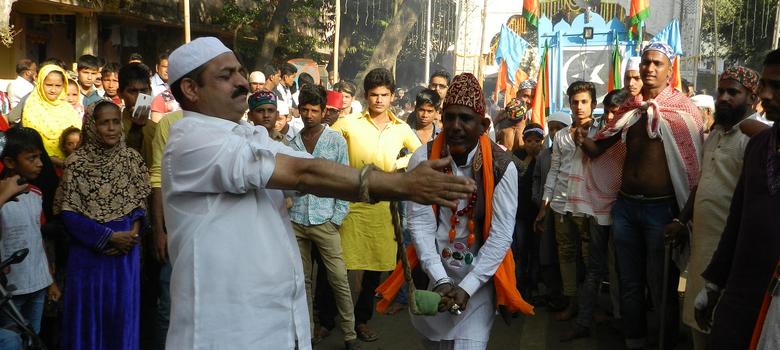
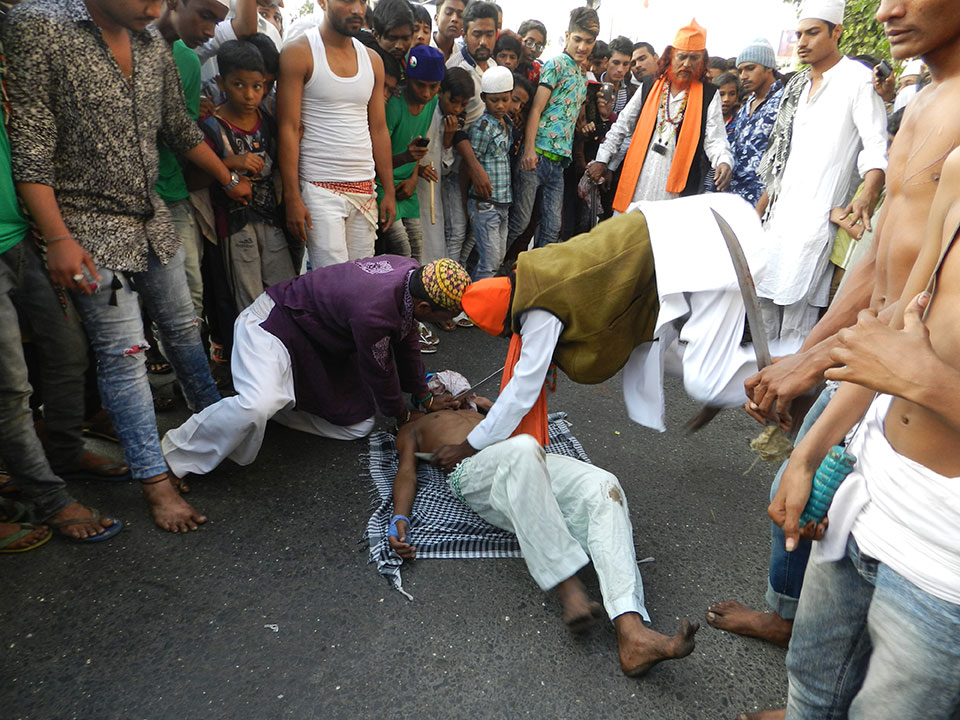
A constable in plain clothes holds his arms out to be whipped.

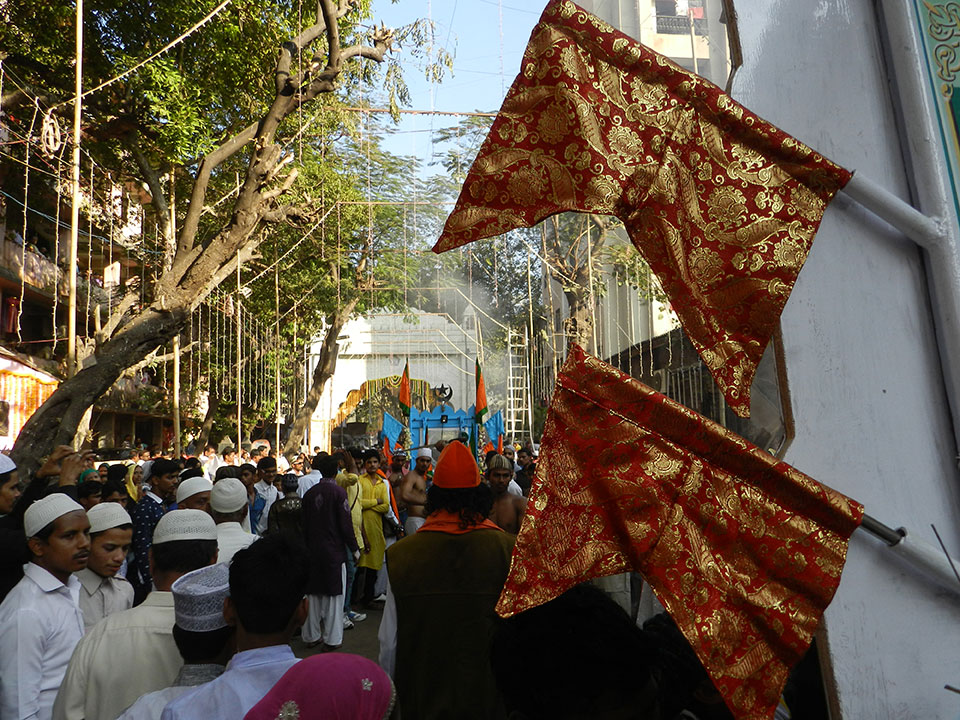
The Mumbai police was out in full force on Friday to mark the first day of the Urs or death anniversary of Makhdum Ali Mahimi, the man to whom the famous Mahim dargah in the central part of the city is dedicated.

Makhdum Ali Mahimi was a 14th-century Sufi scholar remarkable in many ways, but perhaps the most remarkable is that he happens to have been the patron saint of the Mumbai police since its roots as a citizen’s militia in the 17th century.

Once a year on Mahimi’s Urs, thousands from around the city, not least the Mumbai police force, come to pay their respects and seek his blessings. The Mumbai police force has the privilege of laying the first chadar, or decorative tomb covering, of the Urs in Mahimi’s respect.

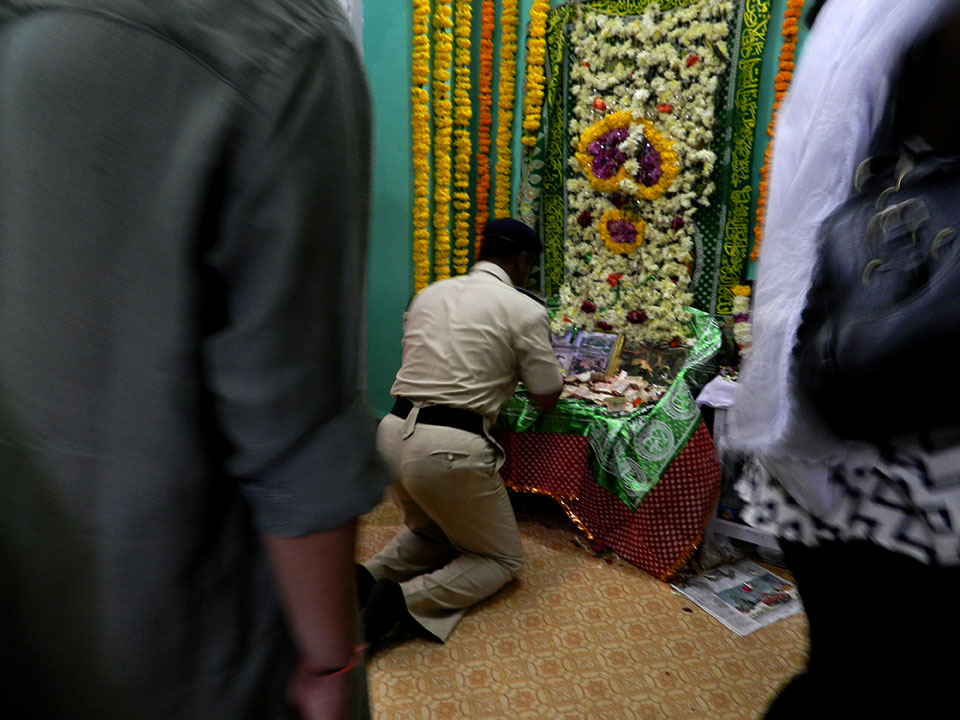
The Mahim police station, about 200 metres away from the dargah, has been built on the site where Mahimi is said to have lived. A green steel cupboard in the Senior Inspector’s room is said to contains the saint’s possessions. During the ten days of the fair held each year to honour Mahimi, the office is thrown open for devotees.

“The full Mumbai police follows Makhdumi Baba,” said Basheer Baba, 55, who is among the dargah officials overseeing the festivities. “Nobody can break that bond. There should be more chances like this of Hindu-Muslim love.”

In the rooom that holds Mahimi's possessions
In the rooom that holds Mahimi’s possessions

An ancient tradition

On hearing that a journalist was in the vicinity, a series of constables in festive plain clothes ushered this reporter in to a small building off the main compound where the retired senior police inspector organising festivities this year, sat with his team of ten constables.

“I was in the papers today,” the inspector said, taking a small, neatly folded rectangle of paper out of his pocket. “See, that’s my name, LB Shaikh.”

Shaikh, as the Times of India said in its three-paragraph note of the procession’s timings, happened to join the police force in 1979 on the very day of Mahimi’s urs. His first posting was at the Mahim police station. This, he said, gave him a special attachment to the holy man.

“He was not a saint – he was our guide,” Shaikh said. “He was a very scholar person, a spiritual and qualified man. Police used to take advice for unsolved cases and he would help us. This is a long tradition of 500 years.”

Makhdum3MPOs30dec2015

Scholar and judge

It is in fact slightly longer than that. Mahimi is thought to have died in 1431, 584 years ago. He was born in 1372 to a family of intellectually inclined Arab immigrants called nawaits. He lived in Mahim his entire life.

Abdus Sattar Dalvi, in a brief history of the Mahim Dargah which is dedicated to Mahimi, writes:

“The figure of Makhdum Ali Mahimi has commanded respect for his unquestioned devotion to his mother, his generosity, his liberal outlook, and his achievements as a Sufi and a scholar.”

As a spiritual and intellectual person, he became a member of an unaffiliated group of Sufis called Uwaysi. He was also renowned for his scholarship, particularly for an early incisive commentary in Arabic on the Quran. Mahimi’s legal excellence, Dalvi notes, was such that Sultan Ahmad Shah of Gujarat made him a qazi for the Muslims of Thana district.

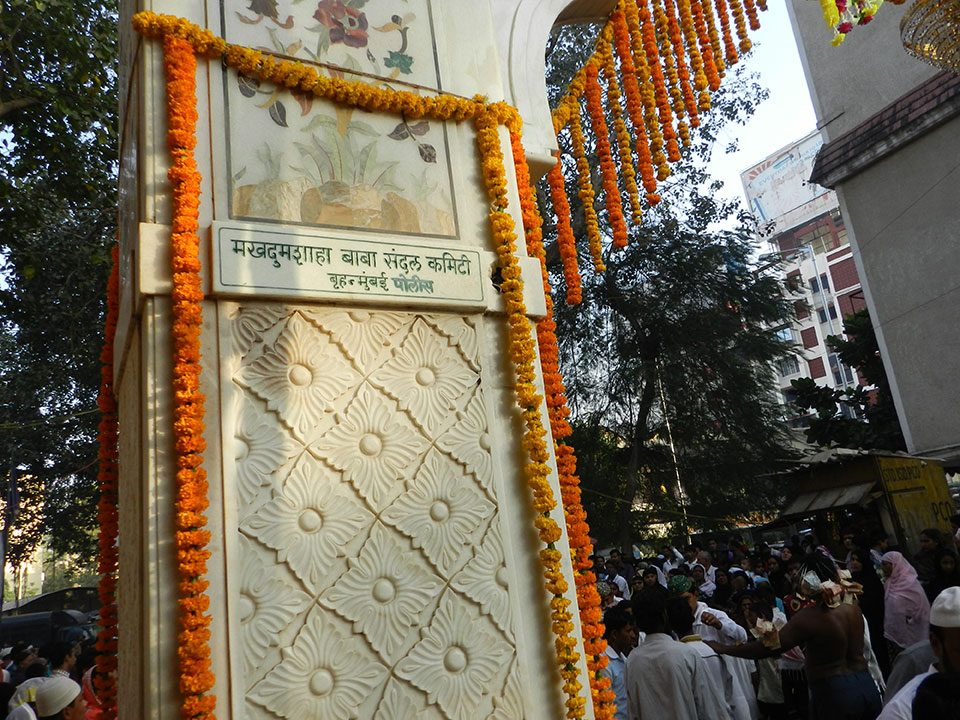
An arch declares the Mumbai police's attachment to Makhdoom Ali Mahimi.
An arch declares the Mumbai police’s attachment to Makhdoom Ali Mahimi.

It was perhaps this appointment that led him to be so closely linked with the Mumbai police. The East India Company formed Bombay’s first militia in 1669, soon after the Portuguese had handed over the group of seven islands to the British in dowry.

The constabulary at that time was drawn largely from conscriptions of land owners, but excluded Brahmins and Banias for a fee. Most of the early recruits were from the Bhandari community of toddy tappers, who were among the original inhabitants of Bombay.

As remained the precedent until Independence, the organising officer of the motley group was a European. It was one of these officers who was said to have worshipped the saint and sought his help for cases.

“A Portuguese sergeant at the time used to worship him and seek his advice a lot,” Shaikh said. “In that way he solved many cases. So at the time of his last illness, he said that after he died, only the police would do Makhdum Shah Baba’s seva.”

Faith runs deep

And so it is today. The Mahim police station was built in 1923 over the site of the saint’s accepted abode. Among the thousands of civilians who lined up on Friday for a chance to seek his blessings, were uniformed members of the police force – traffic police in white, the main force in khaki, and even the red of the police band.

The procession on Friday began, as usual, in the afternoon from the Mahim police station. It ended at the Mahim dargah 200 metres away only at around 11 pm.

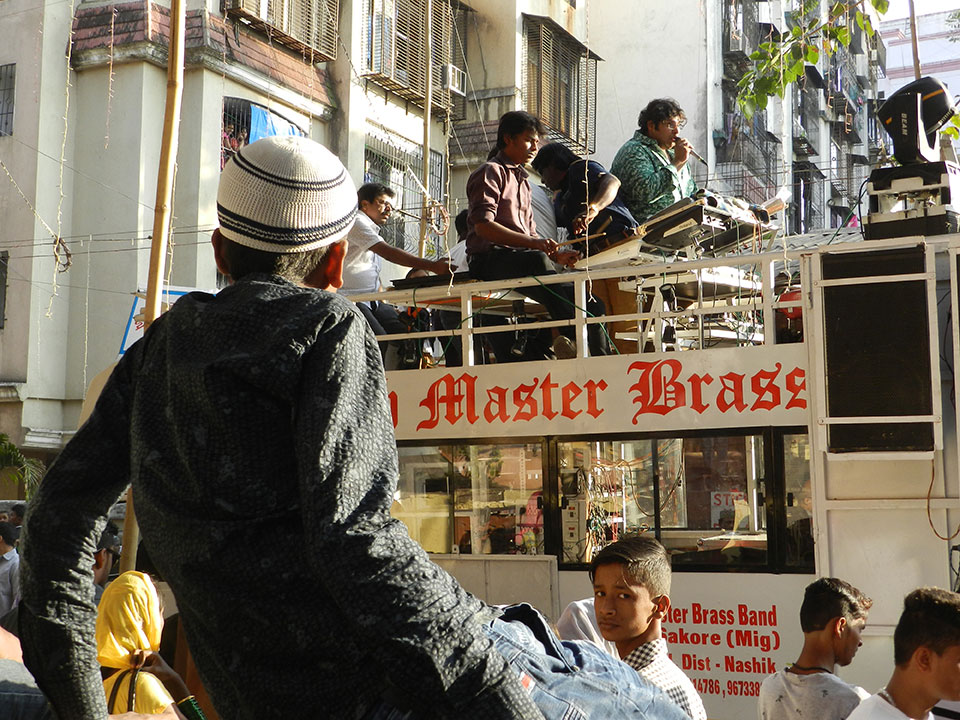
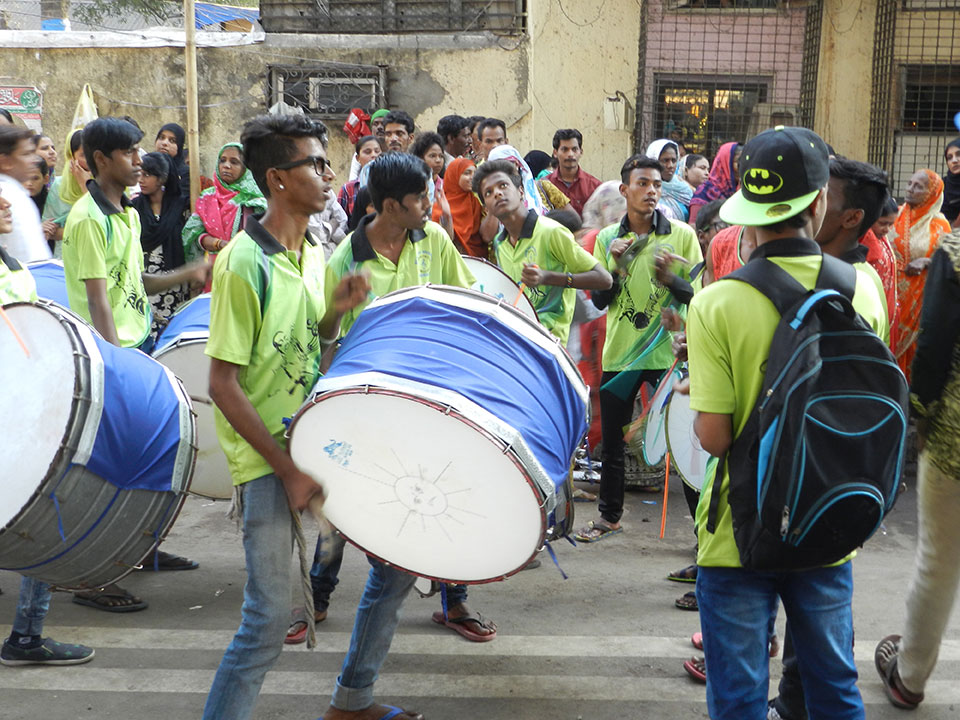
Three vans, all blaring deafening music, marked the procession lines. One, a group called Shaikh Master Brass, had as its star singer a man from Mazgaon whose claim to fame was being one of the qawwali singers in Deewani Mastani from the film Bajirao Mastani.

Makhdum5MPOs30dec2015

A woman dressed in decidedly non-festive clothes and looking as if she were on a mission clutched a decibel meter. When asked which organisation she represented, she wordlessly pointed with an air of doom at its measured 104 decibels and set off once again into the din.

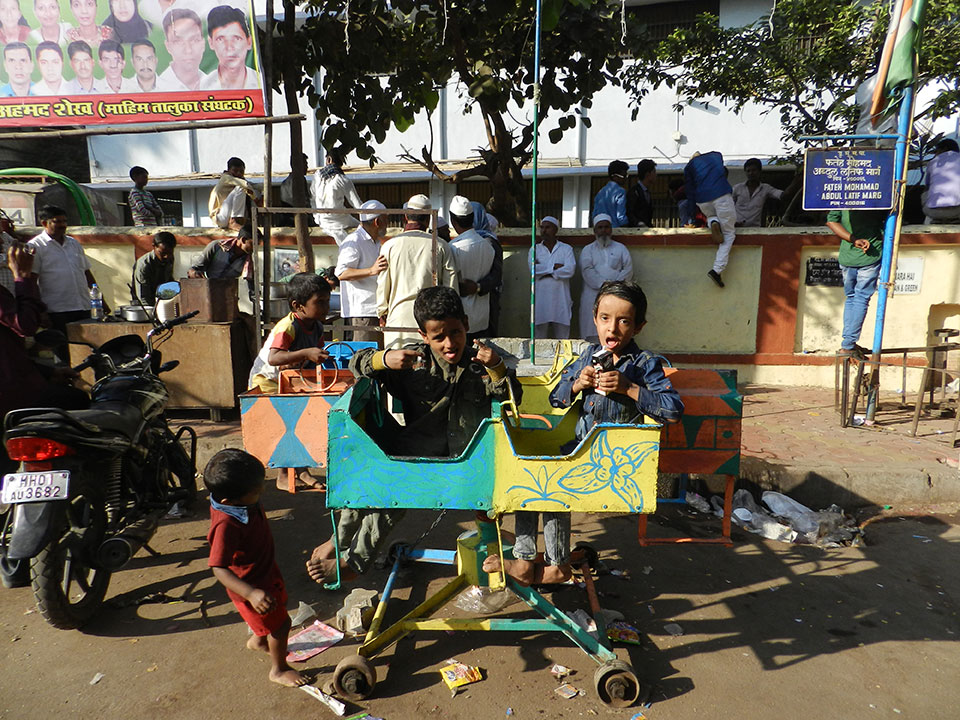
Children and adults alike clambered up to line the boundary walls of residential buildings for a better view as the regular events of an urs proceeded in the centre – devotees swirling incense towards themselves, young men whirling blades to cut their backs, children getting their ears pierced.

Makhdum6MPOs30dec2015


Makhdum7MPOs30dec2015

Sania Qureishi, 8, was a tough customer. When asked what she liked best about the fair, she pursed her lips and said, “I don’t know yet. I will have to wait and see before I can decide.”

A man for Mumbai

Other places in the city also bear Mahimi’s name, notably the colloquially named JJ Flyover that was until a few years ago the longest in Mumbai. In records, it is called the Qutb-e-Kokan Makhdoom Ali Mahimi Flyover.

Nor is he just the saint of the Mumbai police force. Aspiring actor Ramesh Kumar credits his moderate success in films to him.

“I am a Hindu, but I have faith in Baba,” Kumar said. “Hum jaat ko nahi manta, kalakar hai.”

Kumar, or Junior Johny Lever, as he prefers to be known, said that he has been seeing the procession since he was a child growing up in Mahim. Two years ago, he began to perform comedy and anchor small events at the station. He also got a role as extra in two films. This he credits to the intervention of the saint who he began worshipping six years ago.

Said head constable Chandrakant Salve, “See, the way Mount Mary [in Bandra] and Siddhivinayak temple [in Prabhadevi] are both parts of Mumbai, in the same way even Makhdumi Baba is Mumbai’s only. There is no race or religion here – Hindus, Muslims, Christians, they all believe in him. So do I.”

Behind the optics of the grand gesture, though, some problems remain. Muslims form about 1% of the Maharashtra police force, lower than the national average of 4%, according to the National Crime Records Bureau. That’s the kind of structural imbalance offering a chadar to the saint won’t be able to remedy.

Makhdum8MPOs30dec2015

source:  http://www.scroll.in / Scroll.in / Home> Syncretic Tales / by Mridula Chary / Photos by Mridula Chary / December 26th, 2015

Waste picker gives tips to end city’s woes

Bengaluru,  KARNATAKA :

Follow your class 5 moral science lesson on cleanliness, take steps to rein in the garbage mafia and find a solution to sanitary waste -these are not the words of an urban planner but a humble waste picker’s advice to Bengalureans. Mansoor Ahmed, 33, whose hard work fetched him a seat at the Paris climate conference, is back in the city, enlightened and overwhelmed. Still in awe of the French capital, he aims to make Bengaluru the Paris of India.

Mansoor, a waste picker from ward no 198, Jayanagar, collects dry waste from more than 1,000 houses. The passionate worker who spoke about low carbon strategies in the waste sector at the Paris summit has set a threefold agenda for Bengulureans: Keep your surroundings as clean as your house, keep a vigil on the garbage mafia by equipping each ward with cameras and find a way to effectively dispose sanitary waste.

While this is his vision for the city , Mansoor wishes to have a uniform for waste pickers, so that they feel as respectable as any other civic worker. “I have a team of 12 waste collectors and the job we do is exhausting. We show up at people’s doors at 5am and I don’t know how many residents even remember our faces. A uniform will make us feel better about ourselves,” said Mansoor.

The waste picker who doesn’t charge a single paisa for his contribution (he’s not paid by BBMP either) earns a living through his “donate dry waste project”.He collects around 25 tonnes of dry waste in a month and sells it to recycling companies, making enough money for his daily expenses.

“We still don’t have a solution for sanitary waste. We know what to do with dry waste and wet waste but with sanitary waste, we have no option but to burn it.Also, where does all of it go? Even I’m clueless. “I am not educated but still I’m passionate about keeping mine and others’ houses clean. Only if the literate follow what they have been taught in school, their education won’t go waste,” said Mansoor, signing off on a hopeful note.
Needed: A change in attitude

Asked what is the simplest thing he learnt from Paris conference that can be replicated here, Mansoor Ahmed said: “If people’s attitude changes, things will automatically change.When when we go to collect waste, residents are only bothered about the muck getting out of their homes. Whether it lands on the road or in a garbage dump is nobody’s concern. The garbage mafia is our biggest enemy; we should see that after the waste is picked up from a particular ward at 5am, no one uses it as a dumping ground.This can done only if the residents are vigilant and cameras are installed in wards”.

source:  http://www.timesofindia.indiatimes.com / The Times of India / News Home> City> Bangalore / TNN / December 11th, 2015

Testimony to efforts !


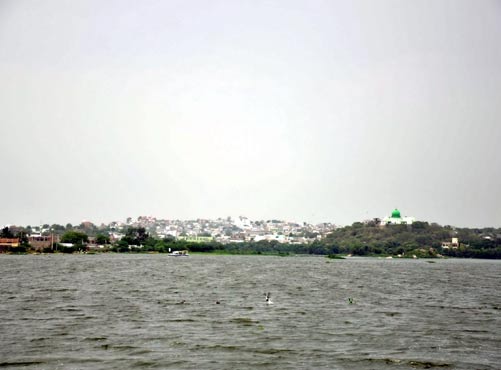
MirAlamTankMPOs30dec2015

Hyderabad , TELANGANA :

Mir Alam Tank is a fresh water tank in Hyderabad, located in the southern part of Musi River. It had been a primary source for drinking water to the city before the construction of Osman Sagar and Himayat Sagar.

The tank was named after Mir Alam Bahadur, the then Prime Minister of Hyderabad during the reign of Asaf Jah III, the third Nizam of Hyderabad State. Mir Alam Bahadur is believed to have laid the foundation for the tank on July 20, 1804 which was then completed in a period of two years and declared open on June 8, 1806. It was from the share of the treasure he got from Srirangapatnam that he built this tank.

It is indeed a treat to watch this engineering marvel that was built by a French engineering company, which comprised of 21 semicircular arches spread across one mile. It was reportedly planned by General Michel Joachim Marie Raymond, popularly known as Monsieur Raymond, the French Military General to whom Hyderabad’s Raymond Tomb has been dedicated and is the founder of Gunfoundry in Hyderabad.

Mir Alam Tank is a testimony to the efforts of Hyderabad’s erstwhile rulers who have used the topography of Deccan plateau to build vast water bodies. The boating facility is popular with tourists where one gets to enjoy the pleasant breeze and a refreshing experience. The cruise facility is available at an affordable price and the tourism department has introduced modern boats as well. During the peak time of Mir Alam Tank’s utilisation, historians say that the water of the tank was so sweet and pure that people carried them in containers to their home towns.

Nehru Zoological Park lies adjacent to this tank and boats are operated on the lake. It is a perfect tourist spot in Hyderabad. One can choose mechanised boats, steering boats or speed boats. With changing time patterns of the day, the lake acquires different hues. Several migratory birds make the precincts their home during different seasons while the dense vegetation of the Nehru Zoological Park at one side offers a tropical feel.

Compiled by Jaya Vellampalli

(This column features strikingly beautiful, yet lesser-known gems of Hyderabad, which have some intriguing tales related to them.)

source:  http://www.metroindia.com / MetroIndia / Home> LifeStyle> Places / by Jaya Vellampalli / December 27th, 2015

City Waste-Picker heads to Paris for COP 21

Mansoor Ahmed (left) transporting garbage

Bengaluru, KARNATAKA :

by: Preethi Ravi

While the Bruhat Bengaluru Mahanagara Palike (BBMP) plans to introduce stringent measures in the city to ensure proper waste segregation by Bengaluru’s citizens, 33-year-old Mansoor Ahmed, waste-picker from the city, will be in Paris for the 2015 United Nations Climate Change Conference, COP (Conference Of Parties) 21, scheduled to be held from November 30 to December 11.

 
His hard work and vision in spreading awareness about waste management among the citizens has led him to Paris to present a talk to participants from across the world.
During his visit to Paris, he will talk about the importance of waste segregation and how he was able to create awareness and convince 75 per cent of his customers to segregate waste at source.

 
Mansoor speaks three languages: Tamil, Hindi and Kannada. He admits he cannot utter a single sentence in English. “English is not a problem as long as my work talks for me. I’m genuine and there is sincerity in my work which will speak for me. Besides, I will have a translator. As part of my talk, I will be narrating my journey from a seven-year old rag-picker to what I’m today,” he says. He has a team of 12 members at the Jayanagar DWCC who manage an inventory of 10-12 tonnes of dry waste every month.

 
Mansoor’s talk will be translated by Kabir Arora, who coordinates Alliance of Indian Waste-pickers (AIW) – an informal network of organisations, cooperatives, and companies working on waste management with the help of waste-pickers. Hasiru Dala, which is a coalition member the AIW and an organisation of waste-pickers and waste workers, is sponsoring Mansoor’s 10-day trip.

 
“The team from Hasiru Dala asked me if I was interested in going to Paris for a conference. I was elated and immediately said yes. My passport and visa had to be made,” says an excited Mansoor. He flew to Delhi from Bengaluru on Monday and will reach Paris later in the day.

 
Mansoor operates the Dry Waste Collection Centre (DWCC) (recyclables and inorganic waste aggregation and sorting unit) in ward 168 of Jayanagar in. He went door-to-door in the area around the centre to encourage residents to segregate their wastes and drop it at the DWCC.

 
The daily collection of the DWCC is about 120 kg from waste-pickers. The DWCC receives one tonne of waste from apartment collection. Mansoor uses a rotating fund of `3,000 to buy wastes from the apartments.

 
He will be part of a joint delegation of Indian Youth Climate Network (IYCN) and Alliance of Indian Waste-pickers (AIW) for COP 21.

 
The IYCN is a network uniting Indian youth and youth-oriented organisations who are concerned about climate change and environment issues. The network works to generate awareness about and establish consensus on what role India should play in the global debate of climate change and how it should address its domestic issues.

 
Mansoor was just a seven-year-old when he began helping his parents collect waste by sorting it. At that time, he used to manage around 500 kg of waste every month.
He attended a small government school near his home but had to drop out of school in Class 5 when his father passed away.

 
He is the oldest among nine siblings (he has six sisters and two brothers), and the burden of responsibility to take care of them brothers and sisters feel upon his young shoulders.
He joined the informal waste sector with his mother to help supplement the family income.

 
They ran a small scrap shop near their home where all the waste-pickers from their slum would bring their daily collection. They would manage around 500 kg of waste every day.
Working with waste has therefore been the only job that Mansoor has known, but it has provided for him and his family. Thanks to the use of technology and people his people-management skills, Mansoor has been able to scale new heights.

 
He says he is eager to learn the concepts of solid waste management followed in Paris and will find ways to implement it at his centre too.

 
From the conference, he wants the countries to pursue the agenda of recycling (Waste to energy) in their climate action commitments as opposed to incineration of waste — which is currently being proposed as a climate solution by many governments. Incineration is being perceived as a threat to Mansoor’s and many other green entrepreneurs’ livelihood.
For his visit, he was asked to buy a pair of thermal wear as Paris would be freezing at this point of time. “I didn’t know that we could find thermal wear here. I was asked to buy them; but one pair costs `2,000. But it’s going to keep me warm when I land there. I have already purchased my formal wear two months ago. I am too excited about my trip. It all feels surreal,” he says.

 
With his contagious smile he has been easily able to build excellent relationships with his customers to whom he provides waste collection services. The last few days he has been flooded with congratulatory messages from them for this prestigious trip.

 
Today, with the Paris trip materialising, he feels his hard work has paid off although he claims never to have imagined that he would be able to visit a foreign country. “This is my first visit to a foreign country…and in an airplane. I’m feeling ecstatic and proud. Never in my life had I imagined that I would get such an opportunity. This would not be possible if it were not for the people who supported me throughout my life. I really want to thank my well-wishers, friends and relatives,” says Mansoor, who has three children: two boys and a girl.

 
He has enrolled his children in Oxford School in JP Nagar. And his aim now: To give his children a solid education … and the freedom to follow their dreams.

source: http://www.bangaloremirror.com / Bangalore Mirror / Home> Bangalore> Civiv / Bangalore Mirror Bureau / November 30th, 2015

MEMOIR – Of places called home

East African Asian society was complex and contradictory as any truly multicultural society needs to be, and perhaps as only Indians can make it

Toronto,  CANADA  :

It is amusing to contemplate that if an Indian man, one afternoon in March 1498, had been able to swim, he would have escaped capture by Vasco da Gama off the Mozambique coast, and the world might have been different. The Indian, whose companions had managed to swim away, was called “Davane” by his captors; he was from the Gujarati city of Khambat (Cambay). Davane gave advice to da Gama on local matters and even assisted him in outwitting the local sultan, so that the Portuguese ships eventually anchored safely in Malindi, up north in present-day Kenya. Here he took a pilot, who was possibly a Gujarati, and reached the Malabar coast.

Portuguese sailors plying the Indian Ocean thereafter often wrote about the presence of Indians and Indian ships in Kilwa, Mombasa, and Malindi. Around 1500, Captain Duarte Barbosa observed, “These ships of Cambay are so many and so large, and with so much merchandise, that it is terrible to think of so great an expenditure of cotton stuffs as they bring.” The trading connection between India and East Africa is actually even older, as the carving of a giraffe on a wall of the Konark sun temple indicates.

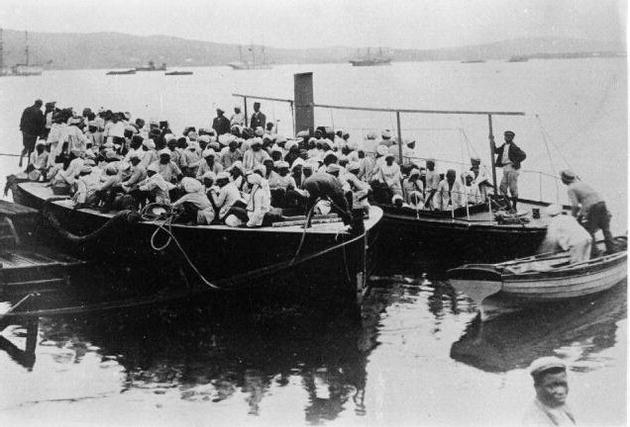
The arrival of Indians in South Africa by boat. / The Hindu Archives

It was in the nineteenth century, however, that Indians began arriving in numbers to trade and settle in Zanzibar, which was by then a major metropolis in the Indian Ocean with international connections, and home to the ruling Omani sultans. The more enterprising men ventured off to the small towns dotting the mainland coast. Most Indians arrived penniless from their drought-prone villages in Kathiawad and Kutch, and remained modest traders, but a few of them went on to become veritable merchant princes with spectacular wealth. Among them were Jairam Sewji, Ladha Damji, and Tharia Topan, to whose firms the sultans farmed out their customs collection and to whom they were often in debt.

Generation of tycoons

With the advent of British and German colonialism in the early twentieth century, Zanzibar’s commercial power and political influence waned, while the interior of East Africa opened up with new infrastructure and increasing trade. As a result, the Indians spread out all over the mainland, which now consisted of the three colonies of Kenya, Uganda, and Tanganyika. (In 1964 Tanganyika and Zanzibar joined to form Tanzania. The Indians went on to be called “Asians”.) The new generation of tycoons included Sewa Haji Paroo, whose caravans went from Bagamoyo (near Dar es Salaam) all the way north to the Kilimanjaro region. His apprentice, Allidina Visram, topped him to become “the uncrowned king of Mombasa,” supplying the dukas (shops) that had sprung up from Mombasa to Uganda, and further in eastern Congo and southern Sudan. In 1890 A.M. Jeevanjee, a Bohra from Karachi, arrived in Mombasa and made his fortune supplying goods (and workers) to the Uganda Railway. Much of early wood-and-iron Nairobi was constructed by his firm; the city’s Jeevanjee Gardens was his donation.

By the mid-twentieth century every small town in East Africa had the characteristic Indian strip of shops, and in even the smallest village you would find an Indian family branch running the solitary Indian shop. The Asian population totalled 366,000, with the highest number, 176,000, in Kenya with its total population of around 9 million. Unlike elsewhere, Indians had settled in East Africa as communities; there were Bhatias and Khojas, Jains, Shahs, Patels, Lohanas, Sikhs, Bohras, Memons, Kumbhads, and others. In the cities, the larger communities like the Khojas had their own primary and secondary schools for girls and boys, hospitals, dispensaries, and community halls. Dar es Salaam, with roughly 100,000 people at the end of the 1950s, had at least five Asian cricket teams. Abject poverty was rare, and even the most straitened household could afford three simple meals a day. For us growing up in East Africa, it was India that was poor and backward, as revealed to us in the newsreels and Indian films of the period.

Complex and multicultural

East African Asian society was complex and contradictory as any truly multicultural society needs to be (and perhaps as only Indians can make it). Asians tended to live close to their own communities; caste discrimination persisted, as did Muslims sectarian differences. Yet by the standards we see today in the world, East Africans were largely tolerant. It was understood that you did your thing. The azaan would go off in the mosques, the Khoja ginans would blare out over loudspeakers from their jamat khanas, a temple procession would block a road, the Diwali fatakdas would explode in the Hindu sections (and elsewhere). There was hardly any inter-communal violence, and nothing to compare remotely with the communal and caste slaughter that seems so routine in India.

Undoubtedly the Asians were racist — looking up to the “Europeans” and down on the Africans, by whom, as middlemen, they were often resented. Intermarriage between communities and races was a taboo that was just beginning to yield as I emerged from my teen years. Because the poorest people were among the Africans, it has been broadly claimed and often in Shylockian language that Asians were their exploiters. Asian liberals like to wallow in self-guilt. I have often retorted that my widowed mother worked from eight in the morning to ten at night, running her small shop, barely making ends meet while raising five children; whom did she exploit? Today many Tanzanian African women run small businesses similar to my mother’s. We often forget the wealthy and sophisticated African peoples who owned land and cattle; and while many Africans had homes in their villages, most Asians in Africa did not. If Asians did not marry Africans, the Africans, with ancient traditions of their own, had their own taboos; to imply that they panted to lay hands on Asian women is itself racist.

TransitionMPOs27dec2015

At the end of the 1960s

Be that as it may, around East Africa’s independence, in the early 1960s, there was a thriving community of Asians who saw themselves as Africans. In Tanzania most would speak two Indian languages plus Swahili and English. Among the elite there was excited talk of the “new African Asian” identity. There were Asian politicians and budding writers — Wole Soyinka’s Poems of Black Africa (1975) includes, significantly, three young Asian poets from Kenya; Africa’s most influential and exciting literary magazine of the 1960s, Transition, was founded and edited by Rajat Neogy of Kampala; and Amir Jamal, Tanzania’s beloved minister of finance for many years, was elected in African constituencies. At the end of the 1960s, there was no doubt in my generation that Africa was our home and we were in the vanguard.

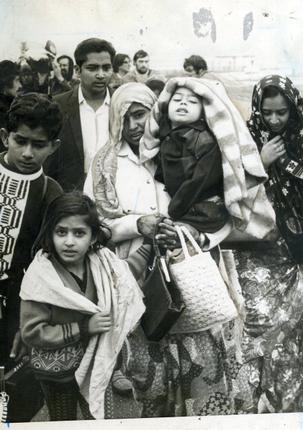
The first set of Ugandan refugees to arrive at Stansted Airport near London after then Ugandan President Idi Amin ordered them on September 18, 1972 to leave the country. / The Hindu Archives

And yet in the 1970s it all fell apart. Kenya’s Asians who had not renounced their British citizenships in time had to leave en masse. In Uganda, Idi Amin had a dream and expelled all the Asians in another “Asian exodus”. In Tanzania, in spite of Nyerere’s enlightened policies, his socialism, combined with the Idi Amin scare, drove out many Asians. What remains of the Asians today is a somewhat insecure and aggrieved population, though most appear dedicated to where they live. Racism of the old sort is gone; intermarriages do happen. At crowded kabab and bhajia restaurants in Dar es Salaam, it is truly pleasing to see Indians and Africans squeezed together at the tables. Indian cuisine has made a big headway especially in Tanzania; country bus stops often have a stand making chapatis; “pilau,” “biriyani” and “sambusa” are Swahili words. What thwarts complete integration is the Asians’ distinct features and cultures, often reinforced by their religious traditions.

A new crop of young Indians has started to arrive. When I see them, they seem foreign and lost. At times I get xenophobic — what are they doing here? do they even speak the language? — when I myself am now Canadian, but also an African Asian.

(M.G. Vassanji is the author of A Place Within: Rediscovering India, and most recently, of And Home Was Kariakoo: A Memoir of East Africa. He lives in Toronto. www.mgvassanji.com)

source:  http://www.thehindu.com / The Hindu / Home> Opinion / by M. G. Vassanji / December 27th, 2015

Tipu’s feared rockets fly into oblivion

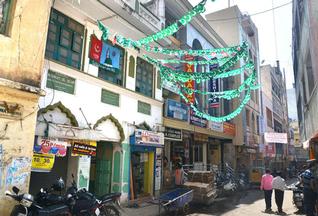
The Sangeen Jame Masjid at Taramandalpet in Bengaluru.— Photo: Bhagya Prakash k
Bengaluru, KARNATAKA :
In the congested old market area of the city, where vehicles and pedestrians jostle for space on narrow lanes, lies a tale of Tipu Sultan’s ingenuity that time seems to have forgotten.

It is in this small clearing, now flanked by a sprawling masjid, that thousands of workers had gathered nearly 300 years ago to cut metal, roll gunpowder into barrels and attach sharp metallic pieces to make the once-feared ‘Bangalore Rockets’.

All that remains now of this ingenious machinery that sustained Tipu Sultan through four wars against the British is the name assumed by the few buildings in the area — Taramandalpet , or roughly, the market of the constellation of stars, a name that refers to the pattern of mid-air explosions of these rockets that then rained shrapnel on an unsuspecting enemy.

Residents — primarily shopkeepers and staff of the masjid and madrassa — seem unaware of the place’s rich history that once fuelled Indian rocketry.

“Workers would prepare these rockets that proved very effective against the British. This would then be transported to the armoury at K.R. Market, which still exists,” says Suresh Moona, a historian.

The entire street was a sort of military laboratory, a fact seen in the unearthing of two cannons during the metro construction work between 2012 and 2015.

Much of these signs, however, have disappeared. Activists point out this irony: while the government announced celebrations of the Mysuru King’s birth anniversary — which ended in violent protests — recently, symbols of the Sultan in Bengaluru and even his birthplace near the swanky International Airport on the outskirts continue to fade away.

Syed Shafiullah, vice-president of the Tipu Sultan Publicity Committee, says: “One armoury that we saw is now just piles of thrash and shops. It is a shame that all of it is going. We have been persuading the government to preserve these areas, or at least, to highlight it. It should be a pride that the technology of the British army came from Karnataka,” he says.

source:  http://www.thehindu.com / The Hindu / Home> National / by Staff Reporter / Bengaluru – December 27th, 2015