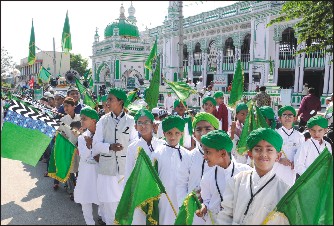
The Central Meelad Committee celebrated Jashn-e-Meelad Un Nabi, the birthday of Prophet Mohamed on Thursday at Meelad Bagh on Ashoka Road here.
Sir Khazi of Mysore Hazrath Moulana Mohamed Usman Shariff presided.
Hazrath Moulana Syed Shahabuddin Nadvi, Mohtamim, Jamia Hazrath Khaki Shah, Hazrath Moulana Mohamed Zaka Ulla Siddiqi, President, All India Milli Council Mysore District Unit, Saleem Pasha, Senior Lecturer, DIET, Chikmagluru, Hazrath Moulana Mufthi Salman Ahmed Rishadi & Nadvi, Vice President, Darul Uloo Siddiqia, Hazrath Moulana Hakim Ziauddin Madni, Ambur, Tamil Nadu, spoke on the life of Prophet Mohamed.
MLA Tanveer Sait, who is also the President of Central Meelad Committee, Ariff A. Mehkri, Chairman, Mysore District Wakf Advisory Committee, former Corporator Shivanna and others were present.Abdul Azeez Chand, Secretary, Darul Uloom Siddiqia. welcomed. S.Moinuddin Pasha proposed vote of thanks.
On the occasion, Tanveer Sait felicitated Social Worker Khaleel ur Rahman for supervising the gardening work and maintainance of Meelad Bagh.
Later, a procession of tableux depicting Kabathulla of Makkah, Gumbad-e-Khizra of Madeena and other famous Masjids was taken out from Meelad Bagh to Dr. Zakir Hussain Circle.
Traffic was diverted for sometime on the procession route. Heavy Police bandobast was provided around Meelad Bagh during the celebrations. The function concluded with Fatheha and Dua by Sir Khazi of Mysore.
source: http://www.starofmysore.com / Star of Mysore / Home> General News / Friday – December 25th, 2015
Eminent writer H S Venkatesha Murthy is among eight achievers selected by Sandesha Foundation for Culture and Education, Mangaluru to receive the Sandesha Awards 2016.
The foundation for the past 24 years has been honouring personalities who have made significant contribution to Kannada, Konkani and Tulu literature, art and culture and in these years has honoured 223 persons, institutions with the award in 10 different categories.
Announcing the awards here, writer Na D’Souza, president of the Sandesha Awards jury said the jury only went by the merit of the names placed before it and did not receive any applications in this regard. The jury comprised on Na Damodhar Shetty, Sara Abubakkar, Chandrakala Nandavar, Eric Ozario and Richard Louis. The awards that consists of Rs 10,000 cash, citation and memento will be presented at an awards ceremony to be held at Sandesha on January 16, 2016.
While Venkatesha Murthy has been selected for Sandesha literature award, Gladys Rego has been selected for Sandesha Konkani literature award, actor-dramatist Devdas Kapikad for Sandesha Tulu literature award, Sugantha Sathiaraj for Sandesha best teacher award, Ustad Rafique Khan from Sandesha Art award, Alexander Joel Pereira for Sandesha Konkani music award, Thomas D’Souza for Sandesha media award and G S Jayadeva for Sandesha music award.
EOM/December 14, 2015
source: http://www.timesofindia.indiatimes.com / The Times of India / News Home> City> Mangaluru / by Jaideep Shenoy, TNN / December 14th, 2015
In an obscure bylane abutting the glitzy Commercial Street, Riyaz Pasha is engrossed in some intricate work. He’s giving the finishing touches to an embroidered orange-magenta dress. Ask him who it is for and pat comes a reply. “For Lord Krishna and Radha,” he says before getting back to fine-tuning the chamkis (golden beads) on the skirt.
For 15 years, Pasha, 48, has been the official embroidery designer for Iskcon, Bengaluru. “Everyone has the right to serve god. I enjoy doing this work for the temple,” he told TOI during his first visit to Iskcon on Thursday.
“When we approached him to do the embroidery, he didn’t think twice. And he has no inhibitions talking about our requirements. We have been working in perfect synchronization for 15 years now. We provide the dress material to him and he does the embroidery and other work,” said Bhaktilata Devi Dasi and Chameri Devi Dasi, dress designers at Iskcon.
So far, Riyaz has designed more than 105 dresses for Radha, Krishna, and Balaram. “It takes me two to three days to get one piece ready. Sometimes, it may even stretch to a week,” he said. When asked if his family or community had any reservation to the job, he said: “This is a business for us. All my family members and community leaders understand that and have no problem. No one has opposed what I do. I keep religion out of my work and treat every assignment equally. I will do this work for the Krishna temple all my life”.
Everyday, the attire is changed twice at the temple. “The whole idea of making the deities wear embroidered Kancheevaram sarees is to make them look brighter, even from a distance,” said Bhaktilata.
Not just in Bengaluru but in Vrindavan (Lord Krishna’s birthplace) too, it is a Muslim who designs dresses for the deities. As Vasudev Keshav Dasa, Iskcon vice-president (deities), puts it: “At Iskcon, we do not discriminate based on religion.”
source: http://www.timesofindia.indiatimes.com / The Times of India / News Home> City> Bengaluru / by Seetha Lakshmi, TNN / December 15th, 2015
Solapur (Maharashtra): In an attempt to highlight the great work that Muslims have done in the field of science, an Assistant Teacher of Urdu High School has written a book called‘Muslim Scienedano ki Scienci Khidmat’.
The 92-page book of Junaid A. Qayyum Shaikh, 37, an Assistant Teacher at Social Urdu High School and Junior College of Science, Solapur, was launched by Prof. Dr. N N Maldar, Vice Chancelor of Solapur University.
Shaikh, who has completed Masters in Science (MSc) and Bachelor of Education (B Ed) wrote this book in Urdu. In order to reach out to more readers, he plans to translate it into other languages. He says he has received several requests for translation of the book into other languages and many are ready to even offer help.
The author used many sources in compiling the present book. Shaikh claims “Book of Knowledge by Al Jazari” an Arabic book in original that was translated by Hill and Donald in English is one of the main source for his work.
He also referred : ‘Invention in the medieval Islamic World’ by Rotlink, ‘Introduction to Historyof Science’ by Sarton and George, ’The Muslim Scientist’ by Muhammad Yasin Owadally, Article on Muslim Scientist by Altaf Hussain Memon Tahari, Muslim Sciencedan by M A Siddiqui & Fayeza Siddique, Musalmano ke Scienci Karname by Muhammad Zakriya Virk and Biography- W Hazmy,Zainurashid Z, Hussain R.
The book presents brief information of Muslim scientists’ contribution in the fields of Mechanical Technology, Transport technology, Gun powder technology, Physics, Chemistry, Botany, Zoology, Optics, etc.
Speaking with TwoCircles.net, Shaikh said, “Today most of us presume that the progress of science and technology is the contribution of Europe and American scientists only. In fact it is our lack of knowledge. The truth is that hundreds of Muslim Scientists have many inventions to their names in the field of science for centuries.”
“I felt that the newer generation is going far from the scientific history of Muslims and therefore thought that they must be reminded of contributions of Muslim Scientists so as to make it guideline and torchbearer for others who are interested in science and technology”, he said while replying to the question of trigger for him to write such book.
“This book is especially written for young Muslims, whose way of thinking is scientific and who are intersected in the research and findings related to science so that they can be motivated”, he added.
source: http://www.twocircles.net / TwoCircles.net / Home / by A. Mirsab / December 13th, 2015
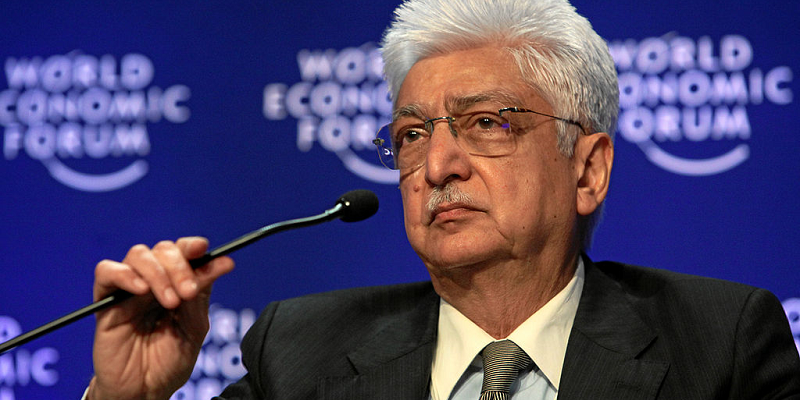
Is there such a thing as the art of giving? Apparently there is. Ask Mark Zuckerberg, who recently pledged 99 percent of his wealth to charity during his lifetime, or Warren Buffett, the guru of philanthropy, or Bill Gates. And closer home, Azim Premji, and maybe a handful of other corporate leaders.
Azim Premji believes charity begins at home.
Philanthropy is suddenly attracting a lot of attention. Though traditionally Indians have always donated to charity in their own little ways, it is usually the big billion dollar charities that get talked about. And who better to demystify philanthropy than Azim Premji who started his philanthropic initiatives systematically in 1999 when he set up the Azim Premji Foundation. He donated 40 percent of his shares of Wipro to not-for-profit philanthropic trust which forms the corpus of Rs 52 thousand crores or $8.5 billion. In the last two years, he has been leading an informal effort with like-minded peers to promote philanthropy.
Premji feels there are two reasons why wealthy Indians don’t give as much as Americans. “One is their families are much larger in terms of wealth sharing. Two, a majority of Indians who are wealthy believe that they must leave their entire money as an inheritance to their children.”
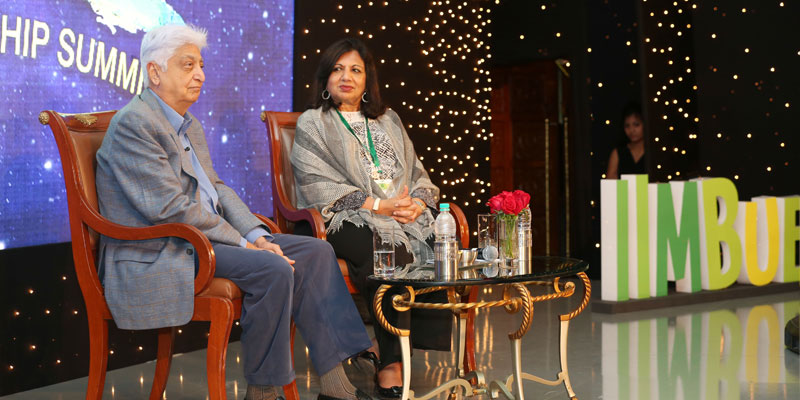
At the first IIM Bangalore Alumni meet, IIMBUE, in Bengaluru on Saturday, Kiran Mazumdar Shaw said if she had to write Premji’s biography, she would call it, ‘Giving it all.’
Here are the excerpts from the engaging fireside chat between Kiran Mazumdar Shaw and Azim Premji.
Azim Premji and Kiran Majumdar Shaw during the fireside chat at IIMBUE.
Kiran Mazumdar Shaw: What is it that influenced you to be so philanthropic? Was it something that was influenced from childhood?
Azim Premji: My greatest influence that encouraged me to go towards philanthropy was my mother. She was a doctor but never practiced medicine. She founded a children’s orthopedic hospital in Bombay (now Mumbai) for polio-stricken children, and children with cerebral palsy. She worked as the chairperson of that hospital from the age of 27 to almost 77. She devoted her whole life to raising money to run this hospital because the hospital depended on government grants which never came on time.
KMS: You have always been someone who has been careful with money. Someone who has avoided staying at five-star hotels and driving expensive cars. In fact, you are known to shun all status symbols. Was there an inflection point in your life that made you take to philanthropy in such a big way?
AP: The reason I give it (money) away is because it is the right thing to do. There is so much poverty, and misappropriation of funds and so many people are majorly disadvantaged.
KMS: There is a great saying that wealth and knowledge must be shared. It is about how we invest in society. How do you send this message to society and ingrain it in people?
AP: My biggest regret is I started too late. It was 14, 15 years back that I started in a small way in education in government schools in villages of India. We’ve really begun to scale in these past four years primarily because we saw such a strong need to uplift the quality of education in government schools. The reality is we started small and we started much later.
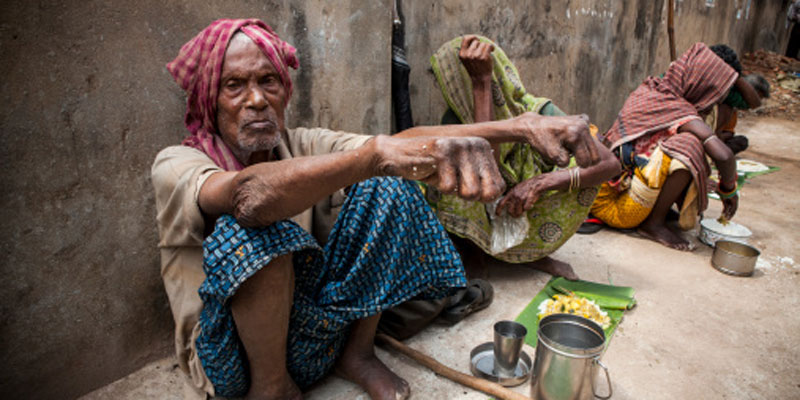
In a country like India, sharing your wealth with the unfortunate goes a long way. (Image credit: Getty Images)
KMS: I would like to take you to another part of your philanthropy which is the philanthropic initiative you have started with Bill Gates. And I must say I’m highly impressed by the time you devote to sensitising others in the corporate world about the concept of giving. Why do you think people need to be told and more importantly, why do you think people are so self-consumed and selfish about their wealth?
AP: (a moment’s silence) I think those are very loaded statements (laughter from the audience). You know I don’t think people need to be told. Most people know what their social responsibilities are. The reason I think the wealthy Indians don’t give as much as Americans — in fact, Americans are actually leaders in this – one is their families are much larger in terms of wealth sharing. Two, a majority of Indians who are wealthy believe that they must leave their entire money as an inheritance to their children.That acts as a deterrent. It is more prevalent in certain parts of India than in other parts of India. I think the more generous part of India is South India.
KMS: We are here with the present and future generation of wealth generators. How do you get the message across that they need to give some of their wealth to philanthropy?
AP: I think the present generation of the wealthy and the semi-wealthy demonstrate much more generosity. They either contribute time, effort, or money to philanthropy. So far the older generation is concerned one has to give examples to them. Keep on persuading them and hopefully, we’ll make a breakthrough. Actually, the people you’ve got to convince are the wives (laughter from the audience). Wives are socially more sensible and have more time at their disposal to lead initiatives of philanthropy. The husbands are much too busy making money (loud cheering and laughter from the audience).
Volunteering one’s time and effort to social causes are a good start towards philanthropy. (Image credit: Getty Images)
KMS: I think this is a great testimony to women and wives. You are here at the leadership summit of IIMB…so talking about giving back to alma mater. Is it important to give back to alma mater? Of course, it is a ridiculous question to ask because it is indefensible as an argument. But should one feel guilty about not giving back to the alma mater?
AP: No. I have not given back to my alma mater (loud cheer from the audience). I think the priority of our society far outweighs those of our alma mater. I think it is a matter of individual priority. But most wonderful universities of the world are significantly financed by their alumni.
KMS: But I am sure if your school or college reached out to you for help, you will not say no.
AP: They reach out to me all the time (laughter from audience).
KMS: So why do you say no?
AP: I just want to prioritise my funds to things which are more relevant to our country (applause from the audience).
KMS: I don’t like the applause that you got, Azim (laughter from the audience). Because I do believe that this has to become a part of our giving back to our alma mater. Because I believe that institutions are responsible for making us who we are today (cheer and applause from the audience).
AP: You got a louder applause (laughter from the audience).
KMS: I hope they mean it. Another question I wanted to ask you is when one looks at global business leaders, one associates philanthropy with entrepreneurial wealth whether it is Bill Gates, Elon Musk, Warren Buffet, or Mark Zuckerberg. Yet one sees a lot of other wealth creators in the corporate world like people in banks and hedge funds with huge salaries and stock options, isn’t that wealth creation as well, and shouldn’t they also be philanthropic? Because you don’t hear about that kind of philanthropy being articulated…the salaried class and employees. How do you create that kind of culture?
AP: I don’t know whether they are giving or not giving. I would be hesitant to make a harsh judgment. It just doesn’t get attention or get publicity.
(Image credit: Getty Images)
KMS: I think it is extremely important for media to cover stories of philanthropy from the salaried people.
Talking about philanthropic philosophy, how can businesses institutionalize it? Can we actually introduce a course on philanthropy in business schools?
AP: Oh! yes…and they can make you a professor (laughter from the audience). This kind of a course can generate a spark…
(After the Fireside Chat, Kiran Mazumdar Shaw opened it up to the audience to ask Azim Premji questions. Here are some excerpts.)
To a question on challenges he faced while giving away his money, Premji said, “The biggest challenge we faced is the size of the problem, the scope of the problem, and the depth of the problem. There was a high sense of frustration. However large an organization setup you are there is frustration that you do not have the bandwidth. We do rely on government machinery in what we do, and you have to keep at it, and keep at it.”
Interestingly, to a question on why he is not in politics, Premji replied, “Because it will kill me in a couple of years. I think you need to cultivate a sense of insensitivity to be in politics.”
But the session ended with the most profound thought from him which was an answer to a question on how does one decide when one should start giving.
“We had a meeting of our philanthropic initiative last week, and one of the panel members, whose family has been active in philanthropy, was telling us that as kids whenever they got money as gifts, they were required to give 25 percent of that to charity. And this was inculcated since he was two years old. That’s how you cultivate philanthropy.”
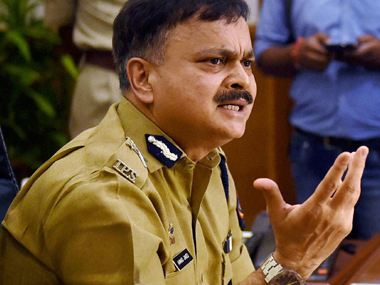
Mumbai Police Commissioner Ahmed Javed has been appointed Ambassador to Saudi Arabia, which has a 2.8 million-strong Indian community.
The Ministry of External Affairs said Javed is expected to take up his assignment shortly.
Ahmed Javed. PTI
The post of Ambassador in Indian Embassy in Riyadh has been lying vacant since April.
Relations between India and Saudi Arabia witnessed some strain after a Saudi diplomat was charged with confinement and rape of two Nepalese women in September. The diplomat later left India.
From trading point of view, Saudi Arabia is a crucial country for India.
The import of crude oil by India forms a major component of bilateral trade with the Gulf nation which is India’s largest supplier of crude oil.
The Indian community in Saudi Arabia is the largest expatriate community in the Kingdom.
IPS officer Julio Ribeiro, who was Mumbai’s police commissioner from 1982 to 1985, also served as Indian Ambassador to Romania.
PTI
source: http://www.firstpost.com / FirstPost.com / Home> F.India> Latest News> India News / December 11th, 2015
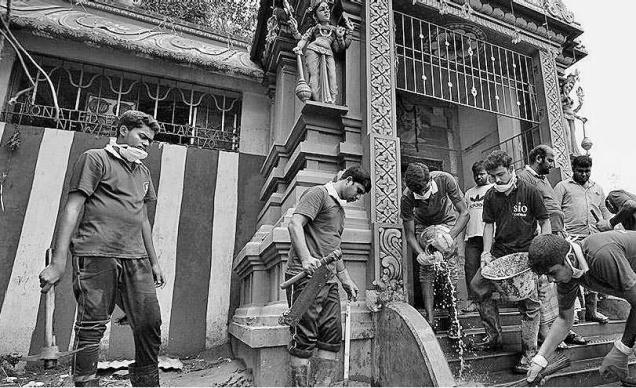
Members of the Jammat E Islami Hind clean a temple at Kotturpuram— Photo: Shaju John
Among the heart-warming stories to have emerged from the Chennai floods is a cleaning drive undertaken by a Muslim organisation.
Around 50 members of Jammat E Islami Hind, a non-governmental organisation (NGO), have been quietly cleaning mosques as well as temples in the flood-hit areas of the city.
In the last two days, they meticulously cleaned two temples, in Kotturpuram and Saidapet. “We find Hindus are unable to worship at temples in some areas because they have been severely affected owing to floods. So, we cleaned the mosques and temples and the streets badly damaged in the two areas. In the coming week, we will do similar work in other areas of the city,” Peer Mohammed, postgraduate in engineering and a student wing secretary (social service) of Jammat E Islami Hind, said. “Throughout the process, people there helped us and were very happy that the cleaning was done,” he added.
Jalaludeen, secretary of the group, said they took utmost care while cleaning the temples in both areas.
Amir Mahal, the official residence of Mohammed Abdul Ali, the prince of Arcot, had become a warehouse of sorts with relief material pouring in.
Mr. Ali commended the people of Chennai for coming together irrespective of caste, creed or religion to serve flood victims.
source: http://www.thehindu.com / The Hindu / Home> News> Cities> Chennai / by Sunitha Sekar / Chennai – December 09th, 2015
Bollywood superstar and Kolkata Knight Riders co-owner Shah Rukh Khan has donated Rs. one crore for the victims of Chennai flood.
According to sources, Shah Rukh, who will be seen with Kajol in his upcoming filmDilwale, has contributed the sum to the Chief Minister’s Public Relief Fund.
The 50-year-old “Chennai Express” star has written a letter to Jayalalithaa, Chief Minister of Tamil Nadu, according to sources.
In the wake of Chennai floods, many Indian actors such as Rana Daggubati ofBahubali fame, and sports persons such as Saina Nehwal and Dipika Pallikal, have come forward to help the flood victims.
About 280 people have died so far across Tamil Nadu since torrential rains on December 1 submerged tracts of Chennai and caused havoc and devastation.
source: http://www.thehindu.com / The Hindu / Home> National> Tamil Nadu / PTI / New Delhi – December 07th, 2015
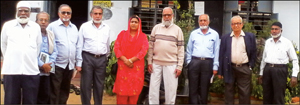
Seen in the picture are (from left) Syed Rafiulla Hussaini, Gowher Tarikervi, Viqar Ahmed Siddiqi, Baqar Umar Khan, Dr. Fouzia Choudhry, Shamim Ahmed, Nyamathulla Khan, Capt. Mir Afzal Hussain and Anwer Pasha.
Mysuru :
Dr. Fouzia Choudhry, Chairperson, Karnataka Urdu Academy, Bengaluru, visited MEWA Educational and Vocational Training Centre at Shantinagar on Nov. 30 and interacted with the trainees of tailoring, fashion designing, computer, Urdu course and students who have taken SSLC Exam as private candidates.
She advised them to work hard and achieve their goals ignoring the hurdles which come across.
She was received by the organisation President Viqar Ahmed Siddiqi, Secretary Shamim Ahmed, Vice-President Capt. Mir Afzal Hussain, Anwer Pasha, Baqar Umar Khan, Syed Rafiulla Hussaini, Gowher Tariikervi, and Nyamathulla Khan.
source: http://www.starofmysore.com / Star of Mysore / Home> General News / Monday – November 07th, 2015
I got attracted to history only after I entered the museum
HISTORY BUFFDr. J. Raja Mohamed has made his career showcasingTamil Nadu’s rich heritage for the public.— Photo: B. Velankanni Raj
Former curator of Pudukottai Government Museum Dr. J. Raja Mohamedcomments on how we allow our awareness of our past to shape our present
“If we want communal harmony, we must have a proper history to be taught to the people, and the younger generation in particular,” says J. Raja Mohamed.
Having spent over three decades in Tamil Nadu State Department of Museums – first as the Curator of the Pudukottai Government Museum from 1968 to 2003 and retiring as Assistant Director of Museums, Chennai in 2004 – Dr. Mohamed is amply qualified to comment on how we allow our awareness of our past to shape our present.
In a way, Dr. Raja Mohamed’s home in Pudukottai’s Jeeva Nagar neighbourhood is like a museum too, a repository of books from all over the world and his own writings (he is the author of around 10 books in Tamil and English on local history and has published over 100 research papers in art, architecture and history).
Like any good historian, all his statements are backed up with meticulous research. “Many facts in history have been distorted over the years, and we do not know at which stage it was done. Similarly, so many things have not been brought to light,” says Dr. Mohamed, who has specialised in the history of Pudukottai and has also written a seminal reference work on the maritime history of Tamil Muslims (see related story on Page 2 ).
So how did this zoology graduate get so interested in history?
New passion
Born in 1946 in Udayarpalayam (in present-day Ariyalur district) to a middle class family trading in animal hides, the young Raja Mohamed was entering high school when his father suffered a heavy financial loss.
“Paying the Rs. 3 fees for school was a huge problem, and most of my siblings had to stop studying due to this,” he recalls today.
“But I was determined to continue my studies, and so I started working in my free time at bakeries, cool drinks shops and factories, to meet my expenses. Saving those three rupees was very tough because a day’s work would only pay one or two annas (16 annas made a rupee),” he says.
After 2 years of hardship, he was one of 6 students from the Composite District of Tiruchi who won a government scholarship of Rs. 12 which took care of his fees from 9th Standard till the end of school.
He stood first in his B.Sc Zoology course, which made it easier for him to apply for Government service. “I decided to work in the Pudukottai Museum because Zoology graduates didn’t really have a choice in those days,” says Dr. Mohamed. “But I got attracted to history only after I entered the museum.” As proof of that new passion, he went on to earn post-graduate degrees in History, Archaeology, Anthropology, and for good measure, a degree in Law besides a certification in Museum Studies. For his doctoral thesis, Dr. Mohamed researched the maritime history of the Muslims of the Coromandel Coast.
Extensive research
Contradictory interpretation of history has remained a concern for Dr. Mohamed.
“When we read Indian history, the biggest accusation made by big and small scholars alike is that Muslim rulers destroyed temples. Some people may simply be repeating what someone else has said. Nobody has gone into researching the merit of these statements for themselves,” says Dr. Mohamed.
With a grant from the Nehru Trust for Indian Collections at the Victoria and Albert Museum (NTICVA), London in 1994-95, Dr. Mohamed set out to research Islamic buildings in Tamil Nadu.
The result of his work was published by the Department of Museums in 2004 as Islamic Architecture in Tamil Nadu , a book that contains photographs and descriptions of buildings throughout the State, some of which date back to the 8th Century.
The research showed him many new truths, he says. “As inscriptions on the sites prove, each and everyminbar (pulpit) of the old mosques that we find in the seashore areas to this day was made for mosques. Temples were never demolished or converted into mosques,” says Dr. Mohamed.
The main point, he says, is that around a thousand years ago, “The sthapathi or mason who was building the temple, was also the person to build the mosque. So when he built the mosques, he used Dravidian architecture, but avoided portraiture of figures and icons as per the tenets of Islam. Many structures look like temples, but they are mosques. And they have inscriptions from the 9th Century and 10th Century that state that they were endowed by Hindu rulers. These facts have got obscured over the years.”
Dr. Mohamed’s research also concludes that the earliest mosque in the State was built in Tiruchi.
“It is a small structure built during the Pallava era and is shaped like a temple mandapam, but with an Arabic inscription of old character, of 8th Century. We discovered that it was built in AD 734,” says Dr. Mohamed of the mosque that may be found in the city’s modern-day Fort Station area.
He also deciphered 200 temple inscriptions, and helped to unearth the ancient villages of Ollaiyur (now in Thirumayam district) and Senikulamanickapuram, which has now become a part of Pudukottai.
Some of his ongoing projects include a book on the ancient history of Pudukottai (till 6th Century) for the Central Institute of Classical Tamil. During the fieldwork for this book, he found a rock painting at Kudmiyanmalai, which takes the history of Pudukottai to 2000 BC.
A book on the village deities and folk arts of Pudukottai is also nearing completion. “People have been willing to accept new ideas in religion and live in peace, even though this has not been made obvious in our printed historical records,” says Dr. Mohamed, who received the State award for communal harmony in 2012.
A father of two sons and a daughter, Dr. Mohamed credits his wife Abida Begum for her unstinting support that helped him to spend time “at home and in the forest”, for his research. Not having his parents around to see him achieve his career milestones is a recurring regret.
“But my early struggles taught me to trust hard work, and not luck. I loved my job, and I still love it even though I retired long ago,” he smiles.
source: http://www.thehindu.com / The Hindu / Home> News> Cities> Tiruchirapalli / by Nahla Nainar / Tiruchi – November 30th, 2015