The 32-year-old Indo-Arab Chamber of Commerce and Industries (IACCI) has set up its South India chapter in the city with Asif Iqbal as its Executive Director and singer-actor Lucky Ali as the Cultural Director. “The chapter will identify new areas of mutual cooperation to ensure the smooth flow of trade, investments, joint ventures, and technology between Indian and Arab industries,” Mr. Iqbal said in a statement on Aug. 4. The chapter will cover Karnataka, Andhra Pradesh, Tamil Nadu, Kerala, and Goa. In the Arab world, it will cover 18 countries.
Established in 1980, the IACCI aims to provide a link for promotion of commercial and economic relations between India and the Arab world. It is also an active forum for Indian businessmen who have close contacts with the Arab world.
The IACCI has supplied manpower and made a breakthrough in construction and project exports, thus ensuring the economic development of the Arab world. The Gulf chapter of the IACCI is in Muscat, Oman. The Bangalore office is located at World Trade Centre, 22nd Floor, Unit 2201A, Brigade Gateway, 26/1. Ph: +91 80-49365431, 98455-84891. Fax:+91 80 49365301. E-mail: asif@indoarabchamber.org
source: http://www.karnatakamuslims.com / Karnataka Muslims / Home> District> Bangalore / by Staff Reporter, KMNM / August 05th, 2012
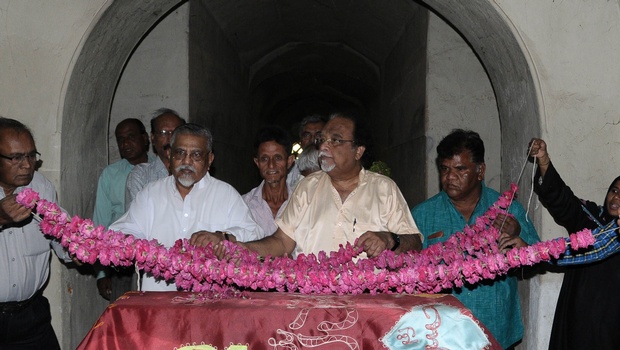
Voice of Telangana president L Panduranga Reddy and Hyderabad Deccan Democratic Alliance K Chiranjeevi and others paying tributes to Muhammad Quli Qutub Shah at 7 tombs in Hyderabad on Saturday | RVK RAO
Hyderabad :
Fondly remembering Quli Qutb Shah, the founder of Hyderabad City, on his 449th birth anniversary here on Saturday, several organisations have demanded the state government to give him the due respect he commanded.
“On his birth anniversary, we appeal to the government to build a bronze statue of the ruler at one of the prominent locations in Hyderabad,” K Chiranjeevi, convener of Hyderabad Deccan Democratic Alliance, said.
The members of the organisation also requested the government to declare his birthday as a state festival, to create awareness among the people about the accomplished ruler.
‘’Since the government is planning to change the syllabus of schools from next year, the government should ensure that the achievements of Quli Qutb Shah are also included in the syallabus,” L Panduranga Reddy, president, Voice of Telangana, said.
Organisations such as Voice of Telangana, Hyderabad Deccan Democratic Alliance, 1969 Telangana Movement Forum etc have paid tributes to Quli Qutb Shah at his tombs on the occasion. Remembering the erstwhile ruler, Captain Chiranjeevi said that his period of rule was considered the golden period of Qutub Shahi dynasty.
He modelled Hyderabad on the lines of the then legendary city of Esfahan, Persia.
“He was one of the most secular leaders of the times. His style of ruling attracted great leaders like Akbar who sent their men to his embassy,” he said, further adding, “He took special interest in sketching the design of Hyderabad and also, built Charminar when people started dying of plague.”
Speaking of his poetic skills, Panduranga Reddy of the Voice of Telangana said, “He was an accomplished poet who wrote verses in Urdu, Persian and Telugu under the pen name Mani. His poetry is complied in a book under the name Kuliyat Kuli,” he said.
source: http://www.newindianexpress.com / The New Indian Express / Home> States> Telangana / by Express News Service / April 05th, 2015
The Telangana government is all set to give wings to a girl from the Old City. Poised for flight, Salwa Fatima, who is the first pilot from purana shahar, will be given Rs 35.5 lakh so as to enable her to soar the skies, this time, in a multi-engine aircraft.
Highly placed sources told STOI on Saturday that the chief minister K Chandrasekhar Rao has sanctioned the funds. A government order (GO) will be issued to the effect next week.
“Taking a keen interest, the CM has treated the case of Salwa Fatima as a “special case,” said Syed Omar Jaleel , special secretary, minorities welfare department. Describing Salwa as a “young girl who shows immense promise”, he added, “The funds will be released in two instalments. They will be given directly to the aviation school where Salwa will be studying. The GO will be released soon.” There exists a precedent of the government granting aid to an individual – to a boy from the SC community, Jaleel observed.
Thanks to the large heartedness of philanthropists, family and her own unbending resolve, Salwa, who already has a commercial pilot license to fly a single engine aircraft, has already clocked over 200 hours of flying. And as a logical conclusion, she wants to upgrade her flying skills to multi-engine aircraft. “In order to do this, I will have to take two courses: the multiengine rating and a specialisation course called type rating. For the former, I will need to have 15 hours of flying in a multiengine aircraft and 10 hours of simulation. The latter will enable me to fly an airbus,” she says. She is still unaware of the CM giving his assent to the release of funds.
The girl, who is a healthy blend of the traditional and the modern, says that she has shortlisted the GMR Aviation Academy and the Telangana State Aviation Academy as her preferred flying schools. “Both courses put together will entail expenses of around Rs 35 lakh,” she says.
Positive about support from her in-laws, she continues, “My husband and in-laws are in fact supportive of my aspirations. There is a tradition of women working here. In fact, my parents wanted me to go to a family which encourages me to work.”
source: http://www.timesofindia.indiatimes.com / The Times of India / Home> City> Hyderabad / by Syed Mohammed, TNN / March 22nd, 2015
The students were guided by Ganesh R. Chitnis, head of the department of mechanical engineering, R.N. Shetty Polytechnic, Belagavi, and C.C. Gavimath of Visvesvaraya Technological University. —PHOTO: by Special Arrangement.
A strong urge to innovate, willingness to work in a team, and readiness to welcome new ideas have helped students of R.N. Shetty Polytechnic to evolve a technique to extract bio-diesel from decayed coconuts.
The sixth semester students of diploma in mechanical engineering came out with a process to extract bio-diesel using chemicals such as methanol and sodium sulphate. They were guided department head Ganesh R. Chitnis and C.C. Gavimath of Visvesvaraya Technological University
Byproducts
Byproducts such as oil cakes and glycerine could be used for fertilizer and cosmetics industries, said principal S.P. Hiremath here on Wednesday.
He said the production of bio-diesel was the need of the hour as it was eco-friendly and relatively cheaper and could be made available at Rs. 34 a litre. It could be used on any diesel engine and for generating electricity in a cost effective way. Riyaz D. Maskewale, Manjunath Udameeshi, and Milton Carvalho had taken keen interest to complete the project, he said.
source: http://www.thehindu.com / The Hindu / Home> News> National> Karnataka / by Vijaykumar Patil / Belagavi – April 02nd, 2015
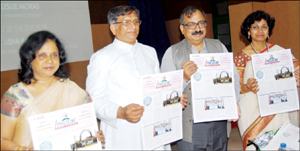
Dr. N. Usha Rani, Professor, Department of Studies in Mass Communication and Journalism, University of Mysore; Fr. Leslie Moras, Principal, St. Philomena’s College (Autonomous); Vijay Grover, Editor (South) of Tehelka and Dr. Sukanya, Head, Department of Journalism, St. Philomena’s College (Autonomous), are seen releasing the Student Journal of St. Philomena’s College – ‘Philoline’ during the one-day seminar on ‘Benchmarking Teaching Best Practices in Journalism in the changed ICT Scenario,’ organised by Department of Communication and Journalism, St. Philomena’s College, Bannimantap, Mysuru, in collaboration with Department of Studies in Mass Communication and Journalism, University of Mysore, held at St. Philomena’s College auditorium in city yesterday.
Mysuru :
A one-day seminar on the topic ‘Benchmarking Teaching Best Practices in Journalism in the changed ICT scenario’ was organised by Department of Communication and Journalism, St. Philomena’s College, Bannimantap, Mysuru, in collaboration with Department of Studies in Mass Communication and Journalism (DoS, MCJ), University of Mysore (UoM), at St. Philomena’s College auditorium in city yesterday.
The Seminar was inaugurated by Vijay Grover, Editor (South) of Tehelka while Rev. Fr. Leslie Moras, Principal of the college, presided over the programme.
Dr. N. Usha Rani, Professor, DoS, MCJ, University of Mysore, was the guest of honour.
There were three panel sessions. The first session was on the topic ‘Need for innovation in media education,’ for which the panellists were Dr. A.S. Chandra Mouli, former Deputy Director, Door Darshan, Dr. Usha Rani, Professor, DoS, MCJ, UoM and Laiqh Khan, Journalist, The Hindu, Mysuru.
Dr. Chandra Mouli, in his address spoke about feature writing, documentaries, editing, content writing, broadcasting, script writing, production and directing.
He called upon the journalism students to be honest and stay updated with what is happening around the world. He noted that journalism students should spend more time in studios, internship and field visits.
He rued that most of the journalism students attend internship just for the sake of getting training certificates.
Sharing his experience of working for Door Darshan, he felt happy that hundreds of TV channels have mushroomed in India these days.
Dr. Usha Rani, in her address, called upon the teachers of journalism to identify the skills in their students and guide them accordingly. She even urged them to make the students become well versed in writing skills.
Laiqh Khan in his address, said, “An editor gives life to a news story.”
He called upon the upcoming journalists to purchase professional cameras to click pictures instead of clicking pictures on their mobile phones.
He urged the upcoming journalists to be honest, inquisitive, curious and to develop their skills on a regular basis.
The second session was on the topic ‘Bridging the Gap Between Theory and Practice in Journalism,’ for which the panellists were Vasanti Hariprakash, Freelance Journalist and Documentary Anchor; Rajashekhar, Chief of News Bureau, The New Indian Express, Bengaluru and Dr. Niranjan Vanalli, Director, CPDPS, UoM.
The third session was on the topic ‘Use of ICT in Media Education,’ for which the panelists were Prof. Nagabhushan, Department of Computer Science, UoM; Dr. Mahesh Chandraguru, Professor, Department of Mass Communication and Journalism, University of Mysore and Fr. Richard Rego, Head, Department of Mass Communication and Journalism, St. Joseph’s College, Bengaluru.
Valedictory : The valedictory was held in the evening. Prof. M. Krishne Gowda, Head, Department of Kannada, St. Philomena’s College presided. Rev. Fr. Leslie Moras, Principal and Rev. Fr. Bernard Prakash, Vice-Principal, were present.
source: http://www.starofmysore.com / Star of Mysore / Home> General News / Friday – March 27th, 2015
Minorities Finance Corporation extends age limit by another 15 years
A good number of petty traders can now escape the stranglehold of moneylenders. The government’s decision to relax the age limit for availing the bank-linked subsidy-cum-loan scheme of the Telangana State Minorities Finance Corporation has brought cheers to thousands.
Last date
Recently the government raised the age limit from the existing 21-40 years to 21-55 years paving way for a large number of minority candidates to avail the scheme. The revised age eligibility is on a par with the backward class and tribal candidates. The last date for online registration for the self-employment scheme for the year 2014-15 is also extended up to April 15.
The age relaxation has led to a spurt in online registration for the economic support scheme. Since March 13 when the GO 15 was issued, a total of 10,816 persons have applied and the number keeps increasing. The maximum of 4,008 applications have come from Mahabubnagar followed by 1,421 (Hyderabad) and 1,387 (Medak). Officials expect a flood of applications in the coming days.
In the current budget the Telangana government has allocated Rs. 82.40 crore for the bank-linked self-employment scheme. But going by the response, officials feel, this amount will prove to be quite insufficient. The increase in age eligibility by 15 years will enable more number of people to apply. This time instead of ration card, the applicants should submit the Aadhar card, income certificate and business quotation. Maximum subsidy of Rs. 1 lakh or 50 per cent of the unit cost will be sanctioned. The maximum loan will be of Rs. 2.50 lakh and Rs. 3 lakh for transport scheme.
Plan shelved
The Minorities Finance Corporation also toyed with the idea of providing microfinance so that petty traders who borrow money on a daily basis can come out of the clutches of moneylenders. But considering the difficulty in recovering the loan the plan is shelved. “We don’t have sufficient staff to recover petty loans”, says Prof. S.A. Shukoor, managing director, Telangana State Minorities Finance Corporation.
source: http://www.thehindu.com / The Hindu / Home> News> Cities> Hyderabad / by J S Ifthekhar / Hyderabad – March 31st, 2015
Not many know that Bhagat Singh, who was hanged to death on March 23, 1931, by the British government for the murder of police officer John Saunders, stayed in Agra for months after committing the murder. Though locals have made something of a monument at the spot, the district administration has shown little interest in conserving the site, besides passing a bill to name Noori Darwaza after Bhagat Singh in 1962.
According to historians, when Bhagat Singh and Bijoy Kumar Sinha were chalking out their course of action after murdering Saunders, they held a meeting in Delhi. There, they decided to go for mass awakening, protests, and also changed the name of the party from Hindustan Republican Association to Hindustan Socialist Republican Association.
“They also decided that the organization should be broadly divided into two groups, mainly the active group and the sympathizers. They also decided to setup the new party’s headquarter,” informed SP Singh, head of the history department at Christ Church College, Kanpur.
He added that the team of revolutionaries decided to keep the party headquarters in Jhansi but later it was changed to Agra. They reached Agra in 1929, took two houses on rent and started training their supporters. With his ever increasing zest for study, Bhagat Singh began to build up a small library in Agra. With this purpose he roamed around, begging for books from sympathizers. In a short time, a distinctive though small library grew up here and the most important section among the books were of course, Economics.
However, currently no library exists here at Noori Darwaza whose official name should have been Shaheed Bhagat Singh Marg, according to the local petha makers. The house where he lived for three months is lying in a dilapidated state.
Former ward corporator Ratan Bharti said that the decision of changing Noori Darwaza’s name to Bhagat Singh Marg was taken in 1962.
“The civic body of Agra had its first elections in 1959 and in the third annual session of municipal corporation, it was decided that Noori Darwaza would be renamed to Shaheed Bhagat Singh Marg. A bill was passed but it remained confined to paper only. The locality is still called Noori Darwaza,” added Ratan Bharti.
Even the voter IDs of the locals says Noori Darwaza instead of Shaheed Bhagat Singh Marg.
“It is shameful that the government and its representatives are least bothered about preserving history and its evidence in Agra. It was only after a prolonged struggle that locals managed to build a statue of Bhagat Singh in 1970. We would also have an annual fair in the name of Bhagat Singh for years, starting from 1978 till 1983,” said Vijay Sharma, a social activist and member of Indian People Theatre Association (IPTA) who used to organize the fair in the name of Bhagat Singh.
He added, “Many attempts were made to ask the administration why they are not renaming the locality as Bhagat Singh Marg to which they said they haven’t received any official confirmation for renaming Noori Darwaza, from the civic body.”
source: http://www.timesofindia.indiatimes.com / The Times of India / Home> City> Agra / by Ishita Mishra, TNN / March 23rd, 2015
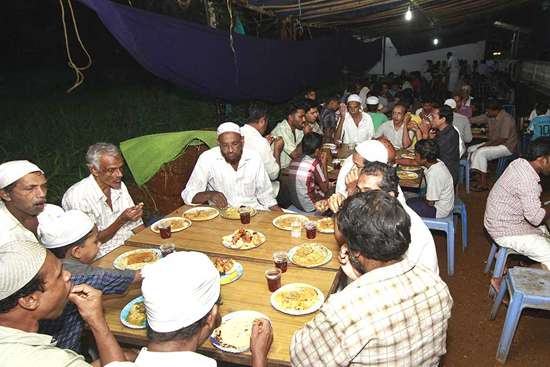
Wake up your buds A typical Mappila feast, biriyani, parottas and suleimani tea / by Sivaram V
Malappuram, carved out for a religion, now holds a key to Kerala
SIgnboards with the ‘Al’ prefix are the second indicator that you are in Mappila (Kerala Muslim) country, the first, of course, being a sartorial style that you cannot miss. This is Malappuram district in north Kerala. Once considered a basket case for its economic, educational and social backwardness, the landscape now bristles with confidence, one that only prosperity, political prowess and education can bring. Malappuram, with over 60 per cent Muslims, was carved out from the districts of Kozhikode and Palakkad way back in 1969 by the then chief minister, the Communist E.M.S. Namboodiripad. It was a political move to appease the Left government’s coalition partner—the Indian Union Muslim League (IUML)—who had demanded a district for the Muslims. Interestingly, it was a first time for the IUML in government. Today, its clout in the Congress-led UDF regime has jumped manifold. With five ministers and crucial portfolios, the IUML can even claim they are in charge of the ‘Kerala sarkar’.
But beyond the sleepy boundaries of Malappuram, there are other forces at play now. A new brand of nationalism seeks to divide rather than unite, one where patriotism hinges on one’s religious identity. Questions have also been asked of Malappuram—is it a “mini Pakistan”, is there a rise in religious fundamentalism there? The district authorities says Malappuram is a peaceful district, that there is absolute communal harmony. But one has just to trawl the net to see the fear-mongering being drummed up—reports of the Hindu minority’s struggle to exist here and further, about the love jehadis roaming the streets of Malappuram on the lookout for Hindu girls to convert to Islam. A website (www.hinduexistence.org) even harks back to 1921 and the Mappila rebellion to remind people of the “devastating revolts and massacres”—described as “killing lakhs of innocent Hindus overnight”.
In order to verify this “account of history”, we travel further north from Malappuram town to Parappanangadi. We cross the angry, muddy Kadalundi river in full spate and zig-zag through roads lined with giant ‘Gulf houses’, each trying to garishly outdo the other (some six lakh people from the district work in the Gulf today.) We pass the historical town of Tirurangadi known for its major revolts against the British and arrive in Parappanangadi to meet with historian M. Gangadharan, who’s authored a book on the revolts of the region, The Malabar Rebellion. Gangadharan, 80, refutes the argument that the Mappila rebellion was any sort of vendetta against the Hindus. He says, “The Mappila resistance was against the British political set-up that had imposed high taxes and empowered the janmis (usually from the Hindu high castes) to exploit the Mappila tenants. They did not attack the Hindus indiscriminately but the violence did frighten them and many did leave the area.”
The Muslim grievances and the revolts were successfully harnessed by Gandhiji during the freedom struggle. Says Gangadharan, “In the second decade of the 20th century, when the Mappilas organised themselves, they received support from the nationalist movement that cleverly linked this rebellion to the Khilafat agitation…. Trade ties between India and the Arab countries meant that the Khilafat movement affected Kerala’s Mappilas. Initially, the movement wasn’t violent but the British oppression and tortures forced the hand of Mappilas. Today, the Hindu fundamentalists are trying to change the narrative to suit their own needs.” On a personal level, Gangadharan says he’s never felt insecure living in a Muslim-dominated area.
This predilection for protests is seen even today. In Parappanangadi town, we witness a silent procession of schoolchildren marching against the Israel attacks in Gaza. K.T. Jaleel, independent MLA (Left-backed) from Thavanur, says Malappuram partakes of Kerala’s anti-imperialistic streak, “We saw protests when Saddam Hussein was killed and we continue to see protests against imperialistic powers. But we are not communal, even post-Babri Masjid there were no clashes here. The Muslims in Malappuram are secular and progressive and have merged with the mainstream.” At the same time, a sullen withdrawal has often been ascribed to them too, as is a tendency to adopt the visible gestures and cues of a modern pan-Islamism, especially in response to inimical global and domestic politics.
Photograph by Sivaram V.
There is an underlying, historical delicacy too. Many Muslim political leaders of Malabar had supported the Partition, crowding out nationalist Muslims who didn’t—their grievance was that India’s mainstream leaders did not come to their aid during the Mappila rebellion. So the creation of a district for Muslims was always viewed with some diffidence by non-Muslims. There are few complaints in the district itself though. “They are secular and progressive,” says Manamboor Rajan Babu, who’s lived in Kuttinangadi for the past 39 years. Rajan Babu is an ex-policeman, novelist and editor of Innu, an inland magazine. “I live in the midst of three Mohammeds,” he jokes. “The neighbours are caring folks. I settled here because of my Muslim friends. The majority do not accept the fundamentalist views of the fringe elements, which is why it doesn’t get much traction in Malappuram.” And anyway, the IUML is in the political business here and they won’t allow the fringe to grow, he feels.
The IUML itself is a curious entity, as corrupt as any other Indian party (if media reports are to be believed), but without any overt fundamentalist agenda. A small reformist group called Aikya Sangham was created in the 1920s to ameliorate the lot of Muslims and harmoniously settle land disputes between Hindus and Muslims. From this stock arose the Muslim League in Kerala and that morphed into the IUML. The League supported the formation of Pakistan so after independence they were sidelined by the nationalist parties. Says political analyst and advocate A. Jayashankar, “After the ems regime fell in 1969, they joined the Congress and ever since have been a major factor in UDF governments, especially since 2001 when the number of their ministers went up to four. At present, they have five. The fifth ministerial berth going to an IUML MLA from Malappuram created a furore in Kerala. The Nairs (NSS) and Ezhavas (SNDP) have felt insecure ever since. The rise in the BJP voteshare in Kerala can be attributed to the flexing of muscles by the Muslims in the ‘minority’ government in Kerala.”
The delimitation based on area population after the 2011 census gave a further boost to the IUML. Most districts in Kerala showed negative growth, but Malappuram registered a decadal population growth of 13.45 per cent since the census. The number of legislative constituencies was increased in the district from 12 to 16 in the last polls. “The Muslim-dominated areas of Kozhikode, Kannur and Palakkad also benefited with an increase in one seat while the Christian-dominated belt of Kottayam, Thrissur and Pathanamthitta lost four seats due to a decline in population,” says Jayashankar. In the 2011 assembly polls, the IUML took 12 of the 16 seats in Malappuram and became the third largest party in the state after the Congress and CPI(M) with 20 seats.
Historian M. Gangadharan at home. (Photograph by Sivaram V.
Kerala’s coalition politics depends on a delicate sharing of spoils, and competition is intense. The recent muscle-flexing by the IUML has not gone down well with the state’s other major religious lobbies. Again and again, the references return to an obsession with population figures and what is seen as increasing control over power stakes. Says political watcher P. Rajan: “Creating a district based on religion was not a wise decision. A district should be created for topographical and geographical reasons. The League benefited politically from the differential in population figures too. But to demand a fifth ministerial berth in the UDF government was not a good move. The Nairs and the SNDP have been highly insecure and the ramifications were seen in the Neyyatinkara byelection, with the BJP coming a close third. In the next state elections, the BJP will be a force to reckon with if the IUML continues with its brazen ways. The Congress has been nervous ever since the Lok Sabha polls. Their voteshare has dipped in many of the Thiruvananthapuram assembly seats.”
Jaleel, who left the IUML and supports the Left, says, “I left the IUML because it’s very corrupt. I questioned the use of funds that they had raised for various issues. The people of Malappuram aren’t always faithful to the IUML. In the 2006 assembly polls, the CPI(M) and the IUML got five (of the 12) seats each, some of the IUML ministers even lost by huge margins. This event can’t be underestimated…people here a more progressive lot.”
Indeed, in the midst of all the fear of growing radicalism, of non-native signs like the skull cap and the burqa, the Malappuram Muslim has been changing—yes, somewhat radically—in other ways too. It’s no longer the backwaters. Decades of remittances have created a more globalised second generation. The number of educational institutions has increased. It has caught up with the rest of Kerala; even rank-holders have emerged from the district. S. Irudayarajan of the Centre for Development Studies, Thiruvananthapuram, says, “About 25 years ago, Malappuram was Kerala’s most backward district. Between 1990 to 2000, unskilled workers came from Malappuram, from 2000 to 2010 there was a rise of semi-skilled workers; 2010 on, even high-skilled workers have been migrating from there.” The natural corollary of swelling remittances—it gets the largest share—ensures that, whichever coalition governs the state, its political fortunes will depend quite a bit on the electorate of Malappuram.
source: http://www.outlookindia.com / Outlook / Magazine> Society / by Minu Ittyipe / Special Independence Day Issue / August 25th, 2014
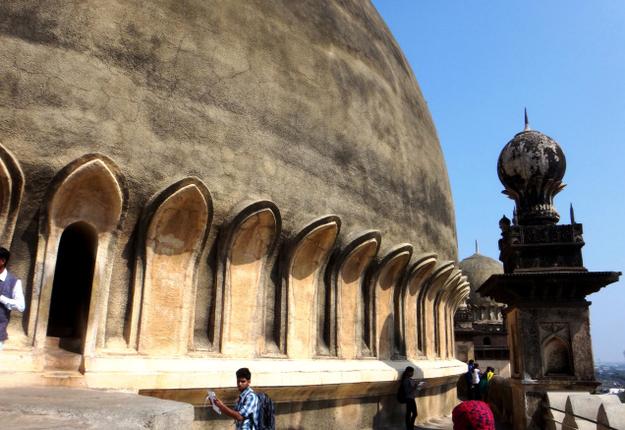
Gol Gumbaz, an elegant edifice located in a sprawling 70-acre manicured estate in Bijapur, deserves much more attention from tourists than what it is getting.
Considered the most beautiful building in the world, Taj Mahal nonchalantly dismisses other ancient constructions across the Indian subcontinent. This was evident as I recently ventured into the hinterlands of southern India to discover a magnificent medieval monument. Dominating the landscape of Bijapur in the Deccan plateau of Karnataka is India’s largest antiquated but amazing dome that is aptly called Gol Gumbaz.
Once upon a time Gol Gumbaz was the only major structure visible on the horizon of ancient Bijapur but today it is sheltered in a sprawling 70 acre manicured estate. It is passionately preserved by a small army of gardeners, guards, horticulturists and archaeologists.
Gol Gumbad at Bijapur / by Special Arrangement
Constructed with diligent dexterity this mammoth monument has a dramatic dome that snugly sits atop an equally colossal tomb. With an age tag of nearly 357 years, Gol Gumbaz is a unique mega structure of incredible India. It is a must-see for every admirer of olden-golden era of our country.
The elegant edifice equating a seven storied structure is befittingly surrounded by lush lawns under the surveillance of the Archaeology Survey of India (ASI). While some historians reckon that Gol Gumbaz is the second largest dome in the world, others deem it to be the biggest in Asia with a robust history.
Despite the disputed status it is worth admiring not merely for its sheer size but the mighty effort of translating tons of raw materials into a desirable structure. In the bygone days when mechanical paraphernalia was non-existent, pure horsepower and manpower was shrewdly applied to erect such an enduring edifice. It took away my breath as I energetically ascended the spiralling narrow stairway that can make the faint hearted pant and rant. Once on the uppermost balcony abutting the outer dome, the views of the tiny town all-round were spectacular and the inside of the dome was even more enchanting.
Curiously Gol Gumbaz (1627) and the Taj Mahal (1632) began construction during the same period by two different sultans governing independent swathes of land. Taj being in the north and the other in southern India separated by 1500 km, obviously were not aware of each other’s strategy. Although Gol Gumbaz took 29 years to complete, the Taj Mahal took 22 years to finish and the former is almost double the size with massive measurements. I pondered whether Taj Mahal has a feminine fetish, while the Gol Gumbaz is geometrically masculine. At any given time more than three million tourists visit the Taj Mahal in a year, which is double the current population of Agra. Comparatively very few travellers visit Gol Gumbaz just because it is not on the regular tourist trail and also not adequately publicised.
Gol Gumbaz is actually a mausoleum of the seventh Sultan of the Adil Shahi dynasty, his two wives, mistress Rambha, daughter and a grandson. Being an architecture marvel it is not only known for its astounding dimensions but also unique acoustic features. This edifice, without doubt, ranks among the most imposing ones in India.
The foundation of this tomb is exceptionally engineered to rest on bedrock which has prevented any unequal settlement. The width of each of the sides is equal to the height at 200 feet. The exterior diameter of the top dome is 144 feet while the interior of the structure is a single large hall, one of the largest ever built, measuring 135 feet across and 178 feet high. The four tall twirling minarets at the corners of the mega tomb are actually a series of steps leading to the top. The inside balcony is called the ‘Whispering Gallery’, because even the faintest whisper or rustle gets magnified like an echo and is truly fascinating.
Bijapur is effortlessly approachable from far and wide because of admirable driving roads. It is nearest from Sholapur at 100 km; Goa at 340 km and 530 km northwest of Bangalore but I preferred to self drive 380 km west of Hyderabad in a friend’s car and explore the town of tombs and domes. Avoiding the highways I romanced the rural roads, stopping once in a while to be smitten by wild water birds frolicking in pristine lakes and experience the rustic atmosphere.
Geographically Bijapur district consists of plain land devoid of any hills and dales. However the Deccan plateau provides enough rocky terrain to excavate stone material for construction. In an introduction to “Architecture at Beejapoor” published in 1866, Philip Meadows Taylor, an Anglo-Indian with a voracious appetite for Indian culture wrote: “Palaces, arches, tombs, cisterns, gateways, and minarets …all carved from the rich basalt rock of the locality, garlanded by creepers, broken and disjointed by peepul trees, each in its turn is a gem of art and the whole a treasury.”
I was so impressed with the Gol Gumbaz that I lingered all day walking all around for different perspectives and ruminating of its past glory. As Bijapur is still strewn with more than 300 mosques, mausoleums, tombs, domes and many ruins, I made up my mind to revisit.
Only a full week of meandering among the other monuments, which are also splendid specimens, would satisfy my hunger for relishing relics and remnants. Meanwhile the Gol Gumbaz deserves to be on the coveted list of world heritage sites and the government is making all efforts to accomplish that.
source: http://www.thehindu.com / The Hindu / Home> Features> MetroPlus / by M. Shiva Kumar / March 29th, 2015
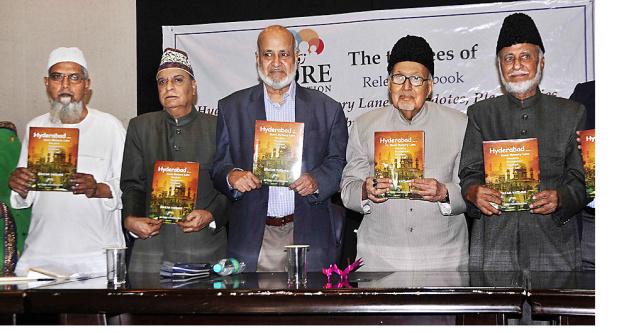
(From L to R) J.S. Ifthekhar, the translator of the book, Rafiuddin Qaudri, president of Dr. Zore Foundation, Mohd Ziauddin Ahmed Shakeb, noted scholar, M.M. Taqi Khan, professor of Chemistry, and Ghulam Yazdani, author of the book, Hyderabad … down memory lane , at the function.- Photo: G. Ramakrishna
Once Makhdoom went to a hotel late in the night and placed order for ‘khushka-salan’. Pat came the reply, ‘khallas’ (meaning finished).
‘Khorma-sheermal?’
‘Khallas’ was the reply again.
Makhdoom was naturally upset when he reeled out names of few other dishes and got the same reply – ‘khallas’.
In an irate tone he asked, ‘Is it a hotel or Makhdoom’s house?”
That was the pitiable situation noted poet Makhdoom Mohiuddin found himself in. Sample this one.
Famous Urdu poet Faiz Ahmed Faiz was being welcomed at the Urdu Hall in Hyderabad.
In her speech, a playful Zeenat Sajida, remarked, “Faiz sahib writes poetry in Urdu but romances in English.”
Those present in the hall broke into uncontrolled laughter as everyone knew Faiz had married an English woman.
These are some of the little known things to be found in senior advocate, Ghulam Yazdani’s bookHyderabad … down memory lane released here on Saturday evening. The book, an English version ofKuch Yadeyn Kuch Bateyn is translated by J.S. Ifthekhar.
The 216-page book published on art paper is a collector’s item. It covers a wide range of subjects right from royalty to literature, culture, cuisine, architecture. Mr. Yazdani finds an interesting angle in all these things to tickle the funny bone.
“You can read it from anywhere and yet enjoy it,” remarked Dr. Mohd Ziauddin Ahmed Shakeb, noted scholar about the book, published by Dr. Zore Foundation.
Well-known scientist M.M. Taqi Khan released the book.
Deputy Chief Minister Mohd Mahmood Ali, who was to have released the book didn’t turn up.
Mr. Yazdani said after the success of his Urdu book released last year, many persons unfamiliar with the language, felt disappointed.
Therefore, he decided to get it translated into English for wider readership.
Prof. Fatima Parveen, general secretary, Zore Foundation, welcomed the gathering.
As Dr. Fatima Shenaz put it, the book captures the spirit of Hyderabad and its socio-literary culture.
source: http://www.thehindu.com / The Hindu / Home> News> Cities> Hyderabad / by J. S. Ifthekhar / Hyderabad – March 30th, 2015