Category Archives: Community Involvement / Social Issues

Now, a women’s sport too

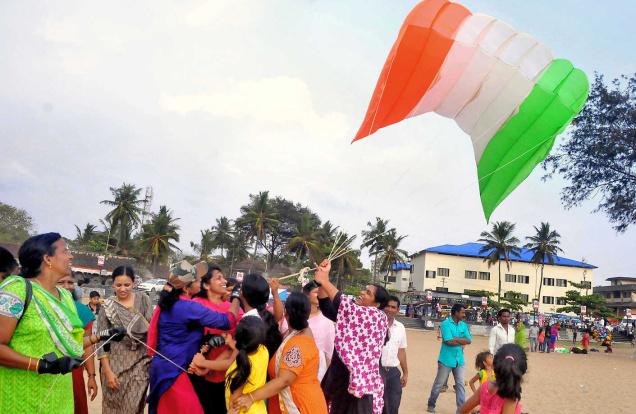
Women, who participated in the kite flying training programme on Sunday on Kozhikode beach, trying to control a kite.— Photo: K. Ragesh

It takes eight to 10 men to control the 1,000-kg circular kite of the One India Kite team. Founder of the team Abdulla Maliyekkal was quite apprehensive when he gave the reins of the kite to a group of women . His apprehension was not misplaced considering how the women struggled with it initially, but it gave way to happiness watching the first professional all-women kite team in the country take form.

The team named ‘Incredible India’ was launched on the Kozhikode beach on Sunday, on the occasion of International Women’s Day.

Training in style

Supported by their parent group One India Kite Team, the women who have undergone training in the nuances of kite flying, took off in style flying the Circular kite and the Kathakali kite amidst the curious Sunday crowd on the beach. “This is the most relaxing experience I have ever had. Controlling a kite is not child’s play. It takes great coordination and team work. Hence while flying the kites, we forget everything else,” said Mini Nair, team captain.

The team now plans to take part in kite festivals across the country and abroad where they plan to present some kites of their own.

As part of the launch of the women’s team, the One India Kite Team, in association with the women’s wing of Junior Chamber International, Calicut, had organised a kite-flying training programme for women, which was attended by 25 women. “The training was given by expert kite flyers Abdulla Maliyekkal, Hashim Kadakkalakam and Shyam Padman.

source: http:// www.thehindu.com / The Hindu / Home> News> National> Kerala / by Aabha Anoop / March 09th, 2015

Meet the Muslims who make ‘Holikas’ for Holi eve

Meerut:

Nine months ago, Teer Gran in Meerut was in the news for all the wrong reasons – communal clashes had broken out, claiming one life. Several people were injured. Few are aware, however, that Teer Gran is home to the Muslim families that make the colourful Holikas that Hindu communities traditionally burn on Holi eve. This locality is also called ‘Holi Mohalla’.

Around 25 Muslim families here make more than a 1,000 Holikas which find their way to various west UP cities besides Meerut. Mohd Yunus, 50, has a small shop near the lane leading to Bhairon Temple. On Tuesday, there were numerous life-size effigies, decked up and colourful, with feminine features, lining his shop.

“Holika symbolizes victory of good over evil. Hindu legend has it that after demon king Hiranyakashipu demanded that he be worshipped, his son Prahlad remained defiant, and said he would only worship Lord Vishnu. The king’s sister Holika, on instructions from her brother, attempted to burn Prahlad alive by taking him in her lap and sitting on a pyre. Holika had a magic shawl with which she could save herself from burning. She hoped her nephew would be reduced to cinders. When the fire was set, however, the shawl flew and enveloped Prahlad instead. Holika was burnt to death. Prahlad escaped unhurt,” Yunus explains.

For generations, Yunus’ family has been making effigies of Holika that are burnt on the eve of Holi festivities.

“We have no records, but for hundreds of years our family has been making these effigies.” There are about 25 Muslim families that make Holikas in Holi Mohalla. The effigies are made with waste paper, masks and colours.

Shaukat Ali, another resident of the area, said, “We need to make about 1,000 Holikas every year. These travel to Muzaffarnagar, Baghpat and Muradnagar.”

The Holika effigies are the work of entire families. With time, interestingly, volumes have grown. Mohd Wasim, an effigy maker, said, “Earlier, communities would select one place to burn the Holika, which was made on order, and would be quite tall and expensive – we have made effigies 20 feet tall, costing about Rs 2,000, at least. Now, as cities have expanded, even small colonies have their own Holika burning ceremony. Volumes have grown, but the size of each Holikas has shrunk. These days, we make Holikas about five feet tall, costing about Rs 250 each, at most.”

While the Muslim families here make Holikas ahead of Holi, they also make effigies of Ravana ahead of Dusshera. “The Ravanas are rather more difficult to make. For the rest of the year, we make decorations for temples and mosques,” Wasim said.

Asked of his experience during the riots last year, Yunus said, “Buddhi bhrasht ho jaati hai logon ki (people go out of their minds) in time of riots. No one wants riots. These are all politically motivated, and everyone only suffers a loss. Thankfully for us, every time communal tension happens here, Hindu friends ask me to move to a safer place and take responsibility for my shop.

source: http://www.timesofindia.indiatimes.com / The Times of India / Home> City> Meerut / by Sandeep Rai / March 03rd, 2015

Sommer House: Tales from the jazz age

SommerHouseBF09mar2015

Bengaluru: 

Back in the 1950s, when Bangalore was like something out of a F. Scott Fitzgerald bok, Whitefield was a small township on the outskirts of the city. On arriving at the railway station, one took a horse-drawn carriage home through the small, winding streets. It wasn’t long, however, before development put paid to much of that old world charm.

The Sommer House, a colonial bungalow that has been restored to its former beauty by long-time resident Sulaiman Jamal, aims to recreate some of that old world charm. Thrown open to the public on Monday evening, as a community center that gives senior citizens and retired army officials that long lost society whirl, Jamal, whose association with the area began when he set up his factory there said: “We have lived in Whitefield for ten years now, but when I first visited, it was a pretty wild place,  Every six months, another bungalow would be torn down.”

The two-bedroom gabled roof Sommer House, bought two years ago by Jamal, replete with antique furniture, is home to a piano that belonged, back in the day, to the Defence Services Cinema. The cottage, sits surrounded by a garden, with restored vintage cars dotting the property.

Jamal would like the House to host programmes like piano nights, dancing, catered dinners and plays. Most importantly, it will also have a free catered dinner every month for senior citizens.
Beth Chapman, Pre­sident, Overseas Women’s Club, has helped put Sulaiman’s ideas in motion.

“I’m always looking for old bungalows and the stories that surround them,” she said.
“The house is opposite Forum Value Mall and people expected a superstructure here,” Sulaiman explained. “They wonder what the catch is, but there is none. We want the people of Whitefield to feel a sense of belonging with what is now a community center.”

source: http://www.deccanchronicle.com / Deccan Chronicle / Home> News> Current Affairs / DC / Darshana Ramdev / June 18th, 2013

Elected unopposed to All India Milli Council , Mysuru

MilliMPOs08mar2015

Mysuru :

Hazrath Moulana Mohammed Zaka Ulla and Corporator K.C. Shoukath Pasha were unanimously elected as President and General Secretary respectively of All India Milli Council, Mysuru District Unit, at a meeting held recently at Madrasa-e-Ashraf Ul Uloom in Kesare here.

The meeting was held under the supervision of Hazrath Moulana Qadeer Ahmed, President, All India Milli Council (AIMC), Karnataka State Unit; Hazrath Moulana Mufthi Baqar Arshad, Vice-President, AIMC, Karnataka State Unit and Syed Shahid Ahmed, General Secretary, AIMC, Karnataka State Unit.

Hazrath Moulana Mohammed Zaka Ulla is also the President of Majlis Ul Ulema and Khateeb & Imam, Masjid-e-Firdose, Bannimantap while Corporator Shoukath Pasha is also the member of District Planning Committee. This is the second term of Pasha as General Secretary of AIMC, Mysuru.

Both the newly elected office- bearers were felicitated on the occasion.

Hazrath Moulana Mohammed Usman Shariff, Sir Khazi of Mysore, Taj Mohammed Khan, Member, AIMC, Karnataka State Unit, Hazrath Moulana Mohammed Naseem, outgoing President, AIMC, Mysuru, Hazrath Moulana Ahmed Khan Rishadi, Moulana Mohammed Ibrahim, former Mayor and Corporator Ayub Khan, Corporator Suhail Baig, JD (S) leader Azeez Ulla, Syed Zaheer Ahmed, General Secretary, Central Muslim Welfare Council, Mohammed Zaheer Ul Haq, Mohammed Mumtaz Ahmed, Secretary, Mysuru District Relief Committee, Syed Akram Pasha, Syed Jalal, Secretary, Muslim Boys Orphanage and others were present on the occasion.

source: http://www.starofmysore.com / Star of Mysore / Home> General News / Monday – March 02nd, 2015

An inspirational message from India’s only woman Muslim pilot

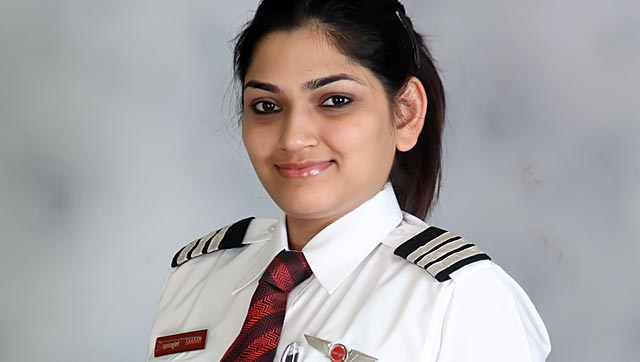
Saarah Hameed Ahmed, India's only Muslim woman pilot
Saarah Hameed Ahmed, India’s only Muslim woman pilot

“People initially think I’m Christian and then gawk when I tell them my full name,” laughs Saarah Hameed Ahmed (25) the Bengaluru girl who is the only known Muslim among the 600-odd women pilots employed in the Indian aviation sector. “I just love the look on people’s faces when they discover I am Muslim.”

People’s reaction to her choice of profession is a constant source of entertainment for Saarah. Many want to know how a girl can handle a machine that’s many times her size, she says as she cracks up again. “Poor things; they don’t know that my fingers are all I need to fly,” she says twiddling her thumbs.

Of course, the reactions are not always amusing or sensitive. Saarah says she too has had to face the brunt of Islamophobia that gripped the world post 9/11. But each time she has managed to win people over with a combination of humour and tact, she says.

However, Saarah’s first battles were fought at home and within the community. She says that she still faces taunts from people who believe a girl’s only job is to get married and produce children.

“Initially none of us encouraged her. In our community girls don’t usually take up professions where they have to stay away from home and live in hotels without an escort,” confesses her father Hameed Hussain Ahmed, a professional photographer. When Saarah showed no signs of relenting, he spoke to his friend Atif Fareed, who is a senior pilot in the US.

“Fareed told me that I should consider myself lucky because most Muslim girls don’t even dream of flying. If he hadn’t convinced me, I might have made the blunder of killing Saarah’s dreams,” he says.

In 2007, when she was just 18, Saarah enrolled with a flying school in the US. “Those days most Muslim students were being denied US Visas. When she got the Visa without any trouble I saw it as a final message from God,” says the deeply religious Ahmed.

Saarah’s mother, Naseema Ahmed, says she never had any doubts about sending her to the US. Her proudest moment, she says, was when a group of Muslim girls surrounded Saarah at a wedding and started asking her for tips to become a pilot.

Saarah has other dreams too. “I really want to get married and have children,” she says. But finding the right man is proving to be tough. “I don’t understand people who just look at my photo and want to get their sons married to me. Don’t they want to know what I have studied or where I work?”

Many of her suitors have either wanted her to quit her job or move cities. “My father has shooed away people asking them to get their sons to quit his job and move cities,” Saarah says letting out another blast of laughter.

She also has a Women’s Day message for Muslim girls like herself: “Don’t fret over what the community thinks of you. And don’t let them kill your dreams.” And what is she planning on women’s day? “Fly, of course! My airline [Spicejet] is very keen that I fly on Women’s Day.”

Waiting in the wings

Ayesha Aziz, 18, is another aspiring pilot. A native of Baramulla, Kashmir, she has already obtained a basic flying licence.

Fatima Salva Syeda, 26, is a licenced commercial pilot. But she has to qualify additional training before she can be a professional pilot.

source: http://www.hindustantimes.com / Hindustan Times / Home> India / by Sudipto Mondal – Hindustan Times, Bengaluru / March 08th, 2015

City visionaries

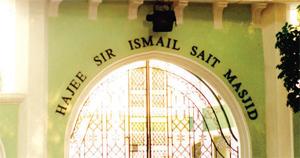
HajiIsmailSaitMasjidMPOs05mar2015

by Aliyeh Rizvi

The history of Bangalore is a colourful tapestry whose warp is interwoven with countless political and cultural narratives. But the equally significant weft consisted of traders and businessmen whose lives extended beyond commercial success to large acts of philanthropy. Despite these extensive contributions that benefitted the city and its people, their memories are now preserved primarily in the hearts of old Bangaloreans, personal family records and physical fragments across the city; a memorial, a building or a road. The Hajee Sir Ismail Sait Masjid was built over 100 years ago and gives Mosque Road it name. It was initially meant to accommodate about three hundred people but the largesse of its builder went far beyond its walls.

Haji Sir Ismail Sait was born on March 7th 1859 and following his father’s untimely demise, moved from Mysore to Bangalore around 1870. Being from the mercantile Cutchi Memon community, he followed suit after being educated in both Bangalore and Chennai. Arif Hussain, at the Hazrat Haider Shah Jeelani Dargah, tells me an anecdote (unverified) about his early years where he was advised by the saint, his spiritual mentor, to initially trade in goods that were white in colour (like eggs, garlic and milk) to ensure wealth and success. The young Ismail Sait evidently had a nose for business and saintly advice. His English Warehouse near St. Mark’s Road soon sold not just milk powder but every conceivable import from England. Branches were opened in Hyderabad and Chennai, where he was the first to bring in imported kerosene from America in the late 19th century through Spencer and Co.

 
The entrepreneurial streak also ran through trading in military provisions, timber and mining. He was a banker, mill owner and export-importer. Over time, he was also Chairman of Chamber of Commerce Mysore; Director in the Mysore Sandalwood Factory, Binny Mills and the Mysore Iron Works, Bhadravathi. It was a diverse portfolio but India was opening up to the world and opportunities were yours for the taking. Business was supported by memberships in several distinguished clubs including the Willingdon Sports Club, Bombay, Calcutta Club and the National Liberal Club of London. “He had great business sense and wonderful PR skills” says Zafar Sait, his great-grandson.

 
But public service was a priority. Healthcare and education were key concerns. The Gosha Hospital (1925) near Queens Road was built with personal funds for reclusive Mohammedan `purdah nashin’ ladies. It was formally opened with 20 beds. Philanthropic friends donated clocks, beds, `frigidaires’, aluminiumware and other supplies. He also built schools, mosques and rest houses in Bangalore, Whitefield and Mysore. Staggering sums of money were donated to the Mysore State University, Aligarh University and medical institutions including Victoria and Bowring Hospitals. His will made strict provisions for educating family members, `both male and female’ and providing alms to the poor.

 
In 1911, he was nominated to the Madras Legislative Council and received the title’ Fakhr-ut- Tujjar from the Mysore Maharaja in 1919. Family photographs show a dapper gentleman dressed in traditional Cutchi Memon robes, and then in European attire when he was knighted in 1923. When Hajee Sir Ismail Sait passed away in 1934, he left behind his wife Ayesha Bai, five sons, two daughters and a legacy of philanthropy that Shabbir Malik Sait, his great grandson says continues even to this day. He belonged to a time when we gave back what we received in equal measure.

The writer is a cultural documentarian and blogs at aturquoisecloud.wordpress.com

source: http://www.bangaloremirror.com / BangaloreMirror.com / Home> Bangalore> Others / by Aliyeh Rizvi, Bangalore Mirror Bureau / May 05th, 2014

Cultivating organic spices in the backyard

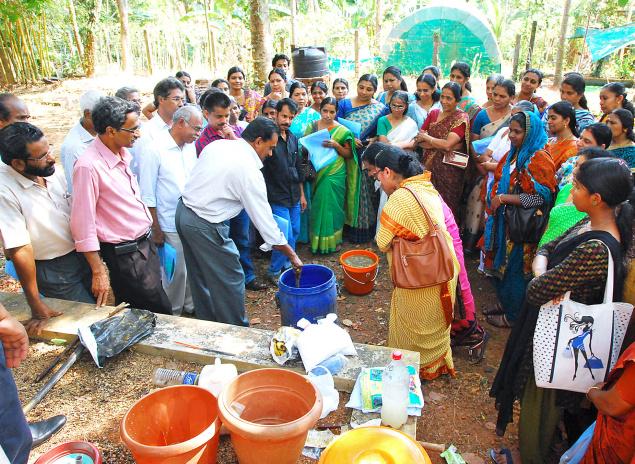
An expert demonstrates how to prepare organic fertilizers during a training programme organised by the National Horticulture Mission on the CWRDM campus at Kunnamangalam in the city. / The Hindu

Along with vegetables, spices also need to be cultivated organically, say experts.

Spreading awareness among people about the importance of producing toxin-free spices through organic cultivation was the main thrust of a training programme in homestead water management and organic spice cultivation organised by the National Horticulture Mission in collaboration with the Centre for Water Resources Development and Management (CWRDM) on its campus at Kunnamangalam here.

Around 60 housewives, who are members of the farmers club aided by the National Bank for Agriculture and Rural Development (NABARD), participated in the two-day training programme, which was inaugurated by the Kunnamangalam MLA P.T.A. Raheem on Monday.

Water resources

In various sessions, scientists as well as experts from the centre and the Agricultural Department spoke on how to go about managing the available water resources in a common household for the cultivation of essential spices including ginger, turmeric and pepper.

E. Abdul Hameed, Technical officer of CWRDM, talked about the things to be done while cultivating spices in the backyard.

While CWRDM scientist Dinesh Kumar spoke about the role of spices in the protection of health, K.R Prasannakumar, another expert from the centre, spoke on the role of soil fertility and use of organic fertilizers for spices cultivation.

P. Vikraman, former Principal Agricultural Officer, demonstrated on how to prepare organic fertilizers and pesticides.

The scientists also clarified various doubts raised by the participants during the programme.

One kg of ginger and turmeric rhizomes each as well as five saplings of pepper were distributed free to the participants at the end of the session. CWRDM executive director N.B. Narasimha Prasad presided over the function. CWRDM Training Education and Extension Division (TEED) head Kamalam Joseph and NABARD District Development manager K.P. Padmakumar among others spoke. Details about organic spices cultivation can be had from the organisers. Ph: 9447276177.

source: http://www.thehindu.com / The Hindu / Home> News> Cities> Kozhikode / by Jabir Musthari / Kozhikode – March 04th, 2015

She made no-polythene zone a reality

Lucknow :

If you spot clean roads around La Martiniere Girls College and a no-polythene zone in zoo, the credit for it goes to Rehana Ali. It was Rehana’s dedication and positive approach that has brought about a small but imperative change.

Rehana, who teaches at La Martiniere Girls College, formed community, ‘Protection of Environment and Animals’, 18 years back. Since then she has pursued her mission with ant-like persistence. Pointing out people for littering the roads or taking students to clean them, she has made several efforts to keep the road and surroundings clean. “It is because of my profession that I do not hesitate in accosting people. Whenever I see anyone throwing wrappers on the streets, I ask them not to do so,” she shares.

Besides raising awareness among her students, Rehana also encourages them to join the noble cause. Every week, all students of the school deposit two paper bags, which are then collectively sent to the zoo. For more than a decade now, Rehana has been supplying paper bags with the participation of her students.

source: http://www.timesofindia.indiatimes.com / The Times of India / Home> City> Lucknow / TNN / March 05th, 2015

A pushcart to promote poetry

Hyderabad :

Imagine poetry being ‘sold’ off the streets. Yes, you heard that right! With a noble mission to revive Telugu poetry in the two states, 50-year-old Sheik Sadiq Ali is seen pushing around his cart which doesn’t sell vegetables, but poetry!

“The declining state of Telugu poetry has always bothered me. So I decided to take it to the masses and what better way to do it than a pushcart,” Sadiq explains. While most people lecture on the need for reviving the Telugu poetry from air-conditioned auditoriums, he decided to do stay connected with lovers of literature. Though he doesn’t have shortage of resources to hold book exhibitions, the 50-year-old decided to use a push-cart for his mission. To buttress his argument for adopting this unconventional method to promote Telugu poetry, he says: “Pusharts are something that people feel comfortable with. They have been a part of our culture for ages. It will be inappropriate for a non-traditional object to promote traditional poetry”.

Sadiq now takes his pushcart around town, one area at a time, holding forth on poetry and inviting people to read books. With over 135 titles on his pushcart, Sadiq literally carries a mobile bookstore to your doorstep. “What surprises me is the kind of response I receive from people of all age groups. Those who are new to Telugu poetry spend some time reading a book and end up buying it. These are small steps towards the bigger mission,” says an earnest Sadiq.

A native of Kalluru in Khammam distruct and a postgraduate in Telugu literature from Osmania University, Sadiq has books by various Telugu poets on his cart. The cart – ‘Thopudu Bandi’ – adorns pictures of famous Telugu poets like Sri Sri, Arudra and Maqdoom Mohinuddin. “People on Facebook started seeing what I am doing and sent in their books. So if someone buys the book, the poet gets the money, which in a way encouraging poetry,” he elaborates.

Sadiq, who was a journalist with a Telugu daily, Udayam, which was shut down long ago – embarked on his his ‘literary’ journey on February 22 when he travelled from Ramnagar to People’s Plaza in the city. Ever since, he has been travelling to one part of the city everyday promoting Telugu literature in his own unique way. And he does not intend to stop until he covers all the districts in Telangana and Andhra Pradesh. “There is a lot to be done and there is not much time. All I want is to bring back the golden era of Telugu poetry,” he says with an air of determination. His initiative has reached many through social networking sites and people like Chukka Ramaiah, a well-known educationist, have heaped praise on him for this unique initiative.

But Sadiq, who left his marriage bureau business, isn’t pushing around the 200-kilo cart full of poetry for fame or money. “I have enough to make ends meet. What I am doing isn’t for a living. It is out of passion. It is for the love of Telugu poetry,” he says with a broad smile and a sense of pride.

A fifty-year-old man pushes his cart on the roads of Hyderabad. He isn’t selling vegetables or trying to earn a living with the cart, but he is a man on a mission to revive Telugu poetry in the two Telugu speaking states.

Meet Sheik Sadiq Ali, who gave up his business to revive the art of Telugu poetry in Andhra Pradesh and Telangana.

While most people talk about reviving Telugu poetry from air-conditioned auditoriums with an ‘intellectual’ audience, Sadiq decided to do exactly the opposite. “The declining state of Telugu poetry has always bothered me. So I decided to take it to the masses and what better way to do it than a pushcart,” he explains.

Despite the availability of funds, the 50-year-old decided to use a cart over an exhibition or a display truck. And the reason: “Carts are something that people feel comfortable with. Carts have been a part of our culture for ages. It will be incorrect to a non-traditional object to promote traditional poetry,” elaborates Sadiq.s

source: http://www.timesofindia.indiatimes.com / The Times of India / Home> City> Hyderabad / by Bhavneet Singh, TNN / March 03rd, 2015

Minister in Mufti Team Has State Link

Karwar :

The new Jammu and Kashmir government has a Karnataka link.

Mohammad Ashraf Mir, who took oath as a minister in the Mufti Mohammad Sayeed Cabinet in Jammu and Kashmir on Sunday, is married to a girl from this port town.

Residents of Bhatkal, especially the Navayath community members, celebrated the news of Mir’s appointment as a minister in the PDP-BJP coalition government in Jammu and Kashmir.

Mir was also in the news after he defeated former chief minister and National Conference leader Omar Abdullah from Sonawar constituency in last year’s Assembly elections in Jammu and Kashmir.

While, Mir secured 14,283 votes, Omar Abdullah managed just 9,500 votes.

Mir married Zareen in Bengaluru in 1996. Zareen is the daughter of Farooq Udyavar, a businessman, who is a resident of Port Road in Bhatkal.

A close relative of the family told Express that Mir and Zareen’s marriage was love-cum-arranged.

Mir and Zareen did  MBA at a private college in Bengaluru. At present, Zareen’s parents are residing in Bengaluru as they are renovating their old house in Bhatkal town.

The family members are planning to visit Srinagar to congratulate Mir.

source: http://www.newindianexpress.com / The New Indian Express / Home> States> Karnataka / by Marx Tejaswi / March 02nd, 2015