Category Archives: Community Involvement / Social Issues

For Malala, this West Bengal teenager is a true hero

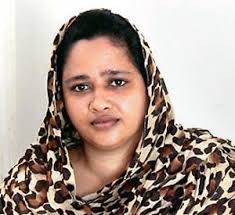
Anoyara Khatun.— Photo: Sushanta Patronobish / The Hindu

As the world celebrates Pakistani teenager Malala Yousafzai winning the Nobel Peace Prize, Malala herself is celebrating the courage of a little known young girl from West Bengal’s Sandeshkhali area who has been quietly working against the trafficking of young girls from the region.

Anoyara Khatun, 18, from North 24 Parganas, has, with the support of other children and non-governmental organisations, built a strong network to resist trafficking of young girls and prevent child marriages in the region.

“Malala and the Malala Fund celebrate Anoyara’s exemplary courage and leadership. She has helped reunite more than 180 trafficked children with their families, prevented 35 child marriages, rescued 85 children from the clutches of child labour and registered 200 out-of-schools (drop-outs) into schools,” says a Facebook post by the Malalafund, an initiative by Malala.

The post made on October 13, International Day of the Girl, only a few days after Ms. Malala was awarded the Nobel Prize, has described Anoyara as “a true girl hero.”

When The Hindu met Anoyara at Sandeshkhali on Wednesday, she was aware of the Facebook post and could not stop talking about Malala. The first year student of a local college has also collected a number of vernacular newspapers that published news of Ms. Malala’s award and shared it with her friends.

“Though I have not met Malala, I did meet her father Ziauddin Yousafzai at Brussels in June 2012,” she said. She made the trip to Belgium when she was nominated for The International Children’s Peace Prize.

“Trafficking of young girls and child marriages were rampant in the villages here. Poverty and lack of awareness and education provided the ideal conditions for traffickers to operate here,” Ms. Anoyara said.

In 2008, Save the Children, an international non-governmental organisation working for child rights, helped establish a number of multi activity centres in the Sandeshkhali area. These centres help create awareness among the children of the region about the dangers of trafficking and similar crimes. Anoyara recalls stories of how she and others chased away traffickers who came offering jobs and marriage to young girls in the region.

Jatin Mondar, the State Programme Manager of Save the Children, West Bengal said that through these centres, the organisation had managed to put in place a “committee-based child protection model” in Sandeshkhali since 2004.

“Now, if someone approaches the villagers with the proposal to take a girl to Delhi or anywhere else for work, that person is sure to be handed over to the police by us,” Anoyara said.

source: http://www.thehindu.com / The Hindu / Home / by Shiv Sahay Singh / Sandeshkhali (North 24 Parganas) / October 16th, 2014

Mehbooba Mufti urges Centre to rebuild health sector in Jammu and Kashmir

MehboobaMPOs150ct2014

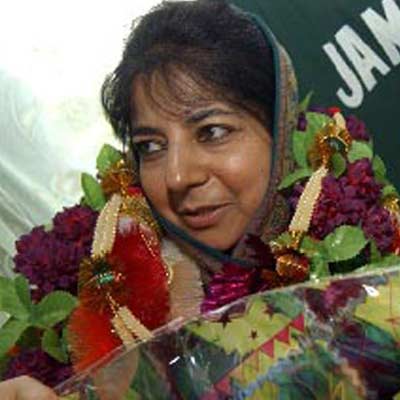
PDP leader Mehbooba Mufti today sought financial help from the Centre to rebuild health sector in Jammu and Kashmir besides a medicine bank and AIIMS-like institutes.

In the Consultative Committee of Parliament for the Ministry of Health and Family Welfare, Mufti said health sector was affected the most in recent  floods and the mountainous region of the state needed fully-equipped ambulances. Health Minister Harsh Vardhan  chaired the first meeting of the committee since the BJP government came to power.

The militancy-hit state also required trauma centres due to large scale violence and cases of road accidents, she said.

Mufti, whose party is in opposition in the state, also drew Vardhan’s attention to the non-functioning status of super-specialty hospitals in the state, saying only buildings exist and no patient care is available there.

She said there should be a nodal officer at the Centre to oversee the central-sponsored projects in the state and added that Centre should partner the state to provide health insurance to people. The premium of the scheme, she said, should depend of the financial status of the people.

Given the magnitude of damages, the situation calls for both material and technical intervention from the Centre to bring the health sector back on rails, Mehbooba told the Health Minister, according to a statement released in Jammu.

“Most of the vital diagnostic equipments including CT scans, X-ray plants, laboratories and blood banks at Srinagar’s referral hospitals – SMHS, Bone and Joints, Lal Ded, JVC and GB Pant – have suffered immense damage due to floods and needs to be restored on priority,” she said.

She also urged the Centre to ask the Medical Council of India (MCI) to relax the norms for J&K so that the newly sanctioned five medical colleges are made functional immediately to cope up with the shortage of doctors. She pointed out that the doctor-patient ratio in Kashmir was 1:1000, far below the World Health Organization (WHO) standard of 1:500.

Apart from medical colleges, Mehbooba also stressed on the need for paramedical institutes like nursing colleges and demanded the setting up of All India Institute of Medical Sciences (AIIMS) and a National Institute of Public Health in the state.

She also stressed the need for strengthening referral healthcare facilities at the district level by setting up integrated super-specialty, trauma, maternity, pediatric and other such institutions in the peripheries so that the patient rush is lessened at existing facilities in the urban centres.

“A major crisis  witnessed during floods was that due to complete breakdown of the healthcare infrastructure in Srinagar and lack of connectivity, the patients had to be diverted to less equipped hospitals both within and outside the city,” she said.

The PDP president also drew the Centre’s attention to lack of funding for equipping health care  centres with necessary infrastructure.

Due to the massive damage to major medical stores in Kashmir because of floods, there is a pressing need for ensuring adequate drug supplies to hospitals in J&K especially for patients suffering from life-threatening diseases, cancer, cardiac problems, diabetes, kidney problems, maternity problems and psychiatric disorders etc, she said.

“A drug bank should be created both at the provincial and district-levels to ensure speedy availability of quality life-saving  drugs  and surgical support on subsidised rates to the patients,” she said.

Mehbooba also called for moving the health sector from a “cure” to a “care” model and introducing Patient Protection and Affordable Care Act which seeks to link the quality of care with the cost of care.

“This law must seek to rebalance the system’s resource allocation and reward the value of care over volume of care,” she said.

She also called for focusing on primary healthcare with thrust on public-private participation in tertiary and super-specialty arenas.

source: http://www.dnaindia.com / DNA / Home> News> India / Place: New Delhi, Agency: PTI / Wednesday – October 15th, 2014

Former Maharashtra labour minister Sabir Shaikh dies

Kalyan :

Senior Sena leader and former state labour minister Sabir Shaikh died on Wednesday due to prolonged illness in a private hospital in Bhiwandi. Qureshi was 71-year-old.

Shaikh who was unmarried was living alone at Kongaon area in Bhiwandi. He was only biggest Muslim face of party who win three times MLA election and was also posted at state labour minister post during Sena-BJP government in state.

It is said that Shaikh was suffering from illness and recently he was admitted in Ved hospital in Kongaon where he died during the treatment.

source: http://www.timesofindia.indiatimes.com / The Times of India / Home> City> Mumbai / Pradeep Gupta, TNN / October 05th, 2014

Office-Bearers of MEWA

The Executive Committee of Muslim Employees Welfare Association (MEWA) was reconstructed at the Annual General body Meeting (AGM) held recently.

The following are the office-bearers unanimously elected for a period of three years, according to a press release from Secretary Shameem Ahamed: V.A. Siddique (President), Capt. Mir Afzal Hussain (Vice-President), Shameem Ahamed (Secretary), Baqar Umer Khan (Joint Secretary), Syed Ibrahim Hussaini (Treasurer), Anwar Pasha, Abdul Razak Shariff, Syed Rafiulla Hussaini and Thalath Afroze (Members) and Mir Sarfarazur Rahman and K. Shafiulla Khan (Co-opted members).

source: http://www.starofmysore.com / Star of Mysore / Home> In Brief / October 09th, 2014

Mysore’s green warrior

Heritage

Karnataka owes much of its position as one of the top-ranking horticultural states in the country to the initiatives taken by Tipu Sultan, who sent missions abroad to collect seeds of flowering plants, vegetables and fruits including the famed Ganjam fig and the Devanahalli pomelo, writes S Tahsin Ahmed.
TipuMPOs15oct2014

On December 10, 1985, when I accompanied the CBI team as the official witness in a raid conducted at Mysore during which a sword belonging to Tipu Sultan was seized, I visualised Tipu as a brave and valiant king who died fighting the British invaders. Later, I realised that Tipu Sultan was a much celebrated ruler in the history of South India not just for his military exploits, but also for his contributions in the fields of sericulture, rocketry, animal husbandary, social reforms, handicrafts, trade and commerce, etc. There is another major achievement of Tipu Sultan that has not been highlighted enough: his contribution to the field of horticulture.

In fact, Karnataka owes much of its position as one of the top ranking horticultural states in the country to the various initiatives taken by Tipu Sultan in his 18-year rule (1782-1799). Today, horticultural crops are raised on 18.99 lakh hectares of land in Karnataka, accounting for about 15.07 per cent of the total cultivable area.
What do historical records reveal?

In 1799, immediately after the defeat of Tipu Sultan, the British asked Francis Buchanan to survey South India which resulted in the publication of the historical work, ‘A journey from Madras through the Countries of Mysore, Canara and Malabar (1807)’. This book gives an interesting account of horticultural fields which were called tota, as existing during Tipu’s regime. “In the ashta gramas, there are four kinds of tota or cultivated garden lands, tarkari tota or kitchen gardens; tayngana tota (read tengina) or coconut gardens; but many other kinds of fruit-trees are planted in them; yele tota or betel-leaf gardens; huvina tota or flower gardens.” Buchanan also lists 48 vegetables grown in the areas ruled by Tipu Sultan.

Francis Buchanan took notes at lectures at the Botanical Garden, Edinburg in 1780 (before he came to Mysore) which got misplaced. Through another traveller, it accidentally reached Srirangapatna and came to the possession of Tipu Sultan. Tipu got this manuscript bound in tooled leather and added it to his big library, a reflection of his interest in botany and passion for horticulture. His library included many books on management of fruit trees.

Tipu kept up a sustained campaign against feudal chiefs called palegars who usurped land belonging to farmers. Land seized from palegars was handed over to farmers, tenants and bonded labourers. Tipu, it seems, was one of the earliest champions of the land reforms movement. Farmers were encouraged to expand the area of horticultural cultivation. Waste lands were exempted from rent in the first year of cultivation which was followed by tax concessions in the succeeding years. Incidentally, area expansion is one of the major schemes of the National Horticultural Mission today.

Tipu had a huge army and military police, to whom he gave cultivable land in addition to regular pay. Low-level workers like nirgunties were also allotted land to boost cultivation. He is the only king in the history of Karnataka who did not grant a single jahgir. These anti-feudal reforms had a far-reaching impact on the growth of agriculture and horticulture.

Missions abroad

An 80-member mission headed by Mohammed Darwesh Khan was sent by Tipu to France. The mission reached Paris on July 16, 1788, and met the French emperor and handed over a memorandum given by Tipu.
Among other things, the memorandum demanded seeds of flowering plants, vegetables, European fruit plants and trees. The mission was successful in procuring spice plants and camphor seedlings from Molucca.

A huge trade mission was sent by Tipu Sultan to Turkey which met Sultan Hameed in Constantinopole on November 5, 1787. It carried large quantities of black pepper, cardamom, sandal wood etc and succeeded in identifying an overseas market for this produce.

The mission brought back seeds of many flowers, vegetables and fruits. The famous Ganjam variety of fig was brought from Turkey.

Tipu Sultan wrote letters to the darogha at Muscat and instructed him to buy saffron seeds and date palms. The darogha was also asked to obtain silk worms from Qishm island and send them to Srirangapatna alongwith a few men knowledgeable about sericulture.

Farmers were encouraged to cultivate mulberry in their lands. In several diplomatic and trade missions sent by Tipu Sultan to countries like Muscat, Oman, Jordan, Iraq, Iran and Penang, export and import of horticultural produce was a major component.
Role of Thigalars

Tipu noticed that a class of people called Thigalars near Salem had expertise in cultivation of vegetables.

He encouraged them to migrate to Bangalore, Hoskote, Kolar, Devanahalli and Sira, which boosted the cultivation of vegetables in Karnataka. Other measures taken were to exempt farmers growing vegetable crops and cash crops like cashew, cardamom and cinnamon from payment of land revenue. The famous Devanahalli pomelo was also introduced by Tipu.

It was made mandatory for the village patels to plant avenue trees on either sides of the roads throughout his kingdom. But the interesting aspect here is that Tipu ordered planting of mango and tamarind trees among other trees which reveals that preference was given to useful trees over ornamental or just shade-giving trees.

Establishment of gardens

One wonders how Hyder Ali, father of Tipu Sultan, who was in the thick of military campaigns throughout his reign, found time to establish gardens. Hyder who had a taste for gardens (‘Char-bagh’ style), planned Lalbagh on 40 acres of land at Bangalore along the lines of Khan Bagh at Sira, established during the time of Dilawar Khan, the representative of the Moghul emperor in the South.

He imported plants form Delhi, Multan, Lahore and Arcot, apart from laying out a garden at Malvalli and another fruit garden at Srirangapatna, also called Lalbagh.
Tipu expanded Bangalore’s Lalbagh by acquiring more land. The garden was earlier known as cypress garden because the roads from the entrance to the garden and inside the garden were lined with cypress trees.

This is evident from a painting of this garden drawn on the spot by R H Colebrooke and published in 1793 at London. Another painting of the Lalbagh by James Hunter published in 1805 and showing many cypress trees is captioned ‘East view of Bangalore with the Cypress garden.’

Equally magnificent was the Lalbagh at Srirangapatna. The Gardens around the Gumbaz where both Hyder Ali and Tipu Sultan are buried were full of fruit trees, flowers and vegetables of every description. This Lalbagh is also believed to have served as a nursery for the kingdom. Fruits like apples, pears, guava and plantains were successfully grown here. Imagine apple trees in a place like Srirangapatna and that too in the 18th century! Also grown were betel nuts, coconuts, sandalwood, sugarcane, indigo, cotton, mulberry, cereals and pulses.

In the Third Mysore War (1792), the cypresses of Lalbagh at Srirangapatna were axed to provide firewood for British troops. After the war, Tipu restored much of the glory. But in the final war of 1799, British troops breached the fort wall and devastated Lalbagh. Nothing remains of this garden except a painting of the entrance to Lalbagh at Srirangapatna by James Hunter (1805).

The fruit orchard at Malavalli also no longer exists. Buchanan who visited this garden after Tipu’s death noticed 2,400 trees with mangoes and oranges in abundance. The garden surrounding the Daria Daulat Bagh at Srirangapatna was more of an ornamental garden, but very well maintained.

Tipu Sultan’s love for horticulture was so great that he linked this with dispensation of justice. For petty offences, convicts had to plant fast growing plants and for major offences, they had to plant trees like jamun, mango and coconut. In 1788, Tipu Sultan issued a circular to all amildars and in 1792 he passed a regulation that the fines of the farmers shall be commuted if the offender plants two trees, waters them and nurtures them till they reach a certain prescribed height.

Can we think of a better environmentalist among kings gone by, long before environment and climate change became fashionable slogans?

(The author is Additional Director of Horticulture (Administration), Lalbagh, Bangalore.)

source: http://www.deccanherald.com / Deccan Herald / Home> Supplements> Spectrum / by S. Tahsin Ahmed / July 04th, 2011
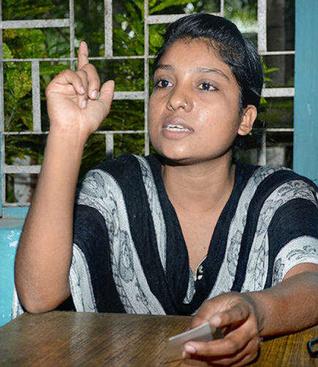
A Muslim, she looks after 14 Hindu HIV positive kids

TabassumMPOs15oct2014

by:Deepthi Sanjiv

​Tabassum faced tough opposition from family and society when she decided to work with the children

Breaking the HIV taboo is a challenging task. The moment a case is diagnosed, some families choose to distance themselves from the victims. About ten years ago, when a close friend of Tabassum died just two days after the doctors told her that she was suffering from HIV, Tabassum saw that none of her friend’s family even wanted to touch her. At this point, Tabassum was left alone to perform her last rites. That was when she decided to dedicate her life for the sake of HIV positive children. Until then, her job with an NGO was nothing more than a source of income.

Speaking to Bangalore Mirror, Tabassum said, “For the past 14 years, I have been working for HIV positive children and pregnant women. My outlook changed after this incident.” Recollecting her past, she said, “I hail from a very poor family. I secured a distinction in SSLC and wanted to study further, but my family could not afford to support my studies. I somehow managed to go up to PUC, but by then, my family got me married. After marriage, I did not want to stay at home and went on to do my degree, after which I took up a job with an NGO for the sake of a living. It is never easy for a Muslim woman to come forward and work, specially with an NGO where you deal all kinds of people. I somehow fought opposition from family and went ahead. I continue to work at the NGO even today, and at the same time since I enjoy working with kids, I took it up as a challenge and went ahead to set up my own protection care centre called ‘Snehadeep’ about two years ago,” she said.
“Strangely, I received lot of opposition; some even said it was not right for a Muslim lady to take up this responsibility. I can proudly say that at Snehadeep, I look after 14 girls in the 7-12 years age group and all of them are Hindus. There is no religion once these children fall sick. Often, their families prefers to distance themselves from the children.

More than their physical health, these children suffer from psychological pain or want of company. The bigger children scan through newspapers everyday looking for any new medicine that can cure them. They know that they will die soon. At times, convincing them to study is also difficult. When these kids are at their last stage and are shifted to the hospital, nobody from their family wants to associate with the child.

Often, they are left to die alone. I try my best to be there with them during their last stage though it is very painful and perform their last rites in the best way I can. With every death, I only pray and hope that this is last child dying before me. The initial days were a struggle. I used to go door-to-door on a Sunday asking people for help. Even a packet of biscuits for kids would make a difference. Getting funds for food is always a big task,” she said.

For Tabassum, spending time with the kids provides peace of mind. “Recently, I was very happy when a child received 92 percent in PUC. ”

source: http://www.bangaloremirror.com / Bangalore Mirror / Home> Bangalore> Others / by Deepthi Sanjiv / Bangalore Mirror Bureau / October 15th, 2014

Surgical cure for ‘silent fracture’

Kolkata :

An alarming 45 to 50% Kolkatans in the age group of 55 to 70 suffer from osteoporosis or some form of bone disorder, mentions a survey done by orthopaedics.

For about half of them, the disorder results from loss of bone density and it cripples them within two years.

“Silent fracture” of the vertebral column induced by osteoporosis is a common manifestation of bone disorder that now affects thousands in the city and 25 million across the country.

However, there is some ray of hope as a new form of treatment has emerged over the last few years to treat bone compression fractures effectively, say experts.

Balloon kyphoplasty is a technique that involves repairing a fractured and compressed bone with a balloon that’s inserted into the vertebral fracture.

It helps to restore the bone in its original position, thereby curing the resultant stoop caused by a curved spine.

The effect, according to doctors, is a long-lasting one and has helped patients improve their quality of life.

“Bone degeneration starts from the age of 45 and it gets very acute in some people. Loss of bone density leads to osteoporosis, often resulting in fracture of the spine. Once that happens, the spine gets curved, leading to a stoop that restricts movement. Balloon kyphoplasty is the only way of repairing a fracture-induced curve. But, it is used only in those who are in intense pain and have a severe stoop,” said Abrar Ahmed, orthopaedic surgeon at Apollo Gleneagles Hospital.

The surgical procedure is a simple one and the recovery time is just about two hours.

A small hole is drilled on the skin near the position of the vertebral fracture. A needle with the balloon is inserted into the fracture to lift up the bone to its normal height, thereby restoring the curve.

The balloon is then taken out with the needle and the gap is filled up with a fluid. The patient can walk within two hours of the surgery. Balloon kyphoplasty is also effective in trauma-induced spinal fractures.

“It works well for trauma patients with spinal fractures,” said Sisir Mandal, another rorthopaedic surgeon.

Experts said a simple bone mass density (BMD) test could help prevent bone compression and spinal fractures. “Those above 50 years of age, people who have been taking steroids for a long time and those with a history of bone injury or illness should undergo the test. BMD helps assess bone health and works as an alert for making pharmacological and lifestyle interventions to restore it timely. It could help to curb at least half of the spinal disorders including fractures. But, very few undergo the test on time,” said Ahmed.

The surgery is expensive, though. It costs Rs 2 lakh and is recommended only when all other forms of treatment are ruled out.

A healthy diet and a regular, active lifestyle help to slow down bone degeneration, said experts.

“Over the last decade, we have seen a major shift in lifestyle and food habits that has affected bone health. Sadly, awareness about bone diseases is among the lowest. This is probably why we have seen a spurt in the number of osteoporosis patients,” said Debashish Basu, preventive medicine expert.

Ahmed said balloon kyphoplasty was among the “safest and most advanced surgeries” of modern times.

source: http://www.timesofindia.indiatimes.com / The Times of India / Home> City> Kolkata / TNN / October 13th, 2014

Swachh Bharat Abhiyan received a huge response at the Aligarh Muslim University campus

AligarhMPOs14oct2014

Aligarh: 

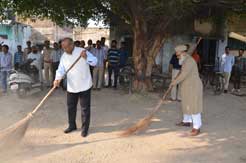
Swachh Bharat Abhiyan, an ambitious programme launched by the Government of India, has received a huge response at the Aligarh Muslim University campus. All schools, colleges, departments and Halls of residence in AMU organized cleanliness drive in their premises on a large scale.

The Pro-Vice Chancellor, Brigadier S. Ahmad Ali launched the Swachh Bharat Abhiyan in the Department of Electricity. He urged the people to adopt cleanliness as a permanent ethos of their life and work for generating awareness regarding clean atmosphere and personal hygiene. Member Incharge, Prof. Mohibullah was also present on this occasion.
Professor Naima Khatoon, Principal, Women’s College initiated the cleanliness drive and took to sweep in the college along with faculty members Professor Imrana Naseem, Dr Hina Parvez, Professor Masood Alvi, Dr Jabir Raza, Dr Shaukat Haseen and Rumana Siddiqui. A large number of girl students participated in the drive. The AMU Girls High School, Principal, Ms Amna Malik led the drive. Addressing on the occasion, she urged the students to promote cleanliness and hygiene and work for a pollution free campus.

At the Centre for Distance Education, Director, Dr Nafees Ansari started the Swachh Bharat Abhiyan and urged the students to strengthen the mission by carrying it to common people in nearby localities.

Professor Shahab F Hashmi, Provost, Hadi Hasan Hall, along with his team of wardens, students and staff members initiated the drive and pledged to maintain cleanliness in the Hall premises. The Swachh Bharat Mission was launched in Begum Sultan Jahan Hall under the supervision of Dr Seemi Hasan, Provost of the Hall. Dr Shireen Sadiq, Dr Albina Shamsi, Dr Sabiha Tabassum and Dr Sana Chaudhary, wardens, residents of the Hall and staff participated in the national initiative with great enthusiasm.

Officiating Provost, R. M. Hall, Dr Imtiaz Ahmad Khan inaugurated the campaign. All post holders and senior students of the Hall took part in the drive. At the Abdullah Hall for girl students, the Swachh Bharat Abhiyan commenced under the supervision of Dr Ghazala Parveen, Provost of the Hall and her team of wardens. The TW Hostel was awarded first prize in the Clean Campus competition.

In order to promote the campaign and create awareness about the Swachh Bharat Mission, Dr Zaheeruddin, Provost, Aftab Hall, along with wardens and office staff, carried out a cleanliness drive in the Hall premises.

source: http://www.indiaeducationdiary.in / IndiaEducationDiary.in  / Thursday – October 09th, 2014

ASI to dig out Deccani Gardens at Naya Qila

Hyderabad :

In a move that could shed more light on the important historical aspects of Naya Qila heritage complex, the Archaeological Survey of India (ASI) has started excavating the site of what was once the Qutub Shahi Gardens.

Reliable sources from the Archaeological Survey of India told TOI that officials of the Hyderabad Circle of the archaeological juggernaut conducted an inspection of the heritage precinct last week. The land is currently in possession of the tourism department and its private partner, the Hyderabad Golf Association, the sources said.

“We have received orders from the director general of the ASI in New Delhi to begin work. The intention is to expose the Qutub Shahi Gardens, also known as Deccani Gardens. Further, there has been a long-pending demand from the activists for us to begin work,” said an ASI official who did not wish to be identified.

The ASI plans to drain the land parcel of the sewage water that has been accumulated over the years. Further, the vegetation and the debris on the heritage land would be also cleared as part of the plan.

“A report by eminent historian Ghulam Yazdani explains the presence of Qutub Shahi Gardens. We are hopeful that the results will be seen within a week of the excavation,” said ASI superintending archaeologist R Krishnaiah.

Rumours about the ASI unearthing a treasure chest began spreading early last week. The ASI, on the other hand, was swift enough to deny these claims.

“There is no treasure. The land was tilled by farmers until a few years ago. All these reports are baseless,” an ASI official said.

source: http://www.timesofindia.indiatimes.com / The Times of India / Home> City> Hyderabad / TNN / October 06th, 2014

Thumbay Group among Forbes ME ‘Top 100’ in Arab world

Ajman :

Thumbay Group has crossed another milestone today. Thumbay Group has been listed in “Top 100 making an impact in the Arab World”, a list compiled by Forbes Middle East Magazine in the May 2013 Issue 14. Rankings, awards, undoubtedly play an important role in recognizing an organization’s success. Thumbay Group, UAE ranks 44 in the list of “Top 100 Making An Impact In The Arab World”.

ThumbayMoideenMPOs12oct2014

Thumbay Group, UAE established in the year 1997 has come a long way. It has developed into a conglomerate having multifarious business activities and operations spread across the globe. The Thumbay Group, UAE today is a leading conglomerate with a host of medical and healthcare institutions under its ambit. The Group encompasses Gulf Medical University, GMC Hospital and Research Centre, Gulf Medical Centre & GMC Pharmacies in Dubai, Sharjah, Ajman and Fujairah.

Gulf Medical University has a student cohort from 67 nationalities, majority of them are locals and Arabs from the GCC, medical professionals and staff from 22 countries. Patients from over 175 nationalities ranging as far as Africa, Iran, Afghanistan, Pakistan, GCC countries and Western Europe receive treatment at GMC Hospitals & Research Centre, a constituent private teaching university hospital with a capacity of 250 beds housed with ultra-modern facilities. The Group also owns and manages international chain of Health Clubs and Coffee Shoppe, Chain of GMC Diagnostic laboratories, Chain of Pharmacies, Chain of Optical Centres.

“In a short span of time we have worked our way to reach to this position today. I thank the Almighty God, the great leaders of this country, all our staff members for their continued support in achieving this proud status today. We have very big and ambitious plans and God willing with each and every immeasurable support we will be able to reach to the pinnacle of success one day” commented Thumbay Moideen, founder president of Thumbay Group, UAE.

source: http://www.daijiworld.com / DaijiWorld.com / Home> Gulf / Media Release / Ajman – May 22nd, 2013 / posted Wednesday – May 22nd, 2013