Category Archives: Community Involvement / Social Issues

Tipu’s watchtower under attack by visitors

Mangalore  :

It was meant to be a watchtower to contain enemies, but today the 224-year-old monument constructed by Tipu Sultan at Sultan Bathery is under attack from within: visitors scribbling messages on its walls and throwing garbage, including liquor bottles, all around.

The monument has fallen on hard times and been subject to vandalism as there’s no attendant to guard it. Besides, the Archaeological Survey of India’s foreman at Karkala visits the monument just once a fortnight.

The watchtower, constructed in 1784, is the favourite haunt of star-crossed lovers from the city and students of various colleges. The monument is 4km from the city and is located on the banks of the scenic Gurupur River where visitors can have the spectacular view of the Thannir Bavi and Bengre and the vast expanse of the Arabian Sea. Sultan Battery, the watch tower, is said to have been built to contain the entry of enemy battleships to the Gurupur river. The watchtower looks like a mini fortress with several musket holes for mounting guns all around.

While vulgar messages being scribbled by miscreants on the walls has been a problem for long, now many use the spot to binge. Beer bottles, cake wrappers, empty plastic bottles and bags lying around reveal what the monument is being used for in the absence of an attendant there.

ASI Karkala sub-circle foreman YB Bhajantri pleads helplessness. “The attendant posted there has been transferred to Barkur (Udupi district). The ASI gives Rs 4,500 per month for maintenance, which is hardly sufficient. I come once in 20 days, get labourers and clean up the monument structure and its surroundings,” he said.

He said rains had prevented him from visiting the monument recently and he has been informed of the grass growth and the rubbish strewn at the monument. He said that by this month-end he would get the place cleaned up again.

source: http://www.timesofindia.indiatimes.com / The Times of India / Home> City> Mangalore / by Stanley Pinto, TNN / October 20th, 2014

Khadi Utsav 2014 begins

KhadiMPOs27oct2014

Mysore :

District in-Charge Minister V. Sreenivasa Prasad inaugurated Khadi Utsav-2014 organised by Department of Industry and Commerce and Karnataka State Khadi & Village Industries Board at Nanjaraja Bahadur Choultry yesterday.

A total of 62 stalls have been erected at the Khadi Utsav which will be held till Nov. 3. Apart from our State, Khadi and Village Industries Board has given opportunity to khadi organisations from other States and NGOs to participate in the Utsav. The stalls are open from 10 am to 7 pm every day.

MLAs Tanveer Sait and Vasu, ZP President Dr. B. Pushpa Amarnath, Mayor R. Lingappa, Karnataka State Khadi & Village Industries Board Development Officer K. Sampath Kumar, District Khadi & Village Industries Officer H.S. Kamathraj and others were present.

‘Don’t you have other work?’: District Minister Sreenivasa Prasad got furious over a senior citizen’s request to close the potholes on road in the city. Reacting to the request, Prasad questioned the senior citizen saying he had asked a wrong question at a wrong place.

“We have given Rs. 10 crore for closure of potholes in city. What more do you expect us to do. Don’t you have any other work to do? Wherever we go the same question is asked,” the Minister said.

source: http://www.starofmysore.com / Star of Mysore / Home> General News  / Tuesday ,  October 21st, 2014

‘Maulana Azad Bhavan’ to come up at all District HQs

Dr. Qamar Ul Islam, Minister for Municipal Administration, Public Enterprises, Minorities Welfare and Wakf, is seen addressing a meeting in city this morning as (from left) DC Shikha, Municipal Administration Secretary Manjula and Minorities Welfare Department Secretary Akram Pasha look on.

Mysore :

“The State Government has proposed to house all District Minorities Welfare Departments under one roof to be named after Maulana Azad,” said Dr. Qamar Ul Islam, Minister for Municipal Administration, Public Enterprises, Minorities Welfare and Wakf.

Chairing a progress review meeting of the Minorities Welfare, Wakf, Municipal Administration and Public Enterprises departments of Mysore Revenue Division at the ZP Hall here this morning, the Minister said that ‘Maulana Azad Bhavan’ will be constructed at all District Head Quarters of the State to facilitate housing of all departments concerned with minorities welfare under one roof, for which the Government has already released Rs. 50 lakh for Mysore.

Dr. Qamar Ul Islam sought details of minority student-scholarship scheme, when the Minister was told that the Minorities Welfare Department in Mysore had received 10 lakh applications (2014-15) this year as compared to the previous year’s (2013-14) number of 7.56 lakh.

The Minister was told that the applications were received only through online, in order to remit the scholarship amount directly to the beneficiary student’s account.

The Minister was also briefed on the functioning of Minorities’ student hostels in districts coming under Mysore region.

source: http://www.starofmysore.com / Star of Mysore / Home> General News  / Monday ,  October 20th, 2014

Saleem holds traffic grievances meet

SaleemBF24oct2014

Mysore :

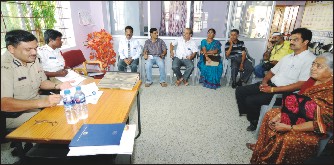
City Police Commissioner Dr. M.A. Saleem conducted monthly traffic grievances meeting at V.V. Puram Traffic Police Station along with Traffic Inspector Susheela this morning.

Around 20 citizens residing at V.V. Puram, Vontikoppal and surrounding areas who participated at that meeting complained about traffic problems being faced near Surya Bakery Circle in Hebbal, lack of walkways for pedestrians and parking facilities near Mathrumandali Circle at V V Puram, rash and negligent driving by KSRTC drivers, cattle menace on roads and other issues.

After listening to the complaints, Dr. Saleem said that the City Police were enforcing strict traffic rules and regulations to prevent violations in city. He said that the department had booked 3.12 lakh cases last year and collected Rs. 3.95 crore as fine amount and this Rs. 5 crore had been collected from 5 lakh cases booked so far this year.

The Government of India has also proposed to amend Motor Vehicle Act which will increase the fine amount to a minimum of Rs. 500 which will help in reducing the traffic offences.

Today’s meeting lacked the presence of local corporators who play a major role in educating the local residence and business establishments to co-operate with the City Police in enforcing the traffic rules and regulations.

He also said that City Police Department would be installing eight additional traffic signals which is sponsored by Infosys. Dr. Saleem added that traffic signals would be installed at Metagalli Police Station junction, Surya Bakery junction in Hebbal, Bharath Hospital & Institute Of Oncology junction in Hebbla, Infosys junction, Rane Madras junction and other three junctions which are yet to be identified. Similar grievances meetings were held at various Traffic Police Stations across the city this morning.

source: http://www.starofmysore.com / Star of Mysore / Home> General News / Saturday ,  October 18th, 2014

Ghostly grandeur of Fatehpur Sikri

Fatehpur Sikri :  Revisiting Akbar’s Masterpiece
Lucy Peck , Roli Books, 2014, pp 145, Rs 795

As I flip through the pages of this handy hardcover with its lacy jharokha artwork that recalls the rosy orange sandstone elegance of its subject, my mind rewinds to my own Fatehpur Sikri experience, years back — the ghostly vacant expanse of a Mughal city, a beautiful haunting, desolate oasis of huge stables, green gardens, a musically serene marble mausoleum to a Sufi saint, as well as the high and mighty Buland Darwaza off whose walls boys jumped, for a few paise, into a baoli stepwell all the way below. So it’s been a pleasure to revisit this masterpiece from the 16th century, a period of Renaissance under the relatively benign Mughal, Akbar.

In this new book, architect, conservationist, Mughal-India specialist author Lucy Peck attempts to dispel popular myths that accompany this well-preserved piece of history, the abandoned city of Fatehpur Sikri. The very first page sports an exquisite ‘company’-style painting from 1836, depicting the marble dargah of Sheikh Salim al-Din Chisti, the saint who satisfied Emperor Akbar with the happy prediction of a long-awaited heir (PrinSalim, later to become King Jahangir), and two more to boot. Ironically, this city of victory, an enigmatic, silent, solid, spectator from the past, owes its own birth to the progeny-predicting powers of a Sufi sheikh.

The remaining 130-odd pages are equally satisfactory, glossy and replete with well-researched text, conjectures and surmises, interesting trivia, paintings, maps and excellent photographs, old and new, overall perspectives, as well as close-ups of the designs that grace lintels, awnings, and all the minutiae of mahals adorning a geometrically designed Indo-Persian city.

Peck is on sure ground as she collates information from diverse sources — the skeptical yet informative Muslim cleric Bada’uni, the official biographer Abu’l-Fazl with his Akbarnama and Ain-i-Akbari, Latin memoirist Monserrate — people who lived in Akbar’s court during his reign. Peck also quotes from a few 17th-century European travellers — like Peter Mundy and William Finch. She simultaneously reveals that many travellers’ tales and court records have not survived the centuries.

Unlike historian John Keay, who refers to Fatehpur Sikri as Akbar’s ‘wildest extravaganza and weirdest folly’, Peck is kinder to Akbar. She talks of the ‘romantic enigma’ that was Fatehpur Sikri, a city that was planned and built quickly from 1571 to 1585, and then equally promptly abandoned, as per general belief. Yet, Peck believes ‘that the fable of Fatehpur Sikri’s desertion is misleading’.

The king and his courtiers left, but some ladies of the royal family (including Akbar’s mother) lived on for decades, as did members and descendants of Sheikh Salim Chishti’s family, a few of whom became powerful members of the royal court. In subsequent years, a few became unofficial guides to gullible international travellers who furthered the spread of myths about the city. Lucy Peck attempts to deflate a commonly held myth about water shortage leading to Fatehpur Sikri’s abandonment. She points to the presence of numerous baolis (stepwells), taals and hammams (royal and common baths), as well as the historical reality of later Mughal construction continuing in and around Sikri village that strides a ridge plateau beside a lake (now farmland) formed by the Yamuna basin.
The author transports the reader through Akbar’s world and his times, delineates his character and philosophy personified in his syncretic sect, the Din-i-Ilahi, which was the very touchstone of his own and the new city’s existence. Through his years at Fatehpur Sikri, Akbar became less and less Islamic, more all-encompassing and secular, filling his court with people of diverse faiths.

The visual delight that is Fatehpur Sikri — with its unique architectural specialties like a single central-columned Diwan-i-Khas, the multi-gated three-sided wall, the lesser-known, interestingly named buildings like Samosa Mahal and Tansen’s Biradari — cannot blind one to an important truth: that this city continues to be a holistic experience, traversing the centuries, still speaking to us. And Lucy Peck’s book helps greatly in this process.

source: http://www.deccanherald.com / Deccan Herald / Home> Supplements> Sunday Herald Books / by Lalitha Subramanian / October 19th, 2014
73 students from Jamia Residential Coaching clears IAS Prelims

New Delhi:

Seventy Three students from the Residential Coaching Academy run by the Centre for Coaching and Career Planning, Jamia Millia Islamia, New Delhi, have cleared Civil Services (Preliminary) Examination 2014. These students appeared at the civil services (Prelims) examination conducted by the Union Public Service Commission on 24th August, 2014.

The Residential Coaching Academy in Jamia Millia Islamia, funded by the UGC, offered free coaching and residential facilities to students belonging to SC, ST, Women and Minorities. They were selected for comprehensive coaching on the basis of an all-India written test followed by individual interviews. They were subsequently taught in a variety of optional and compulsory subjects. Classroom teaching was followed by test series. The students received feedback on their individual performance in respect of various tests.

Jamia’s Residential Coaching Academy has distinguished itself as a unique centre where civil-service aspirants find an enabling environment. Highly responsive faculty, round-the-clock library facility, interactive sessions with invited speakers and guests, personal endeavours and group synergy prepare students for the kind of aim they are set to realize. This has been borne out by the results they have shown now and earlier. In addition to the civil services, many students of the Centre for Coaching and Career Planning get selected in a variety of central and state service.

Prof. Talat Ahmad, Vice Chancellor, Jamia Millia Islamia has already initiated measures to strengthen the functioning of the Residential Coaching Academy. Dr. Saleem Ali, IPS (Retd.) has been appointed as Honorary Director, Centre for Coaching & Career Planning since August, 2014. Last year 53 Jamia students had cracked civil services preliminary examination.

source: http://www.twocircles.net / TwoCircles.net / Home / by TCN News / October 21st, 2014

A smile worth a crore, but she’s worth it

Ranchi :

It costs over Rs 1.2 crore a year to keep her healthy, a sum her petty plywood trader father in Kantatoli can’t imagine.

Ranchi girl Sadaf Naaz (19), who suffers from Gaucher’s disease that strikes one in 100,000 people, is getting a sponsor for the enzymes she needs six years after her diagnosis.

UK-based Shire Pharmaceuticals Limited has started sponsoring expenses incurred on her enzymes and medicines that will annually cost over USD 200,000 (around Rs 1.2 crore). Sadaf got the first dose at AIIMS, New Delhi, on October 1 and second on October 15. They have called her again after a fortnight.

Like any rare disease, Gaucher can fox experts. It occurs when a lipid, glucosylceramide, accumulates in the bone marrow, lungs, spleen, liver and sometimes the brain.

In layman terms, it means Sadaf has lived with liver malfunction for as long as she can recall. Gaucher’s disease also causes patients to bruise and break bones very easily. Lungs don’t function well, too.

Sadaf was diagnosed with Gaucher’s disease at Christian Medical College (CMC) in Vellore in 2008. Before this, she underwent a liver operation at AIIMS, but her disease was undetected. That wasn’t surprising, considering that the genetic enzyme disorder occurs mostly among Jewish children of Eastern European descent.

Once her disease was diagnosed, Sadaf’s parents Muzib Quraishi and Shabnam were faced with the spectre of sponsorships. Regular enzyme replacement being the only treatment, it was soon clear to the parents that only movie stars and industrialists could afford it.

Ranchi-born Brooklyn paediatrician Jamil Akhtar offered to appear before the medical board at AIIMS to explain her case and find sponsors in the US. But, he wasn’t called. The Gaucher Foundation, US, apparently didn’t show much interest. Neither did the Indian government.

Time ticked by, making her parents desperate. This February 28, Muzib and Shabnam stormed a meet on the disease at NIMHANS, Bangalore, where eminent doctors and pharma companies from across the world had come.

“We threatened to immolate ourselves before them if our daughter was left doomed to die a painful death. Seeing our child suffering made us desperate. That’s when AIIMS doctors Neerja Gupta and Madhulika Kabra heard us out,” said mother Shabnam.

The AIIMS doctor duo spoke to representatives of UK-based Shire about Sadaf. “Things looked up,” she said.

Father Muzib added that when the UK pharma firm decided to sponsor Sadaf’s treatment, they gifted her a new life. “Special thanks to The Telegraph for its coverage. The news reports played a crucial role,” he smiled.

source: http://www.telegraphindia.com / The Telegraph, Calcutta / Front Page> Story / by Sudhir Kumar Mishra / Ranchi – October 21st, 2014

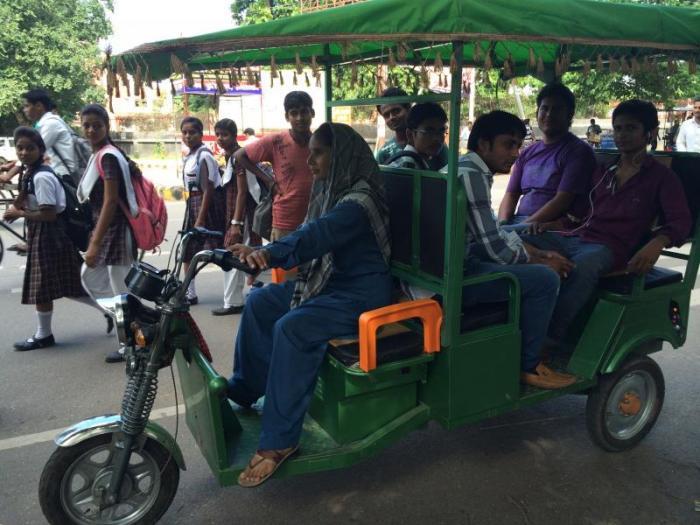
Meet Tabassum Bano – the first female e-rickshaw driver of Allahabad

Tortured by her in-laws for dowry, Tabassum was thrown out of the house with her six months old son, she decided to not give up.

Tabassum Bano riding the e-riskshaw  - Mohammad Anas
Tabassum Bano riding the e-riskshaw – Mohammad Anas

Tabassum Bano decided to fight and not surrender despite facing so many hardships some years back. She had been tortured physically and mentally by her in-laws for dowry, she was thrown out of the house with her six months old son, but Bano didn’t give up. She braved all the difficulties and challenges of her life. Confident and self dependent, Bano has set an example of courage as the first female e-rickshaw driver of Allahabad.

“I came to Allahabad in the year 2005. My family lives in a small village Narsimhagarh in Pratapgarh. One year after marriage, my in-laws started torturing me for more dowry. My son was just six months old at that time. One day they even took my clothes off and threw me out of the house. Tired of their torture, I had even thought of committing suicide, but my child gave me the reason to live and fight,” Bano broke into tears as she narrated her life story to iamin.

“Finally, I decided to get divorce from my husband and made up my mind to come to Allahabad and start a new life. With just two rupees in hand and my son in my arms, I began my journey from Pratapgarh by foot and reached Allahabad after walking 50 kilometres. Once when I wa at new Yamuna bridge, out of hunger, my son started crying uncontrollably and I became restless and helpless in this unknown city. An old man saw us and brought us to Sister Sheeba Jones. My life changed since that day,” said Bano who lives in a rented room at Teliyarganj colony in Allahabad with her son.

Bano gives the credit to Sister Sheeba for changing her life. “Sister Sheeba first taught me how to ride a scooty and then four-wheelers.” Besides riding the e-rickshaw, Bano also works as a maid in houses to bear her expenses of her family members.

Yes, apart from her own son, Bano is taking care of six other members of the family. “After my brother-in-law’s death, I took care of my sister and her three children. My brother died in the year 2011 and his daughter is also my responsibility. There is no male member in our family. I take care of my old mother too,” said Bano.

Besides work, Bano who was an illiterate before coming to Allahabad started studying and cleared class X examination. Her son Abdullah studies in a reputed English school in the city. “I want a better life for my son so, I work hard to send him in a good English medium school.”

Sharing her experience as a female e-rickshaw driver, Bano asserted, “I want to change people’s attitude towards women. There are different types of people in our society. Some people stare at me awkwardly while some praise and encourage me. I want to show that women are strong and can face challenges.”

Bano also uses her scooty to carry people. She sometimes drops school children to their homes free of cost in her e-rickshaw. Tabassum is surely an inspiration for women in the country.

source: http://www.iamin.in / I am in DNA of Allahabad / Home> Allahabad> Trending News / by Mohammad Anas, Edited by : Longjam Dineshwori/ Tuesday – October 21st, 2014


Mammootty’s ‘My Tree Challenge’ a Hit Abroad, Accepted by Australian Mayor

Kochi :

The ‘My Tree Challenge’ campaign, launched by actor Mammootty recently for planting trees, has crossed the oceans and reached other continents, with an Australian mayor accepting the challenge.

Stuart Slade, Mayor of the Glenorchy City Council, has planted a gumtree at the Tolosa park in the capital of Tasmania, an  island city in Australia.

The mayor, who named the tree ‘Gandhi’ as  an honour to Mahatma Gandhi, has also challenged the mayors of Melbourne, New York, Paris and London to plant trees.

Slade thanked Mammootty for the concept, while acknowledging it as a solace to the  planet that is fast becoming polluted. He also invited Mammootty to Tasmania, and urged him to pay respect to the Gandhi tree.

The Mayor, who is an enthusiast of India and the country’s development, came to know about the My Tree Challenge from Sajini Sumar, chairperson of the Multi-cultural Women’s Council of Tasmanaia.

The My Tree Challenge, a campaign involving planting of saplings and challenging others to do so, was launched by Mammootty on August 30 – inspired by the ‘Ice Bucket Challenge’. He had asked Bollywood actor Shah Rukh Khan and Tamil actors Vijay and Suriya to take up the challenge.

Mammootty had also planted a tamarind tree on the premises of Grand Hyatt Hotel, Dubai.

source: http://www.newindianexpress.com / The New Indian Express / Home> States> Kerala / by Express News Service / October 21st, 2014

Cyclone memorial cries for attention

Structure built to remember 30,00 who died in cyclone

A view of cylcone victims memorial constructed during British rule at Gilakaladindi near Machilipatnam in Krishna District of Andhra Pradesh. Photo: Ch. Vijaya Bhaskar / The Hindu

People tend to recollect harrowing times of Diviseema uppena, a cyclone that devastated Machilipatnam, whenever a cyclone hits the State. But, here is a cyclone memorial which has faded in the memories of times gone by.

Great tragedy

Close to 30,000 people were swept away by the giant ocean wave over Machilipatnam town on the night of the cyclone of November 1, 1864. Following the great tragedy, Manuel Fruvall had constructed the memorial in the memory of his brother’s family and 30,000 people of this tiny town who died in the cyclone, at Bandarkota village near here.

A plaque put up outside the this monument says that the memorial was constructed in remembrance of Anthony and Maria Fruvall, their sons Peter Manuel and Daniel and their daughter Honey and her children Joseph and Georgiana and 30,000 people who were swept into the eternity by the ocean.

In 1860s, the total population of the town was around 60,000. In remembrance of then Machilipatnam Chief Magistrate G. Thornhill, who strove to control post-cyclone deaths due to spread of several diseases, Mr. Fravell also dedicated the memorial to him, says amateur Historian Md. Silar.

Many people of the town do not even know where the monument is located there. But, fishermen community in the vicinity recollected that thousands were killed in 1864 cyclone.

Many demanded that the government come up with a plan to restore and preserve the memorial.

Mr. Silar says that the monument commemorates the fate of thousands of people.

The memorial withstood vagaries of nature. But, now stands testimony to negligence by government machinery.

Dilapidated monument

The dilapidated monument is surrounded by the bushes and trees. “Our repeated appeals to the District Collector and authorities concerned to protect the heritage fell on deaf ears,” he adds.

source: http://www.thehindu.com / The Hindu / Home> News> Cities> Vijayawada / by G. V. R. Subba Rao / Machilipatnam – October 16th, 2014