Category Archives: Community Involvement / Social Issues

Book on Muslims living in Assam

Guwahati :

Al-Ameen Welfare Society, an NGO, today announced to take up more initiatives under its project to educate the younger generation about the rich history and heritage of Muslims living in Assam.

The project has come at a time when indigenous Muslims in the state are facing an identity crisis because of unabated influx of immigrant Muslims from Bangladesh.

As part of the comprehensive project, a book on the history and society of Assamese Muslims was released at Srimanta Sankaradeva Kalakshetra here today. Renowned educationist Mohd Taher is the brain behind the project.

Former president of Asam Sahitya Sabha, Birendra Nath Dutta, while releasing the book, said Al-Ameen’s project is very exciting and would highlight how indigenous Muslims have contributed to the assimilation of the greater Assamese society.

Mohd Taher said the project would research and record its findings in the following five volumes, the history and heritage of Muslims of Assam, ethno-cultural study of Muslims in Assam, a study of the old historical mosques, mazarsdargahs, Wakf properties, study of Assamese Islamic literature and geographical distribution of Muslims of Assam and their socio-economic status.

Taufiqur Rahman Borborah, secretary general of Al-Ameen, said though Muslims living in the state for years maintained their religious identity, they assimilated themselves fully with the greater Assamese society in all other aspects and became an important constituent of Assamese culture and heritage. “We felt that the rich cultural heritage and contributions of the Muslims must be recorded for posterity and have thus taken up the project. It is sad that many of the younger generation are not aware of such a rich heritage. We hope that the project would be able to enlighten the future generation of Assamese Muslims about their glorious past,” Borborah said.

Borborah, who was also the principal of Assam Medical College and Hospital in Dibrugarh, said the book on Assamese Muslim history and heritage would be translated into English and published in an e-book format to let the world know about the rich background of Assamese Muslims.

Syed Tanwir Alam, assistant professor of microbiology at Gauhati Medical College and Hospital, who was present during today’s book release function, said Al-Ameen’s project would help the younger and future generation of Assamese Muslims to know their roots. Alam said the history, heritage and contributions of Muslims to the larger Assamese society should be studied, probed and recorded.

source: http://www.telegraphindia.com / The Telegraph, Calcutta / Front Page> North East > Story / by Our Correspondent , Guwahati – November 10th / Monday – November 11th, 2013

Truths that Hurt and Heal

Azadi’s Daughter: Journey of a Liberal Muslim

By Seema Mustafa, Imprint One, Rs 395

Real picture
Real picture

A book written by a Muslim woman about issues of national importance is sure to be taken seriously. Though the book under review talks about the contemporary Muslim psyche, it is also a commentary on the country, its politics and the mindset of its people.

The word ‘azadi’ in the title can be read as ‘freedom’. But Azadi is also the name of the author’s mother. Seema Mustafa writes without inhibition. The book, as she says in the preface, was born out of her discussion about the ‘Muslim mood in India’ with one of her colleagues. The book combines many things: communal riots, the Gujarat pogrom, army repression in Jammu and Kashmir and the Northeast, terrorism, the Sachar report, the question of reservation, the condition of women, the effect of 9/11 on Muslims in India and abroad, apprehensions and dreams of the Muslim youth. It mentions some instances of repression by the police that are shocking, since they violate the notions of democracy and secularism. Anger, fear and sorrow are palpable in the accounts. But Mustafa is optimistic about the Muslim youth, and has an abiding faith in secularism and democracy.

The book records the life of a Muslim lady brought up on liberal values. It also offers a dispassionate view of the Muslim community in India. The account may help to change the stereotypical ideas about the community, its youth and especially its women. It tells us how Muslim girls, even in villages, want to be educated. Mustafa shows how the community is neglected, discriminated and repressed by the insensitive State machinery. But the young men and women of the community still have not lost faith in democracy and a pluralistic society. They want to acquire modern education and lead a better life.

Mustafa identifies a marked shift in Indian politics over the decades, especially after the demolition of the Babri Masjid. She also points to the apathy of political parties about the damage to the secular fabric of the country. Unlike journalists who resort to euphemism when talking about communal issues, Mustafa speaks candidly. She recalls the brazenness with which the Babri Masjid was razed to the ground and the brutality of the 1984 riots. The government, on both the occasions, did not even try to put up a resistance. The violation of human rights in the treatment of Muslim youths picked up in Hyderabad and elsewhere by intelligence branches should be an eye-opener. If Mustafa is angry, she is also worried that the country is being hijacked by communal elements.

Mustafa has the mind of a true journalist; that is her strength as well as her weakness. She weighs everything on the anvil of logic. Her language fails to come out of the confines of journalistic parlance, but she remains true to her purpose of presenting the real picture. Mustafa speaks from a strong sense of injustice. She staunchly criticizes fundamentalists of every community. Even with her elitist background, she feels more for the poor people of her community than the conservative mullahs.

source: http://www.telegraphindia.com / The Telegraph, Calcutta / Front Page> Opinion> Story / Friday – February 08th, 2013

NGO to chronicle Muslim history

Guwahati :

The Shillong Muslim Union, an NGO of prominent Muslims, has started a project to chronicle the contributions and history of the Muslims in Meghalaya.

The general secretary of the NGO, Sayeedullah Nongrum, told this correspondent that the union, since its inception in 1905, had been rendering service to the minority community in particular and people in general for social, cultural, religious and humanitarian causes in Meghalaya.

He said the union had been growing and expanding its work right from British India to pre-Partition days and also from undivided Assam to the present state of Meghalaya with its headquarters at Laban, Shillong.

“Right from setting up a college for poor students, an orphanage, a big idgah and a mosque exclusively for women to offer prayers — the union has already several projects. Though Christianity is the main religion in Meghalaya, there are about three lakh Muslims residing in the state. They are hard working and peace-loving people trying whatever they can do — something worthwhile — for the welfare of all people in the state,” Nongrum who is also a sitting MLA said.

The Muslim population particularly in Shillong comprises Khasis, Assamese, Bengali, Hindi and Nepali-speaking people.

Nongrum said the union had now decided to work on a project to chronicle the rich contributions and history of the Muslims in Meghalaya.

He said the union would first publish a comprehensive book highlighting various Muslim individuals and their works.

“So the union requested its members and a Muslim who once resided in Shillong to join the project for its success. If anyone is associated with the union, he or she is requested to give us details of the particulars by either writing to our websitewww.umshyrpicollege.org or to our office address at Laban, Idgah Complex, Shillong,” Nongrum said.

source: http://www.telegraphindia.com / The Telegraph, Calcutta / Front Page> North East > Story / by A Staff Reporter, Guwahati – March 15th / Friday – March 16th, 2012

Former Kodagu ZP Vice-President Iqbal Hassan shot dead

IqbalHassanMPOs24sept2014

Virajpet :

Local Congress leader and former Kodagu ZP Vice-President Iqbal Hassan (46), was shot dead in broad daylight by unidentified assailants at Virajpet town in Kodagu district on Wednesday.

Iqbal was taking his seat for having lunch at a hotel in the busy Gadiyara Kamba area of the town at about 2 pm, when one of the two miscreants who came in a maroon coloured Maruti Alto car shot him in the chest, killing him instantly.

The miscreant reportedly fired another round which hit another person by name Chandrasekhar, a resident of Shivakeri, who was having lunch in the hotel, injuring him on his leg and chest. He was immediately rushed to Virajpet Government Hospital, from where he was shifted to Madikeri Hospital for advanced treatment. The miscreants managed to flee in the car in which they had come.

It is said that Hassan was reportedly involved in a dispute over a property with one Moosa, his neighbour, which had resulted in a clash between the two rival groups a few days ago, with both the groups complaining to the Virajpet Police.

Following the complaint and counter complaint, the Police had summoned both the groups to the Police Station yesterday and had succeeded in making both the groups arrive at a compromise, it is learnt.

The deceased Hassan is survived by wife and two sons aged 15 and 12. On hearing the news, residents of Virajpet town and surrounding areas streamed into the hospital and demanded arrest of the culprits.

Iqbal Hassan, who was associated with the Congress was serving as on office-bearer of the party’s Kodagu District Minority Cell.

He was elected to Kodagu ZP from Kadanur Constituency in Virajpet Taluk and served as ZP Vice-President from July 12, 2000 to March 12, 2002. He had also been ZP incharge-President for some time.

IGP (Southern Range) B.K. Singh, Kodagu SP Varthika Katiyar and other senior officials rushed to the spot. The Police have stepped up security in Virajpet Town following the murder.

source: http://www.starofmysore.com / Star of Mysore / Home> General News / September 18th, 2014

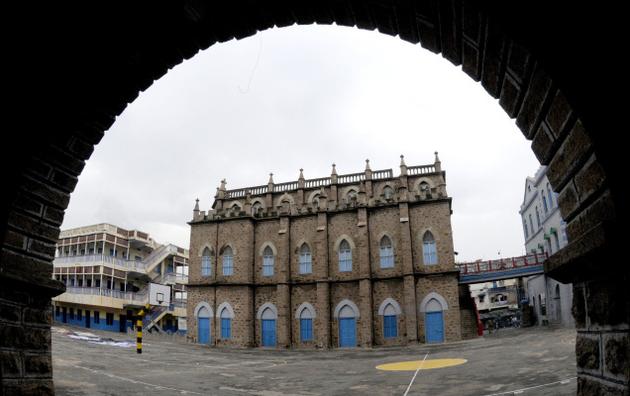
A trip down the memory lane: St. Aloysius High School

A view of the chapel on the St. Aloysius High School premises, the oldest English medium school in Visakhapatnam./  Photo: C.V. Subrahmanyam / The Hindu
A view of the chapel on the St. Aloysius High School premises, the oldest English medium school in Visakhapatnam./ Photo: C.V. Subrahmanyam / The Hindu

Six classmates of the 1961 batch of St. Aloysius High School met after five decades at their alma mater. Reminiscing the old days, Narayanswami, who played cricket for Andhra, said it was in this courtyard that he picked up the rudiments of the game.

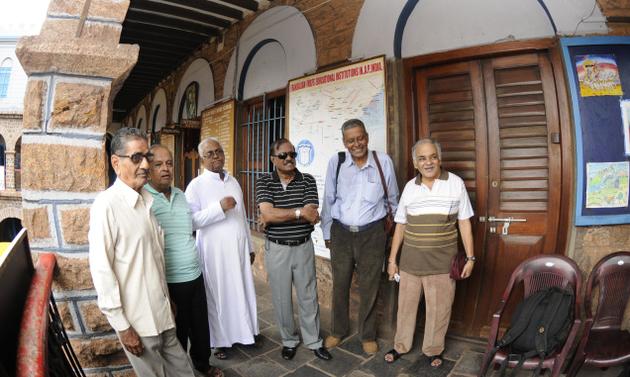
A group of six classmates met after five decades to relive their naughty days at St. Aloysius High School, here on Saturday.

Though, into their late 60s and early 70s none appeared to have lost his youthful vigour. Hopping from one classroom to another, going around the expansive courtyard, and calling their buddies by their nicknames, the six went on a nostalgia drive.

A group of seven friends who studied in St. Aloysius High School meeting after five decades on the school premises to relive the old days in Visakhapatnam on Saturday. Photo: C.V. Subrahmanyam / The Hindu

The old students of the 1961 batch who met were P.R. Narayanswami, former Director of Physical Education in Andhra University, M.A. Raihan, former Commander in the Indian Navy, V.N. Natarajan, Chief Manager of Indian Overseas Bank, Fr. George Kottam, Arun Panse, former Hindustan Shipyard employee, and Md. Ali Khan, a retired officer from the Visakhapatnam Port Trust.

Accompanying them was Rohinton Kapadia, who was a couple of years junior to them in school.

Incidentally, Fr. Kottam was not only an old student but also principal of the school during early 1980s.

Reminiscing the old days, Narayanswami, who played cricket for Andhra, said it was in this courtyard that he picked up the rudiments of the game.

“We are always ahead of the rest in athletics and games. We had the best boxing team in the district. In fact, ours was the only school that had a proper boxing ring. Even the ENC, then INS Circars, would borrow our ring for their tournament,” said Raihan.

We also had a strong NCC contingent and 80 per cent of our students were from the Anglo Indian and Muslim communities. But we never experienced any sort of discrimination based on religion, caste, or creed, said Arun Panse.

On how strict was the school, they came out in chorus, “Fr Eliemeynet, a French national, who was our principal, and our teachers were strict, but they gave us the rope to be mischievous too.”

According to Fr. Kottam, the schooling then was about holistic learning.

For Md. Alikhan, the association with the school has been for three generations. His son also studied in the school and now his grandchildren are studying there

source: http://www.thehindu.com / The Hindu / Home> News> Cities> Visakhapatnam / by Sumit Bhattacharjee / Visakhapatnam – September 21st, 2014

Needed in Aligarh, bookstores

ALIGARH: Reading The Fault in Our Stars, now that social media is abuzz with talks of the film adaptation of the book, maybe a tad difficult if you live in Aligarh. Despite the city being home to one of the country’s most prestigious educational institutions – Aligarh Muslim University – the absence of a good bookshops selling fiction, non-fiction or, for that matter, anything beyond prescribed reading material for students is quite a telling let-down.

“The city has somehow never really felt the need to have the kind of arrangement where you can go and buy fiction in a store that’s well-furnished with eclectic literary offerings,” says Shubhangini, a CAT aspirant. “Although there is not much of a choice when it comes to book shopping, it doesn’t mean people in Aligarh are not aware of the current scenario in the world of literature. Popular books can be procured through some of the stores by placing an order and paying a commission.”

There are nearly 100 bookshops functioning for decades in Aligarh, but they mostly cater to the madrassa-going students and sell Urdu literature. And almost all stores stock reading material that help in preparations for competitive examinations. This leaves the lover of fiction/non-fiction with little choice but to tap online sources or place an order at a bookshop, which may take anywhere between a week and 10 days (depending on availability) to deliver. The other option is to travel down to Delhi or the National Capital Region and go on a book shopping spree or, if one is a student, rely on AMU libraries to satiate the inner bibliophile.

Though education fairs are common in Aligarh, book fairs are few and far between. “It is a small city without much tourist inflow. So, there are not many stores that sell popular books. There are far more education fairs than book fairs here,” says Sandeep Choudhury, who recently organized an education fair in the city.

Students being on the look-out for better opportunities and job prospects have prompted even the oldest bookstore in the city – Malviya Pustakalaya – to stock books for competitive exams and recruitment tests. Malviya Pustakalaya, incidentally, has one of the most valuable collections of literature, religion, philosophy and Hindi novels.

“These were ordered, so we got them,” says Sanjeev Agarwal of Vimal Book Store, pointing to a stack of popular fiction and non-fiction reading material. It was only recently that 1 % of the shop’s stocks began comprising authors like Arundhati Roy and William Dalrymple. “Earlier, there used to be a store selling fiction but now it has shut down, probably because of dipping sales.”

However, what makes Aligarh unique to bookworms is its repository of Urdu literature. Home to a substantial number of madrassa and AMU students, the city’s stores have an enviable collection of fiction and non-fiction by Faiz, Firaq and Ghalib. “Urdu works are most popular as a lot of retired professors or students from madrassas or AMU reside here,” says Asad Faisal Farooqui, who frequents the Education BookHouse established in 1927.

“It is interesting to see modern English literature being translated into Urdu for them,” he says, adding, “Students have bought Urdu translations of books by Jaswant Singh, Irfan Habib and also religious texts, including translations of the Bhagvad Gita.”

However, the trend does not go beyond prescribed reading material or books talked about in popular media. As Ashok Kuckreja of Aligarh Law Books, says, “Students buy what their professors recommend, which may be pertinent to one’s course but may not help build a larger reading repertoire.”

The experienced bookseller rues never being asked for books by, say, legal humourist Marc Galanter or by the likes of AP Herbert. “Not even 1% of that genre is ordered here, I have tried so many times to bring to their notice the works of Edward Heward on Lord Denning, John Mortimer’s ‘The Devil’s Advocate’ and Krishna Swamy’s work on V R Krishna Iyer, but there is no interest,” Kuckreja says.

source: http://www.timesofindia.indiatimes.com / The Times of India / Home> City> Agra / by Eram Agha, TNN / September 22nd, 2014

Gandhiji’s visit to Bangalore and meeting with Mir Hamza Hussain

Sir,

This is in response to Prof. A.V. Narasimha Murthy’s write-up on Gandhiji’s visit to Bangalore in SOM dated Sept. 7. This is to share one more information with the readers.

The bungalow that Gandhiji stayed in Bangalore was the Kumarakrupa. Gandhiji also made a visit to look up Mir Hamza Hussain, the former Inspector General of Police and the member of the Council of the Princely State of Mysore, at his Binfield residence, No. 87, Richmond Road, Bangalore -25. This was a visit to look up Hamza Hussain who was unwell at that time.

Sajjad Hussain, the grandson of Mir Hamza Hussain, recalls the visit. The family had placed a chair next to the patient’s bed for Gandhiji. But he chose to sit on the bed. The topic of discussion was the Dalit movement which was in its peak.

Mrs. Hamza Hussain handed over the gold bangles she was wearing to Gandhiji for the cause. The grandson also told me that his father, Mir Iqbal Hussain, who was the Chief Justice of the High Court of Karnataka, had written about this in the Deccan Herald long ago.

Prof. Shakira Khan, Teacher Fellow, Department of Political Science, Kuvempu University, Shimoga 

14.9.2014

source: http://www.starofmysore.com / Star of Mysore / Home> Voice of the Reader / September 17th,  2014

Jhelum of poet’s muse claims his house


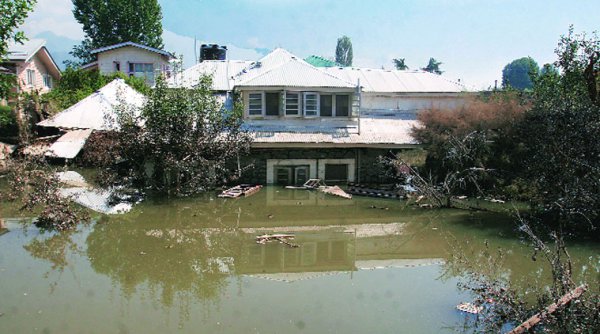
Agha Shahid Ali’s submerged house in Srinagar’s Rajbagh. ( Source: Express photo by Shuaib Masoodi )

The Jhelum flowed through many of Kashmiri poet Agha Shahid Ali’s poems. “When I return, the colours won’t be so brilliant, the Jhelum’s waters so clean, so ultramarine. My love so overexposed”, he wrote. Shahid’s home, his wooden desk, a rocking chair, books and papers are now under Jhelum waters.

This hut of a house of two floors, lower than the nearby road, and nestled in a wild garden in Rajbagh had become the international address for Kashmir’s literary scene. Shahid, who brought into focus Kashmir’s tumult through his poems, grew up here. He later kept returning from the US where he taught at Amherst College till his death in 2001.

A piece of old architecture, this house was Shahid’s last memory in his home city. Its rooms and the hundreds of documents, photographs and books they contained were a reminder of the poet who introduced the ghazal form to English. Today all is submerged and probably destroyed. When Shahid’s father Agha Ashraf Ali was rescued from the house in a rush, nothing else could be saved.

While the deluge has ravaged Srinagar’s roads, buildings and homes, it has also taken away something more precious — invaluable parts of Kashmir’s history and culture. Flood waters have entered the government archives, cultural academy, the building housing Srinagar’s museum and several other libraries. The flood has also destroyed scores of private collections of texts, rare religious manuscripts, letters and other important connection to Kashmir’s past.

A mile from Shahid’s home, the Valley’s best known artist Masood Hussain said he could only save his latest work: seven paintings based on Shahid’s seven couplets that he had promised the poet before his death. “When the flood came, it submerged everything in my neighbourhood,’’ Hussain said. “My brother had two rubber boats but in those hours of crisis, I forgot everything and helped rescue some 40 people. Several houses around my home collapsed.”

A Kashmiri journalist had a 250-year-old copy of the Quran that had been passed from generations in his family. He could not take it out when the flood rushed into his house in Rajbagh. A resident of Tulsibagh had letters from 1890, documenting those times, preserved in his home. They are gone too.

Idrees Kanth, who is researching Kashmir’s social history for his PhD at Leiden University in Amsterdam, said the loss is irreparable. “Many people in Kashmir had private archives. The sudden onset of flood left them no chance to save the precious material, Kanth said. “It’s not just lives and property we have lost, we have lost a part of our history too.”

He said he was praying the government’s archives are safe. “There are 20 lakh files in the archives, which aren’t even indexed. We may never know what has been lost in these floods.”

Director of archives, Mohammad Shafi Zahid told The Indian Express, that the archives are safe. “The flood water has submerged the low lying building but not the one where our archives are housed,’’ he said. “The papers are all safe.”

The archives house old Kashmiri, Persian and Arabic manuscripts which are important for their religious, philosophical and literary value. The building also houses old land records, state subject documents, bureaucratic correspondence of J&K State since the Maharaja’s times among other papers. However, Saima Iqbal of Indian National Trust For Art and Cultural Heritage said she was not allowed into the archives to check.

source: http://www.indianexpress.com / The Indian Express / Home> India> India-Others / by Muzamil Jaleel / Srinagar – September 23rd, 2014

Yusuf Pathan’s other side

The cricketer, who whacks the ball around the stadium ruthlessly, is extremely gentle while dealing with animals. Pathan works with the NGO Gujarat Society for Prevention of Cruelty to Animals

The brutality with which he smacks a cricket ball makes Yusuf Pathan appear ruthless. There’s little or no expression on his face as he wields his willow. But under it all, there is a very soft spot. The one he reserves for animals.

Yusuf accepted our invitation to supper at Port Elizabeth, where India was playing a one-day international against South Africa. With Discovery Channel running in the background, he started talking about his favourite animal – the lion.

When the word ajeeb — perhaps not the most accurate one — was used to describe the king of beasts, he subjected us to a terse lecture. “How can you use the word ajeeb? Have you taken a close look at it? It’s truly a wonderful creation of Allah,” he thundered. Yusuf then went on to describe his encounter with a lion inside Johannesburg’s Lion’s Park.

“We were following this really magnificent creature. Suddenly, it turned and pounced on the car, stood on the jeep’s bonnet and stared at us through the windscreen. Its face with the full mane was awesome.

As it opened its mouth and roared, I could only think of the prey it must have devoured. The lion stood on the vehicle for three minutes and those three minutes were like three hours for us.” The calm Yusuf brings to the crease and the instinct that takes over him when he’s attacking bowlers are perhaps traits he shares in common with the animal he so loves.

This incident was an insight into the man’s love for his environment. He said he inherited his passion from an uncle. “My late maamu, Azizul Islam, was really fond of wildlife. Whenever possible, I would tag along with him on his excursions into forests.

That is how I got hooked,” he says. Initially, Yusuf says, his abba didn’t approve of him bringing animals home. But gradually, he too started loving them. “Now, when I’m not around, he takes care of them.”

The life of an Indian cricketer alternates between various stadiums around the world and the plush environs of multi-starrer hotels.

The first thing Yusuf does when he gets into his hotel room is surf for Animal Planet, which needless to say, is his favourite channel. “I don’t like watching movies. Animal Planet or Discovery is all I want in my spare time,” he says.

Whenever he tours abroad he shops for items that come in handy for a night out in the jungle. “I’ve spent nights out in deep forests and it is the most wonderful of experiences. I usually carry three to four pairs of clothes, a small tent and a torch.

To be honest, I’ve managed to spot only a few wild cats in Gujarat till now. The moment I find time, I will be off to Ranthambore or Gir to see the big cats,” he says.

But his love for animals is not confined to watching wildlife. Snehal Bhatt Bhavsar, who works with the Gujarat Society for Prevention of Cruelty to Animals (GSPCA), is full of tales of the work Yusuf does with her NGO. She says that even before Yusuf became a household name, he would often volunteer for GSPCA and take great interest in rescuing animals, even taking them home to nurse them back to health.

“He has answered our calls in the middle of night and driven around with us to rescue abused animals. It doesn’t matter if it’s a dog, a chicken, a goat, a horse, a pigeon or a baby owl. He’s always there.

He takes the animals to his farm house outside Baroda, treats them and then releases them. He currently has a couple of horses there and really loves them although he has been kicked hard by one of them once,” she says.

Bhavsar says that when chickens were being culled mercilessly during the bird flu, Yusuf was so disturbed that he would plead with people to stop the killing. “When I visited his old house, there was an open air chicken shop on the same lane.

I couldn’t stand the ghastly sight. I pointed out to Yusuf that this was happening right outside his house even though he cared so much for animals. The next time I went there, the shop had disappeared,” Bhavsar adds.

Yusuf says, “I love all animals. Like us, Allah has given them life. What I really like about them is their wafaadari (loyalty). If you give them love, despite their inability to speak, they reciprocate in their own ways. It is so touching and tells you about the greatness of God and how he has balanced things so wonderfully in this world. It’s only we humans who don’t understand.”

source: http://www.punemirror.in / Pune Mirror / Home> Others> Sunday Read / by Ehtesham Hasan / February 06th, 2011

Daughter of the soil

ZainabHussainMPOs23sept2014

by  Mudar Patherya

From knowing zilch about crops, Zainab Husain is now one of Jalgaon and Barwani’s most prosperous farmers.

To find a Dawoodi Bohra agriculturist in the interiors of Madhya Pradesh is not everyday. But that’s not the only reason 33-year-old Zainab Husain merits a story. One of Barwani district’s most prosperous farmers today, Husain inherited her father, Sabir Husain’s 52-acre farm and pesticide and fertiliser business more as liability.

His sudden demise when she was 27, left her, his only child, in charge of the land that yielded cotton, chillies, wheat and bananas. Running the agro-products business was the true challenge, Husain realised, when she discovered that farmers owed her late father Rs 90 lakh.

To sell out, and get her married is the most practical solution, suggested her father’s family. Husain, a post-graduate in chemical science, hadn’t dirtied her hands in the fields.

Neither had she dabbled in business or chased debtors. Based in Jalgaon, a seven-hour drive from Mumbai, Husain had moved there as a child to live with her grandparents since the industrialised city offered the bright student better schooling prospects.

The farm was a good 210 kms from her home, and the family wasn’t moneyed (“We took a Rs 10,000 loan from the jamaat so that we could treat my father in Mumbai,” she says). How would she manage the farm via remote control or dare to sit months at the Barwani trading store? Just when the sale looked most feasible, a contrarian spoke up. Husain herself.

The extended family threw a fit, and just like it sometimes happens, an unlikely game-changer appeared on the scene. It was the goodwill her father had garnered over the years.

“When farmers or farm hands were in trouble,” says Husain, “he’d quietly help them with agrochemical supplies against long credit which they’d repay during the following harvest.

If they needed health assistance, my father would fund the treatment.” When Husain turned up at her store to ferret the list of debtors, she found unlikely allies. “They accompanied me from home to home, farm to farm, requesting the debtors to pay up.”

Sixty per cent of the outstanding was recovered; the family could breathe again. The early months were gruelling — negotiating the eight-hour Jalgaon-Barwani circuit while changing four bus routes; spending three months on the trot in unknown territory; communicating with 50 farm hands to enhance her insight into costing, irrigation potential and cropping patterns, and imploring the general manager of a lending bank in Mumbai to defer instalments. For someone who has been a farmer six years, Husain has a fair report.

Her cotton yields have trebled to 25 quintals per acre, she has more than doubled farm revenues, got into a positive capex cycle with tractor purchase and has plans to set up a back-ended nursery. Success gave her enough confidence to dabble in construction, building bungalows and apartments in Jalgaon. “The construction business provided us advances and perennial revenues, which we could use to fund the seasonal business of agriculture,” she says.

Over the last year, she has ploughed surplus funds into organic manure manufacture (100 tonnes per month, which has proved profitable from year one), forayed into the business of writing education support software, and is widening the construction portfolio to commercial properties.

And, she won’t stop learning. The soft-spoken lady, who could be a small time case study, is pursuing a PhD in agricultural extension.

source: http://www.punemirror.com / Pune Mirror / Home> Others>Sunday Read / May 25th, 2014