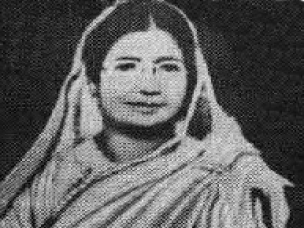
One of the rare rebellions of her time, Roquia Sakhawat Hussain is a name that echoes ceaseless struggle to bring women under the ambit of social respect and admiration. Born in 1880, this gritty and composed lady from a small village of Pairabondh in the then undivided Bengal gave her all towards cementing a respectable position of women during her epoch.
A livid exponent of feminist movement in eastern India, Begum Rokeya conceived and implemented the idea of establishing the first school mainly aimed at Muslim girls. Issues like gender equality and women’s emancipation found a new dimension under her prudent leadership. Being the precursor of future feminist movement in India and Bangladesh, Rokeya did her bit to bolster the position of the so called ‘second sex’ in a puritanical society stuffed with orthodox ideologies.
Married off at an early age, hers was in no way a beginning worth remembering. However, the indomitable urge to stand out for a cause and be the guiding star for he contemporaries and the ages to come drove her forward.
Begum Rokeya had the funny bone as well as the tinge of sarcasm that helped her euphemism narrate real-life incidents of injustice forced upon Bengali-speaking Muslim women. She displayed enough valiance to tell it on the face of the oppressors that they are adopting immoral ways distorting version of Islam.
Oborodhbashini (“The woman in captivity”), Paddorag (“Essence of the Lotus”) and Narir Adhikar (“The Rights of Women”) are among her widely read books that openly defied restrictions on women.
source: http://www.headlinesindia.mapsofindia.com / Headlines India / Home> Social Interest News> Women / Friday – March 04th, 2011
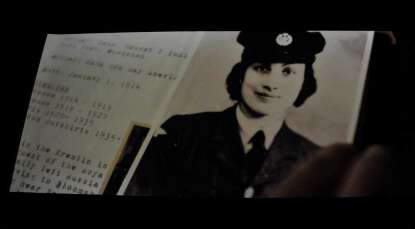
Bruce.Lipsky@jacksonville.com // Noor Inayat Khan is pictured during the film. She was recruited as an operative to help the Allies.
The quiet, unwavering heroism of a young Indian Muslim woman who sacrificed her life to fight against Nazi domination during World War II offers lessons of faith, courage and inspiration as relevant now as it was back then, say those who heard her story Sunday.
Bruce.Lipsky@jacksonville.com / Noor Inayat Khan is pictured during the film. The University of North Florida Distinguished Voices Lecture Series presented “Enemy of the Reich: The Noor Inayat Khan Story” Sunday, September 28, 2014, in Jacksonville, Florida, on campus in the Robinson Theater. (Florida Times-Union/Bruce Lipsky)
“It really makes you think. What would I do in a situation like that? … I hope I would have had her courage,” said K.C. Emerson of Jacksonville, who decided at the last minute Sunday afternoon to attend the screening of “Enemy of the Reich: The Noor Inayat Khan Story” followed by a panel discussion at the University of North Florida’s Andrew A. Robinson Jr. Theater.
The film is the true story of Khan, who sacrificed her life to fight against Nazi domination during World War II. The daughter of an American mother and Indian Muslim father, Khan grew up in a home that nurtured interfaith dialogue and cooperation at a Sufi center of learning in Paris.
In early 1943, she was recruited as a covert operative into Winston Churchill’s Special Operations Executive. By then Khan had trained as a wireless operator in Britain’s Women’s Auxiliary Air Force. As a covert agent, Khan was instrumental to the French Underground’s direct attack on Nazi units in preparation for the Allies’ D-Day invasions.
In August 1943, Khan was the last surviving clandestine radio operator in Paris and signaled London for additional weapons and explosives for the French underground. Khan ultimately was captured and executed at Dachau, the Nazi concentration camp in Germany.
On Sunday, Emerson was among Northeast Florida residents as well as UNF students nearly filling the theater for the screening and panel discussion, part of the 2014 Distinguished Voices Lecture Series. The program co-hosted by UNF and Better Together at UNF, a student organization composed of religiously diverse students with a mission of mobilizing their peers to voice their values, engage with others, and act together to make the world a better place.
“It’s an exploration into meaning and purpose of life, and what values might be worth risking it,” Tarah Trueblood, director of UNF Interfaith Center, said of the program.
Such dialogue, she said, is especially crucial now, given the conflict in the Middle East and fear generated by ISIS and other terrorist groups.
“Peace happens one relationship at a time. And getting to know your neighbor can be that one big step you take today,” said Trueblood, adding sometimes that can take a lot of courage to reach out to our neighbors if they are different from us.
“We want our politicians to make peace or somebody else to make peace. But making peace takes us going over to our neighbors and getting to know them,” Trueblood said.
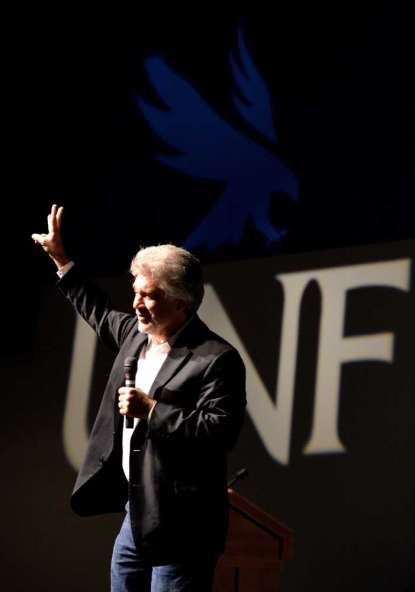
Bruce.Lipsky@jacksonville.com / Alex Kronemer, executive producer of the film about Noor Inayat Khan, speaks before the screening of his film.
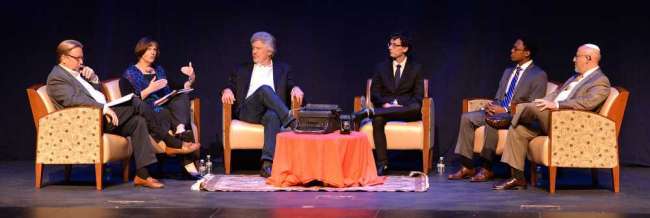
The panelists included Alex Kronemer, one of the film’s producers, UNF Interfaith students, Cheryl Tupper of the OneJax Institute at UNF and vice president of the Arthur Vining Davis Foundation and Rabbi Jonathan Lubliner of the Jacksonville Jewish Center. UNF President John Delaney facilitated the discussion.
Kronemer is co-founder and executive producer for Unity Productions Foundation. A Muslim, he has delivered talks on religious diversity and Islam for the U.S. departments of Justice and State, FBI and other organizations.
Refusing an order to return to England, Khan stayed in Paris and continued radioing information to the Allies after all her comrades were captured by the Nazis.
“In her case, she just had the determination. She had come with these people, bonded with these people and they had all been captured, but she didn’t want their sacrifice to be meaningless. In retrospect, it was a giant decision to make because it led to her ultimately being killed. But at the time, it was a small decision of heroism,” Kronemer said. “That’s really where I think heroes are made. … Today, what are the small decisions of heroism that we’re making?”
Parvez Ahmed, a faculty mentor and UNF professor, encouraged the audience to continue the conversation sparked Sunday through the program.
“I want us to draw upon the inspiration that Noor gave us through our life and our sacrifices. It would be nice if we could all go beyond the lip service that we often give such inspiration and do something that is actually long-lasting and sustainable,” Ahmed said.
To that end, Ahmed said the UNF Interfaith Center is instituting a service award to be presented annually to one or more deserving students. In the form of a scholarship, it will be the Noor Inayat Khan Interfaith Service Award, he said.
Khan was posthumously awarded the George Cross, the highest civilian medal for bravery and sacrifice in Great Britain. The French awarded her the Croix de Guerre with Gold Star. A plaque bearing her name hangs at Dachau, and a memorial statue of her was erected in London’s Gordon Square in 2012.
source: http://www.members.jacksonville.com / The Florida Times-Union / Home> News / by Teresa Stepzinski: (904) 359-4075 / Sunday – September 28th, 2014
Once confined to South India, coffee has emerged into pan Indian beverage, not just at cafes but also in homes. However, the coffee industry is facing several challenges due to shortage of labour in its estates and plantations. Hassan M Kamal investigates
There’s a story that claims how nearly 400 years ago, a Sufi poet named Baba Budan smuggled coffee beans from Mocha (Yemen), to the hills of Chikmagalur in Karnataka. While there is no recorded evidence to prove this story, it has remained a popular folklore among India’s coffee lovers.
The presence of a controversial shrine of the Sufi saint on top of Dattagiri (or Baba Budan) range of the Western Ghats, watching over the coffee estates of Chikmagalur, further lends credence to the belief. After its arrival, over the next four centuries, coffee grew to become an integral part of South Indian culture.
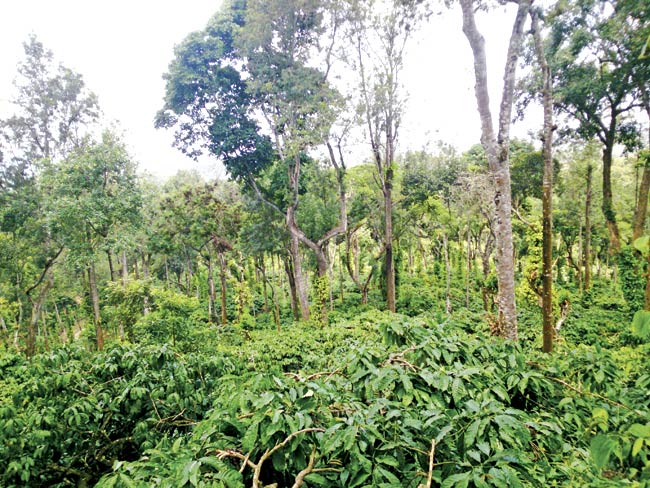
Most coffee plants in India are grown under the shade of trees. Pic courtesy/ Dr Ashwini Kumar BJ
Different communities and cities came to master the art of growing coffee, roasting and brewing a fine concoction from the coffee beans, in their own way.
Aromatic trail
“Even today, there are several households in South India who roast their own batch of coffee beans in the kitchen, grind it and prepare a decoction that suits their needs,” shares Dr Ashwini Kumar BJ, who holds the Coffee Board Research Chair at the Indian Institute of Plantation Management in Bangalore.
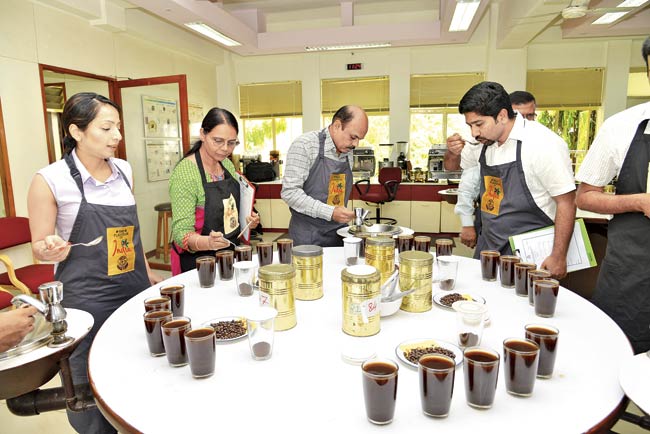
A tasting session in progress at the Coffee Board head office in Bangalore. Pic courtesy/ Dr Ashwini Kumar BJ
Their methods have created specialty coffees, which are in huge demand in the Western markets as well as location-centric versions of Indian filter coffee like the Degree coffee of Kumbakonam in Tamil Nadu (most popular among Tamilians), Coorg coffee and Chikmagalur coffee, each known for its unique taste, informs Dr Kumar (check box for details).
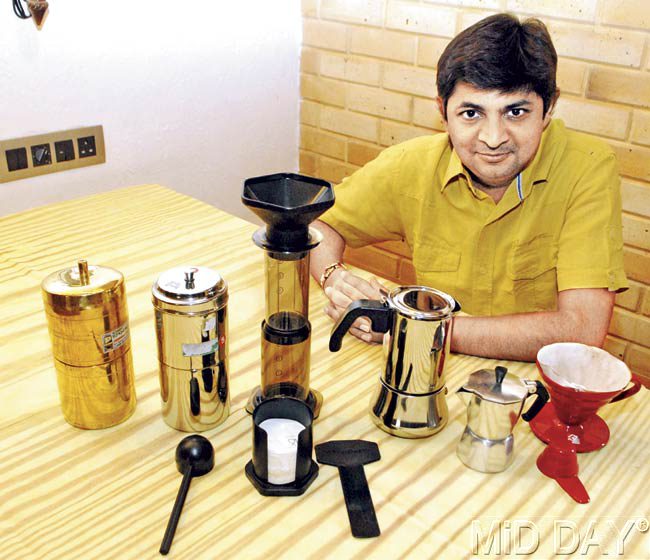
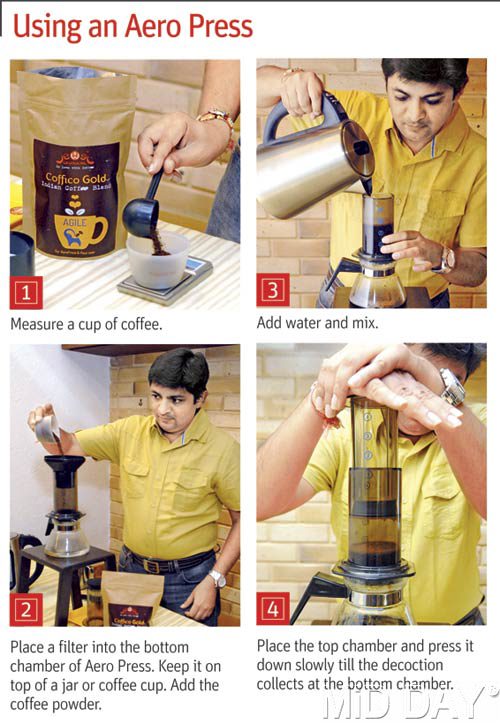
Mumbai-based brewing expert Jignesh Shah with the three coffee-making equipments (from left to right) the Indian Filter Coffee Maker (in brass and steel), Aero Press and the Moka Pot. Pics/ Shadab Khan
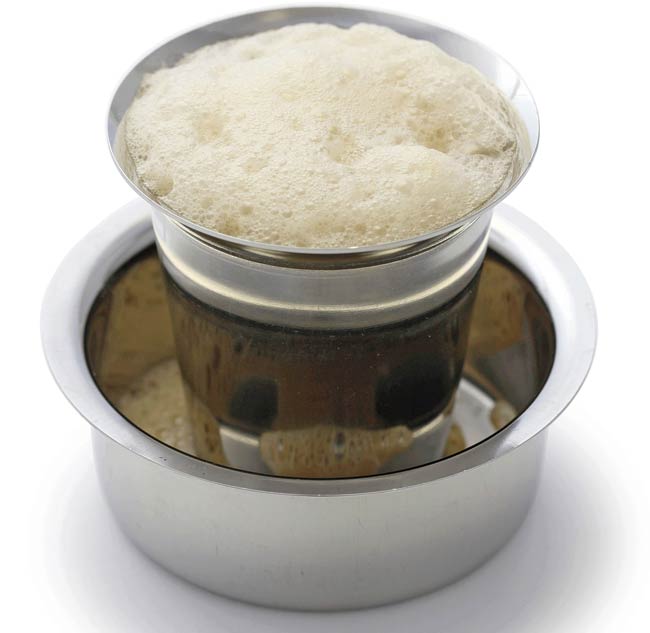
The equipment to make the popular Indian filter coffee is proof of how engrained the beverage is in the daily life of a South Indian. While the origins of the filter coffee maker aren’t documented comprehensively, according to photographer K Suresh, a die-hard coffee lover, the earlier method required keeping ground coffee wrapped around a cloth dipped in a pot of water overnight.
“My grandma would make fresh coffee every morning; jaggery was used to sweeten it. Sugar was reserved for tea,” he recalls. He still sources coffee beans from Mangalore, but also vouches for beans sold at Philips Tea and Coffee in King’s Circle, a locality famous for its authentic coffee. “The process continues with the Indian filter coffee makers, even today.
The ground coffee is kept inside a chamber and filled with hot water. Overnight, the coffee filters down into a chamber right under it, giving the final decoction a strong flavour,” says Jignesh Shah, a Mumbai-based coffee entrepreneur. He adds that in most South Indian families, there’s a tradition of offering the first drink from the brew to the head of the family in the morning.
Arrival of new coffee fans
Shah comes from the new breed of coffee lovers, who are not South Indian, but have acquired a taste for this beverage, and see coffee as an item that needs to be appreciated. “Most Indians have been cheated with, when it comes to coffee, as we have never got anything beyond instant coffee. Coffee is more than that,” says Shah.
He adds that the beverage is gaining popularity among other communities, including the tea-crazy North Indians. “And, I’m not referring to a Barista, Cafe Coffee Day or Starbucks outlet (though they played a role in popularising coffee) or drinking instant coffee from vending machines, but coffee fans who want to prepare it from scratch in their own homes.”
Shah recently launched his brand of coffee, Jewel Aromantic, and has also been conducting workshops and taking classes, teaching Mumbaikars how to brew coffee at home. One of his focus areas has been making inexpensive fuss-free coffee makers like the Italian Moka Pot (comes for just Rs 500), Indian Filter Coffee maker (Rs 500) and the most-recent Aero Press (Rs 2,500), now available in India.
“Most of us are only aware of instant coffee or the expensive espresso machines. But there are several other equipments like the Moka Pot, the Aero Press or the Indian Filter Coffee Maker, which are inexpensive and easy to operate. Now, people are exploring these options, and loving them,” he adds, adding, “Some devices like the Aero Press and Indian Filter Coffee Maker doesn’t require any heat source.”
Home of specialties
India grows two types of commercial coffees Indian Robusta and the Indian Arabica. Earlier, most of the produce used to be the Indian Arabica, which is still in huge demand internationally. But since Arabicas are prone to pests, most coffee estates have moved to the Indian Robusta. “It has a much more stronger taste than the Arabica, and though it was initially not considered good, and still fetches lower prices internationally, it’s gaining popularity in the market,” says Shah.
Dr Kumar says that what gives Indian coffee a special place internationally is its unique coffees, which are referred to as Specialty Coffees. “The three specialty coffees produced in India are Monsooned Malabar, Mysore Nuggets and Robusta Kaapi Royale. All these coffees vary in their cup characteristics, and are popular internationally,” he adds.
India is also gaining popularity for its unique animal coffee, the Monkey Parchment coffee, a rare type of coffee made from beans chewed by Rhesus monkeys. The coffee is produced in Chikmagalur, Karnataka.
“The monkeys select the best coffee cherries, pick them, chew them leisurely for a few minutes and spit the remainder of the fruit onto the ground.
These discarded fruits are collected, rinsed, washed and processed using water to remove the pulp (parchment), and then dried. The enzymes in the saliva of the Rhesus monkey initiates a chemical process, giving the beans a different taste and colour,” says Shah.
Challenges galore
But all is not good with the coffee estates, located mostly in the Western Ghats. In the last few years, there had been several reports of labour constraints in Indian coffee estates. “Most of India’s coffee is grown in undulating slopes of the Western Ghats.
The coffee plantations are experiencing a severe shortage of labour for undertaking key farm operations, such as manuring, application of fertiliser, harvesting and farm-level processing. While larger plantations have initiated efforts for mechanisation, medium and small plantations continue to incur higher costs on labour, thereby reducing their surplus for capital investments,” says Dr Kumar.
According to a report by The Seattle Times, some plantations in India have begun offering good-quality housing, medical care and other benefits to attract labour. But it’s been of no help. Another major problem is the low level of value addition at the farm level, informs Dr Kumar.
“The value addition of coffee takes place at the level of roasters and retailers. But since most of our coffee is exported as green beans (unprocessed), most Indian coffee producers become very susceptible to the fluctuations in international prices. Higher value addition and domestic consumption could reduce the susceptibility of producers to the drastic price fluctuations that are currently seen in primary markets of Indian coffee,” he adds.
Another concern emerges from lower production due to unseasonable and fluctuating rainfall. “While the consumption of Indian coffee has increased, the productivity of Indian coffee plantations has been stagnant,” reveals Dr Kumar adding that India should produce more coffee to meet the domestic demand and exploit opportunities that emerge from a growing international demand for Indian coffee.
Grading of coffee primarily refers to the segregation / classification of coffee beans based on their size. The primary grades of Arabica Coffee are Peaberry, AB, A, B, C, Blacks/Browns, Bits and Bulk. The primary grades of Robusta Coffee are Peaberry, AB, C, Blacks/Browns, Bits and Bulk.
Bits and Bulk are the most inferior in the lot and used to make instant coffee. In India, coffee is also categorised based on taste like Monsooned Malabar, Mysore Nuggets and Robusta Kaapi Royale. Based on the region of production in India, 13 regional coffees have also been defined.
They are Anamalais, Araku Valley, Bababudangiris, Biligiris, Brahmaputra, Chikmagalur, Coorg, Manjarabad, Nilgiris, Pulneys, Shevaroys, Travancore and Wayanaad.
Improve your coffee quotient
What’s roasting?
Roasting is a process that helps bring out the aroma and flavour of coffee.
The major techniques for roasting coffee beans are Rotating cylinder or drum roasting where the coffee beans are fed into a cylinder through which hot air is passed and the drum rotates; and fluidized bed roaster where gases entering into the fixed chamber of the roaster lead to the beans’ rapid turbulent circulation (levitation).
Following roasting, the beans are cooled and run through a destoner that uses air to remove stones and other extraneous materials. The roasted beans are then ground by using grinders.
source: http://www.mid-day.com / MidDay / Home> Life and Style News> Food News / by Hassan M Kamal / September 27th, 2014
The 71st Annual General body Meeting (AGM) of The Crescent Consumer’s Co-operative Stores Ltd., Udayagiri, will be held on Sept. 23 at 10.30 am at the Store premises under the Chairmanship of the Store President Mahmood Hasan Sait.
source: http://www.starofmysore.com / Star of Mysore / Home> In Brief / September 22nd, 2014
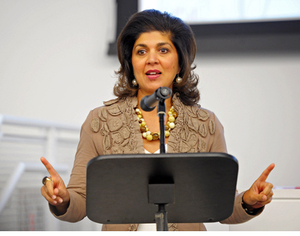
File photo of Special Representative to Muslim Communities Farah Pandith addressing the audience during the UN International Year of Youth Culmination Celebration Summit at the United Nations on Aug. 11, 2011 in New York City. (Getty Images)
Farah Pandith, appointed in June 2009 as the first-ever Special Representative to Muslim Communities by former Secretary of State Hillary Clinton, will be leaving her position to join the Institute of Politics at Harvard University.
Pandith always places people above politics, and she has performed groundbreaking work since her appointment, Secretary of State John Kerry said Jan. 23.
Her legacy “is an extraordinary record of thoughtfulness, balance, and sheer guts and determination. Anyone who’s worked with Farah will note her uncommon ability to bring people of different backgrounds together. I’ve seen that commitment firsthand in her pioneering work to reach out to countries with both Muslim majorities and minorities,” Kerry said in a statement.
Pandith will be joining the Institute of Politics as a Resident Fellow for the spring semester. As a Fellow, the Indian American will lead weekly study groups on a range of topics.
Kerry, in his statement, said of Pandith, “On so many issues, Farah Pandith has been a trailblazer and a visionary,” adding, “It’s in her DNA as a first-generation immigrant who achieved historic firsts for America, from changing the way our embassies engage with Muslim communities in Europe to getting a Quran placed in the White House Library.”
Pandith’s deputy, Adnan Kifayat, will serve as the acting special representative until a permanent replacement is named.
Pandith, originally from Srinagar, has a master’s degree from The Fletcher School of Law and Diplomacy at Tufts University, Boston, Mass., and an A.B. from Smith College.
source: http://www.indiawest.com / India West / Home> News / by A Staff Reporter / Wednesday – January 22nd, 2014
Syeda Ayesha, Assistant Commissioner, Mysore Division, has been appointed as Administrator, District Waqf Advisory Committee (DWAC) of Karnataka State Board of Auqaf, Bangalore.
source: http://www.starofmysore.com / Star of Mysore / Home> In Brief / Sunday , September 21st, 2014
Dasara Tourism Sub-Committee President Sudhakar S. Shetty speaking at the Sub-Committee meeting at Hotel Hoysala this morning as Member Secretary C. Anitha, Sub-Committee Executive President S.K. Husseini, Special Officer H.M. Ramesh, Vice-Presidents Kumar and L. Parshuram look on.
Mysore :
For the first time in the history of Dasara, the Dasara Tourism Sub-Committee plans to display as many as 50,000 Circuit Maps containing details of roads from Mysore to tourist spots in Mysore, Chamarajanagar, Mandya, Kodagu districts at tourists spots and vantage points for the benefit of tourists, said Sub-Committee President Sudhakar S. Shetty here this morning.
Addressing a meeting of the Sub-Committee at Hotel Hoysala on JLB Road in city, he said that the primary objective of the Committee was to ensure proper infrastructure like drinking water, toilets, bathrooms and cleanliness around all tourist spots to meet the needs of tourists.
Stating that 18 tourist kiosks at a cost of Rs. 26,000 each, manned by the students of tourism courses in Mahajana and Vidya Vikas Colleges in city and foreign students in city and 32 guides around Mysore Palace, dressed in specially designed blazers, will be set up at tourist spots and vantage points to guide tourists.
Sudhakar Shetty also said that the Sub-Committee had urged City Police Commissioner Dr. M.A. Saleem to initiate criminal action against those found guilty of selling duplicate products to visitors besides urging the MCC Commissioner to ensure that debris and garbage around the tourist spots in particular and the city in general before the commencement of the Naada Habba.
The Sub-Committee President also said that literature containing details of tourist spots will be placed at boxes which will be placed at all hotels and tourist agency offices in city.
Tourism Development Authority sought: As Mysore and surrounding districts have abundant tourist potential, there is an absolute need for formation of a Tourism Development Authority to promote tourism, which is one of the most flourishing industries in parts of old Mysore region which has numerous places of tourist interest, some members opined.
S.K. Husseini, Assistant Director, Department of Tourism, who is also Sub-Committee Executive President, H.M. Ramesh, Divisional Traffic Controller (City Division), KSRTC, who is also the Sub-Committee Special Officer, C. Anitha, Sub-Committee Member Secretary, Kumar and P arashuram, Sub-Committee Vice-Presidents and Sub-Committee members were present at the meeting.
source: http://www.starofmysore.com / Star of Mysore / Home> General News / Saturday , September 20th, 2014
The great patriot, however, remained unsung on January 24, which marks his 153rd death anniversary
The name of Turehbaz Khan conjures up images of valour and sacrifice. The name also puts Hyderabad on the map of the country’s First War of Independence or the Sepoy Mutiny of 1857. But how many of us know that January 24 marked the 153rd death anniversary of Turehbaz Khan, who, along with several others, rebelled against the English Resident, Major Cuthbert Davidson. The day simply passed off without a whimper.
It was in January 24, 1859, that many believe that Turehbaz Khan was killed in the forests of Toopran by the Talukdar, Mirza Qurban Ali Baig.
His body was brought to Hyderabad and according to several historical accounts was hung near the Residency, what is now Koti Women’s College, for public display and to act as a deterrent against any future rebellion.
Many in Hyderabad also do not know that the road in front of Osmania Medical College is named after Turehbaz Khan.
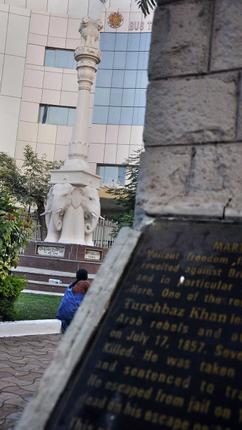
To mark the revolt of 1857, a memorial with the words ‘Memorial to the martyrs of July 17, 1857′ was constructed near Koti bus stand.
Even today, the name Turehbaz Khan is etched on the plaque.
Stark reminder:The memorial for Turehbaz Khan and others at Koti.– Photos: G. Ramakrishna / The Hindu
The uprising was led by Turehbaz Khan and a fiery preacher, Maulvi Allauddin, along with 500 Rohillas, who were of Pashtun (Pathan) stock.
Unequal fight
Essentially, the revolt was to free Jamedar Cheeda Khan, who was held in the prison inside the Residency. The 500 Rohillas tried to storm the Residency under the direction of Turehbaz Khan and Maulvi Allauddin, who controlled the revolt by occupying the houses of two local moneylenders, Abban Saheb and Jaigopal Das.
Historians point out that the fight between the Rohillas and British troops, who were led by Major S. C. Briggs, continued throughout the night. Apparently, Salar Jung alerted the British about the impending revolt. The British troops were prepared and waiting for Khan to attack.
Needless to say, the Rohillas, who wielded swords, were outclassed by trained British soldiers who opened fire on them. By morning the rebellion was crushed.
Shot dead
Many armed men who took part in the revolt were caught and sent to prison. Among them was Turehbaz Khan, who received a life sentence. However, the canny Turehbaz Khan managed to escape from prison on January 8, 1859.
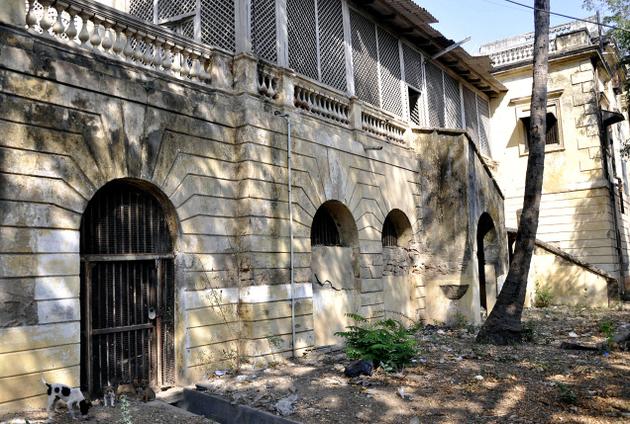
Sentinel of history:The prison inside the Residency building, which is now the Koti Women’s College, where it is believed that Jamedar Cheeda Khan was kept.
Immediately after the escape, the British authorities offered a reward of Rs. 5,000 to anyone who could apprehend Turehbaz Khan.
Within a few days, many believe that it was on January 24, 1859, when Turehbaz Khan was shot in the forest of Toopran by Talukdar Mirza Qurban Ali Baig. As a reward, the Talukdar received Rs. 5,000 and his salary was also raised by Rs. 200.
He was also promoted as Sadar Talukdar, say historical accounts.
Some things touch people’s heart strings in a very strange way and the reason for this is not very easily understood or explained. My last week’s article about HMT watches seems to have stirred people’s sense of nostalgia far beyond my expectations. This is evident by the spate of responses I have been getting over the whole of the week. The emotional impact of the closure of HMT’s watch division on people’s minds can be gauged by the many letters that have appeared in Star of Mysore too ever since the news was published last Friday. But some sad stories too can have happy endings as you will see.
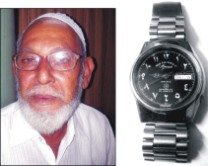
Last evening as I was seeing off the last of my patients for the day, I found a familiar figure walking into my consulting room with a smile. It was Baba Sab, my former neighbour of many years who had sold his house a couple of years ago and moved out to another locality. After exchanging pleasantries for a few moments he complimented me on my writing and said that he was particularly touched by my article on HMT watches. He then removed the wrist watch he was wearing and placed it on my table and said, “This is a watch about which y ou have made a mention in your last article and I have one with me.”
The piece that lay before me was a West End Sowar Prima, an automatic mechanical watch with a black dial and Eastern Arabic numerals. (Incidentally, and perhaps a little interestingly, Arabic numerals are the numerals we use while writing in English while Eastern Arabic numerals are the ones in the actual Arabic script as seen in the picture). I told him that I had indeed mentioned it by name in my article and I knew all about it because my father and grandfather and all my uncles had always worn West End watches. It was a sort of a family tradition and in the good old days, a good watch only meant a West End.
He then surprised me by saying, “I have been wearing it for some years and now I want you to have it because you are one person who knows what it is worth.” I immediately protested and refused his offer to which he said, “I have worn it long enough. Now I want you to accept it as a token of my affection and regard for you. I have always admired your writing and I will be happy if you accept it from me. Please do not refuse my humble offer.” Perplexed, I did not know what to do.
Here was a simple and humble man who thought so highly about me and with his strange and most unexpected gesture of magnanimity he had put me in a very delicate situation if not a real fix. He was indeed an unusual kind of man. When he first thought of selling his house he had come into my consulting room once before and offered it to me at a price considerably lower than the best offer he had received. He very rightly told me that Islam teaches that a good Muslim should give first priority to the welfare and happiness of his or her neighbours in all matters. Only after I reassured him that I had no intention of buying his house did he proceed to sell it to its present owner. And, he did sell it for a sum much higher than for what he had offered it to me.
Now, refusing his gift would have broken his heart and accepting it would have made my own heart heavy. After a few uneasy moments of confused introspection I decided to let his heart have its way and picked up the watch with an uneasy smile. He felt visibly relieved and thanking me profusely for accepting it he quickly left the room leaving me in a daze. My friends are not wrong when they say that interesting things happen to me which provide me interesting writing material!
West End watches came into production in the year 1886 in Switzerland and they were named after the upmarket district of the same name in London. Known for their ruggedness and durability, they quickly became a household name in India and it appears when the Indian Cavalry contingent was dispatched to fight in Mesopotamia during the First World War, the soldiers were provided with West End watches. That is when the model ‘Sowar’ was introduced after the Sowars or Lancers of the cavalry regiment.
We still have my father’s West End Sowar Prima as a family heirloom, along with its original box, user manual, bill and hexagonal spanner. Very oddly, perhaps because they were mechanical watches, every West End watch used to come with a spanner to enable its owner to open its back and make the movement go slow or fast as required to keep the correct time! My friend Ulliada Arun, perhaps has the oldest West End watch that I know of in perfect working condition. It is from the year 1902 and it still keeps the right time and my friend wears it all the time!
A lesson in harmony: Last Wednesday’s SOM had a review by Dr. Manik Bengeri, about the Kannada play ‘Raavi Nadeeya Dandeyelli’ which was recently staged at the Vanaranga theatre of Kalamandira. My wife and I had an occasion to see it at the urging of my friend Sri. K. R. Mohan, a former senior manager of the Syndicate Bank, who had also written a small introductory piece about it in SOM.
Although adding anything to the already very well written piece certainly seems superfluous, what impressed me very much apart from the excellent theme of the play was the portrayal of the way goodness in human nature prevails over baser instincts. The correct presentation of what the Holy Koran says about how we should live in absolute peace and harmony with all those around us, forgetting our castes and creeds, needs to be complimented.
‘Parivarthana’ which presented the play and all those who are responsible for it in some way or the other deserve not only to be congratulated for what they have done but also encouraged to continue to present it before much larger audiences across the length and breadth of the country. Plays like this that can promote communal harmony at a time when it seems to be under great stress should be showcased before the younger generation in schools and colleges and this can be done at a surprisingly modest cost. Therefore managements, parents’ associations and even philanthropic individuals, if not institutions, can do this job if they mind. Do think about it. It certainly is worth a thought.
The play made me recollect an incident that I once heard from the mother of my friend, Mallikarjun Nisty from the turbulent time of partition. It tells a heart touching story of human goodness from a time when goodness seemed to be extinct. It appears a Hindu man and his family from the Pakistan side of the border who were leaving for the Indian side was seated in a crowded train with their belongings. As the train was about to leave, their Muslim neighbour’s wife who was also a very close friend of the man’s wife, rushed into the compartment with an angry expression and began rummaging through their bags, ostensibly to check what they were taking away with them.
Her job done, she left the shell-shocked family but not without taunting and cursing all those who were going away to the other side. As the train steamed out of the station, the man’s wife who was now in tears at her former friend’s unbelievably cruel behaviour put her hand into her bag to find her handkerchief. To her amazement, she found a wad of currency notes with a small note from her friend that said, “I am sorry about the way I behaved. But there was simply no other way I could help you under the watchful eyes of the hostile mobs around. Do keep in touch with us if possible. May God protect you and your family.”
e-mail: kjnmysore@rediffmail.com
source: http://www.starofmysore.com / Star of Mysore / Home> Feature Articles / September 19th, 2014
Assam’s oldest Muslim structures have finally found a chronicler that will recount the legends, the tales and anecdotes that went into making some of the most fascinating architectural masterpieces of the state.
Al-Ameen Welfare Society, a NGO of prominent Muslims, will come out with a book on Assam’s old mosques and dargahs next year.
The aim is to sensitise people and the government to protect and preserve these magnificent structures both in the Brahmaputra and the Barak valley.
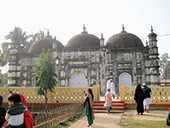
People visit the Panbari mosque in Dhubri on Friday. Picture by Bijoy Kumar Sarma
Take Panbari masjid or Rangamati masjid, for instance. Built in the Mughal era, during the 15th or 16th century, this mosque is the oldest not only in Assam but probably also in the whole of the Northeast.
Very few know about it — with lack of maintenance robbing it of much of its glory.
The book, therefore, hopes to highlight some of these glorious structures and goad people to preserve them.
It is part of the Al-Ameen Welfare Society’s ambitious project to chronicle the history of the Muslims of Assam, complete with their cultural heritage and contributions to greater Assamese society.
Komoruzzaman Ahmed, founder president of the society, told The Telegraph that raw material for the book has been gathered and will be compiled soon.
“Our main project aims at helping the present generation of Muslims realise their ancestors’ positive role in formation of a cohesive and harmonious society in Assam. Such a realisation will also make the present generation of Muslim contribute towards building a unified society in Assam,” he said.
Muslims started settling in Assam in 1206 AD.
Ahmed said the history, heritage and contributions of Muslims to the larger Assamese society should be studied, probed and recorded.
Another book on a comprehensive study of the Islamic religious literature written in Assamese will also be published next year.
“Though Assamese literature is rich in medieval Hindu religious prose, we have so far not been able to trace any Assamese Islamic religious literature and mystic or Sufi songs like Satya Peer’s geet, Chand Sai geet and jikir and jari by Ajan Fakir. The study has made an attempt to probe if Islamic literature in Assamese existed in the mediaeval period,” he said.
Ahmed said there is also a study on contribution of Muslims in the fields of art, handicrafts, architecture, engraving, painting, music, language, food habit and items, utensil, furniture and clothes of Assamese society.
source: http://www.telegraphindia.com / The Telegraph, Calcutta / Front Page> North East > Story / by Daulat Rahman / Guwahati – December 23rd / Saturday – December 24th, 2011