Fervour marks annual sandal and Urs of Hazarath Gulam Rasool Baba Dargah
The 72nd annual sandal and Urs of Hazarath Gulam Rasool Baba Dargah of Chittoor commenced on Saturday amidst religious fervour, with the performing of sandal in the evening, followed by Urus.
The annual event draws huge crowds from all sections of people in Chittoor division, while the Dargah is seen as an epitome of Hindu-Muslim unity since seven decades. Local belief is that the Hazarath while wayfaring down South had settled in Chittoor a century ago. His presence was said to have brought copious rains in the region, driving away the perennial drought conditions. As a mark of respect for the Hazarath, the people of Chittoor built a Dargah. Earlier, the traditional ritual of carrying sandal commenced in the afternoon through the arterial junctions. After performing Fathiha ritual, the Dargah heads distributed the sandal to the gathering. Poor feeding was performed from evening till late night.
source: http://www.thehindu.com / The Hindu / Home> National> Andhra Pradesh / by Staff Reporter / Chittoor – December 15th, 2013
Poets from five States participated in a poetry fest organised in Bidar on Monday night by several literary organisations.
Poets used Shayari couplets, Ghazals and Tarannums to send a message to society. The issues they chose ranged from love, heartbreak, mother’s love, the life of the Prophet Mohammad to the recent carnage in Muzaffarnagar.
B. Narayan Rao, former Zilla Panchayat member, who inaugurated the Mushayira, lamented that Urdu was being limited to Muslims. Urdu is the language that binds India together. “While millions of non-Muslims speak Urdu, millions of Muslims in several States don’t understand the language,” he said.
Tanveer Ahmed Salman, who anchored the Mushayira, said Bidar was the city where the first Urdu book “Masnabi Padamrao Kadamrao” was published in the 14th century. This remains a matter of pride for us, he said. It has produced poets of global repute like Hazrath Ishqui in the 18th century and modern day favourites like Rashid Ahmed Rashid and Suleiman Khatib.
Deputy Commissioner P.C. Jaffer released six books. He said though the number of people who spoke Urdu was increasing, the number of those who could read and write the language was decreasing. “This is the problem with most Indian languages. We should make concerted efforts to preserve Urdu and other Indian languages,” Mr. Jaffer said.
The books that were released included Bidar Ke Asare Kadima, a note on the monuments of Bidar, by Abdul Samad Bharati; Tazkara Mahamud Gawan and Jahan-e-Kaleem by Nissar Ahmed Kaleem; Nashrah and Saad by Ameeroddin Amir and Ghanti by Hameed Saleem.
Poets from Karnataka, Andhra, Maharashtra, Uttar Pradesh and Orissa participated. They included Misbaq Azmi, Akram Nakkash, Saifuddin Saif Ghori, Naveed Abdul Jaleel and Nooruddin Noor.
Poets from Bidar like Mohammad Yousuf Raheem Bidri, Mukhtadir Taj, Nissar Ahmed Kaleem, Basit Khan Sufi, Ameeroddin Amir and Rehana Begum participated.
The surprise package was the singing of two ghazals by Deputy Conservator Forests Sunil Panwar. “A native of Uttarakhand, he learnt to read and write Urdu after being posted to Bidar,” Mr. Bidri, who was a member of the organising committee, said.
‘Bidar has produced poets of global repute like Hazrath Ishqui, Rashid Ahmed Rashid and Suleiman Khatib’
We should make concerted efforts to preserve Urdu and other Indian languages: P.C. Jaffer
source: http://www.thehindu.com / The Hindu / Home> National> Karnataka / by Special Correspondent / Bidar – December 10th, 2013
Clubs belonging to Lions District 324A1 have installed solar power plants at 35 schools run by the State government and Chennai Corporation. / Photo: M. Srinath / The Hindu
The Government Hobart Higher Secondary School for Muslim Girls, Royapettah, recently got a 1.5 KV solar power plant. Students of classes VII, VIII and IX will benefit from the plant that can power 10 lights and seven ceiling fans.
Imtiaz Fathima Wadood, president of the parent-teachers association of the school, said the supply from the plant could also be used to power the examination hall, which has a seating capacity of 100 students, when tests are conducted.
“We have to thank the Lions Club of Periamet for providing the facility worth Rs. 2.5 lakh to the school, which has 300 children from poor families from Triplicane and Royapettah studying,” she said. The Club will maintain the facility for five years.
Clubs belonging to Lions District 324A1 have also installed solar power plants at 35 schools run by Chennai Corporation and the State government.
According to G. Ahmed Sharif, advisor, district 324A1, who is also the project chairman, said a total of 19 government and 11 Corporation schools had been covered under the project this year. “It is the suggestion of the district governor D. Balachandra Reddy that all the clubs are following. The district provides Rs. 50,000 per plant and the clubs have to bear the rest of the cost. Many classrooms are poorly lit and need such solar plants. In the long run, it will also help reduce the schools’ power bills,” he said, adding that more clubs were coming forward to install such plants.
source: http://www.thehindu.com / The Hindu / Home> News> Cities> Chennai / by Special Correspondent / Chennai – December 26th, 2013
People entering Taj Mahal complex for prayers on Fridays will now have to carry identity documents, according to a directive issued by Archaeological Survey of India (ASI) following a complaint that non-Indians were also entering the mosque despite it being closed for visitors.
The directive, issued by ASI’s Agra unit superintending archaeologist N.K. Pathak on Thursday, has, however, received criticism from Taj Mahal’s Mosque Committee which has said that no Muslim, irrespective of nationality, can be stopped from offering prayers at the mosque.
The local ASI unit had received a complaint that an Indian Muslim had allegedly brought five Bangladeshi nationals along with him to Taj Mahal’s mosque last Friday, leading to a row over as to who all should be allowed inside the mosque.
The ASI authorities claim that the body’s Director General has ruled that only Indians should be allowed to enter the mosque to offer prayers on Fridays, when the monument is closed for visitors.
The Taj Mahal Mosque Committee President Ibrahim Hussain Zaidi, however, criticised the directive and said Muslims should not be discriminated on the basis of nationality.
“The Gazette notification of January 1, 2001 issued by Government of India states that Muslims will be allowed to offer prayers at the Taj mosque on Fridays even though it is closed for visitors. Nowhere does it say that Muslims of other nationality should not be allowed,” he said.
Reacting to Zaidi’s criticism, ASI caretaker at Taj Mahal Syed Muazzar Ali said that the mosque committee has no locus standi on the matter.
source: http://www.thehindu.com / The Hindu / Home> News> National> Other States / PTI / Agra – December 27th, 2014
COMMUNITY CHRONICLE The wedding invitation of Wajid Ali Shah’s son, a fatwa by a pundit, nikahnamas embossed in gold, a judgement by Akbar Allahabadi…Khalid Sabir’s house in New Delhi’s Shaheen Bagh preserves remnants of yesteryear Awadh
With age, nostalgia becomes a hobby for many. One of its probable side effects is the fascination for most things old — they become a token of the times that were, appealing for the stories they hold, don’t they?
But with New Delhi’s Shaheen Bagh resident Khalid Sabir, young age never became a deterrent in evoking nostalgia for an age his forefathers belonged to, and he began collecting — and collecting — so many things from the past that most of his two-storey house is now packed with an assortment of things that are clearly rare, precious and deserve space in a museum.
The transformation of Sabir, now 62, into being a hardcore collector rather sprang from a strong sense of documenting history that caught his imagination in his school days in Allahabad. Sipping tea, surrounded by things from his valuable collection spread over a bed, an effervescent Sabir reels back to his first venture at collecting things. “My uncle Ahmad Sabir was the still photographer for Mughal-e-Azam . When the film got released, he came to Allahabad and took the entire family to watch it. It was he who gave me a couple of posters of the film. That triggered in me the urge to collect film posters. Over the years, I had an amazing collection but all got burnt during a fire in the house some years ago.”
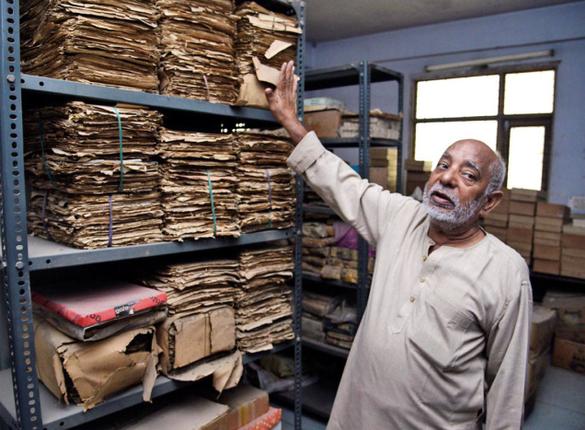
Collector’s items(From left) Khalid reading out from a royal nikahnama; in a room with old documents; an issue of Urdu daily Nawal Kishore Photos: S. Subramanium
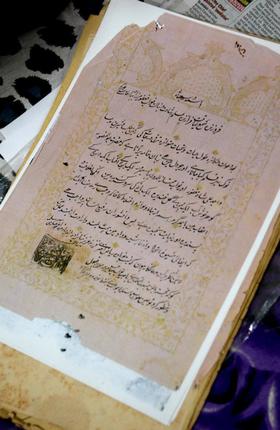
Much later, in the early ’80s, work took Sabir to the U.K. but the urge remained. During visits to his home State Uttar Pradesh — to towns like Allahabad, Lucknow, Rampur, etc. — he would check out on the local scrap collectors, the kabari-wallahs. Each time, he would hit upon a treasure from the past. “I have collected most of my things from kabari-wallahs,” says Sabir, displaying for this reporter a judgement given by the famed Akbar Allahabadi, a silk map of Lucknow dated 1884, an invitation sent out by Nawab Wajid Ali Shah for one of his son’s weddings, a judgement by Sir Lawrence Peel dated 1865 in a case involving Bahu Begum of Faizabad; a fatwa proclaimed by a Hindu pandit in 1800, a pre-1857 nikahnama of a princess written in gold with mehr worth 12 lakhs, among other prized catches culled out from the dump yards. Holding the copy of the fatwa, he points out, “Like the maulanas, Hindu pundits also used to declare fatwa. Urdu was the language of the times, so it was used in them. Every fatwa refers to a hadith, so this one also begins with one written in Urdu by a maulana. It is followed by a pandit answering the maulana by referring to a shloka from the Ramayana in Devnagiri before pronouncing the judgement.” Indicating the date written on top of the fatwa, he says laughing, “This one is before Ghalib.”
Sabir reads out from the wedding invitation of Wajid Ali Shah — known for his love for poetry — prodding you to listen carefully to the language. “It was a time when Urdu was emerging from Persian. You can see the mix here,” he says with relish. That marriage went into trouble, leading to the return of the bride’s dowry. Interestingly, Sabir has letters of the fight between the bride and the groom, also the list of her dowry.
Carefully taking out from a plastic envelope a clasp of yellowed papers a judgement given by the famed poet and judge Akbar Allahabadi in 1862, Sabir says, “Read this, not for nothing there is an old saying in U.P. that what is left in Allahabad apart from Akbar and amrud trees.”
In rows of steel almirahs and shelves covering five rooms of his house, there are stacks of old land deeds of thousands of families across U.P., receipts of property tax issued during the British rule, nikahnamas of Hindu nawabs, initial editions of Urdu dailies like Nawal Kishore , Haqiqat , Awadh Akhbar , personal letters of English couples living in that region among other things. “I have the third issue of the Lucknow newspaper The Pioneer too, which I don’t think the company itself has,” he adds.
A compulsive collector that Sabir is, he also has a roomful of postage stamps from across the world collected since his school days. And another room where stacked to its ceiling are old editions of Indian magazines and press clippings on 400 topics. “I have published 13 books after compiling these press clippings on different subjects,” he informs. Till a while ago, Sabir says, he used to subscribe to 30 newspapers across different languages. “I had employed four people to help me out in preserving my collection. But I have slowed down after a heart attack sometime ago,” he says.
So what does he plan to do with this priceless collection? “I had approached Jamia Millia Islamia, Aligarh Muslim University, Rampur Raza Library, all the important places that you might think would be interested in keeping this Awadhi treasure. But none seem to be really so. I have spent a lot of money and time on this collection, don’t want it to go waste. So I am saving money, planning to start a museum on my own,” he says. Meanwhile, he has just returned from Dubai “after giving photocopies of some old newspaper papers for digitisation to a Dubai-based organisation. It digitises for free old Arabic, Persian and Urdu documents.”
I had approached Jamia Millia Islamia, AMU, Rampur Raza Library to preserve this Awadhi treasure. But none seem to be really interested
source: http;//www.thehindu.com / The Hindu / Home> Features> MetroPlus / by Sangeeta Barooah Pisharoty / September 08th, 2014
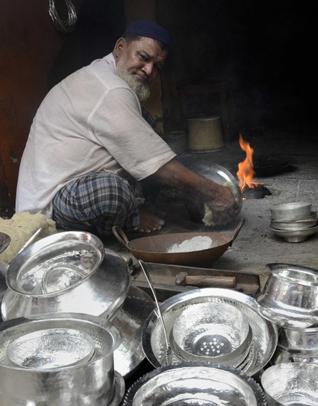
In a sharp contrast to the sweltering heat, a smiling Mohammad Faisal picks up a huge cooking vessel called degh with his right hand, and applies hair-thin Malaysian tin foil on it. Then, with a thick pad of old cotton soaked innausadar (ammonium chloride) ash, he moves the foil within the vessel, while rotating a fixed iron fan on the floor with his left hand. The result: within minutes an ultra shining degh is ready. This polishing technique is called qalai – a tin polish done only on copper and brass utensil.
Faisal is perhaps the last of this generation who inherited this craft from his grandfather Mohammad Sharfuddin, now 82. His uncle Irfan is managing shop No. 1132 at Matiya Mahal Bazar called Qalai Ghar. It is a nondescript shop in a row of attractive ones, except that it draws attention with its shining vessels – from a small bowl to a degh with 80 kg capacity.
The shop has three naand or pits full of water, as big as the bottom of an 80 kg degh , in which it is immersed slowly, soon after the hot tin foil is rubbed on it. After the wash the shine is exemplary.
Says the 52-year-old Irfan: “This shop is 150 years old but we have been in the business of qalai for about 80 years. We learnt it from our father. For now we have quite a lot of work, especially because in Old Delhi, people still keep brass and copper utensils in their homes and also gift them at weddings. Moreover, Karim Hotel gives us its qalai work every two months – we polish their 70 to 80 big and small utensils and this work remains our main source of income.”
Mohammad Irfan charges as little as Rs.20 for a small bowl measuring three inches in diameter to Rs.800 for an 80 kg degh .
Earlier, Delhi’s Bhogal and Sundar Nagar used to be the hubs for qalaiwalas; some of them can still be located in small corners. Muslim Punjabis or sadagars from Pakistan are the main users of copper and brass utensils and most of them live in Old Delhi.
The Walled City used to have as many as 10-15 qalai shops earlier. Three of the big ones were located at Turkman Gate. One of these closed during the Emergency, another one some 25 years ago, and the third one vanished without a trace, say the area residents.
Qalai Ghar too may close down in a few years from now. Sharing the reason, Irfan says: “I have not taught this skill to my three sons. They sell ready-made garments. This business may not grow in future.” He had also stopped getting ‘boys’ as trainees nearly “40 years ago”. Then inflation has also affected the skill adversely. “Earlier wood coal used to cost me Rs.3 per kg, now it is Rs.35. Earlier, a tin foil used to cost Rs.7, now it comes for Rs.1,800. Moreover, the work needs high energy levels, as we are constantly exposed to heat, fumes and our hands do not stop working for almost eight to 10 hours every day.”
There has been no technology invented to keep this skill alive either. Technology, says Irfan, is a far cry because utensil sizes vary. “How many machines can be invented to polish the vessels of all sizes and thickness,” he asks.
Though now almost all five star hotels, especially in the Capital, have again started using copper and brass utensils for health reasons and for showing a ‘connect’ with the Indian roots, yet that hasn’t got people like Irfan going.
Notably, the food cooked in an unpolished brass or copper utensil becomes poisonous, and so is the water kept in one. But some families with diabetic patients still use copper vessels for health benefits. But this is not enough to sustain the waning skill either.
The Walled City however, still has a few qalai walas . A couple of them are pheriwalas who go from door to door; a few have fixed shops at Uncha Charagh, Tazana House and Kala Mahal; while one sits on the footpath at Chandni Mahal.
Veteran Sharfuddin warns: “One should not go for pheriwalas as they do ‘duplicate’ work. They use solder rod foil (used for stitching in electronic goods), while the genuine polish can be achieved only through Malaysian tin foil which is expensive. If you rub your finger on fake-polish utensils, they will turn black, while rubbing finger on genuine polish won’t.”
source: http://www.thehindu.com / The Hindu / Home> National> Other States / by Rana Siddiqui Zaman / New Delhi – September 09th, 2014
She broke the glass ceiling many a time, from being the first woman to enter any Class-I civil service to becoming the first IRS officer to be appointed as a UPSC member, to being the only woman to have worked in the Central Narcotics Department.
After donning multiple hats during her long career, it was another proud moment for Parveen Talha, when she was conferred the Padma Shri award on Saturday for her contribution to the Civil Services.But the road to success wasn’t easy for Talha and her biggest hurdle was to overcome the anti-women mindset of her bosses at the initial stages of her career.”It is indeed a proud moment for me but I am grateful to my bosses too. Though I had to initially deal with their anti-women mindset when I joined services 45 years ago, after a few years I was able to prove that I could handle the tricky jobs as efficiently as my male colleagues,” Talha told PTI.
70-year-old Talha joined the Indian Revenue Service (Customs and Central Excise) in 1969 where she worked for 35 years and was then picked up as a member of the Union Public Service Commission (UPSC) in 2004.
“Once my bosses began to trust in my capabilities, I started getting challenging assignments including posting as Deputy Narcotics Commissioner in Uttar Pradesh,” she said.
“There was a large-scale leakage of opium going on in UP then. While I tried my best to play a stringent officer dealing with certain illegal channels, poppy cultivators were surprised too because they had never seen a woman at that level,” she added.
By halting for days in the cultivation areas and delving deep into the processes of poppy cultivation from sowing to lancing and harvesting, she gathered foolproof intelligence which was put to good use by her hand-picked preventive parties.
During her posting in UP and Bihar in 1990s, she attached illegally acquired property worth millions of rupees belonging to smugglers and drug traffickers, risking her life.
While she was posted as the Director General Training in 2002, Talha provided strategic vision to the Department of Customs and Central Excise in evolving comprehensive packages of programmers for technical capacity building of all cadres and service providers.
Talha, who was honoured with the President Award for “Specially Distinguished Record of Service” in 2000, also has a penchant for writing.
She has written ‘Fida-e-Lucknow’, a collection of 22 short stories, besides writing the script for the serial ‘Husn-e-Jana’ directed by Muzaffar Ali.
“I find there are stories in every nook and corner that are waiting to be told. So I will pursue my passion for writing now that I am a retired person,” she said.
source: http://www.outlookindia.com / Outlook / Home> News / New Delhi – April 27th, 2014
In one of the nicest ironies in Shiv Sena supremo and `Hindutva’ champion Bal Thackeray’s life, the doctor who treated him for the past five years and was with him in his last hours was a Muslim.
Dr Jalil Parkar, well known Pulmonologist from Lilavati hospital who had been Thackeray’s trusted physician for the last five years, made the announcement of Sena chief’s death last evening with tears in his eyes before the crowd of party workers and mediapersons here.
Dr Parkar, a Muslim, earned the faith of Thackeray family after he successfully treated the Sena patriarch’s chronic obstructive pulmonary disease (COPD), a lung disease that makes breathing difficult, some years ago.
From thereon, everytime Thackeray developed health complications, Dr Parkar was called in. He became so close to the family that in the recent years he was spotted on the dais with other VIPs at the annual Dussehra rally of Shiv Sena.
Dr Parkar is credited with saving Thackeray’s life five times in five years. When senior Thackeray needed a second heart intervention in 2009 (the first was needed in 1996), it was Dr Parkar who prescribed the treatment which was readily accepted by the Sena chief.
When Uddhav Thackeray, his son and Shiv Sena executive president, needed a heart surgery some months ago, it was again Dr Parkar who led the medical team which treated him.
Though there was some commentary in political circles about Thackeray’s personal doctor being a Muslim, Dr Parkar never commented on this aspect. All he would say was the Sena Chief had been very kind to him.
source: http://www.outlookindia.com / Outlook / Home> Mumbai – November 18th, 2012
This Muslim woman worked for the French resistance in WW2. Hear her remarkable story
By any standards, Noor Inayat Khan led an unusual life. Born in Moscow in 1914, she was a direct descendent of an 18th century Indian Muslim ruler, later becoming an accomplished musician and children’s author. But then the Second World War broke out, and she was recruited by British spies to help the French resistance. Documentary maker Alex Kronemer has been telling her remarkable story.
Saifuddin Choudhury former CPM MP died on Sunday at a hospital at Delhi. Choudhury was an eminent parliamentarian who will be remembered for his fiery speeches. He was 62 and was suffering from throat cancer for the last few years.
Saifuddin Choudhury. (Picture courtesy Party for Democratic Socialism, India’s official website http://www.pdsindia.org/)
He became an MP from Katwa in Burdwan in 1980. However, there was growing discontent between him and CPM top leadership for which he left the party in 2000 on ideological grounds. He later floated PDS and remained its state head. Saifuddin Choudhury was close to the grass roots and had raised several fundamental questions while Jyoti Basu was the CM in Bengal. He was a student leader but also argued for the farmers and had raised questions how CPM was being drifted away from the farmers.
Choudhury was a logical speaker and had always wanted to form a Left unity forum though he had even delivered speeches from Mamata Banerjee’s platform while Mamata was on her 26-day hunger strike. Choudhury would often criticize CPM leaders for their involvement in unethical practices and he refused to accept them as his party comrade and for which he snapped ties with CPM.
There were proposals to bring him back to CPM, but ultimately that did not happen.
He will be cremated at Memari, his village in Burdwan on Tuesday.
source: http://www.timesofindia.indiatimes.com / The Times of India / Home> India / by Debashis Konar, TNN / September 15th, 2014