Category Archives: Community Involvement / Social Issues

FIRST PERSON – The Last Glimpse

At the funeral procession

The thronging thousands gathered for the last deedaar of their Syedna did not leave, despite the gates being shut after 2:30 AM. 18 lost their lives in the stampede that followed.

Bade mullaaji gujar gaye, deedaar karne jaanaa betaa,” was the first thing my mother-in-law, largely home bound because of poor health, said to me. When the news of demise of ‘The 52nd Dai al-Mutlaq of the world-wide Dawoodi Bohra community, His Holiness Dr. Syedna Mohammed Burhanuddin,’ was announced, the ripples were evident in the community. Before anybody could plan or understand the real magnitude of his demise, crowds—as if on auto cue—had started making their way to Saifee Mahal at Malabar hill, where Syedna breathed his last and the body was kept for deedaar (last glimpse). Although he had passed away in the morning, it was after early evening that crowds had started gathering. Women, children, old people, sick people—all of them—wanted to pay their tribute to the man they had been worshipping for the past 50 years. The hour of the night, lack of transport or sheer difficulty in holding on to each other, did not matter, not even to the women and children. Everyone from our family, including the old and the elderly, also tried to go—some were successful and some had to return midway because of the crowd.

The gates at Saifee Mahal, spread on a huge area in plush south Mumbai Malabar Hills, had to be closed after 2.30 a.m. due to over-crowding but that did not deter thousands and thousands who were pressing against the gate. People did not leave. 18 lost their lives in the stampede that followed, most of them, including a child, dying of suffocation. More than 40 were injured with multiple fractures.
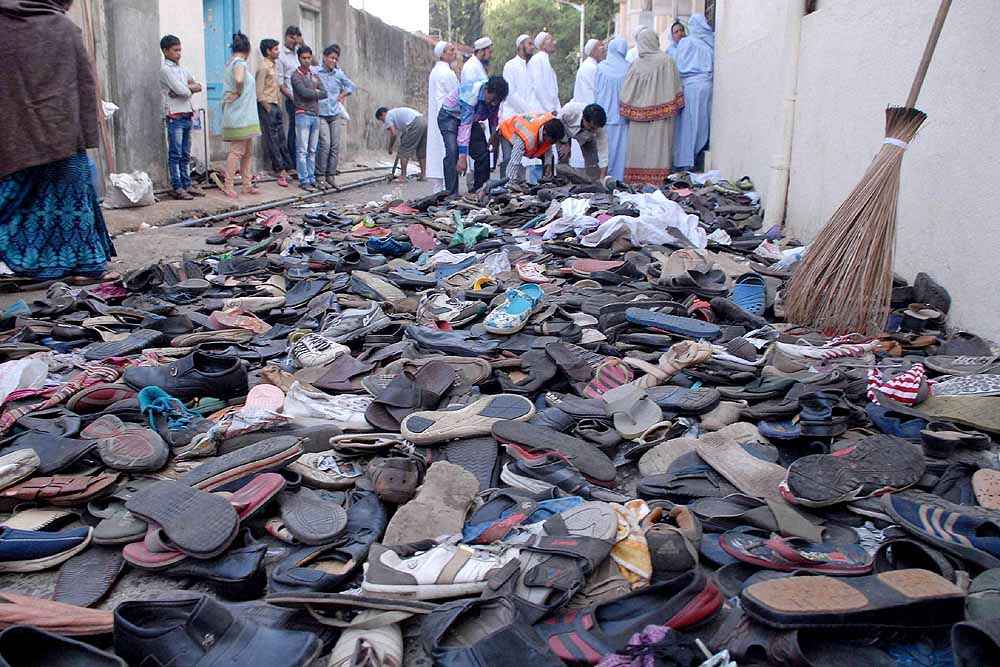
After the stampede
After the stampede

However, the following day, just as many gathered for the funeral procession from Saifee Mahal to Raudat Tahera, where he would be buried later in the day. With the tri-colour on the coffin, thousands, perhaps lakhs (strangely reminiscent of Bal Thackeray’s funeral) walked in the procession, along with Mumbai Police and Rapid Action Force to the exquisite Raudat Tahera mausoleum. His father, 51st Syedna also rests here.

. (AP Photo/Rajanish Kakade)

Apart from his obvious and tangible contributions such as the Saifee Hospital or the on-going Bhendi Bazar cluster redevelopment project, Syedna’s influence seems absolute and unquestionable on most Bohris.

He propagated and provided for education, health care and facilities at mosques such as Jamat cards for all members. Large donations and funds were made available from all across the world at Syedna’s beck and call. It has had the right impact on the million-strong followers—a largely happy, seemingly more modern (because of relatively higher education and colourful ridas/burqas perhaps) and practical people that Bohri business families are.

With popularity among all political leaders—PM Manmohan Singh had inaugurated Saifee Hospital, Narendra Modi tweeted effusive praise for Syedna on his demise—his policies or politics were rarely questioned. Except for reformist Asghar Ali Engineer who fought against absolute authority of Syedna and practice of social boycott and an unidentified Bohri woman who started an online petition against practice of khatna for girls (genital mutilation), there were rarely any voices of dissent.

For most he remains the messenger of Allah who set up grand beautiful modernised mosques (with impeccable audio-visuals for sermons to be telecast), elaborate ceremonies, hospitals and who has brought hope to thousands of poor families in Bhendi Bazar who live in pathetic conditions.

People have cancelled wedding ceremonies, taken off whatsapp profile pictures, downed shop shutters, as per instructions from the mosque officials. They have also cracked jokes about becoming “chunda” (type of pickle) in the crowd. A family friend, who barely managed to come out unscathed from yesterday’s deedaar, was already on her way to the local mosque to see the live telecast funeral procession. “Jaaana toh padegaaa na. abhii khaanaa piinaa sab udhar hi milega. Abhii kuchchh din sirf mullaji ki duaa padhenge,” she said matter-of-factly.

In 2011, Syedna had proclaimed Nass (investiture) upon his second son Syedna Mufaddal Saifuddin in London. The present 53rd Dai al-Mutlaq Syedna Mufaddal Saifuddin led the Namaz-e-Janaza of the late Syedna at Saifee Masjid at Bhendi Bazaar before he was laid to rest at Raudat Tahera mausoleum in Mumbai.

And no, I did not get the last glimpse of bade mullaji but the glimpses of his followers weeping and performing maatam in the sea of humans will stay with me for long. Hope Syedna gives strength to the families of the victims of stampede.

www.outlookindia.com / Outlook / Home> National/Opinion / by Prachi Pinglay -Plumber / Mumbai – Web, January 18th, 2014
Ambassador Islam Siddiqui to deliver Keynote address at Aligarh Alumni Event in USA

by TCN News,

San Francisco:

Hundreds of thousands of students, alumni, and well-wishers of Aligarh Muslim University (one of the oldest and famous seats of learning in Asia) around the world will celebrate Founder’s Day, popularly known as ‘Sir Syed Day’ around this time of the year. In Bay area this event is organized by Aligarh Alumni Association of Northern California on September 20th at India Community Center in Milpitas, CA

Ambassador Islam A. Siddiqui, Senior advisor at the Center for Strategic and International Studies (Former Chief Agriculture Negotiator in the office of the U.S Trade Representative in Obama Administration) will give keynote addresses at the 17th annual Sir Syed Day.

Sir Syed Ahmad Khan

Sir Syed Ahmed Khan, the founder of AMU was born on October 17, 1817. Sir Syed, the famous 19th century scholar, historian and social reformer spent most of his time on promotion of social, economic and educational conditions of Indian Muslims.

Today, AMU symbolizes on the one hand the secular ideals of the Republic of India and on the other the aspirations of more than 150 million Muslims in India. The AMU, which Sir Syed planted as a sapling in British India, has now grown into a blossoming tree.

The Aligarh alumni are spread in large numbers all over the world with the majority being in the sub-continent. Prominent personalities in all walks of life including statesmen such as Dr. Zakir Husain – former president of India, Ayub Khan – former president of Pakistan, and M. Hamid Ansari – current vice president of India.

Dr. Islam Siddiqui

Dr. Shaheer Khan, one of the organizers of the event said, “The Aligarh alumni and present students are proud inheritors of Sir Syed’s legacy of open hearted tolerance, modern enlightened thinking, a love for scholarship, peaceful coexistence and above all a rational approach to our beliefs and our problems.” More than ever, it is time that the ‘Sir Syed Model’ gains wider currency in the Muslim World, Dr. Khan added.

This year’s event will also include the Annual International Mushaira. Many famous Urdu poets from India and Pakistan, along with poets from North America are expected to participate. AMUAA’s annual Mushairas are well recognized and widely acclaimed as the most sophisticated and popular in North America and attract almost 400-500 enthusiasts and admirers of Urdu poetry in the Bay Area.

For more information, visit: http://www.amualumni.org

source: http://www.twocircles.net / TwoCircles.net / Home / by TCN News / September 13th, 2014

Sania’s gesture to young talent

Former National tennis champion Shaikh Jafreen (in the hearing impaired category) was in for a pleasant surprise at the Sania Mirza Tennis Academy in Hyderabad on Friday morning when the three-time Grand Slam winner Sania Mirza walked across to present a cheque of Rs. 5 lakhs to the former to help her prepare for the major events lined up over the next few months.

The 17-year-old Jafreen shifted her base to Hyderabad at the initiative of Sania Mirza and joined the SMTA last year. Ever since, she has been given free coaching and also being mentored personally by the star tennis player.

Only on Thursday, Telangana State Chief Minister K. Chandrasekhara Rao presented a cheque of Rs. 1 crore to Sania, who is brand ambassador of the State Government, as incentive for winning the US Open mixed doubles title.

source: http://www.thehindu.com / The Hindu / Home> Miscellaneous> Others / by Special Correspondent / Hyderabad – September 13th, 2014

This MBA graduate chose to teach underprivileged children in Jharkhand over a plush corporate career

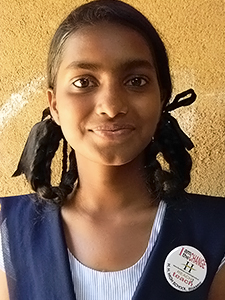
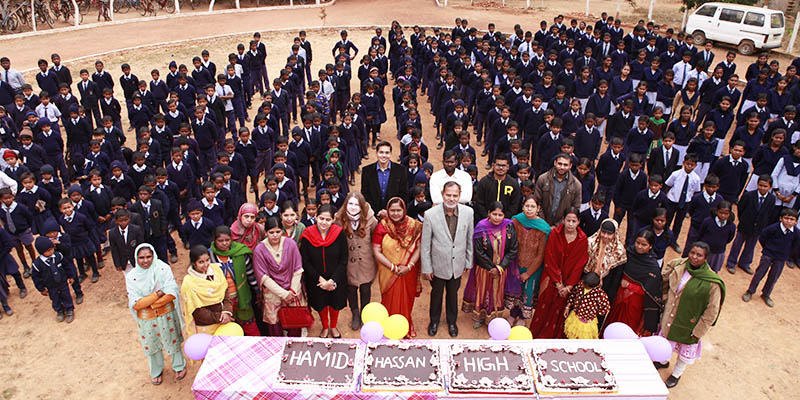
Every social initiative has a story behind it. So does H.H. High School (HHHS). It was founded on January 2010 in Brambe, a small village 20 kms from Ranchi, the capital of Jharkhand.

Shadab Hassan, the Founder Director of the school is an alumnus of BIT Mesra who gave up lucrative job offers in the corporate world to start a school in the village where his father spent his childhood days.

HamidSchool01MPOs12sept2014

Shadab’s father had to struggle a lot in the early years of his life to get to a position where he is today. Due to severe financial crisis in the family, it was difficult for him to pursue his education. But he did not give up. He sold balloons and candies while he was a child to generate money for school fees.

Inspired by his father’s struggle for education, Shadab was determined to open a school in Brambe so that the underprivileged and disadvantaged kids of the village did not have to face the same.

A tough start

Knowing how difficult it was for parents to find a decent school in Brambe, Shadab, along with his mother Roshan Ara and father, brought together a bunch of around 80 kids and started teaching them. But getting these 80 kids wasn’t easy. They went around the nearby villages, knocking each door and finding out the number of children in each household, how many kids went to school, and if not why.

This is where the ‘REACH2teach’ campaign came into effect where people in the village and its surrounding areas were made to understand the importance of education and how it would help them craft a better future for their children in the coming years.

Crossing various hurdles like poverty, part-time or full time jobs that these children were already bound to, they started attending school after the school authorities assured their parents and guardians that they could continue with their jobs.

HamidSchool02MPOs12sept2014

Realizing the laidback attitude and hard-to-change mindset of the rural parents, the team decided to take the campaign to yet another level. This time the school director, Shadab, along with some active volunteers (students from local universities) went around the villages with admission forms and started enrolling kids then and there. This campaign became quite successful and many parents agreed to send their children to school because of on-the-spot registration taking place in the village itself.

“Now that the kids started coming to school, the authorities made use of whatever amenities they could arrange for and created a makeshift classroom for the kids in a semi-constructed building in the residential premises of the school,” says Shadab.

Benches, chairs and tables were absolutely unheard of and the only place to sit, write and read were the huge carpets that were hired by the school at Rs 20 per day along with a rolling blackboard which allowed the teacher to teach the children and conduct the classes. “At this juncture, no teacher was appointed from outside. I took charge along with some volunteers who were either friends or students from local universities,” he adds.

Around 30% of the children in the school were either orphans or had a single parent who often approached the school authorities requesting them to waive their fees.

“We started offering absolutely free of cost education for such children along with orphaned kids who were staying with a relative or guardian. The school also provided books, stationary items, school uniform, shoes and socks for such children so that they could concentrate on their studies without having to worry about the fees,” points out Shahdab.

The only way to sustain the school was to increase the number of students in the school. A number of initiatives and campaigns began which attracted many students from Brambe.

To bring children from nearby villages, the school organized for a van which saved their families the cost of commuting.

HamidSchool03MPOs12sept2014

LIVE classroom: a unique experience for students

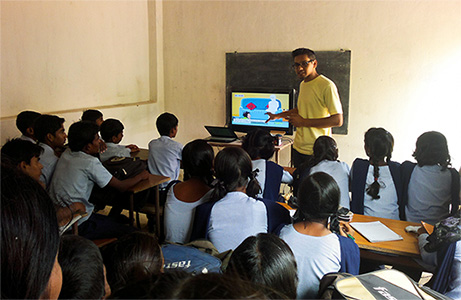
This problem led to a wonderful breakthrough in the school’s method of teaching where the managing committee of the school came up with the idea of conducting LIVE classrooms. The concept of organizing video conferencing in a regular classroom was introduced in the school which opened doors for people around the world who wish to teach underprivileged children but were unable to do so till now.

Apart from providing quality education to the kids of Brambe, H. H. High School also developed partnerships with people in the local community for delivering value to the students and eventually the community at large.

Instead of hiring professionals for basic jobs such as stitching of uniforms, HHHS believes in helping the local people by getting the student’s uniforms stitched from them. It not only gives rise to employment in the village and a positive attitude towards the school, but also helps the children and the school save a lot of money.

One out of three will study for free

“India being a densely populated country, it is quite common to find more than three to four children in a family. Typically, only one or two get an education, the rest are sent to work to bring in extra income,” says Shahdab.

HHHS came up with the idea of offering free education for one out of three siblings of a family as this would ease the parent’s burden of having to pay for the education of all their children. This also encourages more and more children to continue their education without any worries.

Change without changing

Another problem faced by parents is the fact that books and supplies add to the cost of education.“Keeping this in mind, we came up with the concept of allowing children to reuse textbooks so that they not only save money but also develop a sense of responsibility when they use their books with care,” adds Shahdab .

Maatri – an initiative to teach mothers

The school also initiated a programme called ‘Maatri’ which aims at women empowerment in various ways. One of the main aims of this initiative is to educate the mothers of the students by setting up special classes for women every Sunday in the village itself. Along with basic education, they also create awareness about health and sanitation, and teach them how to practice safe child rearing practices.

Google joins the journey

Google has came forward and made use of the already existing LIVE Classroom setup. It has became common for Google employees to take out time from their busy schedule during the day and teach various subjects like English, Mathematics, Science and IT to the students and give them an out-of-classroom experience like never before.

“They also discuss their own job profiles, difficulties and achievements and try to inspire the kids to continue their education and to achieve their goals in life. In recognition of the wonderful efforts put in by the school, Google gifted a 32’’ LCD so that the children could have a rewarding experience through these video classes,” says Shahdab.

Pehel

“What could be more rewarding and prestigious for a founder of a school than to be acknowledged by Dr. A.P.J. Abdul Kalam and also receive the Yuva Prabodhan-2012 award,” says Shahdab.

At present, H.H. High School has 525 students out which around 80 orphans or single parent children are studying free of cost. Their entire education is sponsored by individuals and organizations who donate money through Bless a Child initiative.

In its four years of existence, the school has been able to construct 17 classrooms, provide equipments and facilities for sports like badminton, football, volleyball, cricket, table tennis, and carom board etc. It has appointed 14 full time teachers who are paid monthly salaries for their service.

source: http://www.social.yourstory.com / YourStory.com / Home> Social Story / by Jai Vardhan / September 11th, 2014

When Osman Ali Khan donated 5 tonnes of gold to Govt. of India

Hyderabad :

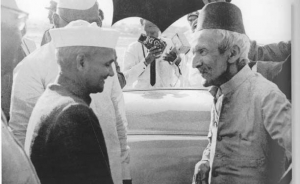
After emerging victorious in the war against Pakistan in 1965, India faced threat from its other neighbour China. In that situation the then Prime Minister Lal Bahadur Shastri started collecting funds to combat any potential threat. He set up National Defence Fund for the purpose. The government of India appealed to Rajas to help in the difficult situation but they didn’t come up to the expectations.

NizamMPOs11sept2014

Then Lal Bahadur Shastri headed for Hyderabad; he knew that Huzoor Nizam Mir Osman Ali Khan would not disappoint Indian government. The PM visited Hyderabad and requested the Nizam to contribute generously to the National Defence Fund. Without a second thought, Mir Osman Ali announced that he would contribute five tonnes of gold for National Defence Fund. The announcement left the people present their flabbergasted. But Asif Jah VII created a record by making biggest ever contribution by any individual or organisation in India that remains unsurpassed till today. In terms of today’s gold price this donation translates to a whopping Rs 1,500 to 1600 crore.

Do the prejudiced and communal leaders who demand to celebrate liberation day on September 17 dare to break this record of generous donation for the country?

Muhammad Riyaz Ahmed

source: http://www.siasat.com / The Siasat Daily / Home> Hyderabad / by Muhammad Riyaz Ahmed / Thursday – September 11th, 2014

Royal Style

AkbarLUCKNOW11sept2014

Centuries before Peter Stillman the elder, the eccentric/insane professor in the first part of Paul Auster’s The New York Trilogy, had conducted a ghastly linguistic experiment on his son by locking him up in a dark, empty room from birth to find out his ‘natural’ language, a famous Indian emperor had supervised a similar research in real life. In the outskirts of Fatehpur Sikri, Akbar kept a ‘dumb house’, where babies were reared by dumb wet nurses: the emperor wanted to ascertain what language they would speak once they grew up under these laboratory conditions. Disappointingly, the experiment failed, and the children were found to have acquired no god-given or natural language when they were visited a few years later.

This incident may suggest that Akbar was a cruel man but the moral judgment would overlook his keen scientific temperament — this disposition had also led him to order the mating of a goat and a deer. The same urge to look beyond the given and to find out what happens when boundaries are crossed must have inspired him to create Din-i-Ilahi, the syncretic religion that still speaks volumes for that progressive man who could think of a faith combining elements from several existing religions in the 16th century. Akbar’s character, as analysed by Lucy Peck in FATEHPUR SIKRI: REVISITING AKBAR’S MASTERPIECE (Roli, Rs 795), is as intriguing as this palace complex built by the emperor over years and then, suddenly abandoned. Peck revisits the old mystery surrounding Akbar’s unexpected moving of court from Fatehpur Sikri, and although she doesn’t join the dots, the solution seems to lurk somewhere in the emperor’s character rather than in material causes, like the alleged shortage of water there.

Peck’s Akbar is an artist, with all the attendant symptoms and characteristics of artisthood. He seems perfectly capabale of believing six contradictory things before breakfast. However, that may well be because the Akbar about whom we read now is a construct of texts by three different people with different agendas — Abul Fazl, who is all-praise for the emperor; Badauni, who, displeased by Akbar’s religious tolerance and out of favour in the court as a result, is embittered; and the Jesuit priest, Monserrate, whose account is seemingly unbiased because it is by an outsider. Sifting through their stories, Peck presents a flamboyant Akbar whose interests range from block-printing, carpet-weaving, taming elephants, flying pigeons to settling his subjects’ disputes hands-on, debating tirelessly on religious issues, sometimes throughout the night. He is possibly an epileptic — given his frequent trances — a dyslexic and an opium eater, subject to bingeing bouts. He spends nights meditating alone on a rock, seeking answers to life’s questions. Add to this driven, excessive nature the emperor’s prerogative, and one can begin to fathom why, for instance, he ordered the dumb house experiment or built a place like Fatehpur Sikri, with its eccentric blend of varied styles, its mix of austerity and extravagance. As Peck writes of the buildings of Fatehpur: “[They] reveal themselves to be remarkably disparate. One can well imagine Akbar hearing about or seeing an unusual building and saying, ‘I’ll have one of those.’”

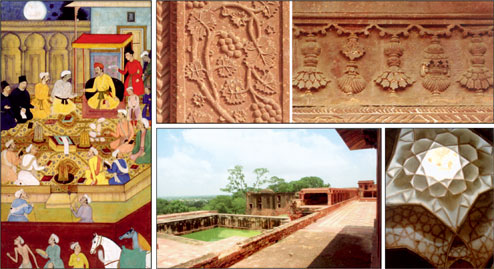
Top right is an illustration of the diverse designs that come together in Fatehpur Sikri. The grapevines look European while the pattern on the right panel resembles the stringed decorations that Hindus hang from the top of door frames on festive occasions. Left shows Akbar in the Ibadat Khana, where he held the discussions with people of other faiths that eventually resulted in Din-i-Ilahi. Bottom left is the tank on the banks of which Akbar’s courtiers had met on the emperor’s birthday in 1582 to celebrate the occasion with games of chaupar, chess and cards. Akbar had looked on with mixed feelings at such frivolities until disaster struck: a side of the tank collapsed and the water swept downhill, washing away settlements. The breathtaking ceiling of the Royal Baths is on bottom right.

source: http://www.telegraphindia.com / The Telegraph, Calcutta / Front Page> Opinion> Story / by Anusua Mukherjee / Friday – September 05th, 2014

Drinking water is prized possession

Parvez Majeed a Srinagar based young journalist, who is doubling as volunteer, helping flood affected

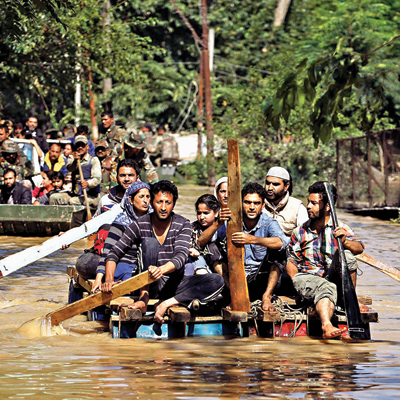
Kashmiri residents use makeshift rafts to rescue flood affected people in Srinagar AP

As most of Srinagar city is inundated and cut off, it is return of medieval periods with no communication links. There is no end to the plight of the victims of the unprecedented  floods . Hordes of people are running from pillar to post in search of food and shelter. The three kilometre stretch of the bypass road between Tangpura and Lasjan, on the outskirts of Srinagar is where the people are being rescued.

The scenario at the rescue camp is worse, people come in search of their relatives and some leave dejected. Former director of Doordarshan Rafiq Masoodi is also missing, his family members visit the camp regularly. Former chief secretary Mehmood-ur-Rahman has been desperately looking for his 92-year old father-in-law, who was rescued form Rajbagh, but is not to be found anywhere.

On third consecutive day on Wednesday, one could see the poignant scenes of crying women and horrified children desperately wanting  drinking water . Volunteers are struggling to provide water and food. Some 400 water filtration plants have been washed away or rendered defunct.

The packaged drinking water stocks in the shops and stores have already exhausted. At rescue camps drinking water is the most precious thing to possess. Some distance away a boat of National disaster  Response Force (NDRF) was ambushed by some miscreants, and looted water bottles, it was carrying to other areas.

At temporary relief centres established by people, voluntarily at Nowgam Chowk bus stop, people are struggling to get food packets. The queues are getting longer by every minute. Full credit to volunteers who are supporting the survivors whom they rescued from submerged localities during these three days.

I am appalled to see no one from National Disaster Response Force (NDRF) is carrying out the rescue operations. It is the young locals who have used all ingenuity at their command, to make temporary boats from tyre tube, plastic water tanks and wooden planks to rescue people from inundated houses. Only at Hyderpora bypass Airport road, I saw a government truck carrying evacuated people from Tangpura, Batmaloo to Hyderpura flyover.

Luckily, the locality of Chhanapura, where I Live, is among the very few Srinagar localities, where houses did not submerged. But we are facing connectivity issue, as the roads are submerged. It is the fifth day on trot, I have not taken bath. I along with my neighbour go out with water, biscuit and bread and hand it over to relief volunteers at Gudwara and Sanat Nagar Community  Centre, Lasjan and Nowgam Chowk. I rush back home as fast as I can to be with my landline phone which miraculously works.

As my neighbour’s car today ran out of fuel, we now cover distances on foot. In fact non availability of fuel is hampering volunteers to rescue and provide relief. Since Monday, helicopters are making countless sorties over Srinagar skyline. Nobody knows what they are doing. Most of the survivors whom I met are very angry at what they call `Absence of the government from the tragedy’.  Ajit Singh Bali of Mehjar Nagar, who is sheltered at Shahid Baga gurdwara said, “I was not rescued by any helicopters or any government rescue team. My two youth neighbours Ashraf and Idrees were the ones who rescued me from my flooded house, after three days.”

source: http://www.dnaindia.com / DNA / Home> News> India / by Parvez Majeed / Thursday – September 11th, 2014

Book Review of CM Naim’s The Muslim League in Barabanki

Muslim League in Barabanki

K Babar

K Babar reviews Indian-American scholar C M Naim’s new collection of essays

The Muslim League in Barabanki
C. M. Naim,
City Press, 2013. Pp.126. ISBN: 9789698380984. Rs.350

The title of this slim volume refers to the first and longest essay in this collection of eleven pieces by the Indian-American scholar and translator Choudhri Mohammed Naim. Most of the essays are reprinted and revised editions of short articles that have appeared over the years in various publications, and which reflect, as Naim himself puts it, his “engagement with India and Indian Muslims”.

The first essay revolves around Naim’s Partition experiences, as well as those of his family. The young Naim and his friends tramped through their town, hoisting a Muslim League flag and chanting inciting slogans while tearing down Congress flags en route to school, determined to stir controversy by refusing to sing the national anthem. But once there the kindliness of a teacher, coupled with bribery consisting of an extra packet of laddu, dampened the enthusiasm of the youths, and they stood by placidly while the national anthem was sung.

The recounting of this incident is a universal reminder of the nature of much of protest. A reminder of the image of the youngster who proudly partakes in some protest march or other, only to stutter or stare blankly when quizzed about what it is he is marching for (or against). And once one has become suspicious of the authenticity of these part-time protesters, one wonders about their true motivations. Is it for the feeling of empowerment that they march through the streets, waving flags and shouting and domineering? Is it a form of release, an outlet, or just entertainment, a change from routine boredom? I wonder how many of these youths would follow the protesting practices of one of the most prominent of all 20th century Indians and refrain from eating not only laddu but anything at all.

Pakistani journalists should take note of Naim’s analytical style

Perhaps the young Naim was at heart ambivalent about Partition, for he later admits to a perpetual fluctuation of sentiment, ranging from pride at the achievement of Pakistan, to regret at the painful divisions it caused between friends and even families. His voice is an honest one, never flinching from uncertainties or complexities.

This is reflected in the remaining essays of this book, which are dominated by Naim’s deconstructions of the vitriolic and intolerant declamations by various Indian Muslim organizations and media outlets towards unorthodox groups such as the Ahmadis. This he does with a lot of skill, undermining the arguments of the opposing side by unearthing historical and religious examples of usually unquestioned authority that directly challenge the supposed Muslim orthodoxy that is being propagated by its self-appointed defenders. In short, his activity consists of picking apart prejudices, revealing fallacies, and pointing out self-contradictions as manifested in newspaper reports, websites, and other media. In addition to highlighting ignorance and hypocrisy, these tasks seem geared towards ensuring that disputes are civilized, that monolithic and oversimplified constructions of Islam and history are not allowed to prevail without opposition, and that those who would use sectarian means for political ends are exposed as being inappropriate leaders in either sphere. A relatively simple analysis of what is being said by whom and in what context is often more than enough to accomplish these goals.

An extra packet of laddus dampened the enthusiasm of the youths

It is always instructive when a linguist takes the time and effort to illustrate the way in which language is used and abused to promulgate an agenda, hidden or otherwise. As a teacher and translator of Urdu with significant credits to his name, Naim performs his duties with diligence. It would be appropriate for Pakistani journalists and scholars to take note of the admirably analytical style of Naim and apply similar precision to their own writings and that of their contemporaries. The only flaw in this book is that it could use some editing to compensate for grammatical errors, untranslated Romanizations of Urdu words, and a somewhat jarring style in the initial sections of the first essay. These relatively minor quibbles aside, one looks forward to seeing more of Naim’s work being published in Pakistan. For instance, his annotated translation of the Zikr-i Mir, the autobiography of the 18th century poet Mir Muhammad Taqi ‘Mir’, which was published by Oxford University Press in India, should be reprinted here, it being a valuable primary source document for the Mughal period.
- See more at: http://www.thefridaytimes.com/tft/muslim-league-in-barabanki/

P.S.

The above article from The Friday Times is reproduced here for educational and non commercial use ( The Friday Times, March 20th, 2014 )

source: http://www.sacw.net / South Asian Citizens Web / Home Page> Special Dossiers> Compilations> Partition of  1947> Book Review / April 07th, 2014


MGA organises personality Development Programme

Hyderabad  :

To promote hidden talents and creative abilities of girls of schools and Junior Colleges, Muslim Girls Association of India is organising a special Personality Development Programme on September 11 from 9:30 am to 3 pm.

Lectures of Mrs. Azra Sayeed, Lilly Group of Institutions, Mrs. Durdana Rafath lecturer Royal Embassy College and other professionals will be held.

Siasat news

source: http://www.siasat.com / The Siasat Daily / Home> Hydereabad / Wednesday – September 10th, 2014

A brand ambassador for palliative care

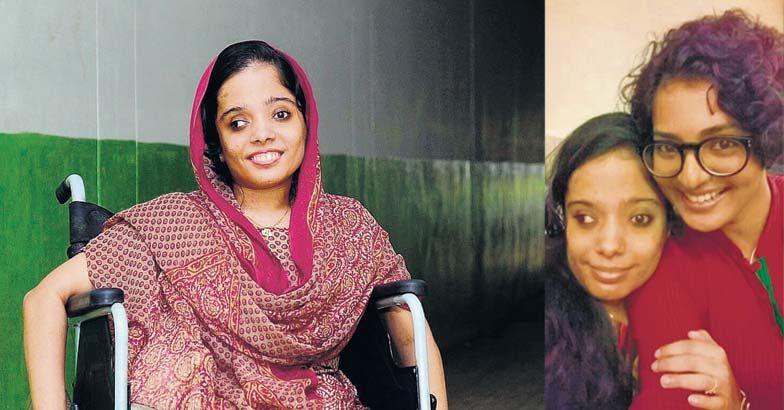
Wheelchair-bound Baby Fatima is the inspiration behind Saira of 'Bangalore Days'. Insert : Fathima with Parvathy (R)
Wheelchair-bound Baby Fatima is the inspiration behind Saira of ‘Bangalore Days’. Insert : Fathima with Parvathy (R)

Remember Saira of ‘Bangalore Days’? The character of Saira, who vanquishes the handicaps of the body using sheer willpower, is based on a real life character who caught Anjali Menon’s attention at a ward in the Kozhikode Medical College. Baby Fatima, a wheelchair-bound young girl who went to each patient, made them smile and consoled them, was the real life inspiration behind Saira.

Baby Fatima, like Saira, is also fast becoming a rage in the campuses. Fatima is visiting campuses to garner support of the students for the palliative care work in connection with the ‘Becoz I Care’ campaign jointly conducted by the Institute of Palliative Medicine and Students in Palliative Care.

Even though not a radio jockey like Saira in ‘Bangalore Days’, Fatima, too, has the gift of gab. The palliative care workers contend that once Fatima speak a few words to them, any patient will be able to forget their woes. Ask Fatima how she came to possess such boundless positive energy, and she will wax eloquent about her family and her childhood.

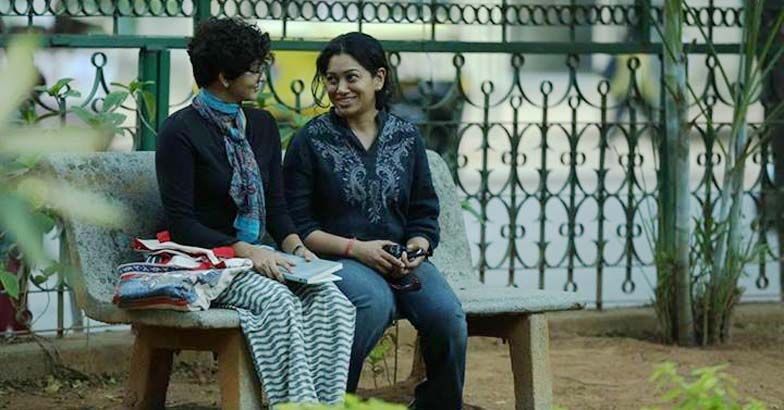
Parvathy (L) with Anjali Menon (R) during the making of the movie, 'Bangalore Days'
Parvathy (L) with Anjali Menon (R) during the making of the movie, ‘Bangalore Days’

Fatima grew up with her ‘moothumma’ Malappuram Kottappadiyil Kiliyamannil Mumtaz Usman’s family as the pampered lone sister of moothumma’s four sons. It was not as a handicapped child that the family treated her. Having been raised in such a way as to instill confidence in her, proved to be her strength, according to Fatima.

Fathima is a second year BSW student now, though she has not gone to school or college for studies. She studied from home. It was as part of the ‘Becoz I Care’ campaign that Fathima had her first glimpse of a campus, giving her immense joy.

BSW was a natural choice for her as social service is her ambition in life. Soon after completing Class 10, Fathima took the lead to meet up with palliative care workers and became part of their activities.

Apart from all these activities, the entrepreneur in Fatima has launched a designer clothes boutique in her own home. Fatima’s muthumma Jamal Ayesha accompanies her to the Medical College every morning, where patients await the girl, who has been a regular presence there for the past five years with a beaming smile and soothing words of care.

Life +ve Becoz I Care campaign is about each student reaching the brochures and registration forms of palliative care to ten households. The goal is to make the kind-hearted souls who are willing to set aside Rs 3 daily (Rs 1000 annually) as members in the ‘Tracks We Live’ project. The palliative care workers will then be able to deliver one time painkillers to one patient at Rs 3. The project aims at alleviating the pain of a patient using one person’s donation.

For registration form visit: www.instituteofpalliativemedicine.org
Phone: 82816 64752

source: http://www.english.manoramaonline.com / OnManorama / Home> Lifestyle> Health / by Kapil Raj / Friday – July 25th, 2014