Category Archives: Community Involvement / Social Issues

Kalam Stresses on Importance of Family in Nation Building

New Delhi :

Economic growth or military strength alone won’t make India strong, a truly sustainable society, at the heart of which is the family, is very much necessary, argues former President A P J Abdul Kalam in his new book.

Kalam and celebrated Jain thinker late Acharya Mahapragya in the book “The Family and the Nation” say that only a strong and happy family can lead to a strong and noble nation.

In writing the book, the ideas of the two authors were shaped by their interaction during the past few decades with millions of countrymen hailing from different walks of life.

“Each interaction enhanced our experience and added to our understanding of the development of a noble family, a noble society and a noble nation,” they write.

While embarking on this journey of writing a book, we realised the magnitude of connectivities involved and the extent of our society’s evolution during the last few centuries,” they say.

“It is true that all of us realise that today’s world is a connected one. Technology and travel have nearly made the world a global village. The world has to become a federation of nations.

A nation is a federation of states, social groups, families and individuals. So what is needed is a situation of live and let live.

“One’s needs, aspirations, accomplishments are all important. But there has to be a concept of a noble nation, where the welfare of the whole nation as a whole is ingrained in the thinking and actions of its people.

This is the need of the hour. How do we achieve this idea of a noble nation,” the authors ask.             According to them, their visualisation of a noble nation is two-fold.

“One is internal, concerned with the individual and encompassing the family, community and society. Another concerns enterprise and covers the issues of livelihood, business, distribution of wealth and respect for individual property and rights,” they say.

The authors do not offer any new theory or postulate any new concept but draw from the heritage of our civilization.

“The bottom line is that a citizen with a value system respects the family, respects society, and thereby respects the nation. Furthermore, the person is conscious that he or she is a part of the world family.

“The operational line is the prosperity of people with adequate earning capacity. We call such a nation a developed nation. Economic prosperity and an embedded value system would promote a peaceful and prosperous society and thereby the evolution of a happy nation,” they write.

The book, published by HarperCollins India, stresses on the values that make for a truly sustainable society, at the heart of which is the family. For it is not economic growth or military strength alone that will make India strong.

Sustainable success comes from values, and these can sustain a society and a nation even in times of hardship. The book expresses an ideal by which Indian society may prosper and speaks of how spirituality can help create a noble nation and a better world. It provides a valuable counterpoint to the modern-day emphasis on consumerism and the philosophy of more is better, highlighting the sanctity of the natural world and its great power to evoke human creativity and love.

The two writers bring their vast experience to bear on this important subject. As the authors put it, it’s only a strong and happy family that will lead to a noble nation, one that can be a true fulfilment of 5,000 years of India’s civilization.

source: http://www.newindianexpress.com / The New Indian Express / Home> Nation / by PTI / August 26th, 2014

Job market on wheels, an initiative by Hyderabad Municipal Corporation, TMI

Hyderabad :

You do not have to now visit offices of placement firms to look for jobs in Hyderabad. Look out for Hyderabad Municipal Corporation’s mobile employment vans in your area.

In a novel initiative, the Greater Hyderabad Municipal Corporation and city-based training and placement firm TMI Group has pressed into service a fleet of eVans (employment vans) which would move around select employment zones in the city.

Job seekers can approach these mobile vans, which will help them look for the right job on the basis of their qualification and experience.

Earlier, the corporation and TMI had together set up Youth Employability Centres across seven locations.  However, it was seen that for many job seekers, it was difficult to approach these centres.  This led to the concept of mobile employment vans.

“These mobile vans are equipped to provide placements in the micro small and medium enterprises, apart from the private sector,” T Muralidharan, managing director of TMI said.

City Mayor Mohammed Majid Hussain launched the eVans today.

source: http://www.thehindubusinessline.com / Business Line / Home> National / The Hindu Bureau / Hyderabad – August 16th, 2014

New Chiefs Appointed to Academies

Bangalore :

The Department of Kannada and Culture has appointed heads and members to various academies.

M S Murthy (Bangalore) has been appointed the Chairman of Karnataka Lalithakala Academy, B A Mohammed Hanif (Dakshina Kannada) is the new chairman of Karnataka Beary Sahitya Academy while Kolkada Girish (Madikeri) has been appointed as the Chairman of Arebhashe Samskruthi Sahitya Academy and Biddatanda S Thammaiah has been appointed the Chairman of Kodava Sahitya Academy.

Members Named

For Karnataka Lalithakala Academy, B L Chauhan, Mahalingappa, Prabhu Urs, B K Badigera, Vishweshwari Tiwari, Devarishi, C Chikkanna, Krishna Devadiga, T H Shanmukappa, Khasim I Kansavi, Sharanappa B H, Wajid Sajid, Vedamurthy, Bargur Markandeya and C Rajashekar have been appointed the members.

source: http://www.newindianexpress.com / The New Indian Express / Home> States> Karnatkaka / by Express News Service / August 14th, 2014

The cleric who is crusading against the drug mafia

Residents of Dongri area were amazed last week when they saw a group of spirited activists, many of them holding torches and sticks, roaming their streets at night. The march was part of the ‘Drug-Free Mumbai Campaign’ being led by Maulana Syed Moinuddin Ashraf, popularly known as Moin Mian, head of Jamia Qadriya Ashrafia madrassa in Grant Road.

Clad in a white flowing robe and a cap, the senior cleric has declared a jihad against drug peddlers with a nexus with police. Moin Mian, accompanied by fellow protestors including MLA Amin Patel and ex-MLA Yusuf Abrahni, invariably invites local cops to the marches through narrow streets. “We have identified 19 localities including, Dongri, Nagpada, JJ, Pydhonie, and Agripada that are dens of drug peddlers. We have forced the anti-narcotics cell of the Mumbai police to crack down on the drug mafia,” says Moin Mian, who adds that ever since he launched the campaign, along with NGO Social Educational Welfare Association (SEWA) on August 15 at Islam Gymkhana, results have been encouraging. “Earlier people were too scared to speak out against the peddlers who don’t hesitate to attack anyone. Now people join the protests and direct police teams to the dens,” says the spiritual leader. “It is an encouraging campaign. We have given our cell numbers to the volunteers to inform us. We are committed to act against the offenders,” says DCP (Anti-Narcotics Cell) Namdeo Chavan.

But why did a spiritual leader who is mostly surrounded by disciples at his Agripada-based home undertake a cause, which may invite the enmity of powerful drug mafia? He says a couple of years ago one Aslam Abdur Rahman narrated to him a traumatic story. Rahman said that his son Qadeer was doing well till he became a drug addict. “He said the boy had sold out two of the three shops he owned and would often become violent when told to quit drug use. The man started sobbing. It moved me and I decided to launch a campaign against it,” recalls Moin Mian. Is he not scared? And is it not enough that like most other religious and spiritual leaders, he should confine his reforms through preaching? “I am not scared of anyone except God. And preaching has its benefits but the time has come when religious leaders should launch mass movements against social evils,” he says. Ex-MLA and SEWA’s president Yusuf Abrahni says: “I am amazed by his determination to fight the powerful drug mafia. For him there could not have been a better cause than this to lead and we will support it.”

Senior psychiatrist and former head of Bombay Psychiatric Society Dr Y A Matcheswalla says the battle against drug addiction can be won through two methods: lowering demand and reducing supply. “Supply reduction can be done by the Narcotics Control Bureau and Anti-Narcotics Cell of the police while demand can be lowered by creating awareness. It is here that spiritual leaders like Moin Mian have a role to play. “He has galvanised the masses,” says Dr Matcheswalla who adds that Mumbai is “the drug capital of India”. “Many of us wrongly think that it is the job of only police and psychiatrists to fight drug menace and addiction.”

source: http://www.timesofindia.indiatimes.com  / The Times of India  / Home> City> Mumbai / Mohammed Wajihuddin, TNN / August 24th, 2014

Modern architect of Jamia Prof Mushirul to deliver lecture on campus

The Department of History and Culture, Jamia Millia Islamia is going to organize a lecture on Partners in Freedom: Jamia Millia Islamia by Professor Mushirul Hasan on August 26 at 11.00 AM in the Seminar Room, Department of History and Culture, Jamia.

Professor Mushirul Hasan (JMI Photo)

Professor Hasan is the former Vice-Chancellor of Jamia and has a distinguished place among historians. As VC of Jamia from 2004 to 2009 he played a crucial role in opening many centres. Many existing buildings and the beautification of the campus happed during his tenure. Many call his the modern architect of Jamia.

He received his education at Aligarh Muslim University and Cambridge University. He is also the recipient of Padma Shree. He is the author of many important books on Indian history. He has written extensively on the Partition of India, on communalism, on the histories of Islam in South-Asia and on the role played by the Muslim community in the freedom struggle and in the process of nation-building. Also, he served as the Vice-Chairman of Indian Institute of Advanced Study, Shimla and Director General of National Archives of India apart from other numerous responsibilities as Member of Professional/Learned Bodies/Societies.

Despite all his achievements and numerous contributions in building Jamia what it is today he had to take VRS, sparking debate whether he was forced to quit.

source: http://www.okhlatimes.com /Okhla Times / Home> JMI> OT Campus Reporter – JMI / OT –  August 25th, 2014

Tributes paid to Shehnai maestro

Varanasi :

Rich tributes were paid to Shehnai maestro Bharat Ratna Late Ustad Bismmillah Khan on his 8th death anniversary observed at Dargah-e-Fatman on Thursday.

A music lover and a fan of Ustad, Narendra Gupta from Delhi, paid tributes to him by reading Sunderkand of Ramcharitmanas and Hanuman Chalisa beside his grave. Gupta visits the city every year on birth and death anniversary of Ustad. Some music lovers also paid a musical tribute to him on the occasion.

They were disappointed to see that the grave of Ustad could not take a shape of a maqbara yet, and a music academy after his name also seemed to be a distant dream. A series of promises were made by the government after the death of Shehnai maestro but none of them have been fulfilled yet.

source: http://www.timesofindia.indiatimes.com / The Times of India / Home> City> Varanasi / TNN / August 22nd, 2014

Touch to reach Kashmir

She is the first Kashmiri to develop an app and is now popularly known as the ‘Android girl’

MehvishMPOs24aug2014

Mehvish Mushtaq (23) Founder of projectDial Kashmir
A . If there is paradise on earth, it is here, it is here, it is here…said Amir Khusrow, Sufi musician, poet and scholar about Kashmir.

Eons ago Kashmir conjured up images of beauty — Dal Lake, boat houses and snow capped mountains. But now, Kashmir has become synonymous with turmoil.

That’s why Mehvish Mushtaq is like a breath of fresh air. She is the first Kashmiri to develop an Android app — Dial Kashmir, which has become an almost mandatory application to have on one’s smartphone in Kashmir that has a population of around five million. She says she created the app with an aim to facilitate communication processes within the Kashmiri society.
Is there a lane that leads to your house that is water logged because a pipe burst, and you are clueless as to how to get in touch with the local municipal department? There’s a fire that needs to be put out? You need to contact a hospital or a newspaper office or get a gas cylinder delivered? These might seem like simple tasks in a city like Bangalore. But in a conflict-ridden Kashmir such problems take on a different hue. Step in Dial Kashmir, which is now into its fifth version, with Mushtaq working on the sixth.
Mushtaq who graduated in Engineering (Computer Science) describes herself as a tech savvy person. “Technology has always fascinated me.” In the winter of 2013, she did an online course on Android application development. As a part of the course, she was supposed to make an app. “I decided to develop something that would be useful to the local people,” she says. “The fact that whenever someone needed a contact number of a particular service, the process to obtain the information was not easy; sometimes the official sites were broken and sometimes you couldn’t find the number at all. All this motivated me to create the app.”
Dial Kashmir (a name suggested by her best friend) caters specifically to the Kashmir region. It gives users extensive information such as addresses, phone numbers and email ids of essential and commercial services in various sectors. In addition to that it also includes features such as prayer timings, railway timings, a flashlight, pin codes, ISD code etc. The app first become operational on February 28, 2013.
Mushtaq, now known as the Android girl, has been getting “appreciative” mails from all over the country. She says the app has not contributed much “materially. But the success gave me confidence and made me more outspoken.” And a new beginning and something to rejoice — for everyone who is bombarded with news about a troubled Kashmir at the other end.

source: http://www.bangaloremirror.com / Bangalore Mirror / Home> Columns> Work / by Sudha Pillai, Bangalore Mirror Bureau / August 22nd, 2014

Postal department to release postage stamps on music maestros

Allahabad :

Yesteryears’ classical music maestros, who gave new dimensions to Indian music would now hog the limelight through postage stamps. For collector’s delight, the postal department has decided to release stamps of eight legendary vocalists and instrumentalists who captivated the audience worldwide through their talents.

The release being commemorative and a one-time release has been eagerly awaited by the city philatelists here. The maestros who had ruled the music world and made their presence felt in overseas also, ranges from that of early 20th century to the past few years.They include Bharat Ratna and three time Grammy award winner Pandit Ravishankar who introduced sitar to the world, Bharat Ratna Bhimsen Joshi who ruled the music arena for over six decades with his ‘khayal’ style of singing and Padma Vibhushan, Kumar Gandharva, famous for his unique vocal style and his innovative genius.

Among the list are sitar maestro Ustad Vilayat Khan who recorded his first performance at the age of eight and gave his last concert at the age of 75 years. Similarly, Ali Akbar Khan, Pandit Mallikarjun Mansur, classical singer of the `khayal’ style and Padma Vibhushan awardee Gangubai Hangal also of the `khayal’ genre and Padma Vibhushan Awardee and DK Pattama, renowned Carnatic musician and a playback singerfor film songs would also figure in the stamps to be released soon by the postal department.

Director, postal services, KK Yadav said, “Gauging from the response the people, specially the young collectors have shown over the stamps of yesteryears’ actors, we are convinced that the collection of the stamps of the musicians which will be released in a limited number across the country will be sold out within couple of days. The stamps release is proposed on September 3.”

Harish, a registered stamp collector said they are eagerly awaiting the collection of stamps of musicians to be released in the month of September.”It will be a valuable collection for us as it would be the first of its kind stamps on Indian music in the past few years,” he added.

source: http://www.timesofindia.indiatimes.com / The Times of India / Home> City> Allahabad / by Vinod Khanal, TNN / August 23rd, 2014

Calligraphy fans come from Jaipur, Japan to hone skills

Allahabad :

In a bid to revive the glory of dying art of calligraphy, youngsters from Jaipur to Japan have assembled here to receive training of the art from Hyderabad-based artist Mohammad Nayeem Sabri. Majority of them do not are experts in Urdu, still they want to carry forward the legacy of this art.

On Friday, TOI spoke to trainees and trainer in the ongoing workshop at Allahabad Museum.

Harpeet Kaur Chabra, a Sanskrit calligrapher, came to know about the training workshop from social site, Facebook in Jaipur. She contacted Allahabad Museum and sought permission to attend the workshop.

“I am a professional dealing with Sanskrit manuscripts and not well acquainted with Urdu language so I decided to participate in the week-long training sessions,” Chabra said.

Asuka from Japan, who was researching on Urdu, joined the workshop to carry the dying art to her country.

“Calligraphy is a medium of expression practiced in English, Urdu and Arabic and others languages. Since I am researching on Urdu, I decided to join the workshop to hone my skills,” Asuka said. Hamidia Girl’s Degree College (HGDC) principal Rehana Tareeq invited her to join the diploma course in calligraphy in her college also.

HGDC student Farheen Kausar and 15 others have decided to join the workshop.

“We are from fine art background, so we decided to learn the difficult form of art. We have added innovations to it by using brush strokes in calligraphy,” Farheen added.

Calligraphist Mohammad Nayeem Sabri (86), who had dedicated his life to the art after getting relieved from 48 years of service as engineer in Hyderabad, said: “There are couple of girls who can make it big in the art of calligraphy if they practice under the guidance of experts.”

“The art is found on nearly every monument in India and even in English there is a immense scope. The calligraphy at Qutab Minar, Taj Mahal had attracted tourists worldwide. At present, this art is passing through a poor phase so I hope government will look into it.”

source: http://www.timesofindia.indiatimes.com / The Times of India / Home> City> Allahabad / by Vinod Khanal, TNN / August 23rd, 2014

ANU student designs baby rescue unit

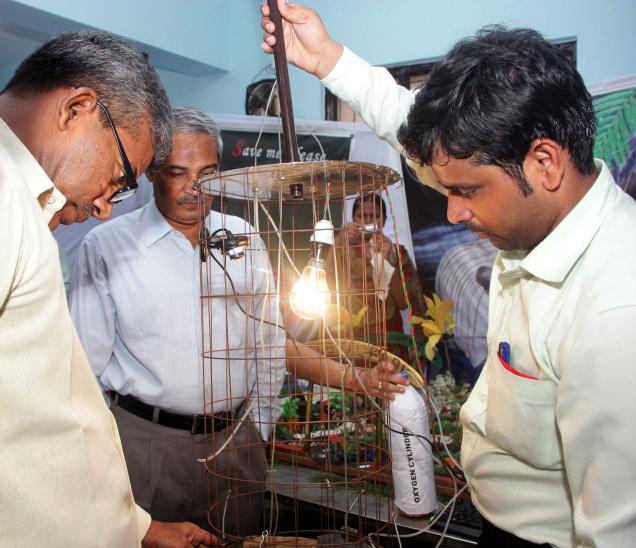
Hassan, an M.Sc (Biochemistry) student, explains working of a baby rescue unit designed by him to ANU Vice-Chancellor K. Viyanna Rao at the academic exhibition held in Guntur on Friday. Photo: T. Vijaya Kuma / The Hindu

An indigenous baby rescue unit to extricate children who accidentally fall into borewells in countryside has been designed by a student of Acharya Nagarjuna University (ANU) here.

Hassan, a first year student of M.Sc. (Biochemistry), has designed a simple baby rescue unit, which he says, can be used to safely extricate babies from borewell pits, which sometimes are well over 100 ft deep.

His exhibit at the ongoing academic exhibition being held on Civil & Mechanical Engineering block has been catching the attention of viewers. ANU Vice-Chancellor K. Viyanna Rao asked the student to further modify the design and added that the university would support further research and development of the model.

Consisting of a cylindrical iron netted structure, the rescue unit has a bulb, a web camera and an oxygen cylinder tube attached to it. The structure is funnelled through the earth soil through extra pipes till it reaches the spot where the baby is located. Using the pictures beamed by the camera, the operator can use the trays at the bottom of the structure to extricate the baby with the soil. The continuous supply of oxygen with the tube helps the baby in staying alive during the operation.

“Conventional method of digging a parallel pit along with borewell consumes a lot of time and poses a risk to the life of baby. With the baby rescue unit designed by me, the whole operation gets completed within 2-3 hours and the precious lives of children can be saved,’’ Hassan told The Hindu.

Dean, College Development Council and Coordinator of academic exhibition, G.V. Chalam said that the exhibition featured innovative solutions including, solar based appliances, national disaster prevention mechanisms, NSS extension activities etc. The 10 science departments, professional colleges and University college of Pharmaceutical Sciences took part in the exhibition.

source: http://www.thehindu.com / The Hindu / Home> News> National> Andhra Pradesh / by P. Samuel Jonathan / Guntur – August 23rd, 2014