Category Archives: Community Involvement / Social Issues

Sanskrit teaches you to become a good person: Kishwar Zubin Nasreen

Lucknow :

Kishwar Zubin Nasreen, the head of the department of Sanskrit at Allahabad University, on Tuesday became the first Muslim woman to receive the Uttar Pradesh Sanskrit Sansthan award for her immense contribution in the field of Sanskrit. The award, instituted in the memory of socialist leader Janeshwar Mishra, will be given annually to a Muslim woman scholar of the language.

Though Nasreen has been a professor of Sanskrit for 36 years, she has been closely associated with the language since 1963.

“Besides being a beautiful language, Sanskrit teaches you to become a good human being and also helps you learn a lot about Indian culture and moral values,” she said.

“My religion never came in my way. In fact, after I learnt Arabic, considered one of the most difficult languages, Sanskrit was a cake walk,” she said.

“The first thing I tell my students is that they should learn Sanskrit as a therapy. That gradually moulds the character of a student, making the person a good human being enriched with the right balance of moral values and patriotism,” she added.

Nasreen said besides parental support, her inspiration to learn the language were compilations of Kalidas, which strike a balance between ancient and contemporary messages.

source: http://www.timesofindia.indiatimes.com / The Times of India / Home> City> Lucknow / TNN / August 06th, 2014

A European war, fought by India

If World War I resonates in such a weak, confused, and even negative way with Europeans, it is little wonder that young Africans or Indians see even smaller stakes in this year’s centenary ceremonies. This is why it is crucial to understand the war’s global scope and the role played by the British Empire and Commonwealth

Did you know that India fought against Britain in the First World War? That, at least, is the belief of over a quarter of Indians, according to a British Council survey earlier this year. It is no consolation that the situation is little better in Europe. Two years ago, another survey showed that over half of Britons didn’t know whether India had contributed over 1,000 troops. This might be a forgivable gap in knowledge, if the real figure were not well over a million.

As Commonwealth heads of state in Glasgow commemorated the First World War centenary on Monday, many in the nations of the Commonwealth — India above all — will therefore wonder why they should care about, much less commemorate, a war fought largely in Europe, led by European politicians, commanded by European officers, and resolved to the benefit of engorged European empires.

War’s legacy

This uninterest is understandable. Even at home, in the war’s European locales, we are separated from its horrors not just by the chasm of multiple generations — the war’s last veteran, Florence Green, died in February 2012 at the age of 110 — but also a growing cultural gap. In a nation of immigrants, increasing numbers of children have grown up without the childhood visits to memorial-strewn French villages or classroom recitation of the war poets that were once ubiquitous. No surprise, then, that a survey in 2012 found that fewer than half of Britons aged 16 to 24 could identify the year that the war broke out.

The war’s legacy has also grown more complicated, as evidenced in the United Kingdom by last year’s political skirmishing among politicians and historians. The (now former) British Education Minister, Michael Gove, attacked the left-wing narrative of a cruel and futile war prosecuted by feckless generals. He argued, instead, “those who fought were not dupes but conscious believers in king and country, committed to defending the western liberal order.” Boris Johnson, the Mayor of London, agreed, insisting, “German militarism was at the root of the First World War.”

In turn, a slew of prominent historians, led by the Regius Professor of History at the University of Cambridge, Richard Evans, retorted that Britain and her allies had fought for dubious aims, against adversaries who were far from evil incarnate. As the writer Kenan Malik put it in a recent essay, “Germany had expansionist aims and a toxically racist culture. Britain, however, was not much different.” Perhaps, these sceptics implied, triumphalism ought to be avoided in the centenary commemorations.

If the war resonates in such a weak, confused, and even negative way with Europeans, it is little wonder that young Africans or Indians see even smaller stakes in this year’s ceremonies. This is why it is crucial to understand the global scope of the war, and the role — often an involuntary one — played by the Empire and Commonwealth. The war’s origins may lie in the Balkans, and it may be the European battlefields that stick in popular memory — the Somme, Ypres, and so on — but the non-European world was profoundly affected, and in turn transformed by the war.

Sourcing manpower

Remember that British forces in the Gold Coast (modern day Ghana) mobilised four days before the British declaration of war, that the first Allied shots were fired in the British and French invasion of German Togoland, and that the first Allied victory came here, not in Europe. Paris and London would later carve up that territory, like so many other spoils of war.

In addition to being a battleground, the British Empire also served as a reservoir of manpower on an astonishing scale; 1,40,000 men served in the Chinese Labour Corps, a force of which most Europeans will never have heard. The West Indies contributed 16,000 men. As John Reader explains in his magisterial history, Africa: A Biography of the Continent, by the war’s end, around two million Africans had participated in the war effort, half of them troops. Around 2,00,000 died. The French colonies alone sent just under half-a-million Africans to fight in Europe, over a tenth of these coming from Algeria. Kenya, Ghana and, above all, Nigeria which provided the lion’s share for Britain.

It is also crucial not to mince words on the nature of this participation. At first, much recruitment was, notionally, voluntary. But, as in India, local political elites were incentivised to supply manpower, and they used all means at their disposal to push villagers into service. As the historian Ranajit Guha explained to journalist Seema Sirohi, “a widespread proxy system developed in the Punjab, whereby a prosperous villager would buy a poor neighbour’s son and donate him to the recruitment centre as his own contribution.” Eventually, the French, the British, the Germans and the Belgians all used the force of law and arms to compel Africans to join their armies.

How were these troops used? Overall, 6,50,000 colonial troops were deployed to Europe. The French, in particular, sent Africans to Europe in large numbers. Senegalese battalions served with distinction at Ypres, for instance, and tens of thousands of African troops even stayed behind for the post-war occupation of the Rhineland (in Mein Kampf, Hitler complained that Jews were responsible for bringing Blacks into the Rhineland). The academic Christian Koller notes that one French general believed West Africans made good soldiers because of their “underdeveloped nervous system and their hereditary fatalism,” permitting them to sleep in trenches if necessary.

London took a different line (despite the urgings of the War Office and others, like Winston Churchill). Much as Britain refused to train African-American soldiers who had entered the war, and rejected Indian participation in the Crimean and Boer Wars, it similarly recoiled from the idea of pitting Africans against white soldiers, and — with the exception of some deployments to the Middle East — preferred to use them mostly within Africa against other Africans.

Indian contribution

The Empire’s biggest contribution was by India. This included 3.7 million tonnes of supplies, over 10,000 nurses, 1,70,000 animals, £146m of Indian revenue, and political support — including that of Gandhi, who helped recruit Indian volunteers in the face of nationalist opposition. But most important of all was the Indian Army, the largest volunteer force in the world, which provided 1.1 million troops to serve overseas, principally in the form of six expeditionary forces labelled ‘A’ to ‘F’. Over 74,000 were killed — five times more than the combined death toll from every war that India has fought since independence — and 80,000 were held prisoner. As the Conservative politician Baroness Sayeeda Warsi put it last year, “our boys weren’t just Tommies — they were Tariqs and Tajinders too.”

It would take volumes to list their achievements in full. These forces not only protected the northwest of India, but also buttressed British garrisons in Egypt, Singapore and China, as well as contributing to seminal battles of the Western Front, such as the Somme and Neuve Chapelle. At Ypres, in particular, Indian casualties were exceptionally high, compounded by the shock of German chlorine gas in April 1915.

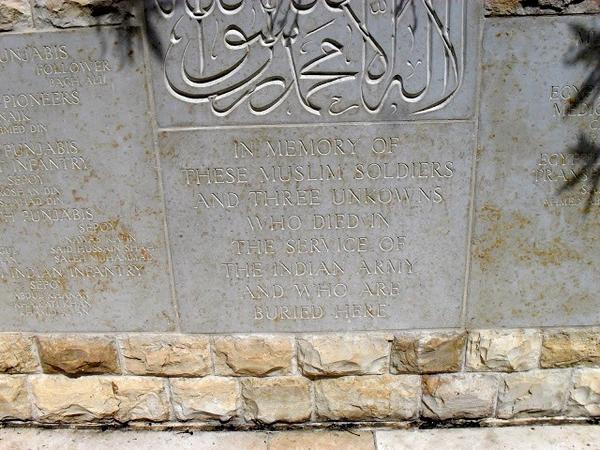
But Indian forces had their greatest impact in West Asia, with 60 per cent of all Indian troops serving in Mesopotamia (modern day Iraq), and another 10 per cent in Egypt and Palestine. As recorded in a new book by Kristian Coates Ulrichsen, The First World War in the Middle East, British and Indian troops in Mesopotamia suffered over 2,00,000 casualties from sickness alone in just one year, 1916. On Jerusalem’s capture the next year, it was Indian Muslim troops who were tasked with protecting the Dome of the Rock.

When the Viceroy laid the foundation stone for India Gate in 1921, he declared, “the stirring tales of individual heroism will live for ever in the annals of this country.” Six years later, French Marshal Ferdinand Foch told Indians gathered at Neuve Chapelle, “proclaim how your countrymen drenched with their blood the cold northern land of France and Flanders.” These words have faded. No surprise, in an age when the newly appointed head of the Indian Council of Historical Research is a man more interested in questions like, “Why are the fish and the pebbles in Ganga not attaining Moksha?” than supporting real history. For the Indians who fought for the Empire, earning a staggering 13,000 gallantry medals in the process, this legacy of ignorance is a scandal.

(Shashank Joshi is a Senior Research Fellow of the Royal United Services Institute in London, and a PhD candidate at Harvard University.)

source: http://www.thehindu.com / The Hindu / Home> Opinion> Lead / by Shashank Joshi / August 05th, 2014
The Mehedis of Aligarh – sherwani makers for presidents

Aligarh :

Mehedi Hasan of Aligarh has served as tailor to former presidents Sanjeeva Reddy, VV Giri and Fakruddin Ali Ahmed. He is reputed to have stitched 175 sherwanis for former president Zakir Hussain, who donned these in all his 17 years of political life.

Mehedi Hasan’s shop was set up in 1947, the year India became independent. These days, the renowned tailor’s sons Anwar and Akhtar Mehedi carry forward the sartorial legacy.

Vice President Hamid Ansari, Congress vice-president Rahul Gandhi, former prime minister Manmohan Singh, actors Saif Ali Khan and Raj Babbar, RLD chief Ajit Singh and Somnath Chatterjee, formerly of the CPI-M, have all donned Mehedi sherwanis. Rahul Gandhi’s body is easy to design for, the tailors say, while Satpal Maharaj is rather “complex”!

This Eid, the brothers are hard at work. Anwar, an engineer by training, pursued his father’s trade and entered into tailoring as he finds it far more creatively satisfying. “I learnt from my valid (father) the secrets of making a perfect sherwani. The art lies in getting the right cut and fitting and a graceful fall. Tailors in Delhi are also making sherwanis but they cannot get the right fit, all of them are making free-size sherwanis!” Anwar says.

In the month of Ramzan, the sherwani assumes formal importance,

“That is because of iftar parties, which are formal. Sherwanis go with the feel of the get-together, and has a regal look. We can’t wear this and go for work. It is too formal to be worn at the workplace. Even today, I stitch sherwanis for the DIG, DMs commissioners for iftar parties,” Anwar says.

This Eid, orders have been pouring in from across the country. The Mehedis are catering to demand for sherwanis from Mumbai, Pune, Madras, Odisha and Jammu & Kashmir. Orders from the USA, UK, UAE and Australia are also received, the Mehedis say.

“There is slight change in the demand. Youngsters want modern elements in the sherwani, so we give them open collars. But the demand for the traditional style is higher,” Anwar Mehedi says.

Visitors to the shop can see the register, which has letters from the secretaries of presidents praising him or his father for their sherwanis.

The Mehedis prefer working with silk wool, polywool and terrawool – these fabrics give a nice fitting, they say.

“The art lies in the details, and in observing the body type – shoulders, back, chest and arms, and the grace of the fall. Everything needs to be taken care of.” Anwar Mehedi said, adding, “Fat people think it won’t look nice on them, but the sherwanis gives their bodies shape because they are made to fit the body frame.”

As for women, he says: “I have made some five sherwanis for women, and sent them to the USA. But then, which woman will spend between Rs5,000 and Rs15,000 on a garment that is not-too-embellished or fancy?”

source: http://www.timesofindia.indiatimes.com / The Times of India / Home> City> Agra / by Eram Agha / July 29th, 2014

Urdu reflects love and affection: Uttar Pradesh CM Akhilesh Yadav

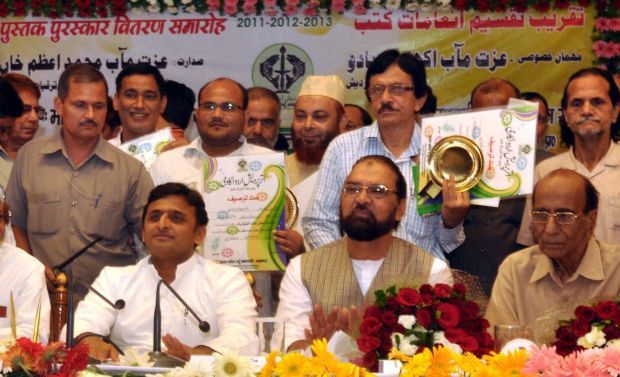
Lucknow: Uttar Pradesh Chief Minister Akhilesh Yadav during the prize distribution ceremony of Urdu Academy at Chief Minister House in Lucknow on Monday (Photo: PTI)

Lucknow: 

Uttar Pradesh Chief Minister Akhilesh Yadav today said that Urdu has always connected hearts and when the language is used, it reflects love and affection. Speaking on the occasion of a book prize distribution ceremony of Uttar Pradesh Urdu Academy at his official residence, Yadav said a message of love and brotherhood would reach the society through this event.

Emphasising on importance of languages for the mutual understanding among masses, the Chief Minister said Hindi and Urdu were being used to take the society forward. He said it was the intention of the SP government that both the languages get promoted and compete with English. Referring to the efforts made by the SP government to promote Indian languages, he said the government has started felicitating Hindi, Urdu and Sanskrit scholars.

source: http://www.deccanchronicle.com / Deccan Chronicle / Home> Nation> Politics / Press Trust of India / August 05th, 2014

A lone woman’s crusade against the sand mafia

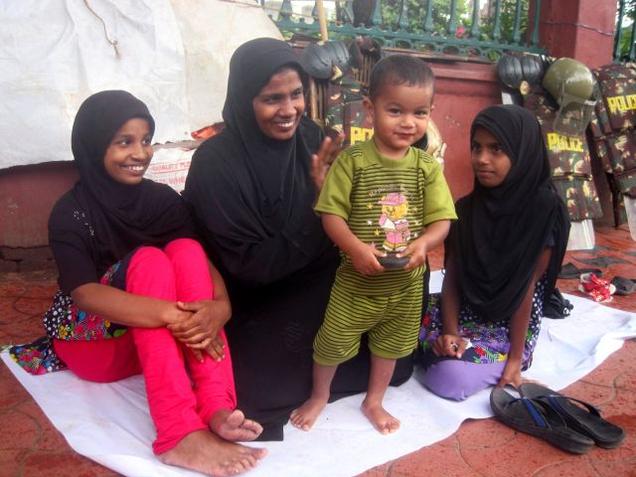
Jazeera along with her children protesting in front of the Secretariat in Thiruvananthapuram. Photo: Kaavya Pradeep Kumar / The Hindu

Jazeera is on a silent campaign, in defence of the Neerozhukkumchal beach in Kannur

The so-called sand mafia of a little taluk in Kannur rues the day Jazeera returned home. Dismissed as an insignificant voice of protest against the rampant exploitation of a stretch of shoreline near Pazhayangadi town, this woman has soon come to be known as a force to be reckoned with. All the way from the northern district of Kannur, she has brought her silent campaign to the State capital, as she sits in front of the Secretariat with her three children — protesting without loud sloganeering or politically coloured flags or leaflets.

Entering the fifth day, Jazeera’s protest has thus far been eclipsed by a far more populous Left protest.

Now that they have left, the presence of this family has become more conspicuous, leading the Chief Minister to meet them briefly on Monday afternoon on the issue of sand-mining in her hometown. For Jazeera, the cause is intensely personal, as the Neerozhukkumchal beach is the canvas all her childhood memories are painted upon.

She is an autorickshaw driver, a profession she has struggled to be part of, in a conservative society. She does not let herself to be affected by such taboos and continued working until after her marriage in 2004, when she moved to Kottayam with her husband.

She has found the new district far more accepting. It was only one and a half years ago, when she returned home during the final month of her third pregnancy, did she see to her shock the daylight robbery of a natural landscape.

Countless visits to the Kannur collectorate and police stations have proved futile.

And for the past one and a half years, her silent protest has involved a sit-in, along with her daughters Rizwana, Shifana and her son Mohammed. The two girls, aged 12 and 10, know everything about the case and have flanked their mother every step. Her husband, Abdul Salaam, is a teacher at a madrasa in Kochi.

While he has not been a visible part of Jazeera’s protest, his support, despite pressure various quarters, has been a huge boon for her.

She is clear about her objective despite the obstacles strewn before her in terms of muscle and money power. Even the police, she says, have pleaded with her to give up. “Their greed is despicable. In broad daylight they commit this heinous crime of emptying our lands, oblivious to the fact that there are so many creatures that depend on it. The sudden depth of water is dangerous as well,” she says.

She is glad to have met the Chief Minister personally and she said he assured her that he would ensure that the vehicles carting away the sand would be immediately dealt with.

She will leave once she obtains something in print promising a complete halt of the activities.

source: http://www.thehindu.com / The Hindu / Home> News> National> Kerala / by Kaavya Pradeep Kumar / Thiruvananthapuram – August 08th, 2013

Urdu’s journey over centuries to be shown on television

‘Dastan-E-Urdu’, a 13-episode miniseries will bring on television for the first time evolution of Urdu over centuries and will aim to break misconceptions about the language among the youth.

The show, which will be aired weekly on Doordarshan National from July 27, will depict the history of the language, how at one point of time, Hindi and Urdu were considered one and what led to that disintegration.

It is produced by filmmaker and Urdu activist Kamna Prasad and directed by Aparna Srivastava Reddy.

“Today’s generation has myths about Urdu and we want to bring clarity to that. They think it is a foreign language and just got adapted in India but that’s not true. It’s an Indian language and its history starts from India,” Prasad told PTI.

The show aims to captures all nuances and aspects of Urdu’s poetic opulence and its universal appeal, by interviewing Urdu experts like eminent lyricist-screenwriter Javed Akhtar, Pt Gulzar Dehlvi and Professor Mushirul Hasan, among others.

“I already knew many of them personally as we keep meeting at Mushairas I organize, in fact Javed Akhtar attends every Mushaira I hold and they are all experts in the field of Urdu, so I spoke with them at length about its history and relevance in today’s scenario,” said Prasad, who has also done the research work for the show.

The producer says series was initially planned to be aired on DD Urdu.

“We first planned for Urdu-loving audience but Doordarshan decided that it should be aired on DD National as the language has national importance and it deserves to reach a wide audience,” Prasad said.

source: http://www.business-standard.com / Business Standard / Home> PTI Stories> National> News / Press Trust of India / New Delhi – July 25th, 2014

JMC’s students cooperative store adjudged best

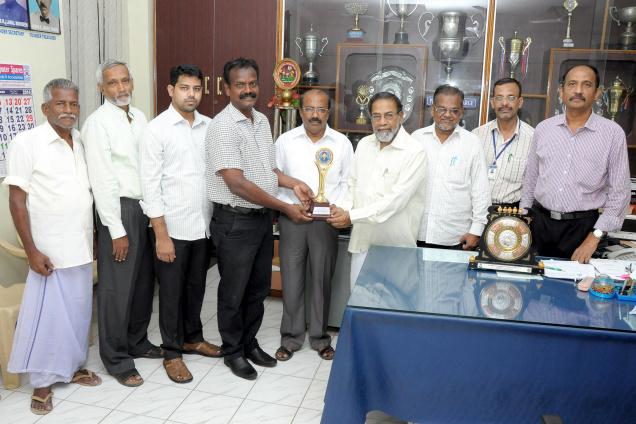
Jamal Mohamed College Students Cooperative Stores, Tiruchi, being awarded as the Best Student Cooperative Stores /.Photo: Special Arrngement / The Hindu

The store managed to achieve a sales turnover of Rs.13 lakh last year and a maximum dividend of 14 per cent has been paid to its members for the last 20 Years.

Jamal Mohamed College Students Cooperative Store has been adjudged the best store among the 276 student cooperative stores functioning in Tiruchi district for the year 2012-13. It won the award for the second consecutive year.

The store has been functioning as an outstanding student store ever since it came into being in 1953. All the students of Jamal Mohamed College are enrolled as members of this store. The teaching and non-teaching members have also been admitted as members and they have to pay a share capital of Rs.100. The student store at present accounted for 109 teachers and non-teaching staff as members and over 2,500 students as associates. The store managed to achieve a sales turnover of Rs.13 lakh last year and a maximum dividend of 14 per cent has been paid to its members for the last 20 Years.K. K. Selvaraj, Managing Director, Tiruchi District Cooperative Union, handed over the shield to Khaja Nazeemudeen, Secretary and Correspondent of the College, and Khaleel Ahamed, treasurer, in the presence of Mohamed Salique, Principal, and Syed Ghayas Ahmed, secretary of the cooperative stores.

source: http://www.thehindu.com / The Hindu / Home> News> Cities> Tiruchirapalli / by Special Correspondent / Tiruchi – July 20th, 2014

Book Review | The Last King In India

Twenty decadent facts from the life and times of India’s last ‘nawab’

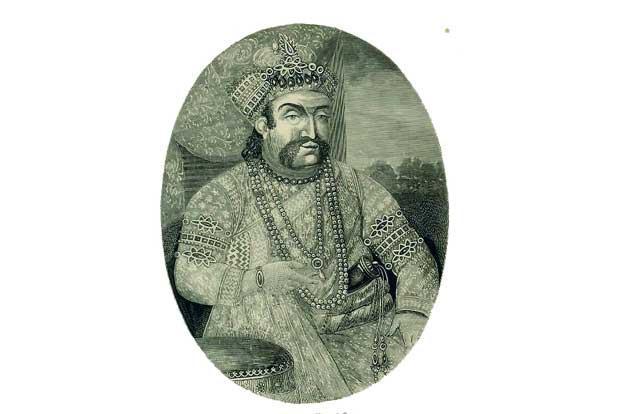
A portrait of Wajid Ali Shah. Photo: Wikimedia Commons.

The poet-ruler Wajid Ali Shah (1822-87) was the last nawab of the north Indian state of Oudh. Deposed by the British, he spent the last 30 years of his life in a riverside mansion near Calcutta (now Kolkata), where he languished in a mock-kingdom with 6,000 subjects. It was a make-believe world. Many of the exiled king’s high-ranking officials held on to their old titles. To the extent that it was possible, Wajid Ali Shah, whose actual reign lasted only nine years, continued the customs of the court.

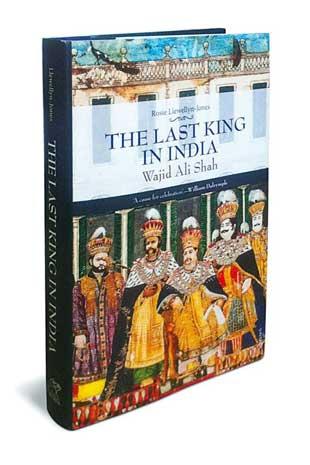
In The Last King In India: Wajid Ali Shah, British historian Rosie Llewellyn-Jones resurrects the nawab with all his tasteful eccentricities. “Holed up in his new palaces, dreaming of love, music and drama,” Llewellyn-Jones writes, “his lack of enterprise only increased the distance between the bubble-like atmosphere of the Court and the reality of peasant life outside the city.”

Days after finishing the book, I mostly remember the following aspects of its hero:

1.  Wajid Ali Shah’s famous portrait (at the Hussainabad Picture Gallery in Lucknow) shows him as a well-fed man wearing a lavishly embroidered tunic. His sash has four rows of large pearls. His left breast and nipple are artistically exposed between the gold borders of his dress.

2.  He married (approximately) 375 women.

3.  At 15, he was married, for the first time, to Khas Mahal, the granddaughter of an Anglo-Indian woman called Sally Begam. Like her husband, Khas Mahal was a poet.

4.  He had three kinds of wives—the mahals, who gave birth to his children and were veiled; the begams, who did not give birth and went unveiled; and the khilawatis, who performed menial household jobs.

The Last King in India—Wajid Ali Shah: Random House, 314 pages, Rs 599

5.  His autobiography was dreamily titled Pari Khana (House Of Fairies).

6.  His poetic pen name was Akhtar, meaning “star” in Persian.

7.  At 22, he wrote the play Radha Kanhaiya Ka Qissa—a rare instance of a would-be Muslim king creatively engaging with Hinduism.

8.  He had a soft corner for dark-skinned women. One of his brides, Yasmin Mahal, “is clearly of African origin with her short curly hair and un-Indian features”.

9.  His personal bodyguards consisted of female African soldiers dressed in red jackets and tight-fitting, rose-coloured silk trousers.

10.  His mother Janab-i Aliyyah, who died during a visit to Europe, lies buried in Père Lachaise, the largest cemetery in Paris, which is also the resting ground of musician Jim Morrison and author Oscar Wilde.

11.  He ascended the throne in 1847; by then he was fairly notorious. Two years earlier, John Shakespear, an East India Company bureaucrat (he was recently described as the great-great-great- great grandfather of British Prime Minister David Cameron), complained to the governor general that “The Heir Apparent’s character holds out no promise of good. By all accounts his temper is capricious and fickle, his days and nights are passed in the female apartments and he appears to have resigned himself to debauchery, dissipation and low pursuits”.

12.  By the time he became king, he had written two lengthy romantic narrative poems—Darya-i-Ta’ashshuq (The River Of Love) and Bahr-e ‘Ishq (The Ocean Of Affection)

13.  Wajid Ali Shah marked the beginning of his reign by building Qaisarbagh Palace—it happened to be Lucknow’s last palace. One of the structures was given the poetic name of Jalpari Darwaza, or The Mermaid Gate, which no longer exists. The palace also had a spiral staircase that led nowhere. In 1955, British architecture critic John Terry saw in the palace “the full horror of the impact of stucco and European baroque”.

14.  After being compelled to move from Lucknow to Bengal in 1856, the deposed nawab was settled by the British in Garden Reach, an area south-west of Calcutta that had opulent villas along the Hooghly river.

15. The Garden Reach estate comprised three buildings. One of them was Azud Manzil. It was the royal menagerie and had 20,000 birds, beasts, snakes and “every conceivable variety of freshwater fish that can live in a hot climate”. The pigeons, of every variety and colour, numbered 18,000 . There was also a collection of cobras. One morning in 1879, a tigress escaped, severely wounding a German man and an Indian lance corporal (it also killed two cows before being shot dead by the Howrah magistrate).

16.  The nawab’s evenings during his years in exile were chiefly spent in the company of musicians and dancing girls.

17.  In his later life, he was carried all over on a sedan chair. He is said to have been afflicted with an anal fistula that forced him to spend many agonizing hours in the toilet.

18.  On his death, the nawab’s survivors—his wives, children and their servers—numbered about a thousand.

19.  At his funeral procession, a military band played Dead March from Saul, the oratorio by German composer George Frederic Handel that was also performed in the funerals of US president Abraham Lincoln and British prime minister Winston Churchill.

20.  Throughout his life, Wajid Ali Shah remained a teetotaller.

source: http://www.livemint.com / Live Mint & The Wall Street Journal / Home> Lounge> Business of Life> Indulge – Leisure / Book Review / by Mayank Austen Soofi / Saturday – July 19th, 2014

Marking Time

SyedanwarMPOs19jul2014

Grey clouds hover over Russell Square. They growl menacingly and then spit out fat raindrops. I take cover at the newspaper stall next to Luna Sweets.

A group of men sit on wooden benches outside a chai shop, sipping hot tea. They complain that Shivajinagar is definitely dirtier and more crowded than before. Prasad, the news stall owner tells me that it affects business.”  It was not like this in earlier times” recollects a grey haired Syed Anwar.

“The Shivajinagar Bus Terminus used to be a football field called the Chota Maidan in the late 40’s.  At the corner of the Square opposite St.Mary’s Basilica was a petrol bunk and in the middle was a large public toilet and well.” They begin to swap stories and I am included in the reminiscences.

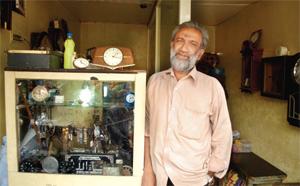
“When my father moved his business here in 1957, military officers and Europeans from the Cantonment came to get watches fixed.” says a bespectacled Syed Mahmood. I peek into his shop; the Paris Watch Company.

It is filled with timepieces; grandfather clocks hang on the wall and squat little brass vintage alarm clocks tick merrily inside a tiny work cabin. “Our earlier shop, the Pearl Watch Company (present Mota Chambers) was on Brigade Road. Business was good there.” The shop shifted to Shivajinagar in 1957.

“My family was originally from Chikmagalur where my grandfather had a circus. He was good with animals but it ran at a loss so he shifted to fixing watches.” My eyes widen. I have unexpectedly come across astory on this rainy evening in Bangalore.Perhaps the city speaks only when we stop to listen.

Syed Mahmood’s father, Syed Jaffer,was a respected horologist, well known amongst vintage watch collectors in the city.  “One day in the late 70’s, Dr. Ajaz Ahmad, a Unani specialist from Mysore called him about a very important job.

Watchmakers across the country and beyond had failed at it since the three missing parts were irreplaceable. My father manufactured the parts,re-assembled the clock in 30 days and took it to Delhi where he presented the working Mantel Clock to its owner, the Prime Minister, Mrs. Indira Gandhi. He charged only `3000 for the job” says Syed Mahmood “but Mrs.Gandhi gave him `10,000.”

Syed Jaffer refused to teach his son the craft through books. “I learnt how to repair and assemble watches standing beside him all day.” His eyes grow moist. “He was a very fine man.”

Syed Jaffer was returning from weekly prayers at a mosque in Kumbarpet when he was unknowingly caught in police firing on MG Road in December 1986, duringa protest over a fictional story in a local newspaper. The stray bullet damaged his voice and his vocation. His shaking hands never fixed a watch again till his demise two years later.

The shop fills with sadness. Syed Mahmood wipes his eyes.
The clouds pass and the stories end. The men discuss world events. Paris Watch Company goes back to work. Syed Mahmood hunches over a dial and scrutinises it carefully.He fixes all kinds of clocks and watches including new ones, but the vintage French mantel clocks are a personal favourite. “Like the English clocks, they are almost impossible to replicate.”

Customers arrive to pick up their resurrected Omega or Rolex watches. They tell me that his skill and dedication too, are equally irreplaceable.The shop’s reputation remains unaltered by time.

The writer is a cultural documentarian and blogs at aturquoisecloud.wordpress.com
source: http://www.bangaloremirror.com / Bangalore Mirror / Home> Columns> Others / by Bangalore Mirror Bureau /July 14th, 2014