Railway Minister Sadananda Gowda, yesterday, said that his Ministry has worked out a plan to lay a second track in the Mysore-Bangalore sector without disturbing the 225-year-old Tipu armoury near Srirangapatna Station.
Refusing to disclose details of the plan, he said that Railway Engineers had chalked out a plan and the track-doubling work would be completed by March, 2015 and maintained “If I disclose the plans now, there will be unnecessary hurdles as this is a sensitive issue and there is no dearth of people who want to rake up controversies.”
The work had hit a road block as the track was expected to pass through Tipu’s armoury. A proposal to relocate the armoury was met with opposition which resulted in the delay, he added.
Funds
Speaking about the funds for other projects in the State, the Railway Minister said that Rs.1,543 crore had been allotted for works that are underway in Karnataka and declared that there was no question of shelving any project initiated by his predecessorMallikarjuna Kharge.
source: http://www.starofmysore.com / Star of Mysore / Home> General News / July 14th, 2014
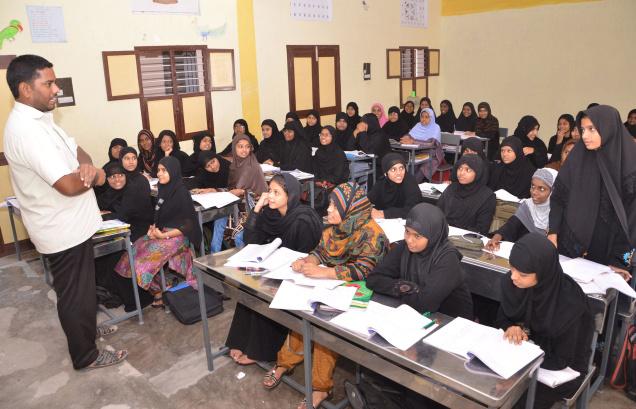
Muslim students getting a special coaching at Islamia Matriculation Higher Secondary School at Kilakarai in Ramanathapuram district./ Photo: L. Balachandar / The Hindu
Islamic Literacy Movement of India shows the way for their development
Having scored 491 out of 500 marks in the SSLC examinations this year, S. A. Mohammed Ameer Suhail was at a crossroads after the sudden death of his father in March, when Islamic Literacy Movement of India (ILMI) showed him the way.
Today, Suhail is one of the 98 Muslim students selected for a special coaching at Islamia Matriculation Higher Secondary School here, the only centre in the State to have been established by the Union Ministry of Minority Affairs.
(The Ministry’s ‘New component of special coaching and allied scheme’ helps minority students from poor families to pass Plus Two examinations with high marks and join professional courses.)
Suhail stood helpless when his father, who was running a fancy store at Ilampillai in Salem, died of heart attack. He learnt about the facility through ILMI’s announcement in the local mosque. “Besides the best coaching, I am getting everything free here and I am confident of cherishing my dream of becoming a doctor,” he says.
For K.S. Shahid Mohiyadeen, whose father is a casual labourer, S. Faridha Banu, whose father is a daily wage worker, and Naurin Nasser, who had lost her father while in class IX, the centre is a dream come true. All of them aspire to become doctors. Most of the students selected for special coaching hail from rural areas and economically weaker families.
They are delighted to get the best coaching by a team of faculty, which has served in Namakkal schools, famous for producing State toppers.
After K.N. Basha, Judge, Madras High Court, inaugurated the centre on June 22, two officials from the Ministry inspected it and were satisfied with the facilities and faculty members, Principal H. Mabel Austus said.
The government had announced a subsidy of Rs.1 crore for 100 students per year, but the school, run by the local Educational Development Committee, would be spending at least Rs.50 lakh more as it provided free uniforms, shoes and stationery, its correspondent M. M. K. Mohideen Ibrahim said. The additional expenditure would be equally borne by the committee and the ILMI.
More than 1,400 students had applied for the coaching and the selected candidates had scored 96 to 99 per cent, ILMI founder Maulana S. Shamsudeen Qasimi said. The ILMI created awareness of the facility through 8,000 mosques in the State, he added.
source: http://www.thehindu.com / The Hindu / Home> News> Cities> Madurai / by D. J. Walter Scott / Kilakarai – July 18th, 2014
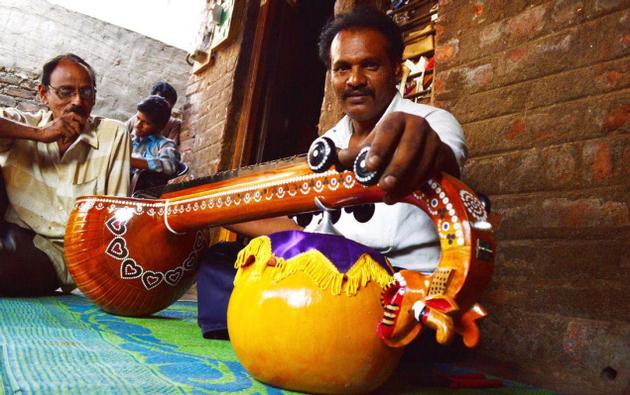
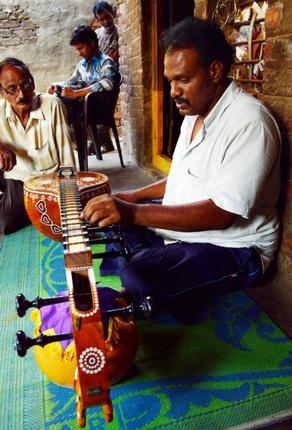
Nuzvid Veena maker Sheik Mabu Saheb training youths at his residence in Nuzvid in Krishna district. Photo: T. Appala Naidu / The Hindu
Sheik Mabu Saheb, a renowned Nuzvid veena maker of Krishna district, has received the Best Artisan Award-2013 from the Andhra Pradesh Handicrafts Development Corporation Limited for his work – Veena with peacock design.
He bagged the award in the category of Veena Making in which artisans from Bobbili were also in the competition. Mr. Saheb had stolen the hearts of the jury members with his small size veena that produces vibrations and sound like any other professional-size veena. “The award is recognition to the art rather than an individual artiste. Despite having a great demand for veena from the world of Indian classical music, shortage of veena makers is still creating problems for the industry’s growth,” Mr. Saheb told The Hindu.
Nuzvid Veena maker Sheik Mabu Saheb training youths at his residence in Nuzvid in Krishna district. Photo: T. Appala Naidu / The Hindu
Handicrafts Department Assistant Director K.N. Murali Krishna said plans were afoot to use the services of Mr. Saheb in training youth in veena making and designing. In a guru-shishya parampara, Mr. Saheb learnt that art from his father Sheik Meera Saheb, one of the first generation veena makers alive. According to Mr. Mabu Saheb, there were only nine veena makers engaged in the profession, spreading the art.
source: http://www.thehindu.com / The Hindu / Home> News> Cities> Vijayawada / by T. Appala Naida / Nuzvid – July 10th, 2014
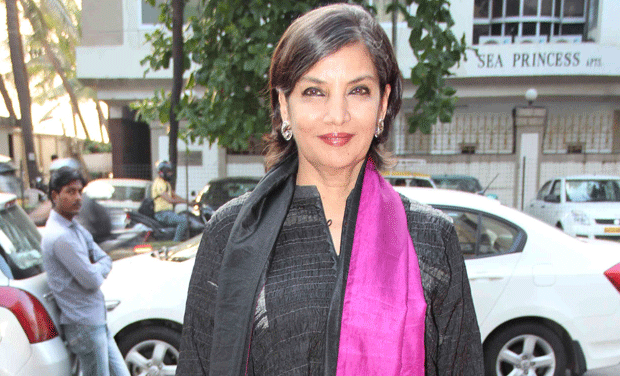
Veteran actress Shabana Azmi haslaunched a website dedicated to her poet father Kaifi Azmi. The audio-visual website hosts videos, poems, songs and gives an insight into the life of the late poet.
“Please check out official updated website of Kaifi Azmi,” Shabana posted on Twitter along with the link. Entitled as ‘Kaifi Azmi : A Rebellious Poet’, the website is divided into five sections — the legend, collection, tributes, Mijwan and press.
The legend section talks about the poet’s early life, achievements, his contribution to films and connection with Hyderabad.
The collection segment has the audio and video of all the famous ghazals, nazms and poems of him. ‘Mijwan’ throws light on Kaifi’s contribution to the tiny village in Azamgarh. It also shares many rare pictures of Shabana and her father.
source: http://www.deccanchronicle.com / Deccan Chronicle / Home> Entertainment> Bollywood / PTI / July 16th, 2014
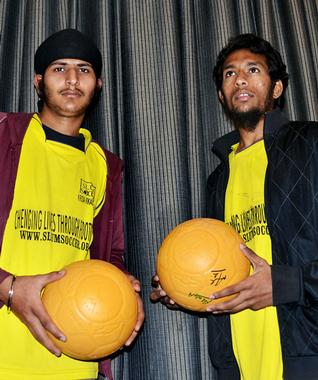
Simarpreet Singh and Tariq Ahmed from Hyderabad who have been selected to represent India in the World Cup football for Homeless to be played in Chile this October. PHOTO: V. V. Subrahmanyam / The Hindu
Soccer fever is reaching a climax in Brazil. But for two young footballers, Tariq and Simarpreet Singh from the city, it might just be the beginning of a journey to recognition. The two boys have been selected to represent India in the Homeless World Cup (for those who come from slums) in Chile in October.
“A World Cup is a World Cup. We are on cloud nine,” the delighted duo exclaimed. They are products of ‘Sports Coaching Foundation’ football camp where Hyderabad Sporting Club chief coach Mohd Saleh trains.
“This is a dream come true and we will try our best to make an impact in this event,” say the soccer duo. Nineteen-year-old Tariq is an engineering graduate from Hussaini Alam and Simarpreet is a commerce graduate from Zaranagar locality of Mehdipatnam. “This is nowhere near the real World Cup soccer but this is a sport that is played with great passion,” the duo says.
“These boys would not have made it to Chile but for the initiative of Kaarmic Education Services’ Dantu Kartik and Adithya Sanjay of Awakening Foundation who spotted talent and started grooming them. I am glad that Tariq and Simarpreet are from the SCF where they have been training under lights,” says a proud K. Sai Baba, general secretary of SCF.
SCF felicitated the duo.
source: http://www.thehindu.com / The Hindu / Home> News> Cities> Hyderabad / by V. V. Subrahmanyam / Hyderabad – July 12th, 2014
Seven boys, including a five-year-old who rescued his younger sister from drowning and a sixth standard student whose presence of mind saved the life of his ten-month-old brother, have been selected for the bravery awards instituted by the Kerala State Council for Child Welfare for the year 2013.
The winners are Muneer Mohammed, 14, of Manippuzha, Kottayam; Shalef Shaji, 9, of Panambukad, Ernakulam; Akhil Biju, 9, Subin Mathew, 10, and Yadukrishnan V S, 13 of Erumeli, Kottayam; Girikrishna, 5, of Kumarakom, Kottayam; and Abhaykrishnan, 11, of Kowdiar in Thiruvananthapuram. Social Justice Minister M K Muneer announced the winners here on Thursday.
Muneer Mohammed won the award for saving the life of Immanuel aka Appu, 72, who was grievously injured in a road accident on the Sabarimala route. When motorists ignored the accident victim, Muneer had run to the middle of the road, waved down a vehicle and rushed Immanuel to hospital. This tenth standard student of St Thomas High School, Erumeli, is the son of Mohammed and Aseena of Venkurinji Keecheri Purayidom, Manippuzha.
Shalef Shaji, a fourth standard student, was selected for the award for saving the life of Alna, the four-year-old daughter of Antony, Panambukad Veliyil, who fell into the backwater while playing with her friends. Shalef had jumped in and holding on to the ropes of a stake net, swum up to Alna and rescued her.
Shalef is a student of the St Joseph’s LP School, Panambukad.
Akhil Biju, Subin Mathew and Yadukrishnan V S saved Kalimuthu, 39, who got trapped in an eddy while bathing in the river. Ten-year-old Akhil jumped in first, but he couldn’t get a hold on Kalimuthu. Yadu dived in next and they managed to reach the drowning man. Subin threw them a towel, and grabbing it, the boys managed a miraculous rescue. All three are sons of daily-wage labourers.
Akhil is the son of Biju and Lekha of Kannimala Puthuvelil and is a sixth standard student of St James UP School, Kannimala, Erumeli. Subin, who is his schoolmate, is the son of Mathew and Sheeba of Kattupurachakal House, Kannimala. Yadukrishnan is the younger son of Sasidharan Nair and Sajini of Vattaparmbil House, and is a ninth standard student of St Joseph’s High School, Kannimala. He is also a recipient of the President’s award for bravery in 2013.
Girikrishna, aged 5, won the award for saving his four-year-old sister Gowri from drowning in a canal near their home. Although he could not swim, he jumped in and dragged young Gowri to the bank. Girikrishna is the son of Satheesh and Babitha of Peedikachira, Kumarakom. He is a first standard student of SKM Public School.
Abhaykrishnan of Kowdiar, Thiruvananthapuram, won the award for saving the life of his ten-month-old brother Adidev.
A huge tree had fallen on to their home in the heavy rain, and their mother, seeing the roof crashing down, tried to shield them with her body. But she collapsed, hit on the head by falling tiles and wood. Abhaykrishnan frantically dragged Adidev and sought cover under a cot.
All three were dragged out of the debris by the neighbours. Abhaykrishnan is the son of Sreenivasan, who is personal assistant to the Chief Secretary, and Sunanda. The award carries Rs 10,000 in cash, a plaque and certificate.
source: http://www.newindianexpress.com / The New Indian Express / Home> Cities> Thiruvananthapuram / by Express News Service / July 11th, 2014
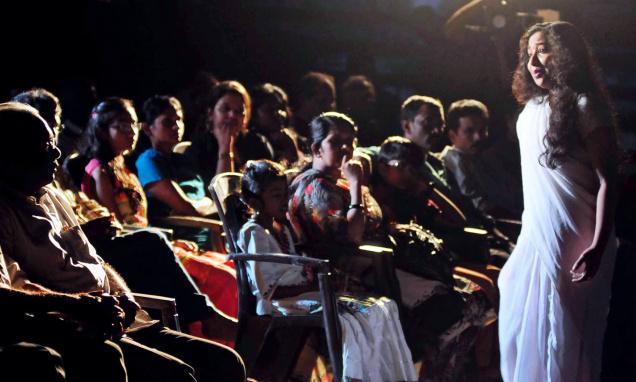
A scene from the solo docudrama ‘Soja Rajakumari,’ featuring 10 female characters from Vaikom Mohammed Basheer’s novels, staged at the Vyloppilly Samskrithi Bhavan in the city on Saturday. / Photo:S. Gopakumar / The Hindu
They were all living their sometimes magical, sometimes sad, and, at other times, quirky lives inside the pages of different books.
That was until Saturday evening, when ten of Vaikom Mohammed Basheer’s memorable female characters came together at the koothambalam inside Vyloppilly Samskrithi Bhavan to commemorate 20 years of the Beypore Sultan’s passing.
Soja Rajakumari, a solo docudrama directed by P.C. Hareesh, took back viewers to the time when they read each of those classics.
The first to arrive was Sainaba from Mucheetukalikkarante Makal, who engaged the audience in some friendly banter, at times touching upon even the rising prices.
The drama was so structured that the audience was very much a part all through, although things could have livened up a bit more had there been a glimmer of a response when the characters tried to involve them.
Bhargavikutti from Neelavelicham arrived in typical ghostly fashion, appearing first on a swing outside the koothambalam. If not for the posse of photographers around her, that would have been a bit more eerie. This being the 50th anniversary year of Bhargavi Nilayam, much of the drama’s time was put aside for Bhargavi, in sequences interspersed with songs and dialogues from the film.
Then there was a sequence between Suhara from Balyakalasakhi and Kunjipathumma fromNtuppuppakkoraanandarunnu. Kunjipathumma’s mother Kunjithachumma too peeked in for a minute. Pathumma from Pathummayude Aadu played out one of the famous conversations with her brother, the author himself, asking him to buy her ornaments.
Jameela Beevi from Poovanpazham took audience interaction to another level by actually distributing plantain to members of the crowd as she was exiting the stage.
Saramma from Pranayalekhanam remembered the classic love letter from Keshavan Nair while Devi from Kamukante Diary laid claim for being the writer’s true love.
The drama ended by reminding us of the pain of Narayani from Mathilukal.
Pooja K.Nair, a ninth grade student of Guruvayur Little Flower Convent High School, switched seamlessly from one character to the other and garnered the crowd’s applause.
The docudrama was staged by the Nataka Padana Kendram, Kozhikode.
source: http://www.thehindu.com / The Hindu / Home> News> Cities> Thiruvananthapuram / by S. R. Parveen / Thiruvananthapuram – July 06th, 2014
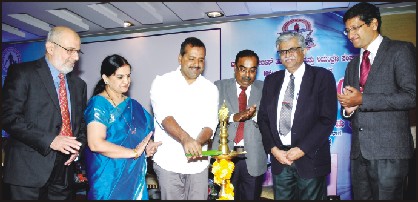
Health Minister U.T. Khader is seen inaugurating APCRICON 2014 in city this morning. Others seen are (from left) Dr. Abdul Rehman, President of APCRI, Dr. Pushpa Sarkar, Director, Mandya Institute of Medical Sciences, Dr. B.J. Mahendra, Organising Chairman, Dr. M.K. Sudarshan, Founder President of APCRI and Dr. M. Vinay, Organising Secretary.
Mysore :
“Rabies, like the malaria and polio diseases, must be made a notified disease by the Central Government in order to adopt preventive measures against rabies, which is highly infectious and severe, affecting domestic animals, wildlife conservation, public health and livestock economies),” said Health and Family Welfare Minister U.T. Khader.
Speaking at APCRICON 2014, the 16th National Conference of Association of Prevention and Control of Rabies in India (APCRI) at Fortune JP Palace in city this morning, he said that the State Government will appeal to the Centre to make Rabies a notified disease and opined that other States too must follow suit.
“In case of the occurrence of such diseases, we blame the animals. But we humans are to be blamed because we need to keep our environment clean and healthy,” said the Minister and called for prevention rather than cure by spreading awareness in schools.
This conference, organised by the Department of Community Medicine, Mandya Institute of Medical Sciences, Mandya, brings together experts from various fields dedicated to rabies research from across the country and world, providing a forum to learn and share valuable experiences of world renowned authorities on rabies.
The inaugural of the conference was presided over by Dr. Abdul Rehman, President of APCRI. Dr. Pushpa Sarkar, Director, Mandya Institute of Medical Sciences was the guest of honour.
Dr. B.J. Mahendra, Organising Chairman, Dr. M. Vinay, Organising Secretary, Dr. M.K. Sudarshan, Founder President of APCRI and Dr. Amlan Goswami, Secretary General of APCRI were present.
Minister U.T. Khader released a souvenir while the APCRI journal was released by Dr. Pushpa Sarkar. Dr. Bankim Patnaik, a physician and former Vice President of APCRI, was felicitated on the occasion and presented with Lifetime Achievement award for his research work in pathology and rabies.
What is a notified disease?
A notifiable disease is any disease that is required by law to be reported to government authorities. The collation of information allows the authorities to monitor the disease, and provides early warning of possible outbreaks. In the case of livestock diseases, there may also be the legal requirement to destroy the infected livestock upon notification. Many governments have enacted regulations for reporting of both human and animal (generally livestock) diseases. This usually happens during pandemics.
If rabies is notifiable in a country, surveillance data can be collected. Better estimates of the number of cases can therefore be made, ensuring a more accurate evaluation of the rabies burden in an area. Rabies needs to be reported so that infected animals can be swiftly identified, isolated and removed reducing the risk of animals and humans across the country contracting the disease. Surveillance data will also provide public health professionals with critical information to make informed decisions about saving human lives. For instance, in a number of countries notification is used by health authorities to investigate possible exposures and organise post-exposure prophylaxis, quarantine and other disease containment measures.
source: http://www.starofmysore.om / Star of Mysore / Home> General News / July 05th, 2014
On Tuesday afternoon A Saleem is getting ready to collect the body of a septuagenarian man he has never met before, from the GH mortuary. He is working on getting the vehicle ready to perform his last rites at a burial ground nearby.
The 29-year-old is no priest, under-taker or mortuary van driver. He just believes that every dead person has the right to rest in peace and While most people probably believe the same, Saleem goes the extra mile to get ensures that dead people get a decent funeral. Saleem, through his organisation Jeevan Shanthy Trust, performs last rites for many unclaimed and unidentified bodies in the city every year. They have buried 154 bodies in the last 10 months.
About five to 10 people from the trust, formed seven years ago but registered two years ago, are at GH every day to collect bodies that are released after postmortems. “We always carry incense stick, candles and camphor, so that we can perform rights according to Hindu, Muslim and Christian customs before burying them,” says Saleem.
The bodies are usually buried at the Aathupaalam burial ground on Podanur Road. Saleem and the other members from the trust pool in money. for a garland and a white cloth to wrap the body.
“It is difficult to identify the religion of an unclaimed body, so unless there is some identification, we go with our instincts,” says another trust member.
The trust started this service seven years ago, when Saleem and his friends realised that bodies of relatives often become a burden for people from the economically weaker sections.
“There were so many people who would have come from Trichy, Tirupur, Pollachi, Erode and other places who could not afford to pay for final rites, A mortuary van would charge a daily wage labourer a rent of 10,000 which is not affordable, ” says Saleem. “Then at crematoriums and burial grounds too, people would demand money for every little thing,” he says. “It was painful to see poor people, who are also emotionally devastated, being fleeced,” he adds. “We also realised that a lot bodies rot in the mortuary for days with no one coming to claim them,” he said.
The trust now has 50 members which primarily s of Saleem’s college mates and friends. They do not raise funds from the public or any NGOs. “We pool in money for everything right from the vehicle, to the fuel for the vehicles, to cloth, garlands, candles and incense sticks,” says Saleem.
The trust has managed to buy two vehicles — a maruti van and an ambulance, to run their service.
The trust also transports a body from GH to their houses or villages km away, allowing the family to perform the last rites. “We initially pooled in money to buy a Maruti van to transport unidentified and unclaimed dead bodies to the burial ground,” says Saleem. “But we also use the vehicle to transport a poor man’s body to his village even if it is 500 km away, so his family can perform the last rites,” he adds. “Around six of us pool in 500 each, fill fuel for 3,000 and take the body,” he says.
They rescue destitute people from the streets and pavements and admit them to the hospital. “Many are abandoned by their families after they tested positive for HIV. So we admit them to the GH, get the necessary tests done, collect and administer their medication. We also provide them with clothesWe also give them a bath and a plate to collect their food,” says Saleem.
Their services are so well-known that 108 ambulance drivers and the police notify them in cases of unidentified bodies or destitute people they rescue.
“We help them by filing FIRs for unclaimed bodies so that it makes their job easier. We have also seen them adopt many abandoned and destitute people from the street and admit them to the hospital,” said a police constable posted at GH.
source: http://www.timesofindia.indiatimes.com / The Times of India / Home> City> Coimbatore / by Pratiksha Ramkumar, TNN / July 07th, 2014
I remembered Sir Mirza Ismail, the renowned Dewan of Mysore, about whom I had written in my column [Down The Memory Lane’ in Nov. 2010] while reading KBG’s Abracadabra in SOM dated July 2 and thought it is worth reproducing a para as to how much Mirza liked his Mysore, describing it in a Radio Broadcast in 1938:
“… Wash themselves with Mysore soap, Dry themselves with Mysore towels (product of KR Mills), Clothe themselves in Mysore Silks, Ride Mysore horses, Eat the abundant Mysore food, Drink Mysore coffee with Mysore sugar, Build their houses with Mysore cement, Mysore timber, Mysore steal, Furnish their houses with Mysore lamps and Write letters on Mysore paper.”
To add to this, a senior personnel from State Bank of Mysore, who met me to collect some material with photos for their Bank’s Centenary Souvenir, remarked, “Sir, we would like to end this with ‘bank’ with Mysore Bank and publish Mirza’s speech in our souvenir.” This made me add one more to the Mysore list: Study in Mysore University.
If Star of Mysore and Mysooru Mithra were being published during his time, Sir Mirza would have added them to his list of Mysore products.
Yes, “Mysore was breathed by Sir Mirza Ismail,” the title I had given to my column.
—K. Vijayakumar, Former Jt. Director of Information & Publicity
V V Mohalla
3.7.2014
source: Voice of the Reader Section / source: http://www.starofmysore.com / Star of Mysore / Home> Voice of the Reader / July 04th, 2014
This is in response to the story. See Post of July 07th, 2014 in www.mpositive.com
While pondering over the absence of ‘Mirza Ismail Road’ in Mysore (Abracadabra, SOM dated July 2), what spontaneously springs to one’s mind is the much-prized ‘Ali Askar Road’ (off Cunningham Road) in downtown Bangalore.
This road is named after Sir Mirza’s grand-father Ali Askar, who was a prominent trader in Arabian horses and Persian carpets, and an influential public figure, with close links to Mummadi Krishnaraja Wadiyar as well as Sir Mark Cubbon. Ali Askar was originally from Persia and found asylum in the court of Mummadi Krishnaraja Wadiyar as a trainer of cavalry and supplier of horses, after fleeing from persecution under Sultan Ahmad Shah of Iran in 1824.
Apart from Sir Mirza, many of Ali Askar’s descendants became well-known figures in business and administration and it is possible that ‘Agha Abbas Ali Road’ and ‘Agha Abdullah Street’ in Bangalore are named after some of these descendants.
While feeling proud on seeing a premier road in Jaipur named after Sir Mirza (it is popularly recognised as M.I. Road, just like M.G. Road in Bangalore), Mysoreans feel proud also of the munificence of the rulers of Mysore in giving the name of a visiting king — Sayyaji Rao Gaekwad III — to a trunk road in their own legendary city.
— S. G. Seetharam
Gita Road, Mysore
8.7.2014
source: Voice of the Reader Section / source: http://www.starofmysore.com / Star of Mysore / Home> Voice of the Reader / July 13th, 2014
This is in response to the story. See Post of July 07th, 2014 in www.mpositive.com